R E S E A R C H
Open Access
Secure relay selection based on learning with
negative externality in wireless networks
Caidan Zhao
1, Liang Xiao
1*, Shan Kang
1, Guiquan Chen
1, Yunzhou Li
2,3and Lianfen Huang
1Abstract
In this paper, we formulate relay selection into a Chinese restaurant game. A secure relay selection strategy is proposed for a wireless network, where multiple source nodes send messages to their destination nodes via several relay nodes, which have different processing and transmission capabilities as well as security properties. The relay selection utilizes a learning-based algorithm for the source nodes to reach their best responses in the Chinese restaurant game. In particular, the relay selection takes into account the negative externality of relay sharing among the source nodes, which learn the capabilities and security properties of relay nodes according to the current signals and the signal history. Simulation results show that this strategy improves the user utility and the overall security performance in wireless networks. In addition, the relay strategy is robust against the signal errors and deviations of some user from the desired actions.
Keywords:Chinese restaurant game, Wireless network, Relay selection, Learning, Security
1. Introduction
Relay selection has been recognized as a critical issue for both cooperative communications [1-3] and multi-hop wireless networks. Efficient and secure relay selections in wireless networks have to overcome various technical challenges at different levels, such as the channel state estimation regarding the relay nodes and attack detec-tion [4,5]. For example, source nodes have to avoid choosing the relay nodes that play packet dropping at-tacks by deliberately dropping some messages and never forwarding them to the destination [4]. In the presence of multiple potential relay nodes in the coverage area, a user has to use the relay node that can provide a high secure data rate with a good radio propagation condition and high transmit power. On the other hand, due to the limited transmission and processing capability of a relay node, each customer user achieves less utility if the cor-responding relay simultaneously serves more users.
To this end, game theory is a powerful math tool to constitute a formal analytical framework that enables the study of complex interactions among the source nodes and relay nodes with different serving properties in
wireless networks. In particular, the Chinese restaurant game (CRG), initially inspired by the Chinese restaurant process, is a promising tool to address the negative ex-ternality issue in the relay selection, where each player makes decision sequentially based on the received sig-nals reflecting the state of the tables in a Chinese res-taurant and avoids choosing a crowded table [6]. The Chinese restaurant game model is a prominent tool to address emerging problems in wireless communications, especially the cooperative spectrum accessing [7] and the spectrum sharing in cognitive radio networks [8].
In this paper, we consider a wireless network with multiple source nodes or users, which aim at sending their messages to the destination nodes. There are mul-tiple potential relay nodes with different transmission capabilities, due to the radio channel conditions, trans-mit power, and processing speed, as well as various se-curity properties. For instance, some nodes might drop some relay messages on purpose or leak the relay mes-sages, resulting in the privacy loss of the source nodes. By formulating the secure relay selection process into a sequential Chinese restaurant game, we propose a learning-based relay selection strategy to improve the se-cure end-to-end data rate in wireless networks. This scheme captures the characteristics of relay nodes at dif-ferent levels, including their security properties, buffer
* Correspondence:[email protected]
1
Department of Communication Engineering, Xiamen University, Xiamen 361005, China
Full list of author information is available at the end of the article
sizes, transmission capacities, and processing speeds, as well as the number of current serving users. Users esti-mate the relay state by learning from the history and the current signals that reflect the relay properties. The relay nodes are chosen to maximize their own expected se-cure data rates accordingly.
Our contributions can be summarized as follows:
1. The CRG-based relay selection strategy takes into account the relay security and avoids choosing a crowded relay and thus can improve the user utility. 2. By exploiting the previous signals received by the
neighboring nodes on the relay properties, the CRG-based strategy can provide some degree of
robustness against the signal error. Moreover, this strategy is also robust against possible irrational decisions or deviations from the proposed schemes. In other words, even when some users deviate from this strategy, the other users can still benefit from following the scheme in the long term.
1.1 Related work
Many interesting works have investigated how a single source node selects relay in cooperative wireless com-munications according to the radio channel information, such as the channel state information (CSI) [1,3], the pa-rameters in the Nakagami channel model [2], and the finite-state Markov channel model [9]. In [10], a co-operative relay transmission strategy was proposed over multiple potential relays. The relay selection can be for-mulated using an optimization model based on the constrained Markov decision process [11]. In [12], a co-operative relay diversity protocol was designed to in-crease the coverage area in wireless networks. In addition, it is shown in [13,14] that node cooperation with known CSI information in wireless networks can improve the user secrecy capacity.
In wireless networks with multiple users that simultan-eously transmit messages, the work [4] provides a distrib-uted relay selection strategy that applies the Stackelberg game to reduce the overall power consumption. Yu and Ray Liu proposed reputation-based, cheat-proof, and attack-resistant cooperation stimulation strategies to
im-prove the security performance in autonomous mobilead
hocnetworks [5]. In [15], an indirect reciprocity principle was applied to improve the performance of a large-scale mobile network, and the stability condition was investi-gated in [16]. In order to improve the communication efficiency, a min-max coalition-proof channel alloca-tion scheme was proposed in [17] for multi-hop wireless networks.
The remainder of the paper is organized as follows: We describe the network model in Section 2 and formu-late it into a Chinese restaurant game in Section 3. We
propose the secure relay selection scheme based on the Chinese restaurant game in Section 4. Next, in Section 5, we present the simulation results to evaluate its perform-ance. Finally, a short conclusion is drawn in Section 6.
2. Network model
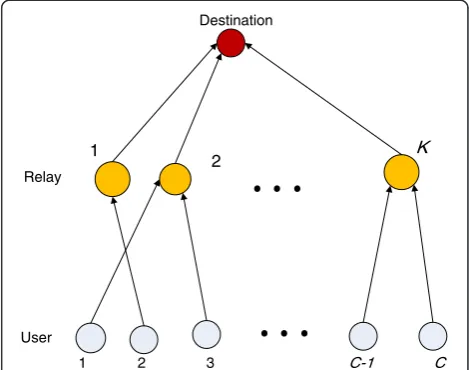
We consider a typical wireless network as shown in
Figure 1, which consists of C source nodes or users, K
relay nodes, and a common destination node. Each source node has to deliver a message to the destination with the help of a relay node. For simplicity, we assume a two-hop wireless network, where the destination node is out of the coverage area of the source nodes but can be reached by the relay nodes.
The message transmission process consists of two stages: (1) theCsource nodes send messages to the relay nodes in sequence, and (2) the relay nodes amplify and forward the messages to the destination node. This work can be extended straightforwardly to the cooperative communication scenarios in single-hop networks, where both the source and relay nodes transmit cooperatively during the second stage.
Without loss of generality, we assume that the relay nodes have different buffer sizes, security properties, and transmission capabilities due to various transmit power and radio channel states and thus provide different ser-vice qualities to the users. For instance, a relay node performing the packet dropping attack deliberately drops some messages and thus reduces the user's end-to-end data rate. In addition, a relay node with serious propaga-tion fading or low transmit power provides lower trans-mission rates to the users.
Therefore, we classify the service quality of a relay node into Qlevels, where 1 is the worst, andQ is assigned to the most powerful relay. LetR(k,w)∈{1, 2,…, Q} denote
Destination
Relay
User 1
2 K
1 2 3 C-1 C
the total secure throughput of relayk, where the second parameter w ∈ {1, 2,…, W} is the relay or network state and is unknown to the users. As some relay nodes have the same transmission capability, the number of relay state, denoted withW, is usually much less thanQK.
In the first stage of the transmission, C users choose sequentially fromKrelay nodes, based on the relay state learnt from the history and current signal. The latter users cannot change the relay selection decisions of the former users. In general, Userihas better understanding on the relay state by investigating more signals than the former users. Once messages from the source nodes are received, relay nodes forward the messages to the destin-ation. The source nodes choosing the same relay node use time rotations to share the transmission and pro-cessing capability of the relay. Thus, a crowded relay de-grades the end-to-end data rate for each customer user.
3. Game formulation
The Chinese restaurant game is a dynamic game, where players have knowledge on both the decisions of the former players and the table state in a Chinese restaur-ant [6,7]. We study the relay selection in a two-hop wireless network with a CRG model, where the players
are C source nodes and the tables are K relay nodes.
The action set in this model is A= {1, 2,…,K}, and the action represents the relay node, which the player selects to deliver their messages to a destination in sequence. The players that are assumed to be rational choose ac-tions to maximize their own utilities, which correspond to their secure data rates to the destination node. For the scope of this paper, we interchangeably use the terms users, source nodes, and players.
Each player is assumed to receive a signal on both the qualities of theKrelay nodes and the signal history of the previous users. Without loss of generality, we take User i
as an example, with 1≤i≤C. In such a game, User i ob-tains from a control channel a signal on the relay state, de-noted withsi∈{1, 2,…,W}, and the signal history,hi= {s1,
s2,…, si − 1}, which contains the revealed signals for the
previous i −1 users. Note that the signals mentioned in this paper inform users about the relay states, instead of being the messages sent to the destination.
The signals are in general imperfect. Let Pr(si|w) rep-resent the probability that the signal to Useriissi, given the true relay state w. For simplicity, we model the sig-nals with the following Bernoulli distribution:
Ρr sðijwÞ ¼ p;1−pif; soi:¼w: ;w
ð1Þ
where p indicates the signal accuracy. Note that this
work is not limited to the Bernoulli model in Equation 1 and can be easily extended to the other signal models.
The prior distribution of w is given by g0 = {g(0,1),
g(0,2),…, g(0,K)}, where g(0,w) = Pr(w = q) is the prior distribution of the relay state w, which is known by all the users.
In this system, the users choosing the same relay node apply time rotations to share the processing and trans-mission resources. The goal of each user is to maximize its own secure data rate. Thus, we define the utility function to Useri that takes actionk, denoted with Ui,k, as follows:
Ui;k ¼UiðR kð ;wÞ;NkÞ ¼
R kð ;wÞ
Nk ; ð 2Þ
whereNkis the number of users selecting Relaykat the end of the game. Useritakes the action in a
determinis-tic manner, and his best response denoted with ri is
given byri¼ arg
kmaxUi;k¼ argkmax R kð;wÞ
Nk :
We will present a learning algorithm in the next sec-tion to obtain the solusec-tion to such an optimizasec-tion
prob-lem. In this way, User i broadcasts his choice and
transmits his message to Relay ri. Next, User i + 1
chooses relay in a similar way, and the game ends
when all the C users have taken actions. For ease of
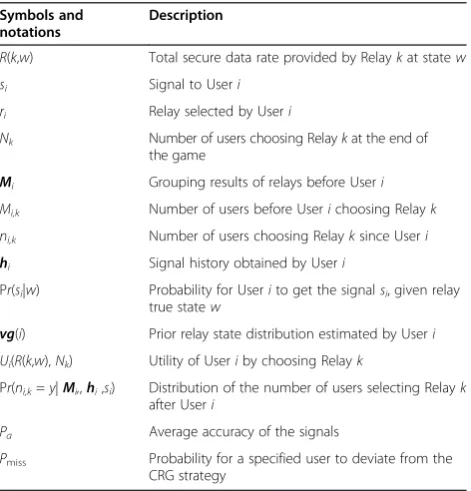
reference, we summarize the commonly used nota-tions in Table 1.
4. Relay selection algorithm based on CRG
In this section, we present a secure relay selection algo-rithm for users to choose relay nodes in sequence in
Table 1 Summary of symbols and notations
Symbols and notations
Description
R(k,w) Total secure data rate provided by Relaykat statew
si Signal to Useri
ri Relay selected by Useri
Nk Number of users choosing Relaykat the end of
the game
Mi Grouping results of relays before Useri
Mi,k Number of users before Userichoosing Relayk
ni,k Number of users choosing Relayksince Useri
hi Signal history obtained by Useri
Pr(si|w) Probability for Userito get the signalsi, given relay
true statew
vg(i) Prior relay state distribution estimated by Useri
Ui(R(k,w),Nk) Utility of Useriby choosing Relayk
Pr(ni,k=y|Mi,,hi,si) Distribution of the number of users selecting Relayk
after Useri
Pa Average accuracy of the signals
Pmiss Probability for a specified user to deviate from the
wireless networks. This is essentially a learning algorithm that enables users to reach a desirable outcome of the CRG as described in Section 3. Each user makes a decision in three steps: (1) learns the relay state based on the current signal, the signal history, and the actions of the previous users, if there are any, (2) estimates the expected utility, and (3) chooses the relay node that maximizes its own utility.
To constitute a concrete example of the learning
process, we consider User i with 1 ≤i ≤ C and present
how the message is delivered to the destination node via a relay. In this process, User i exploits its signal si and the signal history hi = {sj}1 ≤ j < i to estimate the relay state g(i) = {g(i,w)}1≤ w ≤ W, i.e., the service qualities of these Krelays, where g(i,w) = Pr(w|hi,si,g0) is the
prob-ability that User i believes that the relay state isw, and g0 is the prior distribution of the relay state known by the users.
Rational users can apply the Bayesian rule to update their beliefs on the relay state, and the belief of Useriis given by provides the service profile of all the K relay nodes in relay statew, and the secure throughput of Relay kis R
(k,w) in this case.
Users have to avoid the crowded relays because of the negative externality of relay sharing as indicated by Equation 2. Let Mi = {Mi,k}1 ≤ k ≤ K denote the current relay grouping state, where Mi,k is the number of users before User i choosing Relayk. Since each rational user aims at maximizing his expected utility, the action of Useriis given by
where the expectation is taken over both the relay state and the number of users choosing Relaykafter Useri.
Given by Equation 2,Ui,kis the utility to Useri, if the relay state is w, and Nk users including User i choose Relay k. By definition, the expected utility that User i
0.55 0.6 0.65 0.7 0.75 0.8 0.85 0.9 0.95 1
can obtain in this case is given by
whereqis the relay state and the expectation in the sec-ond line is taken over the number of users choosing Relaykafter Useri. In order to calculate Equation 5, we
introduce ni,k to denote the number of users choosing
Relayksince User i. It is clear that the total number of users on Relay kis Nk =Mi,k+ni,k, where Mi,kand ni,k can be obtained by definition:
Miþ1;k¼
According to Equations 4 to 6, we can rewrite Equa-tion 4 as a double summaEqua-tion of the funcEqua-tion that is also
conditioned on the number of users choosing Relay k
after Useriand the relay stateqinUi,k:
The solution to Equation 7 depends on the distribu-tion ofni,k, which can be derived by the following recur-sive method:
Equation 6. The second line in Equation 8 considers both the signal at timei+ 1 (si +1) and the
correspond-ing relay selection (ri +1).
As the last user knows the decisions of all the other users, UserCcan easily calculate the distribution ofnC,k, based on his own choice,rc, i.e.,
PrðnC;k¼1jΜC;hC;sC;rC;wÞ ¼ 1; 0if; roC:w¼: k :
ð9Þ
The total number of iterations to address Equation 8
depends on C. For example, if there are C= 7 users in
the area, it takes seven iterations to calculate the condi-tional probabilities in Equation 8.
In this algorithm, User i chooses a relay node based
on Equations 3 to 9, transmits the message to Relay ri, and broadcasts his decision to the other users in the
0 0.2
neighborhood. Users learn the relay state according to the current signals and the signal history, and predict the behaviors of the following users based on the current relay selection results. This algorithm can be used for radio users to choose relay nodes in wireless networks such as cognitive radio networks and sensor networks.
5. Simulation results
We performed simulation to evaluate the performance of the CRG-based relay selection scheme for a wireless network, which consisted of seven users and two relays that forwarded the users' messages to the destination node. The average signal-to-noise-ratio for each relay node's signal at the destination node was 15 dB, and the overall bandwidth of a relay node was 10 MHz.
We considered two situations regarding relay
perform-ance and setW = 2. Each situation took place with the
same probability. There was a selfish relay node in each situation who dropped 60% of the relay messages to save power. Following straightforward calculation, we can see that for the first situation, w= 1, the total utilities that Relays 1 and 2 provided were 35 and 14, respectively. Otherwise, if w= 2, the total utilities for Relays 1 and 2 were 14 and 35, respectively. The signals to each user were generated independently and uniformly according to the signal accuracy denoted byPa.
For comparison, we also evaluated another two relay selection strategies: The simplest is the random relay strategy, where users choose relay nodes randomly and independently, in disregard of the signals. The second is the myopic strategy, which is also a signal-based strat-egy. In this strategy, users choose relay sequentially. Each user aims at maximizing his current utility and ig-nores the impacts of the latter users in the network. More specifically, Userichooses the relay node given by the following:
Unlike the CRG-based strategy, the decisions of the latter users are ignored, and users make decisions according to their own signals, the signal history, and the decisions of the former users.
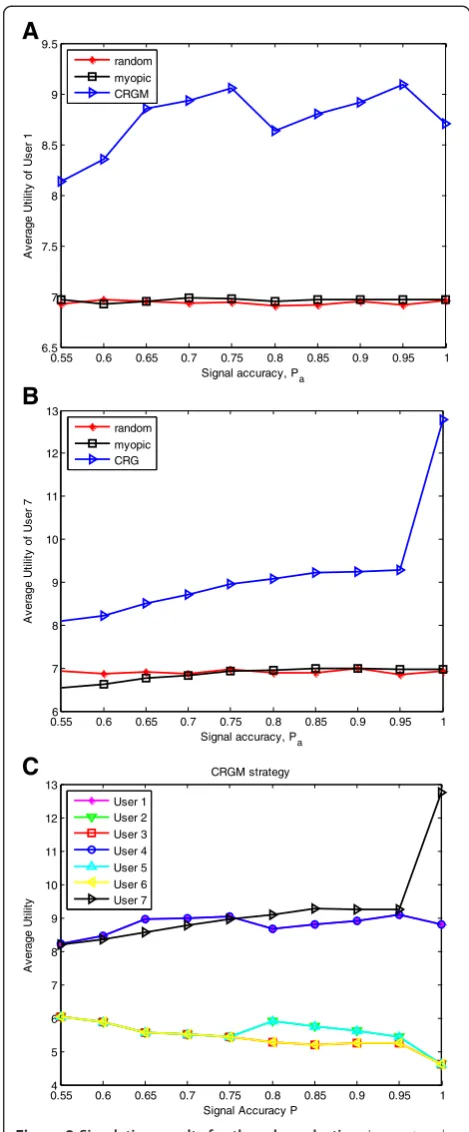
Simulation results in Figure 2 show that compared with the random and the myopic strategy, the CRG-based scheme can provide a higher utility because users estimate the other users' decisions and make decisions accordingly. Clearly, the user utility in this strategy
changes with the signal quality Pa. However, the
per-formance is mostly stable, ifPais greater than 0.9, which means that the scheme has some degree of robustness against the signal errors. In addition, as shown in Figure 2C, users in the middle of the decision making
queue, such as User 3, usually have lower utilities than the other users. The reason is that User 1 has the free-dom to choose any relay, and meanwhile, the last user has the best knowledge on the relay performance and the choice of the other users.
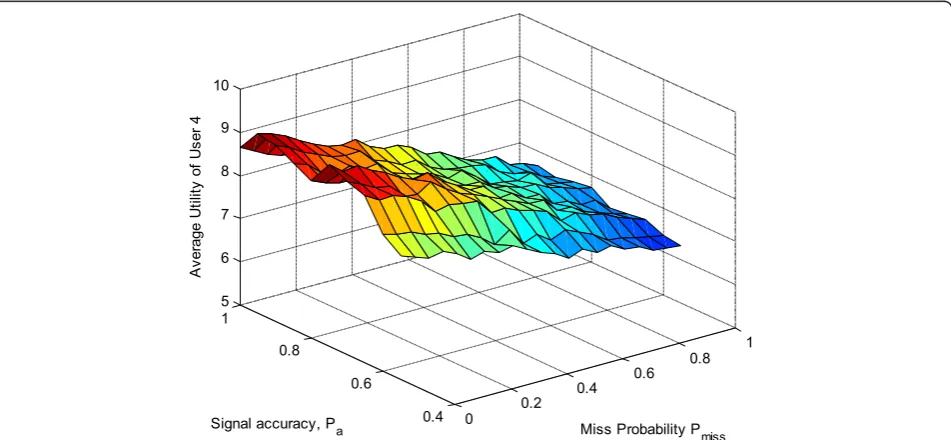
In the second simulation, we consider the CRG-based relay strategy in a scenario similar to experiment 1, ex-cept that User 3 deviates from the CRG strategy with a probability denoted by Pmiss. As shown in Figure 3, the
utility of User 4 slightly decreases with the probability
Pmiss. On the other hand, the performance loss is small
if Pmiss is less than 0.2, indicating that this strategy can
provide robustness against the user deviation to some degree.
6. Conclusion
In this paper, we have investigated the secure relay selec-tion in wireless networks and formulated it with a se-quential Chinese restaurant game model that can take into account the security properties, buffer size, trans-mission strength, and processing ability of relay nodes. We propose a secure relay selection strategy to improve the user utility by avoiding crowded relay nodes. Simula-tion results show that the proposed scheme can achieve a higher average utility than the other two relay strat-egies. In addition, this scheme has some degree of ro-bustness against both the signal inaccuracy and user deviation from the given strategy.
Competing interests
The authors declare that they have no competing interests.
Acknowledgements
The work is partly supported by NSFC (61271242, 61001072, 61172097), the Natural Science Foundation of Fujian Province of China (no. 2010J01347), NCETFJ, SRF for ROCS, SEM, and the Fundamental Research Funds for the Central Universities (2012121028).
Author details
1Department of Communication Engineering, Xiamen University,
Xiamen 361005, China.2Tsinghua National Laboratory for Information
Science and Technology, Tsinghua University, Beijing 100084, China.
3Research Institute of Information Technology, Tsinghua University, Beijing
100084, China.
Received: 20 December 2012 Accepted: 12 April 2013 Published: 26 April 2013
References
1. JL Vicario, A Bel, JA Lopez-Salcedo, G Seco, Opportunistic relay selection with outdated CSI: outage probability and diversity analysis. IEEE T. Wirel. Commun.8(6), 2872–2876 (2009)
2. DS Michalopoulos, ND Chatzidiamantis, R Schober, GK Karagiannidis, Relay selection with outdated channel estimates in Nakagami-m fading, in Proceedings of the IEEE International Conference on Communications (ICC) (Kyoto, 2011)
3. M Soysa, HA Suraweera, C Tellambura, HK Garg, Partial and opportunistic relay selection with outdated channel estimates. IEEE T. Commun.
60(3), 840–850 (2012)
5. W Yu, KJ Ray, Liu, Game theoretic analysis of cooperation stimulation and security in autonomous mobile ad hoc networks. IEEE T. Mobile. Comput.
6(5), 459–473 (2007)
6. CY Wang, Y Chen, KJ Ray, Liu, Chinese restaurant game. IEEE Signal. Proc. Let.19(12), 898–901 (2012)
7. CY Wang, Y Chen, KJ Ray, Liu, Sequential Chinese restaurant game. IEEE Transactions on Signal Processing61(3), 571–584 (2013)
8. BL Zhang, Y Chen, CY Wang, KJR Liu, Learning and decision making with negative externality for opportunistic spectrum access, inProceedings of the IEEE Globecom(, Anaheim, 2012)
9. YF Wei, FR Yu, M Song, VCM Leung, Energy efficient distributed relay selection in wireless cooperative networks with finite state Markov channels, inProceedings of the IEEE Globecom(, Honolulu, 2009)
10. E Beres, R Adve, Selection cooperation in multi-source cooperative networks. IEEE T. Wirel. Commun.7(1), 118–127 (2008)
11. YF Li, P Wang, D Niyato, WH Zhuang, A dynamic relay selection scheme for mobile users in wireless relay networks, inProceedings of the IEEE INFOCOM. Shanghai10–15, 256–260 (Apr 2011)
12. AK Sadek, Z Han, KJR Liu, Distributed relay-assignment protocols for coverage expansion in wireless cooperative networks. IEEE T. Mobile. Comput.9(4), 505–515 (2010)
13. L Dong, Z Han, AP Petropulu, HV Poor, Improving wireless physical layer security via cooperating relays. IEEE Trans. Signal. Proc.58(3), 1875–1888 (2010) 14. J Huang, AL Swindlehurst, Cooperative jamming for secure communications
in MIMO relay networks. IEEE Trans. Signal. Proc.59(10), 4871–4884 (2011) 15. L Xiao, WS Lin, Y Chen, KJR Liu, Indirect reciprocity game modeling for
secure wireless networks, inProceedings of the IEEE International Conference on Communications (ICC)(, Ottawa, 2012)
16. L Xiao, WS Lin, Y Chen, KJR Liu, Indirect reciprocity security game for large-scale mobile wireless networks. IEEE Trans Information Forensics & Security7, 1368–1380 (2012)
17. L Gao, X Wang, Y Xu, Multi-radio channel allocation in multi-hop wireless networks. IEEE Trans. Mobile Computing8(11), 1454–1468 (2009)
doi:10.1186/1687-6180-2013-89
Cite this article as:Zhaoet al.:Secure relay selection based on learning with negative externality in wireless networks.EURASIP Journal on Advances in Signal Processing20132013:89.
Submit your manuscript to a
journal and benefi t from:
7Convenient online submission
7Rigorous peer review
7Immediate publication on acceptance
7Open access: articles freely available online
7High visibility within the fi eld
7Retaining the copyright to your article