R E S E A R C H A R T I C L E
Open Access
Childbirth experience questionnaire (CEQ):
development and evaluation of a
multidimensional instrument
Anna Dencker
1,2*, Charles Taft
1, Liselotte Bergqvist
2, Håkan Lilja
2, Marie Berg
1Abstract
Background:Negative experiences of first childbirth increase risks for maternal postpartum depression and may negatively affect mothers’ attitudes toward future pregnancies and choice of delivery method. Postpartum questionnaires assessing mothers’ childbirth experiences are needed to aid in identifying mothers in need of support and counselling and in isolating areas of labour and birth management and care potentially in need of improvement. The aim of this study was to develop and evaluate a questionnaire for assessing different aspects of first-time mothers’ childbirth experiences.
Methods:Childbirth domains were derived from literature searches, discussions with experienced midwives and interviews with first-time mothers. A draft version of the Childbirth Experience Questionnaire (CEQ) was pilot tested for face validity among 25 primiparous women. The revised questionnaire was mailed one month postpartum to 1177 primiparous women with a normal pregnancy and spontaneous onset of active labor and 920 returned evaluable questionnaires. Exploratory factor analysis using principal components analysis and promax rotation was performed to identify dimensions of the childbirth experience. Multitrait scaling analysis was performed to test scaling assumptions and reliability of scales. Discriminant validity was assessed by comparing scores from subgroups known to differ in childbirth experiences.
Results:Factor analysis of the 22 item questionnaire yielded four factors accounting for 54% of the variance. The dimensions were labelledOwn capacity, Professional support, Perceived safety, andParticipation. Multitrait scaling analysis confirmed the fit of the four-dimensional model and scaling success was achieved in all four sub-scales. The questionnaire showed good sensitivity with dimensions discriminating well between groups hypothesized to differ in experience of childbirth.
Conclusion:The CEQ measures important dimensions of the first childbirth experience and may be used to measure different aspects of maternal satisfaction with labour and birth.
Background
Childbirth is described as a multifaceted experience. Sense of security and perceived control, experienced level of labour pain, personal support, midwifery care, experience of earlier deliveries, intrapartum analgesia, information given and involvement in decision-making contribute to the childbirth experience [1-9]. Unplanned medical interventions during childbirth, e.g. oxytocin augmentation, emergency caesarean and operative
vaginal deliveries, intrapartum complications and need of neonatal intensive care are related to maternal dissa-tisfaction [8-13].
First-time mothers are particularly vulnerable for negative experiences and in Sweden approximately 9% of all primiparous women are dissatisfied with the birth experience one year after the birth [13]. Negative experi-ences increase the risk for maternal postpartum depres-sion and may negatively affect attitudes to future pregnancies and births and may prompt women to request caesarean delivery [14]. Therefore, knowledge of factors affecting maternal satisfaction is important in order to improve childbirth care. For this purpose,
* Correspondence: [email protected] 1
Institute of Health and Care Sciences, Sahlgrenska Academy, University of Gothenburg, Gothenburg, Sweden
Full list of author information is available at the end of the article
postpartum questionnaires covering multidimensional aspects are needed to comprehensively explore women’s experiences of childbirth.
Existing instruments for assessing maternal experi-ences during labour and birth [15-18] either assess iso-lated aspects of the childbirth experience or aggregate diverse aspects into single overall scores. For example, the Labour Agentry Scale (LAS) [15,19] covers only one childbirth dimension, i.e. perceived personal control during pregnancy and childbirth. Another questionnaire used by Lavender et al. [16] aggregates ratings of differ-ent aspects of childbirth experience to a single score of maternal experience. Likewise, the Wijma Delivery Expectancy/Experience Questionnaire (W-DEQ) [17] measures fear of childbirth in one domain. The Child-birth Self-efficacy Inventory (CBSEI) is also a unidimen-sional instrument measuring self-efficacy and coping during childbirth [18]. An exception is the Quality from the Patient’s Perspective Intrapartal (QPP-I) instrument which assesses women’s perceptions of childbirth care [20] in both one general factor and 10 subfactors. How-ever, this questionnaire was developed primarily for evaluating quality of care and many of the domains assess aspects of the physical environment or the perfor-mance of different healthcare professionals. Hence, validated postpartum questionnaires covering multidi-mensional aspects that comprehensively explore women’s perceptions of and feelings about their first labour and birth are lacking.
The aim of this study was therefore to develop and evaluate a questionnaire measuring different dimensions of childbirth experience in first time mothers.
Methods
Instrument development
The Childbirth Experience Questionnaire (CEQ) was developed to study women’s perceptions of first labour and birth. Pertinent domains were identified through lit-erature studies, discussions in a group of four experi-enced midwives and one senior obstetrician and a group interview one month postpartum with twelve mothers, most of them primiparous. Identified areas of childbirth experience included intrapartum sense of security, experience of labour pain, partner’s support, midwifery care and support, memories from the childbirth and experience of own performance. The items regarding memories came from the women’s narratives one month postpartum. Items were drafted to cover the identified areas and formulated as positive and negative state-ments. The response format was a 4-point Likert scale ranging from 1 (Totally agree), 2 (Mostly agree), 3 (Mostly disagree) to 4 (Totally disagree). Memory of labour pain, sense of security and control were assessed with visual analogue scales (VAS). A draft version of the
CEQ was pilot tested for face validity (i.e. comprehen-sion and relevance) in 25 primiparous women. Based on the women’s comments, the questionnaire was revised and comprised totally 28 items. A one-month follow-up frame was chosen. At that point the mothers were expected to have gone through the first relief phase but still have relatively fresh memories of the childbirth experience. Moreover, the women had little or no con-tact with childbirth caregivers after one month and were therefore less likely to give socially desirable responses.
Study sample
The sample included 1177 women who participated in a study on labour progress and oxytocin augmentation between October 1998 and December 2003 at Sahl-grenska University Hospital in Gothenburg and Ryhov County Hospital in Jönköping, Sweden. The study is described in detail elsewhere [21]. In brief, the antenatal clinics provided written information about the study as well as information about the follow-up questionnaire to healthy nulliparous women in their third trimester. Inclusion criteria were nulliparity, a singleton fetus in cephalic presentation, uncomplicated pregnancy, sponta-neous onset of active labor with regular contractions and an effaced cervix dilated not less than four centi-meters and gestational age of between 37+0 and 41+6 weeks at admission to the delivery ward. Informed con-sent was obtained from all respondents who were mailed the questionnaire one month postpartum.
Statistical and psychometric analyses
Descriptive statistics were computed to characterize item score distributions. Item response completeness and frequency distributions were examined to identify items with high missing data rates and/or high ceiling/ floor effects. The VAS-scales scores were transformed to categorical values, 0-40 = 1, 41-60 = 2, 61-80 = 3 and 81-100 = 4. Ratings of positively worded statements and the pain items were reversed so that higher scores reflect more positive scoring.
Exploratory factor analyses using principal compo-nents analysis were performed to examine the construct validity of the CEQ. Both orthogonal (varimax) and obli-que (promax) rotations were conducted. Obliobli-que rota-tion was selected due to the fact that the dimensions were correlated (r = 0.23-0.63). Items with extreme ceil-ing effects were not entered in the analysis. The Kaiser rule (eigenvalue > 1.0) was applied for determining the number of dimensions to extract. Factor extraction was also guided by the clinical interpretability of the factors. Items with maximum loadings less than 0.40 were dropped.
scaling assumptions for aggregating item ratings of the dimensions. Four assumptions were tested: item internal consistency (item-hypothesized scale correlations≥0.40 and Cronbach’s alpha≥0.70), item discriminant validity (item-hypothesized scale correlation > item-other scale), equal item-hypothesized scale correlation (item-scale correlations roughly the same for all items in scale), item equal variance (variances of items in hypothesized scale roughly equal).
Item ratings were aggregated to scale scores for each respondent using the half scale method, i.e., mean values were computed when the respondent had answered at least half of the items in the scale [23].
The method of known-groups validation [24] was used to assess the ability of the CEQ to distinguish between subgroups known to differ on key sociodemographic or clinical variables. Based on previous research results [8-13], it was hypothesized that the women who had a labour lasting more than twelve hours, women who had the labour augmented with oxytocin and women who had experienced an operative delivery would score lower on all scales. Scale scores were compared between groups with Mann-Whitney U-test. All significance tests were two-tailed and conducted at the 5 percent significance level. The Holm-Bonferroni correction method was used when multiple tests were performed [25]. Accordingly, the p-values were ranked from lowest to highest and the smallest p-value was compared to 0.05 divided by 4 (the total number of tests), the second smallest with 0.05 divided by 3 (the total number of tests minus one) and so forth. Effect sizes, as defined by Cohen [26], were com-puted as the difference between group mean scores divided by the pooled standard deviation of the two groups. In line with criteria suggested by Cohen, effect sizes of 0.2-0.5 was regarded as“small”, 0.5-0.8 as“ mod-erate”and above 0.8 as“large”[23].
All statistical analyses were performed using SPSS 15.0 for Windows (SPSS Inc., Chicago, IL, USA) with the exception of multitrait scaling analysis for which the MAP-R program was used [22].
Ethical approval
Permission to conduct the study was obtained from the Regional Ethics Board in Gothenburg in November 1997 (L586-97).
Results
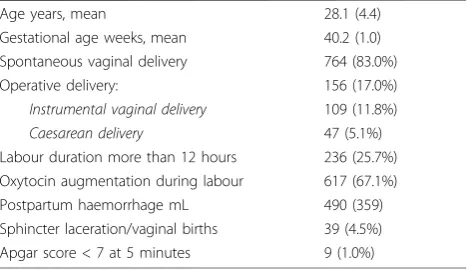
A total of 920 primiparous women (78% response rate) returned evaluable questionnaires. Characteristics of the study population are shown in Table 1. Twenty-six per-cent of the women had a labour lasting more than 12 hours and operative delivery accounted for 17% of the births (12% instrumental vaginal deliveries and 5% emergency caesareans).
Item rating distributions
Item rating distributions were first examined for com-pleteness and skewness. Missing value rates were low for all items. Two items regarding the partner’s support
and one item about the baby (My assurance that the
baby was doing well made me feel secure) showed extreme ceiling effects (80-90% endorsed the most posi-tive response choice) and were excluded from further analysis. Six items concerning midwifery support and care, including one about the medical competence also had high ceiling effects (60%); however, these items were considered to be of clinical importance and were hence retained.
Factor analysis
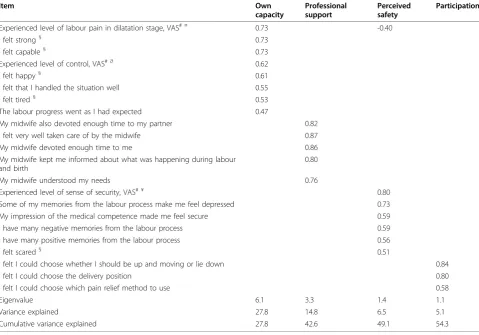
In total, 25 items were initially entered in the explora-tory factor analysis. Two items with maximum loadings less than 0.40 on any domain were excluded: “I have memory lapses from the labour process” and“ Experi-enced pain in second stage”. The item“The care given by my midwife made me feel secure” lowered Cronbach’s alpha for its factor and was also excluded. After elimi-nating these 3 items, four dimensions met extraction
criteria and were retained: Own capacity (8 items
regarding sense of control, personal feelings during childbirth and labour pain), Professional support (5 items about information and midwifery care),Perceived safety(6 items regarding sense of security and memories from the childbirth), and Participation(3 items regard-ing own possibilities to influence the birthregard-ing situation). The four factors accounted for 28, 15, 6, and 5% of the variance, respectively, for a total of 54% (Table 2).
Multitrait scaling analysis
The multitrait scaling analysis showed that scaling assumptions were adequately met for all dimensions (Table 3). Item-scale correlations exceeded 0.40 for nearly all items and those less than 0.40 were still higher with their own scale than with competing scales (item Table 1 Characteristics of study population, n = 920
Age years, mean 28.1 (4.4)
Gestational age weeks, mean 40.2 (1.0) Spontaneous vaginal delivery 764 (83.0%)
Operative delivery: 156 (17.0%)
Instrumental vaginal delivery 109 (11.8%)
Caesarean delivery 47 (5.1%) Labour duration more than 12 hours 236 (25.7%) Oxytocin augmentation during labour 617 (67.1%) Postpartum haemorrhage mL 490 (359) Sphincter laceration/vaginal births 39 (4.5%) Apgar score < 7 at 5 minutes 9 (1.0%)
Table 2 Matrix with factor loadings from exploratory factor analysis and principal component analysis with promax rotation
Item Own
capacity
Professional support
Perceived safety
Participation
Experienced level of labour pain in dilatation stage, VAS# ¤ 0.73 -0.40
I felt strong§ 0.73
I felt capable§ 0.73
Experienced level of control, VAS#∂ 0.62
I felt happy§ 0.61
I felt that I handled the situation well 0.55
I felt tired§ 0.53
The labour progress went as I had expected 0.47
My midwife also devoted enough time to my partner 0.82
I felt very well taken care of by the midwife 0.87
My midwife devoted enough time to me 0.86
My midwife kept me informed about what was happening during labour and birth
0.80
My midwife understood my needs 0.76
Experienced level of sense of security, VAS# ¥ 0.80
Some of my memories from the labour process make me feel depressed 0.73 My impression of the medical competence made me feel secure 0.59
I have many negative memories from the labour process 0.59
I have many positive memories from the labour process 0.56
I felt scared§ 0.51
I felt I could choose whether I should be up and moving or lie down 0.84
I felt I could choose the delivery position 0.80
I felt I could choose which pain relief method to use 0.58
Eigenvalue 6.1 3.3 1.4 1.1
Variance explained 27.8 14.8 6.5 5.1
Cumulative variance explained 27.8 42.6 49.1 54.3
Factor loadings < 0.30 are not shown.
Excluded items were:The presence of my partner made me feel secure, I felt that my partner managed the situation well, My assurance that the baby was doing well made me feel secure, Experienced level of labour pain in expulsion stage VAS, The care given by my midwife made me feel secureandI have memory lapses from the labour process.
#
In summary. The VAS-scales scores were transformed to categorical values, 0-40 = 1, 41-60 = 2, 61-80 = 3 and 81-100 = 4. The pain scores were reversed.
§
...during labour and birth.
¤
Anchor values: No pain-Worst imaginable pain.
∂Anchor values: No control-Complete control. ¥
Anchor values: No sense of security-Feel totally secure.
Table 3 Tests of scaling assumptions
Scale Item internal consistency Item discriminant
validity¤ Item-scalecorrelation,
rprange∂
Item means & variance, M (SD) range¥
Item-scale correlations#
Cronbach’s alpha§
Own capacity 7/8 0.82 8/8 0.30-0.69 1.89-3.25 (0.76-1.03)
Professional support
5/5 0.88 5/5 0.69-0.74 3.64-3.79 (0.52-0.67)
Perceived safety 5/6 0.78 6/6 0.36-0.67 2.99-3.69 (0.52-1.01)
Participation 2/3 0.62 3/3 0.33-0.56 3.35-3.71 (0.60-0.90)
Scaling assumptions:
#
Item-hypothesized scale correlations≥0.40, corrected for overlap/number of correlations.
§
Scale internal consistency reliability coefficients (Cronbach’s alpha).
¤
Item-hypothesized scale correlation significantly higher or higher than item-other scale.
∂Item-scale correlations roughly the same for all items in scale. ¥
discriminant validity). Cronbach’s alpha coefficients were acceptable for group analyses (> 0.70) in all but the par-ticipation scale. Item-scale correlations, means and var-iances showed that items contributed roughly equally to its hypothesized scale.
Known-groups validation
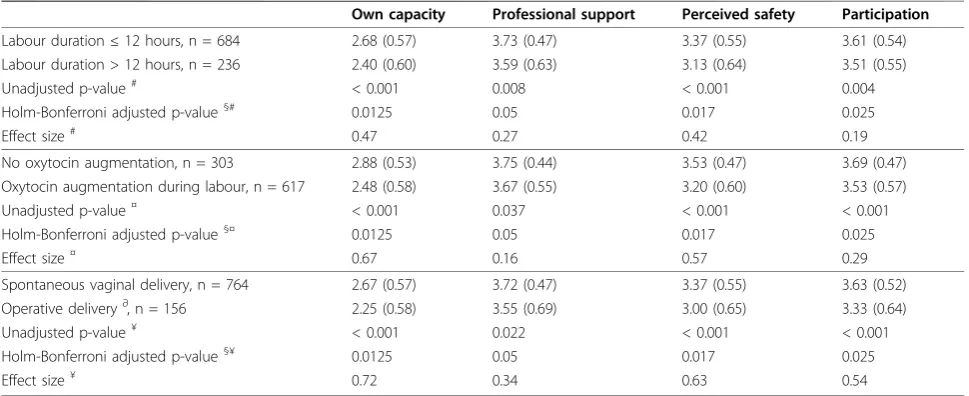
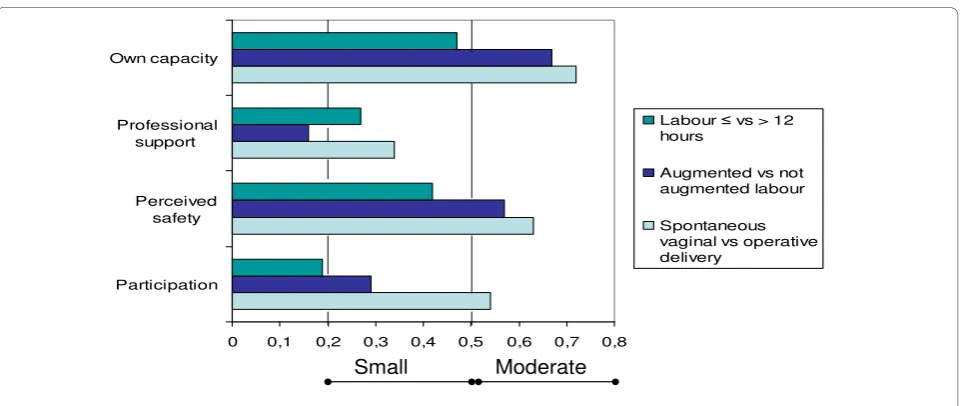
Sensitivity of the model was examined by comparing mean scores on each subscale between women with labour duration more versus less than 12 hours; women with versus without oxytocin augmentation during labour; and women who had a spontaneous vaginal delivery versus those who had an operative delivery (emergency caesarean or instrumental vaginal birth). Women with prolonged labour scored lower in all scales, see Table 4. Effect sizes were, however, small (Own capacity, 0.47;Perceived safety, 0.42 and Profes-sional support, 0.27) to trivial (Participation, 0.19). Women with oxytocin treatment scored significantly lower on all subscales. Effect sizes were moderate (Own capacity, 0.67; Perceived safety, 0.57), small ( Participa-tion, 0.29)or trivial (Professional support, 0.16). Women with operative births scored significantly lower on all four subscales, see Table 4. Effect sizes were moderate (Own capacity, 0.72;Perceived safety, 0.63;Participation, 0.54) or small (Professional support, 0.34), see Figure 1.
Discussion
Factor analysis of the 22 item Childbirth Experience Questionnaire (CEQ) yielded four major dimensions of
the childbirth experience, namely Own capacity, Per-ceived safety, Professional supportandParticipation
These domains confirmed the areas of the childbirth experience found in our literature searches [4-9] and the interviews with mothers one month postpartum. The psychometric properties of the CEQ were also found to be good. Specifically, scaling success was achieved in all four sub-scales and the instrument discriminated well between groups hypothesized to differ in experience of childbirth.
The dimension that explained most of the variance,
Own capacity, included items regarding experienced emotions and sense of control, together with experi-enced labour pain. This dimension corresponds with the Labour Agentry Scale [15], measuring perceived perso-nal control; however, our factor also included an item tapping perceived pain. Labour pain is considered to be a very significant part of childbirth [9,27] and experi-enced pain is likely to be strongly associated with the mother’s sense of control in childbirth. Own capacity
also has a component of self-efficacy (I felt capable) and coping (I felt that I handled the situation well) and thus likens the domain-specific Childbirth Self-efficacy Inven-tory scale [18]. Unlike the above instruments, the recently validated QPP-I measures 10 domains of intra-partal care [20]. Developed primarily for use in evaluat-ing quality of care, many of the domains assess aspects of the physical environment or the role performance of different professionals. Although these aspects are of importance from a quality improvement perspective, our
Table 4 Disciminant validity: differences in subscale scores between groups
Own capacity Professional support Perceived safety Participation
Labour duration≤12 hours, n = 684 2.68 (0.57) 3.73 (0.47) 3.37 (0.55) 3.61 (0.54) Labour duration > 12 hours, n = 236 2.40 (0.60) 3.59 (0.63) 3.13 (0.64) 3.51 (0.55)
Unadjusted p-value# < 0.001 0.008 < 0.001 0.004
Holm-Bonferroni adjusted p-value§# 0.0125 0.05 0.017 0.025
Effect size# 0.47 0.27 0.42 0.19
No oxytocin augmentation, n = 303 2.88 (0.53) 3.75 (0.44) 3.53 (0.47) 3.69 (0.47) Oxytocin augmentation during labour, n = 617 2.48 (0.58) 3.67 (0.55) 3.20 (0.60) 3.53 (0.57)
Unadjusted p-value¤ < 0.001 0.037 < 0.001 < 0.001
Holm-Bonferroni adjusted p-value§¤ 0.0125 0.05 0.017 0.025
Effect size¤ 0.67 0.16 0.57 0.29
Spontaneous vaginal delivery, n = 764 2.67 (0.57) 3.72 (0.47) 3.37 (0.55) 3.63 (0.52) Operative delivery∂, n = 156 2.25 (0.58) 3.55 (0.69) 3.00 (0.65) 3.33 (0.64)
Unadjusted p-value¥ < 0.001 0.022 < 0.001 < 0.001
Holm-Bonferroni adjusted p-value§¥ 0.0125 0.05 0.017 0.025
Effect size¥ 0.72 0.34 0.63 0.54
Data are given as mean (SD). Mann-Whitney U-test is used to compute p-values and Holm-Bonferroni correction was used.
#
Labour duration≤12 vs > 12 hours.
§
p-value for significance.
¤
Oxytocin augmentation during labour vs no augmentation.
∂Caesarean and instrumental vaginal births. ¥
instrument focuses on the mother’s experiences of her own performance and sense of support. There are obvious tradeoffs between domain-specific measures, such as the Labour Agentry Scale, and more generic measures, such as ours, that aim to comprehensively assess the childbirth experience. In future studies we plan to conduct head-on-head comparisons to examine the benefits and weaknesses of our questionnaire in relation to established domain-specific questionnaires.
Items regarding sense of security correlated with state-ments about memories and formed the dimension labelledPerceived safety. A possible explanation for the intercorrelations between fear, sense of security and memories from the childbirth is that distressing recol-lections are symptoms after experienced fear [28]. Child-birth is a stressful event and some women have traumatic stress symptoms, e.g. anxiety and fear of childbirth postpartum [29-31]. It has also been shown that feelings of safety during childbirth influence the memories from the birth [32]. This is an important area and should be included in an overall assessment of the childbirth experience. In contrast, the W-DEQ-scale specifically measures fear of childbirth with questions about anxiety, control and personal feelings in one domain [17] and does not include items regarding mem-ory. Instead all questions are asked both before and after the birth, which is a way to include the influence on the memory. In another instrument [33] fear related to childbirth, in both men and women, is measured with 18 items about fear in four factors, all related to fear. One of the factors is about insecurity and danger, e.g.
“Childbirth is a very risky situation”. The safety dimen-sion in our questionnaire includes items not unlike
these items but most of them are formulated as positive statements, e.g.“My impression of the medical compe-tence made me feel secure“. Adding more negatively for-mulated items can possibly further enhance the discriminatory qualities in this scale.
As mentioned above, three items were found to have very high ceiling effects and were therefore not entered into the factor analysis. These items covered two sepa-rate domains, namely partner support and maternal worries about the baby. Although these domains have been identified as highly important aspects of the child-birth experience, we reasoned that they would be of lit-tle discriminative value [23]. The itemMemory lapses from the childbirthdid not fit into the factor model but may possibly contribute to the knowledge of this phe-nomenon. Memory lapses after labour and birth have been reported earlier [34] but this aspect of the birth experience is not well studied.
The strengths of this study are that domains and items comprising the CEQ were derived from patient interviews, discussions among experienced midwives and other staff, and pilot tested for face validity in a group of primiparous women. The psychometric perfor-mance of the questionnaire was tested on a large and representative sample of primiparous women with spon-taneous onset of active labour (n = 920) living in various settings in Sweden. This heterogeneous sample repre-sents a large group of childbearing women, as approxi-mately 70% of all women expecting their first child are healthy, have a normal pregnancy and experience a spontaneous start of active labour.
The CEQ discriminated between groups of women known to differ in childbirth experiences [8-13].
0 0,1 0,2 0,3 0,4 0,5 0,6 0,7 0,8
Participation Perceived
safety Professional
support Own capacity
Labour vs > 12
hours
Augmented vs not augmented labour
Spontaneous vaginal vs operative delivery
Small Moderate
Specifically, women with labour lasting more than 12 hours had, as expected, significantly lower scores on all scales than did those with shorter labour. Women who had their labour augmented scored lower than those without the treatment. Likewise, women who had deliv-ered operatively had significantly lower scores than did those delivering normally (Table 4). On the other hand, effect sizes were primarily moderate to small, suggesting that further efforts may need to be made to improve the sensitivity of the questionnaire, especially regarding Pro-fessional support andParticipation, where particularly weak effect sizes were observed (Figure 1).
The discriminative ability of theParticipation scale may possibly have been debilitated by the fact that it comprised relatively few items (3 items) and that these items had comparatively poor internal consistency, as reflected by a low Cronbach’s alpha (0.62). Adding rele-vant items and rewording existing items may help to augment the sensitivity of this scale. A reason for the weaker performance of the Professional support scale may be that the distribution of scores was skewed, with substantial ceiling effects. This problem is common in other scales and instruments measuring patient satisfac-tion with care and has serious implicasatisfac-tions for their ability to detect differences both between groups and over time [35]. A possible solution to this problem may be to extend the response scale from a four to a 5-step scale. For example, Moret et al. [36] have shown that extending the number of response alternatives substan-tially reduces or eliminates ceiling effects [37].
Conclusions
In summary, this study reports on the development and testing of the Childbirth Experience Questionnaire to assess different aspects of women’s experiences of first childbirth. The four dimensions revealed in the explora-tory factor analysis are concordant with earlier research and cover important aspects of the childbirth experience [1-9]. Furthermore, the instrument discriminates well between groups known to differ in childbirth ences. A normal first childbirth with a positive experi-ence is very important with regard to future pregnancies and childbirths. Women with a negative experience and a severe fear of childbirth often request an elective cae-sarean delivery [14] which is associated with increased risks for both mother and baby [38-42]. Postpartum questionnaires are needed 1.) to explore how different
types of labour management influence the women’s
childbirth experiences, 2.) to improve care during child-birth and 3.) to identify those in need of support and counselling after a negative birth experience. Although most current instruments assess single domains of the childbirth experience, there is also a need for question-naires that reflect and comprehensively assess the
multidimensional nature of women’s experiences of childbirth. We suggest that this four-dimensional model adequately reflects the multidimensionality of the child-birth experience and can be used as a tool to identify women with negative experiences and for evaluating efforts to improve the quality of childbirth care.
Author details
1Institute of Health and Care Sciences, Sahlgrenska Academy, University of Gothenburg, Gothenburg, Sweden.2Department of Obstetrics and Gynecology, Perinatal Center, Sahlgrenska University Hospital, Gothenburg, Sweden.
Authors’contributions
AD, LB and HL conducted the study. AD, CT, LB, HL and MB analyzed the data. AD wrote the paper and prepared the figures and tables. All the authors revised the paper and agreed to the submission of the final version of the manuscript.
Competing interests
The authors declare that they have no competing interests.
Received: 16 July 2010 Accepted: 10 December 2010 Published: 10 December 2010
References
1. Hodnett ED, Gates S, Hofmeyr GJ, Sakala C:Continuous support for women during childbirth.Cochrane Database Syst Rev2007,3:CD003766. 2. Ford E, Ayers S, Wright DB:Measurement of maternal perceptions of
support and control in birth (SCIB).Journal of women’s health (2002)2009,
18(2):245-252.
3. National Institute for Health and Clinical Excellence. Intrapartum care care of healthy women and their babies dur ing childbirth.[http://www. nice.org.uk/nicemedia/live/11837/36275/36275.pdf].
4. Green JM, Coupland VA, Kitzinger JV:Expectations, experiences, and psychological outcomes of childbirth: a prospective study of 825 women.Birth1990,17(1):15-24.
5. Green JM, Baston HA:Feeling in control during labor: concepts, correlates, and consequences.Birth2003,30(4):235-247.
6. Hodnett ED:Pain and women’s satisfaction with the experience of childbirth: a systematic review.Am J Obstet Gynecol2002,186(5 Suppl Nature):S160-172.
7. Lavender T, Walkinshaw SA, Walton I:A prospective study of women’s views of factors contributing to a positive birth experience.Midwifery
1999,15(1):40-46.
8. Brown S, Lumley J:Satisfaction with care in labor and birth: a survey of 790 Australian women.Birth1994,21(1):4-13.
9. Waldenstrom U:Experience of labor and birth in 1111 women.Journal of psychosomatic research1999,47(5):471-482.
10. Ryding EL, Wijma B, Wijma K:Posttraumatic stress reactions after emergency cesarean section.Acta Obstet Gynecol Scand1997,
76(9):856-861.
11. Wiklund I, Edman G, Ryding EL, Andolf E:Expectation and experiences of childbirth in primiparae with caesarean section.Bjog2008,
115(3):324-331.
12. Nystedt A, Hogberg U, Lundman B:The negative birth experience of prolonged labour: a case-referent study.Journal of clinical nursing2005,
14(5):579-586.
13. Waldenstrom U, Hildingsson I, Rubertsson C, Radestad I:A negative birth experience: prevalence and risk factors in a national sample.Birth2004,
31(1):17-27.
14. Pang MW, Leung TN, Lau TK, Hang Chung TK:Impact of first childbirth on changes in women’s preference for mode of delivery: follow-up of a longitudinal observational study.Birth2008,35(2):121-128.
16. Lavender T, Wallymahmed AH, Walkinshaw SA:Managing labor using partograms with different action lines: a prospective study of women’s views.Birth1999,26(2):89-96.
17. Wijma K, Wijma B, Zar M:Psychometric aspects of the W-DEQ; a new questionnaire for the measurement of fear of childbirth.Journal of psychosomatic obstetrics and gynaecology1998,19(2):84-97.
18. Lowe NK:Maternal confidence for labor: development of the Childbirth Self-Efficacy Inventory.Research in nursing & health1993,16(2):141-149. 19. Cheung W, Ip WY, Chan D:Maternal anxiety and feelings of control
during labour: a study of Chinese first-time pregnant women.Midwifery
2007,23(2):123-130.
20. Wilde-Larsson B, Larsson G, Kvist LJ, Sandin-Bojo AK:Womens’opinions on intrapartal care: development of a theory-based questionnaire.Journal of clinical nursing19(11-12):1748-1760.
21. Dencker A, Berg M, Bergqvist L, Ladfors L, Thorsen L, Lilja H:Early versus delayed oxytocin augmentation in nulliparous women with prolonged labour-a randomised controlled trial.Bjog2009,116(4):530-536. 22. Ware JE, Harris WJ, Gandek B, Rogers BW:Multitrait/multi-item analysis
program-revisedBoston MA: Health Assessment Lab; 1997. 23. Fayers P, Machin D:Quality of life. The assessment, analysis and
interpretation of patient-reported outcomes.Chichester: Wiley;, Second 2007.
24. Kerlinger F:Foundations of behavioral researchNew York: Holt, Rinehart & Winston; 1973.
25. Holm S:A simple sequentially rejective multiple test procedure.
Scandinavian Journal of Statistics1979,6(2):65-70.
26. Cohen J:Statistical Power Analysis for the Behavioral Sciences.Hillsdale, NJ, Lawrence Erlbaum;, 2 1988.
27. Waldenstrom U, Schytt E:A longitudinal study of women’s memory of labour pain–from 2 months to 5 years after the birth.Bjog2009,
116(4):577-583.
28. Ayers S, Joseph S, McKenzie-McHarg K, Slade P, Wijma K:Post-traumatic stress disorder following childbirth: current issues and recommendations for future research.Journal of psychosomatic obstetrics and gynaecology
2008,29(4):240-250.
29. Soderquist J, Wijma B, Wijma K:The longitudinal course of post-traumatic stress after childbirth.Journal of psychosomatic obstetrics and gynaecology
2006,27(2):113-119.
30. Ayers S:Thoughts and emotions during traumatic birth: a qualitative study.Birth2007,34(3):253-263.
31. Zaers S, Waschke M, Ehlert U:Depressive symptoms and symptoms of post-traumatic stress disorder in women after childbirth.Journal of psychosomatic obstetrics and gynaecology2008,29(1):61-71.
32. Ryding EL, Wijma K, Wijma B:Experiences of emergency cesarean section: A phenomenological study of 53 women.Birth1998,25(4):246-251. 33. Eriksson C, Westman G, Hamberg K:Experiential factors associated with
childbirth-related fear in Swedish women and men: a population based study.Journal of psychosomatic obstetrics and gynaecology2005,
26(1):63-72.
34. Waldenstrom U, Borg IM, Olsson B, Skold M, Wall S:The childbirth experience: a study of 295 new mothers.Birth1996,23(3):144-153. 35. Collins K, O’Cathain A:The continuum of patient satisfaction–from
satisfied to very satisfied.Soc Sci Med2003,57(12):2465-2470. 36. Moret L, Nguyen JM, Pillet N, Falissard B, Lombrail P, Gasquet I:
Improvement of psychometric properties of a scale measuring inpatient satisfaction with care: a better response rate and a reduction of the ceiling effect.BMC health services research2007,7:197.
37. Fitzpatrick R:Scope and measurement of patient satisfaction. In Measurement of patients’satisfaction with their care.Edited by: Fitzpatrick R, Hopkins A. London: Royal College of Physicians; 1993:1-17.
38. Liu S, Liston RM, Joseph KS, Heaman M, Sauve R, Kramer MS:Maternal mortality and severe morbidity associated with low-risk planned cesarean delivery versus planned vaginal delivery at term.Cmaj2007,
176(4):455-460.
39. Hansen AK, Wisborg K, Uldbjerg N, Henriksen TB:Risk of respiratory morbidity in term infants delivered by elective caesarean section: cohort study.Bmj2008,336(7635):85-87.
40. Decker E, Engelmann G, Findeisen A, Gerner P, Laass M, Ney D, Posovszky C, Hoy L, Hornef MW:Cesarean delivery is associated with celiac disease but not inflammatory bowel disease in children.Pediatrics
125(6):e1433-1440.
41. Thavagnanam S, Fleming J, Bromley A, Shields MD, Cardwell CR:A meta-analysis of the association between Caesarean section and childhood asthma.Clin Exp Allergy2008,38(4):629-633.
42. Cardwell CR, Stene LC, Joner G, Cinek O, Svensson J, Goldacre MJ, Parslow RC, Pozzilli P, Brigis G, Stoyanov D,et al:Caesarean section is associated with an increased risk of childhood-onset type 1 diabetes mellitus: a meta-analysis of observational studies.Diabetologia2008,
51(5):726-735.
Pre-publication history
The pre-publication history for this paper can be accessed here: http://www.biomedcentral.com/1471-2393/10/81/prepub
doi:10.1186/1471-2393-10-81
Cite this article as:Denckeret al.:Childbirth experience questionnaire
(CEQ): development and evaluation of a multidimensional instrument.
BMC Pregnancy and Childbirth201010:81.
Submit your next manuscript to BioMed Central and take full advantage of:
• Convenient online submission
• Thorough peer review
• No space constraints or color figure charges
• Immediate publication on acceptance
• Inclusion in PubMed, CAS, Scopus and Google Scholar
• Research which is freely available for redistribution