A Novel Method of Dynamic Quick Autonomous
Reconfigurable Wireless Mesh Network
G.Bhavana1*, Ch.Hymavathi2, M.Atiya Mobeen3 and B.Devendra Naik4
Department of Information Technology, G.Pullaiah College of Engineering and Technology, Kurnool, Andhra Pradesh, India*E-mail: [email protected]
Abstract:
Wireless Mesh Network (WMN) could be a communication network created of radio nodes organized in an exceedingly topology. Wireless mesh networks (WMNs) area unit being developed actively and deployed wide for a spread of applications. Multi-hop wireless mesh networks (WMNs) expertise frequent link failures owing to channel
interference, dynamic obstacles, and
information measure demands. These
failures cause severe performance
degradation in WMN. This paper proposes a
Dynamic Quick Autonomous
Reconfiguration System (DQARS) that allows a multi-radio WMN to autonomously pass though native link failures. Conjointly it's the flexibility to preserve network performance. DQARS first searches for possible native configuration changes on the market around a faulty space, and identifies
reconfiguration plans that need the
minimum range of changes for the healthy network settings. It improves the channel-efficiency and within the ability of meeting the applications’ information measure demands.DQARS victimization increased bully algorithmic rule for leader node choice enhances the performance of WMNs in times of link failures within the network
Keywords––
WMNS; NET; DQARS
I. INTRODUCTION
a difficult downside. Maintaining the
performance of WMNs within the face of dynamic link failures remains a difficult downside. However, such failures may be withstood (hence maintaining the specified performance) by enabling mr-WMNs to autonomously reconfigure channels and radio assignments, as within the following examples. Wireless mesh networks (WMNs) have emerged as a key technology for next-generation wireless networking for various applications e.g., broadband home networking, community and neighborhood networks, enterprise networking, building automation, etc. conjointly it's being developed actively and deployed for a range of applications, like public safety, atmosphere observation a wireless web services. Wireless mesh networks usually accommodates mesh shoppers, mesh routers and gateways. The mesh shopper’s square measure usually laptops, cell phones and alternative wireless devices whereas the mesh routers forward traffic to and from the gateways which can however needn't hook up with the net. A mesh network is reliable and offers redundancy. Once one node will not operate, the remainder of the nodes will still communicate with one another, directly or through one or a lot of intermediate nodes. The mesh routers is also mobile, and be touched in step with specific demands arising within the network. There square measure several solutions for WMNs to live through Manuscript received Jan two, 2013.A. Melveena, Department of international intelligence agency, Adhiyamaan school of Engineering,Hosur, India.D.Ramya Dorai, Department of international intelligence agency,
Adhiyamaan school of Engineering, Hosur, India failure, however they need many limitations like they usually need “global” configurations, provides answer by dynamical settings of solely the faulty link(s),but won't be ready to understand full enhancements, which might solely be achieved by considering configurations of neighboring mesh routers additionally to the faulty link(s).Fault-tolerant routing protocols, like native re-routing or multi-path routing , will use network-level multi-path diversity for avoiding the faulty links.
aptitude of organization and
self-configuration, WMNs may be deployed incrementally one node at a time PRN. As a lot of and a lot of nodes square measure put in, the dependability and property for users increase consequently. Deploying a WMN isn't too tough since all the specified parts square measure already gift in sort of Adhoc network routing protocols, IEEE 802.11 raincoat protocol, etc. many corporations have already accomplished the potential of this technology and provide wireless mesh networking product. However, to create WMN be it all may be substantial analysis efforts square measure still required. as an example, the obtainable raincoat and routing protocols applied to WMNs don't have enough scalability: the outturn drops considerably because the variety of nodes or hops in an exceedingly network will increase. Similar issues exist in alternative networking protocols. Consequently, all existing protocols from the appliance layer to move, network raincoat, physical layers ought to be increased or re-invented
II. SYSTEM ANALYSIS
A) Existing System
First, resource-allocation algorithms provide various guidelines for initial network resource planning. However, even though their approach provides a comprehensive and optimal network configuration plan, they often require ―global‖ configuration changes, which are undesirable in case of frequent local link failures. Next, a greedy channel-assignment algorithm can reduce the requirement of network changes by changing settings of only the faulty link(s).
However, this greedy change might not be able to realize full improvements, which can only be achieved by considering configurations of neighboring mesh routers in addition to the faulty link(s).Third, fault-tolerant routing protocols, such as local re-routing [16] or multi-path re-routing [17], can be adopted to use network-level path diversity for avoiding the faulty links. However, they rely on detour paths or redundant transmissions, which may require more network resources than link-level network reconfiguration.
Disadvantages
1. Cannot avoid Propagation of Qos failures To Neighboring Links
2. Unsuitable For Dynamic Network Reconfiguration
B) Proposed System
the minimum number of changes for the
healthy network settings. it detects a long term failures, network –wide planning Algorithms can be Useda hybrid link-quality measurement technique, as we will explain Based on the measurement information, ARS detects link failures and/or generates QoS-aware network reconfiguration plans upon detection of a link failure.ARS has been implemented and evaluated extensively via experimentation on our multi-radio WMN test-bed as well as via ns2-based simulation. Our evaluation results show that ARS outperforms existing failure-recovery methods, such as static or greedy channel assignments, and local re-routing. First, ARS’s planning algorithm effectively identifies reconfiguration plans that maximally satisfy the applications’ QoS demands, accommodating twice more flows than static assignment. Next, ARS avoids the ripple effect via QoS-aware reconfiguration planning, unlike the greedy approach. Third, ARS’s local reconfiguration improves network throughput and channel efficiency by more than 26% and 92%, respectively
Advantages
1. Public safety, environment monitoring and city wide wireless internet services
2. Avoid Propagation of Qos failures To Neighboring Links
3. Provides effective reliability Quality service world widely by recovering from link failures and by providing dynamic Link Quality of Service and also by channel availability
III SYSTEM ARCHITECTURE
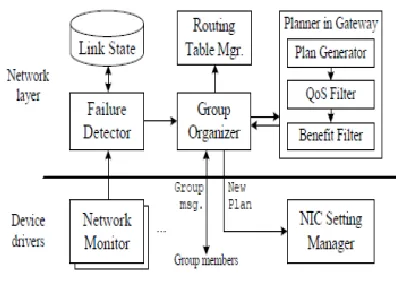
Fig 1.DQARS Architectures
DQRS is a distributed system that is easily deployable in IEEE802.11-based Mr.WMNs. running in every mesh node; ARS supports self-reconfigurability via the following distinct features: • Localized reconfiguration: Based on multiple channels and radio associations available, ARS generates reconfiguration plans that allow for changes of network configurations only in the vicinity where link failures occurred, while retaining configurations in areas remote from failure locations. • QoS-aware planning: DQRS effectively identifies QoS- satisfiable reconfiguration plans by (i) estimating the QoS- satisfiability of generated reconfiguration plans and (ii) deriving their expected benefits in Type a quote from the document or the summary of an interesting point. You can position the text box anywhere in the document. Use the Text Box Tools tab to change the formatting of the pull quote text box. Channel utilization.
QARS architecture contains the following
components.
Network planner: Generates reconfiguration plans only in a Gateway node.
Group organizer: Forms a local group among mesh routers. Failure detector: Periodically interacts with a network monitor and maintains an up-to-date link state table. Routing table manager: DQARS obtains or updates states of a system routing table [9].
Network monitor: Efficiently monitors link-quality and is extensible to support as many multiple radios.
NIC managers: Effectively reconfigures NIC’s settings based on a reconfiguration plan from the group organizer.
B.QARS Operation at mesh node:
1) Monitoring period, for every link measure link-quality using passive monitoring and sends monitoring results to a Gateway. 2) Failure detection and group formation period, if link violates link requirements then request a group formation on channel of link participate in a leader election using the enhanced bully algorithm if a request is received.
3) Planning period, if node is elected as a leader then send a planning request message to a gateway else if node is a
Gateway then synchronizes requests from reconfiguration groups generate a reconfiguration plan send a reconfiguration plan to a leader.
4) Reconfiguration period, if includes changes of node then find the transmission at the reduced delay apply the Changes to links.
Feasible Plan Generation:
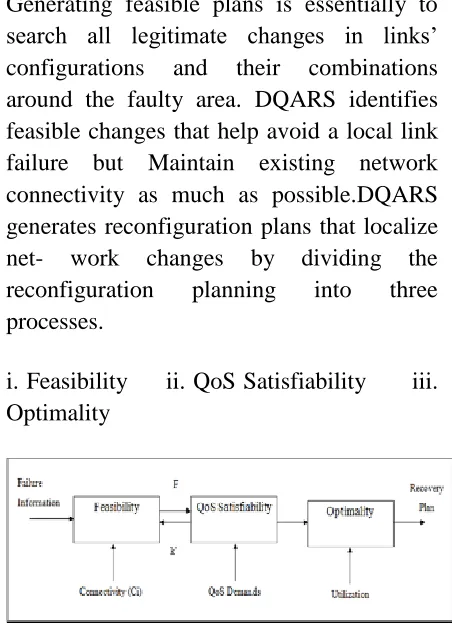
Generating feasible plans is essentially to search all legitimate changes in links’ configurations and their combinations around the faulty area. DQARS identifies feasible changes that help avoid a local link failure but Maintain existing network connectivity as much as possible.DQARS generates reconfiguration plans that localize net- work changes by dividing the reconfiguration planning into three processes.
i. Feasibility ii. QoS Satisfiability iii. Optimality
Fig 2.Localized reconfiguration planning in DQARS
IV CONCLUSION:
DQARS first searches for possible native
configuration changes on the market around a faulty space, supported current channel and radio associations. Then, by imposing current network settings as constraints, DQARS identifies reconfiguration plans that
need the minimum range of changes for the healthy network settings. It will improve the channel-efficiency and therefore the ability of meeting the applications information measure demands.
REFERENCES:
[1] I. Akyildiz, X. Wang, and W. Wang, “Wireless Mesh Networks : A survey,” Computer Networks, no. 47, pp. 445- 487, 2005.
[2] Kyu-Han Kim and Kang G. Shin, ” Self reconfigurable Wireless mesh networks” in IEEE/ACM Transactions on Networking, 2011.
[3] M.Alicherry, R. Bhatia, and L. Li, “Joint channel assignment and routing for throughput optimization in multi-radio wireless mesh networks,” in Proceedings of ACM Mobi Com, Cologne, Germany,Aug. 2005.
[4] D.S.D.Couto, D.Aguayo, J.Bicket, and R.Morris, “A highthroughput path metric for multi-hop wireless routing,” in Proceedings of ACM Mobi Com, San Diego, CA, Sept. 2005.
[5] K. Ramanchandran, E. Belding-Royer, and M. Buddhikot,“Interference aware channel assignment in multi-radio Wireless mesh networks,” in Proceedings of IEEE Info Com, Barcelona, Spain, Apr 2006. [6] M. Kodialam and T. Nandagopal, “Characterizing the capacity region in multi-radio multi-channel wireless mesh networks,” in Proceedings of ACM MobiCom, Cologne, Germany,Aug. 2005.
[7] R. Draves, J. Padhye, and B. Zill, “Routing in multi-radio, multi-hop wireless mesh networks,” in Proc. ACM MobiCom, Philadelphia,PA, Sep. 2004, pp. 114–128. [8] “Atheros Communications,” San Jose,
CA [Online].
Available:http://www.atheros.com
[9] C. Perkins and P. Bhagwat, “Highly dynamic destination Sequenced distance-vector routing (DSDV) for mobile computers,” in Proc.ACM SIGCOMM, London, U.K., Sep. 1994, pp. 234–244. [10] Garcia-Molina, H. Elections in a distributed computing system. IEEE Trans. Comput. 1982,C-13, 48–59.
[11] Mamun, Q.E.K.; Masum, S.M.; Mustafa, M.A.R. Modified Bully Algorithm for Electing Coordinator in Distributed Systems. In Proceedings of the 3rd WSEAS International Conference on Software Engineering, Parallel and Distributed Systems, Salzburg,Austria, 13–15 February 2004.