Web-Based interactive home automation and
Security System Based on Face Recognition
SA BBA NI TEJA
DEPA RTM ENT OF ECE
HOLYM A RY INSTITUTE OF TECHNOLOGY A ND SCIENCE
M R. B. KA RUNA IA H A SSOCIA TE PROFESSOR
DEPA RTM ENT OF ECE
HOLYM A RY INSTITUTE OF TECHNOLOGY A ND SCIENCE
Abstract – Smart home securit y cont rol sy st em has became indispensable in daily life. The design and development of a home security system, based on human face recognition t echnology and remotely monitoring technology, to confirm visitor ident it y and t o control door accessibility has been reported in this paper. This pap er describes about the implementation and dep loy ment of wireless control system and accessibilit y in t o a home environment for aut henticated people only. A wireless network technique Wifi based and image processing technique PCA based, dedicat edly make t he securit y sy st em alive as p er t he request . Wifi module and electromagnetic door lock module combinedly op erat e t he door accessibility, has been designed and developed. Face det ect ion and recognition algorithms, as well as a wireless int erface are used t o det ect and identify visitors and send an email and/or an alert message about the current home environment st at us via GSM net work aut omat ically t o t he home owner’s mobile p hone or any communication devices. The concerned authorit y can cont rol t he system through his/her mobile phone or any communication devices by sending AT Commands to GSM MODEM or by taking necessary act ions for authentication through email, which is again p assword p rotected. Users can monitor visitors and control t he door lock on act ive Web pages enhanced with JavaScript and HTML. This system finds a wide application in areas where p hy sical p resence is not p ossible all the time. T he ent ire cont rol sy st em is built using ARM1176JZF-S microcontroller and tested for actual use in home environment .
Index T erms – Embedded Web Server, Door Access, M icrocont roller, Face Recognit ion, GSM .
hardware platform for its simplicity and dimensionality reduction[13]-[17]. Wireless technologies like radio frequency identification
(RFID), ultra wide band (UWB), and Wifi [18] etc. are used in access control systems.
The proposed system is a wireless access control system designed and developed for smart home environment. The paper proposes a Raspberry pi based door access control and home security system through webpage with Wifi based technology. The system identifies the visitor’s presence, capture and transfers the image through email and/or an alert SMS via GSM network automatically to home owner to recognize the visitors. The system capability to provide access through internet, where subject of received email is read by the developed algorithm fed into Raspberry pi and system responds to the corresponding instruction with high security. The user can directly login and interact with the embedded device in real time without the need to maintain an additional server. It has a variety of features such as energy efficient, intelligence, low cost, portability and high performance.
The article is organized as follows. The system architecture is discussed in Section II, followed by system description in Section III. The system implementation and Experimental work are presented in Section IV and Section V with result respectively. Finally, Section VI draws conclusion
II. SYST EM ARCHIT ECTURE
I. INT RODUCT ION
An efficient and accurate embedded access control system based on face recognition is very important for wide range of commercial and security application. Many countries are gradually adopting smart home security control system [1], [2]. The most important part of any home security system is accurately identifying visitor who enter and leave through the door [3], [4]. An entrance guard can be managed using passwords, RFID sensors, finger prints and face recognition methods [5]. Face recognition is probably the most natural way to perform biometric authentication between human beings. Additionally, it is the second most popular biometric trait, after fingerprints [6]-[8].
Only few researchers have implemented the face recognition techniques in an embedded system for real time applications, such as a wireless door access control system. Most of the system was implementing a principle component
Vol ume 04 Issue 02
Fe bruary 2017
Embedded web server refers to import Web Server at the scene the monitor and control equipment, in support of appropriate hardware platforms and software systems, transfer traditional monitor and control equipment into an internet base, possessed with TCP/IP protocol as the underlying communication protocol and Web server technology as its core [20]. The embedded system can be utilized to serve the embedded web documents, including static and dynamic information about embedded systems, to Web browsers. This type of web server is called an Embedded Web Server (EWS) [21].
Fig. 1 Layout of the proposed system configuration
III. SYST EM DESCRIPT ION
The remote monitoring and controlling of the embedded equipments over the Internet can be mechanized by following certain network architectural design strategies and applying Wifi communication standards. The data transmission of smart camera augmented with Wifi over the internet can be done by integrating an internet gateway with Wifi network. In a Wifi network, end devices collect and forward data to a coordinator and then Wifi protocol data format is translated to Internet protocol (IPV6) format by the gateway.
The virtual home security System is a software developed in python. All communication and instructions are checked for security and safety, in the virtual environment, before implementation in the real home environment. The Raspberry Pi unit and the camera are installed in a home through Wifi. If any visitors arrive, the Raspberry pi sends an appropriate SMS and/or email including the details to an Internet-based server using user email-id. The server then sends to the home owner the name and photo of visitors for further action. The owner can directly login and interact with the embedded Device in real time through webpage without the need to maintain an additional server.
A. Face Recognition Module
Principal Component Analysis technique, effectively and efficiently represents pictures of faces into its eigenface components. It reduces data dimensionality by performing a covariance analysis between factors. When applied on
conditions, PCA will explore correlations between samples or conditions. If we consider an image as a point in a very high dimensional space, the principal components [22] are essentially the eigenvectors of the covariance matrix of this set of face images, which Turk and Pentland termed the Eigenface [23]. Each individual face can then be represented exactly by a linear combination of eigenfaces, or approximately, by a subset of "best" eigenfaces - those that account for the most variance within the face database characterized by its eigenvalues. After performing PCA the output is shown in Fig. 2
Fig. 2 Face Recognition
B. SMS Module
The SIM900A is a GSM/GPRS module which works on various frequencies such as 8S0MHz, 900 MHz, 1800 MHz and 1900 MHz to send SMS [26]. The modem is designed with RS232 level converter circuitry which allows it to be connected to the microcontroller serial interface. It also has TCP/IP stack which enables the microcontroller to connect with internet via GPRS. An SMS activation system is implemented to communicate the home owner [27].
The SMS module consists of GSM modem and a control program. The control program, GSM-dial up and communication protocol are stored in the embedded gateway and the GSM modem is connected to the Raspberry pi via serial interface to the switching module. The SMS module acts as an interface between the embedded processor and the GSM network, making the system login to the network and ready to make any data transfer and communication. The module takes
C. Display on Web Interface
A Linux based server collects sample data by receiving the UDP packets containing sample data from the IoT application gateway and store in a database. These samples can be accessed from the database through a website hosted on the server. The raw sample data, sample source and time of arrival are stored in the database. This enables the samples to be ordered by date and organized by their source. The current data is displayed on the website is shown in the Fig. 4.
Fig. 4 Real-time data display on web interface
IV. EXPERIMENTAL RESULT S
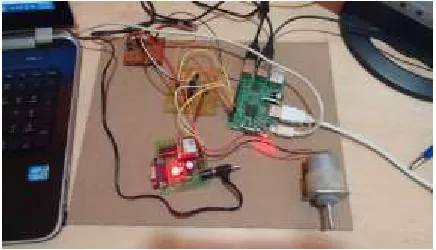
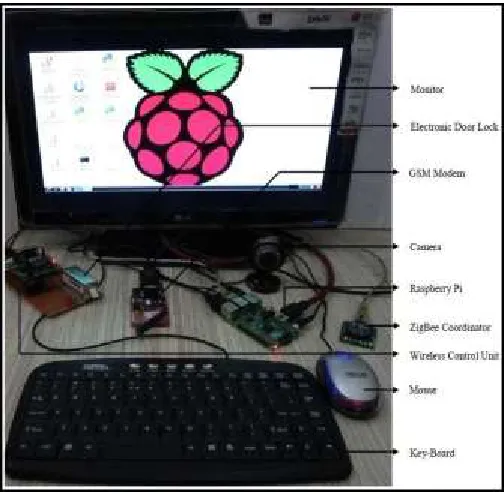
The experimental setup shown in the Fig. 5 is monitoring the environment for visitor entry, the WIU sends the notification email and/or SMS indicating the update visitor to the authorized users and the user then sent mail to WIU for controlling action which is shown from Fig. 6 to Fig. 10, respectively.
The algorithm, read the subject and before forwarding to WCU, will check the existence and safe range of the devices wirelessly. If the system satisfies safety and security norms then WIU will forward the controlling command to WCU wirelessly to perform switching action. For example, an email with the subject OPEN was sent to raspberry pi account ([email protected]' in this case) from the consumer account ([email protected] m' in this case).
Fig. 5 Working Experimental setup, (a) Wireless sensing unit (b) Wireless information unit having GSM modem, Raspberry pi, Wifi coordinator, monitor, keyboard and mouse.
Fig. 6 Screen shot of "E-mail Received with Snapshot of the Visitors" from WIU
Vol ume 04 Issue 02
Fe bruary 2017
The algorithm, read the subject ‘OPEN’ at WIU and send the command to WCU to unlocked door 1 and instantly reply to owner by an email - 'Door opened' under the subject-'Notification on Home Security System'. Fig. 8 shows the screen shot of sent mail from WIU to sender indicating the details of action performed. The code also notify the security breach to prevent unauthorized users to access the system.
Fig. 9 Screen shot of "CONFORMAT ION MAIL" from WIU
Fig. 10 Screen shot of "SECURITY NOTIFICATION" from WIU The owner can monitor the visitors and control door lock through web site. The control program is running on the server. The application is flexible in usage as these devices can be controlled remotely using the secured website.
VI. CONCLUSION
This paper presents the design and the implementation of an interactive home security system with the GSM, Wifi communication and Web-enabled measurement and control systems. The Web based monitor and automatic control of equipment is forming a trend in automation field. Replacing PC with low-cost single chip processor which can make administrators to get parameters of different remote devices and send control information to field equipments at any time through Internet.
The GSM is an excellent choice for this due to its extensive coverage. Since SMS is a text based protocol, even
the most basic GSM systems can have an access to the status of the devices or make changes on these states. The complete system is secured through a login E-mail and Webpage password based authentication. The design is completely wireless and integrated with the software to form a low cost, robust and easily operable system. Wifi communication makes the system easy to install.
References
[1] Jinsoo Han; Chang-Sic Choi; Ilwoo Lee, "More efficient home energy management system based on ZigBee communication and infrared remote
controls," Consumer Electronics, IEEE Transactions on , vol.57, no.1,
pp.85,89, February 2011.
[2] Erdem, H.; Uner, A., "A multi-channel remote controller for home and
office appliances," Consumer Electronics, IEEE Transactions on , vol.55,
no.4, pp.2184,2189, November 2009.
[3] Yuksekkaya, B.; Kayalar, A.A.; Tosun, M.B.; Ozcan, M.K.; Alkar, A.Z., "A GSM, internet and speech controlled wireless interactive home automation system," Consumer Electronics, IEEE Transactions on ,
vol.52, no.3, pp.837,843, Aug. 2006.
[4] Chia-Hung Lien; Ying-Wen Bai; Ming-Bo Lin, "Remote-Controllable Power Outlet System for Home Power Management," Consumer Electronics, IEEE Transactions on , vol.53, no.4, pp.1634,1641, Nov. 2007.
[5] Vernon, S.; Joshi, S.S., "Brain –Muscle–Computer Interface: MobilePhone Prototype Development and Testing," Information
Technology in
Biomedicine, IEEE Transactions on , vol.15, no.4, pp.531,538, July 2011. [6] Faundez-Zanuy, M. Are inkless fingerprint sensors suitable for mobile
use? IEEE Aerospace and Electronic Systems Magazine, Vol. 19, No.4,
pp. 17-21, April 2004.
[7] IFaundez-Zanuy, M., Aprl12005, Technological evaluation of two AFIS
systems, IEEE Aerospace and Electronic Systems Magzne. Vol. 20, No.4,
pp. 13-17.
[8] Faundez-Zanuy, M., February 2005, Privacy issues on biometric systems,
IEEE Aerospace and Electronic Systems Magazine, Vol. 20, No.2, pp. 13- 15.
[9] P. B. Saurabh and D.S.Chaudhari,”Principal Component Analysis for Face Recognition”, International Journal of Engineering and Advanced
Technology, vol. 1, pp. 91-94, 2012.
[10]S. M. Prakash and C. J. Kalpna,”Face Recognition Using PCA”,International Journal of Artificial Intelligence Knowledge
Discovery, vol. 1, pp. 25-28, 2011.
[11]A. M. Martinez and A. C. Kak, ”PCA versus LDA” , LOS ALAMITOS,
pp. 228-233, 2001.
[12]J. Mazanec, et al.,”Support vector machines, PCA and LDA in face recognition”, Journal of Electrical Engineering-Electrotechnicky
CASOPIS, vol. 59, pp. 203-209, 2008.
[13]K. H. Pun, et al.”A face recognition embedded system”, Biometric Technology for Human Identification II,vol. 5779, 2005. [14]R. Ibrahim and Z. M. Zin, ”Study of automated face recogn ition system
Conference in Communication Software and Networks (ICCSN),pp.
132- 136, 2011.
[15]W. Shimin and Y. Jihua, ”Research and implementation of
embedded face
recognition system based on ARM9”, IEEE Conference Proceedings, pp.
2618-2621,2010.
[16]H. T. Ngo, et al., ”A flexible and efficient hardware architecture for realtime face recognition based on eigenface”, IEEE Computer Society Annual Symposium Proceedings in VLSI,pp. 280-281, 2005. [17]G. F. Zaki, et al., ”Using the hardware/software co -design
methodology to
implement an embedded face recognition/verification system on an FPGA”, IEEE Conference Proceedings, pp. 459-462, 2007. [18]Il-Kyu Hwang, and Jin-Wook Baek, “Wireless access monitoring and
control System based on digital door lock”, IEEE Transactions on Consumer Electronics, Vol. 53, pp. 1724-1730, Nov 2007 [19]Maik Schmidt. Raspberry Pi. A Quick Start Guide. Dallas, Texas: The
Pragmatic Bookshelf, pp. 11-42 , 2012.
[20]Mo Guan; Minghai Gu, "Design and implementation of an
embedded web
server based on ARM," Software Engineering and Service Sciences (ICSESS), 2010 IEEE International Conference on , vol., no.,
pp.612,615, 16-18 July 2010.
[21]Hong-T aekJu, _ Mi-Joung Choi and James W. Hong “An efficient and lightweight embedded Web server for Web-based network elementmanagement” International Journal of Network Management,
pp. 261 – 275, Oct 2000.
[22]Karim, T .F.; Lipu, M.S.H.; Rahman, M.L.; Sultana, F., "Face recognition using PCA-based method," Advanced Management Science (ICAMS), 2010 IEEE International Conference on , vol.3, no., pp.158,162, 9-11
July 2010.
[23]M. Turk and A. Pentland, “ Eigenfaces for Recognition”, Journal
Cognitive Nero-science, 3(1), 1991.
[24]XBee-PRO RF Module. Digi Int. Inc., Hopkins, MN, USA. [Online].Available: http://www.digi.com, accessed Jun. 15, 2013. [25]IEEE Standard for Information Technology-Telecommunications and Information Exchange Between Systems-Local and Metropolitan Area
Networks, IEEE Standard 802.15.4-2003, 2003.
[26]Rhydo Technologies, "SIM900 GSM/GPRS RS232 Modem – User
Manual", Dec, 2011.