Page | 248
Difficulties of teaching the circulatory system in Life
Sciences
Wissal Iraqi Houssaini*; Taoufik Hassouni; El Mustapha Benhammi & Tajeddine Manssouri
Department of Life and Earth Sciences - Regional Center for Education and Training - Meknes - MOROCCO
*Corresponding Author: Dr. Wissal IRAQI HOUSSAINI Email: [email protected]
Abstract:
Teaching the concept of the circulatory system (CS) in college is facing many difficulties for both teachers and learners. We present in this paper a series of results which identify these difficulties. Misconceptions among learners as well as the lack of Information and Communication Technologies adoption by
teachers (ICT) are examples of such difficulties. Running experiments in the classroom is another issue faced by teachers. This work also suggests solutions for the identified problems.
Keywords:
Learning, Concept, Difficulties, Obstacles, Teachers, Learners, Experiments.
Abbreviations: LES: Life Earth and Sciences, CS: Circulatory System, ICT: Information and Communication Technologies
1. Introduction
Up until now, the problems associated with learning are rarely defined in terms of difficulties. Rather they are described in relation to the teacher and / or learner, as a lack of competence, or weaknesses related to previous teaching cycles. The difficulties encountered by either the teacher or the learner in a given course may rather be linked to the complexity of the concepts being taught and/or to the learning barriers. We should also mention the perceptions that teachers themselves accumulate through their academic studies (Teacher Epistemology). This difficulty is especially reported about junior teachers by Chevallard, 1985 [4]. In his research published in 1984, De Vecchi underlines the crucial importance of taking into account learners’ representations [8]. Being himself a trainer, he exposed to teachers different aspects of
Page | 249
[7]. References to knowledge were also presented in a document published on the didactics by Terrisse in 2000 [17]. Through all these studies, authors have reported that learners have difficulties in acquiring scientific knowledge. It is to note that the possession of a greater knowledge is not enough to transfer the conceptions to learners [10]. In this context, the identification and analysis of problems are an essential condition to overcome the difficulties related to learning and to ensure a certain quality of education. Consequently, the major difficulties have to be determined first, before developing any learning strategies. It should be noted that these barriers, called sometimes “Educational obstacles”, may be key steps to go through. This is the concept of “Objective-obstacle” introduced in 1996 by Martinand [12]. Furthermore, it is known that the epistemological obstacle is an expression of the philosopher Bachelard [2]. Several studies are published on the conceptions, the obstacles and the acquisition of knowledge in experimental sciences [1], [6], [11].
The aim of our study concerns the difficulties of teaching and learning the CS.
It should be noted that in Moroccan colleges, this concept is taught in the 3rd year, according to official instructions [18], [19], [20].
2. Materials and methods
To perform our work, we surveyed 100 3rd year college learners and 10 LES college teachers, in the region of Meknes. The teachers involved in this study have mostly 5 to 10 years of experience. Learners are 14-15 years old and no one of them is retaking the course. The classrooms, in these colleges, contained between 37 and 40 learners. Data collection was done through two questionnaires that were analyzed quantitatively and qualitatively.
Teacher Questionnaire: Included open questions on the difficulties faced by teachers in teaching the CS and proposed solutions to facilitate it (Table 1).
Question 1
What are your
difficulties in teaching the CS?
Question 2
What are your
suggestions to overcome
the difficulties in
teaching the CS?
Question 3
What are your
difficulties in running experiments related to CS?
Question 4
What is the interest of running experiments in learning the CS?
Table 1: Teacher Questionnaire
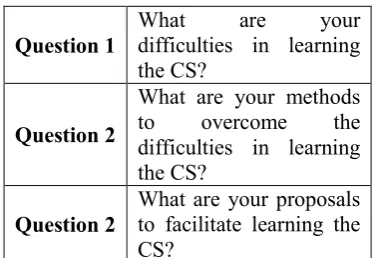
Learner Questionnaire: Included open questions on the difficulties faced by learners in learning the CS and suggestions to overcome these obstacles (Table 2).
Question 1
What are your
difficulties in learning the CS?
Question 2
What are your methods
to overcome the
difficulties in learning the CS?
Question 2
What are your proposals to facilitate learning the CS?
Page | 250 3. Results
3.1 Teacher Questionnaire
3.1.1 Difficulties in teaching the CS
Phases Difficulties encountered
Percentage of teachers
During preparation
of the course
Integration of ICT 60%
Preparation of the
chapter material 40%
During the course
Time management 40%
High number of
learners 30%
Learner
misrepresentations 30%
During the evaluation
Incorrect
understanding of the questions by learners
40%
Difficulties in learner evaluations
(e.g. because
cheating)
40%
Persistent learner
misrepresentations 20%
Table 3: Difficulties in teaching the CS
- During the preparation: Integrating ICT and preparing the chapter material are the major problems. These responses were recorded respectively in 60% and 40% of surveyed teachers.
- During the course: The major problem is the high number of learners from 40% of the teachers in our study. Correcting misrepresentations that learners have and managing the time dedicated to this concept accounted for 30% each.
- During the evaluation: 40% of surveyed teachers have the problem of question misinterpretation by learners. Difficulties in learner evaluation, because of cheating, were reported by 40%. Persistent misrepresentations were also cited by 20% of surveyed teachers.
We collected afterwards teachers’ suggestions to address the difficulties. Responses are reported below.
3.1.2 Teacher suggestions to overcome the difficulties in teaching the CS
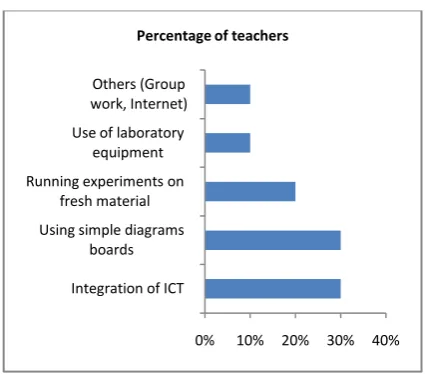
Figure 1. Teacher suggestions to overcome the difficulties in teaching the CS.
Figure 1 shows that teachers propose the integration of animated sequences (30%) and simple diagrams (30%) to make this course easier for learners. Only 20% suggest running experiments on fresh material. The difficulties encountered during experiments were the main cause of teachers’ lack of motivation to run experiments. We detail this point below. In addition, a minority of our sample tend to use laboratory equipment (10%) or to work in groups (10%).
3.1.3 Teacher difficulties during running experiments related to the CS
0% 10% 20% 30% 40%
Integration of ICT Using simple diagrams
boards Running experiments on
fresh material Use of laboratory
equipment Others (Group work, Internet)
Page | 251
Figure2. Teacher difficulties during running experiments related to the CS.
Figure 2 shows that the high number of learners, the lack of equipment and time, the difficulty of changing certain learns’ representations, and the classroom management are the teacher difficulties during experiments.
However, all teachers under our research have confirmed the interest of running experiments in the classroom. We focused in the following, on the scientific contribution of experiments.
3.1.4 Interest of running experiments in learning the CS
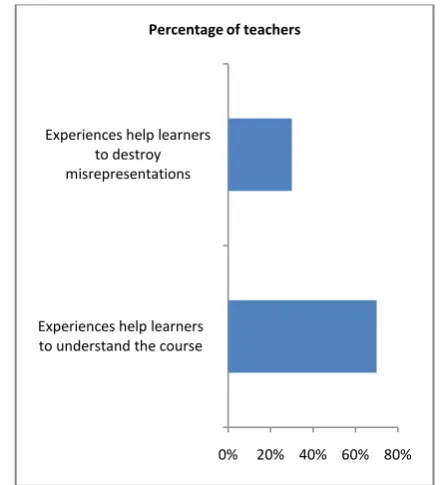
Figure 3. Interest of running experiments in learning the CS.
The results obtained showed that performing experiments in class plays an important role in learning the CS as well as getting rid of false representations that learners already have (Figure 3).
3.2 Learner Questionnaire
3.2.1 Difficulties in learning the CS
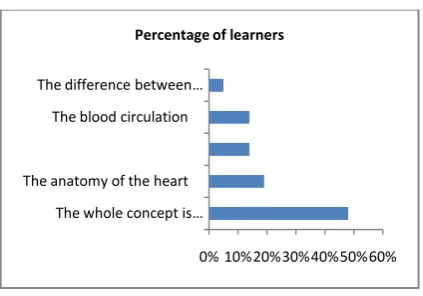
Figure 4. Difficulties in learning the CS.
The collected results showed that 19% of surveyed learners did not come to understand the heart anatomy. The mechanism of blood flow and transport of respiratory gases through blood were also problematic. The difference between arteries and veins was also one of the 0% 10% 20% 30% 40%
High number of learners Lack of equipment Lack of time Difficulty of changing
some learner representations Inability to perform some
experiments Learner management during the experiment
Percentage of teachers
0% 20% 40% 60% 80%
Experiences help learners to understand the course
Experiences help learners to destroy misrepresentations
Percentage of teachers
0% 10%20%30%40%50%60% The whole concept is …
The anatomy of the heart The blood circulation The difference between …
Page | 252
difficulties faced by learners but with a very small percentage (5%). It is important to note that a fairly high percentage (48%) had reported that they didn’t understand the concept at all (Figure 4).
3.2.2 Learner methods to overcome the difficulties of learning the CS
Figure 5. Learner methods to overcome the difficulties of learning the CS.
Figure 5 shows that 31% of learners involved in our study use the Internet to overcome the difficulties encountered in the course of CS versus 26% who use the textbooks. The help of some people, the use of documents outside the program and the tutoring were cited respectively by 22%, 12% and 9% of learners.
3.2.3 Learner proposals to facilitate the learning of the CS
Figure 6. Learner proposals to facilitate the learning of the CS.
The suggestions of learners to facilitate the concept of the CS were divided between running experiments in the classroom and the use of schemes or animated sequences,
42%, 32% and 26%, respectively (Figure 6).
4. Discussion
This study allowed us to review the various difficulties encountered in college, by both the teacher and the learner, regarding the CS.
Results analysis showed that the major difficulty for teachers reside in the misrepresentations among learners. This has been reported on several occasions. This limiting factor was also observed when performing experiments in class. It is interesting to note that 52% of learners have difficulties in understanding the anatomy of the heart, the transport of respiratory gases, the blood circulation and the difference between arteries and veins (Figure 4). A large percentage reported that the entire concept is difficult. Misconceptions may be causing these results. It is interesting to note that these results indicate the epistemological barriers [1], [2], [6], [11]. In this context, experts always recommend to start with the identification of the weakness, its eradication and incorporation of new knowledge [1], [6], [11]. It is also established that knowledge transfer may still need to take into account the misconceptions [5], [14]. It is important to note that 30% of surveyed teachers suffered from managing the time dedicated to the concept of CS (Table 3). This result should lead to reconsider the number of hours reserved for the CS and the methodology. The determination of learner misrepresentations certainly requires a longer time and thus an increase of hours dedicated to this concept.
ICT integration is another keyword that was continually mentioned as part of the difficulties of CS teaching and learning. However, despite ICT importance in the illustration of complex phenomena, 40% of the teachers find difficulty in their use (Table 3). This would certainly be due to a 0% 10%20%30%40%50%60%
The whole concept is … The anatomy of the heart
The blood circulation The difference between …
Percentage of learners
0% 10% 20% 30% 40% 50%
Experiements Simplified schemes Animated sequences
Page | 253
lack of training. In this context, considerable efforts are being made by the Moroccan Ministry of Education to spread and generalize these new technologies in the educational system. The 2009-2012 emergency plan launched by the Moroccan government to give a boost to education and training in Morocco, has devoted an entire project to integrate ICT (Area 1, Project 10) including ICT training.
To overcome the difficulties cited, teachers in our research highlighted the importance of integrating animated sequences and diagrams as well as performing experiments in class (Figure 1). The latter approach has an important role in learning the CS as well as fixing false representations (Figure 3). However, although 70% of teachers had confirmed the scientific value of the classroom experiments, their implementation was reported only by 20% of surveyed teachers (Figure 1). This is certainly due to the high number of learners as well as the lack of equipment and time (Figure 2).
Running experiments in the classroom, the use of patterns and the presentation of animated sequences certainly help learners to assimilate the course (Figure 6). Among the alternatives adopted by learners to understand certain conceptions of the CS, Internet resources, the use of textbooks as well as documents outside the program, the help of some people, and the tutoring were reported (Figure 5).
It is clear from these results that the combination of many methods as running experiments, integration ICT, using schemes and animated sequences would circumvent the difficulties related to the concept of CS.
Many answers were made to our questions about learning the CS but it was difficult to compare our results closely with those published. It should be noted that the references reported throughout this
document affect our subject in its general framework.
5. Conclusion
Our study showed that the major obstacle to overcome, in teaching the CS, is some misconceptions among learners. The results presented in this paper underline the requirement of teachers to deploy more efforts such as running experiments, using simplified schemes and animated sequences. We have also identified the barriers encountered by teachers during running experiments in class such as the high number of learners, the lack of equipment and time, the difficulty of changing certain learns’ representations and classroom management.
References
[1] Astolfi, J. P., Peterfalvi, B. (1993). "Barriers and construction of educational situations” in Experimental sciences, Aster 16, 1993 (Obstacles et construction de situations didactiques en sciences expérimentales).
[2] Bachelard, G. (1938). ” The formation of the scientific mind”, Phylosophic library, J. Vrin, 256 p (La formation de l'esprit scientifique).
[3] Brousseau, G. (1998). “Theory of didactic situations”, Grenoble, the savage mind. (Théorie des situations didactiques. Grenoble : La Pensée Sauvage).
[4] Chevallard, Y. (1985). “Didactic transposition, the learned knowledge to knowledge taught”, Grenoble, The Savage Mind. (La transposition didactique, du savoir savant au savoir enseigné, Grenoble, La Pensée sauvage).
[5] Clement, P. (1991). "On the persistence of design: the continuous pipe digestion and excretion" Aster 13. (Sur la persistance d’une conception: la tuyauterie continue digestion-excrétion).
Page | 254
University Paris-Sud (Le rapport
expérimental au vivant dans la formation des enseignants. Mémoire d’habilitation à diriger des recherches, Université d’Orsay Paris-Sud).
[7] Delacôte, G. (1996). “Know learn: New methods”, Paris, Odile Jacob. (Le savoir apprendre: Les nouvelles méthodes).
[8] De Vecchi, G. (1984). “Terms of inclusion of children's performances in Biology in elementary school and their interest in the training of teachers”, doctoral thesis of the third cycle, University of Paris VII. (Modalités de prise en compte des représentations enfantines en Biologie à l’école élémentaire et leur intérêt dans la formation des maîtres, Thèse de doctorat de 3e cycle, Université Paris VII).
[9] De Vecchi, G. & Giordan, A. (1989). “Science education: how to make "it work?"” Nice Z'éditions. (L’enseignement scientifique: comment faire pour que "ça marche?", Nice, Z’éditions).
[10] Giordan, A., Y. Girault, Y.& Clement, P. (1994). “Conceptions and knowledge”, Bernes: Peter Lang. (Conceptions et connaissances. Peter Lang).
[11] Giordan, A. (1999). “Didactics for experimental science”, Belin. (Une
didactique pour les sciences
expérimentales, Belin).
[12] Martinand, J. L. (1996). “Teaching and learning of modeling in science”, Paris,
National Institute of Educational
Research. (Enseignement et apprentissage de la modélisation en sciences. Paris:
Institut National de Recherche
Pédagogique).
[13] Reuter, Y. (2007/2010). “Dictionary of fundamental concepts of didactics”, Brussels, De Boeck. (Dictionnaire des concepts fondamentaux des didactiques. Bruxelles : De Boeck).
[14] Sauvagoet-Skibine, M. (1993). "From the representation pipes to the concept of internal environment," Aster 17. (De la représentation en tuyaux au concept de milieu intérieur).
[15] Schneeberger, P. (1997). “Place of concept representations in teacher education : An example in the field of Biology and Geology”, SPIRAL, Review of Research in Education - HS # 2, pp.
263-282 (Place du concept des
représentations dans la formation des enseignants: Un exemple dans le domaine de la Biologie-Géologie).
[16] Tavernier, R. & Lamarque, J. (1992). “Teaching Biology and Geology at the elementary school”, school teachers guide IUFMs Paris, Bordas. (Enseigner la Biologie et la Géologie à l’école élémentaire, Guide des professeurs des écoles IUFM, Paris, Bordas).
[17] Terrisse, A. (2000). “Didactic of disciplines”, References to knowledge in Boeck University. (Didactique des disciplines. Les références au savoir. De Boeck Université).
[18] Life and Earth Science textbooks Al Mufid, 2011 Edition, Publisher Dar Attaqafa (Les manuels scolaires des Sciences de la Vie et de la Terre: Al Moufid en SVT - Edition 2011, Maison d’édition Dar Attaqafa).
[19] Life and Earth Science textbooks Al Massar, Publisher Nadia, 2010-2011 Edition (Les manuels scolaires des Sciences de la Vie et de la Terre: Al Massar - Edition 2010-2011, Maison d’édition Nadia).