Actual Cost of Reliability Improvement in Optimal Reliability
Design Derived From an Analytical Cost Function
Stephen B. Twum, Elaine Aspinwall
P
1
P
Faculty of Mathematical Sciences
University for Development Studies, P.O. Box 24 Navrongo, Ghana
P
2
P
School of Mechanical Engineering
University of Birmingham, B15 2TT, United Kingdom
Abstract
Cost is an intrinsic characteristic in optimal design for reliability, whether by redundancy allocation, reliability allocation or both. While the cost expressions in redundancy allocation are typically functions of the number of redundant components and therefore provide a direct measure of the actual cost of reliability specified in a design, those for reliability allocation are not as straight forward, since cost must be a function of reliability in this case. Therefore various analytical cost functions that do not necessarily directly provide a measure of the financial cost of reliability but rather indicate the degree of difficulty in meeting the reliability specification have been used instead. This work provides a methodology to obtain a direct financial cost of reliability in series-parallel systems design derived from a popular analytical cost function. The methodology is tested using data from a previous work. The results show that the methodology is viable
Key words: Analytical, Financial, Cost function, Reliability, System design, Optimal INTRODUCTION
There is cost implication to any level of reliability desired in a product at any stage of its life cycle. Nevertheless, the best time to consider cost of reliability issues in system design is at the conceptual stage (Twum et al 2012; Relex Software Corporation, U.S.A) since this tends to have positive impact on the system’s durability, availability and life cycle costs (Cranwell, 2007).
The conceptual stage is one where an idea for a new product is conceived or a proposal or bid documents are developed in pursuit of a grant or a contract for a product design. The assessment of the reliability and cost implications at this stage can prove advantageous for the design as well as the bidding (James et al, 2002). A critical aspect of the conceptual stage is for the reliability engineer to determine whether the system would conform to a specified reliability target. This involves quantifying the reliability of the system on the basis of the reliabilities of all of its components while ensuring that the reliability goal can be achieved at minimum cost. A system design which does not meet the reliability specification may have its reliability improved either using fault tolerance or fault
The task of improving systems reliability (by means of either fault tolerance or fault avoidance) at minimum cost has classically been formulated as an optimisation problem (Majety et al, 1999) and the area remains a vibrant research field which continues to receive a lot of attention in terms of solution algorithms, methodology and applications. Three fundamental optimisation models characterise the problem; they are: the Redundancy Allocation Problems (RAPs); the Redundancy-Reliability
Allocation Problems (RRAPs); and the Reliability Allocation Problems (RPs) (Twum et al, 2012).
RAPs aim at improving system reliability using a redundant number of components at the component level while RPs seek to do so by increasing components reliabilities without any redundancies. The RRAPs combines both aims into a single model. The interested reader is referred to (Twum and Aspinwall, 2013a) for detailed discussions of the models. It is to be noted therefore that the RAPs are geared towards purely fault tolerant designs while RPs are towards fault avoidance. Since the RRAPs combine both RAPs and RPs formulation techniques they incorporate both fault tolerance and fault avoidance methodologies.
A common feature in all the models (i.e. RAPs, RRAPs and RPs) is that either reliability is maximised subject to constraints on cost and other system characteristics such as weight or volume, or cost in minimised subject to constraints on system or component reliabilities (Twum and Aspinwall, 2013a). A few cases seek to optimise simultaneously both system reliability and cost (Kuo and Prasad, 2000; Shelokar et al, 2002; Coit et al, 2004; Salazar et al, 2006 ) or subsystem reliabilities and cost (Twum et al, 2012; Twum and Aspinwall, 2014). While the cost expressions in RAPs are fundamentally functions of the number of redundant components and thus easy to model the same cannot be said of the cost expressions in RPs especially, since they are required to be functions of the components’ reliabilities and the precise relation between the two is usually unknown (Mettas, 2000). Instead analytical models which depict exponential relations between cost and component reliability have generally been assumed (Aggawal, 1994). The models nevertheless do not provide any direct way of ascertaining the actual financial cost of improving systems reliability.
model due to Mettas (2000). In the next section the analytical cost model is discussed followed by a discussion of the novel method in the next. The technique is then applied to an illustrative example concerned with a series-parallel system reliability optimisation using a model due to Twum et al (2012) and Twum and Aspinwall (2013b). The final section draws conclusions on the work done to end the discussions.
RELIABILITY-COST FUNCTION
A major challenge in RPs, as observed earlier, is with modelling the reliability cost relationship which eventually should provide an assessment of the real cost of reliability. Indeed, the reliability-cost function may be derived empirically from actual reliability-cost data using past experience or that for similar components (Mettas, 2000). For instance it can be obtained from a reliability growth programme in which the stage-to-stage cost of improvement of the reliability of components or systems are tracked and quantified (Reliability Hotwire, 2001). In most cases however the necessary data is not available so a number of analytical models have been used as an alternative. Some of the more common models are discussed by Aggarwal (1994). The main features of these models are the following:
• Cost is modelled as a monotonically increasing function of reliability • Cost is modelled as a differentiable and convex function of reliability • Cost becomes indeterminate as reliability approaches unity
• Cost increases sharply with marginal increases in reliability where the original reliability was
very high.
The analytical cost function used in this work exhibits the above features and was developed by the ReliaSoft Corporation of the USA (Mettas, 2000). It has been chosen because unlike the others it incorporates a feature which accounts for and quantifies the difficulty or otherwise associated with increasing reliability in design; a feature which, in our view, is practical. The series-parallel system to which the cost function would be related is as given in Twum et al (2012) in which there are m
which is the cost of reliability improvement in the
k
'
th
component in thei
'
th
subsystem is thus defined by:
where
f
ki is a constant which measures the difficulty of increasing the reliability of thek
'
th
component
(
k
=
1
,
2
,...,
n
i)
in thei
'
th
subsystem(
i
=
1
,
2
,...,
m
)
relative to the other components in the subsystem. This measure, called the feasibility factor is set such that 0 <f
ki< 1 for allk
andi
(Reliability HotWire, 2001). Expression 1 thus quantifies the cost of reliability improvement in the
th
k
'
component of thei
'
th
subsystem in terms of the component’s achievable reliability,R
ki, whichis an independent variable, and in terms of its feasibility factor, which is an input parameter, together with the initial and maximum achievable reliability values
R
ki,min andR
ki,max respectively.The cost function is thus a dimensionless penalty function calibrated on a scale of one to infinity (one when no improvement in reliability is achieved and infinity when reliability approaches the maximum value). It serves as a measure or indicator of the level of resource expenditure required in order to achieve the reliability levels desired in a component. A major difficulty presented by this notion of cost is with how to assess the significance of the numbers that are assigned. While a technique for converting these numbers into direct monetary terms is desirable (and the focus of this work), it is suggested that the difficulty arises especially when the numbers are treated as absolutes. A comparative approach is better at putting them into context and facilitates a basis for assessing them for a given problem and making the appropriate cost-benefit analysis for decision making. The fact that the upper level of the scale is unbounded, however, remains a major weakness.
It is clear that the higher the value of the feasibility factor the lower the cost (for a given component reliability value and fixed parameter values) and vice versa. Setting appropriate values for
ki
f
for allk
=
1
,
2
,...,
n
i is thus necessary, even though it is not straightforward. The practice has beento use weighting factors which depend on certain influential aspects like complexity of the − − − = ki ki ki ki ki ki R R R R f c max , min , ) 1 (
components, the state of the art, the operational profile, the criticality, etc (Mettas, 2000; Reliability Hotwire, 2001). Engineering judgement based on past experience, supplier quality, supplier availability, may also be used (Reliability Hotwire, 2001). There is therefore some level of subjectivity involved in the determination of the feasibility factor.
The initial reliability value may be taken as the current value of the reliability of a component or can be obtained from the component’s failure data and its corresponding statistical distribution. The initial reliability values of other functionally similar components may also be used. Where a component has competing failure modes the failure data in respect of each of the failure modes would be required in order to estimate a generic initial reliability value for the component. In this case one ought to obtain the configuration of the failure modes (ReliaSoft Corporation, 1999-2007). Suppose, for instance, that the initial reliability of the
k
'
th
component in thei
'
th
subsystem hasp≥2failure modes and the occurrence of any one would result in failure of the component. If it can be established that the failures are independent then the failure modes have a series configuration. Thus ifp ki ki
ki
R
R
R
,min,2 ,min, 1min,
,
,
,...,
are the initial reliability values of thek
'
th
component in thei
'
th
subsystem corresponding respectively to thepfailure modes, then:
whereRki,minis the generic initial reliability estimate of the
k
'
th
component in thei
'
th
subsystem.Similar results may be determined for cases where the configuration is parallel, series-parallel, etc. The maximum achievable reliability value which is usually dictated by technological and financial constraints is a limiting value that may be approached but not necessarily attained; it is thus set very high (Reliability Hotwire, 2001). The value which eventually is a subjective estimate can be set, however, based on engineering judgement and current state of the art (Reliability Hotwire, 2001). Generally, cost rises sharply as the component reliability approaches the maximum achievable value (Mettas, 2000, Twum and Aspinwall, 2014).
∏
= = p
j
j ki
ki R
R
1 min, , min
In the context of a series-parallel system therefore, the overall system reliability may be obtained from the expression:
Expression 3 assumes the overall system cost is the aggregate components’ reliability costs. PROPOSED ACTUAL COST OF RELIABILITY MODEL
Since one would also like to know (especially the decision maker) the direct monetary cost of reliability improvement, a methodology that converts the reliability cost/penalty value discussed in the last section, into a monetary cost estimate is discussed.
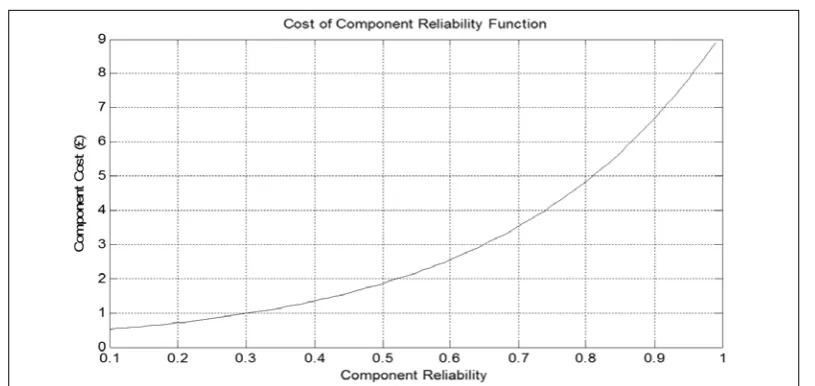
It can be shown (Reliability HotWire, 2001) that by using a fault tolerant scheme (i.e. putting components in a parallel arrangement), an array of component reliability values and their associated cost units can be evolved and used to develop an analogous monetary cost function for a component. A plot of the reliability values against cost (in monetary terms) yields a curve (see Figure 1) which depicts an exponential relation between cost and reliability and thus somewhat justifying the assumed exponential cost of reliability relation referred to earlier. In Figure 1 the cost of a hypothetical component (which could well include the cost of design, manufacture, packaging etc.) is assumed to be One Pound (£1) and the reliability of the component to be 0.3. The plot depicts the cost resulting from a fault tolerant scheme involving one through to eight identical components in a parallel arrangement with the original, and their corresponding reliabilities.
∑∑
= =
=
′
mi n
k ki s
i
c
C
1 1
Figure 1: Plot of component reliability against actual cost, in a fault tolerant scheme
The actual monetary cost function for any component can therefore be modelled (on the basis of Figure 1), generally, by expression 3 (see Reliability HotWire, 2001), where
c′
is the monetary cost (Pounds in this instance) corresponding to any given component reliability value R;λ
andµ
are scalars to be determined.Note that the values of the scalars (
λ
andµ
) are given by expressions 5 and 6:
where the ordered pairs (c1′,R1)and (c2′,R2)are arbitrary points on the curve defined byc′(R). For the purposes of the series-parallel system reliability design problem under discussion, suppose the monetary cost,
c′
ki, of thek
'
th
component in thei
'
th
subsystem is given by
2 1
2 1) ln( )
ln( R R c c − ′ − ′ =
µ
(5) − ′ − ′ − ′ = 2 1 2 1 1 1 ) ln( ) ln( exp R R c c R c
λ
(6) c′(R)=λ
exp(µ
R) (4))
exp(
ki kiki
ki
R
where
λ
kiandµ
kiare the associated scalars determined as given in expressions 4 and 5 respectively,for all
k
=
1
,
2
,...,
n
i (i=1,2,...,m). The fact thatc
kiandc′
kiare exponential functions of componentreliability means that their respective graphs are similar. Therefore one can reasonably assume that the two functions are proportionally related. The relation can thus be approximated by the expression:
where
α
kiis a scalar (cost constant) associated withc
ki (k
=
1
,
2
,...,
n
i; i=1,2,...,m). It is observedthat whenRki =Rki,min, cki(Rki,min)=1 and
c
ki′
(
R
ki,min)
=
c
kio, wherec
kio is the original unit cost ofthe
k
'
th
component in thei
'
th
subsystem (k
=
1
,
2
,...,
n
i;i=1,2,...,m). It follows from expression 8that
α
ki=
c
kio. It is therefore possible to obtain an estimate of the monetary cost of reliability for acomponent given its cost/penalty value. An estimate therefore of the overall monetary cost,
C′
s ofreliability improvement in a series-parallel system is:
Expression 9 assumes that the overall system reliability cost is the aggregate of all the component reliability costs within all subsystems across all subsystems. Note that although expression 1 is dimensionless, that is not the case with the cost expression 9 whose dimension is determined by the unit of the currency in which the cost is measured. The next section presents numerical results to illustrate the reliability cost model.
ILLUSTRATIVE EXAMPLE
The illustrative problem is extracted from a paper by Amari and Pham (2007) which considered the design of a bridge network system for reliability using redundant components in either hot or cold stand-by mode. Figure 2 is a depiction of the network.
ki
m
i n
k o ki
s
c
c
C
i
∑∑
= =
=
′
1 1
(9)
ki ki
ki
c
c1 c3
c2 c5 c4
Figure 2: Bridge Network system
It is assumed in this application that it is desired to optimize the system reliability by allocating higher reliability to the components, c1, c2, c3, c4, and c5, taking cost into account. The component failure rates per a mission time of 1000 time units, and initial reliability (assuming exponential failure rates) for components c1 to c5 are shown in Table 1.
Table 1: Component failure rates and reliability
The bridge system in Figure 2 belongs to the class of complex networks for which a closed form or explicit reliability expression is difficult to obtain (Jin and Coit, 2003). It is also an example of a two-terminal network system, which are usually characterized by a large number of nodes (i.e. components/subsystems) and each node connected to other nodes by a number of links. The larger the number of nodes and links the more difficult it is to evaluate the systems reliability. Fortunately, one can obtain a good approximation of the system reliability using the system’s minimum cut sets, if the component reliabilities are high (Jin and Coit, 2003).
The novel methodology developed in Twum et al (2012) and applied in Twum and Aspinwall (2013b) for optimizing series-parallel and complex systems reliabilities is adopted for the current work. The interested reader may refer to the cited sources for details of the optimization model formulation and solution method. In this application, therefore, the minimum cut set methodology is employed to reduce the network in Figure 2 into series-parallel form in order to apply the optimisation model specified. The bridge system in Figure 2 will fail if any of the following cut sets occur:
k1 ={1,2}, k2 ={3,4},
k
3=
{
1
,
4
,
5
}
, k4 ={2,3,5}Component c1 c2 c3 c4 c5
Failure rate 0.0001 0.00005 0.0001 0.00005 0.0002
Where
k
i,
i
=
1
,
2
,
3
,
4
are minimum cut sets for components 1,2; 3,4; 1,4,5; and 2,3,5 respectively.The resulting series-parallel system thus has four subsystems derived from the cut sets. The analytical cost of reliability model for each component in each subsystem is given by expression 1 and the overall system reliability by expression 3. The actual cost of reliability model follows from expressions 1 and 9. Maximum achievable reliability assumed for each component and subsystem was respectively 0.999999 and 1. The optimization algorithm was run in MATLAB using a single weight
vector of
[
0.225, 0.1]
Tderived according to the weighting scheme in Twum et al (2012). This single weight vector was selected first, because the optimisation model is stable under the weighting scheme (Twum et al, 2012) and second, to reflect preference for higher subsystem reliability than system cost. Feasibility factors of 0.9, 0.7, 0.5 and 0.3 respectively for each component, and unit costs (in Pound Sterling) of 25, 35, 30, 30, and 20 for the components c1, c2, c3, c4, and c5 respectively are assumed. The results are presented in the next section.RESULTS AND DISCUSSIONS
Table 2 presents the components and system values in terms of the feasibility factor (F.FACT), the initial component reliability (R.MIN) and the maximum achievable component reliability (R.MAX). The reliability achieved (R.ACHI), the analytical cost function value (AN COST) and the financial cost (FIN COST) after optimization are also presented.
COMPONENT SYSTEM
C1 C2 C3 C4 C5
F. FACT 0.9 0.9 0.9 0.9 0.9 -
R.MIN 0.904837 0.951229 0.904837 0.951229 0.818731 0.9890728
R.MAX 0.999999 0.999999 0.999999 0.999999 0.999999 1
R.ACHI 0.9684 0.9684 0.9795 0.951229 0.818731 0.9963241
AN COST 1.222814 1.055844 1.439402 1 1 5.71806
FIN COST (£) 30.57036 36.95454 43.18205 30 20 160.70695
F. FACT 0.7 0.7 0.7 0.7 0.7 -
R.MIN 0.904837 0.951229 0.904837 0.951229 0.818731 0.9890728
R.MAX 0.999999 0.999999 0.999999 0.999999 0.999999 1
R.ACHI 0.9684 0.9684 0.9795 0.951229 0.818731 0.9972996
AN COST 1.828444 1.177061 2.982263 1 1 7.9877688
FIN COST (£) 45.7111 41.19715 89.4679 30 20 226.37615
F. FACT 0.5 0.5 0.5 0.5 0.5 -
R.MIN 0.904837 0.951229 0.904837 0.951229 0.818731 0.9890728
R.MAX 0.999999 0.999999 0.999999 0.999999 0.999999 1
R.ACHI 0.9684 0.9684 0.9795 0.951229 0.818731 0.9972996
AN COST 2.734027 1.312195 6.178884 1 1 12.225106
FIN COST (£) 68.35067 45.92684 185.3665 30 20 349.64402
F. FACT 0.3 0.3 0.3 0.3 0.3 -
R.MIN 0.904837 0.951229 0.904837 0.951229 0.818731 0.9890728
R.MAX 0.999999 0.999999 0.999999 0.999999 0.999999 1
R.ACHI 0.9684 0.9684 0.9795 0.951229 0.818731 0.9972996
AN COST 4.088122 1.462844 12.80189 1 1 20.352854
FIN COST (£) 102.2031 51.19953 384.0566 30 20 587.45922
The system cost values for both the analytical and financial ranged from approximately 5.71 and 160.7 respectively, at feasibility of 0.9, to, 20.3 and 587.4, at feasibility of 0.3, depicting the inverse relation between feasibility and cost.
CONCLUSIONS AND FUTURE WORK
A methodology for deriving the financial cost of reliability improvement in a system from an analytical cost function has been proposed, developed and tested. The exponential relation between cost and reliability, whether analytical or financial, was evident in the illustrative example extracted from the literature. Reliability engineers may therefore directly assess the financial cost implications in design for reliability by the proposed methodology for effective decision making.
Future direction for further investigation would be to find a precise relation between the analytical and the monetary cost functions; the assumption of a proportional relation was only approximate, and one would want to have a more precise relation.
REFERENCES
Twum S.B., Aspinwall E., Fliege J. (2012) A Multi-criteria Optimization Model for Reliability Design of Series-Parallel Systems: Part 1, International Journal of Quality and Reliability Management Vol. 29 No. 9 pp 1038 – 1055.
Relex Software Corporation, U.S.A
URL: 31TUhttp://www.relex.com/resources/articles.aspU31T (Accessed: 10/03/09)
Cranwell R.M. (2007) Ground Vehicle Reliability Design-for-Reliability, DoD Maintenance Symposium, Orlando, Florida, November 13-16.
James I.J Marshall J., Walls L. (2002) Improving Design For Reliability with In-Service Data Analysis, Proceedings, Annual Reliability and Maintainability Symposium, pp 417-422.
Mettas A. ReliaSoft Corporation Tucson (2000) Reliability Allocation and Optimization of Complex Systems, Proceedings Annual Reliability and Maintainability Symposium, Los Angeles, California, January 24-27, pp 1-6.
Majety S.R.V., Dawande M., Rajgopal J. (1999) Optimal Reliability Allocation with Discrete Cost-Reliability Data for Components, Operations Research, Vol. 47, No. 6, pp 899-906.
Twum S.B., Aspinwall E. (2013a) Models in Design for Reliability, American Journal of Scientific and Industrial Research, Vol 4 No 1 pp 95 – 110.
Kuo W., Prasad R. (2000) An Annotated Overview of System-Reliability Optimization, IEEE Transactions on Reliability Vol. 49 No. 2 pp 176-187
Shelokar P.S., Javaraman V.K., Kulkari B.D. (2002) Ant Algorithm for Single and Multiobjective Reliability Optimization Problems, Quality and Reliability Engineering International Vol. 18 pp497-514.
Salazar D., Rocco C.M., Galvan B.J. (2006) Optimization of Constrained Multi-objective Reliability Problems Using Evolutionary Algorithms, Reliability Engineering and System Safety Vol.91 pp 1057-1070.
Twum S.B., Aspinwall E. (2014) Appraisal of a Novel Reliability Optimization Model using Hypothetical Problems, International Journal of Engineering Research in Africa, Vol 12 No1 pp 1 – 14.
Aggarwal K.K. (1994) Reliability Engineering, Kluwer Academic Publishers, Netherlands.
Twum S.B Aspinwall E. (2013b) Complex System Reliability Optimization: A Multi-criteria Approach, International Journal of Engineering Research in Africa Vol.9 pp 13 – 21.
Reliability HotWire (2001) Reliability Allocation and Optimisation, The eMagazine for the Reliability Professional Issue 6, August 2001. ReliaSoft Corporation USA
URL: 31TUhttp://www.weibull.com/hotwire/issue6/hottopics6.htmU31T (Accessed: 2008)
ReliaSoft Corporation (1999-2007) Improving Reliability
URL: 31TUhttp://www.chinarel.com/onlinebook/systemRelWeb/improvingreliability .htmU31T (Accessed:
20/05/08)