https://edupediapublications.org/journals/index.php/IJR/ online:
Available
8 5 |
P a g e
Abstract:
These pagers willintroduce a new conversion to distinguish this conversion leads to be discrimination to faces in a new way and like
any method for each
conversion there are properties to be drawn and selected from the main law of conversion and the conversion of five properties ready for selection and demodulation to be at the same time draw and chose this as the rest of the other transfers forgot it discrimination for this conversion reaches 99%.
Keywords :-E_transform,
features_extraction_selection , face classification, face recognition.
Introduction
Confront acknowledgment has
dependably been an
exceptionally difficult
assignment for the explores. From one perspective, its applications might be extremely
helpful for individual
confirmation and
acknowledgment. Then again, it has dependably been exceptionally hard to actualize because of all extraordinary circumstance that a human face can be found. By the by, the methodologies of the most recent decades have been
deciding for face
acknowledgment improvement. Because of the trouble of the
face acknowledgment
An ESSAM Transform for Face Recognition
Essam Haider Mageed
Computer science department Faculty of computer science and
mathematics University of Kufa.
Professor.Hind Rostom Mohmmed Shaban
Computer science department Faculty of computer science and mathematics
University of Kufa
https://edupediapublications.org/journals/index.php/IJR/ online:
Available
59 |
P a g e
undertaking, the quantity of strategies is extensive and differing. sitting by using face recognition technology. It is also possible to know whether students are awake or sleeping and whether students are interested or bored in lecture if face images are annotated with the students’ name, the time and the place[2].
E_transform
This transform 2D its name according to(Essam) for face recognition I introduced new transform with five features for extraction and selection in same time ,this transform leads to be a good transform only for face recognition :-
𝑬𝒕𝒓𝒂𝒏𝒔𝒇𝒐𝒓𝒎(𝒆𝟏,𝒆𝟐)= ∑ ∑ 𝐉𝒇(𝒊, 𝒋) 𝒆𝟐
𝒋=𝟏 𝒆𝟏
𝒊=𝟏
(1).
Where J=(E_s+S_s)./2.
𝑬_𝒔 = ∑ ∑𝒆𝟐 𝒇(𝒊, 𝒋)/𝒎𝒂𝒙|𝒇(𝒊, 𝒋)| 𝒋=𝟏
𝒆𝟏 𝒊=𝟏 (2)
𝑺_𝒔 = ∑ ∑
𝒎𝒊𝒏|𝒇(𝒊,𝒋)|+𝟏 𝒋=𝟏
𝒊=𝟏 (3)
Features_extraction_selection
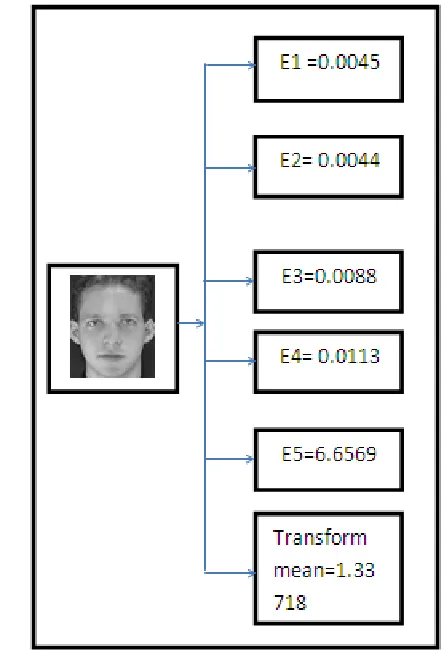
Proposed features is for extraction and selection in same time so this leads to good thing in time , because (extraction and selection) in same time , values of these features in(figure(1)) and these features are:-
E1=
𝒔𝒆𝒍𝒆𝒄𝒕 𝒇𝒊𝒓𝒔𝒕 𝒗𝒂𝒍𝒖𝒆 𝒓𝒐𝒘 | ∑ ∑ 𝑬(𝒆𝟏,𝒆𝟐)|
./∑𝒄𝒐𝒍𝒊=𝟏𝒎𝒆𝒂𝒏 ( 𝒇(𝒊))
(4)
E2=
𝒔𝒆𝒍𝒆𝒄𝒕 𝒍𝒂𝒔𝒕 𝒗𝒂𝒍𝒖𝒆 𝒓𝒐𝒘 | ∑ ∑ 𝑬(𝒆𝟏,𝒆𝟐)| ./
∑𝒓𝒐𝒘𝒎𝒆𝒂𝒏 ( 𝒇(𝒊))
𝒊=𝟏 (5)
E3=
𝒔𝒆𝒍𝒆𝒄𝒕 𝒇𝒊𝒓𝒔𝒕 𝒗𝒂𝒍𝒖𝒆 𝒄𝒐𝒍𝒖𝒎𝒏| ∑ ∑ 𝑬(𝒆𝟏,𝒆𝟐)|
./∑𝒄𝒐𝒍𝒊=𝟏𝒔𝒕𝒅(𝒇 (𝒊))
(6)
E4=
𝒔𝒆𝒍𝒆𝒄𝒕 𝒍𝒂𝒔𝒕 𝒗𝒂𝒍𝒖𝒆 𝒄𝒐𝒍𝒖𝒎𝒏|∑ ∑ 𝑬(𝒆𝟏,𝒆𝟐)|
./∑𝒓𝒐𝒘𝒔𝒕𝒅(𝒇(𝒊))
𝒊=𝟏 (7)
E5=select as
https://edupediapublications.org/journals/index.php/IJR/ online:
Available
60 |
P a g e
Five_feature_algorithm
X=size(𝑬𝒕𝒓𝒂𝒏𝒔𝒇𝒐𝒓𝒎(𝒆𝟏,𝒆𝟐)) 𝑜𝑓 𝑟𝑜𝑤
If X%2==0
E6=𝑬𝒕𝒓𝒂𝒏𝒔𝒇𝒐𝒓𝒎(𝒆𝟏,𝒆𝟐)(𝑥 2,
𝑥 2)
E7=𝑬𝒕𝒓𝒂𝒏𝒔𝒇𝒐𝒓𝒎(𝒆𝟏,𝒆𝟐)(𝑥 2+ 1,
𝑥 2+ 1) E8=𝑬𝒕𝒓𝒂𝒏𝒔𝒇𝒐𝒓𝒎(𝒆𝟏,𝒆𝟐)(𝑥
2, 𝑥 2+ 1) E9=𝑬𝒕𝒓𝒂𝒏𝒔𝒇𝒐𝒓𝒎(𝒆𝟏,𝒆𝟐)(𝑥
2+ 1, 𝑥 2)
E5=((E6+E7+E8+E9))./( ∑𝒓𝒐𝒘𝒊=𝟏 ∑𝒄𝒐𝒍𝒋=𝟏𝒔𝒕𝒅(𝒇(𝒊, 𝒋)
Else
E5=((X./2)+0.5)./( ∑𝒓𝒐𝒘𝒊=𝟏 ∑𝒄𝒐𝒍𝒋=𝟏𝒔𝒕𝒅(𝒇(𝒊, 𝒋)
Endif
Transform_mean=(E1+E2+E3+E4+ E5)./5 % mean of features from
new transform as single value. (8)
Figure (1):-values of features to new transform.
Proposed system
I apply new transform(2D) for image and then take the five features for result from transformation and then find mean for these features to become one value for each
image, for face
https://edupediapublications.org/journals/index.php/IJR/ online:
Available
61 |
P a g e
Algorithm of proposed system
Step1:-Read images database in one loop .
Step2:-Convert (step1)to grayscale and then to double.
Step3:-Apply new transform in (1).
Step4:-Extract
features(E1,E2,E3,E4,E5).
Step5:-Find mean to(step4)and then end loop .
Step6:According to databases (there are persons and poses), to save result according to database , take (re_shape of (step5)), put in form(10,40) and
then take (10,40)' to become (40*10) according to persons and poses .
Step7:-Read image to be test it convert (step1)to grayscale and then to double.
Step8:- Apply new transform in (1).
Step9:-Extract
features(E1,E2,E3,E4,E5) ,and take mean .
Step10:-Apply Manhattan distance between (step6 and step9).
https://edupediapublications.org/journals/index.php/IJR/ online:
Available
62 |
P a g e
End of algorithm.
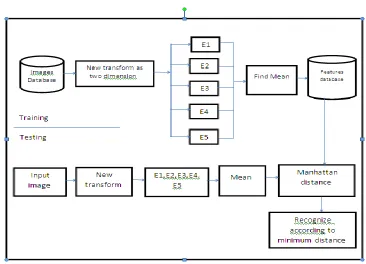
Figure (2):-Training and Testing The analysis of new system
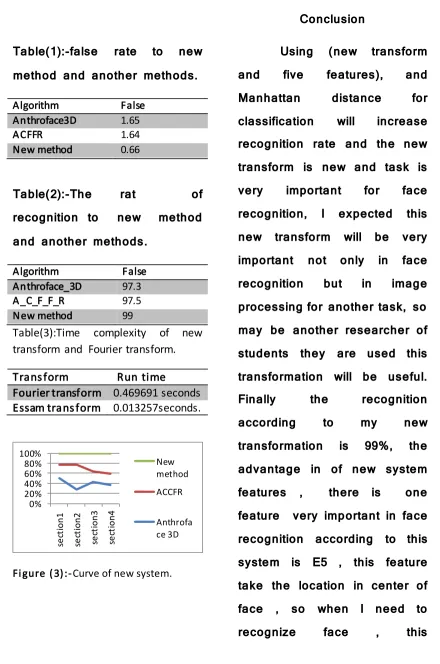
This new system when I compare with another system the error rate less than the others ,face recognition rate greater than others, in (table1) show error rate of another methods and proposed system ,in (table2) show recognition rate also between my system and previous methods , to see all the content of proposed
methods and new system (see figure(2)).
𝑝𝑒𝑟𝑓𝑜𝑟𝑚𝑎𝑛𝑐𝑒
=𝑛𝑢𝑚𝑏𝑒𝑟 𝑜𝑓 𝑓𝑎𝑙𝑠𝑒 𝑖𝑚𝑎𝑔𝑒 𝑡𝑜𝑡𝑙𝑎 𝑛𝑢𝑚𝑏𝑒𝑟 𝑖𝑚𝑎𝑔𝑒 (9)
https://edupediapublications.org/journals/index.php/IJR/ online:
Available
63 |
P a g e
Table(1):-false rate to new method and another methods.
Algorithm False Anthroface3D 1.65
ACFFR 1.64
New method 0.66
Table(2):-The rat of
recognition to new method and another methods.
Algorithm False Anthroface_3D 97.3 A_C_F_F_R 97.5 New method 99
Table(3):Time complexity of new transform and Fourier transform.
Trans form Run time Fourier transform 0.469691 seconds Essam trans form 0.013257seconds.
Fi gure (3):-Curve of new system.
Conclusion
Using (new transform and five features), and
Manhattan distance for
classification will increase recognition rate and the new transform is new and task is very important for face recognition, I expected this new transform will be very important not only in face recognition but in image processing for another task, so may be another researcher of students they are used this transformation will be useful.
Finally the recognition
according to my new
transformation is 99%, the advantage in of new system features , there is one feature very important in face recognition according to this system is E5 , this feature take the location in center of face , so when I need to
recognize face , this
https://edupediapublications.org/journals/index.php/IJR/ online:
Available
64 |
P a g e
factor(feature) leads to be
difference between each
images and the same for person poses itself, the power of this system is in the E5 new features(E1,E2,E3,E4,E5) are five stars for new transform.
Reference
[1]ECE533 – Image Processing Project, Face Recognition Techniques, Jorge Orts.
[2] Face Recognition-based Lecture Attendance System, Department of Intelligence Science and Technology, Graduate School of Informatics, Kyoto University