Efficient and Faster Method for QueryDependent Local
Landmark Scheme
Singanamala Priyanka
1,R.Samaiah
21
M.Tech Student, Department of CSE, Dr.K.V.Subba Reddy College of Engineering for Women
2
Asso. Professor, Department of CSE, Dr.K.V.Subba Reddy College of Engineering for Women
A BSTRA CT: In early days the size of graph become huge that’s why finding shortest distance between queried node is necessary. A lots of methods have been already established just like Dijkshtra’s algorithm, A* search algorithm invented by different authors to find shortest distance between two queried nodes. All of these existing systems make use of landmark embedding approach, that select a set of graph nodes as landmarks and then find the earliest distances from each landmark to all nodes. The local landmark scheme has been developed by Miao Qiao et al. Which find local landmark reliant on queried node and then distance among these two queried nodes is calculated as sum of their shortest distance to local landmark which is earlier than global one. These systems acquire extra computation time. To get distance estimation correctness and rapid computation method we develop Efficient Structure for Query-Dependent Local Landmark Scheme to extent previously presented robus t method with improved SPT approach.
KEYW ORDS: Local search, Least common ancestor, Local landmark scheme, SPT.
I. INT RODUCT I ON
For efficient and immediate communication the computation of shortest distance becomes very essential. Verity of methods are available to find shortest distance between two queried node in large graph, in the landmark embedding
the nodes of the graph are selected as landmark, such method is used online to find shortest distance between two node in the graph that make use of triangular inequalities. One drawback of previous method such as landmark embedding is to choose landmark in large set of nodes in the network. These methods apply the triangle based distance estimation.
The already established methods present some limitations to beat these limitations new method is established named as query dependent local landmark scheme [1] this method find local landmark near to both query nodes to improve the accuracy of distance estimation.
Local landmark is known as least common ancestor (LCA) of two query nodes in the shortest path tree rooted at
one of the global landmark. The local landmark scheme[1] place a local landmark for a rigorous pair of nodes later on it find the space relating two query nodes as the sum of their shortest dis tances to local landmark which is earlier than the global one using shortest path tree. Local landmark scheme generate two procedure, graph compression and local search to acquire improved performance. Graph compression is used to decrease the embedding index size by compressing graph nodes. Local search carry out limited scope online search to advance distance evaluation correctness. In case of huge graph index become too large to fit in the memory. Due to this reason LLS projected diskbased index on relational database because of its great indexing and query optimization mechanism. This approach can be used to decrease distance estimation errors than the older methods. In this paper, we can develop an improved algorithm for the dynamic SPT update to solve the all of these problems.
II. RE L AT E D W ORK
Goldberg et al. [3] proposed shortest path algorithms that use A* search in combination with a new graphtheoretic
shortest paths and work on any directed graph. Give experimental results showing that the most efficient of our new
algorithms outperforms previous algorithms, in particular A* search with Euclidean bounds, by a wide margin on road net works and on some synthetic problem families. Zhang et al. [5] propose a system to use coordinates-based mechanisms in a peer-to-peer architecture to predict Internet network distance (i.e. round-trip propagation and transmission delay). They study two mechanisms. The first is a previously proposed scheme, called the triangulated heuristic, which is based on relative coordinates that are simply the distances from a host to some special network nodes. They proposed the second mechanism, called Global Network Positioning (GNP), which is based on absolute coordinates computed from modelling the Internet as a geometric space. Since end hosts maintain their own coordinates, these approaches allow end hosts to compute their inter-host distances as soon as they discover each other. Moreover coordinates are very efficient in summarizing inter-host distances, making these approaches very scalable. By performing experiments using measured Internet distance data, we show that both coordinates -based schemes are more accurate than the existing state of the art system IDMaps, and the GNP approach achieves the highest accuracy and robustness among them. Shahabi et al. [6] proposed a very important class of queries in GIS applications is the class of K-Nearest Neighbour queries. Most of the current studies on the K-Nearest Neighbour queries utilize spatial index structures and hence are based on the Euclidean distances between the points. In real world road networks, however, the shortest distance between two points depends on the actual path connecting the points and cannot be computed accurately using one of the Murkowski metrics. Thus, the Euclidean distance may not properly approximate the real distance. This system applies an embedding technique to transform a road network to a high dimensional space in order to utilize computationally simple Murkowski metrics for distance measurement. Subsequently, they extend approach to dynamically transform new points into the embedding space. Finally, they proposed an
neighbours more precisely as compared to the Euclidean distance in the original road network. Kleinberg et al. [8] proposed Triangulation and Embedding Using Small Sets of Beacons, concurrent with recent
theoretical interest in the problem of metric embedding, a growing body of research in the networking community has studied the distance matrix defined by node-to-node latencies in the Internet, resulting in number of recent approaches that approximately embed this distance matrix into low dimensional Euclidean space. There is a fundamental distinction, however, between the theoretical approaches to the embedding problem and this recent Internet-related work: in addition to computational limitations, Internet measurement algorithms operate under the constraint that it is only feasible to measure a linear (or near -linear) number of node pairs, and typically in a highly structured way. Indeed, the most common frame work for Internet measurements of this type is a beacon based approach: one chooses uniformly at random a constant number of nodes in the network, each node measure its distance to all beacons, and one then has access to only these measurements for the remainder of the algorithm. Moreover, beacon-based algorithms are often designed not for embedding but for the more basic problem of triangulation, in which one uses the triangle inequality to infer the distances that have not been measured.
III. IM PLIM ENTA TION DETA ILS A. Problem Statement:
To overcome the limitations of existing methods presented for landmark embedding approach, recently new
method presented which is called as a query-dependent local landmark scheme (LLS), which identifies a local
landmark specific to a pair of query nodes. In these approach first needs to find query-dependent “local landmark”
which is close to both query nodes for more accurate distance estimation. Then, the distance between the two query
computation time, processing speed which are very vital in online social networking or web mining domains are not
focused or considered. The existing method is based on use of SPT algorithm which is having limitations of more time required for processing.
B. Proposed System:
Aim of the proposed system is to locate a local landmark for a exacting pair of nodes later that it find the space
linking two query nodes as the sum of their shortest distances to local landmark which is nearer than the global one
using shortest path tree. Local landmark scheme create two procedure, graph compression and local
search to acquire improved performance. Graph compression is used to reduce the embedding index size by compressing graph nodes. Local search carry out limited scope online search to advance distance assessment correctness. In case of large graph index become too large to fit in the memory. For this reason LLS projected disk-based index on relational database because of its great indexing and query optimization mechanism. This approach can be used to reduce distance estimation errors than the older methods.
C. System Architecture:
Fig 1:System Architecture
D. Mathematical Model:
Local Landmark function using SPT:
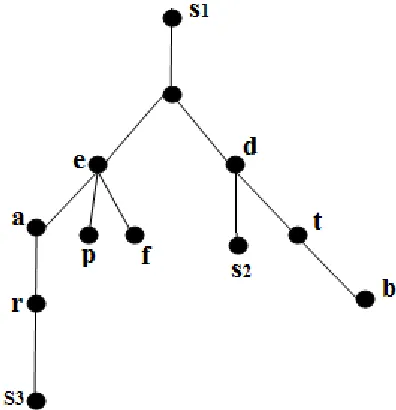
The shortest path tree rooted at node r is tree structured of shortest paths from r to all the other nodes. Shortest path tree rooted at global landmarks facilitate to choose the query-dependent local landmarks connecting two query nodes. A query- dependent local landmark scheme determines local landmarks close to both query nodes to advance distance estimation. Shortest distance is calculated as:
Shortest distance = distance of node S to LCA + distance of node K to LCA.
Where node S and Node K are the queried node and LCA is least common ancestor. Figure 2 shows shortest path tree with root S1.
Fig 2: SPT with root S1
Consider for example z is closer node to both node x and node y then shortest distance is calculated using the function
as,
δ (x, y) = δ (z, x) + δ (z, y).
S = {l1, l2, l3, ….., lk} δ (x, y) = δ(li, x) + δ(li, y)
E. Result Set :
Fig 3: Time Graph
IV. CONCL USI ON AND FUT URE WORK
In this paper, a new efficient algorithm has been planned for dynamically computing a new Shortest Path Tree
(SPT) in a network based. The new algorithm can minimizes the computation time and makes the minimum number of changes to the SPT structure as well. Thus, it can remove the disadvantage caused by static algorithms for SPT
modernize. Compared with all other known dynamic algorithms, the new algorithm can achieves the least running time.
RE FE RE NCE S
1. Miao Qiao, Hong Cheng, Lijun Chang, and Jeffrey Xu Yu, Senior Member, IEEE “Approximate Shortest Distance Computing: A Query-
Dependent Local Landmark Scheme” Published by the IEEE Computer Society, vol. 26, No. 1, JANUARY 2014.
2. E.W. Dijkstra, “A Note on T wo Problems in Connexion with Graphs,” Numerical Mathematic, vol. 1, no. 1, pp. 269-271, 1959.
3. A.V. Goldberg and C. Harrelson, “Computing the Shortest Path: A* Search Meets Graph Theory,” Proc. 16th Ann. ACM-SIAM Symp.
Discrete Algorithms (SODA ’05), pp. 156-165, 2005.
4. A.V. Goldberg, H. Kaplan, and R.F. Werneck, “Reach for A*: Efficient Point-to-Point Shortest Path Algorithms,” Proc. SIAM Workshop
Algorithms Eng. and Experimentation, pp. 129-143, 2006.
5. T .S.E. Ng and H. Zhang, “Predicting Internet Network Distance with Coordinates-Based Approaches,” Proc. IEEE INFOCOM, pp. 170-179,
2002.
6. C. Shahabi, M. Kolahdouzan, and M. Sharifzadeh, “A Road Network Embedding Technique for K-Nearest Neighbour Search in Moving Object
Databases,” Proc. 10th ACM Int’l Symp. Advances in Geographic Information Systems (GIS ’02), pp. 94-100, 2002.