WiNER: A Wikipedia Annotated Corpus for Named Entity Recognition
Abbas Ghaddar RALI-DIRO Universit´e de Montr´eal
Montr´eal, Canada
Philippe Langlais RALI-DIRO Universit´e de Montr´eal
Montr´eal, Canada
Abstract
We revisit the idea of mining Wikipedia in order to generate named-entity anno-tations. We propose a new methodology that we applied to the English Wikipedia to build WiNER, a large, high quality, an-notated corpus. We evaluate its useful-ness on 6 NER tasks, comparing 4 popular state-of-the art approaches. We show that
LSTM-CRFis the approach that benefits the most from our corpus. We report im-pressive gains with this model when using a small portion of WiNER on top of the CONLL training material. Last, we
pro-pose a simple but efficient method for ex-ploiting the full range of WiNER, leading to further improvements.
1 Introduction
Named-Entity Recognition (NER) is the task of identifying textual mentions and classifying them into a predefined set of types. It is an important pre-processing step in NLP and Information Ex-traction. Various approaches have been proposed to tackle the task, including conditional random fields (Finkel et al., 2005), perceptrons (Ratinov and Roth, 2009), and neural network approaches (Collobert et al., 2011; Lample et al., 2016; Chiu and Nichols, 2016).
One issue with NER is the small amount of annotated data available for training, and their limited scope (see Section 4.1). Furthermore, some studies (Onal and Karagoz, 2015; Augen-stein et al., 2017) have demonstrated that named-entity systems trained on news-wire data perform poorly when tested on other text genres. This mo-tivated some researchers to create a named-entity labelled corpus from Wikipedia. This was notably attempted by Nothman et al. (2008) and more
re-cently revisited by Al-Rfou et al. (2015) in a mul-tilingual context. Both studies leverage the link structure of Wikipedia to generate named-entity annotations. Because only a tiny portion of texts in Wikipedia are anchored, some strategies are typ-ically needed to infer more annotations (Ghad-dar and Langlais, 2016b). Such a process typi-cally yields a noisy corpus for which filtering is required.
In this paper, we revisit the idea of auto-matically extracting named-entity annotations out of Wikipedia. Similarly to the aforementioned works, we gather anchored strings in a page as well as their type according to Freebase (Bol-lacker et al., 2008) but, more importantly, we also generate annotations for texts not anchored in Wikipedia. We do this by considering coref-erence mentions of anchored strings as candidate annotations, and by exploiting the out-link struc-ture of Wikipedia. We applied our methodology on a 2013 English Wikipedia dump, leading to a large annotated corpus called WiNER, which con-tains more annotations than similar corpora and, as we shall see, is more useful for training NER systems.
We discuss related work in Section 2 and present the methodology we used to automati-cally extract annotations from Wikipedia in Sec-tion 3. The remainder of the article describes the experiment we conducted to measure the impact of WiNER for training NER systems. We describe the datasets and the different NER systems we trained in Section 4. We report the experiments we conducted in Section 5. We propose a simple but efficient two stage strategy we designed in or-der to benefit the full WiNER corpus in Section 6. We report error analysis in Section 7 and conclude in Section 8.
2 Related Work
Turning Wikipedia into a corpus of named enti-ties annotated with types is a task that received some attention in a monolingual setting (Toral and Munoz, 2006; Nothman et al., 2008), as well as in a multilingual one (Richman and Schone, 2004; Al-Rfou et al., 2015).
In (Nothman et al., 2008) the authors describe an approach that exploits links between articles in Wikipedia in order to detect entity mentions. They describe a pipeline able to detect their types (ORG, PER, LOC, MISC), making use of
hand-crafted rules specific to Wikipedia, and a boot-strapping approach for identifying a subset of Wikipedia articles where the type of the entity can be predicted with confidence. Since anchored strings in Wikipedia lack coverage (in part be-cause Wikipedia rules recommend that only the first mention of a given concept be anchored in a page), the authors also describe heuristics based on redirects to identify more named-entity men-tions. They tested several variants of their corpus on three NER benchmarks and showed that sys-tems trained on Wikipedia data may perform bet-ter than domain-specific systems in an out-domain setting.
Al-Rfou et al. (2015), follow a similar path al-beit in a multilingual setting. They use Freebase to identify categories (PER, LOC, ORG), and trained
a neural network on the annotations extracted. In order to deal with non-anchored mentions in Wikipedia, they propose a first-order coreference resolution algorithm where they link mentions in a text using exact string matching (thus Obama will be linked to the conceptBarack Obama and labelledPER). They still had to perform some
sen-tence selection, based on an oversampling strat-egy, in order to construct a subset of the original training data.
Our work revisits the idea developed in these two studies. Our main contribution consists in dealing specifically with non anchored strings in Wikipedia pages. We do this by analyzing the out-link structure in Wikipedia, coupled to the infor-mation of all the surface forms that have been used in a Wikipedia article to mention the main concept being described by this article. This process, de-tailed in the next section, leads to a much larger set of annotations, whose quality obviates the need for ad-hoc filtering or oversampling strategies.
3 WiNER
We applied the pipeline described hereafter to a dump of English Wikipedia from 2013, and obtained WiNER, a resource built out of 3.2M Wikipedia articles, comprising more than 1.3G to-kens accounting for 54M sentences, 41M of which contain at least one named-entity annotation. We generated a total of 106M annotations (an average of 2 entities per sentence).
3.1 Annotation Pipeline
The pipeline used to extract named-entity annotations from Wikipedia is illustrated in Figure 1, for an excerpt of the Wikipedia article Chilly Gonzales, hereafter named the target article. Similarly to (Nothman et al., 2008; Al-Rfou et al., 2015), the anchored strings of out-links in the target article are elected mentions of named entities. For instance, we identify Warner Bros. Records and Paris as mentions in our target article. In general, a Wikipedia article has an equivalent page in Freebase. We remove mentions that do not have such a page. This way, we filter out anchored strings that are not named entities (such as List of Presidents of the United States). We associate a category with each mention by a simple strategy, similar to (Al-Rfou et al., 2015), which consists in mapping Freebase attributes to entity types. For instance, we map organization/organization,
location/locationandpeople/person
attributes to ORG, LOC and PER, respectively. If
an entry does not belong to any of the previous classes, we tag it asMISC.
Because the number of anchored strings in Wikipedia is rather small — less than 3% of the text tokens according to (Al-Rfou et al., 2015) — we propose to leverage: (1) the out-link struc-ture of Wikipedia, (2) the information of all the surface strings used to describe the main concept of a Wikipedia article. For the latter, we rely on the resource1described in (Ghaddar and Langlais,
2016a) that lists, for all the articles in Wikipedia (those that have a Freebase counterpart), all the text mentions that are coreferring to the main con-cept of an article. For instance, for the article Chilly Gonzales, the resource lists proper names (e.g. Gonzales, Beck), nominal (e.g. the
per-1http://rali.iro.umontreal.ca/rali/en/
[Chilly Gonzales]PER (born [Jason Charles Beck]PER; 20 March 1972) is a [Canadian]MISC musician who resided in [Paris]LOC, [France]LOC for several years, and now lives in [Cologne]LOC, [Germany]LOC. Though best known for his first MC [...], he is a pianist, producer, and songwriter. He was signed to a three-album deal with Warner Music Canada in 1995, a subsidiary of [Warner Bros. Records]ORG . . . While the album’s production values were limited [Warner Bros.]ORG simply . . .
ParisLOC
,→Europe,France, Napoleon, . . .
CologneLOC
,→Germany, Alsace, . . .
Warner Bros. RecordsORG
,→Warner,Warner Bros., . . .
FranceLOC
,→French Republic, Kingdom. . .
OLT
CT
Figure 1: Illustration of the process with which we gather annotations into WiNER for the target page
https://en.wikipedia.org/wiki/Chilly_Gonzales. Bracketed segments are the anno-tations, underlined text are anchored strings in the corresponding Wikipedia page. OLT represents the
out-link table (which is compiled from the Wikipedia out-link graph structure), and CT represents the
coreference table we gathered from the resource.
former) and pronominal (e.g. he) mentions that refer to Chilly Gonzales. From this resource, we consider proper name mentions, along with their Freebase type.
Our strategy for collecting extra annotations is a 3-step process, where:
1. We consider direct out-links of the target arti-cle. We search in its text the titles of the ar-ticles we reach that way. We also search for their coreferences as listed in the aforemen-tioned resource. For instance, we search (exact match) Warner Bros. Recordsand its corefer-ences (e.g. Warner,Warner Bros.) in the target article. Each match is labelled with the type associated (in Freebase) with the out-linked ar-ticle (in our example,ORG).
2. We follow out-links of out-links, and search in the target article (by an exact string match) the titles of the articles reached. For instance, we search for the strings Europe, France, Napoleon, as well as other article titles from the out-link list of the article Paris. The matched strings are elected named entities and are labeled with their Freebase type.
3. For the titles matched at step 2, we also match their coreferent mentions. For instance, be-cause we matched France, we also search its coreferences as listed in the coreference table (CT).
During this process, some collisions may occur. We solve the issue of overlapping annotations by applying the steps exactly in the order presented above. Our steps have been ordered in such a
way that the earlier the step, the more confidence we have in the strings matched at that step. It may also happen that two out-link articles contain the same mention (for instance Washington State andGeorge Washingtonboth contain the mention Washington), in which case we annotate this am-biguous mention with the type of the closest2
un-ambiguous mention.
Step 1 of our pipeline raises the coverage3from
less than 3% to 9.5%, while step 2 and 3 increase it to 11.3% and 15% respectively. This is actually very close to the coverage of the manually anno-tated CONLL-2003 dataset, which is 17%.
Con-sidering that we do not apply any specific filtering, as is done for instance in (Nothman et al., 2008), our corpus contains many more annotations than existing Wikipedia-based named-entity annotated corpora.
3.2 Manual Evaluation
We assessed the annotation quality of a ran-dom subset of 1000 mentions. While we measure an accuracy of 92% for mentions detected during step 1, the accuracy decreases to 88% and 77% during step 2 and 3 respectively. We identified two main sources for errors in the coreferent mentions detection procedure. One source of error comes from the resource used to identify the mentions of the main concept. We measured in a previous work (Ghaddar and Langlais, 2016a), that the pro-cess we rely on for this (a binary classifier) has an accuracy of 89%. Example (a) of Figure 2
trates such a mistake where the family namePope is wrongly assumed coreferent to the brewery El-dridge Pope. We also found that our 3-step pro-cess and the disambiguation rule fails in 15% of the cases. Figure 2 illustrates an example where we erroneously recognize the mentionToronto (re-ferring to the town) as a coreferent of the (non am-biguous mention)Toronto FC, simply because the latter is close to the former.
a) [Eldridge Pope]ORG was a traditional brew-ery...Sixteen years later the [Pope]ORG? brothers floated the business...
b) Montreal Impact’s biggest rival is[Toronto FC]ORG because Canada’s two largest cities have rivalries in and out of sport. Mon-treal and[Toronto]ORG? professional soccer teams have competed against each other for over 40 years.
c) I didn’t want to open up my[Rolodex]ORG? and get everyone to sing for me.
Figure 2: Examples of errors in our annotation pipeline. Faulty annotations are marked with a star.
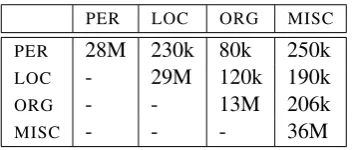
Table 1 shows the counts of token strings anno-tated with at least two types. For instance, there are 230k entities that are annotated in WiNER as
PERandLOC. It is reassuring that different
men-tions with the same string are labelled differently. The cells on the diagonal indicate the number of mentions labelled with a given tag.
PER LOC ORG MISC
PER 28M 230k 80k 250k LOC - 29M 120k 190k
ORG - - 13M 206k
[image:4.595.94.271.531.606.2]MISC - - - 36M
Table 1: Number of times a text string (mention) is labelled with (at least) two types in WiNER. The cells on the diagonal indicate the number of anno-tations.
We further examined a random subset of 100 strings that were annotated differently (in different contexts) and found that 89% of the time, the cor-rect type was identified. For instance, in example Figure 2c) — a sentence of the Chilly Gonzales article — the mentionRolodexis labelled asORG,
while the correct type isMISC. Our pipeline fails
to disambiguate the company from its product.
4 Protocol
4.1 Data Sets
We used a number of datasets in our experiments. For CONLL, MUCand ONTO, that are often used
to benchmark NER, we used the test sets dis-tributed in official splits. For the other test sets, that are typically smaller, we used the full dataset as a test material.
CONLL the CONLL-2003 NER Shared Task
dataset (Tjong Kim Sang and De Meulder, 2003) is a well known collection of Reuters newswire articles that contains a large portion of sports news. It is annotated with four entity types (PER, LOC,ORGandMISC).
MUC the MUC-6 (Chinchor and Sundheim,
2003) dataset consists of newswire articles from the Wall Street Journal annotated with PER, LOC, ORG, as well as a number of temporal
and numerical entities that we excluded from our evaluation for the sake of homogeneity.
ONTO the OntoNotes 5.0 dataset (Pradhan et al.,
2012) includes texts from five different text genres: broadcast conversation (200k), broad-cast news (200k), magazine (120k), newswire (625k), and web data (300k). This dataset is an-notated with 18 fine grained NE categories. Fol-lowing (Nothman, 2008), we applied the proce-dure for mapping annotations to the CONLLtag
set. We used the CONLL 2012 (Pradhan et al.,
2013) standard test set for evaluation.
WGOLD WikiGold (Balasuriya et al., 2009) is a
set of Wikipedia articles (40k tokens) manually annotated with CONLL-2003 NE classes. The
articles were randomly selected from a 2008 En-glish dump and cover a number of topics.
WEB Ratinov and Roth (2009) annotated 20 web
pages (8k tokens) on different topics with the CONLL-2003 tag set.
TWEET Ritter et al. (2011) annotated 2400 tweets
(comprising 34k tokens) with 10 named-entity classes, which we mapped to the CONLL-2003
4.2 Metrics
Since we use many test sets in this work, we are confronted with a number of inconsistencies. One is the definition of the MISC class, which
differs from a dataset to another, in addition to not being annotated in MUC. This led us to
re-port token-level F1 score for 3 classes only (LOC, ORG andPER). We computed this metric with the conllevalscript.4
We further report ODF1, a score that measures
how well a named-entity recognizer performs on out-domain material. We compute it by randomly sampling 500 sentences5for each out-domain test
set, on which we measure the token-level F1. Sampling the same number of sentences per test set allows to weight each corpus equally. This pro-cess is repeated 10 times, and we report the aver-age over those 10 folds. On averaver-age, the newly as-sembled test set contains 50k tokens and roughly 3.5k entity mentions. We excluded the CONLL
-2003 test set from the computation since this cor-pus is in-domain6(see section 5.2).
4.3 Reference systems
We chose two feature-based models: the
StanfordNER (Finkel et al., 2005) CRF clas-sifier, and the perceptron-based Illinois NE Tagger (Ratinov and Roth, 2009). Those systems have been shown to yield good performance over-all. Both systems use handcrafted features; the lat-ter includes gazetteer features as well.
We also deployed two neural network systems: the one of (Collobert et al., 2011), as implemented by Attardi (2015), and theLSTM-CRFsystem of Lample et al. (2016). Both systems capitalize on representations learnt from large quantities of un-labeled text7. We use the default configuration for
each system.
5 Evaluation of WiNER
5.1 Other Wikipedia-based corpora
We compare WiNER to existing Wikipedia-based annotated corpora. Nothman et al. (2008) re-leased two versions of their corpus, WP2 and WP3, each containing 3.5 million tokens. Both
4http://www.cnts.ua.ac.be/conll2000/
chunking/conlleval.txt
5The smallest test set has 617 sentences.
6Figures including this test set do not change drastically
from what we observe hereafter.
7We use the pre-trained representations.
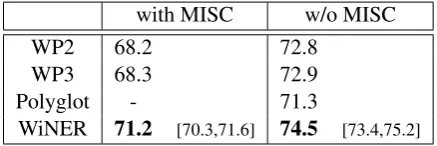
versions enrich the annotations deduced from an-chored strings in Wikipedia by identifying coref-erences among NE mentions. They differ by the rules used to conduct coreference resolution. We randomly generated 10 equally-sized subsets of WiNER (of 3.5 million tokens each). On each subset, we trained the Illinois NER tagger and compared the performances obtained on the CONLLtest set by the resulting models, compared
to those trained on WP2 and WP3. Phrase-level F1 score are reported in Table 2. We also report the results published in (Al-Rfou et al., 2015) with the Polyglot corpus, which is unfortunately not avail-able.
with MISC w/o MISC
WP2 68.2 72.8
WP3 68.3 72.9
Polyglot - 71.3
[image:5.595.307.526.260.333.2]WiNER 71.2 [70.3,71.6] 74.5 [73.4,75.2]
Table 2: Performance of the Illinois toolkit on CONLL, as a function of the Wikipedia-based
training material used. The figures on the last line are averaged over the 10 subsets of WiNER we randomly sampled. Bracketed figures indicate the minimum and maximum values.
Using WiNER as a source of annotations sys-tematically leads to better performance, which val-idates the approach we described in Section 3. Note that in order to generate WP2 and WP3, the authors applied filtering rules that are responsible for the loss of 60% of the annotations. Al-Rfou et al. (2015) also perform sentence selection. We have no such heuristics here, but we still observe a competitive performance. This is a satisfactory result considering that WiNER is much larger.
5.2 Cross-domain evaluation
In this experiment, we conduct a cross-domain evaluation of the reference systems described in Section 4.3 on the six different test sets presented in Section 4.1. Following a common trend in the field, we evaluate the performance of those sys-tems when they are trained on the CONLL
mate-rial. We also consider systems trained on CONLL
CONLL ONTO MUC TWEET WEB WGOLD ODF1 CRF
CONLL 91.6 70.2 80.3 38.7 61.9 68.4 67.0
+WiNER(3M) - - -
-+WiNER(1M) 89.3 (-2.4) 71.8 (+1.7) 78.6 (-1.8) 49.2 (+10.5) 63.0 (+1.1) 69.1 (+0.8) 69.2(+2.2)
Illinois
CONLL 92.6 71.9 84.1 44.9 57.0 71.4 68.3
+WiNER(3M) 85.5 (-6.9) 71.4 (-0.5) 76.2 (-7.9) 51.1 (+6.2) 65.5 (+8.5) 71.8 (+0.4) 69.5(+1.2) +WiNER(30M) 82.0 (-10.6) 71.6 (-0.3) 75.6 (-8.5) 52.2 (+7.3) 63.3 (+6.3) 71.6 (+0.3) 69.0(+0.7)
Senna
CONLL 90.3 68.8 73.2 36.7 58.6 70.0 64.3
+WiNER(3M) 86.6 (-3.7) 70.1 (+1.3) 73.9 (+0.7) 43.2 (+6.4) 62.6 (+4.0) 69.9 (-0.1) 67.0(+2.7) +WiNER(7M) 86.8 (-3.5) 70.0 (+1.2) 72.9 (-0.4) 44.8 (+8.1) 61.5 (+2.9) 69.3 (-0.7) 66.2(+1.9)
LSTM-CRF
CONLL 92.3 71.3 76.6 36.7 57.4 68.0 65.0
[image:6.595.73.526.60.266.2]+WiNER(3M) 91.5 (-0.8) 74.7 (+3.4) 84.7 (+8.1) 48.1 (+11.4) 62.7 (+5.2) 73.2 (+5.2) 72.0 (+7.0) +WiNER(5M) 91.1 (-1.2) 76.6 (+5.3) 84.0 (+7.4) 48.4 (+11.7) 64.4 (+7.0) 74.3 (+6.4) 73.0 (+8.0)
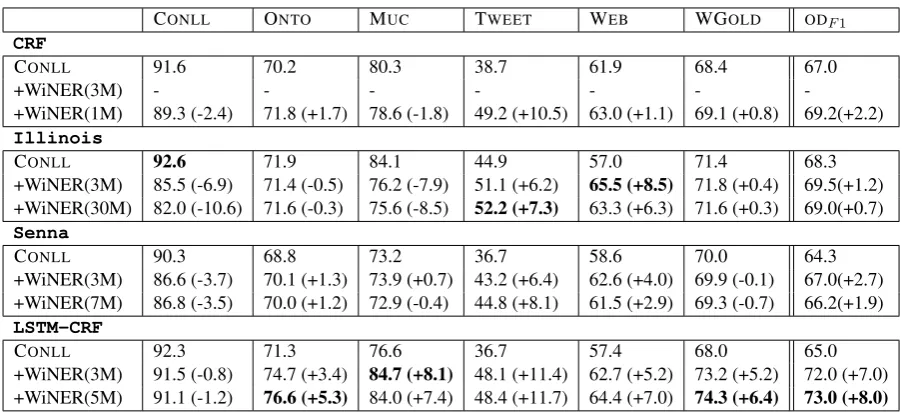
Table 3: Cross-domain evaluation of NER systems trained on different mixes of CONLL and WiNER.
Figures are token-level F1 score on 3 classes, while figures in parentheses indicate absolute gains over the configuration using only the CONLLtraining material. Bold figures highlight column-wise best results.
were created by randomly appending material to smaller ones. Datasets were chosen once (no cross-validation, as that would have required too much time for some models). Moreover, for the comparison to be meaningful, each model was trained on the same 3M dataset. The results are reported in Table 3.
First, we observe the best overall performance with the LSTM-CRF system (73%ODF1), the
sec-ond best system being a variant of theIllinois
system (69.5% ODF1). We also observe that the
former system is the one that benefits the most from WiNER (an absolute gain of 8% in ODF1).
This may be attributed to the fact that this model can explore the context on both sides of a word with (at least in theory) no limit on the context size considered. Still, it is outperformed by the
Illinoissystem on the WEBand the TWEET
test sets. Arguably, those two test sets have a NE distribution which differs greatly from the training material.
Second, on the CONLL setting, our results are
satisfyingly similar to those reported in (Ratinov and Roth, 2009) and (Lample et al., 2016). The former reports 91.06 phrasal-level F1 score on 4 classes, while our score is 90.8 .The latter re-ports an F1 score of 90.94 while we have 90.76. The best results reported far on the CONLL
set-ting are those of (Chiu and Nichols, 2016) with a BiLSTM-CNN model, and a phrasal-level F1 score of 91.62 on 4 classes. So while the models
we tested are slightly behind on CONLL, they
def-initely are competitive. For other tasks, the com-parison with other studies is difficult since the per-formance is typically reported with the full tagset. Third, the best performances are obtained by configurations that use WiNER, with the excep-tion of CONLL. That this does not carry over to
CONLL confirms the observations made by
sev-eral authors (Finkel et al., 2005; Al-Rfou et al., 2015), who highlight the specificity of CONLL’s
annotation guidelines as well as the very nature of the annotated text, where sport teams are overrep-resented. These teams add to the confusion be-cause they are often referred to with a city name. We observe that, on CONLL, the LSTM-CRF
model is the one that registers the lowest drop in performance. The drop is also modest for the CRF model. The WiNER’s impact is particularly observable on TWEET (an absolute gain of 8.8
points) and WEB(a gain of 5.5), again two very
different test sets. This suggests that WiNER helps models to generalize.
Last, we observe that systems differ in their ability to exploit large training sets. For the two feature-based models we tested, the bottle-neck is memory. We did train models with less features, but with a significantly lower perfor-mance. With the CRF model, we could only di-gest a subset of WiNER of 1 million tokens, while
is-sue is training time. On the computer we used for this work — a Linux cluster equipped with a GPU — trainingSennaandLSTM-CRFrequired over a month each for 7 and 5 millions WiNER tokens respectively. This prevents us from measuring the benefit of the complete WiNER resource.
6 Scaling up to WiNER
6.1 Our 2-stage approach
Because we were not able to employ the full WiNER corpus with the NER systems mentioned above, we resorted to a simple method to leverage all the annotations available in the corpus. It con-sists in decoupling the segmentation of NEs in a sentence — we leave this to a reference NER sys-tem — from their labelling, for which we train a local classifier based on contextual features com-puted from WiNER. Decoupling the two decision processes is not exactly satisfying, but allows us to scale very efficiently to the full size of WiNER, our main motivation here.
6.1.1 Contextual representations
Our classifier exploits a small number of features computed from two representations of WiNER. In one of them, each named-entity is bounded by a beginning and end token tags — both encoding its type — as illustrated on lineMIXof Figure 3. In
the second representation, the words of the named-entity are replaced with its type, as illustrated on lineCONT. The former representation encodes
in-formation from both the context and the the words of the segment we wish to label while the second one only encodes the context of a segment.
WiNER [Gonzales]PER will be featured on [Daft Punk]MISC.
MIX hB-PERiGonzaleshL-PERi will be featured
onhB-MISCiDaft PunkhL-MISCi
CONT hPERiwill be featured onhMISCi.
Figure 3: Two representations of WiNER’s anno-tation used for feature extraction.
With each representation, we train a 6-gram backoff language model using kenLM (Heafield et al., 2013). For theMIXone, we also train word
embeddings of dimension 50 usingGlove (Pen-nington et al., 2014).8 Thus, we have the
embed-8We used a window size of 5 in this work.
dings of plain words, as well as those of token tags. The language and embedding models are used to provide features to our classifier.
6.1.2 Features
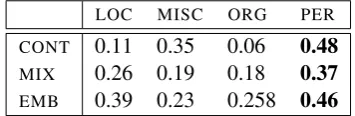
Given a sentence and its hypothesized segmenta-tion into named-entities (as provided by another NER system), we compute with the Viterbi al-gorithm the sequence of token tags that leads to the smallest perplexity according to each language model. Given this sequence, we modify the tag-ging of each segment in turn, leading to a total of 4 perplexity values per segment and per language model. We normalize those perplexity values so as to interpret them as probabilities. Table 4 shows the probability given by both language models to the segmentGonzalesof the sentence of our run-ning example. We observe that both models agree that the segment should be labelledPER. We also
generate features thanks to the embedding model. This time, however, this is done without consid-ering the context: we represent a segment as the sum of the representation of its words. We then compute the cosine similarity between this seg-ment representation and that of each of the 4 pos-sible tag pairs (the sum of the representation of the begin and end tags); leading to 4 similarity scores per segment. Those similarities are reported on lineEMBin Table 4.
LOC MISC ORG PER
[image:7.595.327.505.462.520.2]CONT 0.11 0.35 0.06 0.48 MIX 0.26 0.19 0.18 0.37 EMB 0.39 0.23 0.258 0.46
Table 4: Features for the segmentGonzalesin the sentenceGonzales will be featured on Daft Punk.
To these 4 scores provided by each model, we add 16 binary features that encode the rank of each token tag according to one model (doeshtagihave rankhii?). We also compute the score difference given by a model to any two possible tag pairs, leading to 6 more scores. Since we have 3 models, we end up with 78 features.
6.1.3 Training
We usescikit-learn(Pedregosa et al., 2011) to train a Random Forest classifier9 on the
29k mentions of the CONLL training data. We
9We tried other algorithms provided by the platform with
adopted this training material to ensure a fair comparison with other systems that are typically trained on this dataset. Another possibility would be to split WiNER into two parts, one for com-puting features, and the other for training the clas-sifier. We leave this investigation as future work. Because of the small feature set we have, training such a classifier is very fast.
6.2 Results
We measure the usefulness of the complete WiNER resource by varying the size of the train-ing material of both language models and word embeddings, from 5M tokens (the maximum size the LSTM-CRF mode could process) to the full WiNER resource size.
CO ON MU TW WE WG ODF1
5M 84.3 72.0 78.7 39.8 61.9 70.2 68.1 50M 86.8 75.6 82.3 44.9 64.7 73.8 71.7 500M 88.9 76.2 84.8 45.8 66.6 75.5 74.1 All 90.5 76.9 85.9 46.6 65.3 77.0 74.7
Table 5: Influence of the portion of WiNER used in our 2-stage approach for the CONLL
test set, using the segmentation produced by
LSTM-CRF+WiNER(5M). These results have to be contrasted with the last line of Table 3.
To this end, we provide the performance of our 2-stage approach on CONLL, using the
seg-mentation output byLSTM-CRF+WiNER(5M)10.
Results are reported in Table 5. As expected, we observe that computing features on the same WiNER(5M) dataset exploited by LSTM-CRF
leads to a notable loss overall (ODF1 of 68.1
ver-sus 73.0), while still outperforming LSTM-CRF
trained on CONLL only (ODF1 of 65.0). More
interestingly, we observe that for all test sets, using more of WiNER leads to better perfor-mance, even if a plateau effect emerges. Our approach does improve systematically across all test sets by considering 100 times more WiNER data than what LSTM-CRF can handle in our case. Using all of WiNER leads to anODF1 score
of 74.7, an increase of 1.7 absolute points over
LSTM-CRF+WiNER(5M).
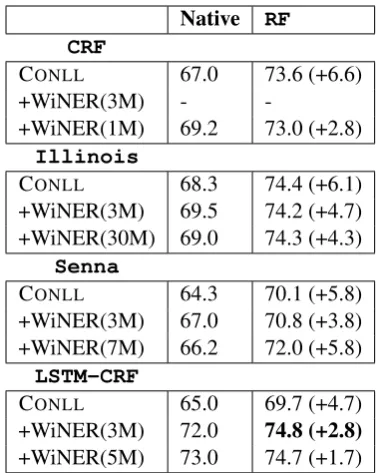
Table 6 reports the improvements in ODF1 of
our 2-stage approach (RF), which uses all of
10The best configuration according to Table 3.
Native RF
CRF
CONLL 67.0 73.6 (+6.6)
+WiNER(3M) -
-+WiNER(1M) 69.2 73.0 (+2.8)
Illinois
CONLL 68.3 74.4 (+6.1)
+WiNER(3M) 69.5 74.2 (+4.7) +WiNER(30M) 69.0 74.3 (+4.3)
Senna
CONLL 64.3 70.1 (+5.8)
+WiNER(3M) 67.0 70.8 (+3.8) +WiNER(7M) 66.2 72.0 (+5.8)
LSTM-CRF
CONLL 65.0 69.7 (+4.7)
+WiNER(3M) 72.0 74.8 (+2.8)
[image:8.595.321.510.60.297.2]+WiNER(5M) 73.0 74.7 (+1.7)
Table 6: ODF1 score of native configurations, and
of our two-stage approach (RF) which exploits the full WiNER corpus. Figures in parenthesis indi-cate absolute gains over the native configuration.
the WiNER material and the segmentation pro-duced by several native systems. Applying our 2-stage approach systematically improves the per-formance of the native configuration. Gains are larger for native configurations that cannot exploit a large quantity of WiNER. We also observe that the 2-stage approach delivers roughly the same level of performance (ODF1'74) when using the
segmentation produced by theIllinoisor the
LSTM-CRFsystems.
7 Error Analysis
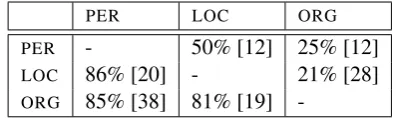
Table 7 indicates the number of disagreements between the LSTM-CRF+WiNER(5M) system (columns) and the 2-stage approach (rows). The table also shows the percentage of times the lat-ter system was correct. For instance, the bottom left cell indicates that, on 38 distinct occasions, the classifier changed the tagPERproposed by the
na-tive system toORGand that is was right in 85% of
these occasions. We exclude errors made by both systems, which explains the low counts observed (1.7% is the absolute difference between the two approaches).
PER LOC ORG PER - 50% [12] 25% [12] LOC 86% [20] - 21% [28] ORG 85% [38] 81% [19]
-Table 7: Percentage of correctness of the 2-stage system (rows) when tagging a named-entity differently than the LSTM-CRF+WiNER(5M) (columns). Bracketed figures indicate the aver-age number of differences over the out-domain test sets.
85% respectively). Most often, re-classified enti-ties are ambiguous ones. Our approach chooses correctly mostly by examining the context of the mention. For instance, the entityOlinin example (a) of Figure 4 is commonly known as a last name. It was correctly re-classified as ORGthanks to its
surrounding context. Replacing its by his in the sentence makes the classifier tag the entity asPER.
Similarly, the entityPiedmontin example (b) was re-classified asORG, although it is mostly used as
the region name (even in Wikipedia), thanks to the context-basedCONTandMIXfeatures that identify
the entity asORG(0.61 and 0.63 respectively).
(a) . . . would give [Olin]PER→ORGaccess to its pro-duction processes . . .
(b) Wall Street traders said [Piedmont]LOC→ORG shares fell partly . . .
(c) ?. . . performed as a tenor at New York City ’s [Carnegie Hall]ORG→LOC.
Figure 4: Example of entities re-classified by our 2-stage approach.
Misclassification errors do occur, especially when the native system tagged an entity as ORG.
In such cases, the classifier is often misled by a strong signal emerging from one family of fea-tures. For instance, in example (c) of Figure 4, bothMIX —p(ORG) = 0.39vs. p(LOC) = 0.33
— and EMB — p(ORG) = 0.39 vs. p(LOC) =
0.38 — features are suggesting that the entity should be tagged asLOC, but the CONTsignal —
p(LOC) = 0.63 vs. p(ORG) = 0.1 — strongly
impacts the final decision. This was to be ex-pected considering the simplicity of our classifier, and leaves room for further improvements.
8 Conclusion and Future Work
We revisited the task of using Wikipedia for generating annotated data suitable for training NER systems. We significantly extended the number of annotations of non anchored strings, thanks to coreference information and an analysis of the Wikipedia’s link structure. We applied our approach to a dump of English Wikipedia from 2013, leading to WiNER, a corpus which surpasses other similar corpora, both in terms of quantity and of annotation quality. We evaluated the impact of our corpus on 4 reference NER systems with 6 different NER benchmarks. The LTSM-CRF system of (Lample et al., 2016) seems to be the one that benefits the most from WiNER overall. Still, shortage of memory or lengthy training times prevent us from measur-ing the full potential of our corpus. Thus, we proposed an entity-type classifier that exploits a set of features computed over an arbitrary large part of WiNER. Using this classifier for labelling the types of segments identified by a reference NER system yields a 2-stage pro-cess that further improves overall performance. WiNER and the classifier we trained are available at http://rali.iro.umontreal.ca/ rali/en/winer-wikipedia-for-ner. As future work, we want to study the usefulness of WiNER on a fine-grained entity type task, pos-sibly revisiting the simple classifier we resorted to in this work, and testing its benefits for other currently successful models.
Acknowledgments
This work has been partly funded by the TRIBE Natural Sciences and Engineering Research Coun-cil of Canada CREATE program and Nuance Foundation. We are grateful to the reviewers for their helpful comments.
References
Rami Al-Rfou, Vivek Kulkarni, Bryan Perozzi, and Steven Skiena. 2015. Polyglot-NER: Massive mul-tilingual named entity recognition. In Proceed-ings of the 2015 SIAM International Conference on Data Mining, Vancouver, British Columbia, Canada. SIAM.
[image:9.595.81.280.62.121.2]Isabelle Augenstein, Leon Derczynski, and Kalina Bontcheva. 2017. Generalisation in named entity recognition: A quantitative analysis. Computer Speech & Language, 44:61–83.
Dominic Balasuriya, Nicky Ringland, Joel Nothman, Tara Murphy, and James R Curran. 2009. Named Entity Recognition in Wikipedia. In Proceed-ings of the 2009 Workshop on The People’s Web Meets NLP: Collaboratively Constructed Semantic Resources, pages 10–18. Association for Computa-tional Linguistics.
Kurt Bollacker, Colin Evans, Praveen Paritosh, Tim Sturge, and Jamie Taylor. 2008. Freebase: A Col-laboratively Created Graph Database for Structur-ing Human Knowledge. InProceedings of the 2008 ACM SIGMOD International Conference on Man-agement of Data, SIGMOD ’08, pages 1247–1250. Nancy Chinchor and Beth Sundheim. 2003. Message
understanding conference (MUC) 6.LDC2003T13. Jason PC Chiu and Eric Nichols. 2016. Named en-tity recognition with bidirectional LSTM-CNNs. In
Proceedings of the 54st Annual Meeting of the Asso-ciation for Computational Linguistics.
Ronan Collobert, Jason Weston, L´eon Bottou, Michael Karlen, Koray Kavukcuoglu, and Pavel Kuksa. 2011. Natural language processing (almost) from scratch. Journal of Machine Learning Research, 12(Aug):2493–2537.
Jenny Rose Finkel, Trond Grenager, and Christopher Manning. 2005. Incorporating Non-local Informa-tion into InformaInforma-tion ExtracInforma-tion Systems by Gibbs Sampling. InProceedings of the 43rd Annual Meet-ing on Association for Computational LMeet-inguistics, pages 363–370. Association for Computational Lin-guistics.
Abbas Ghaddar and Philippe Langlais. 2016a. Coref-erence in Wikipedia: Main Concept Resolution. In
CoNLL, pages 229–238.
Abbas Ghaddar and Philippe Langlais. 2016b. Wiki-Coref: An English Coreference-annotated Corpus of Wikipedia Articles. InProceedings of the Tenth In-ternational Conference on Language Resources and Evaluation (LREC 2016), Portoroˇz, Slovenia. Kenneth Heafield, Ivan Pouzyrevsky, Jonathan H.
Clark, and Philipp Koehn. 2013. Scalable Modified Kneser-Ney Language Model Estimation. In Pro-ceedings of the 51st Annual Meeting of the Associa-tion for ComputaAssocia-tional Linguistics, pages 690–696, Sofia, Bulgaria.
Guillaume Lample, Miguel Ballesteros, Sandeep Sub-ramanian, Kazuya Kawakami, and Chris Dyer. 2016. Neural architectures for Named Entity Recognition.
arXiv preprint arXiv:1603.01360.
Joel Nothman. 2008. Learning named entity recogni-tion from Wikipedia. Ph.D. thesis, The University of Sydney Australia 7.
Joel Nothman, James R Curran, and Tara Murphy. 2008. Transforming Wikipedia into named entity training data. InProceedings of the Australian Lan-guage Technology Workshop, pages 124–132. Kezban Dilek Onal and Pinar Karagoz. 2015. Named
entity recognition from scratch on social media. In
ECML-PKDD, MUSE Workshop.
F. Pedregosa, G. Varoquaux, A. Gramfort, V. Michel, B. Thirion, O. Grisel, M. Blondel, P. Pretten-hofer, R. Weiss, V. Dubourg, J. Vanderplas, A. Pas-sos, D. Cournapeau, M. Brucher, M. Perrot, and E. Duchesnay. 2011. Scikit-learn: Machine learning in Python. Journal of Machine Learning Research, 12:2825–2830.
Jeffrey Pennington, Richard Socher, and Christopher D Manning. 2014. Glove: Global Vectors for Word Representation. In EMNLP, volume 14, pages 1532–1543.
Sameer Pradhan, Alessandro Moschitti, Nianwen Xue, Hwee Tou Ng, Anders Bj¨orkelund, Olga Uryupina, Yuchen Zhang, and Zhi Zhong. 2013. Towards Robust Linguistic Analysis using OntoNotes. In
CoNLL, pages 143–152.
Sameer Pradhan, Alessandro Moschitti, Nianwen Xue, Olga Uryupina, and Yuchen Zhang. 2012. CoNLL-2012 shared task: Modeling multilingual unre-stricted coreference in OntoNotes. InJoint Confer-ence on EMNLP and CoNLL-Shared Task, pages 1– 40.
Lev Ratinov and Dan Roth. 2009. Design challenges and misconceptions in named entity recognition. In
Proceedings of the Thirteenth Conference on Com-putational Natural Language Learning, pages 147– 155. Association for Computational Linguistics. Alexander E. Richman and Patrick Schone. 2004.
Min-ing Wiki Resources for MultilMin-ingual Named Entity Recognition In proceedings. InProceedings of the 46th Annual Meeting of the Association for Compu-tational Linguistics, pages 1–9.
Alan Ritter, Sam Clark, Mausam, and Oren Etzioni. 2011. Named Entity Recognition in Tweets: An Ex-perimental Study. InEMNLP.
Erik F Tjong Kim Sang and Fien De Meulder. 2003. Introduction to the CoNLL-2003 shared task: Language-independent named entity recognition. In
Proceedings of the seventh conference on Natural language learning at HLT-NAACL 2003-Volume 4, pages 142–147. Association for Computational Lin-guistics.