Efficiency-aware Answering of Compositional Questions
using Answer Type Prediction
David Ziegler, Abdalghani Abujabal, Rishiraj Saha Roy and Gerhard Weikum Max Planck Institute for Informatics
Saarland Informatics Campus, Germany
{daziegler, abujabal, rishiraj, weikum}@mpi-inf.mpg.de
Abstract
This paper investigates the problem of an-swering compositional factoid questions over knowledge bases (KB) under effi-ciency constraints. The method, called TIPI, (i) decomposes compositional ques-tions, (ii) predicts answer types for indi-vidual sub-questions, (iii) reasons over the compatibility of joint types, and finally, (iv) formulates compositional SPARQL queries respecting type constraints. TIPI’s answer type predictor is trained using distant supervision, and exploits lexical, syntactic and embedding-based features to compute context- and hierarchy-aware candidate answer types for an input ques-tion. Experiments on a recent benchmark show that TIPI results in state-of-the-art performance under the real-world assump-tion that only a single SPARQL query can be executed over the KB, and substantial reduction in the number of queries in the more general case.
1 Introduction
Motivation. Question answering over knowledge bases (KB-QA) has gained attention, facilitated by the rise of large-scale knowledge bases such as Freebase (Bollacker et al.,2007), DBPedia (Auer
et al., 2007) and YAGO (Suchanek et al., 2007).
The key challenge for KB-QA is to align mentions and relational phrases in a natural language ques-tion to semantic items in the KB (entities and pred-icates), and to construct a valid SPARQL query that is then executed over the KB to retrieve crisp answers (Abujabal et al., 2017;Bast and Hauss-mann,2015;Yahya et al.,2013;Yih et al.,2015).
Questions going beyond simple factoid ques-tions (like“Who won a Nobel Prize in Physics?”)
that are prevalent in popular KB-QA benchmarks are generally out of scope for most state-of-the-art KB-QA systems (Yih et al.,2015;Dong et al.,
2015;Berant and Liang, 2015). However,
ques-tions like“Who won a Nobel Prize in Physics and
was born in Bavaria?”, can be decomposed into a
set of simpler questions“Who won a Nobel Prize
in Physics?” and“Who was born in Bavaria?”.
We refer to such questions ascompositional ques-tions, and these are the focus of this work.
Limitations of state-of-the-art.A few past ap-proaches that can handle such compositional ques-tions (Bao et al., 2016; Xu et al., 2016;
Abuja-bal et al., 2017) generate and execute candidate
SPARQL queries for each sub-question separately and/or use the intersection as the final answer
(Werner Heisenberg, among others). This
cre-ates the challenge of deciding which queries from the different sub-questions fit together. Past ef-forts use information about answers to all gener-ated SPARQL queries, and retrospectively choose a query pair from among these whose answer in-tersection is non-empty. However, this mode of operation is highly inefficient, since it necessitates execution of all generated queries, followed by a ranking or aggregation phase. We aim to address this concern, leveraging the compatibility of ex-pected answer types. Such compatibility, as we show, has the potential to prune the search space of candidate SPARQL queries.
Approach. Given a complex question, our pro-posed method TIPI first decomposes it into simple sub-questions. Next, it predicts a ranked list of fine-grained answer types for each sub-question, respecting a type hierarchy. TIPI then seeks can-didate SPARQL queries corresponding to these sub-questions as input from an underlying KB-QA model, and finds pairs of compatible queries from among these using hierarchy-based reason-ing. Finally, it scores these pairs and finds the best
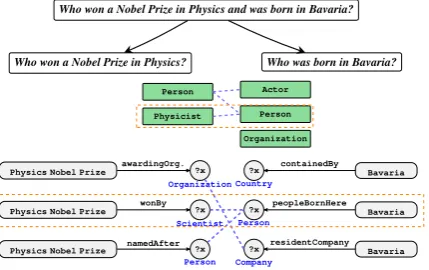
Who won a Nobel Prize in Physics and was born in Bavaria?
Who won a Nobel Prize in Physics? Who was born in Bavaria?
Person Physicist
Actor Person Organization
Physics Nobel Prize awardingOrg. ?x
Physics Nobel Prize wonBy ?x
Physics Nobel Prize namedAfter ?x
?x containedBy Bavaria
Figure 1: A toy example showing how TIPI works. Top: Decompose question. Middle: Determine compatible types among answer types of the two sub-questions. Bottom: Stitch compatible queries together and prune queries by answer type. This is followed by scoring and ranking of the query pairs to formulate the best compositional query.
pair to formulate a compositional query, to be ex-ecuted over the KB. The final two steps contribute towards TIPI’s efficiency-aware perspective.
Contributions. The paper makes the following three contributions:
• We are the first to exploit answer types for han-dling compositional questions in KB-QA;
• Experiments show state-of-the-art perfor-mance under practical efficiency constraints;
• Finally, TIPI contains a hierarchy- and context-aware fine-grained answer typing module that can be used as a plug-in by any KB-QA system.
2 Answering Compositional Questions We now explain the steps by which TIPI handles the answering of a compositional question, taking the running example of“Who won a Nobel Prize
in Physics and was born in Bavaria?”. A
simpli-fied workflow is shown in Figure1.
Question decomposition. Given a composi-tional question, TIPI first decomposes it into sim-ple sub-questions “Who won a Nobel Prize in
Physics?” and“Who was born in Bavaria?”,
us-ing dependency parse patterns (Xu et al., 2016;
Bao et al.,2014). These patterns can handle
sev-eral kinds of compositional questions with mul-tiple entities or relations (e.g., questions with relative clauses and coordinating conjunctions). Question decomposition has also been applied to the IBM Watson system (Boguraev et al., 2014),
where the authors separated cases as being either
parallelornested. This work deals with parallel decomposition, and handling nesting like“which daughter of john f. kennedy studied at radcliffe college?”is future work.
Answer Type prediction. Next, we predict a set ofexpected answer typesfor each sub-question using an answer type predictor, described in the next section. The typing module is a context-aware hierarchical classifier that takes a question as input and produces a set of answer types along with confidence scores as output (like Person:
0.8,Actor: 0.3,Scientist: 0.6; scores need not add up to one).
Type compatibility scoring. We define two types to be compatible whenever they are the same, or one is an ancestor of the other, according to some type system. For example,Scientist and Person are compatible, as the former is a descendant of the latter. Now, let T1 and T2 be
a pair of predicted types for the first and second sub-questions, respectively. We score each such pair with a linear combination ofgranularity and
confidenceas follows:
score(T1, T2) =γ·max(level(T1), level(T2)) + (1−γ)·avg(conf(T1), conf(T2))
if T1 and T2 are compatible, else zero. Here,
level(Ti)andconf(Ti)refer to the level ofTi in
the type system, and the classifier prediction con-fidence for Ti, respectively. We take the root to
be at level zero, with finer types having higher levels. Thus, pairs with fine-grained types (like Physicist), and with high prediction confi-dences, accumulate higher scores. Mixing param-eter γ is chosen to be 0.5. We take the highest scoring type pair, and then take the finer of the two types as the final prediction (Physicist in this example). The intuition here is that one sub-question might reveal more typing informa-tion (“Who won a Nobel Prize in Physics?”gives Physicist) than the other (“Who was born in
Bavaria?”only givesPerson).
pred-[.*]* [which|what] [lemma:be]? [det]? [adj|adv]* [noun]+ [.*]*
(E.g.: What is the current currency in Germany?)
[.*]* [which|what] [lemma:be]? [det]? [adj|adv]* [noun] [of] [det]? [adj|adv]* [noun]+ [.*]*(E.g.: What kind of currency does Germany have?)
[.*]* [which|what] [lemma:be] [det]? [noun]+ [poss] [adj|adv]* [noun]+ [.*]* (E.g.: What is Germany’s currency?)
Table 1: Patterns to extract lexical answer types (underlined). Symbols are borrowed from stan-dard regular expression conventions.
icate. We use our final predicted type to re-move all queries from either sub-question whose type signatures are not compatible to it. Thus, queries likePhysicsNobelPrize wonBy x? and
Bavaria peopleBornHere x?, with compatible
type signatures Physicist and Person are retained, while Bavaria containedBy x? and
PhysicsNobelPrize awardingOrg x? with
sig-natures Country and Organization are re-moved. All surviving query pairs are combined, and are then scored by the sum of the inverses of the ranks they had from the underlying KB-QA model. The pair that maximizes this rank inversion score is finally chosen for execution by the system: PhysicsNobelPrize wonBy x? . Bavaria peopleBornHere x?for our example.
3 Predicting Answer Types
Our strategy for answer type prediction is to har-ness explicit clues available in the question, and to resort to more implicit ones only when such signals are not present. We thus use a two-stage approach, inspired by work on named en-tity typing (Del Corro et al., 2015; Yosef et al.,
2012)1: (1) candidate collection, using
lexico-syntactic patterns to identify lexical types which can be mapped to a set of semantic types using lex-icons; (2) type selection, using a hierarchical clas-sifier to disambiguate among the candidates.Note that in absence of explicit clues for candidates in the question, our method proceeds directly to the second stage.
Candidate Collection. To extract the lexical answer type from a question, we use simple POS patterns (examples in Table1), utilizing Stanford CoreNLP for tokenization and POS-tagging (
Man-ning et al., 2014). In a second step, the
lexi-cal type extracted from the question is mapped
1While the task in named entity typing is somewhat simi-lar to answer typing, the crucial difference is that in the latter the entity (answer) itself is missing.
to a set of semantic types (KB-types) using lexi-cons (Berant et al.,2013). Such lexicons can be constructed by mining entity-annotated relational phrases in CLUEWEB09 (Lin et al., 2012). For example, the lexical type‘physicist’ may map to the semantic typesScientist,Theoretical physicistandQuantum physicist.
Type Selection. From the candidate collection phase, we receive a set of candidate types, for each of which we run a binary classifier to get a confi-dence score. If no lexical answer type could be found in the question (like “Where did Einstein study?”) or there were no lexicon entries, the clas-sifier makes predictions on all types from our type system. The hierarchical classifier works as fol-lows: starting at the root of the type system we predict probabilities for its children that are candi-dates, using per-type binary classifiers. Iteratively, this process is repeated for sub-trees whose root has a confidence score above a global thresholdα. Training. We start with a dataset where each question is labeled with a set of expected answer types. We use thesiblings strategy(Silla and Fre-itas,2011) to train a classifier for each type: we use all questions labeled with T as positive in-stances for a typeT; we useonlythose questions as negative instances that are labeled with some sibling of T according to the type system. We use four sets offeatures: (i)Surface features: n -grams of length up to three from the question; (ii)
Dependency parse features: n-grams constructed
by hops over relations in the dependency tree to capture long-range dependencies; (iii) Word2vec
features: Per question, we add ten words most
similar to the question words (except for stop-words and entities) using a pre-trained model of word2vec (Mikolov et al.,2013); and (iv) Ques-tion length:The number of tokens in the question. To reduce data sparsity, we replace all question en-tities by a wildcard for pattern generalization, be-fore computing the features.
4 Experiments
4.1 Setup
Dataset. We use the very recent dataset of
150compositional questions2created byAbujabal
et al. (2017) which were sampled from the 2013
WikiAnswers resource (Fader et al.,2013). Every question in this dataset was constrained to have more than one named entity or relational phrase (e.g.,“Who directed Braveheart and Paparazzi?”
and“Who directed Braveheart and played in Mad
Max?”). We use Freebase as the underlying KB.
Baselines. We use the following baselines: the open-source AQQU system (Bast and Hauss-mann,2015) (best performing public KB-QA sys-tem on the popular WebQuestions benchmark (
Be-rant et al., 2013)), and reimplemented versions
of the answer stitching mechanism (ANSSTITCH)
inAbujabal et al.(2017), and the query stitching
mechanism (QUERYSTITCH) inBao et al.(2016). As mentioned in Section 2, TIPI acts as a plug-in for KB-QA systems, and hence needs an un-derlying model to generate queries. To this end, we build and evaluate AQQU+TIPI and QUERY S-TITCH+TIPI. If question decomposition fails, or if TIPI prunes away all queries with a non-empty answer set, we back off to the original model.
Abujabal et al.(2017) use an alternative approach
of stitching answers for sub-questions instead of queries, and hence it is not meaningful to have a comparable ANSSTITCH+TIPI system.
Training the type predictor. We use the1000
most frequent types from Freebase as our type sys-tem. Since there is no dataset directly containing questions and answer types, we resort to distant
supervision as follows: for each gold answer to
a question in WebQuestions (WQ) (Berant et al.,
2013) and SimpleQuestions (SQ) (Bordes et al.,
2015), we look up itsnotable typesfrom Freebase. This is often a large set, agnostic to the context of the specific question at hand: e.g. Germany, the answer to “What is Albert Einstein’s nation-ality?”, has 53 notable types, including context-irrelevant ones like Filming Location and Treaty Signatory. We prune this set in two ways: (1) keep only those types that are in our type system, and (2) retrieveexpected typesof Freebase predicates corresponding to relations in the ques-tion (e.g. hasNationality has the expected object typeCountry) and only retain types com-patible to these. This is possible via gold SPARQL queries available in WQ and SQ. We then train the hierarchical classifier on a total of 10k questions (3kfrom WQ,6.4kfrom SQ, and 0.6kFreebase type descriptions). Thresholdα was tuned to0.6
on a development set of2kquestions (0.8k from WQ and1.2kfrom SQ) by optimizing on F1.
Feature Sets Prec (Auto) Prec (Human)
Surface 71.9 65.6
Surface + DP 72.2 65.9
Surface + DP + w2v 73.2 67.1
Surface + DP + w2v + QLen 73.9 67.3
Table 2: Intrinsic evaluation of type prediction, showing effects of feature ablation.
4.2 Results
Intrinsic evaluation of type predictor. We eval-uate our type predictor intrinsically in two ways: (i) automatic evaluation, treating the labels gen-erated by distant supervision as gold labels, and (ii) human evaluation. Three human annotators marked, for each prediction, whether it is cor-rect and context-aware: e.g. for “Who
devel-oped the theory of relativity?”, they would mark
Scientist and Person as correct but not NobelPrizeWinner orTeacher. Note that in the automatic evaluation, the context-oblivious types might be deemed as correct. Table2shows the results of automatic evaluation in the left col-umn and human evaluation in the right colcol-umn. The predictions are of high precision, even under human evaluation which only considers context-aware predictions as correct. Mean Cohen’s
κ (Cohen, 1960) is 0.743, showing good
inter-annotator agreement. Feature ablation shows that each of the four feature sets is useful.
Answering performance. Since each question potentially has a set of correct answers, we com-pute precision, recall and F-score for each ques-tion, and then average it over all 150questions. We evaluate two setups: (i) when only the top-ranking compositional query is executed, and (ii) when the rank-based query scoring component is disabled and all surviving compositional queries (combinations of type-compatible queries) are ex-ecuted. Results are presented in Table3, where we make the following key observations:
TIPI results in state-of-the-art performance.
In the case of best query execution, we find that TIPI’s preferential scoring system for fine-grained types proves highly effective: QUERY S-TITCH+TIPI achieves the highest F1 on the dataset (0.367). It also has the best overall recall (0.469), and is in the top-2 for precision. Thus, TIPI helps attain the best performance under the practi-cal constraint of executing only a single query and eliminating the overhead of answer aggregation.
Approach Only best query executed over KB All queries executed over KB
Metric Precision Recall F1-Score #Queries Precision Recall F1-Score
ANSSTITCH(Abujabal et al.,2017) 0.345 0.409 0.344 97.4 0.495 0.556 0.485
AQQU(Bast and Haussmann,2015) 0.245 0.466 0.253 54.5 0.245 0.466 0.253 AQQU+TIPI 0.209 0.515 0.231 35.7 0.209 0.515 0.231
QUERYSTITCH(Bao et al.,2016) 0.358 0.428 0.360 57.5 0.459 0.544 0.456
QUERYSTITCH+TIPI 0.356 0.469 0.367 36.0 0.439 0.566 0.445
Table 3: Answering performance on150compositional questions from Abujabal et al. (2017). The two best (minimumfor #Queries,maximumfor all other columns) values in every column are marked inbold.
comparable performance. In the unconstrained
scenario, by reasoning over type compatibility, TIPI substantially reduces the number of queries that the KB-QA system executes (35.7from54.5
(AQQU), and 36.0 from 57.5 (QUERYSTITCH)). This is achieved while maintaining comparable F1 performance. Moreover, note that the best per-forming method with TIPI (QUERYSTITCH+TIPI) improves efficiency by a factor of2.71on the over-all best performing ANSSTITCH (97.4 queries to 36.0). The generally lower values corresponding to the AQQUrows is because AQQUwas originally designed for single-relation KB-QA.
Analysis. Question decomposition failures are the primary cause of error. TIPI’s success hinges on the triggering of question decomposition rules adapted from Xu et al. (2016); it is worthwhile to note that results were even more encouraging when the 43 questions for which the rules did not fire were excluded from the analysis. Re-sults averaged over the remaining 107 questions show that QUERYSTITCH+TIPI performs the best on all three metrics (F1= 0.372, Prec = 0.365, Rec = 0.402) under best-query execution. In the all-queries case, QUERYSTITCH+TIPI reduces the number of queries by an even greater factor of 3.13 (w.r.t. ANSSTITCH) with only a 0.02 drop in F1. This error analysis suggests that bet-ter question decomposition, going beyond simple syntactic rules, will improve overall performance. Finally, representative questions that could only be answered when TIPI was used as plug-in, are shown in Table4.
5 Related Work
Answer typinghas proved effective both for
text-based QA (Ravichandran and Hovy, 2002) and KB-QA (Bast and Haussmann, 2015; Savenkov
and Agichtein,2016), for example, in ranking of
answers (Murdock et al.,2012) or queries (Yavuz
“who is the president of the us who played in bedtime for bonzo?”
“who played for ac milan and inter milan?”
“what movie did russell crowe and denzel washington work on together?”
“which country were the adidas and puma footwear founded?”
Table 4: Questions that could be answered only when TIPI was used as a plug-in.
et al.,2016). Answer typing was mostly limited to
considering coarse-grained types (Bast and Hauss-mann,2015;Lally et al.,2012) and lexical answer types (Berant and Liang, 2015; Abujabal et al.,
2017). Both such modes fail when the answer type is not explicit. More recently, Yavuz et al.
(2016) exploit more implicit type cues for KB-QA: but their method of creating training data is context-agnostic, which we remedy in our work. An early line of work deals withquestion classifi-cation(Li and Roth,2002;Blunsom et al.,2006;
Huang et al.,2008), but they were designed for a
handful of TREC types and is not really relevant for KB-QA with thousands of distinct classes. Fi-nally, this work is the first to harness answer types for compositional KB-QA.
6 Conclusion
References
Abdalghani Abujabal, Mohamed Yahya, Mirek Riede-wald, and Gerhard Weikum. 2017. Automated tem-plate generation for question answering over
knowl-edge graphs. InWWW.
S¨oren Auer, Christian Bizer, Georgi Kobilarov, Jens Lehmann, Richard Cyganiak, and Zachary Ives. 2007. Dbpedia: A nucleus for a web of open data.
The Semantic Web.
Junwei Bao, Nan Duan, Zhao Yan, Ming Zhou, and Tiejun Zhao. 2016. Constraint-based question
an-swering with knowledge graph. InCOLING.
Junwei Bao, Nan Duan, Ming Zhou, and Tiejun Zhao. 2014. Knowledge-based question answering as ma-chine translation. InACL.
Hannah Bast and Elmar Haussmann. 2015. More ac-curate question answering on freebase. InCIKM. Jonathan Berant, Andrew Chou, Roy Frostig, and Percy
Liang. 2013. Semantic parsing on Freebase from
question-answer pairs. InEMNLP.
Jonathan Berant and Percy Liang. 2015. Imitation learning of agenda-based semantic parsers. TACL. Phil Blunsom, Krystle Kocik, and James R. Curran.
2006. Question classification with log-linear mod-els. InSIGIR.
Branimir Boguraev, Siddharth Patwardhan, Aditya Kalyanpur, Jennifer Chu-Carroll, and Adam Lally. 2014. Parallel and nested decomposition for factoid
questions. Natural Language Engineering, 20(4).
Kurt Bollacker, Patrick Tufts, Tomi Pierce, and Robert Cook. 2007. A platform for scalable, collaborative,
structured information integration. In Intl.
Work-shop on Information Integration on the Web. Antoine Bordes, Nicolas Usunier, Sumit Chopra, and
Jason Weston. 2015. Large-scale simple question
answering with memory networks. InarXiv.
Jacob Cohen. 1960. A coefficient of agreement for
nominal scales. Educational and psychological
measurement, 20(1).
Luciano Del Corro, Abdalghani Abujabal, Rainer Gemulla, and Gerhard Weikum. 2015. FINET: Context-aware fine-grained named entity typing. In
EMNLP.
Li Dong, Furu Wei, Ming Zhou, and Ke Xu. 2015. Question answering over freebase with
multi-column convolutional neural networks. InACL.
Anthony Fader, Luke Zettlemoyer, and Oren Etzioni. 2013. Paraphrase-driven learning for open question answering. InACL.
Zhiheng Huang, Marcus Thint, and Zengchang Qin. 2008. Question classification using head words and
their hypernyms. InEMNLP.
Adam Lally, John M Prager, Michael C McCord, Bran-imir K Boguraev, Siddharth Patwardhan, James Fan, Paul Fodor, and Jennifer Chu-Carroll. 2012.
Ques-tion analysis: How Watson reads a clue. IBM
Jour-nal of Research and Development.
Xin Li and Dan Roth. 2002. Learning question classi-fiers. InCOLING.
Thomas Lin, Mausam, and Oren Etzioni. 2012. Entity
linking at web scale. In Joint Workshop on
Auto-matic Knowledge Base Construction and Web-scale Knowledge Extraction.
Christopher D. Manning, Mihai Surdeanu, John Bauer, Jenny Finkel, Steven J. Bethard, and David Mc-Closky. 2014. The Stanford CoreNLP natural lan-guage processing toolkit. InACL.
Tomas Mikolov, Kai Chen, Greg Corrado, and Jeffrey Dean. 2013. Efficient estimation of word represen-tations in vector space. InarXiv.
J. William Murdock, Aditya Kalyanpur, Chris Welty, James Fan, David A Ferrucci, DC Gondek, Lei Zhang, and Hiroshi Kanayama. 2012. Typing
can-didate answers using type coercion. IBM Journal of
Research and Development.
Deepak Ravichandran and Eduard Hovy. 2002. Learn-ing surface text patterns for a question answerLearn-ing system. InACL.
Denis Savenkov and Eugene Agichtein. 2016. When a Knowledge Base Is Not Enough: Question Answer-ing over Knowledge Bases with External Text Data. InSIGIR.
Carlos Nascimento Silla and Alex Alves Freitas. 2011. A survey of hierarchical classification across
differ-ent application domains. Data Mining and
Knowl-edge Discovery.
Fabian M Suchanek, Gjergji Kasneci, and Gerhard Weikum. 2007. YAGO: A core of semantic
knowl-edge. InWWW.
Kun Xu, Siva Reddy, Yansong Feng, Songfang Huang, and Dongyan Zhao. 2016. Question answering on freebase via relation extraction and textual evidence. InACL.
Mohamed Yahya, Klaus Berberich, Shady Elbassuoni, and Gerhard Weikum. 2013. Robust question an-swering over the Web of linked data. InCIKM. Semih Yavuz, Izzeddin Gur, Yu Su, Mudhakar Srivatsa,
and Xifeng Yan. 2016. Improving semantic parsing
via answer type inference. InEMNLP.
Wen-tau Yih, Ming-Wei Chang, Xiaodong He, and Jianfeng Gao. 2015. Semantic parsing via staged query graph generation: Question answering with
knowledge base. InACL.