Character-based Joint Segmentation and POS Tagging for Chinese
using Bidirectional RNN-CRF
Yan Shao and Christian Hardmeier and J¨org Tiedemann∗ and Joakim Nivre Department of Linguistics and Philology, Uppsala University
∗Department of Modern Languages, University of Helsinki
{yan.shao, christian.hardmeier, joakim.nivre}@lingfil.uu.se
Abstract
We present a character-based model for joint segmentation and POS tagging for Chinese. The bidirectional RNN-CRF ar-chitecture for general sequence tagging is adapted and applied with novel vec-tor representations of Chinese characters that capture rich contextual information and sub-character level features. The proposed model is extensively evaluated and compared with a state-of-the-art tag-ger respectively on CTB5, CTB9 and UD Chinese. The experimental results indi-cate that our model is accurate and robust across datasets in different sizes, genres and annotation schemes. We obtain state-of-the-art performance on CTB5, achiev-ing 94.38 F1-score for joint segmentation and POS tagging.
1 Introduction
Word segmentation and part-of-speech (POS) tag-ging are core steps for higher-level natural lan-guage processing (NLP) tasks. Given the raw text, segmentation is applied at the very first step and POS tagging is performed on top afterwards. As by convention the words in Chinese are not de-limited by spaces, segmentation is non-trivial, but its accuracy has a significant impact on POS tag-ging. Moreover, POS tags provide useful informa-tion for word segmentainforma-tion. Thus, modelling word segmentation and POS tagging jointly can out-perform the pipeline models (Ng and Low,2004; Zhang and Clark,2008).
POS tagging is a typical sequence tagging prob-lem over segmented words, while segmentation also can be modelled as a character-level tagging problem via predicting the labels that identify the word boundaries. Ng and Low (2004) propose a
joint model which predicts the combinatory la-bels of segmentation boundaries and POS tags at the character level. Joint segmentation and POS tagging becomes a standard character-based se-quence tagging problem and therefore the general machine learning algorithms for structured predic-tion can be applied.
The bidirectional recurrent neural network (RNN) using conditional random fields (CRF) (Lafferty et al., 2001) as the output interface for sentence-level optimisation (BiRNN-CRF) achieves state-of-the-art accuracies on various sequence tagging tasks (Huang et al., 2015; Ma and Hovy, 2016) and outperforms the tradi-tional linear statistical models. RNNs with gated recurrent cells, such as long-short term memory (LSTM) (Hochreiter and Schmidhuber,1997) and gated recurrent units (GRU) (Cho et al., 2014) are capable of capturing long dependencies and retrieving rich global information. The sequential CRF on top of the recurrent layers ensures that the optimal sequence of tags over the entire sentence is obtained.
In this paper, we model joint segmentation and POS tagging as a fully character-based se-quence tagging problem via predicting the com-binatory labels. The BiRNN-CRF architecture is adapted and applied. The Chinese characters are fed into the neural networks as vector representa-tions. In addition to utilising the pre-trained char-acter embeddings, we propose a concatenated n-gram-representation of the characters. Further-more, sub-character level information, namely radicals and orthographical features extracted by convolutional neural networks (CNNs), are also incorporated and tested. Three datasets of dif-ferent sizes, genres and with difdif-ferent annotation schemes are employed for evaluation. Our model is thoroughly evaluated and compared with the joint segmentation and POS tagging model in ZPar
(Zhang and Clark,2010), which is a state-of-the-art joint tagger using structured perceptron and beam decoding. According to the experimental re-sults, our proposed model outperforms ZPar on all the datasets in terms of accuracy.
The main contributions of this work include: 1. We apply the BiRNN-CRF model for general sequence tagging to joint segmentation and POS tagging for Chinese and achieve state-of-the-art accuracy. The experimental results show that our tagger is robust and accurate across datasets of dif-ferent sizes, genres and annotation schemes. 2. We propose a novel approach for vector representa-tions of characters that leads to substantial im-provements over the baseline model. 3. Additional improvements are obtained via exploring the fea-sibility of utilising sub-character level informa-tion. 4. We provide an open-source implementa-tion of our method along with pre-trained charac-ter embeddings.1
2 Model
2.1 Neural Network Architecture
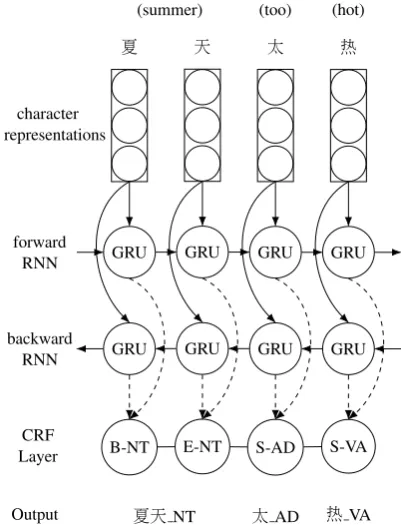
Our baseline model is an adaptation of BiRNN-CRF. As illustrated in Figure1, the Chinese char-acters are represented as vectors and fed into the bidirectional recurrent layers. The character rep-resentations will be described in detail in the fol-lowing sections. For the recurrent layer, we em-ploy GRU as the basic recurrent unit as it has similar functionalities but fewer parameters com-pared to LSTM (Chung et al., 2014). Dropout (Srivastava et al.,2014) is applied to the outputs of the bidirectional recurrent layers. The outputs are concatenated and passed to the first-order chain CRF layer. The optimal sequence of the combi-natory labels is predicted at the end. There is a post processing step to retrieve both segmentation and POS tags from the combinatory tags.
2.2 Tagging Scheme
Following the work of Kruengkrai et al. (2009a), the employed tags indicating the word boundaries are B,I,E, Srepresenting a character at the be-ginning, inside, end of a word or as a single-character word. The CRF layer models condi-tional scores over all possible combinatory labels given the input characters. Incorporating the tran-sition scores between the successive labels, the
op-1https://github.com/yanshao9798/tagger
夏 天 太 热
(too) (hot) (summer)
character representations
GRU GRU GRU GRU forward
RNN
GRU GRU GRU GRU backward
RNN
B-NT E-NT S-AD S-VA CRF
Layer
太AD 热VA
夏天NT
[image:2.595.317.518.64.327.2]Output
Figure 1: The BiRNN-CRF model for joint Chi-nese segmentation and POS tagging. The dashed arrows indicate that dropout layers are applied to the outputs of the recurrent layers.
timal sequence can be obtained efficiently via the Viterbi algorithm both for training and decoding.
The time complexity for the Viterbi algorithm is linear with respect to the sentence length n as O(k2n), wherekis constant and equals to the total
number of combinatory labels. The efficiency can be improved if we reduce k. For some POS tags, combining them with the full boundary tags is re-dundant. For instance, only the functional word
的 can be tagged as DEG in Chinese Treebank
(Xue et al., 2005). Since it is a single-character word, combinatory tags of B-DEG, I-DEG, and
E-DEG never occur in the experimental data and should therefore be pruned to reduce the search space. Similarly, if the maximum length of words under a given POS tag is two in the training data, we prune the corresponding label.
2.3 Character Representations
We propose three different approaches to effec-tively represent Chinese characters as vectors for the neural network.
2.3.1 Concatenated N-gram
夏 天 太 热
(too) (hot) (summer)
Vi,i Vi−1,i Vi−1,i+1 n-gram
character Representation
[image:3.595.308.493.61.149.2]V3
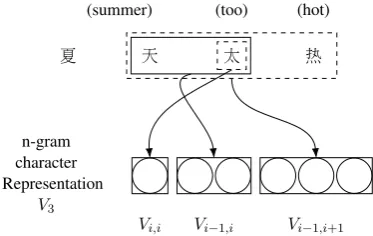
Figure 2: Vector representations of the Chinese characters as incrementally concatenated n-gram vectors in a given context.
n-grams, can be represented by the sequence of characters that they consist of. For example, the vector representation Vm,n of a span cm,n is
ob-tained by passing the vector representations vi of
the characterscito a functionsf as:
Vm,n =f(vm, vm+1, ..., vn) (1)
wherefis usually an RNN (Ling et al.,2015) or a CNN (dos Santos and Zadrozny,2014).
In this paper, instead of completely relying on the BiRNN to extract contextual features from context-free character representations, we encode rich local information in the character vectors via employing the incrementally concatenated n-gram representation as demonstrated in Figure 2. In the example, the vector representation of the pivot character太in the given context is the
concatena-tion of the context-free vector representaconcatena-tion Vi,i
of太 itself along withVi−1,iof the bigram 天太
as well asVi−1,i+1of the trigram天太热.
Instead of constructing the vector representation
Vm,n of an n-gramcm,n from the character
repre-sentations as in Equation 1, Vm,n in different
or-ders, such as Vi,i, Vi−1,i, and Vi−1,i+1, are
ran-domly initialised separately. We use a single spe-cial vector to represent all the unknown n-grams per order. The n-grams in different orders are then concatenated incrementally to form up the vector representations of a Chinese character in the given context, which is passed further to the recurrent layers. As shown in Figure 2, the neighbouring characters on both sides of the pivot character are taken into account.
2.3.2 Radicals and Orthographical Features
Chinese characters are logograms. As opposed to alphabetical languages, there is rich information
太
Conv.
layers poolingMax . . .
fully-connected
layer
Figure 3: Convolutional Neural Networks for or-thographical feature extraction. Only the first convolutional layer and its following max-pooling layer are presented.
encrypted in the graphical components. For in-stance, the Chinese characters that share the same part钅 (gold) are all somewhat related to metals,
such as 银 (silver), 铁 (iron), 针 (needle) and so
on. The shared part 钅 is known as the radical,
which functions as a semantic indicator. Hence, we investigate the effectiveness of using the infor-mation below the character level for our task.
Radicals are first represented as randomly ini-tialised vectors and concatenated as parts of the character representations. Radicals are tradition-ally used as indices in Chinese dictionaries. In our approach, they are retrieved via the unicode representation of Chinese characters as the char-acters that share the same radical are grouped to-gether. They are organised in consistent with the categorisation in Kangxi Dictionary (康熙字典), in which all the Chinese characters are grouped under 214 different radicals. We only employ the radicals of the common characters in the unicode range of (U+4E00, U+9FFF). For the characters out of the range and the non-Chinese characters, we use a single special vector as their radical rep-resentations.
[image:3.595.76.263.64.182.2]2.3.3 Pre-trained Character Embeddings
The context-free vector representations of single characters introduced in section 2.3.1 can be placed by ptrained character embeddings re-trieved from large corpora. We employ GloVe (Pennington et al.,2014) to train our character em-beddings on Wikipedia2 and the freely available Sogou News Corpora (SogouCS).3 We use ran-domly initialised vectors as the representations of the characters that are not in the embedding vo-cabulary. Pre-trained embeddings for higher-order n-grams are not employed in this paper.
2.4 Ensemble Decoding
At the final decoding phase, we use ensemble de-coding, a simple averaging technique, to mitigate the deviations led by random weight initialisation of the neural network. For the chain CRF decoder, the final sequence of the combinatory tags y is obtained via the conditional scores S(yi|xi) and
the transition scores T(yi, yj)given the input
se-quence x. Instead of computing the optimal se-quence with respect to the scores returned by a single model, both the conditional scores and tran-sition scores are averaged over four models with identical parameter settings that are trained inde-pendently:
y∗ = argmax
y∈L(x) p(y|x; ¯{S}, ¯
{T}) (2)
Ensemble decoding is only applied to the best performing model according to the feature experi-ments at the final testing phase in this paper.
3 Implementation
Our neural networks are implemented using the TensorFlow 1.2.0 library (Abadi et al.,2016). We group the sentences with similar lengths into the same buckets and the sentences in the same bucket are padded to the same length accordingly. We construct sub-computational graphs respectively for each bucket. The training and tagging speed of our neural network on GPU devices can be dras-tically improved thanks to the bucket model. The training time is proportional to both the size of the training set and the number of POS tags.
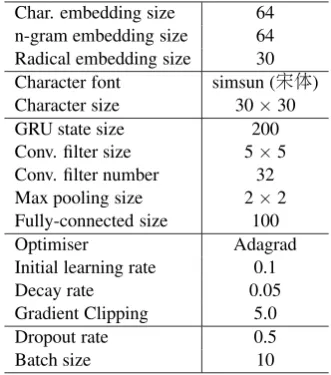
Table 1 shows the adopted hyper-parameters. We use one set of parameters for all the experi-ments on different datasets. The weights of the
2https://dumps.wikimedia.org/
3http://www.sogou.com/labs/resource/cs.php
Char. embedding size 64 n-gram embedding size 64 Radical embedding size 30 Character font simsun (宋体) Character size 30×30
GRU state size 200
Conv. filter size 5×5 Conv. filter number 32 Max pooling size 2×2 Fully-connected size 100
Optimiser Adagrad
Initial learning rate 0.1
Decay rate 0.05
Gradient Clipping 5.0
Dropout rate 0.5
[image:4.595.333.499.62.250.2]Batch size 10
Table 1: Hyper-parameters.
neural networks, including the randomly intialised embeddings, are initialised using the scheme in-troduced in Glorot and Bengio (2010). The net-work is trained with the error back-propagation algorithm. All the embeddings are fine-tuned dur-ing traindur-ing by back-propagatdur-ing gradients. Ada-grad (Duchi et al.,2011) with mini-batches is em-ployed for optimisation with the initial learning rateη0 = 0.1, which is updated with a decay rate ρ= 0.05asηt= ρ(t−η1)+10 , wheretis the index of
the current epoch.
The model is optimised with respect to the per-formance on the development sets. F1-scores of both segmentation (F1Seg) and joint POS tagging
(F1Seg&T ag) are employed asF1Seg∗F1Seg&T ag
to measure the performance of the model after each epoch during training. In our experiments, the models are trained for 30 epochs. To ensure that the weights are well optimised, we only adopt the best epoch after the model is trained at least for 5 epochs.
4 Experiments
4.1 Datasets
We employ three different datasets for our ex-periments, namely Chinese Treebank (Xue et al., 2005) 5.0 (CTB5) and 9.0 (CTB9) along with the Chinese section in Universal Dependencies (UD Chinese) (Nivre et al.,2016) of version 1.4.
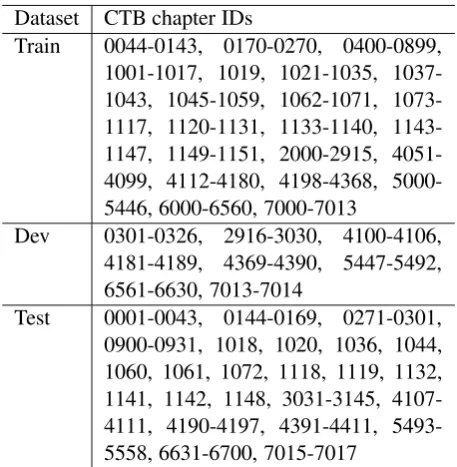
Zhang and Clark(2010). CTB9 consists of source texts in various genres, CTB5 is a subset of it. We split CTB9 by referring to the partition of CTB7 in Wang et al. (2011). We extend the training, development and test sets from CTB5 by adding 80% of the new data in CTB9 to training and 10% each to development and test. The double-checked files are all placed in the test set. The detailed splitting information can be found in Ta-ble10in Appendix. UD Chinese has both univer-sal and language-specific POS tags. They are not predicted jointly in this paper. For the sake of con-venience, we refer the universal tags as UD1 and the language-specific ones as UD2 in the follow-ing sessions. To make the model benefit from the pre-trained character embeddings, we convert the texts in UD Chinese from traditional Chinese into simplified Chinese.
Table2 shows brief statistics of the employed datasets in numbers of words. The out-of-vocabulary (OOV) words are counted regardless of the POS tags. We can see that the size of UD Chinese is much smaller and it has a notably higher OOV rate than the two CTB datasets.
CTB5 CTB9 UD Chinese Train 493,935 1,696,322 98,608 Dev 6,821 136,468 12,663 Test 8,008 242,317 12,012 OOV rate (dev) 8.11 2.93 12.13 OOV rate (test) 3.47 3.13 12.46
Table 2: Statistics of the employed datasets in numbers of words.
4.2 Experimental Results
Both segmentation (Seg) and joint segmentation and POS tagging (Seg&Tag) are evaluated in our experiments.4 We employ word-level recall (R), precision (P) and F1-score (F) as the evaluation metrics. A series of feature experiments are car-ried out on the development sets to evaluate the ef-fectiveness of the proposed approaches for vector representations of the characters. Finally, the best performing model according to the feature experi-ment is applied to the test sets in the forms of sin-gle as well as ensemble and compared with ZPar.
4The evaluation script is downloaded from:
http://people.sutd.edu.sg/ yue zhang/doc/doc/joint files /evaluate.py
4.2.1 Feature Experiments
Table 3 shows the evaluation results of using concatenated n-grams up to different orders as the character representations. By introducing 2-grams, we can obtain vast improvements over solely using the conventional character embed-dings, which indicates that not all the local infor-mation can be effectively captured by the BiRNN using context-free character representations. Util-ising the concatenated n-grams ensures that the same character has different but yet closely related representations in different contexts, which is an effective way to encode contextual features.
From the table, we see that notable improve-ments can be achieved further via employing 3-grams. 4-grams still help but only to CTB9 while adding 5-grams achieves almost no improvement on any of the datasets. The results imply that con-catenating higher-order n-grams can be detrimen-tal, especially on datasets in smaller sizes due to the fact that higher-order n-grams are more sparse in the training data and their vector representations cannot be trained well enough. Besides, adopting higher-order n-grams also substantially increases the numbers of weights and therefore both train-ing and decodtrain-ing become less efficient. Under the circumstances, we consider that 3-gram model is optimal for our task and it is employed in the fol-lowing experiments for all the datasets.
The concatenated n-grams have a bigger size compared to the basic character representation. We conduct one additional experiment using a ba-sic 1-gram character model with a larger character vector size of 300. The evaluation scores are sim-ilar to the basic character model with the size of 64, which shows that the improvements obtained by the n-gram model are not matched by enlarg-ing the size of the vector representation.
[image:5.595.74.293.405.481.2]avail-CTB5 CTB9 UD1 UD2 Seg Seg&Tag Seg Seg&Tag Seg Seg&Tag Seg Seg&Tag size = 300 95.22 91.71 95.53 90.89 91.84 85.43 92.40 85.63
[image:6.595.121.480.62.157.2]1-gram 95.14 91.52 95.25 90.43 91.74 85.07 91.83 84.93 2-gram 97.08 93.72 96.30 91.66 94.50 88.36 94.42 88.14 3-gram 97.14 94.01 96.47 91.75 94.36 88.27 94.43 88.32 4-gram 97.13 94.02 96.48 91.89 94.25 88.37 94.16 88.24 5-gram 96.94 93.84 96.50 91.88 94.40 88.47 94.25 88.03
Table 3: Evaluation of concatenated n-gram representations on the development sets in F1-scores
[image:6.595.116.481.189.252.2]CTB5 CTB9 UD1 UD2 Seg Seg&Tag Seg Seg&Tag Seg Seg&Tag Seg Seg&Tag 3-gram 97.14 94.01 96.47 91.75 94.36 88.27 94.43 88.32 +radicals 97.26 94.42 96.42 91.74 94.37 88.21 94.39 88.36 +graphical 97.25 94.08 96.50 91.78 94.50 88.59 94.23 87.95
Table 4: Evaluation of sub-character level features on the development sets in F1-scores.
CTB5 CTB9 UD1 UD2
Seg Seg&Tag Seg Seg&Tag Seg Seg&Tag Seg Seg&Tag 1-gram 95.14 91.52 95.25 90.43 91.74 85.07 91.83 84.93 +GloVe 95.82 92.45 95.44 90.57 92.77 86.48 93.01 86.48 3-gram, radicals 97.26 94.42 96.42 91.74 94.37 88.21 94.39 88.36 +GloVe 97.42 94.58 96.56 91.96 95.12 89.69 95.02 89.20
Table 5: Evaluation of the pre-trained character embeddings on the development sets in F1-scores.
able.
From Table5, we can learn that employing pre-trained embeddings as initial vector representa-tions for the characters achieves improvements in general, whereas the improvements are compara-tively smaller if the the concatenated n-gram rep-resentations and the radicals are added. Addition-ally, the improvements obtained on UD Chinese are more significant than on CTBs, which indi-cates that the pre-trained character embeddings are more beneficial to the datasets in smaller sizes.
In general, the feature experiments indicate that the proposed Chinese character representations are all sensitive to dataset size. Using higher-order n-grams requires more data for training. On the other hand, the pre-trained embeddings are more vital if the dataset is small. In addition, the different representations are sensitive to tagging schemes as the evaluation results on UD1 and UD2 are quite diverse. Taking both robustness and efficiency into consideration, we select 3-grams along with radicals and pre-trained character em-beddings as the best setting for final evaluation.
4.2.2 Final Results
Table 6 shows the final scores on the test sets. The complete evaluation results in precision,
re-call and F1-scores are contained in Table 11 and Table 12 in Appendix. Our system is compared with ZPar. We retrained a ZPar model on CTB5 that reproduces the evaluation scores reported in Zhang and Clark (2010). We also modified the source code so that it is applicable to CTB9 and UD Chinese. In addition, we perform the mid-p
McNemar’s test (Fagerland et al.,2013) to exam-ine the statistical significances.
[image:6.595.106.492.284.356.2]CTB5 CTB9 UD1 UD2 Seg Seg&Tag Seg Seg&Tag Seg Seg&Tag Seg Seg&Tag
ZPar 97.77 93.82 96.28 91.62 93.75 88.11 93.98 88.16
Single (3-gram, rad., GloVe) 97.89 94.07** 96.47** 91.89** 94.85** 89.41** 94.93** 89.00** Ensemble (4 models) 98.02* 94.38** 96.67** 92.34** 95.16** 89.75* 95.09* 89.42**
[image:7.595.319.515.224.346.2]OOV recall SingleZPar 76.9878.78 68.3469.78 74.1675.83 63.7162.58 78.6981.36 67.4064.40 81.1679.56 64.8666.73 Ensemble 77.34 70.50 75.52 64.14 82.16 68.14 81.56 68.00
Table 6: Evaluations of the best model on the final test sets in F1-scores as well as the recalls of out-of-vocabulary words. Significance tests for Single are in comparison to ZPar, while tests for Ensemble are in comparison to Single (**p <0.01,*p <0.05)
performs very well despite being fully character based. Moreover, it has clear advantages when ap-plied to smaller datasets like UD Chinese, while the prevalence is much smaller on CTB5.
Both our model and ZPar segment OOV words in UD Chinese with higher accuracies than the ones in CTBs despite that UD Chinese is no-tably smaller and the overall OOV rate is higher. Compared to CTB, the words in UD Chinese are more fine-grained and the average word length is shorter, which makes it easier for the tagger to correctly segment the OOV words asZhang et al. (2016) show that the longer words are more diffi-cult to be segmented correctly. For joint POS tag-ging for OOV words, the two systems both per-form significantly better on CTB5 as it is only composed of news text.
In general, our model is more robust to OOV words than ZPar, except that ZPar yields better re-sult for segmentation by a small margin on CTB9. ZPar also obtains higher accuracy for joint POS tagging than the single model on CTB9. The dif-ferences between ZPar and our model for both seg-mentation and POS tagging are more substantial on UD Chinese, which indicates that our model is relatively more advantageous for handling OOV words when the training sets are small, whereas ZPar is able to perform equally well when sub-stantial amount of training data is available as they achieve similar results on the CTB sets.
The single model is further improved by ensemble-averaging four independently trained models. The improvements are not drastic but they are observed systematically across all the datasets. In general, ensemble decoding is beneficial to han-dling OOV words as well except that a small drop for segmentation on CTB5 is observed.
Table 7 displays the evaluation of the ensem-ble model and ZPar on the decomposed test sets
Ensemble ZPar Seg Seg&Tag Seg Seg&Tag BN 97.89* 94.48** 97.68 94.22 CS 96.67** 91.78** 95.61 90.15 FM 96.54** 91.92** 96.30 91.51 MG 94.54** 89.23** 94.22 88.60 NS 97.56 93.92** 97.49 93.70 SM 96.43** 91.78** 96.13 90.32 SP 97.29** 93.93** 96.69 93.35 WB 94.27** 88.44** 93.38 86.88
Table 7: Evaluation on Broadcast News (BN), Conversations (CS), Forum (FM), Magazine (MG), News (NS), Short Messages (SM), Speech (SP) and Weblogs (WB) in CTB9. (**p < 0.01, *p <0.05)
of CTB9 in different genres. Our model surpasses ZPar on all the genres in both segmentation and joint POS tagging. The differences are subtle on the genres in which the texts are normalised, such as News and Broadcast News. This, to a very large extent, explains why our model is only marginally better than ZPar on CTB5, whereas the experimental results reveal that our model is sub-stantially better at processing non-standard text as it yields significantly higher scores on Conversa-tions, Short Messages and Weblogs. The evalua-tion results of both our model and ZPar vary sub-stantially across different genres as some genres are fundamentally more challenging to process.
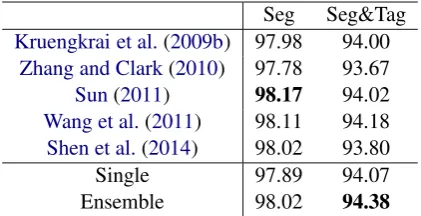
Our models are compared with the previous best-performing systems on CTB5 in Table8. Our models are not optimised particularly with respect to CTB5 but still yield competitive results, espe-cially for joint POS tagging. We are the first to re-port evaluation scores on CTB9 and UD Chinese.
4.3 Tagging Speed
Seg Seg&Tag Kruengkrai et al.(2009b) 97.98 94.00
Zhang and Clark(2010) 97.78 93.67 Sun(2011) 98.17 94.02 Wang et al.(2011) 98.11 94.18 Shen et al.(2014) 98.02 93.80 Single 97.89 94.07 Ensemble 98.02 94.38
Table 8: Result comparisions on CTB5 in F1-scores.
used for processing very large files. The mem-ory demand of decoding is drastically milder com-pared to training, a large batch size therefore can be employed. The tagger takes constant time to build the sub-computational graphs and load the weights.
With bucket size of 10 and batch size of 500, Ta-ble9shows the tagging speed of the tagger using a single Tesla K80 GPU card and the pre-trained model on CTB5. The tagging speed of ZPar is also presented for comparison. GPU devices are not supported by ZPar and therefore the tagging speed is calculated using an Intel Core i7 CPU.
[image:8.595.76.287.62.170.2]Init. Time (s) Sentence/s Chars/s Single 20 299.40 40,188.17 Ensemble 23 230.41 30,928.22 ZPar 4 134.59 18,090.09
Table 9: Tagging speed in numbers of sentences and characters per second
5 Related Work
The fundamental BiRNN-CRF architecture is task-independent and has been applied to many sequence tagging problems on Chinese. Peng and Dredze(2016) adopt the model for Chi-nese segmentation and named entity recognition in the context of multi-task and multi-domain learning. Dong et al. (2016) employ a character level BiLSTM-CRF model that utilises radical-level information for Chinese named entity recognition. Ma and Sun (2016) use a similar architecture but feed the Chinese characters pair-wise as edge embeddings instead. Their model is applied respectively to chunking, segmentation and POS tagging.
Zheng et al. (2013) model joint Chinese seg-mentation and POS tagging via predicting the combinatory segmentation and POS tags. They
employ the adaptation of the feed forward neu-ral network introduced in Collobert et al. (2011) that only extracts local features in a context win-dow. A perceptron-style training algorithm is em-ployed for sentence level optimisation, which is the same as the training algorithm of the BiRNN-CRF model. Their proposed model is not evalu-ated on CTB5 and therefore difficult to be com-pared with our system. Kong et al. (2015) apply segmental recurrent neural networks to joint seg-mentation and POS tagging but the evaluation re-sults are substantially below the state-of-the-art on CTB5.
Bojanowski et al.(2016) retrieve word embed-dings via representing words as a bag of charac-ter n-grams for morphologically rich languages. A similar character n-gram model is proposed by Wieting et al. (2016). Sun et al. (2014) at-tempt to encode radical information into the con-ventional character embeddings. The radical-enhanced embeddings are employed and eval-uated for Chinese segmentation. The results show that radical-enhanced embeddings outper-form both skip-ngram and continues bag-of-word (Mikolov et al.,2013) in word2vec.
6 Conclusion
We adapt and apply the BiRNN-CRF model for se-quence tagging in NLP to joint Chinese segmenta-tion and POS tagging via predicting the combina-tory tags of word boundaries and POS tags. Con-catenated n-grams as well as sub-character fea-tures are employed along with the conventional pre-trained character embeddings as the vector representations for Chinese characters. The fea-ture experiments indicate that concatenated n-grams contribute substantially. However, both rad-icals and graphical features as sub-character level information are less effective. How to incorpo-rate the sub-character level information more ef-fectively will be further explored in the future.
The results on UD Chinese and CTB9 also reveal that our model has great advantages in processing non-standard text, such as weblogs, forum text and short messages. Moreover, the implemented tag-ger is very efficient with GPU devices and there-fore can be applied to tagging very large files. Acknowledgments
We acknowledge the computational resources pro-vided by CSC in Helsinki and Sigma2 in Oslo through NeIC-NLPL (www.nlpl.eu). This work is supported by the Chinese Scholarship Council (CSC) (No. 201407930015).
References
Mart´ın Abadi, Paul Barham, Jianmin Chen, Zhifeng Chen, Andy Davis, Jeffrey Dean, Matthieu Devin, Sanjay Ghemawat, Geoffrey Irving, Michael Isard, et al. 2016. TensorFlow: A system for large-scale machine learning. InProceedings of the 12th USENIX Symposium on Operating Systems Design and Implementation (OSDI). Savannah, Georgia, USA.
Piotr Bojanowski, Edouard Grave, Armand Joulin, and Tomas Mikolov. 2016. Enriching word vec-tors with subword information. arXiv preprint arXiv:1607.04606.
Kyunghyun Cho, Bart Van Merri¨enboer, Dzmitry Bah-danau, and Yoshua Bengio. 2014. On the properties of neural machine translation: Encoder-decoder ap-proaches.arXiv preprint arXiv:1409.1259.
Junyoung Chung, Caglar Gulcehre, KyungHyun Cho, and Yoshua Bengio. 2014. Empirical evaluation of gated recurrent neural networks on sequence model-ing.arXiv preprint arXiv:1412.3555.
Ronan Collobert, Jason Weston, L´eon Bottou, Michael Karlen, Koray Kavukcuoglu, and Pavel Kuksa. 2011. Natural language processing (almost) from scratch. Journal of Machine Learning Research
12(August):2493–2537.
Chuanhai Dong, Jiajun Zhang, Chengqing Zong, Masanori Hattori, and Hui Di. 2016. Character-based LSTM-CRF with radical-level features for Chinese named entity recognition. InInternational Conference on Computer Processing of Oriental Languages. Springer, pages 239–250.
C´ıcero Nogueira dos Santos and Bianca Zadrozny. 2014. Learning character-level representations for part-of-speech tagging. In Proceedings of The 31st International Conference on Machine Learn-ing. pages 1818–1826.
John Duchi, Elad Hazan, and Yoram Singer. 2011. Adaptive subgradient methods for online learning
and stochastic optimization. Journal of Machine Learning Research12(Jul):2121–2159.
Morten W Fagerland, Stian Lydersen, and Petter Laake. 2013. The McNemar test for binary matched-pairs data: mid-p and asymptotic are better than exact conditional. BMC medical research methodology
13(1):91.
Xavier Glorot and Yoshua Bengio. 2010. Understand-ing the difficulty of trainUnderstand-ing deep feedforward neural networks. InAistats. pages 249–256.
Sepp Hochreiter and J¨urgen Schmidhuber. 1997. Long short-term memory. Neural computation
9(8):1735–1780.
Zhiheng Huang, Wei Xu, and Kai Yu. 2015. Bidi-rectional LSTM-CRF models for sequence tagging.
arXiv preprint arXiv:1508.01991.
Wenbin Jiang, Liang Huang, Qun Liu, and Yajuan L¨u. 2008. A cascaded linear model for joint Chinese word segmentation and part-of-speech tagging. In
In Proceedings of the 46th Annual Meeting of the Association for Computational Linguistics. Citeseer. Lingpeng Kong, Chris Dyer, and Noah A Smith. 2015. Segmental recurrent neural networks. arXiv preprint arXiv:1511.06018.
Canasai Kruengkrai, Kiyotaka Uchimoto, Jun’ichi Kazama, Yiou Wang, Kentaro Torisawa, and Hitoshi Isahara. 2009a. An error-driven word-character hy-brid model for joint Chinese word segmentation and POS tagging. InProceedings of the Joint Confer-ence of the 47th Annual Meeting of the ACL and the 4th International Joint Conference on Natural Lan-guage Processing of the AFNLP: Volume 1-Volume 1. Association for Computational Linguistics, Sin-gapore, pages 513–521.
Canasai Kruengkrai, Kiyotaka Uchimoto, Jun’ichi Kazama, WANG Yiou, Kentaro Torisawa, and Hi-toshi Isahara. 2009b. Joint Chinese word segmen-tation and POS tagging using an error-driven word-character hybrid model. IEICE transactions on in-formation and systems92(12):2298–2305.
John Lafferty, Andrew McCallum, Fernando Pereira, et al. 2001. Conditional random fields: Probabilis-tic models for segmenting and labeling sequence data. InProceedings of the eighteenth international conference on machine learning, ICML. volume 1, pages 282–289.
Shuming Ma and Xu Sun. 2016. A new recurrent neu-ral CRF for learning non-linear edge features.arXiv preprint arXiv:1611.04233.
Xuezhe Ma and Eduard Hovy. 2016. End-to-end sequence labeling via bi-directional LSTM-CNNs-CRF. InProceedings of the 54th Annual Meeting of the Association for Computational Linguistics. Berlin, Germany, page 10641074.
Tomas Mikolov, Kai Chen, Greg Corrado, and Jef-frey Dean. 2013. Efficient estimation of word representations in vector space. arXiv preprint arXiv:1301.3781.
Hwee Tou Ng and Jin Kiat Low. 2004. Chinese part-of-speech tagging: One-at-a-time or all-at-once? word-based or character-word-based? In Proceedings of the 2004 Conference on Empirical Methods in Natural Language Processing. Barcelona, Spain, pages 277– 284.
Joakim Nivre, Marie-Catherine de Marneffe, Filip Gin-ter, Yoav Goldberg, Jan Hajic, Christopher D. Man-ning, Ryan McDonald, Slav Petrov, Sampo Pyysalo, Natalia Silveira, Reut Tsarfaty, and Daniel Zeman. 2016. Universal dependencies v1: A multilingual treebank collection. InProceedings of the 10th In-ternational Conference on Language Resources and Evaluation (LREC 2016). pages 1659–1666. Nanyun Peng and Mark Dredze. 2016. Multi-task
multi-domain representation learning for sequence tagging.arXiv preprint arXiv:1608.02689.
Jeffrey Pennington, Richard Socher, and Christo-pher D. Manning. 2014. GloVe: Global vectors for word representation. InEmpirical Methods in Nat-ural Language Processing (EMNLP). Doha, Qatar, pages 1532–1543.
Mo Shen, Hongxiao Liu, Daisuke Kawahara, and Sadao Kurohashi. 2014. Chinese morphological analysis with character-level POS tagging. In Pro-ceedings of the 52nd Annual Meeting of the Associa-tion for ComputaAssocia-tional Linguistics (Volume 2: Short Papers). Association for Computational Linguistics, Baltimore, Maryland, pages 253–258.
Nitish Srivastava, Geoffrey E Hinton, Alex Krizhevsky, Ilya Sutskever, and Ruslan Salakhutdinov. 2014. Dropout: a simple way to prevent neural networks from overfitting. Journal of Machine Learning Re-search15(1):1929–1958.
Weiwei Sun. 2011. A stacked sub-word model for joint Chinese word segmentation and part-of-speech tag-ging. In Proceedings of the 49th Annual Meeting of the Association for Computational Linguistics: Human Language Technologies-Volume 1. Associ-ation for ComputAssoci-ational Linguistics, Portland, Ore-gon, USA, pages 1385–1394.
Yaming Sun, Lei Lin, Nan Yang, Zhenzhou Ji, and Xiaolong Wang. 2014. Radical-enhanced Chinese character embedding. InInternational Conference
on Neural Information Processing. Springer, pages 279–286.
Yiou Wang, Jun’ichi Kazama, Yoshimasa Tsuruoka, Wenliang Chen, Yujie Zhang, and Kentaro Torisawa. 2011. Improving Chinese word segmentation and POS tagging with semi-supervised methods using large auto-analyzed data. InProceedings of 5th In-ternational Joint Conference on Natural Language Processing. Asian Federation of Natural Language Processing, pages 309–317.
John Wieting, Mohit Bansal, Kevin Gimpel, and Karen Livescu. 2016. CHARAGRAM: Embedding words and sentences via character n-grams.arXiv preprint arXiv:1607.02789.
Naiwen Xue, Fei Xia, Fu-Dong Chiou, and Marta Palmer. 2005. The Penn Chinese treebank: Phrase structure annotation of a large corpus. Natural lan-guage engineering11(02):207–238.
Meishan Zhang, Yue Zhang, and Guohong Fu. 2016. Transition-based neural word segmentation. In Pro-ceedings of the 54th Annual Meeting of the Associa-tion for ComputaAssocia-tional Linguistics (Volume 1: Long Papers). Association for Computational Linguistics, pages 421–431.
Yue Zhang and Stephen Clark. 2008. Joint word seg-mentation and POS tagging using a single percep-tron. InProceedings of the 46th Annual Meeting of the Association for Computational Linguistics. Columbus, Ohio, pages 888–896.
Yue Zhang and Stephen Clark. 2010. A fast decoder for joint word segmentation and POS-tagging using a single discriminative model. In Proceedings of the 2010 Conference on Empirical Methods in Natu-ral Language Processing. Association for Computa-tional Linguistics, Massachusetts, USA, pages 843– 852.
Appendix
Dataset CTB chapter IDs
Train 0044-0143, 0170-0270, 0400-0899, 1001-1017, 1019, 1021-1035, 1037-1043, 1045-1059, 1062-1071, 1073-1117, 1120-1131, 1133-1140, 1143-1147, 1149-1151, 2000-2915, 4051-4099, 4112-4180, 4198-4368, 5000-5446, 6000-6560, 7000-7013
Dev 0301-0326, 2916-3030, 4100-4106, 4181-4189, 4369-4390, 5447-5492, 6561-6630, 7013-7014
[image:11.595.71.300.93.327.2]Test 0001-0043, 0144-0169, 0271-0301, 0900-0931, 1018, 1020, 1036, 1044, 1060, 1061, 1072, 1118, 1119, 1132, 1141, 1142, 1148, 3031-3145, 4107-4111, 4190-4197, 4391-4411, 5493-5558, 6631-6700, 7015-7017
Table 10: The split of Chinese Treebank 9.0
P R F
CTB5 Ensemble 97.57 98.47 98.02Single 97.49 98.30 97.89
CTB9 Ensemble 96.61 96.74 96.67Single 96.38 96.55 96.47
UD1 Ensemble 95.07 95.27 95.17Single 94.71 94.99 94.85
[image:11.595.83.281.380.498.2]UD2 Ensemble 95.00 95.22 95.11Single 94.98 94.93 94.93
Table 11: Evaluation of segmentations in preci-sion, recall and F1-scores
P R F
CTB5 Ensemble 93.95 94.81 94.38Single 93.68 94.47 94.07
CTB9 Ensemble 92.28 92.40 92.34Single 91.81 91.97 91.89
UD1 Ensemble 89.67 89.86 89.77Single 89.28 89.54 89.41
UD2 Ensemble 89.33 89.54 89.43Single 88.95 89.04 89.00
[image:11.595.84.281.552.674.2]