Multimodal Comparable Corpora as Resources for Extracting Parallel
Data: Parallel Phrases Extraction
Haithem Afli, Lo¨ıc Barrault and Holger Schwenk Universit´e du Maine,
Avenue Olivier Messiaen F-72085 - LE MANS, France
Abstract
Discovering parallel data in comparable corpora is a promising approach for over-coming the lack of parallel texts in statis-tical machine translation and other NLP applications. In this paper we propose an alternative to comparable corpora of texts as resources for extracting parallel data: a multimodal comparable corpus of audio and texts. We present a novel method to detect parallel phrases from such corpora based on splitting comparable sentences into fragments, called phrases. The au-dio is transcribed by an automatic speech recognition system, split into fragments and translated with a baseline statistical machine translation system. We then use information retrieval in a large text corpus in the target language, split also into frag-ments, and extract parallel phrases. We compared our method with parallel sen-tences extraction techniques. We evaluate the quality of the extracted data on an En-glish to French translation task and show significant improvements over a state-of-the-art baseline.
1 Introduction
The development of a statistical machine trans-lation (SMT) system requires one or more paral-lel corpora called bitexts for training the transla-tion model and monolingual data to build the tar-get language model. Unfortunately, parallel texts are a limited resource and they are often not avail-able for some specific domains and language pairs. That is why, recently, there has been a huge in-terest in the automatic creation of parallel data. Since comparable corpora exist in large quantities and are much more easily available (Munteanu and Marcu, 2005), the ability to exploit them is highly
beneficial in order to overcome the lack of parallel data. The ability to detect these parallel data en-ables the automatic creation of large parallel cor-pora.
Most of existing studies dealing with compara-ble corpora look for parallel data at the sentence level (Zhao and Vogel, 2002; Utiyama and Isa-hara, 2003; Munteanu and Marcu, 2005; Abdul-Rauf and Schwenk, 2011). However, the de-gree of parallelism can vary considerably, from noisy parallel texts, to quasi parallel texts (Fung and Cheung, 2004). Corpora from the last cate-gory contain none or few good parallel sentence pairs. However, there could have parallel phrases in comparable sentences that can prove to be help-ful for SMT (Munteanu and Marcu, 2006). As an example, consider Figure 1, which presents two news articles with their video from the English and French editions of the Euronews website1. The ar-ticles report on the same event with different sen-tences that contain some parallel translations at the phrase level. These two documents contain in par-ticular no exact sentence pairs, so techniques for extracting parallel sentences will not give good re-sults. We need a method to extract parallel phrases which exist at the sub-sentential level.
For some languages, text comparable corpora may not cover all topics in some specific domains and languages. This is because potential sources of comparable corpora are mainly derived from multilingual news reporting agencies like AFP, Xinhua, Al-Jazeera, BBC etc, or multilingual en-cyclopedias like Wikipedia, Encarta etc. What we need is exploring other sources like audio to gener-ate parallel data for such domains that can improve the performance of an SMT system.
In this paper, we present a method for detecting and extracting parallel data from multimodal cor-pora. Our method consists in extracting parallel
1www.euronews.com/
Comparable audio
Comparable texts
Manual Transcription
[image:2.595.85.532.60.242.2]Manual Transcription
Figure 1: Example of multimodal comparable cor-pora from the Euronews website.
Audio (en)
Text (fr)
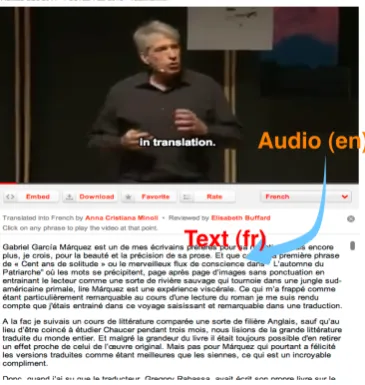
Figure 2: Example of multimodal comparable cor-pora from the TED website.
phrases.
2 Extracting parallel data
2.1 Basic Idea
Figure 2 shows an example of multimodal compa-rable data coming from the TED website 2. We have an audio source of a talk in English and its text translation in French. We think that we can extract parallel data from this corpora, at the sen-tence and the sub-sentential level.
In this work we seek to adapt and to improve machine translation systems that suffer from re-source deficiency by automatically extracting par-allel data in specific domains.
2http://www.ted.com/
Audio L1
Sentences L1
Translations L2
Phrases L2
ASR
SMT
IR
Texts L2 Multimodal Comparable Corpora
Parallel Data
Filter Phrases L1
Split
[image:2.595.74.257.293.486.2]Phrases L2 Split
Figure 3: Principle of the parallel phrase extrac-tion system from multimodal comparable corpora.
2.2 System Architecture
The basic system architecture is described in Fig-ure 3. We can distinguish three steps: auto-matic speech recognition (ASR), statistical ma-chine translation (SMT) and information retrieval (IR). The ASR system accepts audio data in the source language L1 and generates an automatic transcription. This transcription is then split into phrases and translated by a baseline SMT system into language L2. Then, we use these translations as queries for an IR system to retrieve most sim-ilar phrases in the texts in L2, which were previ-ouslt split into phrases. The transcribed phrases in L1 and the IR result in L2 form the final parallel data. We hope that the errors made by the ASR and SMT systems will not impact too severely the extraction process.
2.3 Baseline systems
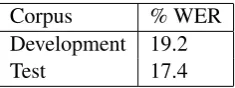
Our ASR system is a five-pass system based on the open-source CMU Sphinx toolkit3(version 3 and 4), similar to the LIUM’08 French ASR system described in (Del´eglise et al., 2009). The acous-tic models are trained in the same manner, except that a multi-layer perceptron (MLP) is added us-ing the bottle-neck feature extraction as described in (Gr´ezl and Fousek, 2008). Table 2.3 shows the performances of the ASR system on the develop-ment and test corpora.
Corpus % WER
Development 19.2
[image:3.595.123.241.229.273.2]Test 17.4
Table 1: Performance of the ASR system on de-velopment and test data.
Our SMT system is a phrase-based system (Koehn et al., 2003) based on the Moses SMT toolkit (Koehn et al., 2007). The standard four-teen feature functions are used, namely phrase and lexical translation probabilities in both directions, seven features for the lexicalized distortion model, a word and a phrase penalty and a target language model. It is constructed as follows. First, word alignments in both directions are calculated. We used the multi-threaded version of the GIZA++ tool (Gao and Vogel, 2008). Phrases and lexical reorderings are extracted using the default settings of the Moses toolkit. The parameters of our sys-tem were tuned on a development corpus, using the MERT tool (Och, 2003).
We use the Lemur IR toolkit (Ogilvie and Callan, 2001) for the phrases extraction proce-dure. We first index all the French text (after split-ting it into segments) into a database using Indri Index. This feature enable us to index our text documents in such a way we can use the trans-lated phrases as queries to run information re-trieval in the database, with the specialized Indri Query Language. By these means we can retrieve the best matching phrases from the French side of the comparable corpus.
For each candidate phrases pair, we need to de-cide whether the two phrases are mutual transla-tions. For this, we calculate the TER between them using the tool described in (Servan and
3Carnegie Mellon University:
http://cmusphinx.sourceforge.net/
Schwenk, 2011),4 i.e. between automatic trans-lation, and the phrases selected by IR.
3 Experiments
In our experiments, we compare our phrase ex-traction method (which we call PhrExtract) with the sentence extraction method (SentExtract) of (Afli et al., 2012). We use the extracted dataset by both methods as additional SMT training data, and measure the quality of the parallel data by its im-pact on the performance of the SMT system. Thus, the final extracated parallel data is injected into the baseline system. The various SMT systems are evaluated using the BLEU score (Papineni et al., 2002). We conducted experiments on an English to French machine translation task. All the text data is automatically split into phrases of two to ten tokens.
3.1 Data description
Our multimodal comparable corpus consists of spoken talks in English (audio) and written texts in French. The goal of the TED task is to trans-late public lectures from English into French. The TED corpus totals about 118 hours of speech. We call the English transcriptions of the audio part TEDasr witch is split into phrases (called TEDasr split). A detailed description of the TED task can be found in (Rousseau et al., 2011).
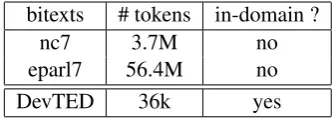
The development corpusDevTEDconsists of 19 talks and represents a total of 4 hours and 13 min-utes of speech transcribed at the sentence level. The language model is trained with the SRI LM toolkit (Stolcke, 2002), on all the available French data without the TED data. The baseline system is trained with version 7 of the News-Commentary (nc7) and Europarl (eparl7) corpus.5 The indexed
data consist of the French text part of theTED cor-pus which contains translations of the English part of the corpus. We call it TEDbi. It is split into phrases (called TEDbi split). Tables 2 and 3 sum-marize the characteristics of the different corpora used in our experiments.
3.2 Experimental results
We first apply sentence extraction on the TED cor-pus with a method similar to (Afli et al., 2012). We then apply phrase extraction on the same data split
4
http://sourceforge.net/projects/ tercpp/
bitexts # tokens in-domain ?
nc7 3.7M no
eparl7 56.4M no
[image:4.595.97.265.62.121.2]DevTED 36k yes
Table 2: MT training and development data.
Data # tokens in-domain ?
TEDasr 1.8M yes
TEDbi 1.9M yes
[image:4.595.89.273.157.232.2]TEDbi split 80.4M yes TEDasr split 82.7M yes
Table 3: Comparable data used for the extraction experiments.
as described in 2.2. Then, both methods are com-pared.
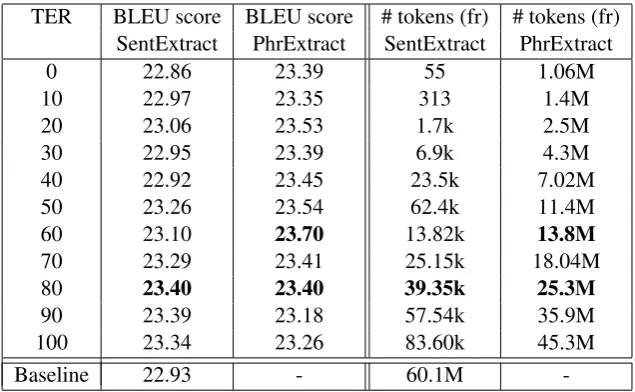
As mentioned in section 2.3, the TER score is used as a metric for filtering the result of IR. We keep only the sentences or phrases which have a TER score below a certain threshold determined empirically. Thus, we filter the selected sen-tences or phrases in each condition with different TER thresholds ranging from 0 to 100 by steps of 10. The extracted parallel data are added to our generic training data in order to adapt the baseline system. Table 4 presents the BLEU score obtained for these different experimental conditions.
Our baseline SMT system, trained with generic bitexts achieves a BLEU score of 22.93. We can see that our new method of phrase extraction sig-nificantly improve the baseline system more than sentences extraction method until the TER thresh-old of 80 is reached: the BLEU score increases from 22.93 to 23.70 with the best system of our proposed method and from 22.93 to 23.40 with the best system using the classical method of sentence extraction.
The results show that the choice of the appro-priate TER threshold depends on the method. We can see that for PhrExtract the best threshold is 60 when the best one is 80 forSentExtract. This last one is also an important point in the general evaluation of the two methods. In fact, we can see on Figure 4 that from this point our proposed method gives less performing results than SentEx-tractmethod.
This suggest to apply combination of the two methods. This corresponds to injecting the ex-tracted phrases and sentences into the training
data. The combination method is called CombEx-tract. Figure 4 presents the comparison of the dif-ferent experimental conditions in term of BLEU score for each TER threshold. We can see that ex-cept for threshold 30, the curve of the combination follows in general the same trajectory of the curve ofPhrExtract. These results show thatSentExtract has no big impact in combination with the PhrEx-tract method and the best threshold when using PhrExtractis at 60.
22 22.5 23 23.5 24
0 20 40 60 80 100
BLEU score
TER threshold
PhrExtract SentExtract CombExtract Baseline
Figure 4: Performance ofPhrExtract,SentExtract and their combination in term of BLEU score for each TER threshold.
This is because of the big difference on the quantity of data between the two methods as we can see in Table 4. The benefit of our method is that it can generates more quantities of paral-lel data than the sentence extraction method for each TER threshold, and this difference of quanti-ties improves results of MT system until the TER threshold of 80 is reached. However, we can see in Table 4 that the quality of only 39.35k (TER 80) extracted bySentExtractcan have exactly the same impact of 25.3M extracted by our new tech-nique. That is why we intend to investigate in the filtering module of our system.
4 Related Work
Research on exploiting comparable corpora goes back to more than 15 years ago (Fung and Yee, 1998; Koehn and Knight, 2000; Vogel, 2003; Gaussier et al., 2004; Li and Gaussier, 2010). A lot of studies on data acquisition from compara-ble corpora for machine translation have been re-ported (Su and Babych, 2012; Hewavitharana and Vogel, 2011; Riesa and Marcu, 2012).
[image:4.595.310.530.213.366.2]TER BLEU score BLEU score # tokens (fr) # tokens (fr) SentExtract PhrExtract SentExtract PhrExtract
0 22.86 23.39 55 1.06M
10 22.97 23.35 313 1.4M
20 23.06 23.53 1.7k 2.5M
30 22.95 23.39 6.9k 4.3M
40 22.92 23.45 23.5k 7.02M
50 23.26 23.54 62.4k 11.4M
60 23.10 23.70 13.82k 13.8M
70 23.29 23.41 25.15k 18.04M
80 23.40 23.40 39.35k 25.3M
90 23.39 23.18 57.54k 35.9M
100 23.34 23.26 83.60k 45.3M
Baseline 22.93 - 60.1M
-Table 4: Number of tokens extracted and BLEU scores on DevTED obtained withPhrExtractand Sen-tExtractmethods for each TER threshold.
Marcu, 2006) was the first attempt to extract paral-lel sub-sentential fragments (phrases), from com-parable corpora. They used a method based on a Log-Likelihood-Ratio lexicon and a smoothing fil-ter. They showed the effectiveness of their method to improve an SMT system from a collection of a comparable sentences. The weakness of their method is that they filter source and target frag-ments separately, which cannot guarantee that the extracted fragments are a good translations of each other. (Hewavitharana and Vogel, 2011) show a good result with their method based on on a pair-wise correlation calculation which suppose that the source fragment has been detected.
The second type of approach in extracting paral-lel phrases is the alignment-based approach (Quirk et al., 2007; Riesa and Marcu, 2012). These meth-ods are promising, but since the proposed method in (Quirk et al., 2007) do not improve significantly MT performance and model in (Riesa and Marcu, 2012) is designed for parallel data, it’s hard to say that this approach is actually effective for compa-rable data.
This work is similar to the work by (Afli et al., 2012) where the extraction is done at the phrase level instead of the sentence level. Our methodol-ogy is the first effort aimed at detecting translated phrases on a multimodal corpora.
Since our method can extract parallel phrases from a multimodal corpus, it greatly expands the range of corpora which can be usefully exploited.
5 Conclusion
We have presented a fully automatic method for extracting parallel phrases from multimodal com-parable corpora, i.e. the source side is available as audio stream and the target side as text. We used a framework to extract parallel data witch combine an automatic speech recognition system, a statistical machine translation system and infor-mation retrieval system. We showed by experi-ments conducted on English-French data, that par-allel phrases extracted with this method improves significantly SMT performance. Our approach can be improved in several aspects. The automatic splitting is very simple; more advanced phrases generation might work better, and eliminate re-dundancy. Trying other method on filtering can also improve the precision of the method.
6 Acknowledgments
This work has been partially funded by the French Government under the project DEPART.
References
S. Abdul-Rauf and H. Schwenk. 2011. Parallel sen-tence generation from comparable corpora for
im-proved smt. Machine Translation.
H. Afli, L. Barrault, and H. Schwenk. 2012. Paral-lel texts extraction from multimodal comparable
cor-pora. InJapTAL, volume 7614 ofLecture Notes in
Computer Science, pages 40–51. Springer.
[image:5.595.140.458.61.257.2]sys-tem based on CMU Sphinx: what helps to
signifi-cantly reduce the word error rate? In Interspeech
2009, Brighton (United Kingdom), 6-10 september.
P. Fung and P. Cheung. 2004. Multi-level bootstrap-ping for extracting parallel sentences from a
quasi-comparable corpus. InProceedings of the 20th
in-ternational conference on Computational
Linguis-tics, COLING ’04.
P. Fung and L. Y. Yee. 1998. An ir approach for
translating new words from nonparallel, compara-ble texts. In Proceedings of the 17th international conference on Computational linguistics - Volume 1, COLING ’98, pages 414–420.
Q. Gao and S. Vogel. 2008. Parallel
implementa-tions of word alignment tool. InSoftware Engineer-ing, TestEngineer-ing, and Quality Assurance for Natural Lan-guage Processing, SETQA-NLP ’08, pages 49–57.
E. Gaussier, J.-M. Renders, I. Matveeva, C. Goutte, and H. D´ejean. 2004. A geometric view on bilingual lexicon extraction from comparable corpora. In Pro-ceedings of the 42nd Annual Meeting on Association for Computational Linguistics, ACL ’04.
F. Gr´ezl and P. Fousek. 2008. Optimizing bottle-neck
features for LVCSR. In 2008 IEEE International
Conference on Acoustics, Speech, and Signal Pro-cessing, pages 4729–4732. IEEE Signal Processing Society.
S. Hewavitharana and S. Vogel. 2011. Extracting
par-allel phrases from comparable data. InProceedings
of the 4th Workshop on Building and Using Compa-rable Corpora: CompaCompa-rable Corpora and the Web, BUCC ’11, pages 61–68.
P. Koehn and K. Knight. 2000. Estimating word trans-lation probabilities from unrelated monolingual
cor-pora using the em algorithm. InProceedings of the
Seventeenth National Conference on Artificial Intel-ligence and Twelfth Conference on Innovative Ap-plications of Artificial Intelligence, pages 711–715. AAAI Press.
P. Koehn, Franz J. Och, and D. Marcu. 2003. Sta-tistical phrase-based translation. InProceedings of the 2003 Conference of the North American Chapter of the Association for Computational Linguistics on Human Language Technology - Volume 1, NAACL ’03, pages 48–54.
P. Koehn, H. Hoang, A. Birch, C. Callison-Burch, M. Federico, N. Bertoldi, B. Cowan, W. Shen, C. Moran, R. Zens, C. Dyer, O. Bojar, A. Constantin, and E. Herbst. 2007. Moses: open source toolkit for statistical machine translation. In Proceedings of the 45th Annual Meeting of the ACL on Interac-tive Poster and Demonstration Sessions, ACL ’07, pages 177–180.
B. Li and E. Gaussier. 2010. Improving corpus parability for bilingual lexicon extraction from
com-parable corpora. In Proceedings of the 23rd
Inter-national Conference on Computational Linguistics, COLING ’10, pages 644–652.
D. S. Munteanu and D. Marcu. 2005.
Improv-ing Machine Translation Performance by ExploitImprov-ing
Non-Parallel Corpora. Computational Linguistics,
31(4):477–504.
D. S. Munteanu and D. Marcu. 2006. Extracting
parallel sub-sentential fragments from non-parallel
corpora. In Proceedings of the 21st International
Conference on Computational Linguistics and the 44th annual meeting of the Association for Compu-tational Linguistics, ACL-44, pages 81–88.
Franz J. Och. 2003. Minimum error rate training in statistical machine translation. InProceedings of the 41st Annual Meeting on Association for Computa-tional Linguistics - Volume 1, ACL ’03, pages 160– 167, Stroudsburg, PA, USA. Association for Com-putational Linguistics.
P. Ogilvie and J. Callan. 2001. Experiments using the lemur toolkit. Procedding of the Trenth Text Re-trieval Conference (TREC-10).
K. Papineni, S. Roukos, T. Ward, and W.-J. Zhu. 2002. Bleu: a method for automatic evaluation of machine translation. InProceedings of the 40th Annual Meet-ing on Association for Computational LMeet-inguistics, ACL ’02, pages 311–318.
Q. Quirk, R. Udupa, and A. Menezes. 2007. Gener-ative models of noisy translations with applications to parallel fragment extraction. InIn Proceedings of MT Summit XI, European Association for Machine Translation.
J. Riesa and D. Marcu. 2012. Automatic parallel
frag-ment extraction from noisy data. InProceedings of
the 2012 Conference of the North American Chap-ter of the Association for Computational Linguistics: Human Language Technologies, NAACL HLT ’12, pages 538–542.
A. Rousseau, F. Bougares, P. Del´eglise, H. Schwenk,
and Y. Est`eve. 2011. LIUM’s systems for the
IWSLT 2011 speech translation tasks.International
Workshop on Spoken Language Translation 2011.
C. Servan and H. Schwenk. 2011. Optimising multiple
metrics with mert. The Prague Bulletin of
Mathe-matical Linguistics (PBML).
S. Snover, B. Dorr, R. Schwartz, M. Micciulla, and J. Makhoul. 2006. A study of translation edit rate
with targeted human annotation.Proceedings of
As-sociation for Machine Translation in the Americas, pages 223–231.
A. Stolcke. 2002. SRILM - an extensible
lan-guage modeling toolkit. In International
F. Su and B. Babych. 2012. Measuring comparabil-ity of documents in non-parallel corpora for effi-cient extraction of (semi-)parallel translation
equiv-alents. In Proceedings of the Joint Workshop on
Exploiting Synergies between Information Retrieval and Machine Translation (ESIRMT) and Hybrid Ap-proaches to Machine Translation (HyTra), EACL 2012, pages 10–19. Association for Computational Linguistics.
M. Utiyama and H. Isahara. 2003. Reliable measures for aligning japanese-english news articles and
sen-tences. InProceedings of the 41st Annual Meeting
on Association for Computational Linguistics - Vol-ume 1, ACL ’03, pages 72–79.
S. Vogel. 2003. Using noisy bilingual data for sta-tistical machine translation. In Proceedings of the tenth conference on European chapter of the Asso-ciation for Computational Linguistics - Volume 2, EACL ’03, pages 175–178.