Ensemble Triangulation for Statistical Machine Translation
∗Majid Razmara and Anoop Sarkar
School of Computing Science Simon Fraser University
Burnaby, BC, Canada
{razmara,anoop}@sfu.ca
Abstract
State-of-the-art statistical machine transla-tion systems rely heavily on training data and insufficient training data usually re-sults in poor translation quality. One so-lution to alleviate this problem is triangu-lation. Triangulation uses a third language as a pivot through which another source-target translation system can be built. In this paper, we dynamically create multi-ple such triangulated systems and combine them using a novel approach called ensem-ble decoding. Experimental results of this approach show significant improvements in the BLEU score over the direct source-target system. Our approach also outper-forms a strong linear mixture baseline.
1 Introduction
The objective of current statistical machine trans-lation (SMT) systems is to build cheap and rapid corpus-based SMT systems without involving hu-man translation expertise. Such SMT systems rely heavily on their training data. State-of-the-art SMT systems automatically extract transla-tion rules (e.g. phrase pairs), learn segmentatransla-tion models, re-ordering models, etc. and find tuning weights solely from data and hence they rely heav-ily on high quality training data. There are many language pairs for which there is no parallel data or the available data is not sufficiently large to build a reliable SMT system. For example, there is no Chinese-Farsi parallel text, although there ex-ists sufficient parallel data between these two lan-guages and English. For SMT, an important re-search direction is to improve the quality of trans-lation when there is no, insufficient or poor-quality parallel data between a pair of languages.
∗
This research was partially supported by an NSERC, Canada (RGPIN: 264905) grant and a Google Faculty Award to the second author.
One approach that has been recently proposed is triangulation. Triangulation is the process of translating from a source language to a target lan-guage via an intermediate lanlan-guage (aka pivot, or bridge). This is very useful specifically for low-resource languages as SMT systems built using small parallel corpora perform poorly due to data sparsity. In addition, ambiguities in translating from one language into another may disappear if a translation into some other language is available.
One obvious benefit of triangulation is to in-crease the coverage of the model on the input text. In other words, we can reduce the number of out-of-vocabulary words (OOVs), which are a ma-jor cause of poor quality translations, using other paths to the target language. This can be espe-cially helpful when the model is built using a small amount of parallel data.
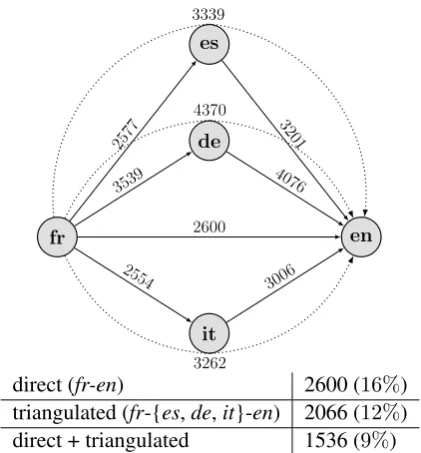
Figure 1 shows how triangulation can be useful in reducing the number of OOVs when translating from French to English through three pivot lan-guages: Spanish (es), German (de) and Italian (it). The solid lines show the number of OOVs for a direct MT system with regard to a multi-language parallel test set (Section 6.2 contains the details about the data sets) and the dotted lines show the OOVs in the triangulated (src pvt tgt) sys-tems. The number of OOVs on triangulated paths can never be less that the first edge (i.e.srcpvt) and it is usually higher than the second edge (i.e. pvttgt) as well. Thus, the choice of intermediate language is very important in triangulation.
languages will be more useful. In Figure 1, we can expect Italian (it) to help more than Spanish (es) and both to help more than German (de) in trans-lation from French (fr) to English (en), which we confirmed in our experimental results (Table 1).
In addition to providing translations for other-wise untranslatable phrases, triangulation can find new translations for current phrases. The condi-tional distributions used for the translation model have been estimated on small amounts of data and hence are not robust due to data sparseness. Using triangulation, these distributions are smoothed and become more reliable as a result.
For each pivot language for which there exists parallel data with the source and the target lan-guage, we can create asrctgtsystem by bridg-ing through the pivot language. If there are a number of such pivot languages with correspond-ing data, we can use mixture approaches to com-bine them in order to build a stronger model. We propose to apply the ensemble decoding approach of (Razmara et al., 2012) in this triangulation sce-nario. Ensemble decoding allows us to combine hypotheses from different models dynamically at the decoder. We experimented with 12 different language pairs and 3 pivot languages for each of them. Experimental results of this approach show significant improvements in the BLEU and ME-TEOR scores over the direct source-target system in all the12language pairs. We also compare to a strong linear mixture baseline.
2 Related Work
Use of pivot languages in machine translation dates back to the early days of machine transla-tion. Boitet (1988) discusses the choice of pivot languages, natural or artificial (e.g. interlingua), in machine translation. Schubert (1988) argues that a proper choice for an intermediate language for high-quality machine translation is a natural lan-guage due to the inherent lack of expressiveness in artificial languages. Previous work in applying pivot languages in machine translation can be cat-egorized into these divisions:
2.1 System Cascades
In this approach, a src pvt translation system translates the source input into the pivot language and a secondpvttgtsystem takes the output of the previous system and translates it into the tar-get language. Utiyama and Isahara (2007) use this
es
de
fr en
it
2577
3539
2554
2600 32
01
4076
3006 3339
4370
3262
direct (fr-en) 2600 (16%) triangulated (fr-{es,de,it}-en) 2066 (12%) direct + triangulated 1536 (9%)
Figure 1: Number of OOVs when translating di-rectly from fr to en (solid lines), triangulating through es, de or it individually (dotted lines), and when combining multiple triangulation sys-tems with the direct system. OOV numbers are based on a multi-language parallel test set and the models are built on small corpora (10k sentence pairs), which are not multi-parallel.
approach to triangulate between Spanish, German and French through English. However, instead of using only the best translation, they took the n-best translations and translated them into the target lan-guage. MERT (Och, 2003) has been used to tune the weights for the new feature set which consists ofsrcpvtandpvttgtfeature functions. The highest scoring sentence from the target language is used as the final translation. They showed that using15hypotheses in thepvtside is generally su-perior to using only one best hypothesis.
2.2 Corpus Synthesis
2.3 Phrase-Table Triangulation
In this approach, instead of translating the input sentences from a source language to a pivot lan-guage and from that to a target lanlan-guage, triangu-lation is done on the phrase level by triangulating two phrase-tables: srcpvtandpvttgt:
( ¯f ,e¯)∈TFE ⇐⇒
∃¯i: ( ¯f ,¯i)∈TFI
∧ (¯i,e¯)∈TIE
wheref ,¯¯iande¯are phrases in the sourceF, pivot I and targetE languages respectively and T is a set representing a phrase table.
Utiyama and Isahara (2007) also experimented with phrase-table triangulation. They compared both triangulation approaches when using Span-ish, French and German as the source and target languages and English as the only pivot language. They showed that phrase-table triangulation is su-perior to the MT system cascades but both of them did not outperform the directsrctgtsystem.
The phrase-table triangulation approach with multiple pivot languages has been also investi-gated in several work (Cohn and Lapata, 2007; Wu and Wang, 2007). These triangulated phrase-tables are combined together using linear and log-linear mixture models. They also successfully combined the mixed phrase-table with a src-tgt phrase-table to achieve a higher BLEU score.
Bertoldi et al. (2008) formulated phrase triangu-lation in the decoder where they also consider the phrase-segmentation model between src-pvt and the reordering model betweensrc-tgt.
Beside machine translation, the use of pivot lan-guages has found applications in other NLP ar-eas. Gollins and Sanderson (2001) used a similar idea in cross-lingual information retrieval where query terms were translated through multiple pivot languages to the target language and the trans-lations are combined to reduce the error. Pivot languages have also been successfully used in in-ducing translation lexicons (Mann and Yarowsky, 2001) as well as word alignments for resource-poor languages (Kumar et al., 2007; Wang et al., 2006). Callison-Burch et al. (2006) used pivot lan-guages to extract paraphrases for unknown words.
3 Baselines
In this paper, we compare our approach with two baselines. A simple baseline is the direct system
between the source and target languages which is trained on the same amount of parallel data as the triangulated ones. In addition, we implemented a phrase-table triangulation method (Cohn and Lap-ata, 2007; Wu and Wang, 2007; Utiyama and Isa-hara, 2007). This approach presents a probabilistic formulation for triangulation by marginalizing out the pivot phrases, and factorizing using the chain rule:
p(¯e|f¯) = X
¯i
p(¯e,¯i|f¯)
= X
¯i
p(¯e|¯i,f¯)p(¯i|f¯)
≈ X
¯i
p(¯e|¯i)p(¯i|f¯)
where f ,¯e¯ and¯i are phrases in the source, tar-get and intermediate language respectively. In this equation, a conditional independence assumption has been made that source f¯and target phrases ¯
eare independent given their corresponding pivot phrase(s)¯i. The equation requires that all phrases in thesrcpvtdirection must also appear inpvt tgt. All missing phrases are simply dropped from the final phrase-table.
Using this approach, a triangulated source-target phrase-table is generated for each pivot lan-guage. Then, linear and log-linear mixture meth-ods are used to combine these phrase-tables into a single phrase-table in order to be used in the decoder. We implemented the linear mixture ap-proach, since linear mixtures often outperform log-linear ones (Cohn and Lapata, 2007). We then compare the results of these baselines with our ap-proach over multiple language pairs (Section 6.2). In linear mixture models, each feature in the mix-ture phrase-table is computed as a linear interpo-lation of corresponding features in the component phrase-tables using a weight vector~λ.
p(¯e|f¯) = X i
λipi(¯e|f¯)
p( ¯f|e¯) = X i
λipi( ¯f|e¯)
∀ λi >1
X
i
λi = 1
4 Ensemble Decoding
SMT log-linear models (Koehn, 2010) find the most likely target language output e given the source language inputf using a vector of feature functionsφ:
p(e|f)∝expw·φ
Ensemble decoding combines several models dynamically at the decoding time. The scores are combined for each partial hypothesis using a user-defined mixture operationover component models.
p(e|f)∝expw1·φ1w2·φ2. . .
Razmara et al. (2012) successfully applied en-semble decoding to domain adaptation in SMT and showed that it performed better than ap-proaches that pre-compute linear mixtures of dif-ferent models. Several mixture operations were proposed, allowing the user to encode belief about the relative strengths of the component models. These mixture operations receive two or more probabilities and return the mixture probability
p(¯e|f¯) for each rulef¯→ e¯used in the decoder. Different options for these operations are:
• Weighted Sum (wsum)is defined as:
p(¯e|f¯) ∝ M X
m
λm exp wm ·φm
where m denotes the index of component models, M is the total number of them and
λmis the weight for componentm. • Weighted Max (wmax)is defined as:
p(¯e|f¯) ∝ max
m λm exp wm ·φm
• Model Switching (Switch): Each cell in the CKY chart is populated only by rules from one of the models and the other models’ rules are discarded. Each component model is con-sidered an expert on different spans of the source. A binary indicator function δ( ¯f , m) picks a component model for each span:
δ( ¯f , m) =
1, m= argmax
n∈M
ψ( ¯f , n)
0, otherwise
The criteria for choosing a model for each cell,ψ( ¯f , n), is based on max top score, i.e.
for each cell, the model that has the highest weighted best-rule score wins:
ψ( ¯f , n) =λnmax
e (wn ·φn(¯e,
¯f))
The probability of each phrase-pair(¯e,f¯) is then:
p(¯e|f¯) = M X
m
δ( ¯f , m)pm(¯e|f¯)
5 Our Approach
5.1 Dynamic Triangulation
Given a src pvt and a pvt tgt system which are independently trained and tuned on their cor-responding parallel data, these two systems can be triangulated dynamically in the decoder.
For each source phrasef¯, the decoder consults thesrc pvtsystem to get its translations on the pivot side¯iwith their scores. Consequently, each of these pivot-side translation phrases is queried from thepvt tgt system to obtain their transla-tions on the target side with their corresponding scores. Finally a ( ¯f , ¯e) pair is constructed from each ( ¯f ,¯i) and(¯i,e¯) pair, whose score is com-puted as:
pI( ¯f|e¯) ∝
max
¯i exp
w1. φ1( ¯f ,¯i)
| {z }
FI
+ w2. φ2(¯i , ¯e)
| {z }
IE
This method requires the language model score of the src pvt system. However for simplic-ity we do not use the pivot-side language mod-els and hence the score of the src pvt system does not include the language model and word penalty scores. In this formulation for a given source and target phrase pair ( ¯f , e¯), if there are multiple bridging pivot phrases¯i, we only use the one that yields the highest score. This is in contrast with previous work where they take the sum over all such pivot phrases (Cohn and Lapata, 2007; Utiyama and Isahara, 2007). We usemaxas it out-performssumin our preliminary experiments.
It is noteworthy that in computing the score for
pI( ¯f|e¯), the scores fromsrcpvtandpvttgt
A naive implementation of phrase-triangulation in the decoder would requireO(n2)steps for each source sub-span, where n is the average number of translation fan-out (i.e. possible translations) for each phrase. However, since the phrase can-didates from both srcpvt andpvt tgtare al-ready sorted, we use a lazy algorithm that reduces the computational complexity toO(n).
5.2 Combining Triangulated Systems
If we can make use of multiple pivot languages, a system can be created on-the-fly for each pivot language by triangulation and these systems can then be combined together in the decoder using ensemble decoding discussed in Section 4. Fol-lowing previous work, these triangulated phrase-tables can also be combined with the direct system to produce a yet stronger model. However, we do not combine them in two steps. Instead, all trian-gulated systems and the direct one are combined together in a single step.
Ensemble decoding is aware of full model scores when it compares, ranks and prunes hy-potheses. This includes the language model, word, phrase and glue rule penalty scores as well as stan-dard phrase-table probabilities.
Since ensemble decoding combines the scores of common hypotheses across multiple systems rather than combining their feature values as in mixture models, it can be used to triangulate het-erogeneous systems such as phrase-based, hierar-chical phrase-based, and syntax-based with com-pletely different feature types. Considering that ensemble decoding can be used in these diverse scenarios, it offers an attractive alternative to cur-rent phrase-table triangulation systems.
5.3 Tuning Component Weights
Component weights control the contribution of each model in the ensemble. A tuning proce-dure should assign higher weights to the models that produce higher quality translations and lower weights to weak models in order to control their noise propagation in the ensemble. In the ensem-ble decoder, since we do not have explicit gradient information for the objective function, we use a di-rect optimizer for tuning. We usedCondor (Van-den Berghen and Bersini, 2005) which is a pub-licly available toolkit based on Powell’s algorithm. The ensemble between three triangulated mod-els and a direct one requires tuning in a
4-dimensional space, one for each system. If, on average, the tuner evaluates the decoder n times in each direction in the optimization space, there needs to be n4 ensemble decoder evaluations, which is very time consuming. Instead, we re-sorted to a simpler approach for tuning: each tri-angulated model is separately tuned against the di-rect model with a fixed weights (we used a weight of 1). In other words, three ensemble models are created, each on a single triangulated model plus the direct one. These ensembles are separately tuned and once completed, these weights comprise the final tuned weights. Thus, the total number of ensemble evaluations reduces from O(n4) to
O(3n).
In addition to this significant complexity reduc-tion, this method enables parallelism in tuning, since the three individual tuning branches can now be run independently. The final tuned weights are not necessarily a local optima and one can run fur-ther optimization steps around this point to get to even better solutions which should lead to higher BLEU scores.
6 Experiments & Results
6.1 Experimental Setup
For our experiments, we used the Europarl cor-pus (v7) (Koehn, 2005) for training sets and ACL/WMT 20051 data for dev/test sets (2k sen-tence pairs) following Cohn and Lapata (2007). Our goal in this paper was to understand how multiple languages can help in triangulation, the improvement in coverage of the unseen data due to triangulation, and the importance of choosing the right languages as pivot languages. Thus, we needed to run experiments on a large number of language pairs, and for each language pair we wanted to work with many pivot languages. To this end, we created small sub-corpora from Eu-roparl by sampling 10,000 sentence pairs and con-ducted our experiments on them. As we will show, using larger data than this would result in pro-hibitively large triangulated phrase tables. Table 2 shows the number of words on both sides of used language pairs in our corpora.
The ensemble decoder is built on top of an in-house implementation of a Hiero-style MT sys-tem (Chiang, 2005) called Kriya (Sankaran et al., 2012). This Hiero decoder obtains BLEU
1
src↓ tgt→
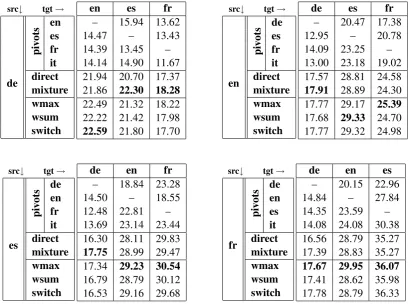
Table 1: Results of i) single-pivot triangulation; ii) baseline systems including direct systems and linear mixture of triangulated phrase-tables; iii) ensemble triangulation results based on different mixture op-erations. The mixture and ensemble methods are based on multi-pivot triangulation. These methods are built on 10k sentence-pair corpora.
L1-L2 L1tokens (K) L2tokens (K)
Table 2: Number of tokens in each language pair in the training data.
scores equal to or better than the state-of-the-art in phrase-based and hierarchical phrase-based trans-lation over a wide variety of language pairs and data sets. It uses the following standard fea-tures: forward and backward relative-frequency and lexical TM probabilities; LM; word, phrase and glue-rules penalty. GIZA++ (Och and Ney,
2000) has been used for word alignment with phrase length limit of10. In both systems, feature weights were optimized using MERT (Och, 2003). We used the target sides of the Europarl corpus (2M sentences) to build 5-gram language models and smooth them using the Kneser-Ney method. We used SRILM (Stolcke, 2002) as the language model toolkit.
6.2 Results
op-90 92 94 96 98
de - en
de - es
de - fr
en - de
en - es
en - fr
es - de
es - en
es - fr
fr - de
fr - en
fr - es
Coverage (%)
direct triangulated(3) triangulated(3) + direct
direct 478K 393K 403K 665K 1,084K 1,155K 479K 927K 1,319K 394K 743K 976K tri + direct 83M 102M 132M 113M 103M 133M 129M 101M 152M 141M 109M 129M
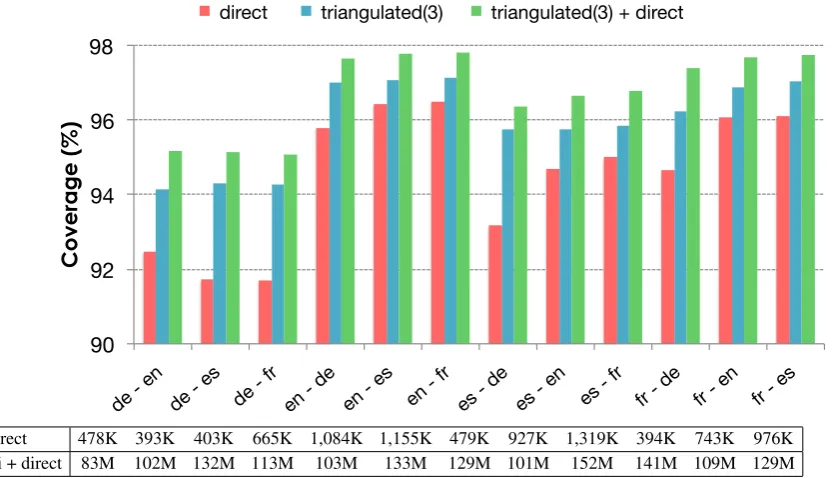
Figure 2: Coverage for i) direct system; ii) combined triangulated system with three3languages; and iii) the combination of the triangulated phrase-tables and the direct one. The table shows the number of rules for each system and language pair after filtering based on the source side of the test set.
erations are illustrated at the bottom.
As the table shows, our approach outperforms the direct systems in all the 12 language pairs while the mixture model systems fail to improve over the direct system baseline for some of the language pairs. Our approach also outperforms the mixture models in most cases. Overall, en-semble decoding with wmax as mixture opera-tion performs the best among the different systems and baselines. Figure 3 shows the average of the BLEU score of the direct system, mixture models andwmaxon all12systems. On average thewmax method obtains0.33BLEU points higher than the mixture models.
24.6 24.27 23.82
22.5 23 23.5 24 24.5
ensemble (wmax)
mixture direct
BLEU
Figure 3: The average BLEU scores of the direct system, mixture models andwmaxensemble trian-gulation approach over all12language pairs.
We also computed the Meteor scores (Denkowski and Lavie, 2011) for all systems
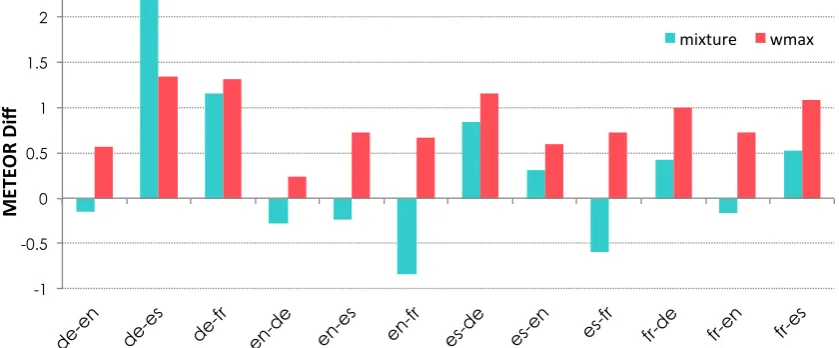
and the results are summarized in Figure 4. As the figure illustrates, our ensemble decoding approach withwmaxoutperforms the mixture models in11 of12language pairs based on Meteor scores.
6.3 Phrase table coverage
-1 -0.5 0 0.5 1 1.5 2
de-e n
de-e s
de-fr en-de en-e s
en-fr es-de es-en es-fr fr-de fr-en fr-es
ME
TE
O
R
D
iff
mixture wmax
Figure 4: Meteor score difference between mixture models and direct systems as well as the difference between ensemble decoding approach withwmaxand the direct system.
6.3.1 Choice of Pivot Language
Cohn and Lapata (2007) showed that the pivot lan-guage should be close to the source or the tar-get language in order to be effective. For exam-ple, when translating between Romance languages (Italian, Spanish, etc.), the pivot language should also be a Romance language. In addition to those findings, based on the results presented in Table 1, here are some observations for these five European languages:
• When translating from or tode,enis the best pivot language;
• Generallydeis not a suitable pivot language for any translation pair;
• When translating from en to any other lan-guage,fris the best pivot;
• it is the best intermediate language when translating from fr oresto other languages; except when translating todefor whichenis the best pivot language (c.f. first finding);
7 Conclusion and Future Work
In the paper, we introduced a novel approach for triangulation which does phrase-table triangula-tion and model combinatriangula-tion on-the-fly in the de-coder. Ensemble decoder uses the full hypothesis score for triangulation and combination and hence is able to mix hypotheses from heterogeneous sys-tems.
Another advantage of this method to the phrase-table triangulation approach is that our method is
applicable even when there exists no parallel data between source and target languages for tuning be-cause we only use the src-tgt tuning set to opti-mize hyper-parameters, though phrase-table trian-gulation methods use it to learn MT log-linear fea-ture weights for which having a tuning set is much more essential. Empirical results also showed that this method withwmaxoutperforms the baselines. Future work includes imposing restrictions on the generated triangulated rules in order to keep only ones that have a strong support from the word alignments. By exploiting such constraints, we can experiment with larger sizes of parallel data. Specifically, a more natural experimental setup for triangulation which we would like to try is to use a small direct system with big src pvtand pvt
tgtsystems. This resembles the actual situation
for resource-poor language pairs. We will also ex-periment with higher number of pivot languages.
Currently, most research in this area focuses on triangulation on paths containing only one pivot language. We can also analyze our method when using more languages in the triangulation chain and see whether there would any gain in doing such.
References
N. Bertoldi, M. Barbaiani, M. Federico, and R. Cattoni. 2008. Phrase-based statistical machine translation with pivot languages. Proceeding of IWSLT, pages 143–149.
C. Boitet. 1988. Pros and cons of the pivot and trans-fer approaches in multilingual machine translation.
Maxwell et al.(1988), pages 93–106.
C. Callison-Burch, P. Koehn, and M. Osborne. 2006. Improved statistical machine translation using para-phrases. In Proceedings of the main conference on Human Language Technology Conference of the North American Chapter of the Association of Com-putational Linguistics, pages 17–24. Association for Computational Linguistics.
David Chiang. 2005. A hierarchical phrase-based model for statistical machine translation. In ACL ’05: Proceedings of the 43rd Annual Meeting on As-sociation for Computational Linguistics, pages 263– 270, Morristown, NJ, USA. ACL.
Trevor Cohn and Mirella Lapata. 2007. Machine translation by triangulation: Making effective use of multi-parallel corpora. InProceedings of the 45th Annual Meeting of the Association of Computational Linguistics, pages 728–735, Prague, Czech Repub-lic, June. Association for Computational Linguis-tics.
A. de Gispert and J.B. Marino. 2006. Catalan-english statistical machine translation without parallel cor-pus: bridging through spanish. InProc. of 5th In-ternational Conference on Language Resources and Evaluation (LREC), pages 65–68.
Michael Denkowski and Alon Lavie. 2011. Meteor 1.3: Automatic Metric for Reliable Optimization and Evaluation of Machine Translation Systems. In
Proceedings of the EMNLP 2011 Workshop on Sta-tistical Machine Translation.
T. Gollins and M. Sanderson. 2001. Improving cross language retrieval with triangulated translation. In
Proceedings of the 24th annual international ACM SIGIR conference on Research and development in information retrieval, pages 90–95. ACM.
Martin Kay. 1997. The proper place of men and ma-chines in language translation. Machine Transla-tion, 12(1/2):3–23.
P. Koehn. 2005. Europarl: A parallel corpus for statis-tical machine translation. InMT summit, volume 5.
Philipp Koehn. 2010. Statistical Machine Translation. Cambridge University Press, New York, NY, USA, 1st edition.
Shankar Kumar, Franz Josef Och, and Wolfgang Macherey. 2007. Improving word alignment with bridge languages. InEMNLP-CoNLL, pages 42–50. ACL.
Gideon S. Mann and David Yarowsky. 2001. Mul-tipath translation lexicon induction via bridge lan-guages. In Proceedings of the second meeting of the North American Chapter of the Association for Computational Linguistics on Language technolo-gies, NAACL ’01, pages 1–8, Stroudsburg, PA, USA.
F. J. Och and H. Ney. 2000. Improved statistical align-ment models. InProceedings of the 38th Annual Meeting of the ACL, pages 440–447, Hongkong, China, October.
Franz Josef Och. 2003. Minimum error rate training for statistical machine translation. InProceedings of the 41th Annual Meeting of the ACL, Sapporo, July. ACL.
Majid Razmara, George Foster, Baskaran Sankaran, and Anoop Sarkar. 2012. Mixing multiple transla-tion models in statistical machine translatransla-tion. InThe 50th Annual Meeting of the Association for Compu-tational Linguistics, Proceedings of the Conference, July 8-14, 2012, Jeju Island, Korea - Volume 1: Long Papers, pages 940–949. The Association for Com-puter Linguistics.
Baskaran Sankaran, Majid Razmara, and Anoop Sarkar. 2012. Kriya – an end-to-end hierarchical phrase-based mt system. The Prague Bulletin of Mathematical Linguistics, 97(97), April.
K. Schubert. 1988. Implicitness as a guiding principle in machine translation. InProceedings of the 12th conference on Computational linguistics-Volume 2, pages 599–601. Association for Computational Lin-guistics.
Andreas Stolcke. 2002. SRILM – an extensible lan-guage modeling toolkit. In Proceedings Interna-tional Conference on Spoken Language Processing, pages 257–286.
M. Utiyama and H. Isahara. 2007. A comparison of pivot methods for phrase-based statistical machine translation. In Proceedings of NAACL-HLT, vol-ume 7, pages 484–491.
Frank Vanden Berghen and Hugues Bersini. 2005. CONDOR, a new parallel, constrained extension of powell’s UOBYQA algorithm: Experimental results and comparison with the DFO algorithm.Journal of Computational and Applied Mathematics, 181:157– 175, September.
H. Wang, H. Wu, and Z. Liu. 2006. Word alignment for languages with scarce resources using bilingual corpora of other language pairs. InProceedings of the COLING/ACL on Main conference poster ses-sions, pages 874–881. Association for Computa-tional Linguistics.