A Study of using Syntactic and Semantic Structures
for Concept Segmentation and Labeling
Iman Saleh∗, Shafiq Joty, Llu´ıs M`arquez,
Alessandro Moschitti, Preslav Nakov ALT Research Group
Qatar Computing Research Institute {sjoty,lmarquez,amoschitti,pnakov}
@qf.org.qa
Scott Cyphers, Jim Glass MIT CSAIL
Cambridge, Massachusetts 02139 USA
{cyphers,glass}@mit.edu
Abstract
This paper presents an empirical study on using syntactic and semantic information for Concept Segmentation and Labeling (CSL), a well-known component in spoken language understand-ing. Our approach is based on rerankingN-best outputs from a state-of-the-art CSL parser. We perform extensive experimentation by comparing different tree-based kernels with a variety of representations of the available linguistic information, including semantic concepts, words, POS tags, shallow and full syntax, and discourse trees. The results show that the structured representa-tion with the semantic concepts yields significant improvement over the base CSL parser, much larger compared to learning with an explicit feature vector representation. We also show that shallow syntax helps improve the results and that discourse relations can be partially beneficial.
1 Introduction
Spoken Language Understanding aims to interpret user utterances and to convert them to logical forms, or, equivalently, database queries, which can then be used to satisfy the user’s information needs. This process is known as Concept Segmentation and Labeling (CSL): it maps utterances into meaning repre-sentations based on semantic constituents. The latter are basically sequences of semantic entities, often referred to as concepts, attributes or semantic tags. Traditionally, grammar-based methods have been used for CSL, but more recently machine learning approaches to semantic structure computation have been shown to yield higher accuracy. However, most previous work did not exploit syntactic/semantic structures of the utterances, and the state-of-the-art is represented by conditional models for sequence la-beling, such as Conditional Random Fields (Lafferty et al., 2001) trained with simple morphological and lexical features. In our study, we measure the impact of syntactic and discourse structures by also com-bining them with innovative features. In the following subsections, we present the application context for our CSL task and then we outline the challenges and the findings of our research.
1.1 Semantic parsing for the “restaurant” domain
We experiment with the dataset of McGraw et al. (2012), containing spoken and typed questions about restaurants, which are to be answered using a database of free text such as reviews, categorical data such as names and locations, and semi-categorical data such as user-reported cuisines and amenities.
Semantic parsing, in the form of sequential segmentation and labeling, makes it easy to convert spoken and typed questions such as “cheap lebanese restaurants in doha with take out” into database queries. First, a language-specific semantic parser tokenizes, segments and labels the question:
[Pricecheap] [Cuisinelebanese] [Otherrestaurants in] [Citydoha] [Otherwith] [Amenitytake out]
Then, label-specific normalizers are applied to the segments, with the option to possibly relabel mis-labeled segments; at this point, discourse history may be incorporated as well.
[Pricelow] [Cuisinelebanese] [Citydoha] [Amenitycarry out]
∗
Iman Saleh ([email protected]) is affiliated to Faculty of Computers and Information, Cairo University.
This work is licensed under a Creative Commons Attribution 4.0 International Licence. Page numbers and proceedings footer are added by the organisers. Licence details: http://creativecommons.org/licenses/by/4.0/
Finally, a database query is formed from the list of labels and values, and is then executed against the database, e.g., MongoDB; a backoff mechanism may be used if the query does not succeed.
{$and [{cuisine:"lebanese"}, {city:"doha"}, {price:"low"}, {amenity:"carry out"}]}
1.2 Related work on CSL
Pieraccini et al. (1991) used Hidden Markov Models (HMMs) for CSL, where the observations were word sequences and the hidden states were meaning units, i.e,concepts. In subsequent work (Rubinstein and Hastie, 1997; Santaf´e et al., 2007; Raymond and Riccardi, 2007; De Mori et al., 2008), other genera-tive models were applied, which model the joint probability of a word sequence and a concept sequence, as well as discriminative models, which directly model a conditional probability over the concepts in the input text.
Seneff (1989) and Miller et al. (1994) used stochastic grammars for CSL. In particular, they applied stochastic Finite State Transducers (FST) for recognizing constituent annotations. FSTs describe local syntactic structures with a sequence of words, e.g., noun phrases or even constituents. Papineni et al. (1998) proposed and evaluated exponential models, but, nowadays, Conditional Random Fields (Lafferty et al., 2001) are considered to be the state-of-the-art. More recently, Wang et al. (2009) illustrated an approach for CSL that is specific to query understanding for web applications. A general survey of CSL approaches can be found in (De Mori et al., 2008). CSL is also connected to a large body of work on shallow semantic parsing; see (Gildea and Jurafsky, 2002; M`arquez et al., 2008) for an overview.
Another relevant line of research with a considerable body of work is reranking in NLP. Tree kernels for reranking syntactic parse trees were first proposed in (Collins and Duffy, 2002). Some variants used explicit spaces (Kudo et al., 2005), and feature vector approaches were proposed in (Koo and Collins, 2005). Other reranking work using tree kernels regards predicate argument structures (Moschitti et al., 2006) and named entities (Nguyen and Moschitti, 2012). In (Dinarelli et al., 2011), we rerank CSL hypotheses using structures built on top of concepts, words and features that are simpler than those studied in this paper. The work of Ge and Mooney (2006) and Kate and Mooney (2006) is also similar to ours, as it models the extraction of semantics as a reranking task using string kernels.
1.3 Syntactic and semantic structures for CSL
The related work has highlighted that automatic CSL is mostly based on powerful machine learning al-gorithms and simple feature representations based on word and tagn-grams. In this paper, we study the impact of more advanced linguistic processing on CSL, such as shallow and full syntactic parsing and discourse structure. We use a reranking approach to select the best hypothesis annotated with concepts derived by a local model, where the hypotheses are represented as trees enriched with semantic con-cepts similarly to (Dinarelli et al., 2011). These tree-based structures can capture dependencies between sentence constituents and concepts. However, extracting features from them is rather difficult as their number is exponentially large. Thus, we rely on structural kernels (e.g., see (Moschitti, 2006)) for au-tomatically encoding tree fragments, which represent syntactic and semantic dependencies from words and concepts, and we train the reranking functions with Support Vector Machines (e.g., see (Joachims, 1999)). Additionally, we experiment with several types of kernels and newly designed feature vectors.
2 CSL reranking
Reranking is based on a list ofN annotation hypotheses, which are generated and sorted by probability using local classifiers. Then a reranker, typically a meta-classifier, tries to select the best hypothesis from the list. The reranker can exploit global information, and, specifically, the dependencies between the different concepts that are made available by the local model. We use semi-CRF as our local model since it yields the highest accuracy in CSL (when using a single model), and preference reranking with kernel machines to rerank theN hypotheses generated by the semi-CRF.
2.1 Basic parser using semi-CRF
We use a semi-Markov CRF (Sarawagi and Cohen, 2004), or semi-CRF, a variation of a linear-chain CRF (Lafferty et al., 2001), to produce theN-best list of labeled segment hypotheses that serve as the input to reranking. In a linear-chain CRF, with a sequence of tokens x and labelsy, we approximate
p(y|x) as a product of factors of the form p(yi|yi−1, x), which corresponds to features of the form
fj(yi−1, yi, i, x), whereiiterates over the token/label positions. This supports a Viterbi search for the
approximateNbest values ofy. WithMlabel values, if for each labelymwe know the bestNsequences
of labelsy1, y2, . . . , yi−1 = ym, then we can usep(yi|yi−1, x)to get the probability for extending each path by each possible labelyi =ym0 . Then for each labelym0 , we will haveMN paths and scores, one
from each of the paths of lengthi−1ending withym. For eachy0m, we pick theN best extended paths.
With semi-CRF, we want a labeled segmentation srather than a sequence of labels. Each segment
si = (yi, ti, ui) has a label yi as well as a starting and ending token position for the segment, ti and ui respectively, whereui + 1 = ti+1. We approximatep(s|x), with factors of the formp(si|si−1, x), which we simplify top(yi, ui|yi−1, ti), so features take the formfj(yi−1, yi, ti, ui), i.e., they can use the
previous segment’s label and the current segment’s label and endpoints. The Viterbi search is extended to search for a pair of label and segment end. Whereas forM labels we kept track ofMN paths, we must keep track ofMLN paths, whereLis the maximum segment length.
We use tokenn-gram features relative to the segment boundaries,n-grams within the segment, token regular expression and lexicon features within a segment. Each of these features also includes the labels of the previous and current segment, and the segment length.
2.2 Preference reranking with kernel machines
Preference reranking (PR) uses a classifier C of pairs of hypotheseshHi, Hji, which decides if Hi is
better thanHj. Given each training question Q, positive and negative examples are generated for training
the classifier. We adopt the following approach for example generation: the pairshH1, Hii constitute
positive examples, where H1 has the lowest error rate with respect to the gold standard among the hypotheses for Q, and vice versa,hHi, H1iare considered as negative examples. At testing time, given a new question Q0, C classifies all pairs hHi, Hji generated from the annotation hypotheses of Q0: a positive classification is a vote forHi, otherwise the vote is forHj. Also, the classifier score can be used
as a weighted vote.Hkare then ranked according to the number (sum) of the (weighted) votes they get.
We build our reranker with kernel machines. The latter, e.g., SVMs, classify an input objectousing the following function: C(o) = PiαiyiK(o, oi), whereαi are model parameters estimated from the
training data, oi are support objects and yi are the labels of the support objects. K(·,·) is a kernel
function, which computes the scalar product between the two objects in an implicit vector space. In the case of the reranker, the objectsoarehHi, Hji, and the kernel is defined as follow:
K(hH1, H2i,hH10, H20i) =S(H1, H10) +S(H2, H20)−S(H1, H20)−S(H2, H10).
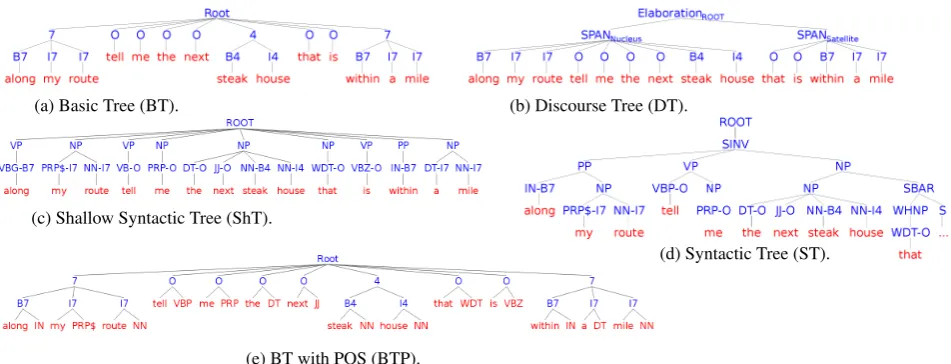
(a) Basic Tree (BT). (b) Discourse Tree (DT).
(c) Shallow Syntactic Tree (ShT).
(d) Syntactic Tree (ST).
[image:4.595.64.540.60.242.2](e) BT with POS (BTP).
Figure 1: Syntactic/semantic trees. The numeric semantic tagset is defined in Table 7.
3 Structural kernels for semantic parsing
In this section, we briefly describe the kernels we use inS(H, H0)for preference reranking. We engineer them by combining three aspects: (i)different types of existing tree kernels,(ii)new syntactic/semantic structures for representing CSL, and(iii)new feature vectors.
3.1 Tree kernels
Structural kernels, e.g., tree and sequence kernels, measure the similarity between two structures in terms of their shared substructures. One interesting aspect is that these kernels correspond to a scalar product in the fragment space, where each substructure is a feature. Therefore, they can be used in the training and testing algorithms of kernel machines (see Section 2.2). Below, we briefly describe different types of kernels we tested in our study, which are made available in the SVM-Light-TK toolkit (Moschitti, 2006). Subtree Kernel (K0)is one of the simplest tree kernels, as it only generates complete subtrees, i.e., tree fragments that, given any arbitrary starting node, necessarily include all its descendants.
Syntactic Tree Kernel (K1), also known as a subset tree kernel (Collins and Duffy, 2002), maps ob-jects in the space of all possible tree fragments constrained by the rule that the sibling nodes cannot be separated from their parents. In other words, substructures are composed of atomic building blocks corresponding to nodes, along with all of their direct children. In the case of a syntactic parse tree, these are complete production rules for the associated parser grammar.
Syntactic Tree Kernel + BOW (K2)extends ST by allowing leaf nodes to be part of the feature space. The leaves of the trees correspond to words, i.e., we allow bag-of-words (BOW).
Partial Tree Kernel (K3)can be effectively applied to both constituency and dependency parse trees. It generates all possible connected tree fragments, e.g., sibling nodes can be also separated and be part of different tree fragments. In other words, a fragment is any possible tree path from whose nodes other tree paths can depart. Thus, it can generate a very rich feature space.
Sequence Kernel (K4)is the traditional string kernel applied to the words of a sentence. In our case, we apply it to the sequence of concepts.
3.2 Semantic/syntactic structures
As mentioned before, tree kernels allow us to compute structural similarities between two trees without explicitly representing them as feature vectors. For the CSL task, we experimented with a number of tree representations that incorporate different levels of syntactic and semantic information.
However, part-of-speech (POS) and phrasal information could be informative for both segmentation and labeling in semantic parsing. To incorporate this information, we use two extensions of the basic tree: one that includes the POS tags of the words (Figure 1e), and another one that includes both POS tags and syntactic chunks (Figure 1c). The POS tags are children of the semantic tags, whereas the chunks (i.e., phrasal information) are included as parents of the semantic tags.
We also experiment with full syntactic trees (Figure 1d) to see the impact of deep syntactic informa-tion. The semantic tags are attached to the pre-terminals (i.e., POS tags) in the syntactic tree. We use the Stanford POS tagger and syntactic parser and the Twitter NLP tool1for the shallow trees.
A sentence containing multiple clauses exhibits a coherence structure. For instance, in our example, the first clause“along my route tell me the next steak house”iselaboratedby the second clause“that is within a mile”. The relations by which clauses in a text are linked are calledcoherencerelations (e.g.,
Elaboration, Contrast). Discourse structures capture this coherence structure of text and provide addi-tional semantic information that could be useful for the CSL task (Stede, 2011). To build the discourse structure of a sentence, we use a state-of-the-art discourse parser (Joty et al., 2012) which generates discourse trees in accordance with the Rhetorical Structure Theory of discourse (Mann and Thompson, 1988), as exemplified in Figure 1b. Notice that a text span linked by a coherence relation can be either a
nucleus(i.e., the core part) or asatellite(i.e., a supportive one) depending on how central the claim is. 3.3 New features
In order to compare to the structured representation, we also devoted significant effort towards engineer-ing a set of features to be used in a flat feature-vector representation; they can be used in isolation or in combination with the kernel-based approach (as a composite kernel using a linear combination): CRF-based: these include the basic features used to train the initial semi-CRF model (cf. Section 2.1).
n-gram based: we collected 3- and 4-grams of the output label sequence at the level of concepts, with artificial tags inserted to identify the start (‘S’) and end (‘E’) of the sequence.2
Probability-based: two features computing the probability of the label sequence as an average of the probabilities at the word levelp(li|wi)(i.e., assuming independence between words). Theunigram
prob-abilities are estimated by frequency counts using maximum likelihood in two ways:(i)from the complete 100-best list of hypotheses;(ii)from the training set (according to the gold standard annotation). DB-based: a single feature encoding the number of results returned from the database when constructing a query using the conjunction of all semantic segments in the hypothesis. Three possible values are considered by using a thresholdt: 0 (if the query result is void), 1 (if the number of results is in[1, t]), and 2 (if the number of results is greater thant). In our case,tis empirically set to 10,000.
4 Experiments
The experiments aim at investigating which structures, and thus which linguistic models and combination with other models, are the most appropriate for our reranker. We first calculate theoracleaccuracy in order to compute an upper bound of the reranker. Then we present experiments with the feature vectors, tree kernels, and representations of linguistic information introduced in the previous sections.
4.1 Experimental setup
In our experiments, we use questions annotated with semantic tags in the restaurant domain,3which were collected by McGraw et al. (2012) through crowdsourcing on Amazon Mechanical Turk.4 We split the dataset into training, development and test sets. Table 1 shows statistics about the dataset and about the size of the parts we used for training, development and testing (see the semi-CRF line).
We subsequently split the training data randomly into ten folds. We generated the N-best lists on the training set in a cross-validation fashion, i.e., iteratively training on nine folds and annotating the remaining fold. We computed the 100-best hypotheses for each example.
1Available fromhttp://nlp.stanford.edu/software/index.shtmlandhttps://github.com/aritter/twitter nlp, respectively. 2For instance, if the output sequence isOther-Rating-Other-Amenitythe 3-gram patterns would be:S-Rating,
Other-Rating-Other, Rating-Other-Amenity, andOther-Amenity-E. 3http://www.sls.csail.mit.edu/downloads/restaurant
4We could not use the datasets used by Dinarelli et al. (2011), because they use French and Italian corpora for which there
Train Devel. Test Total
semi-CRF 6,922 739 1,521 9,182 Reranker 28,482 3,695 7,605 39,782 Table 1: Number of instances and pairs used to train the semi-CRF and rerankers, respectively.
N 1 2 5 10 100
[image:6.595.78.269.63.95.2]F1 83.03 87.76 92.63 95.23 98.72
Table 2: Oracle F1-score forN-best lists of different lengths.
We used the development set to experiment and tune the hyper-parameters of the reranking model. The results on the development set presented in Section 4.2 were obtained by semi-CRF and reranking models learned on the training set. The results on the test set were obtained by models trained on the training plus development sets. Similarly, theN-best lists for the development and test sets were generated using a single semi-CRF model trained on the training set and the training+development sets, respectively.
Each generated hypothesis is represented using a semantic tree and a feature vector (explained in Section 3) and two extra features accounting for (i) the semi-CRF probability of the hypothesis, and
(ii)the hypothesis reciprocal rank in theN-best list. SVM-Light-TK5is used to train the reranker with a combination of tree kernels and feature vectors (Moschitti, 2006; Joachims, 1999). Although we tried several parameters on the validation set, we observed that the default values yielded the highest results. Thus, we used the default c(trade-off) and tree kernel parameters and a linear kernel for the feature vectors. Table 1 shows the sizes of the train, the development and the test sets used for the semi-CRF as well as the number of pairs generated for the reranker. As a baseline, we picked the best-scored hypothesis in the list, according to the semi-CRF tagger. The evaluation measure used in all the experiments is the harmonic mean of precision and recall, i.e., the F1-score (van Rijsbergen, 1979), computed at the token level and micro-averaged over the different semantic types.6 We used paired t-test to measure the statistical significance of the improvements: we split the test set into31 equally-sized samples and performed t-tests based on the F1-scores of different models on the resulting samples. 4.2 Results
Oracle accuracy. Table 2 shows the oracle F1-score for N-best lists of different lengths, i.e., which can be achieved by picking the best candidate of theN-best list for various values ofN. We can see that going to 5-best increases the oracle F1-score by almost ten points absolute. Going down to 10-best only adds 2.5 extra F1points absolute, and a 100-best list adds 3.5 F1points more to yield a respectable F1-score of 98.72. This high result can be explained considering that the size of the complete hypothesis set is smaller than 100 for most questions. Thus, we can conclude that theN-best lists do include many good options and do offer quite a large space for potential improvement. We can further observe that going to 5-best lists offers a good balance between the length of the list and the possibility to improve F1-score: generally, we do not want too long N-best lists since they slow down computation and also introduce more opportunities to make the wrong choice for a reranker (since there are just more candidates to choose from). In our experiments with largerN, we observed improvements only for 10 and only on the development set; thus, we will focus on 5-best lists in our experiments below.
K0 K1 K2 K3 K4
[image:6.595.203.395.577.610.2]Dev 84.21 82.92 83.07 85.07 83.78 Test 84.08 83.19 83.20 84.61 82.93
Table 3: Results for using different tree kernels on the basic tree (BT) representation.
Choosing the best tree kernel. We first select the most appropriate tree kernel to limit the number of experiment variables. Table 3 shows the results of different tree kernels using the basic tree (BT) representation (see Figure 1a). We can observe that for both the development set and the test set, kernel K3 (see Section 3.1) yields the highest F1-score.
Impact of feature vectors. Table 4 presents the results for the feature vector experiments in terms of F1-scores and relative error reductions (row RER). The first column shows the baseline, when no reranking is used; the following four columns contain the results when using vectors including different
5http://disi.unitn.it/moschitti/Tree-Kernel.htm
6‘Other’ is not considered a semantic type, thus ‘Other’ tokens are not included in the F
Baseline n-grams CRF features Count DB ProbBased AllFeat
Dev 83.86 83.79 83.96 83.80 83.86 83.87 84.49
RER -0.4 0.6 -0.4 0.0 0.0 3.9
Test 83.03 82.90 83.44 82.90 83.01 83.09 83.86
[image:7.595.125.473.66.120.2]RER -0.7 2.4 -0.7 -0.1 0.3 4.8
Table 4: Feature vector experiments:F1 score and relative error reduction (in %).
Combining AllFeat and
Baseline BT BTP ShT ST AllFeat +BT +ShT +ShT +BT
Dev 83.86 85.07 85.41 85.06 84.30 84.49 85.57 85.58 85.33
RER 7.5 9.6 7.4 2.8 3.9 10.6 10.7 9.1
Test 83.03 84.61 84.63 84.07 83.81 83.86 84.67 84.79 84.76
RER 9.3 9.4 6.1 4.5 4.8 9.6 10.2 10.2
p.v. 0.00049 0.0002 0.012 0.032 0.00018 0.00028 0.00004 0.000023 Table 5: Tree kernel experiments:F1-score, relative error reduction (in %), andp-values.
kinds of features: (i) n-gram features, (ii)all features used by the semi-CRF,(iii)count features, and
(iv) database (DB) features. In each case, we include two additional features: the semi-CRF score (i.e., the probability) and the reciprocal rank of the hypothesis in theN-best list. Among(i)–(iv), only the semi-CRF features seem to help; the rest either show no improvements or degrade the performance. However, putting all these features together (AllFeat) yields sizable gains in terms of F1-score and a relative error reduction of 4-5%; the improvement is statistically significant, and it is slightly larger on the test dataset compared to the development dataset.
Impact of structural kernels and combinations. Table 5 shows the results when experimenting with various tree structures (see columns 2-5): (i) the basic tree (BT), (ii) the basic tree augmented with part-of-speech information (BTP), (iii) shallow syntactic tree (ShT), and (iv) syntactic tree (ST). We can see that the basic tree works rather well, yielding +1.6 F1-score on the test dataset, but adding POS information can help a bit more, especially for the tuning dataset. Interestingly, the syntactic tree kernels, ShT and ST, perform worse than BT and BTP, especially on the test dataset. The last three columns in the table show the results when we combine the AllFeat feature vector (see Table 4) with BT and ShT. We can see that combining AllFeat with ShT works better, on both development and test sets, than combining it with BT or with both ShT and BT. Also note the big jump in performance from AllFeat to AllFeat+ShT. Overall, we can conclude that shallow syntax has a lot to offer over AllFeat, and it is preferable over BT in the combination with AllFeat. The improvements reported in Tables 5 and 6 are statistically significant when compared to the semi-CRF baseline as shown by the p.v. (value) row. Moreover, the improvement of AllFeat + ShT over BT is also statistically significant (p.v.<0.05).
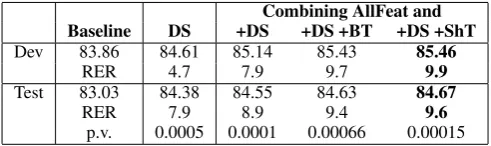
Combining AllFeat and Baseline DS +DS +DS +BT +DS +ShT
Dev 83.86 84.61 85.14 85.43 85.46
RER 4.7 7.9 9.7 9.9
Test 83.03 84.38 84.55 84.63 84.67
RER 7.9 8.9 9.4 9.6
[image:7.595.176.422.540.613.2]p.v. 0.0005 0.0001 0.00066 0.00015
Tag ID Other Rating Restaurant Amenity Cuisine Dish Hours Location Price
0 Other 8260 35 43 110 15 19 55 113 9
1 Rating 29 266 0 14 3 6 0 0 8
2 Restaurant 72 6 657 20 19 15 0 5 0
3 Amenity 117 9 10 841 27 27 7 12 7
4 Cuisine 36 2 12 26 543 44 3 1 0
5 Dish 23 0 4 20 33 324 1 4 0
6 Hours 61 0 1 2 6 1 426 9 1
7 Location 104 1 14 20 2 1 1 1457 0
[image:8.595.127.472.62.145.2]8 Price 22 1 0 7 0 2 0 1 204
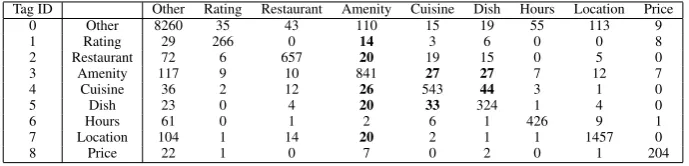
Table 7: Confusion matrix for the output of the best performing system. 4.3 Error analysis and discussion
Table 7 shows the confusion matrix for our best-performing modelAllFeat+ShT (rows = gold standard tags; columns = system predicted tags). Given the good results of the semantic parser, the numbers in the diagonal are clearly dominating the weight of the matrix. The largest errors correspond to missed (first column) and over-generated (first row) entity tokens. Among the proper confusions between semantic types, Dish andCuisine tend to mislead each other most. This is due to the fact that these two tags are semantically similar, thus making them hard to distinguish. We can also notice that it is difficult to identifyAmenitycorrectly, and the model mistakenly tags many other tags asAmenity. We looked into some examples to further investigate the errors. Our findings are as follow:
Inaccuracies and inconsistencies in human annotations. Since the annotations were done in Me-chanical Turk, they have many inaccuracies and inconsistencies. For example, the word good with exactly the same sense was tagged as bothOtherandRatingby the Turkers in the following examples:
Gold:[Otherany good] [Pricecheap] [Cuisinegerman] [Otherrestaurants] [Locationnearby]
Model:[Otherany] [Ratinggood] [Pricecheap] [Cuisinegerman] [Otherrestaurants] [Locationnearby]
Gold:[Otherany place] [Locationalong the road] [Otherhas a] [Ratinggood] [Dishbeer] [Otherselection that also serves] ... Requires lexical semantics and more coverage. In some cases our model fails to generalize well. For instance, it fails to correctly tagestablishmentsandtamelesfor the following examples. This suggests that we need to consider other forms of semantic information, e.g., distributional and compositional semantics computed from large corpora and/or using Web resources such as Wikipedia.
Gold:[Otherany] [Locationdancing establishments] [Otherwith] [Pricereasonable] [Otherpricing]
Model:[Otherany] [Amenitydancing] [Otherestablishments] [Otherwith] [Pricereasonable] [Otherpricing]
Gold:[Otherany] [Cuisinemexican] [Otherplaces have a] [Dishtameles] [Amenityspecial today]
Model:[Otherany] [Cuisinemexican] [Otherplaces have a] [Amenitytameles] [Otherspecial] [Hourstoday]
5 Conclusions
We have presented a study on the usage of syntactic and semantic structured information for improved Concept Segmentation and Labeling (CSL). Our approach is based on reranking a set of N-best se-quences generated by a state-of-the-art semi-CRF model for CSL. The syntactic and semantic informa-tion was encoded in tree-based structures, which we used to train a reranker with kernel-based Support Vector Machines. We empirically compared several variants of syntactic/semantic structured representa-tions and kernels, including also a vector of manually engineered features.
Acknowledgments
This research is developed by the Arabic Language Technologies (ALT) group at Qatar Computing Re-search Institute (QCRI) within the Qatar Foundation in collaboration with MIT. It is part of the Interactive sYstems for Answer Search (Iyas) project.
References
Michael Collins and Nigel Duffy. 2002. New ranking algorithms for parsing and tagging: Kernels over discrete structures, and the voted perceptron. InProceedings of the 40th Annual Meeting on Association for Computa-tional Linguistics, ACL ’02, pages 263–270, Philadelphia, PA, USA.
Renato De Mori, Dilek Hakkani-T¨ur, Michael McTear, Giuseppe Riccardi, and Gokhan Tur. 2008. Spoken language understanding: a survey.IEEE Signal Processing Magazine, 25:50–58.
Marco Dinarelli, Alessandro Moschitti, and Giuseppe Riccardi. 2011. Discriminative reranking for spoken lan-guage understanding. IEEE Transactions on Audio, Speech and Language Processing, 20(2):526–539.
Ruifang Ge and Raymond Mooney. 2006. Discriminative reranking for semantic parsing. InProceedings of the 21st International Conference on Computational Linguistics and the 44th Annual Meeting of the Association for Computational Linguistics, COLING-ACL’06, pages 263–270, Sydney, Australia.
Daniel Gildea and Daniel Jurafsky. 2002. Automatic labeling of semantic roles. Computational Linguistics, 28(3):245–288.
Thorsten Joachims. 1999. Advances in kernel methods. In Bernhard Sch¨olkopf, Christopher J. C. Burges, and Alexander J. Smola, editors,Making Large-scale Support Vector Machine Learning Practical, pages 169–184, Cambridge, MA, USA. MIT Press.
Shafiq Joty, Giuseppe Carenini, and Raymond Ng. 2012. A novel discriminative framework for sentence-level dis-course analysis. InProceedings of the Joint Conference on Empirical Methods in Natural Language Processing and Computational Natural Language Learning, EMNLP-CoNLL ’12, pages 904–915, Jeju Island, Korea. Rohit Kate and Raymond Mooney. 2006. Using string-kernels for learning semantic parsers. InProceedings of
the 21st International Conference on Computational Linguistics and the 44th Annual Meeting of the Association for Computational Linguistics, COLING-ACL ’06, pages 913–920, Sydney, Australia.
Terry Koo and Michael Collins. 2005. Hidden-variable models for discriminative reranking. InProceedings of the Conference on Human Language Technology and Empirical Methods in Natural Language Processing, HLT-EMNLP ’05, pages 507–514, Vancouver, British Columbia, Canada.
Taku Kudo, Jun Suzuki, and Hideki Isozaki. 2005. Boosting-based parse reranking with subtree features. In
Proceedings of the 43rd Annual Meeting on Association for Computational Linguistics, ACL ’05, pages 189– 196, Ann Arbor, MI, USA.
John Lafferty, Andrew McCallum, and Fernando Pereira. 2001. Conditional random fields: Probabilistic models for segmenting and labeling sequence data. InProceedings of the 18th International Conference on Machine Learning, ICML ’01, pages 282–289, Williamstown, MA, USA.
William Mann and Sandra Thompson. 1988. Rhetorical structure theory: Toward a functional theory of text organization. Text, 8(3):243–281.
Llu´ıs M`arquez, Xavier Carreras, Kenneth Litkowski, and Suzanne Stevenson. 2008. Semantic Role Labeling: An Introduction to the Special Issue. Computational Linguistics, 34(2):145–159.
Ian McGraw, Scott Cyphers, Panupong Pasupat, Jingjing Liu, and Jim Glass. 2012. Automating crowd-supervised learning for spoken language systems. InProceedings of 13th Annual Conference of the International Speech Communication Association, INTERSPEECH ’12, Portland, OR, USA.
Scott Miller, Richard Schwartz, Robert Bobrow, and Robert Ingria. 1994. Statistical language processing using hidden understanding models. In Proceedings of the workshop on Human Language Technology, HLT ’94, pages 278–282, Morristown, NJ, USA.
Alessandro Moschitti. 2006. Efficient convolution kernels for dependency and constituent syntactic trees. In
Proceedings of the 17th European Conference on Machine Learning, ECML’06, pages 318–329, Berlin, Hei-delberg. Springer-Verlag.
Truc-Vien T. Nguyen and Alessandro Moschitti. 2012. Structural reranking models for named entity recognition.
Intelligenza Artificiale, 6(2):177–190.
Kishore Papineni, Salim Roukos, and Todd Ward. 1998. Maximum likelihood and discriminative training of direct translation models. In Proceedings of the IEEE International Conference on Acoustics, Speech and Signal Processing, volume 1, pages 189–192, Seattle, WA, USA.
Roberto Pieraccini, Esther Levin, and Chin-Hui Lee. 1991. Stochastic representation of conceptual structure in the ATIS task. InProceedings of the Workshop on Speech and Natural Language, HLT ’91, pages 121–124, Pacific Grove, CA, USA.
Christian Raymond and Giuseppe Riccardi. 2007. Generative and discriminative algorithms for spoken language understanding. InProceedings of 8th Annual Conference of the International Speech Communication Associa-tion, INTERSPEECH ’07, pages 1605–1608, Antwerp, Belgium.
Yigal Dan Rubinstein and Trevor Hastie. 1997. Discriminative vs informative learning. InProceedings of the Third International Conference on Knowledge Discovery and Data Mining, KDD ’97, pages 49–53, Newport Beach, CA, USA.
Guzm´an Santaf´e, Jose Lozano, and Pedro Larra˜naga. 2007. Discriminative vs. generative learning of Bayesian network classifiers. Lecture Notes in Computer Science, 4724:453–464.
Sunita Sarawagi and William Cohen. 2004. Semi-Markov conditional random fields for information extraction. In Proceedings of the 18th Annual Conference on Neural Information Processing Systems, NIPS ’04, pages 1185–1192, Vancouver, British Columbia, Canada.
Stephanie Seneff. 1989. TINA: A probabilistic syntactic parser for speech understanding systems. InProceedings of the Workshop on Speech and Natural Language, HLT ’89, pages 168–178, Philadelphia, PA, USA.
Manfred Stede. 2011. Discourse Processing. Synthesis Lectures on Human Language Technologies. Morgan and Claypool Publishers.
Cornelis Joost van Rijsbergen. 1979.Information Retrieval. Butterworth.