Inducing Multilingual Text Analysis Tools
via Robust Projection across Aligned Corpora
David Yarowsky
Dept. of Computer Science
Johns Hopkins University
Baltimore, MD 21218 USA
Grace Ngai
Dept. of Computer Science
Johns Hopkins University
Baltimore, MD 21218 USA
Richard Wicentowski
Dept. of Computer Science
Johns Hopkins University
Baltimore, MD 21218 USA
ABSTRACT
This paper describes a system and set of algorithms for automati-cally inducing stand-alone monolingual part-of-speech taggers, base noun-phrase bracketers, named-entity taggers and morphological analyzers for an arbitrary foreign language. Case studies include French, Chinese, Czech and Spanish.
Existing text analysis tools for English are applied to bilingual text corpora and their output projected onto the second language via statistically derived word alignments. Simple direct annotation projection is quite noisy, however, even with optimal alignments. Thus this paper presents noise-robust tagger, bracketer and lemma-tizer training procedures capable of accurate system bootstrapping from noisy and incomplete initial projections.
Performance of the induced stand-alone part-of-speech tagger applied to French achieves 96% core part-of-speech (POS) tag ac-curacy, and the corresponding induced noun-phrase bracketer ex-ceeds 91% F-measure. The induced morphological analyzer achie-ves over 99% lemmatization accuracy on the complete French ver-bal system.
This achievement is particularly noteworthy in that it required absolutely no hand-annotated training data in the given language, and virtually no language-specific knowledge or resources beyond raw text. Performance also significantly exceeds that obtained by direct annotation projection.
Keywords
multilingual, text analysis, part-of-speech tagging, noun phrase brac-keting, named entity, morphology, lemmatization, parallel corpora
1.
TASK OVERVIEW
A fundamental roadblock to developing statistical taggers, brack-eters and other analyzers for many of the world’s 200+ major lan-guages is the shortage or absence of annotated training data for the large majority of these languages. Ideally, one would like to
lever-.
[
]
[
]
IN NNP NNP VBG VBG JJ JJ JJ NNS NNS
Hong In
Kong
national law(s) implementing of
10 9 8 7 6 5 4 3 2 1 0
National laws applying in Hong Kong
2 3 4 5
[
JJ]
VBG IN[
NNP NNP]
0 1
NNS
un producteur important de petrole brut
DT
[
NN
20 NN
]
a significant producer for crude oil
[
]
22 23
NN JJ IN
21 JJ
19 18
12
JJ
JJ NN
13 14 15
11 10
[
]
[
]
DT
[PLACE]
[PLACE]
Annotations From Existing English Tools
Annotations From Existing English Tools Induced Annotations for Chinese
Induced Annotations for French
Figure 1: Projecting part-of-speech tags, named-entity tags and noun-phrase structure from English to Chinese and French.
croyaient croissant croire croitre
believe growing grow
believing believed
French Roots French Inflections
BELIEVE
GROW English Bridge Lemmas
V
Figure 2: French morphological analysis via English
age the large existing investments in annotated data and tools for resource-rich languages (such as English and Japanese) to over-come the annotated resource shortage in other languages.
in Figures 1 and 2. These bedrock tools are important components of the language analysis pipelines for many applications, and their low cost extension to new languages, as described here, can serve as a broadly useful enabling resource.
2.
BACKGROUND
Previous research on the word alignment of parallel corpora has tended to focus on their use in translation model training for MT rather than on monolingual applications. One exception is bilin-gual parsing. Wu (1995, 1997) investigated the use of concurrent parsing of parallel corpora in a transduction inversion framework, helping to resolve attachment ambiguities in one language by the coupled parsing state in the second language. Jones and Havrilla (1998) utilized similar joint parsing techniques (twisted-pair gram-mars) for word reordering in target language generation.
However, with these exceptions in the field of parsing, to our knowledge no one has previously used linguistic annotation pro-jection via aligned bilingual corpora to induce traditional stand-alone monolingual text analyzers in other languages. Thus both our proposed projection and induction methods, and their applica-tion to multilingual POS tagging, named-entity classificaapplica-tion and morphological analysis induction, appears to be highly novel.
3.
DATA RESOURCES
The data sets used in these experiments included the English-French Canadian Hansards, the English-Chinese Hong Kong Han-sards, and parallel Czech-English Reader’s Digest collection. In addition, multiple versions of the Bible were used, including the French Douay-Rheims Bible, Spanish Reina Valera Bible, and three English Bible Versions (King James, New International and Re-vised Standard), automatically verse-aligned in multiple pairings. All corpora were automatically word-aligned by the now publicly availableEGYPTsystem (Al-Onaizan et al., 1999), based on IBM’s Model 3 statistical MT formalism (Brown et al., 1990). The tag-ging and bracketing tasks utilized approximately 2 million words in each language, with the sample sizes for morphology induc-tion given in Table 3. All word alignments utilized strictly raw-word-based model variants for English/French/Spanish/Czech and character-based model variants for Chinese, with no use of mor-phological analysis or stemming, POS-tagging, bracketing or dic-tionary resources.
4.
PART-OF-SPEECH TAGGER INDUCTION
Part-of-speech tagging is the first of four applications covered in this paper. The goal of this work is to project POS analysis capabil-ities from one language to another via word-aligned parallel bilin-gual corpora. To do so, we use an existing POS tagger (e.g. Brill, 1995) to annotate the English side of the parallel corpus. Then, as illustrated in Figure 1 for Chinese and French, the raw tags are transferred via the word alignments, yielding an extremely noisy initial training set for the 2nd language. The third crucial step is to generalize from these noisy projected annotations in a robust way, yielding a stand-alone POS tagger for the new language that is con-siderably more accurate than the initial projected tags.
Additional details of this algorithm are given in Yarowsky and Ngai (2001). Due to lack of space, the following sections will serve primarily as an overview of the algorithm and its salient issues.
4.1
Part-of-speech Projection Issues
First, because of considerable cross-language differences in fine-grained tag set inventories, this work focuses on accurately assign-ing core POS categories (e.g. noun, verb, adverb, adjective, etc.),
with additional distinctions in verb tense, noun number and pro-noun type as captured in the English tagset inventory. Although impoverished relative to some languages, and incapable of resolv-ing details such as grammatical gender, this Brown-corpus-based tagset granularity is sufficient for many applications. Furthermore, many finer-grained part-of-speech distinctions are resolved primar-ily by morphology, as handled in Section 7. Finally, if one desires to induce a finer-grained tagging capability for case, for example, one should project from a reference language such as Czech, where case is lexically marked.
Figure 3 illustrates six scenarios encountered when projecting POS tags from English to a language such as French. The first two show straightforward 1-to-1 projections, which are encoun-tered in roughly two-thirds of English words. Phrasal (1-to-N) alignments offer greater challenges, as typically only a subset of the aligned words accept the English tag. To distinguish these cases, we initially assign position-sensitive phrasal parts-of-speech via subscripting (e.g. Les/NNS lois/NNS), and subsequently learn a probablistic mapping to core, non-phrasal parts of speech (e.g. PDTNNS) that is used along with tag sequence and lexical prior models to re-tag these phrasal POS projections.
French
Induced Tags NN
O ... salon ... Les lois ...
DT NNS Tagger Output
English ... living room ...
VBG NN
The laws ... DT NNS
... veterans ...
... anciens combattants ... NNS NNS
NNS
(JJ) (NNS) ... potatoes ...
... pommes de terre ... NNS
NNS NNS NNS (IN) (NN) (NNS) Tagger Output
English
French Induced Tag Correct Tag
Les lois ... NNS (DT) (NNS) O Laws ... NNS
O Les lois ...
Laws ...
NNS NNS (DT) (NNS)
NNS
b a b
a c a b
Figure 3: French POS tag projection scenarios
4.2
Noise-robust POS Tagger Training
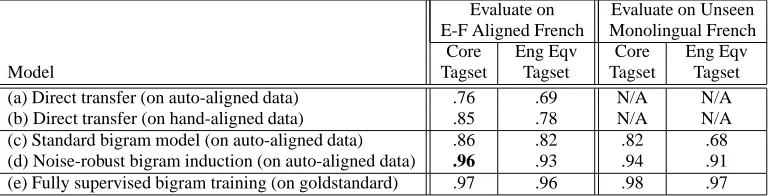
Even at the relatively low tagset granularity of English, direct projection of core POS tags onto French achieves only 76% ac-curacy using EGYPT’s automatic word alignments (as shown in Table 1). Part of this deficiency is due to word-alignment error; when word alignments were manually corrected, direct projection core-tag accuracy increased to 85%. Also, standard bigram taggers trained on the automatically projected data achieve only modest success at generalization (86% when reapplied to the noisy train-ing data). More highly lexicalized learntrain-ing algorithms exhibit even greater potential for overmodeling the specific projection errors of this data.
Thus our research has focused on noise-robust techniques for distilling a conservative but effective tagger from this challenging raw projection data. In particular, we modify standard n-gram mod-eling to separate the training of the tag sequence model from the lexical prior models, and apply different confidence weighting and signal amplification techniques to both.
4.2.1
Lexical Prior Estimation
ag-Evaluate on Evaluate on Unseen E-F Aligned French Monolingual French
Core Eng Eqv Core Eng Eqv
Model Tagset Tagset Tagset Tagset
(a) Direct transfer (on auto-aligned data) .76 .69 N/A N/A
(b) Direct transfer (on hand-aligned data) .85 .78 N/A N/A
(c) Standard bigram model (on auto-aligned data) .86 .82 .82 .68
(d) Noise-robust bigram induction (on auto-aligned data) .96 .93 .94 .91 (e) Fully supervised bigram training (on goldstandard) .97 .96 .98 .97
Table 1: Evaluation of 5 POS tagger induction models on 2 French datasets and 2 tagset granularities
gressive re-estimation in favor of this bias, amplifying the model probability of the majority POS tag, and reducing or zeroing the model probability of 2nd or lower ranked core tags proportional to their relative frequency with respect to the majority tag. This process is then applied recursively, similarly amplifying the proba-bility of the majority subtags within each core tag. Further details, including the handling of 1-to-N phrasal alignment projections, are given in Yarowsky and Ngai (2001).
Tag
P(Tag)
Tag
P(Tag)
Tag
P(Tag)
Directly Projected Tag
Word J N V R I
achat 0 62 48 0 1
cadre 2 35 7 1 1
cadres 1 5 0 0 0
pr´evu 1 11 48 0 0
$
Smoothed % &')(+*
,.-N V NN NNS VBN VBG
.76 .24 .73 .03 .03 .21 .90 .10 .86 .04 .03 .00 .94 .00 .04 .90 .00 .00 .09 .91 .08 .01 .86 .00
Figure 4: Hierarchical smoothing of/0 ! tag probabilities
4.2.2
Tag Sequence Model Estimation
In contrast, the training of the tag sequence model21+2143650798:8;8 focuses on confidence weighting and filtering of projected training subsequences. The contribution of each candidate training sentence is weighted proportionally with both its EGYPT/GIZA sentence-level alignment score and an agreement measure between the pro-jected tags and the 1st iteration lexical priors, a rough measure of alignment reasonableness. Given the observed bursty distri-bution of alignment errors in the corpus, this downweighting of low-confidence alignment regions substantially improves sequence model quality with tolerable reduction in training volume.
4.3
Evaluation of POS Tagger Induction
As shown in Table 1, performance is evaluated on two evalua-tion data sets, including an independent 200K-word hand-tagged French dataset provided by Universit´e de Montr´eal, which is used to gauge stand-alone tagger performance. Signal amplification and noise reduction techniques yield a 71% error reduction, achieving a core tagset accuracy of 96%, closely approaching the upper-bound 97% performance of an equivalent bigram model trained directly on an 80% subset of the hand-tagged evaluation set (using 5-fold cross-validation). Thus robust training on 500K words of very noisy but automatically-derived tag projections can approach the performance obtained by fully supervised learning on 80K words of hand-tagged training data.
5.
NOUN PHRASE BRACKETER
INDUCTION
Our empirical studies show that there is a very strong tendency for noun phrases to cohere as a unit when translated between lan-guages, even when undergoing significant internal re-ordering. This strong noun-phrase cohesion even tends to hold for relatively free word order languages such as Czech, where both native speakers and parallel corpus data indicate that nominal modifiers tend to re-main in the same contiguous chunk as the nouns they modify. This property allows collective word alignments to serve as a reliable basis for bracket projection as well.
5.1
BaseNP Projection Methodology
The projection process begins by automatically tagging and brac-keting the English data, using Brill (1995) and Ramshaw & Marcus (1994), respectively.
As illustrated in Figure 5, each word within an English noun phrase is then subscripted with the number of its NP in the sentence, and this subscript is projected onto the aligned French (or Chinese) words. In the most common case, the corresponding French/Chinese noun phrase is simply the maximal span of the projected subscript.
Figure 6 shows some of the projection challenges encountered. Nearly all such cases of interwoven projected NPs are due to align-ment errors, and a strong inductive bias towards NP cohesion was utilized to resolve these incompatible projections.
J N VBD N N IN N
[ ] [ ] [
DT N J VBD N de N DT N[
1 1 2 2 3
(3) (2)
(2) (1)
(1)
(1) ] ] ]
[
]
O
[ [
Figure 5: Standard NP projection scenarios.
DT J N VBD N N
[
1 1 1]
[
2 2]
(1) (1)
[
DT N VBD N J de N]
[
(2)}
{
(1) (2)]
OFigure 6: Problematic NP projection scenarios.
5.2
BaseNP Training Algorithm
For stand-alone tool development, the Ramshaw & Marcus IOB bracketing framework and a fast transformation-based learning sys-tem (Ngai and Florian, 2001) were applied to the noisy baseNP-projected data described above.
alignment errors). Data with lower-confidence POS tagging were not filtered,< however, as this filtering reduces robustness when the stand-alone bracketers are applied to noisy tagger output. Addi-tional details are provided in Yarowsky and Ngai (2001).
Current efforts to further improve the quality of the training data include use of iterative EM bootstrapping techniques. Separate pro-jection of bracketings from aligned parallel data with a 3rd lan-guage also shows promise for providing independent supervision, which can further help distinguish consensus signal from noise.
5.3
BaseNP Projection Evaluation
Because no bracketed evaluation data were available to us for French or Chinese, a third party fluent in these languages hand-bracketed a small, held-out 40-sentence evaluation set in both lan-guages, using a set of bracketing conventions that they felt were appropriate for the languages. Table 2 shows the performance rela-tive to these evaluation sets, as measured by exact-match bracketing precision (Pr), recall (R) and F-measure (F).
Exact Match Acceptable Match
Method Pr R F Pr R F
Chinese:
Direct (auto) .26 .58 .36 .48 .58 .51 Direct (hand) .47 .61 .53 .86 .86 .86 French:
Direct (auto) .43 .48 .45 .60 .58 .59
Direct (hand) .56 .51 .53 .74 .70 .72 FTBL (auto) .82 .81 .81 .91 .91 .91
Table 2: Performance of BaseNP induction models
It is important to note, however, that many decisions regarding BaseNP bracketing conventions are essentially arbitrary, and agree-ment rates between additional human judges on these data were measured at 64% and 80% for French and Chinese respectively. Since the translingual projections are essentially unsupervised and have no data on which to mimic arbitrary conventions, it is also rea-sonable to evaluate the degree to which the induced bracketings are deemed acceptable and consistent with the arbitrary goldstandard (e.g. no crossing brackets). To this end, an additional pool of 3 judges were asked to further adjudicate the differences between the goldstandard and the projection output, annotating such situations as either acceptable/compatible or unacceptable/incompatible.
Overall, these translingual projection results are quite encourag-ing. For the Chinese, they are similar to Wu’s 78% precision re-sult for translingual-grammar-based NP bracketing, and especially promising given that no word segmentation (only raw characters) were used. For French, the increase from 59% to 91% F-measure for the stand-alone induced bracketer shows that the training algo-rithm is able to generalize successfully from the noisy raw projec-tion data, distilling a reasonably accurate (and transferable) model of baseNP structure from this high degree of noise.
6.
NAMED ENTITY TAGGER INDUCTION
Multilingual named entity tagger induction is based on the ex-tended combination of the part-of-speech and noun-phrase brac-keting frameworks. The entity class tags used for this study were FNAME, LNAME, PLACEand OTHER(other entities including or-ganizations). They were derived from an anonymously donated MUC-6 named entity tagger applied to the English side of the French-English Canadian Hansards data.
Initial classification proceeds on a per-word basis, using an ag-gressively smoothed transitive projection model similar to those
de-scribed in Section 7. For a given second-language word FW and all English words=>?1 aligned to it:
NEclass@AFWCBED
1
NEclass@AEW1F EW1FW
PLACECor´eeGBHPLACEKoreaI6JKoreaCor´eeLKM8:8;8
The co-training-based algorithm given in Cucerzan and Yarowsky (1999) was then used to train a stand-alone named entity tagger from the projected data. Seed words for this algorithm were those French words that were both POS-tagged as proper nouns and had an above-threshold entity-class confidence from the lexical projec-tion models.
Performance was measured in terms of per-word entity-type clas-sification accuracy on the French Hansard test data, using the 4-class inventory listed above. Classification accuracy of raw tag projections was only 64% (based on automatic word alignment). In contrast, the stand-alone co-training-based tagger trained on the projections achieved 85% classification accuracy, illustrating its ef-fectivess at generalization in the face of projection noise. Notably, most of its observed errors can be traced to entity classification er-rors from the original English tagger. In fact, when evaluated on the English translation of the French test data set, the English tagger only achieved 86% classification accuracy on this directly compa-rable data set. It appears that the projection-induced French tagger achieves performance nearly as high as its original training source. Thus further improvements should be expected from higher quality English training sources.
7.
MORPHOLOGICAL ANALYSIS
INDUCTION
Bilingual corpora can also serve as a very successful bridge for aligning complex inflected word forms in a new language with their root forms, even when their surface similarity is quite different or highly irregular.
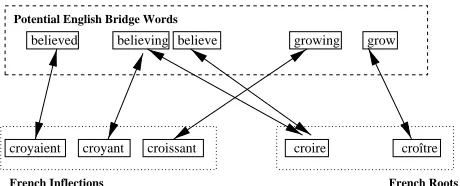
croyaient croissant croire croître
believe growing grow
believing believed
French Roots French Inflections
croyant Potential English Bridge Words
Figure 7: Direct-bridge French inflection/root alignment
As illustrated in Figure 7, the association between a French ver-bal inflection (croyant) and its correct root (croire), rather than a similar competitor (croˆıtre), can be identified by a single-step tran-sitive association via an English bridge word (believing). However, in the case of morphology induction, such direct associations are relatively rare given that inflections in a second language tend to as-sociate with similar tenses in English while the singular/infinitive forms tend to associate with analogous singular/infinitive forms, and thus croyaient (believed) and its root croire have no direct En-glish link in our aligned corpus.
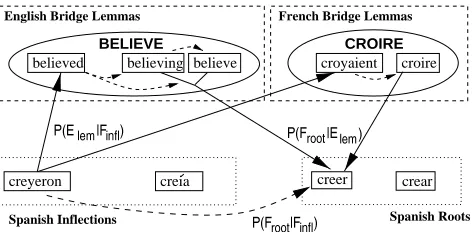
However, Figure 2 (first page) illustrates that an existing invest-ment in a lemmatizer for English can help bridge this gap by joining a multi-step transitive association croyaient$
believed$
NPOQ:RS4SUTVQ;WX4YZ[
Figure 8: Multi-bridge French inflection/root alignment
lemmatization can be potentially utilized for all other English lem-mas (such asTHINK) with which croyaient and croire also asso-ciate, offering greater potential coverage and robustness via multi-ple bridges.
Formally, these multiple transitive linkages can be modeled as shown below, by summing over all English lemmas (=badcfehg) with which either a candidate foreign inflection (i infl) or its root (i root) exhibit an alignment in the parallel corpus:
6eCjkUi6l+m+mon+i 1)pq aCBHD
1
Uirl2m+mono= adcfe goF U= adcfe g0i 1:psq a
For example:
reCjJcroirecroyaientGB
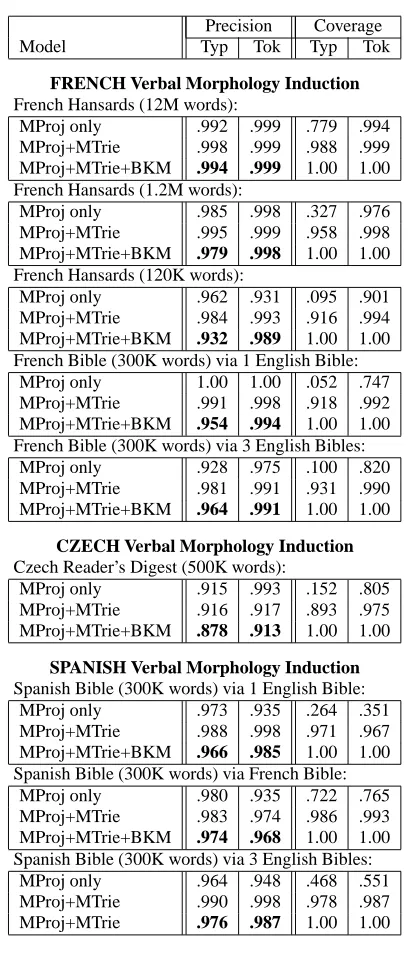
6JcroireBELIEVEI6FBELIEVEcroyaient2K croireTHINKF THINKcroyaienttKM8;8;8 This projection/bridge-based similarity measure mpUi rooti infl can be quite effective on its own, as shown in the MProj only entries in Table 3 (for multiple parallel corpora in 3 different languages), especially when restricted to the highest-confidence subset of the vocabulary (5.2% to 77.9% in these data) for which the association exceeds simple fixed probability and frequency thresholds. When estimated using a 1.2 million word subset of the French Hansards, for example, the MProj measure alone achives 98.5% precision on 32.7% of the inflected French verbs in the corpus (constitut-ing 97.6% of the tokens in the corpus). Unlike traditional str(constitut-ing- string-transduction-based morphology induction methods where irregular verbs pose the greatest challenges, these typically high-frequency words are often the best modelled data in the vocabulary making these multilingual projection techniques a natural complement to existing models.
7.1
Trie-based Morphology Models
The high precision on the MProj-covered subset also make these partial pairings effective training data for robust supervised algo-rithms that can generalize the string transformation behavior to the remaining uncovered vocabulary. While any supervised morpho-logical analysis technique is possible here, we employ a trie-based modeling technique where the probability of a given stem-change (from the inventory observed in the MProj-paired training data) is modeled hierarchically using variable suffix context, as described in Yarowsky and Wicentowski (2000):
rootinflectionCBu4vxwhvzyGCBH4y
$
whvzyGCB
{
1U4y
$
w~k1 for k16B suffix4272vy
For example:
commencercommenc¸aGBuc¸a
$
cercommenc¸aGB
|k
cerenc¸a KM8;8;8
ployerploieGBHie
yerloietKu8;8;8
An important property of the trie-based models is their effective-ness at clustering words that exhibit similar morphological behav-ior, both reducing model size and facilitating generalization to pre-viously unseen examples. This property is illustrated in Figure 9, showing a sample (inflection$
root) trie branch for French verbal inflections, with suffix histories =’oie’, =’noie’, =’roie’, etc. At each history node, the hierarchically smoothed probabilities of severaly
$
w (inflection
$
root) changes are given. Note that the relative probabilities of the competing analyses ie$
ir and ie$ yer differ substantially for diffent suffix histories, and that there are subexceptions that tend to cluster by affix history. This allows for the successful analysis of 8 of the 9 italicized test words that had not been seen in the bilingual projection data or where the MProj model yielded no root candidate above threshold.
o
Test data incorrectly analyzed Training data from MProj analysis Test data correctly analyzed
✙
Figure 9: Example of a French MTrie branch, showing inflec-tion$
root probabilities (4y
$
whk1) for variable length
suffix histories ( 1). MTrie analyses on test data are given in
italics.
verb lemmatization precision on the 1.2M word Hansard subset ex-ceeds 99.5% (by type) and 99.9% (by token) with 95.8% coverage by type and 99.8% coverage by token. A backoff model based on Levenshtein-distance and distributional context similarity handles the relatively small percentage of cases where MProj and MTrie together are not sufficiently confident, bringing the system cov-erage to 100% covcov-erage with a small drop in precision to 97.9% (by type) and 99.8% (by token) on the unrestricted space of in-flected verbs observed in the full French Hansards. As shown in Section 7.3, performance is strongly correlated with size of the ini-tial aligned bilingual corpus, with a larger Hansard subset of 12M words yielding 99.4% precision (by type) and 99.9% precision (by token). Performance on Czech is discussed in Section 7.3.
Precision Coverage
Model Typ Tok Typ Tok
FRENCH Verbal Morphology Induction
French Hansards (12M words):
MProj only .992 .999 .779 .994
MProj+MTrie .998 .999 .988 .999
MProj+MTrie+BKM .994 .999 1.00 1.00 French Hansards (1.2M words):
MProj only .985 .998 .327 .976
MProj+MTrie .995 .999 .958 .998
MProj+MTrie+BKM .979 .998 1.00 1.00 French Hansards (120K words):
MProj only .962 .931 .095 .901
MProj+MTrie .984 .993 .916 .994
MProj+MTrie+BKM .932 .989 1.00 1.00 French Bible (300K words) via 1 English Bible:
MProj only 1.00 1.00 .052 .747
MProj+MTrie .991 .998 .918 .992
MProj+MTrie+BKM .954 .994 1.00 1.00 French Bible (300K words) via 3 English Bibles:
MProj only .928 .975 .100 .820
MProj+MTrie .981 .991 .931 .990
MProj+MTrie+BKM .964 .991 1.00 1.00
CZECH Verbal Morphology Induction
Czech Reader’s Digest (500K words):
MProj only .915 .993 .152 .805
MProj+MTrie .916 .917 .893 .975
MProj+MTrie+BKM .878 .913 1.00 1.00
SPANISH Verbal Morphology Induction
Spanish Bible (300K words) via 1 English Bible:
MProj only .973 .935 .264 .351
MProj+MTrie .988 .998 .971 .967
MProj+MTrie+BKM .966 .985 1.00 1.00 Spanish Bible (300K words) via French Bible:
MProj only .980 .935 .722 .765
MProj+MTrie .983 .974 .986 .993
MProj+MTrie+BKM .974 .968 1.00 1.00 Spanish Bible (300K words) via 3 English Bibles:
MProj only .964 .948 .468 .551
MProj+MTrie .990 .998 .978 .987
MProj+MTrie .976 .987 1.00 1.00
Table 3: Performance of full verbal morphological analysis, including precision/coverage by type/token
7.2
Morphology Induction via Aligned Bibles
Performance using even small parallel corpora (e.g. a 120K sub-set of the French Hansards) still yields a respectable 93.2% (type) and 98.9% (token) precision on the verb-lemmatization test set for the full Hansards. Given that the Bible is actually larger (approxi-mately 300K words, depending on version and language) and avail-able on-line or via OCR for virtually all languages (Resnik et al., 2000), we also conducted several experiments on Bible-based mor-phology induction, further detailed in Table 3.
7.2.1
Boosting Performance via Multiple
Parallel Translations
Even though at most one translation of the Bible is typically available in a given foreign language, numerous English Bible ver-sions are freely available and a performance increase can be achie-ved by simultaneously utilizing alignments to each English version. As illustrated in Figure 10, different aligned Bible pairs may exhibit (or be missing) different full or partial bridge links for a given word (due both to different lexical usage and poor textual parallelism in some text-regions or version pairs). However, Uirl2momono= adcfe g and 6JU= adcfe gxi infl need not be estimated from the same Bible pair. Even if one has only one Bible in a given source language, each alignment with a distinct English version gives new bridging opportunities with no additional resources needed on the source language side. The baseline approach (evaluated here) is simply to concatenate the different aligned versions together. While word-pair instances translated the same way in each version will be re-peated, this rather reasonably reflects the increased confidence in this particular alignment. An alternate model would weight version pairs differently based on the otherwise-measured translation faith-fulness and alignment quality between the version pairs. Doing so would help decrease noise. Increasing from 1 to 3 English versions reduces the type error rate (at full coverage) by 22% on French and 28% on Spanish with no increase in the source language resources.
NPOQRS4SUTVQWX4YZ[ VQ
NPO\AZ]4^_WX4YZ[
[
Z]4^ NPOQRSUS4T`V\
croyaient
French Inflections
croitre V
French Roots
croire believing
believed
believed
believe
BELIEVE
SOURCE 1
SOURCE 2
SOURCE 3
(e.g. KJV)
(e.g. NIV)
(e.g. RSV)
English Bridge Lemma
croyant
Figure 10: Use of multiple parallel Bible translations
7.2.2
Boosting Performance via Multiple
Bridge Languages
com-parable to the use of 3 parallel English Bible versions.
:44;4
P` UU
believe believing believed
BELIEVE
English Bridge Lemmas
4 44
French Bridge Lemmas
Spanish Inflections Spanish Roots
croire croyaient
CROIRE
creyeron creia creer crear
Figure 11: Use of bridges in multiple languages.
7.3
Morphology Induction: Observations
This section includes additional detail regarding the morphol-ogy induction experiments, supplementing the previous details and analyses given in Section 7 and Table 3.
Performance induction using the French Bible as the bridge source is evaluated using the full test verb set extracted from the French Hansards. The strong performance when trained only using the Bible illustrates that even a small single text in a very different genre can provide effective transfer to modern (conversational) French. While the observed genre and topic-sensitive vocabulary differs substantially between the Bible and Hansards, the observed inventories of stem changes and suffixation actually have large overlap, as do the set of observed high-frequency irregular verbs. Thus the in-ventory of morphological phenomena seem to translate better across genre than do lexical choice and collocation models.
Over 60% of errors are due to gaps in the candidate rootlists. Currently the candidate rootlists are derived automatically by applying the projected POS models and selecting any word with the probability of being an uninflected verb greater than a generous threshold and also ending in a canonical verb suf-fix. False positives are easily tolerated (less than 5% of errors are due to spurious non-root competitors), but with missing roots the algorithms are forced either to propose previously unseen roots or align to the closest previously observed root candidate. Thus while no non-English dictionary was used in the computation of these results, it would substantially improve performance to have a dictionary-based inventory of potential roots, increasing coverage and decreasing noise from competing non-roots and spelling errors.
Performance in all languages has been significnatly hindered by low-accuracy parallel-corpus word-alignments using the original Model-3 GIZA tools. Use of Och and Ney’s re-cently released and enhancedGIZA++ word-alignment mod-els (Och and Ney, 2000) should improve performance for all of the applications studied in this paper, as would iterative re-alignments using richer alignment features (including lemma and part-of-speech) derived from this research.
The current somewhat lower performance on Czech is due to several factors. They include (a) very low accuracy ini-tial word-alignments due to often non-parallel translations of the Reader’s Digest sample and the failure of the initial word-alignment models to handle the highly inflected Czech
morphology. (b) the small size of the Czech parallel cor-pus (less than twice the length of the Bible). (c) the com-mon occurrence in Czech of two very similar perfective and non-perfective root variants (e.g. odol´avat and odolat, both of which mean to resist). A simple monolingual dictionary-derived list of canonical roots would resolve ambiguity re-garding which is the appropriate target.
Many of the errors are due to all (or most) inflections of a sin-gle verb mapping to the same incorrect root. But for many applications where the function of lemmatization is to cluster equivalent words (e.g. stemming for information retrieval), the choice of label for the lemma is less important than cor-rectly linking the members of the lemma.
.005 .01
Error Rate
.001 .002 .02 .05
120 K 300 K 1.2 M 12 M
Size of Aligned Corpus (words) .10
(by type)
(by token) French Bible French Bible
(Error rate by TOKEN) French Hansards (Error rate by TYPE)
French Hansards
Figure 12: Learning Curves for French Morphology
The learning curves in Figure 12 show the strong correlation between performance and size of the aligned corpus. Given that large quantities of parallel text currently exist in trans-lation bureau archives and OCR-able books, not to mention the increasing online availability of bitext on the web, the natural growth of available bitext quantities should continue to support performance improvement.
The system analysis examples shown in Table 4 are repre-sentative of model performance and are selected to illustrate the range of encountered phenomena. All system evaluation is based on the task of selecting the correct root for a given inflection (which has a long lexicography-based consensus regarding the “truth”). In contrast, the descriptive analysis of any such pairing is very theory dependent without standard consensus. The “TopBridge” column shows the strongest English bridge lemma utilized in mapping (typically one of many potential bridge lemmas).
These results are quite impressive in that they are based on essen-tially no language-specific knowledge of French, Spanish or Czech. In addition, the multilingual bridge algorithm is surface-form in-dependent, and can just as readily handle obscure infixational or reduplicative morphological processes.
8.
CONCLUSION
the most comprehensive existing exploration of a very promising new paradigm
for cross-language resource projection.
Acknowledgements
This research has been partially supported by NSF grant IIS-9985033 and ONR/MURI contract N00014-01-1-0685. The au-thors thank Silviu Cucerzan, Radu Florian, Jan Hajic, Gideon Mann and Charles Schafer for their valuable contributions and feedback.
9.
REFERENCES
[1] Y. Al-Onaizan, J. Curin, M. Jahr, K. Knight, J. Lafferty, D. Melamed, FJ Och, D. Purdy, N. Smith and D. Yarowsky. 1999. Statistical Machine Translation (tech report). Johns Hopkins University.
[2] E. Brill. 1995. Transformation-based error-driven learning and natural language processing: A case study in part of speech tagging. Computational Linguistics, 24(1): 543–565. [3] P. Brown, J. Cocke, S. DellaPietra, V. DellaPietra, F. Jelinek,
J. Lafferty, R. Mercer, and P. Rossin. 1990. A statistical approach to machine translation. Computational Linguistics, 16(2):29–85.
[4] S. Cucerzan and D. Yarowsky. 1999. Language independent named entity recognition combining morphological and contextual evidence.” In Proceedings, 1999 Joint SIGDAT Conference on Empirical Methods in NLP and Very Large Corpora, pp. 90-99.
[5] P. Fung and K. Church. 1994. K-vec: a new approach for aligning parallel texts. In Proceedings of COLING-94, pp. 1096–1102.
[6] P. Fung and K. McKeown. 1994. Aligning noisy parallel corpora across language groups: Word pair feature matching by dynamic warping. In Proceedings of AMTA-94, pp. 81–88. [7] D. Jones, and R. Havrilla. 1998 Twisted pair grammar:
Support for rapid development of machine translation for low density languages In Procs. of AMTA’98, pp. 318–332. [8] D. Melamed. 1999. Bitext maps and alignment via pattern
recognition. Computational Linguistics, 25(1):107–130. [9] G. Ngai and R. Florian. 2001. Transformation-based learning
in the fast lane. In Proceedings of NAACL-2001, pp. 40-47. [10] F.J. Och and H. Ney. 2000. Improved statistical alignment
models. In Proceedings of ACL-2000, pp. 440-447. [11] L. Ramshaw and M. Marcus, 1999. Text chunking using
transformation-based learning. In Armstrong et al. (Eds.), Natural Language Processing Using Very Large Corpora. Kluwer, pp. 157-176.
[12] P. Resnik, M. Olsen, and M. Diab. 2000. The Bible as a parallel corpus: annotating the ‘Book of 2000 Tongues’ Computers and the Humanities, 33(1-2):129-153.
[13] D. Wu. 1995. An algorithm for simultaneously bracketing parallel texts. In Proc. of ACL-95, pp. 244–251.
[14] D. Wu. 1997. Statistical inversion transduction grammars an bilingual parsing of parallel corpora. Computational
Linguistics, 23(3):377-404.
[15] D. Yarowsky and G. Ngai. 2001. Inducing multilingual POS taggers and NP Bracketers via robust projection across aligned corpora. In Proceedings of NAACL-2001, pp. 377-404. [16] D. Yarowsky and R. Wicentowski. 2000. Minimally
supervised morphological analysis by multimodal alignment. In Proceedings of ACL-2000, pp. 207-216.
Induced Morphological Analyses for CZECH
Inflection Root Out Analysis TopBridge
bral br´at al$
´at marry
brala br´at ala$
´at accept
brali br´at ali$
´at marry
chovala chovat la$
t behave
chov´a chovat ´a$
at behave
chov´ame chovat ´ame$
at behave
chodila chodit la$
t walk
chod´ı chodit ´ı$
it walk
choˇdte chodit ˇdte$
dit swim
chr´anila chr´anit la$
t protect
chr´an´ı chr´anit ´ı$
it protect
couval couvat l$
t back
chce cht´ıt ce$
t´ıt want
chcete cht´ıt cete$
t´ıt want
chceˇs cht´ıt ceˇs$
t´ıt want
chci cht´ıt ci$
t´ıt want
chtˇej´ı cht´ıt ˇej´ı$
´ıt want
chtˇeli cht´ıt ˇeli$
´ıt want
chtˇelo cht´ıt ˇelo$
´ıt want
Induced Morphological Analyses for SPANISH
Inflection Root Out Analysis TopBridge aborreci´o aborrecer i´o$
er hate
aborrec´ıa aborrecer ´ıa$
er hate
aborrezco aborrecer zco$
cer hate
abrace abrazar ce$
zar embrace
abrazado abrazar ado$
ar embrace
adquiere adquirir ere$
rir get
andamos andar amos$
ar walk
andando andar ando$
ar walk
andar´an andar ar´an$
ar wander
andar´as andar ar´as$
ar wander
andemos andar emos$
ar walk
anden andar en$
ar walk
anduvo andar uvo$
ar walk
busc´ais buscar ´ais$
ar seek
busc´o buscar ´o$
ar seek
busque buscar que$
car seek
busqu´e buscar qu´e$
car seek
Induced Morphological Analyses for FRENCH
Inflection Root Out Analysis TopBridge abr`ege abr´eger `ege$
´eger shorten abr`egent abr´eger `egent$
´eger shorten abr´egerai abr´eger erai$
er curtail
ach`ete acheter `ete$
eter buy
ach`etent acheter `etent$
eter buy
ach`etera acheter `etera$
eter buy
advenait advenir ait$
ir happen
advenu advenir u$
ir happen
adviendrait advenir iendrait$
enir happen advient advenir ient$
enir happen
ali`ene ali´ener `ene$
´ener alienate ali`enent ali´ener `enent$
´ener alienate conc¸u concevoir c¸u$
cevoir conceive
crois croire s$
re believe
croyaient croire yaient$
ire believe