172
Comparative Analysis of Indirect Vector Control of Induction
Motor Drive using PI and PID Controllers
Manoj Kumar Behera
1, Pabitra Kumar Behera
2, Asst.Prof.Amit Kumar Sahoo
3 Electrical and Electronics Engineering1,2,3,Centurion Institute of Technology, Bhubaneswar, India1,2,3Email: [email protected]1
Abstract-The most common type of speed controller to be used the speed control of induction motor is conventional proportional
integral (PI) controller. But this paper presents a performance based on comparative study of conventional proportional integral (PI) controller and proportional integral derivative (PID) controller. The induction motor well known as its robustness, relatively low cost, good reliability and efficiency. But induction motor also characterized by complex, highly non-linear and time varying dynamics. Hence their speed control is challenging problem in the industry. The approach of vector control techniques has solved induction speed control problems. Simulation is carried out in MATLAB/Simulink environment and results are compared for speed control of induction motor PI controller and with PID controller.
Index Terms-Convectional PI controller; Conventional PID controller; Squirrel cage induction motor;Indirect vector control
technique.
1.INTRODUCTION
Induction motors has many application in industry because of their low maintenance, robustness and high performance. The speed control of induction motor is more important to achieve maximum torque and efficiency. In recent years, the control of the induction motor drive is an active research area for engineering science. And the technology has further advances in drives field. Generally, the control and estimation of ac drives ware significantly more complex than the dc drives, and this complexity increases to a large extent if the high performances are demanded. The need of multiple frequency, machine parameter variations, and the difficulties of processing feedback signals in the presence of harmonics create the complexity [9].
Vector control techniques are now being accepted widely for high performance control of induction motor drive. In particular, the indirect vector control is considered to be the most practical scheme because of the various advantagesand higher reliability for speed control. However, the speed controller of such a system plays an important role in drive system performances, and the decoupling characteristics ofvector–controlled induction motor are affected by the parameters variation [1].
In most of industrial drive control applications, the standard method to control squirrel cage induction motors is based on the field-oriented or vector control principle in order to achieve the best dynamic behaviors of the system. There are essentially two general methods of vector control. One is called the direct or feedback method, and the other is the indirect or feed forward method [8]. Indirect vector controlled (IVC) induction motor (IM) drives used in high performance systems is very popular in industrial applications due to their relative simple configuration, as compared to the direct method which requires flux and torque estimator. The primary advantages of indirect vector control are the decoupling of torque and flux characteristics and easy implementation in industry.In an indirect vector control induction motor drive, the flux and torque commands are calculated from the IM variables based on machine parameters. It is desirable that those parameters match the actual parameters of the machine at all operating conditions to achieve decoupling control of the machine [8].
173 the help of both conventional PI controller and
conventional PID controller with the use of vector control technique. Because the of major advantages of vector control, this method of control will drive out scalar control, and this will be accepted as the industry-standard control for ac drives [3]. PID controllers are widely used in different industries for control of different plants and have a fair performance. The conventional proportional integral controller increases the order of the system, improves damping, eliminate maximum overshoot and increase the rise time. But the proportional integral controller can never achieve perfect control, that is, keep the speed of induction motor continuously at a desired set point value in the presence of disturbance or set point change. Therefore, we need an advance control technique such as PID controller [6].
In this article we will discuss the performance based on comparative study of both conventional PI and conventional PID controller. Finally we will present the simulation result for speed control of induction motor using both PI and PID controller and a brief discussion.
2. INDIRECT VECTOR CONTROL
The invention of vector control in the beginning of 1970s, and the demonstration that an induction motor can be controlled like a separately excited dc motor, brought a revival of in the high performance control of ac drives [5].The indirect or feed forward method, was invented by Hasse [1]. The indirect vector field orientation was made according to the rotor flux vector of induction motor. The magnitude of the rotor flux is obtained using a flux observer, but the controlled induction motordrive; here the principle of indirect vector control with the help of phasor diagram is explained.
Fig.1 Phasor diagram of indirect vector control of induction motor
The phasor diagram, the s s
d −q axes are fixed on the
The rotor circuit equations
0
Substituting the above condition in equations (2) and (3), we get
Then the slip frequency can be calculated as:
174
It is found that the ideal decoupling can be achieved if the above slip angular speed command is used for making field orientation. The constant rotor flux ψr
and d r 0 dt
ψ =
can be substituted in equation (4), so
that the rotor flux set as:
r L im ds
ψ = (7)
The electromagnetic torque developed in the motor is given by
3. CONVENTIONAL PI CONTROLLER
The PI controllers are widely used in industries for the speed control of induction motor drive. The PI controller produces an output signal consisting of two term signals and the other proportional to the integral of inputsignal. The combination of proportional and integral terms is important to increase the speed of the response and also to eliminate the steady state error. The process control application more than 95% of the controller is PI type. The block diagram of PI controller shown in fig.2.
Fig.2 Block diagram of PI controller
The transfer function of PI controller is:
C
The proportional and integral term is given by:
( )
p( )
I( )
u t =K e t +K
∫
e t dt (10)4. CONVENTIONAL PID CONTROLLER
The PID controller is ubiquitous in industry. The conventional PID controller gives better performances of dynamic responses. A PID controller calculates an error value e t
( )
as the difference i.e. the proportional the integral and derivative value which is the denoted by P, I and D. Here the three controllers are assembled.Fig.3 shows block diagram of PID controller.Fig.3. Block diagram of PID controller
The error value is influence by the PID controller to produce a command signal for the system given by:
( )
p( )
i( )
d( )
de t
u t K e t K e t dt K
dt
= +
∫
+ (12)The transfer function of PID controller is:
C INDUCTION MOTOR DRIVE
175
Fig.4 Simulation model of indirect vector of induction motor drive using PI and PID controllers
6. SIMULATION RESULTS
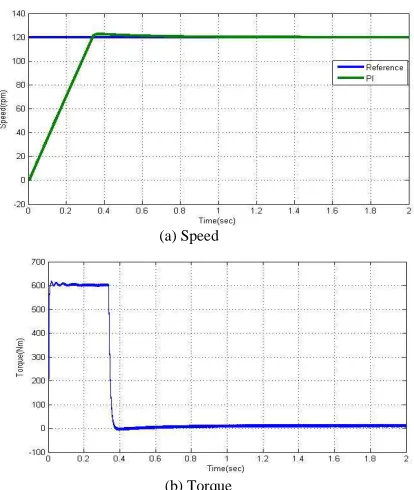
The simulations are carried out in MATLAB environment and the results are detected for the speed versus time. The speed response of induction motor is checked for both conventional PI and PID controllers which is shown in fig.5 and 6.
(a) Speed
(b) Torque
Fig.5 Performance of indirect vector controller of induction motor using PI controller with reference speed 120 rad/sec (a) Speed, (b)
Torque
(a) Speed
(b) Torque
Fig. 6 Performance of indirect vector control of induction motor using PID controller with reference speed 120 rad/sec (a) Speed,
(b) Torque
To improve speed performance of induction motor we use the PID controllerbecause the steady state error is eliminated and the rise time is improved.
pul se generator T orque Sel ecti on
iapi
Flux Cal culati on
0
176
7. COMPARISION
The main purpose of this paper is to control the speed of induction motor.PID controller is better to improve the speed performance of induction motor. The speed of induction motor using PID controller settled earlier to compare to PI controller. The comparative results are also reported in the table below.
Parameters PI controller PID controller Speed 120 rpm 120 rpm Settling Time 0.912 sec 0.368 sec
Rise Time 0.352 sec 0.338 sec Peak Time 0.368 sec 0.339 sec
Table I. Comparison of speed of induction motor, PI controller and PID controller
8. CONCLUSION
This paper has successfully demonstrated a properly carried out PI and PID controllers. We have studied and compared two controllers for speed control of indirect vector control of induction motor drive. And the results are checked and compared. From the comparison of speed of induction motor using PID controller that, the PIDcontroller gives better speedresponse in terms of settling time, rise time and steady state error.
8. APPENDIX
The three phase squirrel cage 50hp, 460V induction motor specifications:
Parameters Symbol Value Supply
Frequency
F 50Hz
Voltage V 460V
Stator Resistance Rs 0.087ohm Stator Inductance Ls 0.0008H Rotor Resistance Rr 0.228ohm Rotor Inductance Lr 0.0008H
Mutual
Table II. Induction motor parameters
REFERENCES
[1] Bose B.K. (2008) "Modern power electronics and ac drives "Prentice-Hall OJ India, New Delhi. [2] Boshi C. (2003), Electrical Drive Control System, Beijing: China machine.
[3] Gopal M. (1993), “Modern Control System Theory”, 2nd ed., Wiley Eastern Ltd.
[4] HuadeL. (2005), AC drive system, Beijing: china machine.
[5] JoshiDheeraj and GillMegha (2013), “Comparison of Vector control techniques for induction motor drive”, Indian Journal of Electrical and Biomedical Engineering, Vol. 1,Number 1, January-June, pp. 17-27.
[6] Krishnan, R. (2001) “Electric Motor Drives, Modeling, Analysis and Control”, 1st ed., Singapore: Pearson Education.
[7] KumarVinod and JoshiR.R (2005), “Hybrid controller based Intelligent speed control of Induction motor”, Journal of Theoretical and Information Technology , Vol.3 no.1, pp. 71-75.
[8] MhaisgwaliMadhavi L. and Muley S.P. “Induction motor speed control using PID controller”, International Journal of Technology and Engineering Science, vol.1 (2), pp.151-155. ISSN: 2320-8007.
[9] MishraAshutosh and ChoudharyPrasant (2012), “Speed control of an Induction motor by using Indirect vector control method”, International Journal of Emerging Technology and Advanced Engineering,Vol.2, Issue 12, December.
NOTATIONS
e e
d −q Synchronously rotating reference frame (or rotating frame) direct and quadrature axes
s s
d −q Stationary reference frame direct and quadrature axes
s qs
i q -axis rotor current(Ampere) s
s
i q -axis stator currente
J Moment of inertia (Kg-m2)
177
r
L Rotor inductance
lr
L Rotor leakage inductance
ls
L Stator Leakage inductance PNumber of Poles
r
R Rotor resistance (ohm)
s
R Stator resistance
e
T Developed torque (Nm)
r
ψ Rotor flux linkage
s dr
ψ s
d -axis rotor flux linkage
s ds
ψ s
d -axis stator flux linkage
qr
ψ e
q -axis rotor flux linkage
qs
ψ e
q -axis stator flux linkage
r
ω Rotor electrical speed
sl
ω Slip frequency
p
K Proportional gain
i
K Integral gain
d
K Derivative gain