Discourse dependency structures as constrained
DAG
s
Laurence Danlos
TALANA/ LATTICE
Universit´e Paris 7
[email protected]
Abstract
I show that the semantic structure for dis-courses, understood as a dependency represen-tation, can be mathematically characterized as
DAGs, but theseDAGs present heavy structural
constraints. The argumentation is based on a simple case, i.e. discourses with three clauses and two discourse connectives. I show that only four types ofDAGs are needed for these discourses.
1
Introduction
Within a multi-level approach to discourse processing, this paper focuses on the semantic level. This level re-flects the discourse structure (how things are said, how
the discourse is rhetorically organized). This structure
plays an important role, e.g., it constrains both anaphora resolution and the attachment of incoming propositions in understanding. I assume that the informational content level (what is said) is based on first order logic.
A nice tool for the semantic level is dependency graphs. This is what is adopted inRST (rhetorical struc-tures correspond roughly to dependency strucstruc-tures), but it is not the case in SDRT1: discourse structures, called
SDRSs, are represented as boxes. Nevertheless, it is easy
to translate the conditions of anSDRSinto a dependency graph (Section 2.1).
Our goal in this paper is to determine to which mathe-matical object dependency structures for discourses cor-respond. InRST, it is a basic principle that this object is a tree. InSDRT, the issue is not discussed. I will show that this object is an ordered directed acyclic graph (DAG),
1
SDRTstands for Segmented Discourse Representation The-ory (Asher, 1993) (Asher and Lascarides, 2003). It is an ex-tension ofDRT, Discourse Representation Theory (Kamp and Reyle, 1993). (S)DRSstands for (Segmented) Discourse Repre-sentation Structure.RSTstands for Rhetorical Structure Theory (Mann and Thompson, 1987).
which may be not tree shaped. Some authors, e.g. (Bate-man, 1999) and (Blackburn and Gardent, 1998), have al-ready brought forward discourse structures which are not tree shaped. However nobody says explicitly that dis-course dependency structures areDAGs considering
seri-ously all the consequences of this claim2.
Our argumentation is based on one of the simplest cases of discourses, namely discourses of type S1 Conna
S2 Connb S3 with two discourse connectives (Conna/b) and three clauses (Si). A discourse connective Conn can be either a subordinating or coordinating conjunction or a discourse adverbial. It denotes a discourse relation R, a predicate with two arguments. I will show (Section 3) that they are topologically only four types of DAGs for these discourses. This allows us to state that DAGs for these discourses are not arbitrary: they satisfy structural constraints (Section 5). I stipulate that this result can be extrapolated to discourses in which sentences are sim-ply juxtaposed without discourse connective. It can also be foreseen that dependency structures for more complex discourses (e.g. discourses with more than three clauses) are also constrainedDAGs.
This can be seen as an important result since many au-thors in the discourse community hang on trees as dis-course structures, even if it means to use artificial trees as shown in Section 2.4. They reject DAGs because they view them as completely unconstrained (except the acyclicity constraint) and so as unusable in discourse pro-cessing. This is truly not the case. Semantic dependency structures for discourses are orderedDAGs but theseDAGs present heavy structural constraints, which can help us to cut down the number of possibilities when processing discourses (although this issue is not discussed here).
Before getting to the heart of the matter, let us give some preliminaries.
2
2
Preliminaries
2.1 Translation of anSDRSinto aDAG
Formally, anSDRSis is a couple of setshU,Coni. U is a set of labels ofDRSorSDRSwhich may be viewed as “speech act discourse referents”. Con is a set of condi-tions on labels of the form:
• π:K, whereπis a label from U andKis a (S)DRS
(labelling);
• R(πi, πj), where πi andπj are labels andR a dis-course relation (structuring).
The set of conditions can be translated into a depen-dency graph by applying the following rules.
• A conditionR(πi, πj)is translated as a binary tree, the root of which isR, the ordered leaves areπiand πj.πiis the first argument ofR(it corresponds gen-erally to the “nucleus” inRST),πj its second argu-ment (it corresponds generally to the “satellite” in
RST).
• A conditionπ : K in whichK is aSDRS leads to a sub-graph obtained by translating recursively the conditions inK, this sub-graph is labeledπ.
• A conditionπ : K in whick K is aDRSis simply translated asπ.
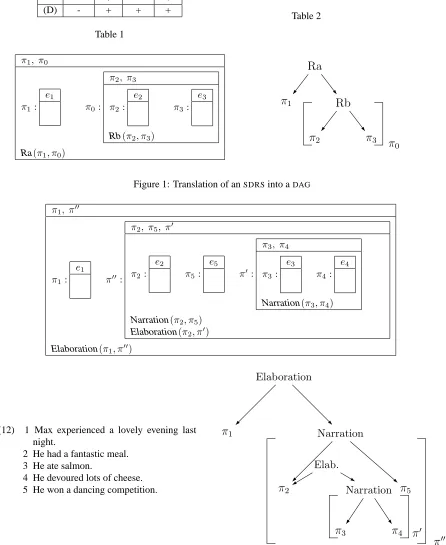
Figures 1 and 2 give examples of this translation mech-anism.
2.2 Linear order
Subordinate conjunctions (noted as Conj) are the only discourse connectives which allow us to invert the order of the sentences: a subordinate clause can be postposed (the linear order is then the “canonical” one S1 Conj (,)
S2) or preposed (then the non canonical order is Conj S2, S1). Following works inMTT3, a trace of the linear or-der can be recorded in a semantic dependency represen-tation, however it should not affect its structure. From this principle, the position of subordinate clauses should not affect semantic structures. That is to say that S1 Conj
S2 and Conj S2, S1 are both represented asR(π1, π2)in
whichπiis the semantic representation of Si.
What happens for a sentence with two subordinate clauses? Establishing the canonical order with only post-posed subordinate clauses may generate ambiguities: for example, a sentenceX of the type Conja S1, S2 Conjb
S3, with a preposed subordinate clause and a postposed
one, corresponds, in the canonical order, either toY1 = S2 Conja S1 Conjb S3 or toY2= S2 Conjb S3 Conja S1.
3
MTTstands for Meaning to Text Theory, a dependency for-malism for sentences (Mel’cuk, 2001).
In (Danlos, 2003), I have shown, using LTAG as a syn-tactic formalism, that X receives two synsyn-tactic analyses which allow us to computeY1andY2. From the principle
that the position of subordinate clauses does not affect se-mantic structures (see above),Xdoes not yield any other semantics thanY1 andY2, i.e. the semantics of X is
in-cluded in the semantics ofY1andY2.
As a consequence, our study on the semantics of sen-tences with two subordinate clauses can be limited to the study of such sentences in the canonical order. Since sub-ordinate conjunctions are the only discourse connectives which allow us to invert the order of the sentences, our study on the semantics of discourses with three clauses and two discourse connectives can be limited to dis-courses which satisfy the linear order S1 ConnaS2 Connb
S3.
2.3 Compositionality principle
LetDn be a DAGwithnleaves representing the depen-dency structure of a discourse Dn. It will be shown that the following principle is true: ifDp is a sub-graph of
Dn withpleaves, 1 < p < n, then the discourse Dp corresponding toDp can be inferred from the discourse
Dn. On the other hand, it will be shown that the converse principle is not always true, i.e. if a sub-discourse Dp can be inferred from Dn, it does not always mean that the graphDpis a sub-graph ofDn.
2.4 Interpretation of dependency relations in trees
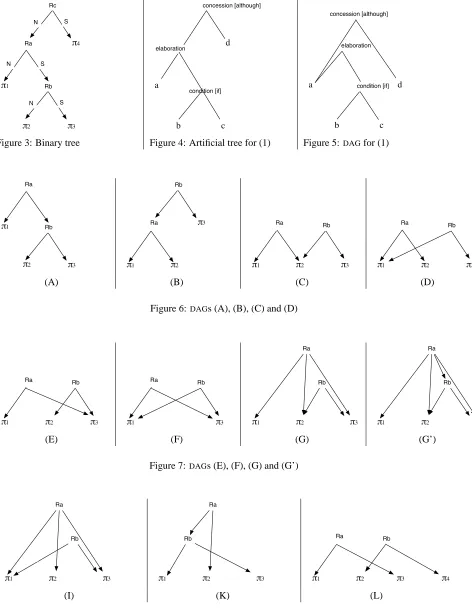
Two different ways can be used to interpret dependency relations in trees: the standard one used in mathematics and computer science, and the “nuclearity principle” put forward in RST (Marcu, 1996). Let us illustrate them with the tree in Figure 3. With the standard interpreta-tion, the first argument (nucleus) of Rcis its left daughter (the tree rooted at Ra), while with the nuclearity prin-ciple, it isπ1 (the leaf which is the first argument
(nu-cleus) of Ra). Similarly, with the standard interpretation, the second argument (satellite) of Rais its right daughter (the tree rooted at Rb), while with the nuclearity princi-ple, it isπ2(the leaf which is the first argument (nucleus)
of Rb). To put it in a nutshell, the arguments of a dis-course relation can be intermediary nodes or leaves with the standard interpretation, while they can only be leaves with the nuclearity interpretation.
(1) a. Although John is very generous -b. if you need some money, c. you only have to ask him for it -d. he’s very hard to fin-d.
Let us show that some predicate-argument relations are given by the nuclearity interpretation and other ones by the standard interpretation in their tree. From (1), (2) can be inferred. This is evidence that the arguments of the discourse relation “concession” in their tree areaandd. These predicate-argument dependencies are given by the
nuclearity interpretation.
(2) a. Although John is very generous, d. he’s very hard to find.
From (1), (3) can also be inferred. This is evidence that the arguments of “elaboration” in their tree areaand the tree rooted at “condition”. These dependencies are given by the standard interpretation.
(3) a’. John is very generous -b. if you need some money, c. you only have to ask him for it.
Nevertheless, one should not feel free to use trees rely-ing on a mixed interpretation (the standard and nuclearity ones), except if the conditions governing the use of one or the other interpretation are formally defined4. In
Sec-tion 4, I will make an attempt to lay down rules on the choice of one of these two interpretations according to the “coordinating or subordinating” type of discourse re-lations. However, this enterprise leads to a failure: no general rule can be laid down. Mixed interpretation for trees should thus be discarded. As a consequence, one has to admit that discourse structures areDAGs, for ex-ample, theDAGin Figure 5 for (1). ThisDAGis conform
to our compositionality principle: it can be viewed as the fusion of the dependency graphs for (2) and (3), while the discourse in (1) can be viewed as the fusion of the discourses in (2) and (3), with the factorization of John is
very generous which corresponds to the factorization of
”a” in theDAG.
3
DAGs for S1 Conn
aS2 Conn
bS3
It is standardly assumed that the arguments of a discourse relation expressed through a discourse connective are given by text units5 which are adjacent to the discourse
connective (Mann and Thompson, 1987), (Duchier and Gardent, 2001). However, there exist counter-examples to this adjacency principle, see (7) below. So I make
4
I thank an anonymous reviewer for drawing my attention on this point.
5
A text unit (noted asU) is either a clause or, recursively, a non discontinuous sequenceUiConnUj.
a weaker assumption, that I call “left1-right2 principle” which states the following: the first (resp. second) ar-gument of a discourse relation expressed through a dis-course connective is given by a text unit which occurs on the left (resp. right) of the discourse connective. This principle makes sense only for discourses in the canonical order. Recall (Section 2.2) that our study can be limited to discourses which satisfy the canonical linear order S1
ConnaS2 ConnbS3.
A consequence of the left1-right2 principle in dis-courses of the type S1 Conna S2 Connb S3, is that the first argument of Rais compulsorilyπ1, the only text unit
which occurs on the left of Conna. On the other hand, its second argument may vary depending on scope. More specifically, it may a priori be:
• either the representation of the whole right hand side of Conna, i.e. the semantic representation of the text unit S2 Connb S3. I call this case “wide scope” of
Connaor Ra. It leads toDAG(A) in Figure 66. The dependency relations in (A), which is tree shaped, must be interpreted in the standard way: the second argument of Ra is its right daughter, i.e. the tree rooted at Rb.
• or the representation of one of the two clauses on the right of Conna. This case leads either to tree (A1) = Ra(π1, π2)or to tree (A2) = Ra(π1, π3).
Similarly, the second argument of Rbis compulsorily π3, the only text unit on the right of Connb, but depend-ing on the scope of Connb, its first argument may a
pri-ori be Ra(π1, π2), see (B) in Figure 6, orπ2 in (B1) =
Rb(π2, π3)orπ1in (B2) = Rb(π1, π3).
We are now ready to study the combinatory coming from the fusion ofDAGs (Ai) and (Bj). The goal is to
distinguish theDAGs which correspond to coherent dis-courses S1 Conna S2 ConnbS3 from those which do not (i.e. which cannot be linguistically realized).
A) Graph (A): This graph is linguistically realized in
(4a)7. The wide scope of Conna = because can be seen in the dialogue in (4b-c) in which the answer is Because
S2 Connb S38. In conformity with our compositionality principle, (A) includes the sub-graph Rb(π2, π3)and S2 Connb S3 can be inferred: if (4a) is true, then it is true that Fred played tuba while Mary was taking a nap. The reader will check that the adverbial Conna= therefore in (4d) has also wide scope.
6
In this figure, as well as in other subsequent figures, the label for the sub-graph is omitted.
7
To indicate that it is stressed when spoken, the word while is written in capital letters in (4).
8
(4) a. Mary is in a bad mood because Fred played tuba
WHILEshe was taking a nap. b. - Why is Mary in a bad mood?
c. - Because Fred played tubaWHILEshe was tak-ing a nap.
d. Fred wanted to bother Mary. Therefore, he played tubaWHILEshe was taking a nap.
B) Graph (B): This graph is linguistically realized in
(5a). The wide scope of Connb = in order that/to can be seen in the dialogue in (5b-c) in which the question is Why S1 Connb S2? In conformity with our composi-tionality principle, (B) includes the sub-graph Ra(π1, π2)
and S1 ConnbS2 can be inferred from (5a). The adver-bial Connb= therefore in (5d) has also wide scope.
(5) a. Fred played tubaWHILEMary was taking a nap in order to bother her.9
b. - Why did Fred play tubaWHILEMary was tak-ing a nap?
c. - In order to bother her.
d. Fred played tubaWHILEMary was taking a nap. Therefore, she is in a bad mood.
C) Graphs (A1) and (B1): The fusion of (A1) and
(B1) leads toDAG(C) in Figure 6. ThisDAG is not tree shaped:π2has two parents. It is linguistically realized in (6a), in which S2 is said to be “factorized” since both S1
ConnaS2 = Mary is in a bad mood because her son is ill and S2 ConnbS3 = Her son is ill. Specifically, he has an
attack of bronchitis can be inferred from (6a), which is in
conformity with our compositionality principle since (C) includes both (A1) = Ra(π1, π2)and (B1) = Rb(π2, π3).
A similar situation is observed in (6b) and (6c).
(6) a. Mary is in a bad mood because her son is ill. Specifically, he has an attack of bronchitis. b. Fred played tuba. Next he prepared a pizza to
please Mary.
c. Fred was in a foul humor because he hadn’t slept well that night because his electric blanket hadn’t worked.10
D) Graphs (A1) and (B2): The fusion of (A1) and
(B2) leads toDAG (D) in Figure 6. ThisDAGis not tree shaped: π1has two parents. It is linguistically realized in (7a), in which S1 is said to be “factorized” since both
S1 ConnaS2 = Fred prepared a pizza to please Mary and
S1 ConnbS3 = Fred prepared a pizza. Next he took a nap can be inferred, in conformity with our compositionality principle. A similar situation is observed in (7b) and (7c).
9
When while is not stressed, the interpretation of (5a) may correspond toDAG(D) in Figure 6.
10
This discourse is a modified version (including discourse connectives) of an example taken in (Blackburn and Gardent, 1998). These authors acknowledged that the structure of this discourse is a “re-entrant graph”.
(7) a. Fred prepared a pizza to please Mary. Next, he took a nap.
b. Fred prepared a pizza, while it was raining, be-fore taking a walk.
c. Fred is ill. More specifically, he has an attack of bronchitis. Therefore, Mary is in a bad mood.
In discourses analyzed as (D), S3 is linked to S1 (which is not adjacent) and not to S2 (which is adjacent). There-fore, these discourses are counter-examples to the adja-cency principle adopted inRST.
The DAG (D) exhibits crossing dependencies and it does correspond to coherent discourses. (D) is thus a counter-example to the stipulation made by (Webber et al., 2003), namely “discourse structure itself does not
ad-mit crossing structural dependencies”11.
E) Graphs (A2) and (B1): The fusion of (A2) and
(B1) leads toDAG(E) in Figure 7, in whichπ3has two parents. I cannot find any discourse corresponding to (E), i.e. with S3 factorized, although I wrote down all possible examples I could think of. Laurence Delort, who works on (French) corpus neither. I cannot prove that something does not exist, I can just stipulate it. However there is some evidence, coming from syntax, which supports my stipulation when Conna and Connb are both subordinat-ing conjunctions (Conj). Namely, no standard syntactic analysis of sentences of the type S1 Conja S2 Conjb S3 can lead, in a compositional way, to an interpretation in which S3 is factorized12. As I see no reason to make a difference between subordinating conjunctions and other discourse connectives at the semantic level (see note 11), I extrapolate this result to other discourse connectives.
F) Graphs (A2) and (B2): The fusion of (A2) and
(B2) leads to DAG (F) in Figure 7. This graph cannot represent a discourse S1 ConnaS2 ConnbS3 since it does not includeπ2.
So far, we have examined only cases where a discourse relation has two arguments. It remains to examine what is called “multi satellite or nucleus cases” inRST, in which a discourse relation is supposed to have more than two arguments.
G) Graphs (A1), (A2) and (B2): The fusion of (A1),
(A2) and (B2) leads toDAG (G) in Figure 7. ThisDAG
could be said to be linguistically realized in (8a): since
11
Among discourse connectives, (Webber et al., 2003) dis-tinguish “structural connectives” (e.g. subordinating conjunc-tions) from discourse adverbials including then, also, otherwise,
. . . . They argue that discourse adverbials do admit crossing of
predicate-argument dependencies, while structural connectives do not. I don’t make any distinction between discourse connec-tives at the semantic level, but I emphasize that (7b) comprises only structural connectives (subordinating conjunctions) and its structure exhibits crossing structural dependencies.
12
Recall that I feel entitled to make this claim because I have studied in detail the syntactic analyses of sentences of the type
both S1ConnaS2 and S1ConnaS3 can be inferred from (8a), one may be willing to lay down both Ra(π1, π2)and
Ra(π1, π3), i.e. to consider (8a) as a multi-satellite case
with Ra = Elaboration. Rb = Narration linksπ2andπ3.
The following question arises: is Rbin a dependency rela-tion with Ra? It is hard to give an answer for (8a). How-ever the answer seems positive for (8b), which could also be analyzed as a multi-satellite case with Ra= Explana-tion. Rb= Joint linksπ2andπ3. This leads toDAG(G’)
in Figure 7. However, consider (8c) which differs from (8b) only by the use of or instead of and. Graphs (G) or (G’) would not do justice to (8c): neitherRa(π1, π2)
norRa(π1, π3)can be laid down. (8c) can only be
rep-resented as DAG (A) with Ra = Explanation and Rb = Disjunction.
(8) a. Guy experienced a lovely evening last night. More specifically, he had a fantastic meal. Next he won a dancing competition.13
b. Mary is in a bad mood because she had’nt slept well and it is raining.
c. Mary is in a bad mood because she had’nt slept well or it is raining.
It seems clear that (8b) and (8c) should be represented at the semantic level as the very same graph. This graph can only be (A), which is the only possibility for (8c). For the sake of homogeneity and compatibility with SDRT, (8a) should also be represented as (A)14. Recall more-over that (4a) with wide scope ofConna is also repre-sented as (A). All in all, (A) happens to be a semantic structure which is shared by discourses whose informa-tional content shows quite different relations between the eventualities at stake. Is it a problem? I would say no, be-cause, from (A), semantic to content rules, based on the values ofRaandRb, can make the difference: they can compute the following (simplified) logical forms, which show that the discourses in (8) and (4a) do not have the same type of informational content as far as the relations between eventualities are concerned, althoug they share the same (dependency) semantic structure:
• for (8a) with Ra = Elaboration and Rb= Narration: e1∧e2∧e3∧precede(e2, e3)
∧subevent(e1, e2)∧subevent(e1, e3)
• for (8b) with Ra= Explanation and Rb= Joint:e1∧
e2∧e3∧cause(e1, and(e2, e3))
→e1∧e2∧e3∧cause(e1, e2)∧cause(e1, e3)
13
This discourse is a modified version (including discourse connectives) of an example taken in (Asher and Lascarides, 2003).
14
The (A) analysis is the translation of the SDRSproposed by (Asher and Lascarides, 2003) for (8a), namely theSDRSin Figure 1 with Ra= Elaboration and Rb= Narration.π1is
con-sidered as the “topic” (common theme) forπ2andπ3.
• for (8c) with Ra = Explanation and Rb = Disjunc-tion:e1∧e2∧e3∧cause(e1, or(e2, e3))
→e1∧e2∧e3∧(cause(e1, e2)∨cause(e1, e3))
• for (4a) with Ra = Explanation and Rb = Circum-stances:e1∧e2∧e3∧overlap(e2, e3)
∧cause(e1, overlap(e2, e3))
We have touched here a crucial question in discourse processing (within a multi-level approach): to what ex-tent should the semantic (dependency) level (how things
are said) echo the informational content level (what is said)? I don’t pretend to give a general answer to this
fundamental question. However we have seen that the same semantic dependency structure (orSDRS) can lead to quite different informational contents according to the values of the discourse relations at stake. What is called multi-satellite case inRST, e.g. (8a) or (8b), leads to a logical form in which the same eventuality variable, here e1, occurs conjunctively multi-times as the argument of
the same predicate, e.g. preda(e1, e2)∧preda(e1, e3)
withpreda = subeventin (8a) andpreda = causein (8b). It is unnecessary to represent such a case at the semantic level trough a predicate a discourse relation -with more than two arguments. The multi-satelitte anal-ysis inRSTcomes from the following principle: if a sub-discourse Dpcan be inferred from a discouse Dn, with
1 < p < n, then the graphDp must be a sub-graph of
Dn. This principle is simply wrong. On the other hand, the converse implication is true.
H) Graphs (A1), (B1) and (B2): The fusion of (A1),
(B1) and (B2) leads to aDAGwhich could be said to be linguistically realized in (9). This discourse allows us to infer both S1 ConnbS3 and S2 ConnbS3. So it would be classified as a multi-nucleus case in RST. However, by the same argumentation as previously, it should be repre-sented as (B).
(9) Fred washed the dishes and Guy cleaned up the bath-room, while Mary was taking a nap.
I) Graphs (A1), (A2) and (B2): The fusion of these
graphs lead to DAG (I) in Figure 8. I cannot find any example corresponding to thisDAG.
J) Graphs (A2), (B1) and (B2): Along the same lines,
the fusion of these graphs lead to aDAGfor which I can-not find any instance.
No other fusion of graphs (Ai) and (Bj) leads to aDAG which corresponds to a coherent discourse. So we have arrived at the following result:
The dependency structure of a discourse S1
which are not tree shaped, cover multi parent cases (factorization of a sentence). (D) exhibits crossing dependencies.
Before commenting on this result, let us come back to the interpretation of dependency relations in trees.
4
Interpretation of dependency relations in
trees (concluding episode)
First, let us underline the following point. Interpreting tree shaped graphs (A) and (B) with the nuclearity princi-ple amounts to interpreting (A) as (C), and (B) as (D)15.
But then, cases with wide scope are not taken into ac-count, which is unacceptable. Therefore, the standard in-terpretation of dependency relations in a tree is needed.
Next, the following question arises: is it possible to state that the dependency relations in a tree should be computed sometimes by the standard interpretation and some other times by the nuclearity one? In the tree (B), this question is instantiated in the following way: should the first argument of Rbbe given sometimes by the stan-dard interpretation (it is then the tree rooted at Ra) and some other times by the nuclearity principle (it is then π1, and (B) is equivalent to (D))16? An answer to this
question is sound only if it is possible to define formally “sometimes”. The only sound answer consists in stat-ing that there exist two types of discourse relations: the dependency relations are computed with the standard in-terpretation for the first type, and computed with the nu-clearity interpretation for the second one. The only types of discourse relations which have been put forward up to now are the “coordinating and subordinating” types (Hobbs, 1979), (Asher and Lascarides, 2003), (Asher and Vieu, 2003). Laurence Delort in (Delort, 2004) has ex-amined, in the framework ofSDRT, myDAGs (A)-(D) in studying for each relation Ra or Rb if it could be of the coordinating and/or subordinating type. Her results are summarized in Table 1. This table shows that (B) is pos-sible only when Ra is coordinating and (D) only when Rais subordinating (in both cases, Rbcan be equally co-ordinating or subco-ordinating). Therefore, it is possible to lay down the following rule: the dependency relations in the tree (B) are computed with the standard interpretation when Ra is coordinating, and with the nuclearity inter-pretation when Rais subordinating.
However, let us examine the situation for the tree (A). From Table 1, the reader can check that no rule can be laid down for the dependency relations in (A) when Rbis coordinating: they can be computed with either the stan-dard or the nuclearity interpretation. These two cases are
15
With the nuclearity principle, the second argument of Rain
(A) isπ2, and the first argument of Rbin (B) isπ1. 16
For the other dependency relations in (B), both interpreta-tions give the same result.
illustrated in (10) with Ra= Contrast and Rb= Narration: (10a) should be analyzed with the standard interpretation of (A) with wide scope of Conna, while (10b) should be analyzed with the nuclearity interpretation of (A), i.e. as (C) with S2 factorized.
(10) a. Fred has made no domestic chore this morning. However, this afternoon, he wed up the dishes. Next he ran the vacuum cleaner.
b. Fred has made no domestic chore this morn-ing. However, this afternoon, he washed up the dishes. Next he went to see a movie.
In conclusion, a mixed interpretation for trees must be discarded: the coordinating or subordinating type of discourse relations does not allow us to choose between the standard and nuclearity interpretations. As a conse-quence, since the standard interpretation is needed for wide scope cases, the nuclearity principle should be dis-carded.
5
Analysis of the result and conclusion
The result I arrived at does not take into account the dis-course connectives / relations at stake. However, for a given pair of connectives, it may happen that only some of theDAGs among (A)-(D) are observed. For example, if Conna is an adverbial and Connb a subordinate con-junction, then (B) with wide scope of Rb should be ex-cluded. On the top of part of speech considerations, the lexical value of each connective may exclude some of theseDAGs. Finally, the distinction between coordinat-ing and subordinatcoordinat-ing discourse relations must be taken into account. Table 1 from (Delort, 2004) presented as in Table 2 shows that a givenDAGamong (A)-(D) never cor-responds to the2?2 = 4possibilities given by the combi-natory Ra/bcoordinating or subordinating discourse rela-tion.
To put it in a nutshell, there is a maximum of four or-deredDAGs representing the semantic structures of dis-courses S1 ConnaS2 ConnbS3. I stipulate that this result can be extrapolated to cases where sentences are simply juxtaposed without discourse connective.
It can be considered that there is only a fewDAGs cor-responding to coherent discourses with three clauses17.
First, recall that the left1-right2 principle (Section 3) dis-cards right away a number ofDAGs, for example (K) in Figure 8 (in (K), Ra is not the mother ofπ1). Secondly,
among theDAGs which satisfy the left1-right2 principle, some are not instantiated, e.g. (E), and also (F). A look
17
on the topology of the ordered DAGs (A)-(D) allows us to bring forward this other structural constraint: Ramust
“left-dominate”π2. The definition of left-dominance in
a tree is the following (Danlos, 2003): a node X left-dominates a node Y iff Y is a daughter of X (immediate dominance) or there exists a daughter Z of X such that Y belongs to the left-frontier of the tree rooted at Z. For example, Raleft-dominatesπ1, Rb andπ2in (A), while Rbleft-dominates Ra,π1andπ3in (B)18.
Let us here examine the consequences of this left-dominance constraint in non formal terms. Ra must be the mother ofπ1and must left-dominateπ2. This means
that Ra establishes some semantic link between S1 and
S219. This result may sound trivial on psycho-linguisitics
grounds: what would be a discourse in which the second clause is not linked at all to the first one?20 It has the
following consequence: the semantic representation of a discourse with four clauses and three discourse connec-tives cannot beDAG(L) in Figure 8. In (L), Ra does not left-dominateπ2, or informally, there is no link between S1 and S2. (L) includes two crossing dependencies.
I have just half-opened the door towards an extension of this study to discourses with more than three clauses. I stipulate that the conclusion of this forthcoming study will be the same. Namely, semantic dependency struc-tures for discourses are orderedDAGs which satisfy heavy structural constraints, which can help us to cut down the number of possibilities when processing discourses.
Acknowledgements
I want to thank Laura Kallmeyer for her many valuable comments.
References
Nicholas Asher and Alex Lascarides. 2003. Logics of Conversation. Cambridge University Press,
Cam-bridge.
Nicholas Asher and Laure Vieu. 2003. Subordinating and coordinating discourse relations. Lingua. forth-coming.
18Left-dominance is a notion more restrictive than
domi-nance (e.g. Radominatesπ1, Rb,π2and alsoπ3in (A)) and
less restrictive than the nuclearity principle (e.g. by this princi-ple, Radominates only the leavesπ1, andπ2in (A)).
19
This result can be seen as a weaker version of the adjacency principle for the first two clauses of a discourse.
20
The link between the first two clauses can be given by a third sentence, as in (11) in which S3 establishes a joint link between S1 and S2 through its plural subject. TheDAGfor (11) is (B) with Ra= Joint and Rb= Comment.
(11) It is raining. Ted arrived late. These two facts irritated Mary.
Nicholas Asher. 1993. Reference to Abstract Objects in
Discourse. Kluwer, Dordrecht.
John Bateman. 1999. The dynamics of ‘surfacing’: an initial exploration. In Proceedings of International
Workshop on Levels of Representations in Discourse (LORID’99), pages 127–133, Edinburgh.
Patrick Blackburn and Claire Gardent. 1998. A specifi-cation language for discourse semantics. In
Proceed-ings of LACL’98, pages 61–67, Grenoble.
Laurence Danlos. 2003. Repr´esentation s´emantique sous-sp´ecifi´ee pour les conjonctions de subordination. In Actes de TALN 2003, pages 44–54, Batz-sur-Mer, France.
Laurence Delort. 2004. Relations subordonnantes et coordonnantes pour la d´esambigu¨ısation du discours. In Proceedings of International Workshop on SDRT,
TALN’04, F`es, Maroc.
Denis Duchier and Claire Gardent. 2001. Tree descrip-tions, contraints and incrementality. In R. Muskens H. Bunt and E. Thijsse, editors, Computing Meaning, pages 205–227. Kluwer Academic Publishers, Dor-drecht.
Jerry Hobbs. 1979. Coherence and coreference.
Cogni-tive Science, (3):67–90.
Hans Kamp and Uwe Reyle. 1993. From Discourse to
Logic. Kluwer Academic Publishers, Dordrecht.
William Mann and Sandra Thompson. 1987. Rhetorical structure theory: Description and construction of texts structures. In G. Kempen, editor, Natural Language
Generation, pages 85–95. Martinus Nijhoff Publisher,
Dordrecht.
Daniel Marcu. 1996. Building up rhetorical structure trees. In The Proceedings of the 13th National
Confer-ence on Artificial IntelligConfer-ence, pages 1069–1074,
Port-land.
Igor Mel’cuk. 2001. Communicative Organization in Natural Language: The Semantic-Communicative Structure of Sentences. John Benjamins Publishing Company, Amsterdam.
B. Webber, A. Joshi, M. Stone, and A. Knott. 2003. Anaphora and discourse structure. Computational
Ra Ra Rb Rb coor. sub. coor. sub.
(A) + + +
-(B) + - + +
(C) + - + +
- + - +
(D) - + + +
Table 1
P P
P P
PP
PP
Ra
Rb
coordinating subordinating
coordinating (A), (B), (C) (B), (C) subordinating (A), (D) (C), (D)
Table 2
π1, π0
π1:
e1
π0:
π2, π3
π2:
e2
π3:
e3
Rb(π2, π3)
Ra(π1, π0)
Ra
Rb
π
1π
2π
3π
0Figure 1: Translation of anSDRSinto aDAG
π1, π00
π1:
e1
π00:
π2, π5, π0
π2:
e2
π5:
e5
π0:
π3, π4
π3:
e3
π4:
e4
Narration(π3, π4)
Narration(π2, π5)
Elaboration(π2, π0)
Elaboration(π1, π00)
(12) 1 Max experienced a lovely evening last night.
2 He had a fantastic meal. 3 He ate salmon.
4 He devoured lots of cheese. 5 He won a dancing competition.
Elaboration
Narration
Elab.
Narration
π
1π
2π
5π
3π
4π
0π
00Figure 2: Translation of theSDRSfor (12) into aDAG
-Ra
N
Rc
S
π1
N S
π2
π4
Rb
N S
π3
concession [although]
a
b
d
condition [if]
c elaboration
concession [although]
d
elaboration
a
b
condition [if]
c
Figure 3: Binary tree Figure 4: Artificial tree for (1) Figure 5:DAGfor (1)
Ra
Rb π1
π2 π3
Ra Rb
π1 π2
π3 Ra Rb
π1 π2 π3
Ra Rb
π1 π2 π3
(A) (B) (C) (D)
Figure 6: DAGs (A), (B), (C) and (D)
Ra Rb
π1 π2 π3
Ra Rb
π1 π3
Ra
Rb
π1 π2 π3
Ra
Rb
π1 π2 π3
(E) (F) (G) (G’)
Figure 7: DAGs (E), (F), (G) and (G’)
Ra
Rb
π1 π2 π3
Ra
Rb
π1 π2 π3
Ra Rb
π1 π2 π3 π4
(I) (K) (L)