Applications of Lexical Information for Algorithmically Composing
Multiple-Choice Cloze Items
Chao-Lin Liu† Chun-Hung Wang† Zhao-Ming Gao‡ Shang-Ming Huang† †Department of Computer Science, National Chengchi University, Taipei 11605, Taiwan
‡Dept. of Foreign Lang. and Lit., National Taiwan University, Taipei 10617, Taiwan †[email protected], ‡[email protected]
ABSTRACT1
We report experience in applying techniques for nat-ural language processing to algorithmically generat-ing test items for both readgenerat-ing and listengenerat-ing cloze items. We propose a word sense disambiguation-based method for locating sentences in which des-ignated words carry specific senses, and apply a collocation-based method for selecting distractors that are necessary for multiple-choice cloze items. Experimental results indicate that our system was able to produce a usable item for every 1.6 items it returned. We also attempt to measure distance be-tween sounds of words by considering phonetic fea-tures of the words. With the help of voice synthe-sizers, we were able to assist the task of compos-ing listencompos-ing cloze items. By providcompos-ing both readcompos-ing and listening cloze items, we would like to offer a somewhat adaptive system for assisting Taiwanese children in learning English vocabulary.
1 Introduction
Computer-assisted item generation (CAIG) allows the creation of large-scale item banks, and has at-tracted active study in the past decade (Deane and Sheehan, 2003; Irvine and Kyllonen, 2002). Ap-plying techniques for natural language processing (NLP), CAIG offers the possibility of creating a large number of items of different challenging lev-els, thereby paving a way to make computers more adaptive to students of different competence. More-over, with the proliferation of Web contents, one may search and sift online text files for candidate sentences, and come up with a list of candidate cloze
1A portion of results reported in this paper will be expanded
in (Liu et al., 2005; Huang et al., 2005).
items economically. This unleashes the topics of the test items from being confined by item creators’ per-sonal interests.
NLP techniques serve to generate multiple-choice cloze items in different ways. (For brevity, we use
cloze items or items for multiple-choice cloze items
henceforth.) One may create sentences from scratch by applying template-based methods (Dennis et al., 2002) or more complex methods based on some pre-determined principles (Deane and Sheehan, 2003). Others may take existing sentences from a corpus, and select those that meet the criteria for becoming test items. The former approach provides specific and potentially well-controlled test items at the costs of more complex systems than the latter, e.g., (Shee-han et al., 2003). Nevertheless, as the Web provides ample text files at our disposal, we may filter the text sources stringently for obtaining candidate test items of higher quality. Administrators can then se-lect really usable items from these candidates at a relatively lower cost.
Some researchers have already applied NLP tech-niques to the generation of sentences for multiple-choice cloze items. Stevens (1991) employs the con-cepts of concordance and collocation for generating items with general corpora. Coniam (1997) relies on factors such as word frequencies in a tagged corpus for creating test items of particular types.
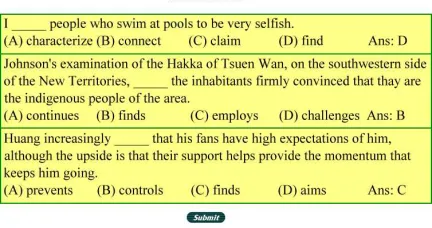
postprocess-Figure 1: A multiple-choice cloze item for English
ing workload. In addition, composing a cloze item requires not just a useful sentence.
Figure 1 shows a multiple-choice item, where we call the sentence with a gap the stem, the answer to the gap the key, and the other choices the
distrac-tors. Given a sentence, we still need distractors for
a multiple-choice item. The selection of distractors affects the item facility and item discrimination of the cloze items (Poel and Weatherly, 1997). There-fore, the selection of distractors calls for deliberate strategies, and simple considerations alone, such as word frequencies, may not satisfy the demands.
To remedy these shortcomings, we employ the techniques for word sense disambiguation (WSD) for choosing sentences in which the keys carries spe-cific senses, and utilize the techniques for comput-ing collocations (Manncomput-ing and Sch¨utze, 1999) for selecting distractors. Results of empirical evaluation show that our methods could create items of satisfac-tory quality, and we have actually used the generated cloze items in freshmen-level English classes.
For broadening the formats of cloze items, we also design software that assists teachers to create listening cloze items. After we defining a metric for measuring similarity between pronunciations of words, our system could choose distractors for lis-tening cloze items. This addition opens a door to offering different challenging levels of cloze items.
We sketch the flow of the item generation pro-cess in Section 2, and explain the preparation of the source corpus in Section 3. In Section 4, we elab-orate on the application of WSD to selecting sen-tences for cloze items, and, in Section 5, we delve into the application of collocations to distractor gen-eration. Results of evaluating the created reading cloze items are presented in Section 6. We then outline methods for creating listening cloze items in Section 7 before making some concluding remarks.
2 System Architecture
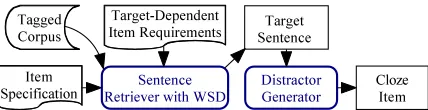
Figure 2 shows major steps for creating cloze items. Constrained by test administrator’s specifications and domain dependent requirements, the Sentence
Retriever chooses a candidate sentence from the
7DJJHG &RUSXV
7DUJHW'HSHQGHQW ,WHP5HTXLUHPHQWV
,WHP 6SHFLILFDWLRQ
7DUJHW 6HQWHQFH
6HQWHQFH
5HWULHYHUZLWK:6' 'LVWUDFWRU*HQHUDWRU &OR]H,WHP
Figure 2: Main components of our item generator
Tagged Corpus. Target-Dependent Item
Require-ments specify general principles that should be
fol-lowed by all items for a particular test. For example, the number of words in cloze items for College En-trance Examinations in Taiwan (CEET) ranges be-tween 6 and 28 (Liu et al., 2005), and one may want to follow this tradition in creating drill tests.
Figure 3 shows the interface to the Item
Specifi-cation. Through this interface, test administrators
[image:2.612.319.533.53.108.2]select the key for the desired cloze item, and specify part-of-speech and sense of the key that will be used in the item. Our system will attempt to create the re-quested number of items. After retrieving the target sentence, the Distractor Generator considers such constraining factors as word frequencies and collo-cations in selecting the distractors at the second step.
Figure 3: Interface for specifying cloze items
Figure 4 shows a sample output for the specifica-tion shown in Figure 3. Given the generated items, the administrator may choose and edit the items, and save the edited items into the item bank. It is possi-ble to retrieve previously saved items from the item bank, and compile the items for different tests.
3 Source Corpus and Lexicons
Employing a web crawler, we retrieve the con-tents of Taiwan Review <publish.gio.gov.tw>,
Tai-wan Journal<taiwanjournal.nat.gov.tw>, and China
[image:2.612.317.533.401.462.2]Figure 4: An output after Figure 3
the mixture of titles, main body of the reports, and multimedia contents, and then segment the ex-tracted paragraphs into individual sentences. We segment sentences with the help of MXTERMINA-TOR (Reynar and Ratnaparkhi, 1997). We then tok-enize words in the sentences before assigning useful tags to the tokens.
We augment the text with an array of tags that facilitate cloze item generation. We assign tags of part-of-speech (POS) to the words with MXPOST that adopts the Penn Treebank tag set (Ratnaparkhi, 1996). Based on the assigned POS tags, we annotate words with their lemmas. For instance, we annotate
classified with classify and classified, respectively,
when the original word has VBN and JJ as its POS tag. We also employ MINIPAR (Lin, 1998) to ob-tain the partial parses of sentences that we use exten-sively in our system. Words with direct relationships can be identified easily in the partially parsed trees, and we rely heavily on these relationships between words for WSD. For easy reference, we will call words that have direct syntactic relationship with a wordW asW’s signal words or simply signals.
Since we focus on creating items for verbs, nouns, adjectives, and adverbs (Liu et al., 2005), we care about signals of words with these POS tags in sen-tences for disambiguating word senses. Specifically, the signals of a verb include its subject, object, and the adverbs that modify the verb. The signals of a noun include the adjectives that modify the noun and the verb that uses the noun as its object or predicate. For instance, in “Jimmy builds a grand building.”, both “build” and “grand” are signals of “building”. The signals of adjectives and adverbs include the words that they modify and the words that modify the adjectives and adverbs.
When we need lexical information about English words, we resort to electronic lexicons. We use
WordNet <www.cogsci.princeton.edu/˜wn/> when we need definitions and sample sentences of words for disambiguating word senses, and we employ HowNet<www.keenage.com>when we need infor-mation about classes of verbs, nouns, adjectives, and adverbs.
HowNet is a bilingual lexicon. An entry in HowNet includes slots for Chinese words, English words, POS information, etc. We rely heavily on the slot that records the semantic ingredients related to the word being defined. HowNet uses a limited set of words in the slot for semantic ingredient, and the leading ingredient in the slot is considered to be the most important one generally.
4 Target Sentence Retriever
The sentence retriever in Figure 2 extracts qualified sentences from the corpus. A sentence must contain the desired key of the requested POS to be consid-ered as a candidate target sentence. Having identi-fied such a candidate sentence, the item generator needs to determine whether the sense of the key also meets the requirement. We conduct this WSD task based on an extended notion of selectional prefer-ences.
4.1 Extended Selectional Preferences
Selectional preferences generally refer to the phe-nomenon that, under normal circumstances, some verbs constrain the meanings of other words in a sentence (Manning and Sch¨utze, 1999; Resnik, 1997). We can extend this notion to the relation-ships between a word of interest and its signals, with the help of HowNet. Letwbe the word of interest, andπbe the first listed class, in HowNet, of a signal word that has the syntactic relationship µ with w. We define the strength of the association ofwandπ as follows:
Aµ(w, π) = PrPrµ(w, π) µ(w)
, (1)
wherePrµ(w)is the probability ofwparticipating in
theµrelationship, and Prµ(w, π)is the probability
that bothwandπparticipate in theµrelationship.
4.2 Word Sense Disambiguation
of “spend” in the candidate target sentence “They say film makers don’t spend enough time developing a good story.” The word “spend” has two possible meanings in WordNet.
1. (99) spend, pass – (pass (time) in a specific way; “How are you spending your summer va-cation?”)
2. (36) spend, expend, drop – (pay out; “I spend all my money in two days.”)
Each definition of the possible senses include (1) the head words that summarize the intended mean-ing and (2) a sample sentence for sense. When we work on the disambiguation of a word, we do not consider the word itself as a head word in the follow-ing discussion. Hence, “spend” has one head word, i.e., “pass”, in the first sense and two head words, i.e., “extend” and “drop”, in the second sense.
An intuitive method for determining the mean-ing of “spend” in the target sentence is to replace “spend” with its head words in the target sentence. The head words of the correct sense should go with the target sentence better than head words of other senses. This intuition leads to the a part of the scores for senses, i.e.,Stthat we present shortly.
In addition, we can compare the similarity of the contexts of “spend” in the target sentence and sam-ple sentences, where context refers to the classes of the signals of the word being disambiguated. For the current example, we can check whether the subject and object of “spend” in the target sentence have the same classes as the subjects and objects of “spend” in the sample sentences. The sense whose sample sentence offers a more similar context for “spend” in the target sentence receives a higher score. This in-tuition leads to the other part of the scores for senses, i.e.,Ssthat we present below.
Assume that the key w has nsenses. Let Θ =
{θ1, θ2,· · · , θn}be the set of senses ofw. Assume that senseθjof wordwhasmjhead words in
Word-Net. (Note that we do not considerwas its own head word.) We use the setΛj ={λj,1, λj,2,· · · , λj,mj}
to denote the set of head words that WordNet pro-vides for senseθj of wordw.
When we use the partial parser to parse the tar-get sentence T for a key, we obtain information about the signal words of the key. Moreover, for
each of these signals, we look up their classes in HowNet, and adopt the first listed class for each of the signals when the signal covers multiple classes. Assume that there are µ(T) signals for the key
w in a sentence T. We use the set Ψ(T, w) =
{ψ1,T, ψ2,T,· · · , ψµ(T),T} to denote the set of
sig-nals forwinT. Correspondingly, we useυj,T to
de-note the syntactic relationship betweenw andψj,T
inT, use Υ(T, w) = {υ1,T, υ2,T,· · ·, υµ(T),T}for
the set of relationships between signals inΨ(T, w) and w, use πj,T for the class of ψj,T, and use Π(T, w) = {π1,T, π2,T,· · ·, πµ(T),T}for the set of
classes of the signals inΨ(T, w).
Equation (2) measures the average strength of as-sociation of the head words of a sense with signals of the key inT, so we use (2) as a part of the score forwto take the sense θj in the target sentenceT.
Note that both the strength of association andStfall
in the range of [0,1].
St(θj|w, T)
= 1
mj mj
X
k=1 1 µ(T)
µ(TX)
l=1
Aµl,T(λj,k, πl,T) (2)
In (2), we have assumed that the signal words are not polysemous. If they are polysemous, we as-sume that each of the candidate sense of the signal words are equally possible, and employ a slightly more complicated formula for (2). This assumption may introduce errors into our decisions, but relieves us from the needs to disambiguate the signal words in the first place (Liu et al., 2005).
Since WordNet provides sample sentences for im-portant words, we also use the degrees of similarity between the sample sentences and the target sen-tence to disambiguate the word senses of the key word in the target sentence. LetT andSbe the tar-get sentence ofwand a sample sentence of senseθj
ofw, respectively. We compute this part of score,
Ss, forθj using the following three-step procedure.
If there are multiple sample sentences for a given sense, sayθj ofw, we will compute the score in (3)
for each sample sentence ofθj, and use the average
score as the final score forθj.
Procedure for computingSs(θj|w, T)
Ψ(T, w) = {ψ1,T, ψ2,T,· · · , ψµ(T),T}, Υ(T, w) = {υ1,T, υ2,T,· · ·, υµ(T),T}, Ψ(S, w) = {ψ1,S, ψ2,S,· · ·, ψµ(S),S},and Υ(S, w) = {υ1,S, υ2,S,· · · , υµ(S),S}
2. We look for ψj,T and ψk,S such that υj,T = υk,S, and then check whether πj,T = πk,S.
Namely, for each signal of the key in T, we check the signals of the key inSfor matching syntactic relationships and word classes, and record the counts of matched relationship in
M(θj, T)(Liu et al., 2005).
3. The following score measures the proportion of matched relationships among all relationships between the key and its signals in the target sen-tence.
Ss(θj|w, T) = Mµ(T(θj, T) ) (3)
The score forw to take senseθj in a target
sen-tence T is the sum of St(θj|w, T) defined in (2)
and Ss(θj|w, T) defined in (3), so the sense of w
in T will be set to the sense defined in (4) when the score exceeds a selected threshold. When the sum ofSt(θj|w, T)andSs(θj|w, T)is smaller than
the threshold, we avoid making arbitrary decisions about the word senses. We discuss and illustrate ef-fects of choosing different thresholds in Section 6.
arg max θj∈Θ
St(θj|w, T) +Ss(θj|w, T) (4)
5 Distractor Generation
Distractors in multiple-choice items influence the possibility of making lucky guesses to the answers. Should we use extremely impossible distractors in the items, examinees may be able to identify the correct answers without really knowing the keys. Hence, we need to choose distractors that appear to fit the gap, and must avoid having multiple answers to items in a typical cloze test at the same time.
There are some conceivable principles and al-ternatives that are easy to implement and follow. Antonyms of the key are choices that average exam-inees will identify and ignore. The part-of-speech tags of the distractors should be the same as the key in the target sentence. We may also take cul-tural background into consideration. Students in
Taiwan tend to associate English vocabularies with their Chinese translations. Although this learning strategy works most of the time, students may find it difficult to differentiate English words that have very similar Chinese translations. Hence, a culture-dependent strategy is to use English words that have similar Chinese translations with the key as the dis-tractors.
To generate distractors systematically, we employ ranks of word frequencies for selecting distractors (Poel and Weatherly, 1997). Assume that we are generating an item for a key whose part-of-speech is ρ, that there are n word types whose part-of-speech may beρin the dictionary, and that the rank of frequency of the key among thesen types ism. We randomly select words that rank in the range
[m−n/10, m+n/10]among thesentypes as candi-date distractors. These distractors are then screened by their fitness into the target sentence, where fitness is defined based on the concept of collocations of word classes, defined in HowNet, of the distractors and other words in the stem of the target sentence.
Recall that we have marked words in the corpus with their signals in Section 3. The words that have more signals in a sentence usually contribute more to the meaning of the sentence, so should play a more important role in the selection of distractors. Since we do not really look into the semantics of the tar-get sentences, a relatively safer method for selecting distractors is to choose those words that seldom col-locate with important words in the target sentence.
LetT ={t1, t2,· · · , tn}denote the set of words
in the target sentence. We select a setT0 ⊂T such that eacht0
i∈T0has two or more signals inT and is
a verb, noun, adjective, or adverb. Letκbe the first listed class, in HowNet, of the candidate distractor, andℵ = {τi|τiis the first listed class of at0i ∈ T0}.
The fitness of a candidate distractor is defined in (5).
−1
|ℵ|
X
τi∈ℵ
log Pr(κ, τi)
Pr(κ) Pr(τi) (5)
The candidate whose score is better than 0.3 will be admitted as a distractor. Pr(κ) and Pr(τi) are
the probabilities that each word class appears indi-vidually in the corpus, and Pr(κ, τi) is the
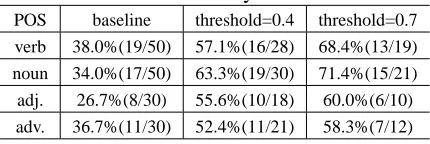
Table 1: Accuracy of WSD
POS baseline threshold=0.4 threshold=0.7 verb 38.0%(19/50) 57.1%(16/28) 68.4%(13/19) noun 34.0%(17/50) 63.3%(19/30) 71.4%(15/21) adj. 26.7%(8/30) 55.6%(10/18) 60.0%(6/10) adv. 36.7%(11/30) 52.4%(11/21) 58.3%(7/12)
are provided in (Liu et al., 2005). The term in the summation is a pointwise mutual information, and measures how often the classes κ and τi collocate
in the corpus. We negate the averaged sum so that classes that seldom collocate receive higher scores. We set the threshold to 0.3, based on statistics of (5) that are observed from the cloze items used in the 1992-2003 CEET.
6 Evaluations and Applications
6.1 Word Sense Disambiguation
Different approaches to WSD were evaluated in dif-ferent setups, and a very wide range of accuracies in [40%, 90%] were reported (Resnik, 1997; Wilks and Stevenson, 1997). Objective comparisons need to be carried out on a common test environment like SEN-SEVAL, so we choose to present only our results.
We arbitrarily chose, respectively, 50, 50, 30, and 30 sentences that contained polysemous verbs, nouns, adjectives, and adverbs for disambiguation. Table 1 shows the percentage of correctly disam-biguated words in these 160 samples.
The baseline column shows the resulting accu-racy when we directly use the most frequent sense, recorded in WordNet, for the polysemous words. The rightmost two columns show the resulting accu-racy when we used different thresholds for applying (4). As we noted in Section 4.2, our system selected fewer sentences when we increased the threshold, so the selected threshold affected the performance. A larger threshold led to higher accuracy, but increased the rejection rate at the same time. Since the cor-pus can be extended to include more and more sen-tences, we afford to care about the accuracy more than the rejection rate of the sentence retriever.
We note that not every sense of all words have sample sentences in the WordNet. When a sense does not have any sample sentence, this sense will receive no credit, i.e., 0, for Ss. Consequently,
our current reliance on sample sentences in
Word-Table 2: Correctness of the generated sentences
POS of the key # of items % of correct sentences
verb 77 66.2%
noun 62 69.4%
adjective 35 60.0%
adverb 26 61.5%
overall 65.5%
Table 3: Uniqueness of answers
item category key’s POS number of items results
verb 64 90.6%
noun 57 94.7%
cloze adjective 46 93.5%
adverb 33 84.8%
overall 91.5%
Net makes us discriminate against senses that do not have sample sentences. This is an obvious draw-back in our current design, but the problem is not really detrimental and unsolvable. There are usually sample sentences for important and commonly-used senses of polysemous words, so the discrimination problem does not happen frequently. When we do want to avoid this problem once and for all, we can customize WordNet by adding sample sentences to all senses of important words.
6.2 Cloze Item Generation
We asked the item generator to create 200 items in the evaluation. To mimic the distribution over keys of the cloze items that were used in CEET, we used 77, 62, 35, and 26 items for verbs, nouns, adjectives, and adverbs, respectively, in the evaluation.
Figure 5: A phonetic concordancer
6.3 More Applications
We have used the generated items in real tests in a freshman-level English class at National Chengchi University, and have integrated the reported item generator in a Web-based system for learning En-glish. In this system, we have two major subsys-tems: the authoring and the assessment subsystems. Using the authoring subsystem, test administrators may select items from the interface shown in Fig-ure 4, save the selected items to an item bank, edit the items, including their stems if necessary, and fi-nalize the selection of the items for a particular ex-amination. Using the assessment subsystem, stu-dents answer the test items via the Internet, and can receive grades immediately if the administra-tors choose to do so. The answers of students are recorded for student modelling and analysis of the item facility and the item discrimination.
7 Generating Listening Cloze Items
We apply the same infrastructure for generating reading cloze items, shown in Figure 2, for the gen-eration of listening cloze items (Huang et al., 2005). Due to the educational styles in Taiwan, students generally find it more difficult to comprehend mes-sages by listening than by reading. Hence, we can regard listening cloze tests as an advanced format of reading cloze tests. Having constructed a database of sentences, we can extract sentences that contain the key for which the test administrator would like to have a listening cloze, and employ voice synthe-sizers to create the necessary recordings.
Figure 5 shows an interface through which ad-ministrators choose and edit sentences for listening cloze items. Notice that we employ the concept that is related to ordinary concordance in arranging the extracted sentences. By defining a metric for mea-suring similarity between sounds, we can put sen-tences that have similar phonetic contexts around the key near each other. We hope this would better help teachers in selecting sentences by this rudimentary
Figure 6: The most simple form of listening cloze
clustering of sentences.
Figure 6 shows the most simple format of listen-ing cloze items. In this format, students click on the options, listen to the recorded sounds, and choose the option that fit the gap. The item shown in this figure is very similar to that shown in Figure 1, ex-cept that students read and hear the options. From this most primitive format, we can image and imple-ment other more challenging formats. For instance, we can replace the stem, currently in printed form in Figure 6, into clickable links, demanding students to hear the stem rather than reading the stem. A middle ground between this more challenging for-mat and the original forfor-mat in the figure is to allow the gap to cover more words in the original sentence. This would require the students to listen to a longer stream of sound, so can be a task more challenging than the original test. In addition to controlling the lengths of the answer voices, we can try to modulate the speed that the voices are replayed. Moreover, for multiple-word listening cloze, we may try to find word sequences that sound similar to the answer se-quence to control the difficulty of the test item.
8 Concluding Remarks
We believe that NLP techniques can play an impor-tant role in computer assisted language learning, and this belief is supported by papers in this workshop and the literature. What we have just explored is limited to the composition of cloze items for English vocabulary. With the assistance of WSD techniques, our system was able to identify sentences that were qualified as candidate cloze items 65% of the time. Considering both word frequencies and collocation, our system recommended distractors for cloze items, resulting in items that had unique answers 90% of the time. In addition to assisting the composition of cloze items in the printed format, our system is also capable of helping the composition of listening cloze items. The current system considers features of phonemes in computing distances between pro-nunciations of different word strings.
We imagine that NLP and other software tech-niques could empower us to create cloze items for a wide range of applications. We could control the for-mats, contents, and timing of the presented material to manipulate the challenging levels of the test items. As we have indicated in Section 7, cloze items in the listening format are harder than comparable items in the printed format. We can also control when and what the students can hear to fine tune the difficul-ties of the listening cloze items.
We must admit, however, that we do not have suf-ficient domain knowledge in how human learn lan-guages. Consequently, tools offered by computing technologies that appear attractive to computer sci-entists or computational linguists might not provide effective assistance for language learning or diagno-sis. Though we have begun to study item compari-son from a mathematical viewpoint (Liu, 2005), the current results are far from being practical. Exper-tise in psycholinguistics may offer a better guidance on our system design, we suppose.
Acknowledgements
We thank anonymous reviewers for their invaluable comments on a previous version of this report. We will respond to some suggestions that we do not have space to do so in this report in the workshop. This research was supported in part by Grants 93-2213-E-004-004 and 93-2411-H-002-013 from the National Science Council of Taiwan.
References
D. Coniam. 1997. A preliminary inquiry into using corpus word frequency data in the automatic generation of English language cloze tests. Computer Assisted Language
Instruc-tion Consortium, 16(2–4):15–33.
P. Deane and K. Sheehan. 2003. Automatic item gen-eration via frame semantics. Education Testing Service: http://www.ets.org/research/dload/ncme03-deane.pdf. I. Dennis, S. Handley, P. Bradon, J. Evans, and S. Nestead.
2002. Approaches to modeling item-generative tests. In
Item generation for test development (Irvine and Kyllonen,
2002), pages 53–72.
S.-M. Huang, C.-L. Liu, and Z.-M. Gao. 2005. Computer-assisted item generation for listening cloze tests and dictation practice in English. In Proc. of the 4th Int. Conf. on
Web-based Learning. to appear.
S. H. Irvine and P. C. Kyllonen, editors. 2002. Item
Genera-tion for Test Development. Lawrence Erlbaum Associates,
Mahwah, NJ.
D. Lin. 1998. Dependency-based evaluation of MINIPAR. In
Proc. of the Workshop on the Evaluation of Parsing Systems in the 1st Int. Conf. on Language Resources and Evaluation.
C.-L. Liu, C.-H. Wang, and Z.-M. Gao. 2005. Using lexi-cal constraints for enhancing computer-generated multiple-choice cloze items. Int. J. of Computational Linguistics and
Chinese Language Processing, 10:to appear.
C.-L. Liu. 2005. Using mutual information for adaptive item comparison and student assessment. J. of Educational
Tech-nology & Society, 8(4):to appear.
C. D. Manning and H. Sch¨utze. 1999. Foundations of
Statisti-cal Natural Language Processing. MIT Press, Cambridge.
C. J. Poel and S. D. Weatherly. 1997. A cloze look at place-ment testing. Shiken: JALT (Japanese Assoc. for Language
Teaching) Testing & Evaluation SIG Newsletter, 1(1):4–10.
A. Ratnaparkhi. 1996. A maximum entropy part-of-speech tag-ger. In Proc. of the Conf. on Empirical Methods in Natural
Language Processing, pages 133–142.
P. Resnik. 1997. Selectional preference and sense disambigua-tion. In Proc. of the Applied NLP Workshop on Tagging Text
with Lexical Semantics: Why, What and How, pages 52–57.
J. C. Reynar and A. Ratnaparkhi. 1997. A maximum entropy approach to identifying sentence boundaries. In Proc. of the
Conf. on Applied Natural Language Processing, pages 16–
19.
K. M. Sheehan, P. Deane, and I. Kostin. 2003. A partially auto-mated system for generating passage-based multiple-choice verbal reasoning items. Paper presented at the Nat’l Council on Measurement in Education Annual Meeting.
V. Stevens. 1991. Classroom concordancing: vocabulary ma-terials derived from relevant authentic text. English for
Spe-cific Purposes, 10(1):35–46.
Y. Wilks and M. Stevenson. 1997. Combining independent knowledge sources for word sense disambiguation. In Proc.