International Journal of Research in Advent Technology, Vol.6, No.7, July 2018
E-ISSN: 2321-9637
Available online at www.ijrat.org
1593
Durability and Strength analysis of Concrete by Partial
Replacement of Cement with Corn Cob Ash and Rice
Husk Ash
Sunita Kumari1, Dinesh Chander2, Rinku Walia3
Department of Civil Engineering, IKGPTU, Jalandhar1, 2, 3, DCRSUT, Murthal1 Email: [email protected], [email protected], [email protected]
Abstract - The study in this paper is to reduce the amount of cement in concrete by partial replacement of cement with corn cob ash. The physical and mechanical properties were examined and compared among them. This paper investigates the strength property of ordinary concretes of grade M20, containing Corn Cob Ash (CCA) at various replacement levels and Corn Cob & Rice Husk Ash (RHA) at 10% replacement level of cement. The concrete cubes were tested at the curing ages of 3, 7, 14 and 28 days. The Results indicated that 7.5% was the optimum replacement level in M20 concrete. Durability tests were performed on control mix, corn cob ash of 7.5 %( CCA-7.5%) and 5%Corn Cob & 5% rice husk ash (CR-10%) after 28 days curing period. From the results it was found that the compressive strength of control mix, CCA-7.5% and CR – 10% were 27.51 N/mm2, 26.73 N/mm2 and 28.15N/mm2 respectively. Durability tests were conducted by phenolphthalein and Silver Nitrate to determine Carbonation and Free chloride in the conventional & modified concrete. Results indicated that corn cob ash and corn cob- rice husk ash can be used for light weight bearing structures up to given replacement level of cement in concrete.
Key Words - Corn Cob Concrete, Carbonation, Compressive strength, Free Chloride
1. INTRODUCTION
Due to increase in population and provision for accommodation for all the demand of concrete is rising day by day. Production of one ton cement discharges one ton of carbon dioxide to the atmosphere, which causes greenhouse gas effect in atmosphere [10]. Therefore the consumption and rate of cement needs to be economizing. Besides it, disposal of agro waste ash from the industries are creating environmental problem. The sustainable solution is to use agro waste ash as an supplementary cementitious material like Rice husk ash, Corn Cob ash, Bagasse ash, coconut ash, sunflower seed husk ash, groundnut husk ash etc. It helps in cost reduction of concrete that arise due to rising the cost of cement and volume of agro waste for disposal. The utilisation of ash brings ecological as well as economical benefits to the world. . Improvement in Concrete Technology can reduce the overburden of
natural resources and also deduce the production of pollution of the environment by using Supplementary Cementitious Materials.
International Journal of Research in Advent Technology, Vol.6, No.7, July 2018
E-ISSN: 2321-9637
Available online at www.ijrat.org
1594 2. LITERATURE REVIEW
According to Adetogun et al. (2013) studied the combustion properties of Briquettes produced from maize cob of different particle size. The result indicated higher particles size 6.30 gave the higher energy value 24.97 and higher percentage of volatile (62.91) matter with moderate ash content [2]. Mitchual et al. (2013) investigated the Briquettes from maize cobs and Ceiba pentandra sawdust at room temperature and low compacting pressure without a binder [14]. Ikelle et al.(2014) carried out study on the heating ability of coal and corn cob briquettes. The test revealed that 60:40 of Coal and Corn Cob gave optimum combustibility value when compared to other proportioned briquette [5]. P Suwanmaneechot et al.(2015) investigated the Improvement, characterization and use of waste corn cob ash in cement – based materials in Thailand. This study concluded that partial replacement of cement can improve the compressive strength with CCA and CCA600 [9]. Antonio Price et al. (2014) studied the effects of the CCA into PC concrete. The results showed that 10% replacement of CCA with cement does not affect the structural properties of OPC while improved the compressive strength and workability of concrete and reduced the thermal conductivity of the mixture. Owolabi T.A. et al. (2015) studied the effect of CCA as partial replacement for cement in Concrete, Nigeria. The results showed that workability of CCA concrete reduced with increased CCA content [12]. Ndububa et al. (2015) described the effect of (GCHA) Guinea Corn Husk Ash as partial replacement for Cement in Concrete in Nigeria. The compressive strength and density were found to be decreased with increase in GCHA percentage except 5% replacement which were 25.5N/mm2 and 2432 Kg/ cm2 for 28 days. The results showed that GCHA has a good pozzolana quality [11]. Adesanya et al. 2010 study the permeability and acid attack of corn cob ash blended cement at 0 % to 25% replacement level. The results indicated that at 15% replacement reduction in permeability and loss of weight which provide resistance against HCl and H2SO4 [1].
3. OBJECTIVES
The objective of the present study is
-To investigate the suitability of Corn Cob Ash (CCA) as pozzolanic material for partial replacement of Cement.
-To study the durability of modified concrete at optimum level of corn cob ash and rice husk ash (CR).
4. METHODOLOGY
5. EXPERIMENTAL WORK
5.1 Material
5.1.1 Cement
Ordinary Portland cement (OPC) of 43 grade of wonder Brand was used and tests were conducted for Specific gravity, consistency, initial setting and final setting time. All the values of the tests were compared with the permissible limits of IS code 10262:2009. The initial and final setting time of cement was found to be 190 minutes and 345 minutes respectively. Specific gravity of cement is 3.18.
5.1.2. Aggregates
International Journal of Research in Advent Technology, Vol.6, No.7, July 2018
E-ISSN: 2321-9637
Available online at www.ijrat.org
1595 Table1. Properties of Fine aggregates and Coarse
aggregates
Material Specific
Gravity
Finesse Modulus
Moisture content Fine
aggregates
2.69 2.64 1.647
Coarse aggregates
2.703 2.89 1.377
5.1.3. Corn Cob ash & Rice husk Ash
Corn cobs were collected from the fields of nearby villages in Sonepat. The Corns were removed and cobs were broken in small pieces to dry in the sun for one week. The dried corn was burnt in Open air furnace at controlled temperature of 900oC. Ash cooled down within two days. The ash was grind in millet and sieved through 90micron. The specific gravity of corn cob ash was found to be 1.937. Rice husk ash was obtained from chemical industry. It collected and transported to the laboratory, where it was oven dried for 2 hours to remove its moisture and was cooled before use. The specific gravity of Rice husk ash was found to be 1.781.
5.1.4. Control Mix Concrete
As per IS 10262: 2000, Control concrete mix ratio of 1: 1.99: 3.42 (Cement: Fine Aggregates: Coarse Aggregates) with 0.55 w/c ratio was obtained. Cement 348.36kg, Fine aggregates 695.71 kg , Coarse aggregates 1190.32 kg and water 191.6 kg for one cubic meter were obtained.
5.1.5. Corn Cob Concrete
Corn cob concrete was prepared by partial replacement of cement with Corn Cob Ash at 2.5%, 5%, 7.5%, 10%, 12.5% and 10% (Corn Cob Ash & Rice Husk Ash) replacement level respectively. Nine cubes of size ( 150mm x 150mm x 150mm) each mix CCA-0%, CCA– 2.5%, CCA -5%, CCA – 7.5%, CCA – 10%, and CCA – 12.5% were casted respectively and cured for 3 , 7, 14 and 28 days. After the curing period cube were crushed under the compressive strength testing machine to determine the compressive strength. Crushed samples were also collected for further analysis of sample.
6. RESULT AND DISCUSSION
6.1. Chemical analysis
[image:3.612.326.540.605.759.2]Corn cob was burned up to 700oC in furnace for 2 hrs for complete combustion. Cooled and powdered ash was used for chemical analysis. The amount of SiO2 and Cao were found to be 23.77% and 2.69% by mass. The chemical pozzolonic condition of SiO2 + Al2O3+ Fe2O3 greater than or equal to 70% was not satisfied. The CaO greater than 20% was also not satisfied. The least amount of SiO2 was satisfied. But this could be due to uncontrolled incineration process. According to Bapat the incineration process under controlled condition can improve the oxides component. Chemical analysis is shown in table 12. Chemical analysis of RHA shows that SiO2 found to be 82.10% by mass and it is „F‟ type ash. The sum of oxide SiO2 + Al2O3 + Fe2O3 found to be 83.94. Chemical analysis of Corn Cob Ash and Rice Husk ash is shown in table 2.
Table 2. Chemical analysis of CCA and RHA
6.1.2. SEM analysis of CCA & RHA
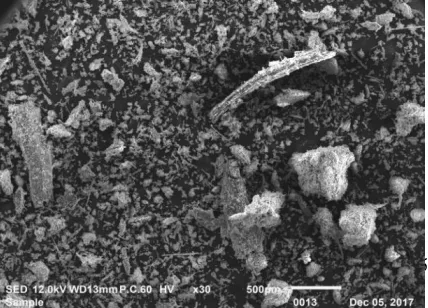
The morphology of Corn Cob Ash and Rice Husk Ash are shown in fig.3. To evaluate the morphology of corn cob Ash (CCA) Low Vacuum Scanning Electron Microscope of Model Joel JSM – 59010LV with accelerating voltage of 15 kV equipped with EDX oxford spectrometer was used. Evaluation of
S.No Parameters By Mass (%)
700oC/CCA
By Mass (%) above 1000OC RHA
1 Silica ( SiO2) 25.77 82.10
2 Alumina ( Al2O3) 1.64 0.95
3 Lime ( Cao) 2.69 0.89
4 Iron Oxide ( Fe2O3) 0.32 0.93
5 Magnesia ( MgO) 1.06 0.53
6 Sodium Oxide (
Na2O)
0.29 0.80
7 Potassium Oxide ( K2O)
1.56 0.89
International Journal of Research in Advent Technology, Vol.6, No.7, July 2018
E-ISSN: 2321-9637
Available online at www.ijrat.org
1596 this image shows that CCA & RHA consists of
[image:4.612.321.517.116.179.2]irregular with micro pores particles which due to burning of organic component of ash. The irregular particle size may affect the properties of concrete. Therefore it is necessary to Ash sample should be sieved before mixing with cement [7].
Fig. 1. SEM Image of Corn Cob Ash
Fig. 2. SEM Images of RHA
6.2. Mechanical properties
6.2.1. Slump
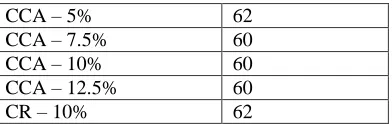
Table 3 shows that Slump was found to be 70mm for control mix while it decreased from 65mm to 62mm and then 50mm for CCA -2.5% , CCA - 5%, CCA – 7.5%, CCA – 10% and CCA – 12.5% replacement respectively. The Slump value of CCA replaced mixes at different replacement level. Workability decreased with increase in replacement level.
The results indicate that concrete becomes less workable and slump reduced up to 14.28% this leads to requirement of more water. This happened due to increase in silica amount in concrete. This is similar to the pozzolan concrete behavior in which silica – lime reaction required additional amount of water during hydration reaction [16, 3].
Table 3. Slump of CCA & CR Concrete
Specimen Slump (mm)
CCA – 0 70
CCA – 2.5% 65
CCA – 5% 62
CCA – 7.5% 60
CCA – 10% 60
CCA – 12.5% 60
CR – 10% 62
The slump value at 7.5% replacement was found to be 60mm while it was 62mm for CR-10% (CCA & RHA) concrete. Corn cob Ash is porous and it absorbed water during mixing on the other hand when CCA & RHA of 5 - 5% added, the self – desiccation property of hydrated cement - RHA, it released the absorbed water from the porous of RHA [14].
6.2.2. Compressive strength
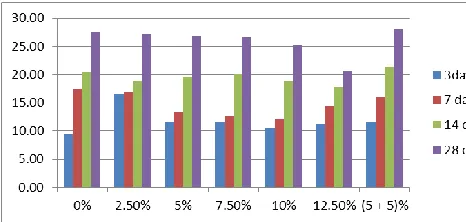
Table 4 shows the 3 days of curing period, Compressive strength was found be 9.44 N/mm2 for control mix while 16.53 N/mm2, 11.61 N/mm2 , 11.51 N/mm2 , 10.47N/mm2 and 11.32 N/mm2 for 0, 2.5, 5, 7.5, 10 and 12.5% respectively. The 28 days compressive strength of control mix was found to be 27.51 while 27.13 N/mm2, 26.81N/mm2, 26.73 N/mm2, 25.15 N/mm2 and 20.67 N/mm2 for other replacement levels. Compressive strength increased with curing age and an addition of CCA resulted in decrease in compressive strength, consistent with the behavior of SCMs. Similar behavior was seen by Shetty and Bapat due to the Corn cob Ash which act as inert filler for the voids and not improving the compressive strength, while at lateral stage it SiO2 of Corn Cob Ash reacts with Ca (OH)2 (Lime) and produce gel of secondary C-S-H which produce strength to the concrete.
Table 4. Compressive strength of CCA & CR Concrete
Replacement 3days 7 days 14 days 28 days
CCA-0 9.44 17.45 20.44 27.51
CCA-2.5 16.53 16.9 18.81 27.13
CCA-5 11.61 13.41 19.59 26.81
CCA -7.5 11.51 12.61 20.11 26.73
CCA – 10 10.47 12.13 18.79 25.15
CCA - 12.5 11.32 14.5 17.76 20.67
[image:4.612.74.291.221.375.2]International Journal of Research in Advent Technology, Vol.6, No.7, July 2018
E-ISSN: 2321-9637
Available online at www.ijrat.org
1597 Graph1. Compressive strength of CCA & CR
6.2.3. Density of cubes
[image:5.612.73.306.128.239.2]In Table 5 shows the density of Corn cube ash at various replacement levels. Density of cubes for 3 days curing period was found to be 2097 Kg/m3, 2123 kg/m3, 2125 kg/m3, 2367 kg/m3 and 2260 Kg/m3 .For 28 days curing period it was found to be 2124 Kg/m3, 2130 Kg/m3, 2135 Kg/m3 2168 Kg/m3 and 2163 Kg/m3 for 2.5%, 5%, 7.5% 10% and 12.5% replacement respectively. Due to their low specific gravity, Density of CCA replaced cubes was lower than control mix. Densities further reduced with curing period. Corn cob Ash provides an advantage by decreasing mass of concrete per unit volume as compared to 100% cement due its lower specific gravities. It was found that density was decreasing with increase of curing period due to the consumption of SiO2 present in CCA & RHA. Free lime and SiO2 present in ashes hydrate in secondary reaction and provides strength of the concrete [ 8].
Table 5. Density of CCA & CR Concrete
Replacement 3days 7 days
14 days
28 days CCA-0 2431 2334 2436 2440 CCA-2.5 2397 2322 2336 2324 CCA -5 2350 2298 2275 2260 CCA -7.5 2295 2282 2238 2235 CCA – 10 2268 2243 2226 2216 CCA - 12.5 2260 2233 2219 2198 CR-10 2239 2190 2178 2160
6.3. Durability test
6.3.1. Water Absorption test
Two set of Cube specimen of 150 x 150 x150 mm size were casted, One with optimum replacement of 7.5% with corn Cob Ash while another with CR-10% replacement ( 5% Corn Cob Ash & 5% Rice Hush Ash) and cured for 28 days in potable water. After that cube were kept in oven at a temperature of 105oC to a constant mass for 72 hrs. The cube‟s weight was taken as W1. Cooled the cubes to the room temperature and immersed in water till the saturation weight as W2. The percentage of gain in weight of cube is water absorption shown in table 6.
Table 6. Water absorption test of control mix, CCA and CR concrete
Sample W1 W2 Water
Absorption %
CCA – 0 7.366 7.603 3.12
CCA-7.5 7.691 8.095 4.99
CR – 10 7.721 8.108 4.77
[image:5.612.71.291.573.697.2]International Journal of Research in Advent Technology, Vol.6, No.7, July 2018
E-ISSN: 2321-9637
Available online at www.ijrat.org
1598 Graph 2: Water Absorption of Control Mix, CCA and
CCA & RHA.
6.3.2. Acid Attack
28 days cured cubes were immersed in 5% diluted sulfuric acid (H2SO4), Nitric Acid (HNO3) for a period of 90 days. The concentration of acids was maintained throughout this period. After 90 days cubes were taken out from the acids and weighted after cleaning the surface. The cubes were tested for compressive strength under a uniform load of 140 kg/cm2. With this test change in strength can be determined.
Compressive strength of control mix was found to be 23.24 N/mm2 and 22.76 N/mm2 in HNO3 and H2SO4 acids respectively. Similarly compressive strength of Corn Cob Ash Concrete and Corn Cob – Rice Husk Ash were found to be 25.82N/mm2 & 27.69N/mm2 and 22.67N/mm2 & 24N/mm2 in HNO3 and H2SO4 respectively.
6.3.2.1. Sulfuric Acid Attack
It was found that top layer of cubes was splint out and coarse aggregates were visible due to which weight of the cube decreases. This may be Gypsum which is produce by chemical reaction between sulfuric acid and concrete. This gypsum causes the expansion in volume of concrete which results tensile stress in concrete and splinting of top concrete surface [5].
Ca (OH)2 + H2SO4 CaSO4.2H2O…Eq. (1)
3CaO.Al2O3.12H2O + 3(CaSO4.2H2O) + 14 H2O
3CaO.Al2O3.3CaSO4.32H2O…… Eq. (2)
CaO.SiO2.2H2O + H2SO4 CaSO4 + Si (OH) 4 + H2O……. Eq. (3)
4.3.2.2. Nitric Acid
It was found that nitric acid corroded the concrete samples. This may be the transformation of Calcium hydroxide [Ca(OH)2]in to highly soluble calcium nitrate salt and less soluble calcium nitroaluminate hydrate. This leads to Leaching out of soluble calcium nitrate which is responsible for shrinkage and change in compressive strength.
2HNO3 + Ca(OH)2 Ca(NO3)2. 2H2O
[Calcium nitrate]…Eq. (4)
Ca(NO3)2.2H2O +3CaO.Al2O3.8H2O
3CaO.Al2O3.Ca(NO3)2.10H2O…..Eq. (5)
[Calcium nitroaluminate hydrate] [6]
According to Mtallib [11] Continuous contact between nitrate – substance and concrete leads to reduced compressive strength of concrete.
6.3.3. Sulfate Attack
28 days crushed specimens were and dipped in to Sulfate solution of 5% diluted solution of Na2SO4 and 5% of MgSO4. Compressive strength was determined after 90 days curing period. Results indicate that control mix showed less resistance to CC-7.5% concrete while corn cob ash less resistance to CCA + RHA-10%. Na2SO4 showed good performance than MgSo4. This may be due to the formation of gypsum as given in equation:
Ca(OH)2 + sulfate + water Gypsum
The presence of Calcium, Magnesium, Aluminum and Ammonium of sulfate salt affect the type and severity of attack which were not present. As reported by Tehimina Ayub et al. 2013 and Hanifi 0
2 4 6
Control mix CCC CCA+RHA Water Absorption
International Journal of Research in Advent Technology, Vol.6, No.7, July 2018
E-ISSN: 2321-9637
Available online at www.ijrat.org
1599 binic 2008[15], that the use of supplementary
cementitious materials with cement improves the sulfate resistance of concrete than the plain concrete of same grade due to the reduction of pore size and slow down the penetration of sulfate ions. After hydration of cement ettringite produce which expand and gain volume and produce high tensile stress also. Expansion of ettringite decrease the pores size results in improvement of resistance while presence of high tensile stress causes development of cracks also which were shown on cubes after 90 days curing period in sulphate solution.
When Magnesium sulphate (MgSO4) attack, magnesium ion react with C-S-H (Calcium silicate hydrate) formed during hydration of cement and form Magnesium Silicate Hydrate (M-S-H), this is not a cementitious material and do not provide any strength or resistance of concrete. Therefore it causes loss of strength in MgSO4.
Graph 3: Loss of mass w.r.t Control mix.
(- ve shows gain in mass.)
Graph 4: Compressive strength w.r.t Control mix.
6.4. Visual Assessment of concrete
6.4.1. Carbonation test
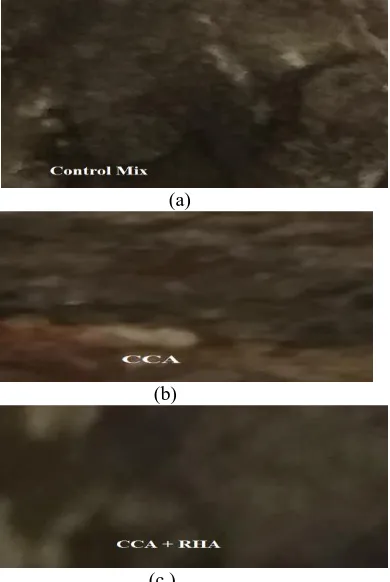
The method used to determine the depth upto which carbonated deposited on the surface of hardened concrete with the help of an indicator. A solution is prepared by adding 1 g of phenolphthalein powder is to the 95% ethyl alcohol. This solution is sprayed on the splinted cube surface which is subjected to carbonation. The fresh crushed surface of concrete turns purple , the pH is above 8.6 and it is non – carbonated , where surface remain colorless , the pH is less than 8.4 and concrete is carbonated.
From the visual assessment of concrete samples, (shown in fig1.) it was found that control mix concrete and Corn Cob ash- rice husk concrete turns purple while Corn Cob ash concrete shows very light color of pink.
International Journal of Research in Advent Technology, Vol.6, No.7, July 2018
E-ISSN: 2321-9637
Available online at www.ijrat.org
1600
(a)
(b)
[image:8.612.71.290.116.457.2](c)
Fig.3. Carbonation test on Control mix (a), Corn Cob Ash (b), Corn cob & Rice husk ash (c) concrete. 6.4.2. Free Chloride test
As shown in fig 4, colorimetric method was used to determine the free chloride in various concrete samples. In this method Silver Nitrate in aqueous form of 0.1 mol/l concentration was sprayed on freshly fractured sample and change in color were observed. It was found that freshly fractured pieces of Control mix concrete develop dark brown color while Corn Cob ash & Rice Husk ash medium brown color and corn cob ash concrete developed light brown color on the top surface and inner surface of samples [13].
(a)
(b)
[image:8.612.327.522.118.409.2](c )
Fig 4: Free chloride in Control Mix (a), Corn Cob Ash (b) and Corn Cob – Rice Husk ash (c) Concrete. The test was used to show the presence of free chloride in concrete. The tests were performed on freshly fractured sample and colorimetric test was performed with silver nitrate. And found that the entire sample developed dark brown or light brown color which means sample is chloride free or it has very less amount of chloride (Concentration of chloride cannot be measured directly). The silver ions react with ions of chloride to form white precipitates of silver chloride in white portion. In brown part, the silver ions react with ions of hydroxyl to form brown precipitates and this portion is “Chloride free area” [4, 17].
7. CONCLUSION
International Journal of Research in Advent Technology, Vol.6, No.7, July 2018
E-ISSN: 2321-9637
Available online at www.ijrat.org
1601 controlled incineration. The compressive strength,
sulfate resistance, acid attack resistance test showed good results. Overall it is suggested that corn cob ash concrete or Corn cob- rice husk ash concrete are alternate cementitious material and use of these ashes can help in reducing emission of carbon dioxide in atmosphere, impacts on environment and reduce cost of cement.
Acknowledgement
I would like to thank IKGPTU for this research work.
REFERENCES
[1] Adesanya, D.A. ; Raheem A. A (2009): A study of the workability and compressive strength characteristics of corn cob Ash Blended Cement Concrete. Journal of Construction and Building Materials, 23(2), pp.311 – 317.
[2] Adetogun, A.C.; Ogunjobi, K.M.; Are, D.B. (2014): Combustion properties of briquettes produced from maize cob of different particle size, JFEWR, 6 (1), pp. 28 – 38.
[3] Akeem, A. R.; Solomon, O.; Oyebisi.; Akintayo, S .O; Oyeniran, M. I. (2014): Effects of Admixtures on the Properties of Corn Cob Ash Cement Concrete, Construction and Building material, 4(1), pp. 202 – 210.
[4] Fuqiang ,He.; Caijun, Y.; Changping, C,; Keren, Z. (2012) AgNO3 – based colorimetric method for measurement of chlorides in concrete, Journal of Construction and Building Materials, 26 (1), pp. 1-8.
[5] Ikelle, I. I.; Ogah, S. P. I. (2014): Determination of the Heating Ability of Coal and Corn Cob Briquettes. IOSR Journal of Applied Chemistry 7 (2), pp. 77-82.
[6] Kamau, J.; Ahmed, A.; Hirst, P.; Kangwa, J (2016) : Suitability of Corn Cob Ash as a Supplementary Cementitious Material, International Journal of Materials Science and Engineering, 4( 4) , pp. 215 – 228.
[7] Khan, R.; Jabbar, A.; Ahmad, I.; Khan, A.; Khan, A. N.; Mirza, J. (2012): Reduction in environmental problems using rice – husk ash in concrete, Journal of Construction and Building Materials, 30, pp. 360 – 365
[8] Mtallib, M. O. A (2002): Compressive strength of concrete in contact with nitrate – based substances, Proceeding of the Millennium Conference building in the 21st century, Department of Building, Ahmadu Bello University, Zaria, pp. 102 - 111
[9] Ndububa, E. E.; Nurudeen, Y. (2015) Effect of Guinea Corn Husk Ash as Partial Replacement for Cement in Concrete, Journal of Mechanical and Civil Engineering , 12( 2), pp. 40-45.
[10] Oladipupo, S.O; Olutogo, F.A. (2010):Strength properties of corn cob ash concrete, Journal of emerging Trend in Engineering and Applied Science, 3(2), pp. 297 – 301.
[11] Olusola, O.K.; Joshua, O., (2012): Effect of Nitric Acid Concentration on the Compressive Strength of Laterized Concrete, International journal of Civil and Environmental Research, 2 (10), pp.48 -58.
[12] Owolabi, T.A.; Oladipo, I.O.; Popoola, O.O. (2015): Effect of Corncob Ash as Partial Substitute for Cement in Concrete, New York Science Journal, 8(11), pp. 1- 4.
[13] Real, L.V.; Oliveira, D.R.B.; Soares, T.; Medeiros, M.H.F; (2015): AgNO3 spray method for measurement of chloride penetration: the state of art, ALCONPAT Journal, .5(2), pp. 141 – 151.
[14] Stephen, J. M.; Kwasi, F. M.; Nicholas, A. D.; Akowuah, J.O. (2013): Briquettes from maize cobs and Ceiba pentandra at room temperature and low compacting pressure without a binder, International Journal of Energy and Environmental Engineering, 4(1), pp. 38 – 45.
[15] Suwanmaneechot, P.; Nochaiya, T.; Julphunthong, P. (2015): Improvement, characterization and use of waste corn cob ash in cement-based materials, 4th Global Conference on Materials Science and Engineering, IOP Publishing, IOP Conf. Series: Materials Science and Engineering, pp.103.
[16] Waswa – Sabuni; B, Syagga, P. M.; Dulo, S. O. ; Kamau, G. N. (2002): Rice Husk Ash Cement – An Alternative Pozzolana Cement for Kenyan Building Industry, Journal of Civil Engineering, 8 (1), pp. 13 – 26.