A Tree Adjoining Grammar Analysis of the Syntax and Semantics of
It-Clefts
Chung-hye Han
Department of Linguistics Simon Fraser University
Nancy Hedberg
Department of Linguistics Simon Fraser University
Abstract
In this paper, we argue that in it-clefts as in It was Ohno who won, the cleft pronoun (it) and the cleft clause (who won) form a discontinuous syntactic constituent, and a semantic unit as a definite description, presenting arguments from Percus (1997) and Hedberg (2000). We propose a syn-tax of it-clefts using Tree-Local Multi-Component Tree Adjoining Grammar and a compositional semantics on the pro-posed syntax using Synchronous Tree Ad-joining Grammar.
1 Introduction
The extant literature on the syntax of it-clefts, as in (1), can be classified into two main approaches. First, the cleft pronoun it is an expletive, and the cleft clause bears a direct syntactic or semantic relation to the clefted constituent, such as one of predication (Jesperson, 1937; Chomsky, 1977; Williams, 1980; Delin, 1989; Delahunty, 1982; Rochemont, 1986; Heggie, 1988; ´E. Kiss, 1998). Second, the cleft clause bears a direct syntactic or semantic relation to the cleft pronoun and is spelled-out after the clefted constituent through extraposition or by forming a discontinuous con-stituent with the cleft pronoun from the base-generated position at the end of the sentence (Jes-person, 1927; Akmajian, 1970; Emonds, 1976; Gundel, 1977; Wirth, 1978; Percus, 1997; Hed-berg, 2000). Under this second approach, the cleft pronoun is not necessarily expletive but rather has a semantic function such as that of a definite arti-cle.
(1) It
cleft pronoun + was copula + OHNO
clefted constituent + [who cleft
won]. clause
In this paper, we argue for a particular version of the second approach, in which the cleft pronoun and the cleft clause form a discontinuous syntac-tic constituent, and a semansyntac-tic unit as a definite description. We propose a syntax of it-clefts us-ing Tree-Local Multi-Component Tree Adjoinus-ing Grammar (MCTAG), and a compositional seman-tics on the proposed syntax using Synchronous Tree Adjoining Grammar (STAG). In section 2, we present arguments against the expletive approach, and in section 3, we provide arguments supporting the discontinuous constituent analysis. We present our TAG analysis in section 4 and extend our pro-posal to grammatical variations on it-clefts in sec-tion 5.
2 Arguments against the expletive approach
It has been shown in Hedberg (2000) that the cleft pronoun can be replaced with this or that, as in (2), depending on the discourse contextual inter-pretation of the cleft clause. The fact that the choice of the cleft pronoun is subject to pragmatic constraints indicates that the cleft pronoun cannot simply be an expletive element devoid of any se-mantic content.
(2) a. This is not Iowa we’re talking about. (Hedberg 2000, ex. 17)
b. That’s the French flag you see flying over there. (Hedberg 2000, ex. 20)
Although the details are different, many exple-tive analyses advocate for the position that the clefted constituent is syntactically associated with the gap in the cleft clause either directly through movement, or indirectly through co-indexation with an operator in the cleft clause. One thing that is common in all these analyses is that the cleft clause is not considered to have the internal struc-ture of a restrictive relative clause. We point out
that the initial element in the cleft clause may be realized either as a wh-word (1) or as that (3a), or it may be absent altogether when the gap is not in the subject position (2, 3b). It may even be in the form of a genitive wh-word as in (3c). The cleft clause is thus a restrictive relative clause.
(3) a. It was Ohno that won.
b. It was Ohno Ahn beat.
c. It was Ohno whose Dad cheered.
The cleft clause, however, does not relate to the clefted constituent in the way that a restrictive rel-ative clause relates to its head noun, as first noted in Jespersen (1927). This is because the clefted constituent can be a proper noun, unlike a head noun modified by a restrictive relative clause, as illustrated in (4). This suggests that there is no syntactic link between the clefted constituent and the gap in the cleft clause.
(4) * Ohno that won is an American.
3 A discontinuous constituent analysis
As pointed out in Percus (1997) and Hedberg (2000), it-clefts have existential and exhaustive presuppositions, just as definite descriptions do. The inference in (5c) associated with (5a) survives in the negative counterpart in (5b). This is ex-actly the way the presupposition associated with the definite description the king of France behaves: the presupposition spelled-out in (6c) survives in both the affirmative (6a) and the negative counter-part in (6b). Both authors argue that this paral-lelism between definite descriptions and it-clefts can be accounted for if the cleft pronoun and the cleft clause form a semantic unit, with it playing the role of the definite article and the cleft clause the descriptive component. What this translates to syntactically is that the cleft clause is a restric-tive relarestric-tive clause which is situated at the end of the sentence, forming a discontinuous constituent with the cleft pronoun.
(5) a. It was Ohno who won.
b. It was not Ohno who won.
c. Someone won, and only one person won.
(6) a. The king of France is bald.
b. The king of France is not bald.
c. There is one and only one king of France.
Percus (1997) further points out that it-clefts pattern with copular sentences containing definite description subjects with regard to anaphor bind-ing. In the absence of c-command, an anaphor in the clefted constituent position can be bound by an antecedent inside the cleft clause, as shown in (7a). While we don’t yet have an explanation for how this type of binding takes place, we follow Percus in noting that since copular sentences with definite description subjects also exhibit this pat-tern of binding, as shown in (7b), a uniform expla-nation for the two cases can be sought if the cleft pronoun and the cleft clause together form a defi-nite description.
(7) a. It was herself that Mary saw first.
b. The one that Mary saw first was herself.
Under the discontinuous constituent analysis, it-clefts reduce to copular sentences, and therefore the observation that they can have equative and predicational interpretations (Ball 1978, DeClerck 1988, Hedberg 2000), the readings attested in cop-ular sentences, follows. For instance, (5a) (re-peated as (8a)) can be paraphrased as (8b), and corresponds to a typical equative sentence. And (9a) can be paraphrased as (9b), and corresponds to a typical predicational sentence. According to our analysis, (8a) will be assigned the semantic representation in (8c), and (9a) will be assigned the semantic representation in (9c).
(8) a. It was Ohno who won.
b. The one who won was Ohno.
c. THEz[won(z)] [z= Ohno0]
(9) a. It was a kid who beat John.
b. The one who beat John was a kid.
c. THEz[beat(z, John0)] [kid(z)]
4 Our TAG analysis
D
Ohno
(α0Ohno)
T
Ohno0
(αwas) TP DP0i↓1 T0T
wask
CopP
Cop
tk
FP 1
DP0
ti
F0
F
DP1↓2 (α0was)
F 1
R
λxλy.x=y
T↓1 T↓2
(αit) DPD
it
(βwho won) FP
FP* CP
DPl
D
who C0
C TP
DP
tl
T0
T
[past] VP
DP
tl
V
won
(α0it)T
z
(β0who won)
F
THEz F
R
λx.won(x)
T
z
F*
Figure 1: Syntactic and semantic elementary trees for It was Ohno who won
(δ8a) (αwas)
(αOhno)
DP1
(αit)
DP0
(βwho won)
FP
(δ08a)
(α0was)
(α0Ohno) (α0it) (β0who won)
Figure 2: Syntactic and semantic derivation trees for It was Ohno who won
For the derivation of equative it-clefts as in (8a), we adopt the copular tree in (αwas), a tree simi-lar to the one proposed in Frank (2002) for copu-lar sentences. In this tree, FP is a small clause of the copula from which the two DPs being equated originate. (8a) is derived by substituting (αit) into DP0 in (αwas), adjoining (βwho won) into FP in (αwas), and substituting (αOhno) into DP1 in (αwas). The syntactic derivation tree and the de-rived tree for (8a) are given in (δ8a) in Figure 2 and (γ8a) in Figure 3 respectively.
Postulating separate projections for the copula and the small clause can account for the fact that the clefted constituent and the cleft clause seem to form a constituent, as in (10ab) (from Hedberg 2000), and yet they can be separated by an adver-bial phrase, as in (10c). In our analysis, (10ab) are possible because the bracketed parts are FPs. (10c) is possible because an adverbial phrase can adjoin onto FP or F0, separating the clefted con-stituent and the cleft clause.
(10) a. I said it should have been [Bill who ne-gotiated the new contract], and it should have been.
b. It must have been [Fred that kissed Mary] but [Bill that left with her].
c. It was Kim, in my opinion, who won the race.
D
it
T0
T
wask
CopP
Cop
tk
FP
FP
DP
ti
F0
F
DP
D
Ohno CP
DPl
D
who C0
C TP
DP
tl
T0
T
[past] VP
DP
tl
V
won (γ08a)
F
THEz F
R
λx.won(x)
T
z
F
R
λxλy.x=y
T
z
T
Ohno0
Figure 3: Syntactic and semantic derived trees for It was Ohno who won
tic derived tree is given in (γ08a) in Figure 3. Note that the semantic derivation tree in (δ08a) is iso-morphic to the syntactic one in (δ8a). The seman-tic derived tree in (γ08a) can be reduced to the for-mula in (11) after the application ofλ-conversion.
(11) THEz[won(z)] [z= Ohno0]
For the derivation of predicational it-clefts as in (9a), we use the tree pairs in <(αwas kid), (α0was kid)>, <(αJohn), (α0John)>, and
<{(αit), (βwho beat)}, {(α0it), (β0who beat)}>
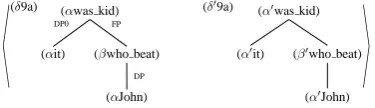
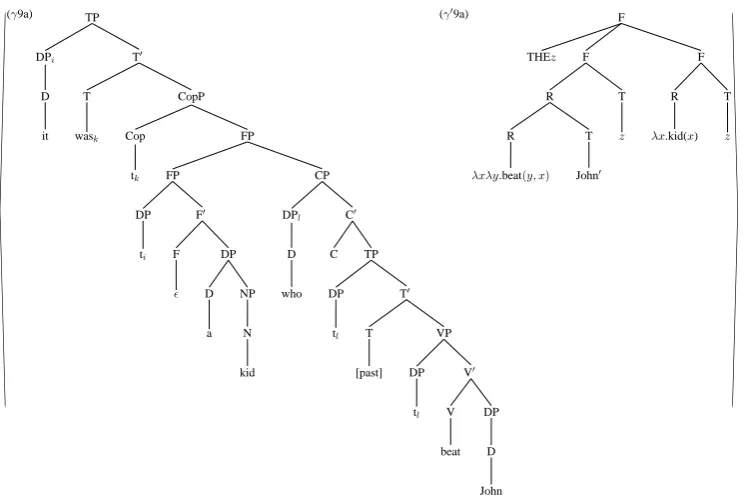
in Figure 4. The elementary tree in (αwas kid) which represents a predicational copular sentence is similar to the one in (αwas) in that in both trees, the copula combines with a small clause FP. The important difference is that in (αwas kid) the subject DP is an argument substitution site and the predicative DP (a kid) is lexicalized, whereas in (αwas) both the subject and the non-subject DPs are argument substitution sites. This difference is reflected in the semantic trees, as seen in (α0was) in Figure 1 with two term nodes and (α0was kid) in Figure 4 with one term node. The syntactic and semantic derivation trees, which are isomorphic, are given in <(δ9a), (δ09a)>in Figure 5, and the corresponding derived trees are given in <(γ9a), (γ09a)>in Figure 6. The semantic derived tree in (γ09a) can be reduced to the formula in (12) after the application ofλ-conversion.
(12) THEz[beat(z, John0)] [kid(z)]
(δ9a) (αwas kid)(αit)
DP0
(βwho beat)
FP
(αJohn)
DP
(δ09a)
(α0was kid)
(α0it) (β0who beat)
(α0John)
Figure 5: Syntactic and semantic derivation trees for It was a kid who beat John
5 Extensions
In this section, we extend the proposed syntactic analysis to grammatical variations on it-clefts: wh-extraction of the clefted constituent as in (13), un-bounded dependency between the relative pronoun and its gap in the cleft clause as in (14), and coor-dination of the constituent containing the clefted constituent and the cleft clause as in (15).
(13) Whoj was it tj who won?
(14) It was Ohno wholthe judges said tlwon.
(15) It was [Ohno who won] and [Kim who lost].
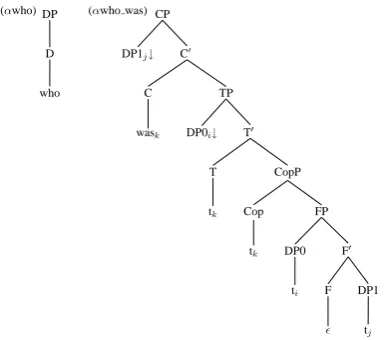
For the derivation of (13), the elementary trees in Figure 7 are required in addition to {(αit), (βwho won)}in Figure 1. (αwho was) represents the structure with the wh-extraction of the clefted constituent. Substituting (αwho) into DP1 and (αit) into DP0, and adjoining (βwho won) onto FP in (αwho was), as in the derivation tree in (δ13), produces the derived tree in (γ13) in Figure 8.
T
wask
CopP
Cop
tk
FP 1
DP0
ti
F0
F
DP
D
a NP
N
kid
(α0was kid)
F 1
R
λx.kid(x)
T↓1
(αJohn) DPD
John (α0John)
T
John0
(αit) DPD
it
(βwho beat) FP
FP* CP
DPl
D
who C0
C TP
DP
tl
T0
T
[past]
VP
DP
tl
V0
V
beat DP↓
(α0it) Tz
(β0who beat)
F
THEz F
R
R
λxλy.beat(y, x)
T↓ T
z
F*
Figure 4: Syntactic and semantic elementary trees for It was a kid who beat John
(γ9a) TPDPi
D
it
T0
T
wask
CopP
Cop
tk
FP
FP
DP
ti
F0
F
DP
D
a NP
N
kid
CP
DPl
D
who C0
C TP
DP
tl
T0
T
[past]
VP
DP
tl
V0
V
beat DP
D
John (γ09a)
F
THEz F
R
R
λxλy.beat(y, x)
T
John0
T
z
F
R
λx.kid(x) T
z
(αwho) DP
D
who
(αwho was) CP
DP1j↓ C0
C
wask
TP
DP0i↓ T0
T
tk
CopP
Cop
tk
FP
DP0
ti
F0
F
DP1
tj
Figure 7: Syntactic elementary trees for Who was
it who won?
(δ13) (αwho was)
(αwho)
DP1
(αit)
DP0
(βwho won)
FP
(γ13) CP
DPj
D
who
C0
C
wask
TP
DPi
D
it
T0
T
tk
CopP
Cop
tk
FP
FP
DP
ti
F0
F
DP
tj
CP
DPl
D
who C0
C TP
DP
tl
T0
T
[past] VP
DP
tl
V
won
Figure 8: Derivation and derived trees for Who
was it who won?
(αthe judges) DP
D
the NP
N
judges
(βsaid) C0
C TP
DPm↓ T0
T
[past]
VP
DP
tm
V0
V
said C0
Figure 9: Syntactic elementary trees for It was
Ohno who the judges said won
(βwho won)} in Figure 1. Adjoining (βsaid) onto the C0 node in (βwho won) has the effect of stretching the dependency between the relative pronoun who and its gap in the cleft clause. The derivation and the derived trees for (14) are given in Figure 10.
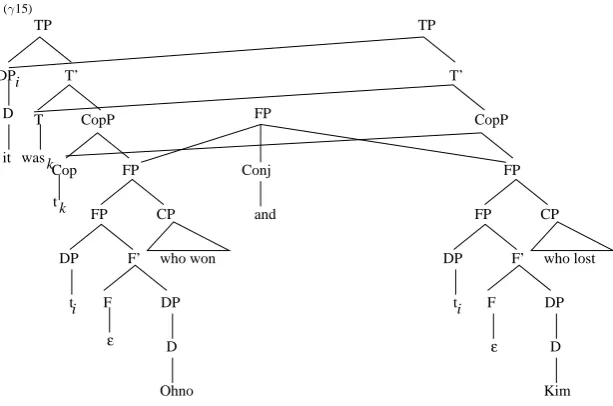
To handle the coordination of the constituent containing the clefted constituent and the cleft clause, as illustrated in (15), we propose to use Node Contraction and Conjoin proposed in Sarkar and Joshi (1996). Informally, Node Contraction takes two nodes of like categories and collapses them into a single node, and Conjoin coordinates the least nodes dominating the two contiguous strings. We use the conjunction tree in Figure 11 to apply Conjoin at FP.
Figure 12 contains the elementary tree anchor-ing equative was. We mark the nodes to be con-tracted with a box, and augment the name of the elementary tree with a set listing these contrac-tion nodes. Thus, (αwas){DPi,T,Cop} means that DPi, T and Cop nodes are marked for contraction
in (αwas) elementary tree.
(γ15)
Figure 13: Derived structure for It was Ohno who won and Kim who lost
(δ14) (αwas)
Figure 10: Derivation and derived trees for It was
Ohno who the judges said won
Conj(and) FP
FP Conj
and FP
Figure 11: Elementary tree for conjunction
(αwas){DPi,T,Cop} TP
Figure 12: Elementary tree anchoring equative
was with contraction nodes
(δ15)
it) Conj(and)
FP FP
FP FP
DP1 DP0 DP0 DP1
{DP0,T,Cop}
Figure 14: Derivation structure for It was Ohno
who won and Kim who lost
The derivation structure for (15) is also a di-rected graph, as shown in Figure 14. (αit) is dominated by two (αwas){DPi,T,Cop} trees, indicating that it is being shared by the two
(αwas){DPi,T,Cop}trees.
6 Conclusion
ex-tendable to handle various grammatical variations on it-clefts such as wh-extraction of the clefted constituent, unbounded dependency between the relative pronoun and its gap in the cleft clause and coordination of the constituent containing the clefted constituent and the cleft clause. In our TAG analysis of it-clefts, the cleft pronoun and the cleft clause bear a direct syntactic relation be-cause the elementary trees for the two parts belong to a single multi-component set. They do not ac-tually form a syntactic constituent in the derived tree, but as the elementary trees for the two belong to the same multi-component set, the intuition that they form a discontinuous constituent is captured. Further, the semantics of the two trees is defined as a definite quantified phrase, capturing the intu-ition that they form a semantic unit as a definite description.
Acknowledgment
We thank Anoop Sarkar and the three anonymous reviewers for their insightful comments.
References
Ann Abeill´e. 1994. Syntax or semantics? han-dling nonlocal dependencies with MCTAGs or Syn-chronous tags. Computational Intelligence, 10:471– 485.
Adrian Akmajian. 1970. On deriving cleft sentences from pseudo-cleft sentences. Linguistic Inquiry,
1:149–168.
Noam Chomsky. 1977. On wh-movement. In P. W. Culicover, T. Wasow, and A. Akmajian, editors,
For-mal Syntax, pages 71–132. Academic Press, New
York.
Gerald P. Delahunty. 1982. Topics in the syntax and
semantics of English cleft sentences. Indiana
Uni-versity Linguistics Club, Bloomington.
Judy L. Delin. 1989. Cleft constructions in discourse. Ph.D. thesis, University of Edinburgh.
Katalin ´E. Kiss. 1998. Identificatinoal focus versus information focus. Language, 74(245-273). Joseph E. Emonds. 1976. A Transformational
Ap-proach to English Syntax. Academic Press, New
York.
Robert Frank. 2002. Phrase Structure Composi-tion and Syntactic Dependencies. MIT Press,
Cam-bridge, MA.
Jeanette K. Gundel. 1977. Where do cleft sentences come from? Language, 53:53–59.
Nancy Hedberg. 2000. The referential status of clefts.
Language, 76(4):891–920.
Lorie A. Heggie. 1988. The syntax of copular
struc-tures. Ph.D. thesis, University of Southern
Califor-nia, Los Angeles.
Otto Jesperson. 1927. A Modern English Grammar, volume 3. Allen and Unwin, London.
Otto Jesperson. 1937. Analytic Syntax. Allen and Un-win, London.
Anthony S. Kroch and Aravind K. Joshi. 1987. Ana-lyzing extraposition in a Tree Adjoining Grammar. In G. Huck and A. Ojeda, editors, Discontinuous
Constituents, volume 20 of Syntax and Semantics.
Academic Press.
Orin Percus. 1997. Prying open the cleft. In K. Kusumoto, editor, Proceedings of the 27th
An-nual Meeting of the North East Linguistics Society,
pages 337–351. GLSA.
Michael Rochemont. 1986. Focus in Generative Grammar. John Benjamins, Amsterdam.
Anoop Sarkar and Aravind Joshi. 1996. Coordination in tree adjoining grammars: formalization and im-plementation. In Proceedings of COLING’96, pages 610–615, Copenhagen.
Stuart Shieber. 1994. Restricting the weak-generative capacity of synchronous tree-adjoining grammars.
Computational Intelligence, 10(4).
Edwin Williams. 1980. Predication. Linguistic
In-quiry, 11:203–238.