A Multilingual Dataset for Evaluating
Parallel Sentence Extraction from Comparable Corpora
Pierre Zweigenbaum
Serge Sharoff
Reinhard Rapp
LIMSI, CNRS, Universit´e Paris-Saclay,
F-91405 Orsay, France [email protected]
University of Leeds Leeds, United Kingdom [email protected]
Magdeburg-Stendal University of Applied Sciences and University of Mainz, Germany
Abstract
Comparable corpora can be seen as a reservoir for parallel sentences and phrases to overcome limitations in variety and quantity encountered in existing parallel corpora. This has motivated the design of methods to extract parallel sentences from comparable corporad. Despite this interest and work, no shared dataset has been made available for this task until the 2017 BUCC Shared Task. We present the challenges faced to build such a dataset and the solutions adopted to design and create the 2017 BUCC Shared Task dataset, emphasizing issues we had to cope with to include Chinese as one of the languages. The resulting corpus contains a total of about 3.5 million distinct sentences in English, French, German, Russian, and Chinese, mostly from Wikipedia. We illustrate the use of this dataset in the shared task and summarize the main results obtained by its participants. We finally outline remaining issues.
Keywords:Comparable corpora, parallel sentences, parallel sentence extraction, cross-language similarity, annotated corpus
1.
Parallel Sentence Extraction from
Comparable Corpora
Parallel sentences are the fuel needed to train machine translation systems. Large parallel corpora have been ob-tained from international bodies or collected from the Web. However, they only cover a small subset of the variety of language pairs, domains and genres that are found in lan-guage. Besides, because by construction at least half of the sentences in these corpora are the result of (human) trans-lation, they are likely to display translation biases such as calques and other such phenomena.
Comparable corpora are (typically multilingual) corpora selected with similar criteria such as domain, genre, time period. In contrast to parallel corpora, they display much more variety and are normally original texts rather than translations. They hold much promise therefore as a com-plement to parallel texts for machine translation and other applications.
One way in which comparable corpora have been used to help machine translation is by spotting parallel sentences that occur naturally in these corpora, and using these sen-tence pairs to extend parallel corpora (Munteanu et al., 2004). This has motivated research into methods that aim to perform this task, such as (Utiyama and Isahara, 2003; Munteanu et al., 2004; Abdul-Rauf and Schwenk, 2009; Smith et al., 2010). This task is usually calledParallel Sen-tence Extraction from Comparable Corpora.
It is however difficult to compare earlier work and assess progress because of the absence of a shared dataset with gold standard annotations. Some past shared tasks ad-dressed related objectives. Cross-language plagiarism de-tection in PAN (Potthast et al., 2012) aims to spot text that has been translated into a target language and reused in (in-serted into) text in that target language. It is therefore quite close to our task. However, plagiarism detection can take advantage of differences in style between the original tar-get text and the translated text, and of intrinsic properties
of ‘translationese’. This is not the case in our task, where all sentences are expected to be original. Cross-language text similarity as in SemEval 2016 (Agirre et al., 2016) as-sesses the level of semantic similarity of pairs of sentences on a given scale. It is also close to our task. Nevertheless, it has been proposed with already paired sentences instead of large monolingual corpora, thus removing the sentence spotting stage. Bilingual document alignment in a large Web collection has been proposed in WMT 2016 (Buck and Koehn, 2016). However, on the one hand it addressed documents instead of sentences; and on the other hand, it included meta-information in the form of document URLs, a property that we want to avoid.
This highlights the need for a publicly available dataset that would make it possible to compare methods that extract parallel sentences from comparable corpora. This paper describes the principles according to which we designed such a corpus, their implementation, the resulting corpus and a first use of that corpus in a shared task. This corpus was built in the context of the BUCC 2017 Shared Task de-scribed in (Zweigenbaum et al., 2017). The present paper provides more detail about our motivation and design crite-ria, about the rationale we followed to implement these de-sign criteria, and about the processing of the Chinese part of the corpus.
2.
A Dataset for Parallel Sentence
Extraction from Comparable Corpora
2.1.
Desiderata for a Dataset for the Task
We aimed to build a bilingual corpus to measure progress on the identification of parallel sentences in monolingual corpora. This led us to the following desiderata and design choices.
linked Wikipedia pages or Web pages, sharing im-ages or links to external documents, news published in a close time frame, etc. Our target corpus should not give such clues, and should therefore include no metadata on the documents in which the sentences are found.
Realistic size. Spotting parallel sentences is useful when performed at scale. We therefore aimed at a corpus with at least millions of sentences: although not espe-cially large by today’s standards, this already requires to use scalable algorithms.
Natural text. We wished to provide natural text rather than a simple list of sentences. First, this makes the task more realistic, since extraction of sentences from com-parable corpora happens in the context of complete documents. Second, we can expect that the document context is likely to influence assessment of compa-rability between the sentences. This desideratum is probably less necessary, but we considered it would make the corpus closer to what the task should ad-dress.
Known true positives. Since we want to be able to evalu-ate system results, we must have a gold standard. This is the most challenging part of building such a corpus: recall that ultimately we want systems to spot pairs of sentences that occur naturally in a pair of monolingual corpora and happen to be translations of each other. We know of no such situation in which such sentence pairs would be marked in some way.
2.2.
Pragmatic Choices
2.2.1. Creating an Artificial Corpus
Spotting naturally occurring sentence pairs in comparable corpora, if performed by humans, can be extremely time consuming: exhaustively spotting such pairs in, say, two corpora of 400,000 sentences each may require the exam-ination of 160 billion sentence pairs. When preparing a gold standard is not feasible a priori, some shared tasks, e.g. ad hoc information retrieval, have resorted to pool-ing of system results then a posteriori human evaluation. A posteriori, we know that BUCC 2017 Shared Task par-ticipants produced a few hundred thousand sentence pairs: this is many orders of magnitude below that of the above-mentioned a priori evaluation, but is still sizeable. We did not have human resources to allocate to such a human eval-uation either. We therefore decided to design a synthetic corpus containing controlled parallel sentences. We per-formed this by inserting known parallel sentence pairs into existing monolingual corpora.
We chose Wikipedia articles (20161201 dumps 1) as our
monolingual corpora and News Commentary (v112) as our
source for parallel sentence pairs.
In terms of domains, although in principle Wikipedia cov-ers all domains, it over-represents named entities, specif-ically contemporary people and locations. The domain of News Commentary is that of commentaries on international
1
http://ftp.acc.umu.se/mirror/wikimedia.org/dumps/
2
http://www.casmacat.eu/corpus/news-commentary.html
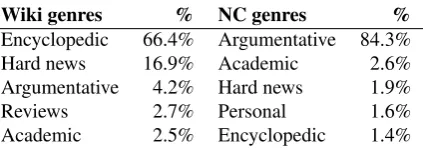
Wiki genres % NC genres %
Encyclopedic 66.4% Argumentative 84.3%
Hard news 16.9% Academic 2.6%
Argumentative 4.2% Hard news 1.9%
Reviews 2.7% Personal 1.6%
Academic 2.5% Encyclopedic 1.4%
Table 1: Most common genres in our sources
news, hence it mentions a large number of contemporary people and locations. This results in a reasonable match of the domains of the two corpora.
We also performed a quantitative analysis of the two datasets in terms of topics and genres. Extraction of key-words and comparison of the cosine similarity between the resulting vectors (Sharoff, 2013) gives an estimate of how similar the documents are across the corpora. The inter-decile range of the cosine similarity scores between the News Commentary texts and their nearest Wikipedia coun-terparts is [0.971,0.980], i.e., for any News Commentary text it is nearly guaranteed that there is a sufficiently simi-lar Wikipedia text.
Using the genre classifier from (Sharoff, 2018) we also as-sessed the genre composition of the two corpora, see Ta-ble 1. Even though precision of automatic genre classi-fication for different genres varies from 65% to 85%, the results indicate a general trend confirming that the News Commentary corpus corresponds of a considerable portion of Wikipedia in terms of genres, albeit with a different dis-tribution. Wikipedia contains many news-like or argumen-tative texts, which are similar to the News Commentary cor-pus, while the latter also contains some encyclopedic intro-ductions and research-like texts similar to those found in Wikipedia.
The following two examples illustrate the similarities in both topics and genres between the two sources: Wikipedia id=13811803 “Saltwater Keynesian economists” argue that business cycles represent market failures, and should be counteracted through discretionary changes in aggre-gate public spending and the short-term nominal interest rate. “Freshwater economists” often reject the effective-ness of discretionary changes in aggregate public spending as a means to efficiently stabilize business cycles.
News Commentary: The Chicago School claims that real-world market economies produce roughly efficient (so-called “Pareto optimal”) outcomes on which public policy cannot improve. Thus, any state intervention in the econ-omy must make someone worse off. The MIT School, by contrast, argues that real-world economies are afflicted by pervasive market failures, including imperfect competition and monopoly, externalities associated with problems like pollution, and an inability to supply public goods such as street lighting or national defense.
2.2.2. Inserting Parallel Sentences in Monolingual Corpora
The inserted parallel sentence pairs should not be trivially detectable in the monolingual corpora. In other words, these sentences should be coherent with the context in which they are inserted. We aimed at topical coherence by looking in the monolingual corpora for sentences with sim-ilar contents to the parallel sentences and using the spotted sentences as insertion points. To perform this efficiently, we used a search engine to index each English sentence of the monolingual corpus (English Wikipedia dump, con-verted to text and split into sentences) and each French sen-tence of the monolingual corpus (French Wikipedia dump, converted to text and split into sentences). We used the Solr search engine and queried it for each sentence pair in the parallel corpus (French-English News Commentary) to find the most similar French sentence and English sentence for this pair.3 If two similar enough sentences were found,
we inserted the English parallel sentence after the matching English sentence in the monolingual corpus and the French parallel sentence after its matching French sentence in the monolingual corpus. Similarity constraints were enforced on the one hand by the Solr query parameters and on the other hand by post-filters including: a length in words (be-fore stopword removal) in the range[10,20]; a length ratio in the range[0.8,1.2].
In early experiments, we observed that the cohesion of the resulting sequence of two sentences was better if the start of the inserted sentence contained the common words with the pre-existing monolingual sentence (those words that make the sentences similar). To favor this, we decided to trun-cate the queries built from parallel sentences to the firstT words.Twas set to 5 words based on observations in these experiments.
2.2.3. Making Inserted Sentences Less Conspicuous
In early experiments, we realized that very short parallel sentences might happen to be inserted among much larger monolingual sentences, or the reverse. This would increase the risk that such sentences might break the cohesion of the original text. To reduce this risk, we acted on the distribu-tion of sentence lengths in both the monolingual and paral-lel sentences: we excluded sentences shorter than 10 words and longer than 20 words. This range of lengths covered a large percentile of the original sentences, and is typical of what Machine Translation systems address.
We also realized that due to construction idiosyncrasies, Wikipedia texts had specific distributions of typographical features such as the presence of some typographical quota-tion marks; they were also subject to conversion issues that created systematic clues of their origin. This was notably caused by the use of Wikipedia templates, that were partic-ularly numerous in the French Wikipedia. We endeavored to remove such idiosyncrasies by revisiting the Wikipedia conversion workflow. We added our own extensions to an existing Wikipedia conversion tool, WikiExtractor.py,4. We
included sentence splitting based on NLTK, and removed
3We used the following Solr parameters: efType=edismax,
qs=5, ps=5, ps2=5, mm=70%, stopwords=true.
4
https://github.com/attardi/wikiextractor
the sentences that contained a Wikipedia template. Removing sentences brought the additional advantage of making the original text slightly less cohesive: in that con-text of slightly reduced cohesion, the potential cohesion is-sues incurred by the addition of (parallel) sentences were likely to be less noticeable.
2.2.4. Controlling Unknown True Positives
The insertion of known parallel sentences aimed to control the true positives present in the datasets we were building. Parallel sentences might however already exist in the pair of monolingual corpora we started from. Indeed, the true nature of the task would be to find these pre-existing, nat-urally occurring parallel sentences. But we were instead aiming to populate our monolingual corpora with known parallel sentence pairs. We therefore needed to prevent as much as possible naturally occurring parallel sentence pairs from remaining in our monolingual corpora. The strategy we adopted in this purpose was to desynchronize our com-parable corpora. Since we started from Wikipedia articles in two languages, we knew that interlinked articles would be highly likely to contain such parallel sentences: this is indeed a property that is often desired by past work on par-allel sentence extraction. This is also how our previous shared task on detection of comparable texts has been setup (Sharoff et al., 2015): the gold standard was based on the iwiki links.
In contrast to such work, we built pairs of monolingual cor-pora which never contained two interlinked Wikipedia ar-ticles. This was also in line with our desideratum not to include meta-information on the sentences, such as being found in two interlinked articles.
The main drawback in doing so is that the most comparable pairs of documents for a given language pair are removed from the pairs of corpora we built: only one out of two interlinked pages can be kept in one of our corpora. This reduces the comparability of our datasets. However, the two sides of each dataset still share several dimensions along which they are comparable:
• They belong to the same genre distribution, mainly ‘encyclopedic article’ (see Table 1).
• They were written in the same time period: contempo-rary prose.
• Because Wikipedia has a dense coverage of many top-ics, removing one page does not suppress a topic en-tirely.
As we discuss later, some of the participant systems did de-tect original sentence pairs that were translations of each other, i.e., that we had not artificially inserted into the monolingual corpora. This is another clue of the compa-rability of these corpora.
2.2.5. Preparing Training and Test Splits
Pair Sample (2%) Training (49%) Test (49%)
fr en gold fr en gold fr en gold de-en 32593 40354 1038 413869 399337 9580 413884 396534 9550 fr-en 21497 38069 929 271874 369810 9086 276833 373459 9043 ru-en 45459 72766 2374 460853 558401 14435 457327 566356 14330
zh-en 8624 13589 257 94637 88860 1899 91824 90037 1896
Table 2: Corpus statistics: number of monolingual sentences (fr, en) and of parallel pairs (gold) for each split and each language pair. Thefrcolumn stands for the non-English language in each pair. Reprinted from (Zweigenbaum et al., 2017).
fr-000001779
De mˆeme le conflit du Rwanda a ´et´e ju-ridiquement qualifi´e de g´enocide.
fr-000001780
Ainsi la Banque mon-diale pr´esente-t-elle en 2015 un rapport intitul´e¡¡ La transi-tion d´emographique africaine: dividende ou d´esastre?
fr-000001781
En fait, lors du r´ecent sommet du G-20, la Banque mondiale a pr´esent´e un Rapport de coordination sur le Fi-nancement `a long terme pour la croissance et le d´evelopement.
fr-000001782
Quelques pays (Ghana, Cˆote d’Ivoire, Malawi, Mozambique et Nami-bie) ont d´ej`a ´et´e iden-tifi´es comme ´etant sur cette voie.
He contributed to the labor aspects of the Torrijos-Carter Treaty signed in 1977 between Panama and the United States of America.
en-000019024
Attended meetings at the World Bank and the International Monetary Fund in Washington, Berlin and Paris.
en-000019025
In fact, at the recent G-20 meeting, the World Bank presented an Um-brella Report on Long-Term Investment Fi-nancing for Growth and Development.
en-000019027
Among the important pieces of writings are those of his friends, political adversaries, family and coworkers.
en-000019028
The United States wanted the treaty to gain control of agri-cultural lands for more European-American set-tlers.
en-000019029
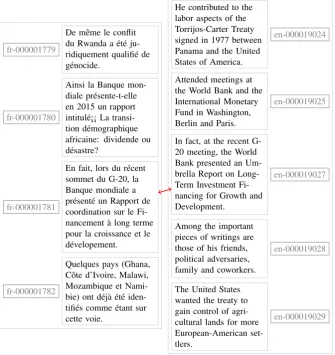
Figure 1: Excerpt from the English-French corpus: fr-000001781 and en-000019027 are inserted parallel sentences.
parts of these monolingual corpora. Splitting the result-ing corpora after insertion was therefore liable to separate a large proportion of sentence pairs. Therefore we randomly split the documents of the corpora before parallel sentence pair insertion. An additional constraint was the need to sep-arate interlinked articles. This constraint was taken into ac-count at splitting time, correcting the random assignment of a document to a given split (and redrawing another assign-ment) if an interlinked document was already present in this split. We actually split the corpora into three parts: a small sample split shown on the shared task Web site, and training and test splits that required registration prior to download. We arbitrary chose 2% of the total for the size of the sample split, and gave training and test half of the remaining data (i.e., 49% each). The corpus preparation process was then
performed on each split.5
We applied this process to five languages: Chinese (zh), English (en), French (fr), German (de), Russian (ru); this produced four bilingual datasets (see Table 2). Figure 1 shows an example drawn from the English-French dataset.
2.3.
The Case of Chinese
Adding a language to our corpora, i.e., providing an addi-tional language paired with English, requires the following data and components:
• A monolingual corpus: Wikipedia is a possible candi-date for a large number of languages.
• A parallel corpus with English on one side: in the
5An anonymous reviewer rightly pointed out that a
present work we used News Commentary 2016, which pairs English with eleven languages: Arabic, Dutch, Chinese, Czech, German, Spanish, French, Italian, Japanese, Portuguese, and Russian.
• A configuration for indexing and search in the Solr search engine, typically based on a tokenizer, stop words, and possibly more language components.
• Constraints on the range of sentence lengths.
We report here how we included Chinese data in the present corpus.
The Chinese writing system does not separate words with spaces6. This raises issues for tokenization that have
con-sequences on our dataset construction pipeline. Various methods have been proposed to tokenize Chinese, includ-ing Conditional Random Fields classifiers in the Stanford Chinese Word Segmenter (Tseng et al., 2005) and in the Chinese Mecab7. Independently of these methods, sev-eral guidelines have been proposed for human annotation of Chinese tokens, including the Chinese Penn Treebank and the Peking University standard (Duan et al., 2003). This results in tokens with shorter or larger spans depending on the guideline, for instance 有线(cable)电视 (television) according to Peking University vs. 有线电视(cable tele-vision) according to Chinese Penn Treebank. Chinese to-kenizers display the same variety in their choices of token span length; some, such as Stanford or jieba,8 leave it to
the user to choose which strategy to apply (full=short, de-fault=large, search=multiple solutions). We attempted to avoid these considerations by working directly with char-acters. This was initially motivated by the technical choice of Solr (v6.4.0), whose only option for a Chinese tokenizer was bigrams. We kept sentences between 15 and 40 char-acters, which we estimated to yield sizes comparable to the English sentences (between 10 and 20 words). Query sen-tences were truncated to 15 characters (instead of 5 words). However, working with characters raised the following is-sues. First, character-based Solr search resulted in a lower sentence similarity than in other languages. It often oc-curred that given a (parallel) Chinese sentence as a query, the matching unigrams or bigrams of characters would be stop words or other common (bigrams of) characters. We compiled a set of 533 stop expressions including punctua-tion, short common words (一one,一切every), and locu-tions such as不仅(not only),一方面(on the one hand),另 一方面(on the other hand),反过来说(on the other hand), etc. Stop expressions were removed from parallel sentences before using them as queries.
Besides, sentences would sometimes start with a common locution followed by a comma: 从历史上看, (from a historical point of view),由此可见,(from this, it can be seen that), etc. Seeing the large variety of such locutions, we decided to remove any leading sequence of up to six characters followed by a comma from the start of Chinese parallel sentences before using them as queries.
6
Throughout this paper we use the term Chineseto refer to Modern Standard Chinese, often called Mandarin Chinese.
7
https://github.com/panyang/MeCab-Chinese
8
https://github.com/fxsjy/jieba
These heuristics were designed and tuned by human review of samples of resulting sequences of two sentences.
3.
Use in Two Shared Tasks
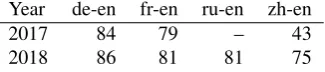
These datasets were used in the BUCC 2017 and 2018 Shared Tasks (Zweigenbaum et al., 2017; Zweigenbaum et al., 2018). Participants were taskeed with detecting in a bilingual pair of corpora the inserted parallel sentences. Three of the four language pairs were addressed by the par-ticipants in 2017: French, German, and Chinese, with a maximum F-score of 0.84 on German-English (Azpeitia et al., 2017) (see Table 3). All four language pairs were ad-dressed in 2018, with improved F-scores topping at 0.86 for German-English again.
Year de-en fr-en ru-en zh-en
2017 84 79 – 43
2018 86 81 81 75
Table 3: Best F-scores (%) at the BUCC Shared Tasks in 2017 and 2018
4.
Discussion and Perspectives
The resulting corpora can be obtained from the BUCC Web site.9 They total about 3.5 million sentences in five
lan-guages. Participants found methods to cope with this large number of sentences without metadata. To our knowledge, no participant tried to take advantage of a possible lack of cohesion or other features of the inserted sentences that would come from their artificial insertion into the mono-lingual corpora. The remaining question is that of the accu-racy of the provided gold standard, which only accounts for artificially inserted parallel sentences: this accuracy may be reduced by the possible existence of naturally occurring parallel sentence pairs. We estimated their rate of occur-rence to be at most 5%, based on a human assessment of the proportion of sentence pairs among the false positives of the most precise systems that are actually true parallel sentence pairs (Zweigenbaum et al., 2017).
5.
Acknowledgements
PZ acknowledges funding from the European Union’s Horizon 2020 research and innovation programme under the Marie Sklodowska-Curie grant agreement No 676207. We thank Zheng Zhang for his help in evaluating the cohe-sion of Chinese sentence pairs in earlier experiments. Is-sues in the cohesion of the final corpora are our own re-sponsibility.
6.
Bibliographical References
Abdul-Rauf, S. and Schwenk, H. (2009). Exploiting com-parable corpora with TER and TERp. In Proceedings of the 2nd Workshop on Building and Using Compara-ble Corpora: From Parallel to Non-parallel Corpora, BUCC ’09, pages 46–54, Stroudsburg, PA, USA. Asso-ciation for Computational Linguistics.
9
https://comparable.limsi.fr/bucc2017/bucc2017-task.
Agirre, E., Banea, C., Cer, D., Diab, M., Gonzalez-Agirre, A., Mihalcea, R., Rigau, G., and Wiebe, J. (2016). SemEval-2016 Task 1: Semantic textual simi-larity, monolingual and cross-lingual evaluation. In Pro-ceedings of the 10th International Workshop on Semantic Evaluation (SemEval-2016), pages 497–511, San Diego, California, June. Association for Computational Linguis-tics.
Azpeitia, A., Etchegoyhen, T., and Mart´ınez Garcia, E. (2017). Weighted set-theoretic alignment of compara-ble sentences. InProceedings of the 10th Workshop on Building and Using Comparable Corpora, pages 41–45, Vancouver, Canada, August. Association for Computa-tional Linguistics.
Buck, C. and Koehn, P. (2016). Findings of the WMT 2016 bilingual document alignment shared task. In Proceed-ings of the First Conference on Machine Translation, pages 554–563, Berlin, Germany, August. Association for Computational Linguistics.
Duan, H., Bai, X., Chang, B., and Yu, S. (2003). Chinese word segmentation at Peking University. InProceedings of the Second SIGHAN Workshop on Chinese Language Processing, pages 152–155, Sapporo, Japan, July. Asso-ciation for Computational Linguistics.
Munteanu, D. S., Fraser, A., and Marcu, D. (2004). Improved machine translation performance via paral-lel sentence extraction from comparable corpora. In Daniel Marcu Susan Dumais et al., editors,HLT-NAACL 2004: Main Proceedings, pages 265–272, Boston, Mas-sachusetts, USA, May 2 - May 7. Association for Com-putational Linguistics.
Potthast, M., Gollub, T., Hagen, M., Kiesel, J., Michel, M., Oberl¨ander, A., Tippmann, M., Barr´on-Cede˜no, A., Gupta, P., Rosso, P., and Stein, B. (2012). Overview of the 4th international competition on plagiarism detec-tion. In Pamela Forner, et al., editors,CLEF 2012 Evalu-ation Labs and Workshop, Online Working Notes, Rome, Italy, September 17-20, 2012, volume 1178 of CEUR Workshop Proceedings. CEUR-WS.org.
Sharoff, S., Zweigenbaum, P., and Rapp, R. (2015). BUCC shared task: Cross-language document similarity. In
Proc Eighth Workshop on Building and Using Compa-rable Corpora, pages 74–78, Beijing, China, July. Asso-ciation for Computational Linguistics.
Sharoff, S. (2013). Measuring the distance between com-parable corpora between languages. In Serge Sharoff, et al., editors,BUCC: Building and Using Comparable Corpora, pages 113–129. Springer.
Sharoff, S. (2018). Functional text dimensions for annota-tion of web corpora. Corpora, 13(1).
Smith, J. R., Quirk, C., and Toutanova, K. (2010). Extract-ing parallel sentences from comparable corpora usExtract-ing document level alignment. In Human Language Tech-nologies: The 2010 Annual Conference of the North American Chapter of the Association for Computational Linguistics, pages 403–411. Association for Computa-tional Linguistics.
Tseng, H., Chang, P., Andrew, G., Jurafsky, D., and Man-ning, C. (2005). A Conditional Random Field word
seg-menter for SIGHAN Bakeoff 2005. InSIGHAN Work-shop on Chinese Language Processing. Association for Computational Linguistics, January.
Utiyama, M. and Isahara, H. (2003). Reliable measures for aligning Japanese-English news articles and sentences. InProceedings of the 41st Annual Meeting of the Associ-ation for ComputAssoci-ational Linguistics, pages 72–79, Sap-poro, Japan, July. Association for Computational Lin-guistics.
Zweigenbaum, P., Sharoff, S., and Rapp, R. (2017). Overview of the second BUCC shared task: Spotting par-allel sentences in comparable corpora. InProceedings of the 10th Workshop on Building and Using Comparable Corpora, pages 60–67, Vancouver, Canada, August. As-sociation for Computational Linguistics.