123
IMPROVEMENT OF BIT ERROR PROBABILITY
(BEPS) OF THE TWO-LEVEL FH-CDMA SCHEME
FOR WIRELESS COMMUNICATION SYSTEMS
OVER NOISY CHANNEL
Ravula Kishore Kumar
1S.Sreechandra
21,2
ECE Department.
1
M.Tech Student,Sri Mitta palli college of Engineering,Guntur
1Assistant Professor,ECE Dept,Sri Mittapalli College of Engineering,Guntur
2[email protected]
ABSTRACT: In this project, we propose a “two-level” frequency hopping code-division multiple-access (FH-CDMA) scheme for wireless communication systems. The new scheme provides flexibility in the selection of modulation codes and FH patterns. By partitioning the modulation codes, our two-level scheme can be modified to support more possible users without increasing the number of FH patterns. The performance and spectral efficiency (SE) of the scheme are analyzed. Our results show that the partitioned two-level FH-CDMA scheme supports higher data rate and greater SE than Goodman’s frequency-shift-keying FHFH-CDMA scheme under some conditions.
Keywords: FH-CDMA, spectral efficiency(SE),hopping.
1. INTRODUCTION
FREQUENCY-HOPPING code-division multiple access (FH-CDMA) provides frequency diversity and helps mitigate multipath fading and diversify interference. Major advantages of FH-CDMA over direct-sequence CDMA include better resistance to multiple access interference (MAI), less stringent power control, and reduced near-far problem and multipath interference. By assigning a unique FH pattern to each user, a FH-CDMA system allows multiple users to share the same transmission channel simultaneously. MAI occurs when more than one simultaneous users utilize the same carrier frequency in the same time slot. “One-hit” FH patterns have been designed in order to minimize MAI.
In addition, Goodman, proposed to add -ary frequency-shift-keying (MFSK) a top FH-CDMA in order to increase data rate by transmitting symbols, instead of data bits. Furthermore, the uses of prime and Reed-Solomon (RS) sequences as modulation codes atop FH-CDMA were proposed in which the symbols were represented by non-orthogonal sequences, rather than non-orthogonal MFSK. These prime/FH-CDMA and RS/FH-CDMA schemes supported higher data rate than Goodman’s MFSK/FH-CDMAscheme at the expense of worsened performance. However, the weights and lengths of the modulation codes and FH patterns needed to be the same in both schemes, restricting the choice of suitable modulation codes and FH patterns to use.
124
flexible in the selection of the modulation codes and FH patterns (not limited to prime or RS sequences only) in order to meet different system operating requirements. The prime/FH-CDMA and RS/FHCDMA schemes are special cases of the new scheme.Also in Section II, we propose a partitioning method on the modulation codes, such that modulation codes with lower cross-correlation values are grouped together. Using different groups of modulation codes as an additional level of address signature, the partitioned two-level FH-CDMA scheme allows the assignment of the same FH pattern to multiple users, thus increasing the number of possible users. The performance of our two-level FH-CDMA scheme over additive white Gaussian noise (AWGN), and Rayleigh and Rician fading channels are analyzed algebraically in Section III.
In Section IV, we compare the new scheme with Goodman’s MFSK/FH-CDMA scheme in terms of performance and, a more meaningful metric, spectral efficiency (SE). Numerical examples show that our two-level FH-CDMA scheme provides a trade-off between performance and data rate.
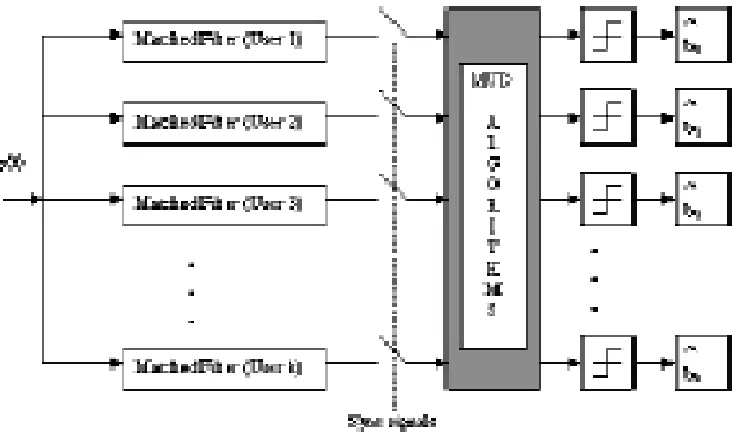
[image:2.595.118.486.346.562.2]An attempt at reaching certain conclusions has also been carried out. Fig. 1 shows the general structure of multi-user detector.
Fig. 1 General structure of multi-user detector.
125
2. NEW TWO-LEVEL FH-CDMA SCHEME DESCRIPTION2.1 Two-level FH-CDMA Scheme
In our two-level FH-CDMA scheme, the available transmission bandwidth is divided into ℎ frequency bands with . carrier frequencies in each band, giving a total of ℎ carrier frequencies. In the first (modulation) level, a number of serial data bits is grouped together and represented by a symbol. Each symbol is, in turn, represented by a modulation code of dimension × and weight (i.e., number of elements) , where is the number of frequencies, is the number of time slots (i.e., code length). The number of data bits that can be represented by a symbol depends on the number of available modulation codes. If there are available modulation codes, each symbol can represent up to ⌊log2 ⌋ data bits, where ⌊⋅⌋ is the floor function.
TABLE I
TWENTY-FIVE (4 × 5, 4, 0, 1) PRIME SEQUENCES, WHICH CAN BE ORGANIZED INTO FIVE GROUPS WITH ′ , = 0 WITHIN EACH GROUP.
In the second (FH) level, each user is assigned a unique FH pattern of dimension ℎ × ℎ and weight (i.e., number of elements) ℎ, where ℎ is the number of frequencies, ℎ is the number of time slots (i.e., pattern length). The elements in the modulation codes and FH patterns determine the carrier frequencies of the final FH-CDMA signals. While an element of a modulation code defines the carrier frequency used in a frequency band in a given time slot, an element of the FH pattern determines which frequency band (out of ℎ bands) to use. In our scheme, we can choose any families of ( × , , , , , ) modulation codes and ( ℎ × ℎ, ℎ, ,ℎ, ,ℎ) FH patterns as long as ℎ≥ , where , ( ,ℎ) and , ( ,ℎ) denote the maximum autocorrelation sidelobes and cross-correlation values of the modulation codes (FH patterns), respectively.
To illustrate the main concept of our two-level FH-CDMA scheme, we here use prime sequences as the modulation codes; other codes, such as the RS sequences, quadratic congruence codes (QCCs), and multilevel prime codes (MPCs), can also be used. The prime sequences are constructed in Galois field GF( ) of a prime number . Each prime sequence of weight = is denoted by 1, 2 = ( 1, 2,0, 1, 2,1, . . . , 1, 2, , . . . , 1, 2, −1), where the th element 1, 2, = 2 ⊕ ( 1 ⊙ ) represents the frequency used in the th position (i.e., time slot) of
1, 2 , { 1, 2, } ∈ GF( ), “⊕ ” denotes a modulo- addition, and “⊙ ” denotes a modulo- multiplication.
3. PERFORMANCE ANALYSIS
In FH-CDMA systems, MAI depends on the cross correlation values of FH patterns. For our two-level FHCDMA scheme, the cross-correlation values of the modulation codes impose additional (symbol) interference and need to be considered. Assume that one-hit FH patterns of dimension ℎ × ℎ are used and the transmission
band is divided into ℎ frequencies, in which frequencies are used to carry the modulation codes of weight
. The probability that a frequency of an interferer hits with one of the frequencies of the desired user is
126
Assume that there are simultaneous users, the probability that the dehopped signal contains entries in anundesired row is given by
Over AWGN, and Rayleigh and Rician fading channels, false alarms and deletions may introduce detection errors to the received FH-CDMA signals. A false-alarm probability, , is the probability that a tone is detected in a receiver when none has actually been transmitted. A deletion probability, , is the probability that a receiver missed a transmission tone. For these three types of channels, the false-alarm probability is generally given by
For an AWGN channel, the deletion probability is given by
where 0 denotes the actual threshold divided by the rootmean- squared receiver noise, is the number of bits per
symbol, / is the average bit-to-noise density radio, ( , ) = ∫ ∞ exp[−( 2 + 2)/2] 0( ) is Marcum’s - function, and 0(⋅) is the modified Bessel function of the first kind and zeroth order. To minimize the error probability, the optimal 0 of an AWGN channel should be a function of the signal-to-noise ratio (SNR), ( / ) ⋅
( / ) and can be more accurately written as
(Eb/N0 ).(kb/wm) (4)
rather than an inaccurate constant value (i.e., 0 = 3, used ). For a Rayleigh fading channel, the deletion probability is given by
127
Finally, for a Rician fading channel, the deletion probability is given bywhere the Rician factor ! is given as the ratio of the power in specular components to the power in multipath
components . Similarly, 0 and 1 can be more accurately written as
128
In FH-CDMA systems, an error occurs when interference causes undesired rows in the dehopped signal to have equal or more entries than the desired rows. In addition, an error may still occur in our two-level FH-CDMA scheme even when the undesired rows have less entries than the desired rows. It is because the nonzero cross-correlation values of the modulation codes add extra undesired entries. To account for this, let "# denote theconditional probability of the number of hits (seen at any one of the incorrect rows) being increased from # to#+ , where ∈ [1, ,]. To account for the effect of , ⁄= 0, we derive a new probability of having a peak of # as
where when # + $ > . The computation of is exampled in Appendix. If there are 2 −1 incorrect
rows, the probability that is the maximum number of entries and that exactly $ unwanted rows contain entries is
129
Over a noisy or fading channel, the probability of having an entry in a desired row is 1− . Therefore, the probability that there exist entries in a desired row is given byThe desired symbol is detected wherever the maximum number of entries in the $ incorrect rows is less than . As
the receiver decides which symbol (out of 2 symbols) is recovered by searching for the modulation code with
thelargest matching entries, the bit error probability (BEP) is finally given by
4. PERFORMANCE AND SE COMPARISONS
In this section, we compare the performances of the new two-level FH-CDMA and Goodman’s MFSK/FH-CDMA schemes under the condition of same transmission parameters: % = ℎ, % = ℎ, and % = , where %, %, and % are the number of frequencies, number of time slots, and weight of FH patterns utilized by Goodman’s MFSK/FHCDMA scheme, respectively. As illustrated , the prime sequences may give at most two hits in Goodman’s MFSK/FHCDMA scheme under a symbol-asynchronous assumption. The main difference is that Goodman’s MFSK/FH-CDMA scheme supports % modulation symbols (represented by the orthogonal frequencies), while the two-level FH-CDMA scheme supports 2 − + symbols with the symbol interference level , = 1.While the number of simultaneous users of our partitioned two-level FH-CDMA scheme is only slightly less than that of Goodman’s FH-CDMA scheme in Fig. 4, the larger results in a net gain in the SE,
130
0 10 20 30 40 50 60 70
10-3 10-2 10-1 100
No.of Simultaneous Users
[image:8.595.123.481.164.446.2]B it E rr o r P ro b a b il it y Rayleigh channel Awgn channel Rician channel
Fig. 5. BEPs of the two-level FH-CDMA scheme versus the number of simultaneous users over AWGN, and Rayleigh and Rician fading channels.
Using matlab,the simulated results have been obtained for Bit error probability vs No. of Simulations users.
6. CONCLUSIONS
In this project, we proposed a new two-level FH-CDMA scheme. The prime/FH-CDMA and RS/FH-CDMA schemes were special cases of our scheme. The performance analyses showed that the two-level FH-CDMA scheme provided a trade-off between performance and data rate. The partitioned two-level FH-CDMA scheme increased the number of possible users and exhibited higher data rate and greater SE than Goodman’s MFSK/FH-CDMA scheme. In summary, the new scheme offered more flexibility in the design of FH-CDMA systems to meet different operating requirements.
REFERENCES
[1] Y. R. Tsai and J. F. Chang, “Using frequency hopping spread spectrum technique to combat multipath interference in a multi-accessing environment," IEEE Trans. Veh. Technol., vol. 43, no. 2, pp. 211-222, May 1994.
131
[3] J.-Z. Wang and L. B. Milstein, “CDMA overlay situations for microcellular mobile communications," IEEE Trans. Commun., vol. 43, no. 2/3/4, pp. 603-614, Feb./Mar./Apr. 1995.
[4] J.-Z. Wang and J. Chen, “Performance of wideband CDMA systems with complex spreading and imperfect channel estimation," IEEE J. Sel. Areas Commun., vol. 19, no. 1, pp. 152-163, Jan. 2001.
[5] D. J. Goodman, P. S. Henry, and V. K. Prabhu, “Frequency-hopping multilevel FSK for mobile radio," Bell Syst. Tech. J., vol. 59, no. 7, pp. 1257-1275, Sep. 1980.
[6] G. Einarsson, “Address assignment for a time-frequency, coded, spreadspectrum system," Bell Syst. Tech. J., vol. 59, no. 7, pp. 1241-1255, Sep. 1980.
[7] S. B. Wicker and V. K. Bhargava (eds.), Reed-Solomon Codes and Their Applications. Wiley-IEEE Press, 1999.
[8] G.-C. Yang and W. C. Kwong, Prime Codes with Applications to CDMA Optical and Wireless Networks. Norwood, MA: Artech House, 2002.
[9] C.-Y. Chang, C.-C. Wang, G.-C. Yang, M.-F. Lin, Y.-S. Liu, and W. C. Kwong, “Frequency-hopping CDMA wireless communication systems using prime codes," in Proc. IEEE 63rd Veh. Technol. Conf., pp. 1753- 1757, May 2006.