U s i n g C a t e g o r i e s
i n t h e E U T R A N S S y s t e m
J. C. A m e n g u a l 1 J . M . B e n e d f 2
A. Castellanos 1
D.
L l o r e n s ~
E. V i d a l 2
(1) Unidad Predepartamental de Inform£tica
Campus Penyeta Roja
Universitat Jaume I
12071 Castelldn de la Pinna (Spain)
A b s t r a c t
The EUTRANS project, aims at devel- oping Machine Translation systems for limited domain applications. These sys- tems accept speech and text input, and are trained using an example based ap- proach. The translation model used in this project is the Subsequential Trans- ducer, which is easily integrable in con- ventional speech recognition systems. In addition, Subsequential Transducers can be automatically learned from corpora. This paper describes the use of categories for improving the EUTRANS translation systems. Experimental results with the task defined in the project show that this approach reduces the number of exam- ples required for achieving good models.
1
I n t r o d u c t i o n
The EUTRANS project 1 (Amengual et al., 1996a), funded by the European Union, aims at develop- ing Machine Translation systems for limited do- main applications. These systems accept speech and text input, and are trained using an ex- ample based approach. The translation model used in this project is the Subsequential Trans- ducer (SST), which is easily integrable in con- ventional speech recognition systems by using it both as language and translation model (Jimdnez et al., 1995). In addition, SSTs can be automati- cally learned from sentence aligned bilingual cor- pora (Oncina et ai., 1993).
This paper describes the use of categories both in the training and translation processes for im- proving the EUTRANS translation systems. The 1Example-Based Understanding and Translation Systems (EuTRANS). Information Technology, Long Term Research Domain, Open Scheme, Project Num- ber 20268.
F. C a s a c u b e r t a 2 A. C a s t a f i o 1
A. M a r z a l 1
F.
P r a t 1
J. M . V i l a r 1
(2) Depto. de Sistemas Inform~ticos y
Computacidn
Universidad Politdcnica de Valencia
46071 Valencia (Spain)
approach presented here improves that in (Vilar et al., 1995), the integration of categories within the systems is simpler, and it allows for categories grouping units larger than a word. Experimental results with the Traveler Task, defined in (Amen- gual et al., 1996b), show that this method reduces the number of examples required for achieving good models.
The rest of the paper is structured as follows. In section 2 some basic concepts and the notation are introduced. The technique used for integrat- ing categories in the system is detailed in section 3. Section 4 presents the speech translation system. Both speech and text input experiments are de- scribed in section 5. Finally, section 6 presents some conclusions and new directions.
2
B a s i c C o n c e p t s - r i d N o t a t i o n
Given an alphabet X, X* is the free monoid of strings over X. The symbol A represents the empty string, first letters (a, b, c, . . . ) rep- resent individual symbols of the alphabets and last letters (z, y, x, . . . ) represent strings of the free monoids. We refer to the individual el- ements of the strings by means of subindices, as in x = a l . . . a n . Given two strings x , y E X ' , x y denotes the concatenation of x and y.2.1 S u b s e q u e n t i a l T r a n s d u c e r s
Formally, a SST is a tuple r = (X, Y, Q, q0, E, o-) where X and 1," are the input and output alphabets, Q is a finite set of states, qo E Q is the initial state, E E Q x X x Y" x ~ is a set of arcs satisfying the determinism condition, and a : Q ~ Y" is a state emission function 2. Those states for which o" is defined are usually called final states. The determinism condition means that, if (p, a. y, q) and (p, a, y', q') belong to E, then y = y' a n d q = q ' . Given a s t r i n g x = a l . . . a n E X ' , a sequence (qo~al,yl,ql) . . . . , (qn-l,a,~,yn,q,~) is a valid path if (qi-1, ai, Yi, qi) belongs to E for every i in 1 , . . . , n, and qn is a final state. In case there exists such a valid path for z, the translation of z by r is y l . . . yna(q~). Otherwise, the transla- tion is undefined. Note that due to the condition of determinism, there can be no more than one valid path, and hence at most one translation, for a given input string. Therefore, r defines a func- tion between an input language, L t C_ X °, and an output language, Lo C Y*. Both L t and L o are regular languages and their corresponding au- t o m a t a are easily obtainable from the SST. In par- ticular, an a u t o m a t o n for L t can be obtained by eliminating the o u t p u t of the arcs and states, and considering the final state set of the a u t o m a t o n being the same as in the SST. A state is useless if it is not contained in any valid path. Useless states can be eliminated from a SST without changing the function it defines.
In section 3, we will relax the model. Instead of imposing the determinism conditition, we will only enforce the existence of at most one valid path in the transducer for each input string (non- ambiguity). We will call them Unambiguous SSTs (USSTs). Standard algorithms for finding the path corresponding to a string in an unambigous finite state a u t o m a t o n (see for instance (Hopcroft and UNman, 1979)) can be used for finding the translation in a USST. When the problem is the search for the best path in the expanded model during speech translation (see section 4), the use of the Viterbi algorithm (Forney, 1973) guarantees that the most likely path will be found.
2.2 I n f e r e n c e o f S u b s e q u e n t i a l T r a n s d u c e r s
The use of SSTs to model limited domain trans- lation tasks has the distinctive advantage of al- lowing an a u t o m a t i c and efficient learning of the translation models from sets of examples. An in- ference algorithm known as OSTIA (Onward Sub- 21n this paper, the term function refers to partial
functions. W e will use f ( z ) = @ to denote that the function .f is undefined for ~.
sequential Transducer Inference Algorithm) allows the obtainment of a SST t h a t correctly models the translation of a given task, if the training set is representative (in a formal sense) of the task (On- cina et al., 1993). Nevertheless, although the SSTs learned by OSTIA are usually good trans- lation models, they are often poor input language models. In practice, they very accurately trans- late correct input sentences, but also accept and translate incorrect sentences producing meaning- less results. This yields undesirable effects in case of noisy input, like the one obtained by OCR or speech recognition.
To overcome this problem, the algorithm OSTIA-DR (Oncina and Var6, 1996) uses finite state domain (input language) and range (out- put language) models, which allow to learn SSTs that only accept input sentences and only produce output sentences compatible with those language models. OSTIA-DR can make use of any kind of finite state model. In particular, models can be n-testable automata, which are equivalent to n-grams (Vidal et al., 1995) and can be also au- tomatically learned from examples.
3
Introducing Word
Categories in
the Learning and Translation
Processes
An approach for using categories together with SSTs was presented in (Vilar et al., 1995), proving it to be useful in reducing the number of examples required for learning. However, the approach pre- sented there was not easily integrable in a speech recognition system and did not provide for the case in which the categories included units larger than a word.
For the EUTRANS project, the approach was changed so t h a t a single USST would comprise all the information for the translation, including elementary transducers for the categories. These steps were followed:
• CATEGORY IDENTIFICATION. T h e categories used in EUTRANS were seven: masculine names, femenine names, surnames, dates, hours, room numbers, and general numbers. T h e election of these categories was done while keeping with the example based nature of the project. In particular, the categories chosen do not need very specific rules for recognising them, the translation rules they follow are quite simple, and the amount of special linguistic knowledge introduced was very low.
Original sample:
D6me la Ilave de la habitaci6n ciento veintitr~.s
Give me the key to room number one two three
EGORI ER ?
Categorized sample:
D~me la II-',ve de la habltact6n SROOM Give me the key to room number $ROOM
( OS' ,A-DR )
I
( EXPANDER )
LEARNING PROCESS
[npu¢ sentence:
D~me la llave de la habitaci6n quinientos setenta y ocho
Give me the key m room SROOM $ROOM=[five seven eight
(
PosT ocv.ssoR
)
"rrmmlalt4m:
Give me the key to room number five seven eight
TRANSLATION PROCESS
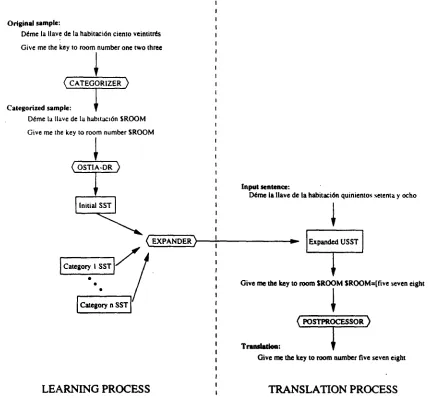
Figure 1: General schema of the treatment of categories in the learning and translation processes.
gories were defined, simple scripts substituted the words in the categories by adequate la- bels, so that the pair (ddme la Have de la habitaci6n ciento veintitrds - give me the key to room one two three) became ( d i m e Is Uave de la habitaci6n $ R O O M - give m e the key to room SROOM), where $ R O O M is the cat- egory label for room numbers.
• I N I T I A L M O D E L L E A R N I N G . T h e categorised corpus was used for training a model, the ini- tial SST.
• C A T E G O R Y M O D E L L I N G . For e a c h c a t e - g o r y , a simple SST was built: its category S S T (cSST).
• C A T E G O R Y EXPANSION. The arcs in the ini- tial SST corresponding to the different cate-
gories were expanded using their cSSTs. A general view of the process can be seen in Fig- ure 1. The left part represents the elements in- volved in the learning of the expanded USST, ex- emplified with a single training pair. The right part of the diagram gives a schematic representa- tion of the use of this transducer.
The category expansion step is a bit more com- plex than just substituting each category-labeled arc by the corresponding cSST. The main prob- lems are: (I) how to insert the output of the cSST within the output of the initial transducer; (2) how to deal with more than one final state in the cSST; (3) how to deal with cycles in the cSST involving its initial state.
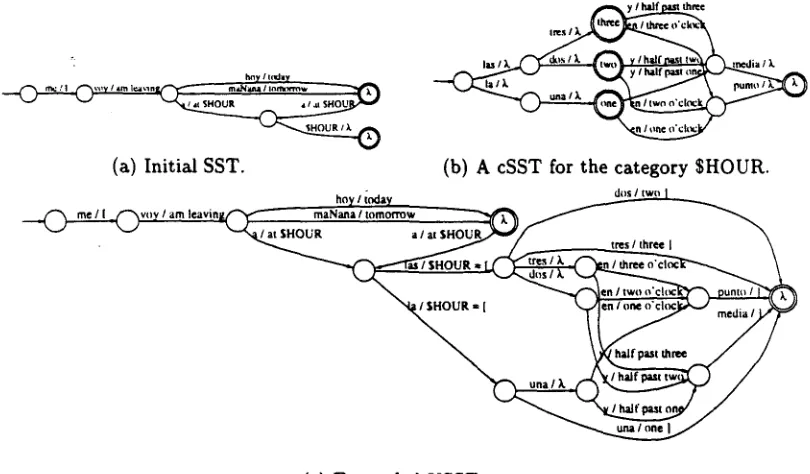
[image:3.612.79.509.44.442.2]can a p p e a r before or after the label has been seen in the input. For example, consider the transducer in F i g u r e 2 ( a ) and a Spanish sentence categorised as me voy a $HOUR, which corresponds to the categorised English one I am leaving at $HOUR. Once me roy a is seen, the continuation can only be $HOUR, so the initial SST, before seeing this category label in the input, has already produced the whole o u t p u t (including $HOUR). Taking this into account, we decided to keep the output of the initial SST and to include there the information necessary for removing the category labels. To do this, the label for the category was considered as a variable that acts as a placeholder in the o u t p u t sentence and whose contents are also fixed by an assignment a p p e a r i n g elsewhere within that sen- tence. In our example, the expected o u t p u t for me roy a l a s tres y media could be I am leaving at $HOUR $HOUR = [half past three]. This as- sumes that each category a p p e a r s at most once within each sentence.
T h e expanded model is obtained by an itera- tive procedure which starts with the initial SST. Each time the procedure finds an arc whose in- put symbol is a category label, it expands this arc by the adequate cSST producing a new model. This expansion can introduce non-determinism, so these new models are now USSTs. W h e n every arc of this kind has been expanded, we have the ex- panded USST. T h e expansion of each arc follows these steps:
• Eliminate the arc.
• Create a copy of the cSST corresponding to the category label.
• Add new arcs linking the new cSST with the USST. These arcs have to ensure t h a t the o u t p u t produced in the cSST is embraced be- tween c=[ and ], c being the category label. • Eliminate useless states.
Formally, we have an USST 7" = ( X , Y , Q , qo, E , a ) , a cSST r~ = ( X , Y , Qc, qoe, E~,ac), where we assume t h a t ac(qoc = 0, and an arc (p, c, z, q) e ~ E. We will produce a new USST r' = ( x , v , Q u Q ~ , q o , ( E - ( p , e , z , q ) ) u E~,a'). T h e new elements are:
• T h e set Q~ is disjoint with Q and there exists a bijection ¢ : Qc ~ Q~.
• T h e new set of arcs is:
E'~ = {(¢(r),a,y,¢(s))lCr, a,~,s)
e E c ) } u {(p,a, z c = [ y , ¢ ( s ) ) l ( q o c , a , y , s ) E Ee)}u
{(¢(r),a, yac(s)],q)l(r,a,y,s) ~ Ec)
Aa¢(s) # 0}
U {(p,a, zc=[ya~(s)],q)[(qo¢,a,y,s) E Ec)
^so(s) ~ o}
Note t h a t this solves the problems deriving from the cSST having multiple final states or cycles involving the initial state. T h e price to pay is the introduction of non-determinism in the model.
• T h e n e w state emission function is: { a ( s ) i f s E Q
Finally, the useless states t h a t m a y a p p e a r during this construction are removed.
A simple e x a m p l e of the effects of this procedure can be seen on Figure 2. T h e drawing (a) depicts the initial SST, (b) is a cSST for the hours between o n e and three (in o'clock and half past forms), and the expanded USST is in (c).
4
O v e r v i e w o f t h e S p e e c h
Tr-an.~lation S y s t e m
A possible scheme for speech translation consists in t r a n s l a t i n g the o u t p u t of a conventional Contin- uous Speech Recognition (CSR) front-end. This implies t h a t some restrictions present in the trans- lation and t h e output language, which could en- hance the acoustic search, are not taken into ac- count. In this sense, it is preferable to integrate the translation model within a conventional CSR s y s t e m to c a r r y out a simultaneous search for the recognised sentence and its corresponding trans- lation. T h i s integration can be done by using a SST as language and translation model, since it has included in the learning process the restric- tions introduced by the translation and the o u t p u t language. E x p e r i m e n t a l results show t h a t bet- ter p e r f o r m a n c e is achieved (Jimdnez et al., 1994; Jim/mez et al., 1995).
Thus, our s y s t e m can be seen as the result of in- tegrating a series of finite state models at different levels:
• A C O U S T I C LEVEL. Individual phones are rep-
resented by m e a n s of Hidden M a r k o v Models
(HMMs).
h e r I .~Ja~
I =¢ SHOUR • I ,u SHOU
(a) Initial SaT. (b) A cSST for the category SHOUR.
hop / i~ay
'
una/one I
(c) Expanded USST.
Figure 2: An example of the expansion procedure.
• SYNTACTIC AND TRANSLATION LEVEL. The syntactic constrains and translation rules are represented by an USST.
In our case, the integration means the substitution of the arcs of the USST by the automata describ- ing the input language words, followed by the sub- stitution of the arcs in this expanded automata by the corresponding HMMs. In this way, a conven- tional Viterbi search (Fomey, 1973) for the most likely path in the resulting network, given the in- put acoustic observations, can be performed, and both the recognised sentence and its translation are found by following the optimal path.
5
Experiments
5.1 T h e T r a v e l e r T a s k
The Traveler Task (Amengual et al., 1996b) was defined within the EUTRANS project (Amengual et al., 1996a). It is more realistic that the one in (Castellanos et al., 1994), but, unlike other cor- pora such as the Hansards (Brown et al., 1990), it is not unrestricted.
The general framework established for the Trav- eler Task aims at covering usual sentences that can be needed in typical scenarios by a traveler visiting a foreign country whose language he/she does not speak. This framework includes a great variety of different translation scenarios, and thus results appropriate for progressive experimentation with
increasing level of complexity. In a first phase, the scenario has been limited to some human-to- human communication situations in the reception of a hotel:
• Asking for rooms, wake-up calls, keys, the bill, a taxi and moving the luggage.
• Asking about rooms (availability, features, price).
• Having a look at rooms, complaining about and changing them.
• Notifying a previous reservation.
• Signing the registration form.
• Asking and complaining about the bill.
• Notifying the departure.
• Other common expressions.
[image:5.612.103.508.55.292.2]Table 1: Some examples of sentence pairs from the Traveler Task. S p a n i s h : P o t favor, ~quieren pedirnos un taxi p a r a la habitacidn trescientos diez? E n g l i s h : " Will you ask for a taxi for room number three one oh for us, please?
S p a n i s h : DeseaHa reservar una habitaciSn tranquiIa con teldfono y teIevisidn hasta pasado mal~ana.
G e r m a n : Ich mSchte ein ruhiges Zimmer mit TeIefon und Fernseher his iibermorgen reservieren. S p a n i s h : zMe pueden dar las llaves de la habitaciSn, p o r favor?
I t a l i a n : Mi potreste dare le chiavi della stanza, per favore?
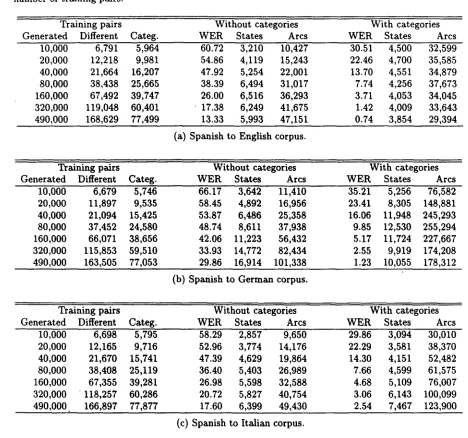
Table 2: Main features of the Spanish to English, Spanish to G e r m a n and Spanish to Italian text corpora.
Spanish to English Spanish to G e r m a n Spanish to Italian
Vocabulary size 689 514 691 566 687 585
Average sentence length 9.5 9.8 8.9 8.2 12.7 11.8 Test set perplexity 13.8 7.0 13.2 9.0 13.6 10.6
to these schema specifications in order to express
optional rules, permutation of phrases, concor- dance (of gender, number and case), etc. The use of automatic corpora generation was convenient due to time constrains of the first phase of the E U T R A N S project, and cost-effectiveness. More- over, the complexity of the task can be controlled.
The languages considered were Spanish as input and English, G e r m a n and Italian as output, giving a total of three independent corpora of 500,000 pairs each. S o m e examples of sentence pairs are shown in Table I. S o m e features of the corpora can be seen in Table 2. For each language, the test set perplexity has been computed by training a trigram model (with simple fiat smoothing) using a set of 20,000 random sentences and computing the probabilities yielded by this model for a set of
i0,000 independent random sentences. The lower perplexity of the output languages derives from a design decision: multiple variants of the input sentences were introduced to account for different ways of expressing the same idea, but they were given the same translation.
Finally, a multispeaker speech corpus for the task was acquired. It consists of 2,000 utterances in Spanish. Details can be found in (Amengual et al., 1997a).
5.2 Text Input E x p e r i m e n t s
Our approach was tested with the three text cor- pora. Each one was divided in training and test sets, with 490,000 and 10,000 pairs, respectively. A sequence of models was trained with increasing subsets of the training set. Each model was tested using only those sentences in the test set that were
not seen in training. This has been done because a model trained with O S T I A - D R is guaranteed to reproduce exactly those sentences it has seen during learning. The performance was evaluated
in terms of Word Error Rate (WER), which is
the percentage of output words that has to be in- serted, deleted and substituted for they to exactly match the corresponding expected translations.
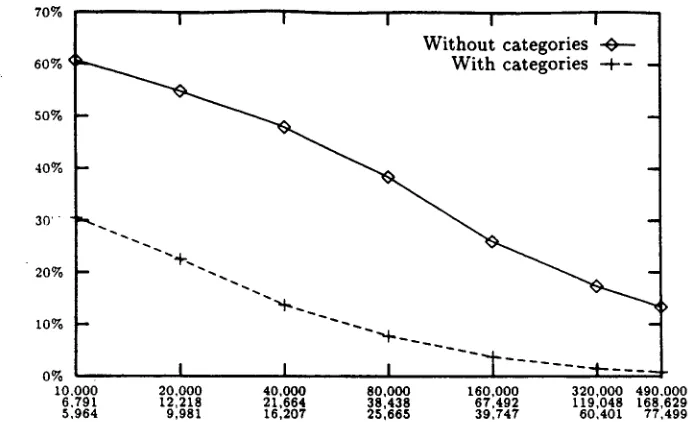
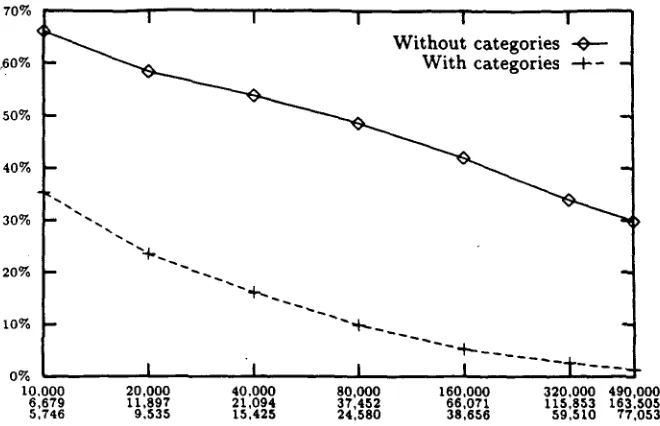
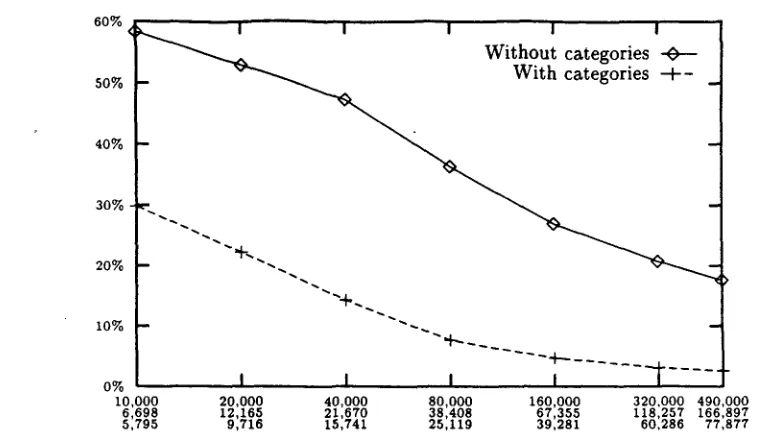
The results for the three corpora can be seen on Table 3. The columns labeled as "Different" and "Categ.", refer to the number of different sen- tences in the training set and the number of differ- ent sentences after categorization. Graphical rep- resentations of the same results are on Figures 3, 4 and 5. As expected, the use of lexical categories had a major impact on the learning algorithm. The differences in W E R attributable to the use of lexical categories can be as high as about a 4 0 % in the early stages of the learning process and de- crease when the number of examples grows. The large increase in performance is a natural conse- quence of the fact that the categories help in re- ducing the total variability that can be found in the corpora (although sentences do exhibit a great
deal of variability, the underlying syntactic struc-
ture is actually m u c h less diverse). They also have the advantage of allowing an easier extension in the vocabulary of the task without having a neg- ative effect on the performance of the models so obtained (Vilar et al., 1995).
5.3 S p e e c h Input E x p e r i m e n t s
Table 3: Text input results: Translation word error rates (WER) and sizes of the transducers for different number of training pairs.
Training pairs Without categories With categories
Generated Different Categ. WER States Arcs WER States Arcs
I0,000 6,791 5,964 60.72 3 , 2 1 0 I0,427 30.51 4,500
20,000 1 2 , 2 1 8 9,981 54.86 4 , 1 1 9 15,243 22.46 4,700
40,000 21,664 16,207 47.92 5 , 2 5 4 22,001 13.70 4,551
80,000 38,438 25,665 38.39 6 , 4 9 4 31,017 7.74 4,256
160,000 67,492 39,747 26.00 6 , 5 1 6 36,293 3.71 4,053
320,000 119,048 60,401 " 17.38 6 , 2 4 9 41,675 1.42 4,009
490,000 168,629 77,499 13.33 5 , 9 9 3 47,151 0.74 3,854
32.599 35.585 34879 37.673 34045 33643 29394
(a) Spanish to English corpus.
Training pairs Without categories With categories
Generated Different Categ. WER States Arcs WER States Arcs
10,000 6,679 5,746 66.17 3 , 6 4 2 I1,410 35.21 5 , 2 5 6 76,582
20,000 1 1 , 8 9 7 9,535 58.45 4 , 8 9 2 16,956 23.41 8 , 3 0 5 148,881
40,000 21,094 15,425 53.87 6 , 4 8 6 25,358 16.06 11,948 245,293
80,000 37,452 24,580 48.74 8 , 6 1 1 37,938 9.85 12,530 255,294
160,000 66,071 38,656 42.06 11,223 56,432 5.17 11,724 227,667
320,000 115,853 59,510 33.93 14,772 82,434 2.55 9 , 9 1 9 174,208
490,000 163,505 77,053 29.86 16,914 101,338 1.23 10,055 178,312
(b) Spanish to German corpus.
Training pairs Without categories With categories
Generated Different Categ. WER States Arcs WER States Arcs
I0,000 6,698 5,795 58.29 2 , 8 5 7 9,650 29.86
20,000 1 2 , 1 6 5 9,716 52.96 3 , 7 7 4 14,176 22.29
40,000 2 1 , 6 7 0 15,741 47.39 4 , 6 2 9 19,864 14.30
80,000 38,408 25,119 36.40 5 , 4 0 3 26,989 7.66
160,000 67,355 39,281 26.98 5 , 5 9 8 32,588 4.68
320,000 118,257 60,286 20.72 5 , 8 2 7 40,754 3.06
490,000_ 166,897 77,877 17.60 6 , 3 9 9 49,430 2.54
3 094 3 581 4 151 4 599 5 109 6 143 7 467
30,010 38,370 52,482 61,575 76,007 100,099 123,900
[image:7.612.63.531.145.583.2]70%
60%
50%
40°7o
30"
20%
lO%
o%
I0,000 6,791 5,964
I I I I I
Without categories 0 ties -.4--- -
| . . . -t-- . . . .
I I I
[image:8.612.109.453.45.256.2]20,000 40,000 80,000 160,000 320,000 490,000 12,218 21,664 38 438 67,492 119,048 L68,629 9,981 16,207 251665 39,747 60,401 77,499
Figure 3: Evolution of translation W E R with the size of the training set: Spanish to English text corpus.
The sizes in the horizontal axis refer to the first three columns in Table 3(a).
Table 4: Speech input results:Translation word er-
ror rates ( W E R ) and real time factor (RTF) for the best Spanish to English transducer.
N u m b e r of H M M B e a m
Gaussians Width W E R R T F
1,663 300 2.3 % 5.9
1,663 150 6.4 % 2.2
5,590 300 1.9 % 11.3
5,590 150 6.3 % 5.6
section 4) the following models:
• ACOUSTIC LEVEL. T h e phones were rep- resented by context-independent continuous- density HMMs. Each HMM consisted of six states following a left-to-right topology with loops and skips. T h e emission distribution of each state was modeled by a mixture of Gaus- sians. Actually, there were only three emi~. sion distributions per HMM since the states were tied in pairs (the first with the second, the third with the fourth, and the fifth with the sixth). Details about the corpus used in training these models and its parametrization can be found in (Amengnal et al., 1997a). • LEXICAL LEVEL Spanish Phonetics allows
the representation of each word as a sequence of phones t h a t can be derived from standard rules. This sequence can be represented by a simple chain. T h e r e were a total of 31 phones,
including stressed and unstressed vowels plus two types of silence.
SYNTACTIC AND TRANLATION LEVEL. We used the best of the transducers obtained in the Spanish to English text experiments. It was enriched with probabilities estimated by parsing the same training d a t a with the final model and using relative frequencies of use as probability estimates.
T h e Viterbi search for the most likely path was speeded up by using beam search at two levels: independent beam widths were used in the states of the SST (empirically fixed to 300) and in the states of the HMMs. Other details of the experi- ments can be found in (Amengnal et al., 1997a).
Table 4 shows that good translation results (a W E R of 6.4%) can be achieved with a Real Time Factor (RTF) of just 2.2. It is worth noting that these results were obtained in a HP-9735 worksta- tion without resorting to any type of specialised hardware or signal processing device. When trans- lation accuracy is the main concern, a more de- tailed acoustic model and a wider beam in the
search can be used to achieve a W E R of 1.9%, but with a R T F of 11.3.
6 C o n c l u s i o n s
7O%
..6O%
50% --
4O% --
3O%
2O% --
10% --
O%
10,000 6,679 5,746
I
I
20,000 11,897 9,535
I I I
W i t h o u t categories 0 W i t h categories - F - -
i. i l . . .
40,000 8 0 ~ 0 160,0~ 320,000 490
21,094 37'452 66,071 116,853 1 6 3
15,425 241580 38,656 59,510 77
000 505 053
Figure 4: Evolution of translation W E R with the size of the training set: Spanish to G e r m a n text corpus. The sizes in the horizontal axis refer to the first three columns in Table 3(b).
automatically learned from corpora of examples. This learning process can be improved by means of categories using the approach detailed in this paper.
Experimental results show that this approach reduces the number of examples required for achieving good models, with good translation re- sults in acceptable times without using speciaiised hardware.
Our current work concentrates in further reduc- ing the number of examples necessary for training the translation models in order to cope with spon- taneous instead of synthetic sentences. For this, new approaches are being explored, like reordering the words in the translations, the use of new in- ference algorithms, and automatic categorization. Results obtained with a different enhancement of our text input system, the inclusion of error correcting techniques, can be found in (Amengual et al., 1997b).
References
Juan-Carlos Amengual, JosA-Miguel Benedi, Francisco Casacuberta, Asuncidn Castafio, An- tonio Castellanos, Victor M. Jimdnez, David Llorens, Andrds MarzM, Federico Prat, Hdctor Rulot, Enrique Vidal, Juan MiKuel Vilar, Cristina Delogu, Andrea Di Carlo, Hermann Ney, Stephan Vogel, Josd Manuel Espejo, and Josep R a m d n Freixenet. 1996a. E U T R A N S : Example-based understanding and translation
systems: First-phase project overview. Techni- cal Report D4, Part 1, E U T R A N S (IT-LTR-OS- 20268). (Restricted).
Juan-Carlos Amenguai, Jos~-Miguel Benedi, Asuncidn Casta~o, Andrds Marzai, Federico Prat, Enrique Vidai, Juan Miguel Vilar, Cristina Delogu, Andrea Di Carlo, Hermann Ney, and Stephan Vogel. 1996b.. Definition of a machine translation task and generation of corpora. TechnicaJ Report DI, E U T R A N S (IT- LTR-OS-20268). (Restricted).
J. C. A m e n g u M , J. M. Benedi, K. Beulen, F. Casacuberta, A. Castafio, A. Castella- nos, V. M. Jimdnez, D. Llorens, A. Marzal, H. Ney, F. Prat, E. Vidal, and J. M. Vilar. 1997a. Speech translation based on automat- ically trainable finite-state models. To appear in Proceedings of E U R O S P E E C H ' 9 7 .
Juan C. Amengual, Josd M. Benedi, Francisco Casacuberta, Asuncidn Castafio, Antonio Cas- tellanos, , David Llorens, Andrds Marzal, Fed- erico Prat, Enrique Vidal, and Juan M. Vilar. 1997b. Error correcting parsing for text-to-text machine translation using finite state models. To appear in Proceedings of TMI 97, July.
J. Berstel. 1979. Transductions and Contezt-Free
Languages.
Teubner. [image:9.612.140.470.49.262.2]6O%
50%
40%
30%
20%
10%
0%
IO,OOO
6 698 5:795
L,...,...,...,...,...I I I I I
Without categories O
I I I
20,000 40,000 80,000 160,000 320,000 490,000 12 165 21,670 38 408 67 355 118 257 166,897 9:716 15,741 25:119 39:281 60:286 77,877
Figure 5: Evolution of translation W E R with the size of the training set: Spanish to Italian text corpus. The sizes in the horizontal axis refer to the first three columns in Table 3(c).
and Paul S. Roossin. 1990. A statistical ap- proach to machine translation. Computational
Linguistics, 16(2):79-85, June.
A. Casteltanos, I. Galiano, and E. Vidal. 1994. Application of OSTIA to machine translation tasks. In Rafael C. Carrasco and Joss On- cina, editors, Grammatical Inference and Appli-
cations, volume 862 of Lecture Notes in Com-
puter Science, pages 93-105. Springer-Verlag,
September.
G. D. Forney, Jr. 1973. The Viterbi algorithm.
Proceedings of the IEEE, 61(3):268-278, March.
R. C. Gonzalez and M. G. Thomason. 1978. Syn-
tactic Pattern Recognition: An Introduction.
Addison-Wesley, Reading, Massachusetts.
J. E. Hopcroft and J. D. UNman. 1979. Introduc- tion to Automata Theory, Languages and Com-
putation. Addison-Wesley, Reading, Mass.,
USA.
V.M. Jim~nez, E. Vidal, J. Oncina, A. Cas- tellanos, ,H. Rulot, and J. A. S~inchez. 1994. Spoken-language machine translation in limited-domain tasks. In H. Niemann, R. de Mori, and G. Hanrieder, editors, Pro- ceedings of the CRIM/FORWISS Workshop on Progress and Prospects of Speech Research and
Technology, pages 262-265. Infix.
V. M. Jim~nez, A. Castellanos, and E. Vidal. 1995. Some results with a trainable speech translation and understanding system. In Pro-
ceedings of the ICASSP-95, Detroit, MI (USA).
J o s 6 0 n c i n a and Miguel Angel Var6. 1996. Us- ing domain information during the learning of a subsequential transducer. In Laurent Miclet and Colin de la Higuera, editors, Grammati- cal Inference: Learning Syntax from Sentences,
volume 1147 of Lecture Notes in Computer Sci-
ence, pages 301-312. Springer-Verlag.
Jose Oncina, Pedro Garcia, and Enrique Vidal. 1993. Learning subsequential transducers for pattern recognition interpretation tasks. IEEE Transactions on Pattern Analysis and Machine
Intelligence, 15(5):448-458, may.
Enrique Vidal, Francisco Casacuberta, and Pe- dro Garcia. 1995. Grammatical inference and automatic speech recognition. In A. J. Ru- bio and J. M. L6pez, editors, Speech Recogni- tion and Coding, New Advances and Trends,
NATO Advanced Study Institute, pages 174- 191. Springer-Verlag, Berlin.
Juan Miguel Vilar, AndrOs Marzal, and Enrique Vidal. 1995. Learning language translation in limited domains using finite-state models: some extensions and improvements. In 4th Euro- pean Conference on Speech Communication and
[image:10.612.88.479.20.239.2]