Automatic Extraction of Learner Errors in ESL Sentences
Using Linguistically Enhanced Alignments
Mariano Felice Christopher Bryant Ted Briscoe ALTA Institute
Computer Laboratory
University of Cambridge Cambridge, UK
{mf501, cjb255, ejb1}@cl.cam.ac.uk
Abstract
We propose a new method of automatically extracting learner errors from parallel English as a Second Language (ESL) sentences in an effort to regularise annotation formats and reduce inconsistencies. Specifically, given an original and corrected sentence, our method first uses a linguistically enhanced alignment algorithm to determine the most likely mappings between to-kens, and secondly employs a rule-based function to decide which alignments should be merged. Our method beats all previous approaches on the tested datasets, achieving state-of-the-art results for automatic error extraction.
1 Introduction
Within the field of Machine Translation (MT), one of the first steps of data processing is to align a source sentence with a target sentence. This is necessary because we want to determine which tokens and phrases in the source language map to which equivalent tokens or phrases in the target language. As this would be extremely time consuming to do manually, several tools, such as GIZA++ (Och and Ney, 2003), have been made available to do this automatically.
Within the related field of Grammatical Error Correction (GEC), we similarly want to align a source sentence with a target sentence to map errors to corrections (sometimes referred to as ‘correction detec-tion’; see example in Table 1). However, unlike in MT, the source and target sentences in GEC are in the samelanguage and so a majority of tokens match. This means alignment is comparatively more straight-forward and so it is more feasible to annotate texts manually, rather than automatically. In fact two of the largest publicly available GEC datasets, the First Certificate in English (FCE) corpus (Yannakoudakis et al., 2011) and the National University of Singapore Corpus of Learner English (NUCLE) (Dahlmeier and Ng, 2012), were aligned and annotated manually.
We took a guide tour on center city .
We took a guided tour of the city center .
Table 1: A sample alignment between an original uncorrected sentence and its corrected version.
Nevertheless, automatic alignment of GEC data still has several advantages over manual alignment, not least because the latter is slow, laborious work. This is especially important for datasets that do not always contain explicit alignments, such as Lang-8 (Mizumoto et al., 2011), or GEC system output that needs to be aligned to the original uncorrected sentence.
Another important benefit of an automatic alignment is that it tends to be more consistent than a human alignment. For example, within both the FCE and NUCLE, strings such ashas eatingare inconsistently corrected as [has→was] or [has eating→was eating] even though they fundamentally equate to the same thing. In fact, the latter seems less desirable given the tokeneatingdoes not actually change. A similar case is [has eating→ was eaten], which is inconsistently realised either as one edit, as above, This work is licensed under a Creative Commons Attribution 4.0 International Licence. Licence details: http:// creativecommons.org/licenses/by/4.0/
or two edits: [has→was] and [eating→eaten]. Ultimately, it seems desirable to regularise such edits and hence reduce ambiguity in the data. If all datasets are treated in the same way, this would also make them fully compatible with each other.
Finally, automatic alignment can also simplify the annotation of new data. For instance, Sakaguchi et al. (2016) recently claimed that forcing annotators to annotate grammatical errors within the confines of an error scheme often led to unnatural sounding sentences and that unconstrained editing correlated more with human judgements. As such, if we no longer ask humans to explicitly mark edit boundaries in new data, we would need to extract this information automatically. This is particularly useful for English as a Second Language (ESL) teaching, where teachers could edit text freely and then let a computer delimit the edits.
2 Background
There is very little previous work on automatic alignment of sentences for GEC. The first attempt was made by Swanson and Yamangil (2012), who built a system to align sentences and then classify the non-match tokens type for the purposes of ESL feedback. In particular, they used the well-known Levenshtein distance to align the sentences and then classified any non-matches according to the FCE error scheme (Nicholls, 2003) using a maximum entropy classifier.
One complication noted by Swanson and Yamangil is that edits do not necessarily consist of just a single token. For instance, reordering errors (e.g. [only can→ can only]) or errors involving phrasal verbs (e.g. [look at → watch]) necessarily consist of more than one token on at least one side of the edit. The Levenshtein distance, however, only aligns individual tokens and so some alignments must be merged in order to obtain multi-token edits. Swanson and Yamangil hence experimented with some basic merging strategies and found that simply merging all adjacent non-match alignments most closely approximated human alignments.
Building on this foundation, Xue and Hwa (2014) carried out an analysis of Swanson and Yamangil’s work and found that approximately 70% of all errors in their error type classifier were the result of bad alignments (merged or otherwise). In order to improve on the simpleall-mergealignment strategy, they hence trained a binary maximum entropy classifier to determine whether edits should be merged or not. They tested this merging classifier on several datasets, including NUCLE and the FCE, and reported improvements of between 5-10% for both alignment and classification compared to Swanson and Yamangil.
Despite these improvements, however, there is still a considerable margin between automatic and human edit annotation. In addition, both approaches require training on existing annotations, which vary across datasets and can often be inconsistent. Ultimately, training on different datasets leads to different results and so undermines any effort towards data standardisation.
3 Automatic Alignment
A high-quality alignment between an original and corrected sentence is crucial for deriving meaningful edits. Unfortunately, however, the most common method of aligning sentences is to use the Levenshtein distance, which only optimises in terms of insertions, deletions and substitutions. This means that, while optimal in terms of edit operation, the alignments do not take linguistic information into account and are hence not optimal in terms of human intuition (see Table 2 (a)). Human alignments, on the other hand, do make use of linguistic information, so we propose automatic alignments should do the same.
3.1 Damerau-Levenshtein
function DL_distance_extended(a, b):
declare d[0..length(a), 0..length(b)]
for i := 0 to length(a) inclusive do
d[i, 0] := i
for j := 0 to length(b) inclusive do
d[0, j] := j
for i := 1 to length(a) inclusive do for j := 1 to length(b) inclusive do
if a[i] = b[j] then
d[i, j] := 0
else
d[i, j] := min(d[i-1, j ] + del_cost(a[i]), d[i , j-1] + ins_cost(b[j]), d[i-1, j-1] + sub_cost(a[i], b[j]))
// Damerau-Levenshtein extension for multi-token transpositions
k = 1
while i > 1 and j > 1 and (i - k) >= 1 and (j - k) >= 1 and
d[i-k, j-k] - d[i-k-1, j-k-1] > 0 do
if sorted(lowercase(a[i-k:i+1])) = sorted(lowercase(b[j-k:j+1])) then
d[i, j] := min(d[i, j], d[i-k, j-k] + trans_cost(a[i-k:i+1], b[j-k:j+1])
break
k += 1
return d[length(a), length(b)]
Listing 1: Damerau-Levenshtein distance allowing for transpositions of arbitrary length.
As the majority of word order errors in NUCLE and FCE data tend to only involve two tokens, this implies that the standard Damerau-Levenshtein distance, which is likewise only able to handle two-token transpositions, is generally sufficient for our purposes. Nevertheless, while it might seem acceptable to ignore the longer word order errors, this ultimately means they will be broken up into smaller and less meaningful edits which will increase the overall number of false positives and false negatives in the alignment.
To overcome this problem, we extend the Damerau-Levenshtein distance to allow for transpositions of arbitrary length, as shown in Listing 1. This is achieved by traversing a diagonal back from the current cell in the cost matrix and looking for a source sequence that would match the target sequence in any order. The cost of a transposition of lengthnis defined asn−1, which is compatible with the original definition.
3.2 Linguistically Motivated Alignment
In an effort to incorporate linguistic information into the alignment, we replaced the substitution cost in Damerau-Levenshtein with the function shown in Listing 2. In this function, we set the cost to0if the original and corrected tokens differ only in case (e.g. [the→The]), otherwise, the substitution cost is the sum of sub-costs for lemma, part of speech and character differences. Each of these sub-costs is defined as follows:
lemma cost: 0if tokens share the same lemma or derivationally related form (e.g. ‘met’ and ‘meeting’), otherwise0.499.
part-of-speech cost: 0if tokens share the same part of speech, otherwise0.25if both tokens are content words (adjectives, adverbs, nouns or verbs) and0.5in all other cases.
function substitution(a, b):
if lowercase(a) = lowercase(b) then return 0
else
return lemma_cost(a, b) + pos_cost(a, b) + char_cost(a, b)
Listing 2: Our linguistically motivated token substitution function.
(a) This wide spread propaganda benefits only to the companys .
This widespread publicity only benefits their companies .
(b) This wide spread propaganda benefits only to the companys .
This widespread publicity only benefits their companies .
Table 2: Differences between (a) standard Levenshtein and (b) linguistically-enriched Damerau-Levenshtein alignment.
the verb ‘met’ is ‘meet’, the lemma of the noun ‘meeting’ is ‘meeting’, which suggests these words are not related. By also lemmatising ‘meeting’ as a verb however, we find that the two tokens do share a common lemma, ‘meet’, which instead correctly suggests they are related and should align. Ultimately, we consider two tokens to be derivationally related if their respective sets of lemmas intersect.
The sub-costs are also set in such a way that the overall substitution function always yields values in the[0,2)range. Keeping the cost asymptotic to2is important to enforce a preference for substitutions over insertions and deletions (both set to1); this is why we use a lemma cost of0.499instead of0.5. We tried different combinations of these costs, provided they met this condition, but did not find significant differences in the results.
By incorporating all this additional linguistic information into the cost, we improve the likelihood that tokens with a similar etymology, spelling or function will align. This is better than the simple surface matching used by the standard token-level Levenshtein distance and hence, we argue, results in more natural, human-like alignments (see Table 2 (b)). The final alignment is retrieved by collecting the operations that make up the optimal path in the cost matrix. Given that the cost is now dependent upon a variable function, it is often the case that there is just a single optimal alignment.
3.3 Data
We evaluated our improved alignment algorithm using the public FCE (Yannakoudakis et al., 2011), NUCLE corpus (Dahlmeier et al., 2013), and CoNLL test sets (Ng et al., 2013; Ng et al., 2014). While the CoNLL data is available in a pretokenised format, the FCE data is not, and so to keep things comparable, we only worked with the untokenized CoNLL data.
It should be noted that processing each of these datasets in a standard way is not at all straightforward. For example, unlike the CoNLL data, the FCE contains nested edits; e.g. [entery→entry→entrance] indicates a spelling error followed by a replacement noun error. Similarly, the NUCLE corpus can be quite noisy and it is not uncommon for annotators to select entire paragraphs or even essays as edits with comments such as “Rewrite in the 3rd person”, which, in the context of edit extraction, should definitely be ignored.
In addition to these, a more general problem concerns converting character level edit spans into token level edit spans; there is no guarantee that a human-annotated character span will map exactly to a token span, which has consequences for token-based processing and evaluation. Similarly, some edits change sentence boundaries, which subsequently makes aligning original sentences with corrected sentences a lot more complicated, especially when there are multiple annotators. Ultimately, we refer the reader to Bryant and Felice (2016) for more information about the challenges involved in processing these datasets and for details about how we overcame them in our implementation.
Dataset Sents Edits
CoNLL 2013 1,375 3,415
CoNLL 2014 (0) 1,314 2,397 CoNLL 2014 (1) 1,319 3,331
NUCLE 55,963 43,832
FCE-test 2,715 4,776
[image:5.595.75.243.61.160.2]FCE-train 31,022 48,026
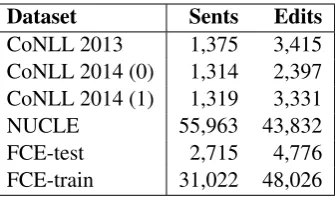
Table 3: Basic statistics of the datasets we use. CoNLL 2014 was annotated by two annotators who changed different sentence boundaries.
Alignment Lev Lev DL
Reference Gold Gold-Min Gold-Min
CoNLL 2013 49.17 62.29 70.51
CoNLL 2014 (0) 51.09 60.40 66.81
CoNLL 2014 (1) 48.41 62.98 69.16
[image:5.595.264.527.62.146.2]FCE-test 58.52 63.30 72.45
Table 4: Table showing how minimised edits in the refer-ence (Gold-Min) and our linguistically enriched Damerau-Levenshtein algorithm (DL) perform against standard Lev-enshtein (Lev) and unmodified references (Gold). All scores are F1.
speech (POS) tag and lemmatise each sentence. The basic statistics of each processed dataset are shown in Table 3.
3.4 Alignment Experiments
To establish a baseline, we simply compared a standard Levenshtein alignment against the human align-ments of the CoNLL 2013, CoNLL 2014 (each annotator individually) and FCE test sets (Table 4). The results show that Levenshtein alone does not perform particularly well at this task and is only able to achieve F1scores of about 50%.
In addition to improving alignment quality, another aim of our work is to attempt to standardise edit annotation. As mentioned previously, human annotations sometimes include tokens that do not change; e.g. [has eating→ was eating]. Automatic alignments will never match these human edits, however, because any token that is common to both sides will be considered a match and hence not part of an edit. This is undesirable, so we also minimised the gold human reference edits by recursively removing tokens that were common to both sides of the edit from the right and left hand sides. This also removes edits that annotators detected, but were unable to correct. Results showing the effect of this minimisation, as well as of comparing Levenshtein against our linguistically enhanced Damerau-Levenshtein approach, are also shown in Table 4.
The first thing to notice about these results is that the scores for the minimised gold reference are typically substantially higher than for the unmodified gold reference. In the case of CoNLL 2014 (1), using the minimised gold reference even shows an improvement of almost 15% F1. While the increase in score is less pronounced for FCE-test, at just under 5% F1, this nevertheless demonstrates the high degree of variability in the way GEC data is annotated and that it is highly desirable to standardise annotations. In light of this result, we only use minimised edit spans in all subsequent experiments.
Comparing Levenshtein against our own approach, we again see a significant improvement, with scores greater than 70% F1 on some datasets. This is significant, because these results are in spite of the fact that we fail to match all multi-token edits given that we do not yet merge any alignments.
4 Alignment Merging
The output of the automatic alignment is a list of individual token-level operations that map the original sentence to the corrected sentence in terms of insertions, deletions, substitutions and transpositions. An example of this is shown in Table 5. Each of these operations involves one token at most in either sentence, except in the case of transpositions, which involve 2 or more tokens in both sentences.
In most cases, these individual operations already represent a complete error: [propaganda→ pub-licity] is a word choice error, [benefits only→ only benefits] is a word order error and [companys → companies] is a noun inflection error. Other errors, however, may involve more than one single op-eration. For example, the correction [wide spread → widespread] in Table 5 involves two individual operations: a substitution ([wide→widespread]) and a deletion ([spread→Ø]).
M S D S T D S S M This wide spread propaganda benefits only to the companys . This widespread publicity only benefits their companies .
Table 5: Individual operations obtained from automatic alignment: (M)atch, (I)nsertion, (D)eletion, (S)ubstitution and (T)ransposition.
Orig:Corr Token NUCLE FCE-train
Edit Size Cum. Freq. % Cum. Freq. %
1:1 17,580 41.23% 23,833 51.51%
0:1 24,823 58.22% 32,875 71.06%
1:0 30,599 71.77% 37,743 81.58%
0–2:0–2 36,868 86.47% 43,593 94.22%
0–3+:0–3+ 42,636 100.00% 46,265 100.00%
Table 6: Distribution of edits in minimised gold NUCLE and FCE-train according to the number of tokens on either side of the edit; e.g. there are 17,580 instances of 1:1 token substitutions in NUCLE. Total edits are lower than in Table 3 because edit minimisation causes some edits to disappear.
on either side of an edit (i.e. 0:1, 1:0 or 1:1), and so a simpleall-split strategy that merges nothing is likely to cover most of these edits. In fact this explains why the results in Table 4 are so high; just using Damerau-Levenshtein is equivalent to theall-splitsetting. Nevertheless, multi-token edits still form an important class of learner errors and so we should attempt to handle them.
4.1 Merging Rules
In order to improve performance and capture multi-token edits, we hence implemented a recursive rule-based merging function. First, we analysed the relationship between human annotations and how they mapped to alignment operations in NUCLE and FCE-train. For example, we found that the most common multi-token errors involved phrasal verbs, such as [look at→watch]; possessive nouns, such as [friends →friend ’s]; or orthographic changes, such as [wide spread→widespread]. Second, we wrote rules to merge or separate alignments based on these observed patterns.
The complete list of rules and their priority is as follows:
1. Any match operation (M) breaks a sequence into sub-sequences that are processed individually, e.g. MDDSMMTMSI is split into DDS, T and SI.
2. Any operation that involves punctuation and is followed by a token that changes case is merged, e.g. [,→.] + [we→We] becomes [, we→. We].
3. Transpositions are returned as individual edits, e.g. [only can→can only].
4. Any operation that involves a possessive suffix is merged with any previous operations, e.g. [freinds →friend] + [Ø→’s] becomes [freinds→friend ’s].
5. Operations that add or remove whitespace between tokens are merged, even if they have unmatched apostrophes, e.g. [sub→subway] + [way→Ø] = [sub way→subway].
6. Substitutions between very similar tokens (> 70% character matches) are returned as individual edits, e.g. [writting→ writing], unless they have the same POS as the previous token, e.g. [eated →have eaten]; the verb phrase would be split without this exception.
7. Substitutions preceded by another substitution are returned as individual edits.
8. Any combination of operations that involves at least one content word is merged, e.g. [On→In] + [the→Ø] + [other→Ø] + [hand→addition] = [On the other hand→In addition].
9. Consecutive operations that involve tokens with the same part of speech are merged, e.g. [because →Ø] + [of →for] = [because of →for].
Original This wide spread propaganda benefits only to the companys .
Correction This widespread publicity only benefits their companies .
Operation M S D S T D S S M
Rule 1 wide spread propaganda benefits only to the companys
widespread publicity only benefits their companies
Rule 5 wide spread propaganda benefits only to the companys
widespread publicity only benefits their companies
Rule 3 propaganda benefits only to the companys
publicity only benefits their companies
Remainder propaganda to the companys
publicity their companies
Rule 6 to the companys
their companies
Rule 10 to the
their
[image:7.595.81.515.61.310.2]Remainder to
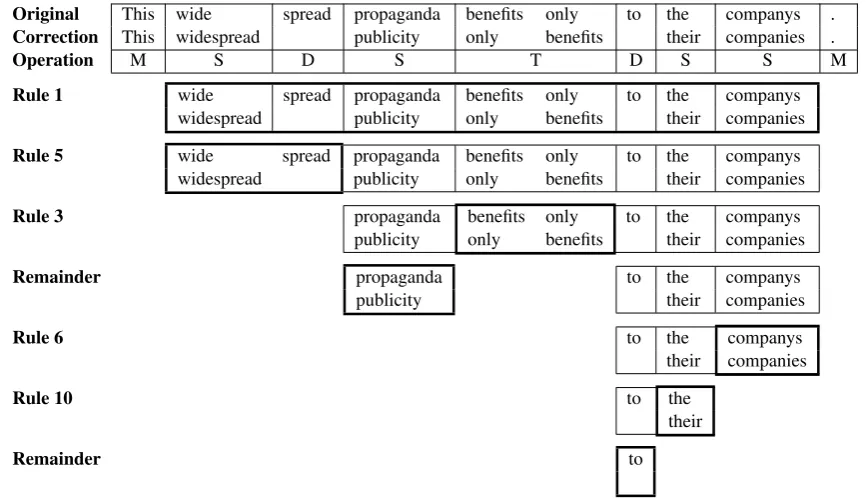
Figure 1: A step-by-step edit extraction example.
Each sequence of alignment operations between two sentences (e.g. MSDSTDSSM) is processed recursively using the above rules in a top-down fashion. Rules are applied in order, with priority relative to their position in the list. Every time an edit is returned by one of the rules, we process the remaining sub-sequences individually until they are exhausted or no more rules can be applied (see Figure 1). It should be noted that rules that iteratively grow the merge range of the alignment (e.g. #8) can be overridden by others with higher priority (e.g. #4), causing the remaining operations in the truncated subsequence to be reprocessed from scratch.
4.2 Merging Experiments
We evaluated our rule-based merging method on the CoNLL 2013, CoNLL 2014 (each annotator indi-vidually) and FCE test sets, and contrasted it against the following merging strategies:
all-split: All consecutive non-matches are split, e.g. DDSI→D, D, S, I.
all-merge: All consecutive non-matches are merged, e.g. DDSI→DDSI.
all-equal: All consecutive non-matches of the same operation are merged, e.g. DDSI→DD, S, I. All of these methods were applied to the output of our enhanced Damerau-Levenshtein alignment described in the previous section. In addition to evaluating edit extraction against a minimised reference, we also evaluate error type classification on the merged output to replicate results for an end-to-end classification system. For this purpose, we retrained Xue and Hwa’s publicly available implementation of their MaxEnt error type classifier2separately on NUCLE and FCE-train. This classifier was based on
work by Swanson and Yamangil and is used in all classification experiments.
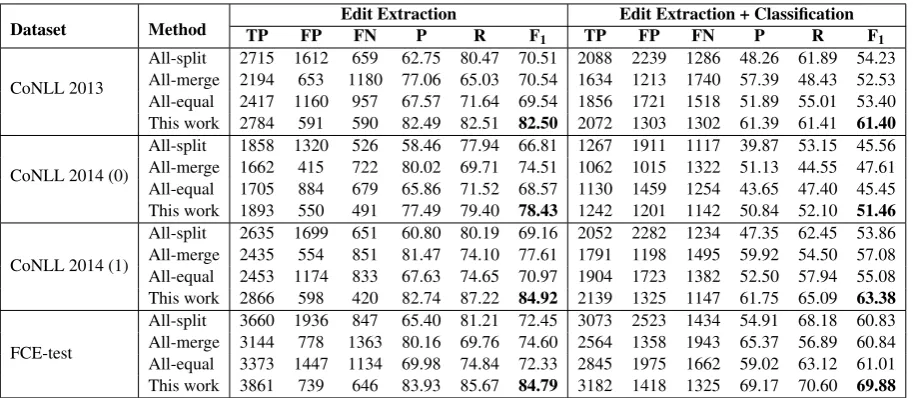
Results for both tasks are reported in Table 7 and reveal that our method achieves the best performance on all tasks and datasets. For edit extraction (i.e. merging), improvements in F1 range between 4% and 12% over the second-best method (all-merge). We also observe that while all-split tends to have the highest number of TPs and lowest number of FNs, it also has the highest number of FPs, which shows how ignoring multi-token edits affects performance. In contrast, the all-mergestrategy has the lowest number of FPs, but at the cost of also having the lowest number of TPs and highest number of FNs. This shows that each strategy has different strengths which our rule-based approach attempts to exploit.
Dataset Method TP FP Edit ExtractionFN P R F1 TP Edit Extraction + ClassificationFP FN P R F1
CoNLL 2013
All-split 2715 1612 659 62.75 80.47 70.51 2088 2239 1286 48.26 61.89 54.23 All-merge 2194 653 1180 77.06 65.03 70.54 1634 1213 1740 57.39 48.43 52.53 All-equal 2417 1160 957 67.57 71.64 69.54 1856 1721 1518 51.89 55.01 53.40 This work 2784 591 590 82.49 82.51 82.50 2072 1303 1302 61.39 61.41 61.40
CoNLL 2014 (0)
All-split 1858 1320 526 58.46 77.94 66.81 1267 1911 1117 39.87 53.15 45.56 All-merge 1662 415 722 80.02 69.71 74.51 1062 1015 1322 51.13 44.55 47.61 All-equal 1705 884 679 65.86 71.52 68.57 1130 1459 1254 43.65 47.40 45.45 This work 1893 550 491 77.49 79.40 78.43 1242 1201 1142 50.84 52.10 51.46
CoNLL 2014 (1)
All-split 2635 1699 651 60.80 80.19 69.16 2052 2282 1234 47.35 62.45 53.86 All-merge 2435 554 851 81.47 74.10 77.61 1791 1198 1495 59.92 54.50 57.08 All-equal 2453 1174 833 67.63 74.65 70.97 1904 1723 1382 52.50 57.94 55.08 This work 2866 598 420 82.74 87.22 84.92 2139 1325 1147 61.75 65.09 63.38
FCE-test
[image:8.595.72.529.61.260.2]All-split 3660 1936 847 65.40 81.21 72.45 3073 2523 1434 54.91 68.18 60.83 All-merge 3144 778 1363 80.16 69.76 74.60 2564 1358 1943 65.37 56.89 60.84 All-equal 3373 1447 1134 69.98 74.84 72.33 2845 1975 1662 59.02 63.12 61.01 This work 3861 739 646 83.93 85.67 84.79 3182 1418 1325 69.17 70.60 69.88 Table 7: Performance of different merging methods on the edit extraction and full error classification task. TP: true positives, FP: false positives, FN: false negatives, P: precision, R: recall.
Table 7 also reports performance on error classification, given edit extraction, revealing how each merging strategy affects automatic error type prediction. Results are consistent with edit extraction, although they are (expectedly) lower by an average 21.1% F1. Improvements in F1 between our method and the second-best range between 3.9% and 9.0%. While CoNLL 2014 (1) achieved the best result for edit extraction, FCE-test achieved the best result for error classification. This might be because the two datasets are annotated according to different error classification frameworks and the FCE annotation is more consistent than NUCLE annotations.
5 Discussion
It is worth stating that many of our reported results are actually an underestimate of true performance. This is because, despite gold reference minimisation, there is a high degree of variability in the way humans annotate this sort of data. For instance, as shown by Bryant and Ng (2015), human annotators often have very different perceptions of grammaticality and it is linguistically plausible that, for example, [has eaten→was eating] is annotated either as one edit (as above) or two edits ([has→was] + [eaten → eating]) by different, or even the same, annotators. This means theall-split merging strategy will never match the former while theall-mergemerging strategy will never match the latter, even though the annotations fundamentally equate to the same thing. Due to this inconsistency, system performance will be underestimated regardless of which merge strategy you choose.
In contrast, we consider merge consistency a strength of our rule-based approach. Even if our align-ment does not agree with the gold standard in some cases, at least the decision to merge or split is con-sistent across all similar cases. Our approach could hence be used to standardise ambiguous annotations where splits or merges are equally plausible.
Another strength of a rule-based approach is that it is easier to diagnose which rules are responsible for producing a given output sequence. This is in contrast with machine learning techniques, which additionally require feature engineering and retraining, where it is much more difficult to determine why certain edits were merged in a certain way. Nevertheless, considering only about 30% of all edits (at most) in any dataset require merging anyway, a rule-based approach seemed a more cost-effective solution.
Dataset Method Single-token editsP R F Multi-token edits
1 P R F1
CoNLL 2013 S&YX&H 95.67 65.73 77.92 16.62 40.62 23.5990.34 73.13 80.82 24.53 48.75 32.64 This work 88.76 87.80 88.28 51.00 31.87 39.23
CoNLL 2014 (0) S&YX&H 95.79 68.59 79.94 24.11 51.5289.44 74.88 81.52 25.70 41.67 31.7932.85 This work 83.27 85.96 84.60 34.57 21.21 26.29
CoNLL 2014 (1) S&YX&H 94.11 73.95 82.82 31.56 53.81 39.7990.71 80.87 85.51 38.06 52.38 44.09 This work 86.32 93.64 89.83 71.43 40.48 51.67
[image:9.595.117.484.61.253.2]FCE-test S&YX&H 95.19 69.76 80.51 30.19 52.08 38.2282.98 83.90 83.44 66.27 52.72 58.72 This work 88.35 91.00 89.65 74.06 50.16 59.81
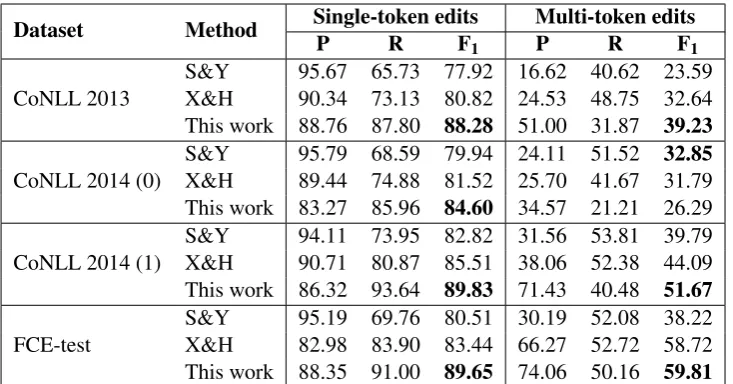
Table 8: Performance of our proposal vs. previous methods in terms of single and multi-token edits. S&Y used Levenshtein with anall-mergestrategy while X&H used Levenshtein with a MaxEnt merging classifier.
others in the single-token setting, it makes up for this with a much higher recall. In contrast, our method achieves a higher precision in the multi-token setting, but at the cost of a lower recall. Ultimately, however, our method increases overall performance in almost all cases, the exception being multi-token edits in CoNLL 2014 (0), which is known to be an inconsistent dataset. These results hence confirm that our rule-based merging strategy is superior to previous approaches.
In addition to a quantitative analysis, we also carried out an informal qualitative analysis of the errors made by our system. One source of errors involves tokens that are affected by more than one mistake; e.g. [wide spraed→widespread]. While our system includes a rule to merge adjacent alignments where the only difference is white space, this rule does not activate in the above case since one of the tokens also contains a misspelling. This consequently means the alignments are not merged and do not match the gold standard; such cases are difficult to handle.
Another issue is that reference minimisation is unable to deal with edits where identical tokens occur in the middle of an edit; e.g. [can easily been→ could easily be]. As an automatic alignment will always consider easily a matched token, the remaining non-matches will become isolated and hence never merged. In this case, however, we would argue that our automatic alignment is more informative than the human alignment which needlessly includes a redundant token in the edit.
Finally, we provide a comparison between our method and the previous approaches by Swanson and Yamangil (S&Y) and Xue and Hwa (X&H) (Table 9). Our method achieves state-of-the-art performance on all tasks and datasets, with an average improvement over X&H of 6.0% F1 for edit extraction and 4.1% F1when adding error classification.
6 Conclusion
We have presented a new method for extracting edits from a parallel original and corrected sentence pair based on a linguistically enhanced token alignment and rule-based merging component. Results on a number of GEC test sets show that our method outperforms all previous work on edit extraction and can also boost error classification performance.
Dataset Method Extraction FEdit Edit Extraction +
1 Classification F1
CoNLL 2013 S&YX&H 70.4274.07 52.8555.89
This work 82.50 61.40
CoNLL 2014 (0) S&YX&H 72.9274.25 46.9549.15
This work 78.43 51.46
CoNLL 2014 (1) S&YX&H 76.3979.21 56.1859.24
This work 84.92 63.38
FCE-test S&YX&H 73.5979.18 59.8065.33
[image:10.595.127.469.61.255.2]This work 84.79 69.88
Table 9: Performance of our proposal vs. previous methods in an end-to-end edit extraction and classifi-cation task.
References
Christopher Bryant and Mariano Felice. 2016. Issues in preprocessing current datasets for grammatical error correction. Technical Report UCAM-CL-TR-894, University of Cambridge, Computer Laboratory, September.
Christopher Bryant and Hwee Tou Ng. 2015. How far are we from fully automatic high quality grammatical error correction? InProceedings of the 53rd Annual Meeting of the Association for Computational Linguistics and the 7th International Joint Conference on Natural Language Processing (Volume 1: Long Papers), pages 697–707, Beijing, China, July. Association for Computational Linguistics.
Daniel Dahlmeier and Hwee Tou Ng. 2012. Better evaluation for grammatical error correction. InProceedings of
the 2012 Conference of the North American Chapter of the Association for Computational Linguistics: Human Language Technologies, pages 568–572, Montr´eal, Canada, June. Association for Computational Linguistics.
Daniel Dahlmeier, Hwee Tou Ng, and Siew Mei Wu. 2013. Building a large annotated corpus of learner
en-glish: The NUS corpus of learner english. InProceedings of the Eighth Workshop on Innovative Use of NLP
for Building Educational Applications, pages 22–31, Atlanta, Georgia, June. Association for Computational Linguistics.
Tomoya Mizumoto, Mamoru Komachi, Masaaki Nagata, and Yuji Matsumoto. 2011. Mining revision log of
language learning sns for automated japanese error correction of second language learners. InProceedings
of 5th International Joint Conference on Natural Language Processing, pages 147–155. Asian Federation of Natural Language Processing.
Hwee Tou Ng, Siew Mei Wu, Yuanbin Wu, Christian Hadiwinoto, and Joel R. Tetreault. 2013. The CoNLL-2013
shared task on grammatical error correction. InProceedings of the Seventeenth Conference on Computational
Natural Language Learning: Shared Task, pages 1–12, Sofia, Bulgaria. ACL.
Hwee Tou Ng, Siew Mei Wu, Ted Briscoe, Christian Hadiwinoto, Raymond Hendy Susanto, and Christopher
Bryant. 2014. The CoNLL-2014 shared task on grammatical error correction. InProceedings of the Eighteenth
Conference on Computational Natural Language Learning: Shared Task, pages 1–14, Baltimore, Maryland, USA. ACL.
Diane Nicholls. 2003. The cambridge learner corpus: Error coding and analysis for lexicography and ELT. In Proceedings of the Corpus Linguistics 2003 conference, pages 572–581.
Franz Josef Och and Hermann Ney. 2003. A systematic comparison of various statistical alignment models. Computational Linguistics, 29(1):19–51.
Keisuke Sakaguchi, Courtney Napoles, Matt Post, and Joel Tetreault. 2016. Reassessing the goals of
grammat-ical error correction: Fluency instead of grammatgrammat-icality. Transactions of the Association for Computational
Ben Swanson and Elif Yamangil. 2012. Correction detection and error type selection as an ESL educational
aid. InProceedings of the 2012 Conference of the North American Chapter of the Association for
Computa-tional Linguistics: Human Language Technologies, pages 357–361, Montr´eal, Canada, June. Association for Computational Linguistics.
Huichao Xue and Rebecca Hwa. 2014. Improved correction detection in revised esl sentences. InProceedings
of the 52nd Annual Meeting of the Association for Computational Linguistics (Volume 2: Short Papers), pages 599–604, Baltimore, Maryland, June. Association for Computational Linguistics.
Helen Yannakoudakis, Ted Briscoe, and Ben Medlock. 2011. A new dataset and method for automatically
grad-ing esol texts. InProceedings of the 49th Annual Meeting of the Association for Computational Linguistics: