Data-Driven Morphological Analysis and Disambiguation for
Morphologically Rich Languages and Universal Dependencies
Amir More
IDC Herzliya [email protected]
Reut Tsarfaty
Open University of Israel [email protected]
Abstract
Parsing texts intouniversal dependencies (UD)in realistic scenarios requires infrastructure for morphological analysis and disambiguation (MA&D)of typologically different languages as a first tier. MA&D is particularly challenging inmorphologically rich languages (MRLs), where the ambiguous space-delimited tokens ought to be disambiguated with respect to their constituent morphemes. Here we present a novel, language-agnostic, framework for MA&D, based on a transition system with two variants, word-based and morpheme-based, and a dedicated transition to mitigate the biases of variable-length morpheme sequences. Our experiments on a Modern Hebrew case study outperform the state of the art, and we show that the morpheme-based MD consistently outperforms our word-based variant. We further illustrate the utility and multilingual coverage of our framework by morphologically analyzing and disambiguating the large set of languages in the UD treebanks.
1 Problem Statement
A decade following the emergence of statistical parsers for English (Charniak, 1996; Bod, 1995), the CoNLL data sets presented a new challenge: the development of data-driven statistical parsers that can be trained to parse any language given an appropriately annotated treebank (Buchholz and Marsi, 2006; Nivre et al., 2007). These data sets facilitated the development of accurate, language-agnostic, depen-dency parsers (Nivre et al. (2006), McDonald (2006) etc.), but not without shortcomings: they require that input tokens bemorphologically analyzed and disambiguatedin advance.
This latter assumption breaks down in realistic parsing scenarios where the morphological analysis of an input token may consist of multiple syntactic words to participate in the parse tree (Tsarfaty et al., 2010). Theuniversal dependencies (UD)initiative aims to remedy this by presenting a harmonized set of treebanks, now 54 and counting, with a unified annotation scheme and multilayered annotation. Specifically, UD data distinguishes the input space-delimited tokens from the (morpho)syntactic words that participate in the parse tree (Nivre et al., 2016).
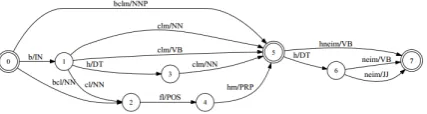
Efforts towards parsing texts intouniversal dependenciesin realistic scenarios thus require language-agnostic infrastructure for automaticmorphological analysis and disambiguation (MA&D)of data from typologically different languages. MA&D is particularly challenging inmorphologically rich languages (MRLs), where space-delimited input tokens may have multiple analyses, only one relevant in context. Thismorphological ambiguityof a token is typically represented as a lattice. The termMorphological Disambiguation(MD) refers to selecting a single path through themorphological analysis(MA) lattice. In Semitic languages, MD is particularly challenging (Adler, 2007; Bar-haim et al., 2008; Shacham and Wintner, 2007; Pasha et al., 2014; Habash and Rambow, 2005). To illustrate, Figure 1 shows the MA lattice of the Hebrew phrase ‘bclm hneim’1(literally: in-shadow-of-them the-pleasant, meaning: in their pleasant shadow). Different paths in the lattice represent different disambiguation decisions. In This work is licenced under a Creative Commons Attribution 4.0 International License. License details: http:// creativecommons.org/licenses/by/4.0/
1We transliterate as in Sima’an et al. (2001).
Figure 1: An example of an MA lattice of the phrase “bclm hneim” (“in their pleasant shadow”) in transliterated Hebrew. Edges mark syntactic words, and double circles mark white spaces.
the context of ‘bclm hneim’, the correct path of ‘bclm’ is ‘b-cl-(fl)-hm’, “in-shadow-(of)-them”. In the context of another sentence, the token ‘bclm’ may be “Betzelem”, the name of a famous organization.
In MRLs, MD is also more subtle than simply segmenting the space-delimited tokens. Many MRLs are fusional, and clitics may be fused into hosts. In Figure 1, in the phrase ‘b-cl-(fl)-hm’ (literally: in-shadow-(of)-them), the possessive ‘fl’ (of) is fused into the pronoun ‘hm’ (them) and remains implicit in the surface form. Such fusion results in an ambiguous number of morphosyntactic nodes that participate in the analysis, impacting downstream applications as syntactic and semantic parsing, translation, etc.
Previous work on MA&D in MRLs, and in Semitic languages in particular (Adler, 2007; Bar-Haim et al., 2005; Shacham and Wintner, 2007; Pasha et al., 2014), relied on language-specific lexica and cannot be executed cross-linguistically. General CRF implementations, such as MarMoT (M¨uller et al., 2013), that can be applied across languages, assume an unrealistic, gold pre-segmented setting (Bjorkelund et al., 2013). For generic morphological segmentation, Morfessor (Smit et al., 2014) uses a max-likelihood in semi-supervised settings, but it cannot handle the rich labeling of morphological segments.
In this paper we present a general, language-agnostic solution the for the MA&D task. We targetjoint morphological segmentation and tagging, as has been advocated in monolingual cases (Zhang and Clark, 2011; Bar-haim et al., 2008; Adler and Elhadad, 2006; Habash and Rambow, 2005), inuniversalsettings. Our technical approach extends the transition-based framework for structured prediction of Zhang and Clark (2011). We define and implement two MD variants: word-based and morpheme-based. We present the best MA&D results to date, and demonstrate that the morpheme-based variant consistently outper-forms our word-based one, while providing state-of-the-art results on full-fledge, fine-grained, MD of Hebrew. Furthermore, our MA&D framework is intentionally designed with language independence in mind. Devoid of requiring language-specific resources, we show robust and competitive MA&D perfor-mance on MRLs and non-MRLs alike, for circa 50 languages in the most recent release of UD treebanks (Nivre et al., 2016).
2 Challenges and Formal Settings
We propose a data-driven framework for MA&D of MRLs and non-MRLs alike. The MA component im-plements a function that maps each input sentence to its MA lattice, and the MD component imim-plements a transition-based model that accepts the lattice as input and returns a selected path as output.
Formally, our transition system is a quadrupleS = (C, T, cs, Ct), whereCis a set of configurations, T is a set of transitions,csis an initialization function, andCt ⊆C is a set of terminal configurations.
A transition sequence y of length n, y = c0, t1(c0), ..., tn(cn−1), starts with an initial configuration c0 =cs(x)for the input sentencexand ends with a terminal configurationcn ∈Ct, whereti ∈T and cn=tn(cn−1)∈Ct. We employ an objective functionF wherexis the input sentence andGEN(x)is
the set of possible transition sequences forx:
F(x) =argmaxy∈GEN(x)Score(y) (1)
To compute Score(y), y ∈ GEN(x) is mapped to a global feature vector Φ(y) ∈ Nd, where each
feature is a count of occurrences of a pattern defined by a feature functionφ. The feature vectorΦ(y)is defined via a set ofdfeature functions{φi}di=1. The wayΦis defined effectively determines the quality
weights. Given this vector,Score(y)is computed by multiplyingΦ(y)with a weights vector~ω∈Rd.
Score(y) = Φ(y)·~ω= X
cj∈y
d
X
i=1
ωiφi(cj) (2)
Following Zhang and Clark (2011), our system learns the weights vector~ω ∈Rdvia the generalized
perceptron, using the early-update averaged variant of Collins and Roark (2004). The algorithm iterates through a gold-annotated corpus, each sentence is disambiguated (decoded) with the last known weights, and if the decoded result differs from the gold standard, the weights are updated. As in Zhang and Clark (2011), decoding is based on the beam search algorithm, where a number of possible parse sequences are evaluated concurrently to mitigate irrecoverable prediction errors. At each step, the transition system applies all valid applicable transitions to all candidates. TheBhighest scoring expanded candidates are maintained and passed on to the next step. Those that don’t make theBmark, fall off the beam.
Our MRL setting (cf. Tsarfaty et al. (2010)) poses three technical challenges to this general scheme: (i) the formal challenge:how should we define a transition system for MA&D?
(ii) the learning challenge: how can we define feature functions that learn morphological phenomena? (iii) the decoding challenge: how can we effectively compare morpheme sequences of variable length?
3 Our Proposed Solution
Letx =x1...xkbe an input sentence ofktokens andL =MA(x1), ..., MA(xk)be the morphological
ambiguity lattice forx, whereLis a contiguous series of word-latticesLi =MA(xi)connected top to
bottom, as illustrated in Figure 1. Each word lattice Li is a set of sequences of morphemes, and each
sequence is a single disambiguated analysis forxi. We define themorphosyntactic representation(MSR)
of an arc in the lattice as a tuplem = (s, e, f, t, g)with lattice nodessandemarking the start and end of a morpheme, a formf, a part-of-speech tagt, and a setgof attribute:value grammatical properties. Defining Configurations. A configuration for the MD transition system is a quadruple (L, n, i, M)
whereL=MA(x)is the sentence-lattice,nis a node inL,iis the0-based index of a word-lattice inL, andMis a set of disambiguated morphemes (i.e., selected arcs). The terminal configuration is defined to beCt = {(L, top(L), tokens(L), M)}for anyL, M, wheretokens(L)is the number of word-lattices
that formL. The initial configuration functioncsconcatenates theLilattices of the tokens into a single
structureL=MA(x1) +...+MA(xk), and setsn=bottom(L),i= 0andM =∅.
Defining Transitions. There are two conceivable ways to make morphological disambiguation deci-sions, in aword-based(WB), and in amorpheme-based(MB), fashion, in the terminology of Tsarfaty and Goldberg (2008). In WB models (a.k.atoken-levelin the UD terminology), the disambiguation de-cision determines a complete path of morphemes between token-boundaries. In the lattice, this refers to selecting a path between two token-boundary nodes (double circles). MB disambiguation decisions (also termedlexical-level, orword-levelin UD) occur at any node in the lattice indicating a morpheme boundary, with more than one outgoing arc, choosing a specific arcmamong them.
Interim: Word-Based or Morpheme-Based? WB and MB strategies face contradicting, and comple-mentary, challenges. In WB models, disambiguation decisions are complex, and learning how to score them is expected to suffer from data sparseness. MB models, on the other hand, over-generalize in terms of possible morphological combinations, and learning to score combinations may fail to generalize and be prone to over-fitting. On top of that, morpheme sequences are longer than word sequences, which, in a transition-based system, is known to be more error prone. Finally, variable-length sequences introduce length biases which negatively impact performance. Since MA&D is the base for the NLP pipeline, it is critical to settle this debate empirically and establish the basis for downstream tasks.
items. To satisfy these desiderata, we define adelexicalization projectionfor a pre-defined set of parts-of-speech tagsO capturing open-class categories. Simply put, this projection neutralizes the lattice-nodes specific indices, and, for any tagt∈O, it further neutralizes the lexical form. Formally:
DLEXO(m) =
(
( , , , t, g) ift∈O
( , , f, t, g) otherwise (3)
3.1 Word-Based Modeling
The Transition System For word-based (WB) modeling, a single transition morphologically disam-biguates whole word-lattices such that the node nof a configuration is always at a word boundary (a node that is a bottom, top, or both, of word-lattices ofL). We define the transitions in the WB system as an open set of transitions termedMDs, specifying the parametersas a single path:
MDs: (L, n, i, M)→(L, q, i+ 1, M ∪ {m0, .., mj}) (4)
Here,{m0, ..., mj} ∈Lform a contiguous path of arcs, wherem0 starts at noden,mj ends at nodeq
(they can be the same arc), andsis the projected pathss=DLEXO(m0), ..., DLEXO(mj). A terminal
configuration will therefore contain the union of contiguous paths of word-lattices inL, together forming a complete morphological disambiguation of the ambiguous tokens of the input sentence.
Learning We define three types of word-lattice properties: o- the surface form of the token itself, a
- theDLEX-projected lattice (all MSRs projected by the delexicalization function), and p- a chosen disambiguated path, which only exists for previously processed lattices. Using these properties, we define baseline feature templates modeled after POS tagging: unigram, bigram, and trigram combinations ofoanda, andp-based features, which predict the next disambiguation decision based on the previous one(s).
3.2 Morpheme-Based Modeling
The Transition System For morpheme-based (MB) modeling, a single transition chooses an outgoing arc of the current nodenin the lattice, requiring a disambiguation decision if (and only if) there is more than one outgoing arc. Again we define the transitions as an open set of transitions termedMDs, now
specifyingsas a singlearc:
MDs: (L, n, i, M)→(L, q, j, M ∪ {m}) (5)
Here,mis a morpheme(n, q, f, t, g)∈L, ands=DLEXO(m). If nodeqis at a word boundary, then j = i+ 1, otherwisej = i. For a terminal configuration, eachm ∈ M is an outgoing arc of the end node of another arc inM (with the exception of the first morpheme, starting atbottom(L)) forming a contiguous path that disambiguatesx.
Learning In the MB model we can access specific information concerning the current node inside the word-lattice. We define the properties f, tandg, corresponding to arcs’ form, part-of-speech and morphological attribute:value pairs. We use these properties in various unigram, bigram, and trigram combinations, in parallel with the WB model. As in the WB model we also define the propertypas the path in the previously disambiguated word-lattices. We define the propertynto be the set ofDLEX -projected outgoing morphemes of the current node (this parallels the property aof WB models, but at morpheme granularity). Similarly to the WB case, we use unigram, bigram, and trigram combinations of these properties as well.
Decoding Since the number of arcs in lattices’ paths forxmay vary, so do the number of transitions in our morpheme-based transition system. This violates a basic assumption of standard beam search decoding — that the number of transitions is a deterministic function of the input.
sequence may temporarily be the best candidate and fulfill the goal, while longer (and possibly correct) sequences are incomplete and may be lost. On the other hand, long sequences have more features, therefore their score may be arbitrarily inflated. So the score may be higher for longer paths, even though a shorter one may be correct and may fall off the beam.
To address these challenges we introduce a special transition we callENDTOKEN (ET), that explicitly incrementsi, instead of implicitly inMDs. So, in equation (4) we setj=iand apply:
ET: (L, n, i, M)→(L, n, i+ 1, M) (6)
ET is required to occur exactly once at the end of the word-lattice, whennis the top of some word-lattice inL. Set aside from other transitions, ET has its own set of features. Other than incrementing
i, ET has no effect on configurations, but it does cause a re-ordering of candidates in the beam during decoding, at each token boundary. Note that ET kicks in only for variable length lattices. On same-length lattices, ET is skipped and equation (4) remains as is — the process essentially falls back on the standard, same-length decoding.
An MD transition sequence thus becomes the union of disjoint sets of configurationsy =ymd∪yet,
and changesScorein Equation (2), where|yet|is the # of tokens inLwith variable length paths. : d
While the number of morphemes, and therefore |ymd|, can vary, |yet| is deterministic per lattice.
Using this anchor, the features of the ET transition provide a counter-balance to the effects of varied-length sequences by scoring fully disambiguated paths of each word-lattice individually, occuring a fixed amount of times for all paths.
ENDTOKEN vs. IDLE transitions Variable-length sequences in beam search also exist in the struc-tured prediction of constituency trees. Zhu et al. (2013) introduced an IDLE transition (also adopted in Honnibal and Johnson (2014) and Zhang et al. (2014)) that, like ET, has no effect on configuration, but unlike ET, occurs only at the end of the parsing sequence, an arbitrary number of times, until all parsing sequences are complete.
While IDLE transitions make sense when applied after a complete hierarchical structure is predicted — where they may learn to rerank candidates based on features that are visible at the top of the structure (the root) — it is futile to use last-seen features that arbitrarily exist at the end of a morphological disambiguation (linear) sequence, to rerank candidates again and again. This is because at the end of the sequence, we can no longer save candidates that were lost earlier on due to length discrepancies .
To mitigate this, one might try to create IDLE padding with global features spanning the entire disam-biguated path. Even then, the learned model parameters would not generalize well, since these features will be applied an arbitrary number of times — the maximal length of an occasional word lattice we are at — which has no linguistic significance, and may arbitrarily inflate certain scores.
ET transitions, in contrast, occur right when they are needed — at the boundary of a word-lattice. This position enables the reordering of candidates right after a length discrepancy may have been introduced. Moreover, ET scores are counted against the global score a fixed number of times per lattice, for all, any length, candidates. This enables a fair comparison of all paths per lattice.
4 Empirical Evaluation
We empirically evaluate the proposed models, and investigate their strengths, weaknesses, and bounds. We start with a detailed investigation of MA&D in the Semitic language Modern Hebrew, which is known for its rich morphology and significant ambiguity. We then verify the cross-linguistic coverage of the models on the set of UD treebanks (Nivre et al., 2016), to validate their efficacy.
(a)
Word-Based
unigram +bigram +trigram +next unigram +next with bigram 85.73 (86.72) 86.9 (87.88) 86.7 (87.66) 92.19 (92.76) 91.98 (92.59) +ET 89.09 (89.81) 89.93 (90.71) 90 (90.85) 93.39 (93.94) 92.84 (93.46)
(b)
Morpheme-Based
unigram +bigram +trigram +next unigram +next with bigram 90.67 (91.41) 91.12 (91.88) 90.09 (91.82) 93.56 (94.16) 93.89 (94.49)
+ET 92.68 (93.36) 92.74 (93.55) 92.64 (93.47) 94.27 (94.92) 94.33 (94.9)
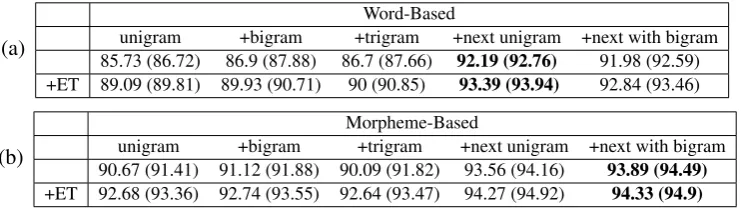
Table 1: Dev. set results for Word-Based (a) and Morpheme-based (b) MD:F1for full morphological
disambiguation (form, part of speech, morphological properties). (n parenthesis:F1for form and POS only. The +ET lines indicate a variant that employs the ENDTOKEN transition at token boundaries.
We report theF1metric comparing the MSRs ofpredictedvs.goldlattice arcs, for full morphological disambiguation (segmentation, POS tags, and all morphological properties), and for segmentation and POS tags only. For comparison with previous work, we also report token-level accuracy (whileF1awards
partial success on word-lattices, token-level accuracy requires exact match on a whole path per token).
4.1 The Case for Modern Hebrew
Setup We evaluate MA&D performance on the Modern Hebrew section of the SPMRL 2014 Shared Task (Seddah et al., 2014), which has been derived from the Unified-SD treebank of Tsarfaty (2013). We updated the treebank to provide consistent theories for the treebank annotation and lexicographic resources (Itai and Wintner, 2008), a consistency that we found lacking in the SPMRL 2014 Hebrew section. We use the standard split, and train on the standard train set (5k sentences). Here we provide results and in-depth analysis ondevand confirm our findings ontest.
A pre-condition for the execution of our MD models is anMA(x)function that generates word-lattices forx(§2). We start off with a morphological analyzer that we implemented, called HEBLEX, which re-lies on the Ben-Gurion Hebrew Lexicon used by Adler and Elhadad (2006). The lexicon contains full analyses for 567,483 words and 102 prefixes. HEBLEX uses the lexicon to determine the various combi-nations of prefixes and words that form valid tokens. This process is far from trivial due to morphological fusion, as some morphemes are implicit (§1).
Although the lexicon is quite large, there are still tokens which areout-of-vocabulary (OOV). OOV tokens may be of two types: it may be that an entire string is out of the lexicon (mostly proper nouns) or that the affixes and the open class items are seen, but their combination has not yet been encountered. We address OOV by assigning proper noun analyses to entire tokens, as well as to all arcs combined with seen affixes. This adds ambiguity to the lattices, but gives the MD the chance to select a correct path.
In our experiments we aim to quantify exactly the effect of lexical coverage of the MA on MD ac-curacy. To this end, we add an option toinfusemissing gold analyses into the MA lattices provided by HEBLEX and present two sets of results: once disambiguating lattices with infused gold analyses (ideal MA), and once without infusing gold analyses (realistic MA).
Results Tables (1a), (1b) present our investigation of the WB and MB models on the dev test, respec-tively, with different feature templates. Our results show that the MB disambiguation consistently out-performs our WB variant, in various feature template settings. Moreover, the ET transition consistently improves performance, with best results for Hebrew atF1 scores of 94.3 (94.9) for full MD (seg/POS
only). The token-level accuracy for our best results are 93.07 (93.9) for full MD (seg/POS).
These results were obtained oninfusedlattices, that include the gold path as one of the alternatives. In order to gauge the effect of incomplete lexical coverage, we disable infusion of the gold analyses into the HEBLEX lattices. We then observe a drop toF1 scores of 89.62 (92.06) and token accuracy
MarMoT (M¨uller et al., 2013), a state of the art CRF tagger, obtainsF193.38 on full MD on this set.
Next we aim to verify that ET transitions indeed act as intended. We classify a sequence length error as either an overshoot (predicted morphological disambiguation sequence is longer than gold) or undershoot (predicted shorter than gold). Without ET, in the infused setting, 36.8% of sentences have incorrect length and the overshot:undershoot ratio is 6.6:1. Adding ET transitions results in 31.8% length errors, correcting 20.62% of the overshoot errors, resulting in ratio of 4:1. In the un-infused setting, 41.4% of the sentences have incorrect length with a ratio of 6.39:1. Adding ET results in 36% length errors, correcting 20.67% of the overshoot errors, resulting in ratio of 3.7:1.
Hebrew previous results are non-trivial to compare to due to significant changes of the treebank along the way and unavailable code of previous work. The most relevant results to ours are by Adler (2007), who reports state-of-the-art results for Modern Hebrew in realistic (non-infused) setting, with self-reported token accuracy of 90% (93%) on a different evaluation set. For his prediction on our dev set,F1evaluation yields 85.74 (87.95), much lower than ours. SegmentationF1for Adler is 96.35, while ours is 97.6. We confirm our findings on the test set, for which AdlerF1 yields 82.91 (85.56). Our best
model now yields 86.23 (88.85) and 92.96 (93.73) in realistic and infused settings, respectively.
4.2 The Case for Universal Dependencies
Setup We evaluate the cross-linguistic coverage of our MD models on the UD set. We parse 48 UD treebanks from the UD1.3 release (Nivre et al., 2016), training on thetrainset and evaluating ontest.2
We implement a universal data-driven morphological analyzer, that can be trained out-of-the-box along with our MD models for any treebank in the CoNLL-U format. We generate a dictionary for each language from its train set by collecting all seen analyses of each token in the training data, where an analysis is composed of MSRs that contain a lemma, POS, and the full set of morphological features. The dictionary maps each token to a set of MSR sequences, which then compose their ambiguous MA lattices. For out-of-vocabulary (OOV) tokens, the MA pre-computes the cardinality of each coarse POS — the number of unique tokens per coarse POS — and consider the top 5 POS as “open-class”. For these top 5 POS, the MA computes the 50 highest-frequency MSRs (POS + morph. properties) to be used as the OOV lattice of an OOV token. When applying MA to the training set, we add the OOV lattice to tokens whose known analysis contains an open-class POS. The model thus encounters during training a larger space of states than the observed one, and learns to accurately apply transitions in OOV circumstances at test time.
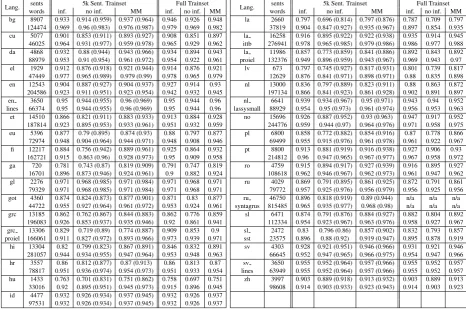
Results Table 2 reports F1 accuracy for full MD and seg/POS for UD languages that do not require
segmentation. For most large train sets (> 200k tokens), we observe 2-3 points absolute drop from infused (ideal) to uninfused (realistic) setting. This suggests that when large train sets exist, our data-driven MA is a viable economic alternative to costly hand-crafted monolingual lexical resources. To scrutinize our realistic results we also report non-OOV-onlyF1for 5k limited uninfused setting. Here we
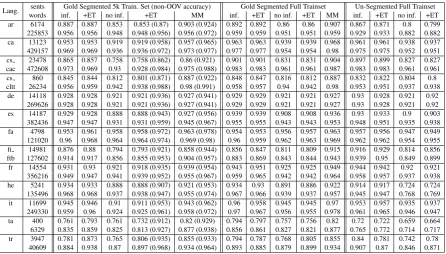
see that for ~80% of languages, our results are on a par with a state-of-the-art tagger, MarMot, retrained on these data, within 0.035 (or less) points gap. This demonstrates that our disambiguation capacity is on-par with MarMot, where performance gaps come mostly from our OOV strategy (which is intentionally restrained, to allow handling of MRL segmentation that is handled by MarMot). Table 3 shows results for UD MRLs that require segmentation, contrasting results on gold pre-segmented input and un-segmented raw data. For raw data we see a minor, ~0.02, drop inF1, compared to gold-segmented settings. That is,
our model still retains the competitive MA&D performance, in asingle, universal, trainablemodel — we attribute this to ourjointsegmentation and tagging strategy, which overcomes error propagation.3
2We do not present results for 6 languages: cs,kk,es ancora,en esl,pt br,ja ktc, as some or all form fields are empty. 3Shortly before submitting this article, UDPipe (Straka et al., 2016), a tool for tokenization, morphological analysis, tagging
Lang. wordssents inf. 5k Sent. Trainsetno inf. MM inf.Full Trainsetno inf. MM bg 8907 0.933 0.914 (0.959) 0.937 (0.964) 0.946 0.926 0.948
124474 0.969 0.96 (0.983) 0.976 (0.987) 0.979 0.969 0.982 cu 5077 0.901 0.853 (0.911) 0.893 (0.927) 0.908 0.851 0.897 46025 0.964 0.931 (0.977) 0.959 (0.978) 0.965 0.929 0.962 da 4868 0.932 0.88 (0.944) 0.943 (0.966) 0.934 0.894 0.943 88979 0.953 0.91 (0.954) 0.961 (0.972) 0.954 0.922 0.961 el 1929 0.912 0.876 (0.918) 0.921 (0.944) 0.914 0.876 0.921 47449 0.977 0.965 (0.989) 0.979 (0.99) 0.978 0.965 0.979 en 12543 0.904 0.887 (0.927) 0.904 (0.937) 0.927 0.914 0.93
204586 0.923 0.911 (0.951) 0.923 (0.954) 0.942 0.932 0.945 en 3650 0.95 0.944 (0.955) 0.96 (0.969) 0.95 0.944 0.96 lines 66374 0.95 0.944 (0.955) 0.96 (0.969) 0.95 0.944 0.96 et 14510 0.866 0.821 (0.911) 0.883 (0.933) 0.913 0.884 0.928
187814 0.923 0.895 (0.953) 0.933 (0.961) 0.951 0.932 0.959 eu 5396 0.877 0.79 (0.895) 0.874 (0.93) 0.88 0.797 0.877 72974 0.948 0.904 (0.964) 0.944 (0.971) 0.948 0.908 0.946 fi 12217 0.884 0.756 (0.942) 0.889 (0.961) 0.925 0.864 0.932 162721 0.915 0.863 (0.96) 0.928 (0.973) 0.95 0.909 0.958 ga 720 0.781 0.743 (0.87) 0.819 (0.909) 0.791 0.747 0.819 16701 0.896 0.873 (0.946) 0.924 (0.961) 0.9 0.882 0.924 gl 2276 0.971 0.968 (0.985) 0.971 (0.984) 0.971 0.968 0.971 79329 0.971 0.968 (0.985) 0.971 (0.984) 0.971 0.968 0.971 got 4360 0.874 0.824 (0.873) 0.877 (0.901) 0.871 0.83 0.877 44722 0.955 0.927 (0.964) 0.961 (0.972) 0.953 0.924 0.961 grc 13185 0.862 0.762 (0.867) 0.844 (0.883) 0.862 0.776 0.859 196083 0.926 0.853 (0.937) 0.935 (0.946) 0.92 0.861 0.941 grc 13306 0.829 0.719 (0.89) 0.774 (0.887) 0.909 0.853 0.9 proiel 166061 0.911 0.827 (0.972) 0.893 (0.966) 0.973 0.939 0.971
hi 13304 0.82 0.799 (0.823) 0.867 (0.891) 0.846 0.832 0.891 281057 0.944 0.934 (0.955) 0.947 (0.964) 0.953 0.948 0.963 hr 3557 0.86 0.812 (0.877) 0.87 (0.913) 0.86 0.813 0.87
78817 0.951 0.936 (0.974) 0.954 (0.973) 0.951 0.933 0.954 hu 1433 0.763 0.701 (0.831) 0.751 (0.862) 0.758 0.697 0.751 33016 0.92 0.895 (0.951) 0.945 (0.973) 0.915 0.896 0.945 id 4477 0.932 0.926 (0.934) 0.937 (0.945) 0.932 0.926 0.937 97531 0.932 0.926 (0.934) 0.937 (0.945) 0.932 0.926 0.937
Lang. wordssents inf. 5k Sent. Trainsetno inf. MM inf.Full Trainsetno inf. MM la 2660 0.797 0.696 (0.814) 0.797 (0.876) 0.787 0.709 0.797
37819 0.904 0.847 (0.927) 0.935 (0.967) 0.897 0.854 0.935 la 16258 0.916 0.895 (0.922) 0.922 (0.938) 0.935 0.914 0.945 ittb 276941 0.978 0.965 (0.985) 0.979 (0.986) 0.986 0.977 0.988 la 11986 0.857 0.773 (0.859) 0.841 (0.886) 0.892 0.843 0.892 proiel 132376 0.949 0.896 (0.959) 0.943 (0.967) 0.969 0.943 0.97
lv 673 0.797 0.745 (0.927) 0.817 (0.931) 0.801 0.739 0.817 12629 0.876 0.841 (0.971) 0.898 (0.971) 0.88 0.835 0.898 nl 13000 0.836 0.797 (0.889) 0.823 (0.911) 0.88 0.863 0.872 197134 0.866 0.841 (0.923) 0.861 (0.928) 0.902 0.891 0.897 nl 6641 0.939 0.934 (0.967) 0.95 (0.971) 0.943 0.94 0.952 lassysmall 88929 0.954 0.95 (0.973) 0.961 (0.974) 0.956 0.953 0.963 no 15696 0.926 0.887 (0.952) 0.93 (0.963) 0.947 0.917 0.952 244776 0.959 0.944 (0.97) 0.964 (0.976) 0.971 0.958 0.975 pl 6800 0.858 0.772 (0.882) 0.854 (0.916) 0.87 0.778 0.866 69499 0.955 0.915 (0.976) 0.961 (0.978) 0.961 0.922 0.967 pt 8800 0.913 0.881 (0.919) 0.916 (0.938) 0.927 0.906 0.93
214812 0.96 0.947 (0.965) 0.967 (0.977) 0.967 0.958 0.972 ro 4759 0.915 0.894 (0.917) 0.927 (0.939) 0.916 0.895 0.927 108618 0.962 0.946 (0.967) 0.962 (0.973) 0.961 0.947 0.962 ru 4029 0.869 0.791 (0.895) 0.861 (0.925) 0.872 0.791 0.861 79772 0.957 0.925 (0.976) 0.956 (0.979) 0.956 0.925 0.956 ru 46750 0.896 0.818 (0.919) 0.89 (0.944) n/a n/a n/a syntagrus 815485 0.965 0.935 (0.977) 0.968 (0.98) n/a n/a n/a sl 6471 0.874 0.791 (0.876) 0.884 (0.927) 0.882 0.804 0.892
112334 0.954 0.923 (0.967) 0.963 (0.976) 0.958 0.927 0.967 sl 2472 0.83 0.796 (0.86) 0.857 (0.902) 0.832 0.793 0.857 sst 23575 0.896 0.88 (0.92) 0.919 (0.947) 0.895 0.878 0.919 sv 4303 0.928 0.921 (0.951) 0.946 (0.966) 0.931 0.921 0.946 66645 0.952 0.947 (0.965) 0.966 (0.975) 0.954 0.947 0.966 sv 3650 0.955 0.952 (0.964) 0.957 (0.966) 0.955 0.952 0.957 lines 63949 0.955 0.952 (0.964) 0.957 (0.966) 0.955 0.952 0.957 zh 3997 0.903 0.889 (0.918) 0.913 (0.932) 0.903 0.889 0.913 98608 0.914 0.903 (0.933) 0.923 (0.943) 0.914 0.903 0.923
Table 2: MA&D for unsegmented languages : F1scores of the languages in UD that do not require morphological segmentation, the upper line indicates full MD, the lower line indicates segmentation
and POS only. MM columns are results for MarMoT. Results in parentheses areF1scores for
Lang. wordssents inf.Gold Segmented 5k Train. Set (non-OOV accuracy)+ET no inf. +ET MM inf.Gold Segmented Full Trainset+ET no inf. +ET MM inf.Un-Segmented Full Trainset+ET no inf. +ET
ar 6174 0.887 0.887 0.853 0.853 (0.87) 0.903 (0.924) 0.892 0.892 0.86 0.86 0.907 0.867 0.871 0.8 0.799
225853 0.956 0.956 0.948 0.948 (0.956) 0.956 (0.972) 0.959 0.959 0.951 0.951 0.959 0.929 0.933 0.882 0.882 ca 13123 0.953 0.953 0.919 0.919 (0.958) 0.957 (0.965) 0.963 0.963 0.939 0.939 0.968 0.961 0.961 0.938 0.937 429157 0.969 0.969 0.936 0.936 (0.972) 0.973 (0.977) 0.977 0.977 0.954 0.954 0.98 0.975 0.975 0.952 0.951 cs 23478 0.865 0.857 0.758 0.758 (0.862) 0.86 (0.921) 0.901 0.901 0.831 0.831 0.904 0.897 0.899 0.827 0.827 cac 472608 0.973 0.969 0.93 0.928 (0.984) 0.975 (0.988) 0.983 0.983 0.961 0.961 0.987 0.983 0.983 0.961 0.961
cs 860 0.845 0.844 0.812 0.801 (0.871) 0.887 (0.922) 0.848 0.847 0.816 0.812 0.887 0.832 0.822 0.804 0.8
cltt 26234 0.956 0.959 0.942 0.938 (0.988) 0.98 (0.991) 0.958 0.957 0.94 0.942 0.98 0.953 0.951 0.937 0.938 de 14118 0.928 0.928 0.921 0.921 (0.936) 0.927 (0.941) 0.929 0.929 0.921 0.921 0.927 0.93 0.928 0.921 0.92 269626 0.928 0.928 0.921 0.921 (0.936) 0.927 (0.941) 0.929 0.929 0.921 0.921 0.927 0.93 0.928 0.921 0.92
es 14187 0.929 0.928 0.888 0.888 (0.943) 0.927 (0.956) 0.939 0.939 0.908 0.908 0.936 0.93 0.933 0.9 0.903
382436 0.947 0.947 0.931 0.931 (0.959) 0.945 (0.967) 0.955 0.955 0.943 0.943 0.953 0.948 0.951 0.935 0.938 fa 4798 0.953 0.961 0.958 0.958 (0.972) 0.963 (0.978) 0.954 0.953 0.956 0.957 0.963 0.957 0.956 0.947 0.949 121020 0.96 0.968 0.964 0.964 (0.974) 0.969 (0.98) 0.96 0.959 0.962 0.963 0.969 0.962 0.962 0.954 0.955 fi 14981 0.876 0.88 0.794 0.793 (0.921) 0.858 (0.944) 0.856 0.847 0.811 0.809 0.915 0.916 0.929 0.814 0.856 ftb 127602 0.914 0.917 0.856 0.855 (0.953) 0.904 (0.957) 0.883 0.869 0.843 0.844 0.943 0.939 0.95 0.849 0.899 fr 14554 0.931 0.93 0.921 0.918 (0.935) 0.939 (0.954) 0.943 0.951 0.925 0.925 0.949 0.944 0.942 0.92 0.921 356216 0.949 0.947 0.941 0.939 (0.952) 0.955 (0.967) 0.959 0.965 0.942 0.942 0.964 0.958 0.957 0.937 0.938 he 5241 0.934 0.933 0.888 0.888 (0.907) 0.921 (0.953) 0.934 0.93 0.891 0.886 0.922 0.914 0.917 0.724 0.724 135496 0.968 0.968 0.937 0.938 (0.947) 0.955 (0.974) 0.967 0.966 0.939 0.937 0.957 0.945 0.947 0.768 0.769
it 11699 0.945 0.946 0.91 0.911 (0.953) 0.943 (0.962) 0.96 0.958 0.945 0.945 0.97 0.953 0.957 0.935 0.937
249330 0.959 0.96 0.924 0.925 (0.961) 0.958 (0.972) 0.97 0.967 0.956 0.955 0.978 0.961 0.965 0.946 0.947
ta 400 0.761 0.793 0.761 0.732 (0.912) 0.82 (0.929) 0.794 0.797 0.757 0.756 0.82 0.72 0.722 0.659 0.664
6329 0.835 0.859 0.825 0.813 (0.927) 0.877 (0.938) 0.856 0.861 0.827 0.821 0.877 0.765 0.772 0.714 0.717 tr 3947 0.781 0.873 0.765 0.806 (0.935) 0.855 (0.933) 0.794 0.787 0.768 0.805 0.855 0.84 0.781 0.742 0.78 40609 0.884 0.938 0.87 0.897 (0.968) 0.934 (0.964) 0.893 0.885 0.879 0.899 0.934 0.907 0.87 0.846 0.871
Table 3: MA&D in segmented languages:F1scores of the languages in UD which require
morphological segmentation. The upper line indicate full MD, the lower line indicates segmentation and POS only. The left hand side shows results for GOLD segmentation, the right hand side for input lattices. MM columns are results for MarMoT. Results in parentheses areF1scores for non-OOV-only
tokens.
5 Conclusion
We present an MD transition-based system that can effectively cope with extreme morphological ambigu-ities in MRLs. To the best of our knowledge, this is the first joint framework for MRL segmentation and tagging in a transition-based setup. Moreover, we present the best MA&D results for Modern Hebrew to date, and the first ever set of MA&D results for the most recent release of UD treebanks (UD1.3).4 Our system provides a first tier for dependency parsing in real-world scenarios, dispensing with the need of external pre-processing. Furthermore, this transition-based model can be extended into ajointmodel for completemorphological and syntactic analysis, as has been previously advanced in phrase-based parsing (Tsarfaty, 2006; Goldberg and Tsarfaty, 2008; Cohen and Smith, 2007; Green and Manning, 2010).
References
Meni Adler and Michael Elhadad. 2006. An unsupervised morpheme-based hmm for Hebrew morphological disambiguation. In Nicoletta Calzolari, Claire Cardie, and Pierre Isabelle, editors,ACL. The Association for Computer Linguistics.
Meni Adler. 2007. Hebrew Morphological Disambiguation: An Unsupervised Stochastic Word-based Approach. Ph.D. thesis, Ben-Gurion University of the Negev, Beer-Sheva, Israel.
Roy Bar-Haim, Khalil Simaan, and Yoad Winter. 2005. Part-of-speech tagging for Hebrew and other semitic languages.Master’s thesis, Technion, Haifa, Israel.
Roy Bar-haim, Khalil Sima’an, and Yoad Winter. 2008. Part-of-speech tagging of Modern Hebrew text. Natural
Language Engineering, 14(2):223–251.
Anders Bjorkelund, Ozlem Cetinoglu, Richard Farkas, Thomas Mueller, and Wolfgang Seeker. 2013. (re)ranking meets morphosyntax: State-of-the-art results from the SPMRL 2013 shared task. InProceedings of the Fourth
Workshop on Statistical Parsing of Morphologically-Rich Languages, pages 135–145, Seattle, Washington,
USA, October. Association for Computational Linguistics.
Rens Bod. 1995. Enriching Linguistics With Statistics. Ph.D. thesis, University of Amsterdam.
Sabine Buchholz and Erwin Marsi. 2006. CoNLL-X shared task on multilingual dependency parsing. In
Proceed-ings of CoNLL-X, pages 149–164.
Eugene Charniak. 1996. Tree-Bank Grammars. InAAAI/IAAI, Vol. 2, pages 1031–1036.
S. B. Cohen and N. A. Smith. 2007. Joint morphological and syntactic disambiguation. InProceedings of EMNLP. Michael Collins and Brian Roark. 2004. Incremental parsing with the perceptron algorithm. InProceedings
of the 42Nd Annual Meeting on Association for Computational Linguistics, ACL ’04, Stroudsburg, PA, USA.
Association for Computational Linguistics.
Yoav Goldberg and Reut Tsarfaty. 2008. A single framework for joint morphological segmentation and syntactic parsing. InProceedings of ACL.
Spence Green and Christopher D. Manning. 2010. Better Arabic parsing: Baselines, evaluations, and analysis. In
Proceedings of the 23rd International Conference on Computational Linguistics, COLING ’10, pages 394–402,
Stroudsburg, PA, USA. Association for Computational Linguistics.
Nizar Habash and Owen Rambow. 2005. Arabic tokenization, part-of-speech tagging and morphological disam-biguation in one fell swoop. InProceedings of the 43rd Annual Meeting on Association for Computational
Linguistics, ACL ’05, pages 573–580, Stroudsburg, PA, USA. Association for Computational Linguistics.
Matthew Honnibal and Mark Johnson. 2014. Joint incremental disfluency detection and dependency parsing.
Transactions of the Association of Computational Linguistics – Volume 2, Issue 1, pages 131–142.
Alon Itai and Shuly Wintner. 2008. Language resources for Hebrew. Language Resources and Evaluation, 42(1):75–98, March.
Christopher D. Manning, 2011. Computational Linguistics and Intelligent Text Processing: 12th International
Conference, CICLing 2011, Tokyo, Japan, February 20-26, 2011. Proceedings, Part I, chapter Part-of-Speech
Tagging from 97% to 100%: Is It Time for Some Linguistics?, pages 171–189. Springer Berlin Heidelberg, Berlin, Heidelberg.
Ryan McDonald. 2006. Discriminative Learning and Spanning Tree Algorithms for Dependency Parsing. Ph.D. thesis, University of Pennsylvanya.
Thomas M¨uller, Helmut Schmid, and Hinrich Sch¨utze. 2013. Efficient higher-order crfs for morphological tag-ging.In Proceedings of EMNLP.
Joakim Nivre, Johan Hall, and Jens Nilsson. 2006. Maltparser: A data-driven parser-generator for dependency parsing. InProceedings of LREC, pages 2216–2219.
Joakim Nivre, Johan Hall, Sandra K¨ubler, Ryan McDonald, Jens Nilsson, Sebastian Riedel, and Deniz Yuret. 2007. The CoNLL 2007 shared task on dependency parsing. InProceedings of the CoNLL Shared Task Session
Joakim Nivre, ˇZeljko Agi´c, Lars Ahrenberg, Maria Jesus Aranzabe, Masayuki Asahara, Aitziber Atutxa, Miguel Ballesteros, John Bauer, Kepa Bengoetxea, Yevgeni Berzak, Riyaz Ahmad Bhat, Cristina Bosco, Gosse Bouma, Sam Bowman, G¨uls¸en Cebiro˘glu Eryi˘git, Giuseppe G. A. Celano, C¸a˘grı C¸¨oltekin, Miriam Connor, Marie-Catherine de Marneffe, Arantza Diaz de Ilarraza, Kaja Dobrovoljc, Timothy Dozat, Kira Droganova, Tomaˇz Erjavec, Rich´ard Farkas, Jennifer Foster, Daniel Galbraith, Sebastian Garza, Filip Ginter, Iakes Goenaga, Koldo Gojenola, Memduh Gokirmak, Yoav Goldberg, Xavier G´omez Guinovart, Berta Gonz´ales Saavedra, Normunds Gr¯uz¯itis, Bruno Guillaume, Jan Hajiˇc, Dag Haug, Barbora Hladk´a, Radu Ion, Elena Irimia, An-ders Johannsen, H¨uner Kas¸ıkara, Hiroshi Kanayama, Jenna Kanerva, Boris Katz, Jessica Kenney, Simon Krek, Veronika Laippala, Lucia Lam, Alessandro Lenci, Nikola Ljubeˇsi´c, Olga Lyashevskaya, Teresa Lynn, Aibek Makazhanov, Christopher Manning, C˘at˘alina M˘ar˘anduc, David Mareˇcek, H´ector Mart´ınez Alonso, Jan Maˇsek, Yuji Matsumoto, Ryan McDonald, Anna Missil¨a, Verginica Mititelu, Yusuke Miyao, Simonetta Montemagni, Keiko Sophie Mori, Shunsuke Mori, Kadri Muischnek, Nina Mustafina, Kaili M¨u¨urisep, Vitaly Nikolaev, Hanna Nurmi, Petya Osenova, Lilja Øvrelid, Elena Pascual, Marco Passarotti, Cenel-Augusto Perez, Slav Petrov, Jussi Piitulainen, Barbara Plank, Martin Popel, Lauma Pretkalnin¸a, Prokopis Prokopidis, Tiina Puolakainen, Sampo Pyysalo, Loganathan Ramasamy, Laura Rituma, Rudolf Rosa, Shadi Saleh, Baiba Saul¯ite, Sebastian Schuster, Wolfgang Seeker, Mojgan Seraji, Lena Shakurova, Mo Shen, Natalia Silveira, Maria Simi, Radu Simionescu, Katalin Simk´o, Kiril Simov, Aaron Smith, Carolyn Spadine, Alane Suhr, Umut Sulubacak, Zsolt Sz´ant´o, Takaaki Tanaka, Reut Tsarfaty, Francis Tyers, Sumire Uematsu, Larraitz Uria, Gertjan van Noord, Vik-tor Varga, Veronika Vincze, Jing Xian Wang, Jonathan North Washington, Zdenˇek ˇZabokrtsk´y, Daniel Zeman, and Hanzhi Zhu. 2016. Universal dependencies 1.3. LINDAT/CLARIN digital library at the Institute of Formal and Applied Linguistics, Charles University in Prague.
Arfath Pasha, Mohamed Al-Badrashiny, Mona Diab, Ahmed El Kholy, Ramy Eskander, Nizar Habash, Manoj Pooleery, Owen Rambow, and Ryan Roth. 2014. Madamira: A fast, comprehensive tool for morphological analysis and disambiguation of Arabic. InProceedings of the Ninth International Conference on Language
Resources and Evaluation (LREC-2014). European Language Resources Association (ELRA).
Djam´e Seddah, Sandra K¨ubler, and Reut Tsarfaty. 2014. Introducing the spmrl 2014 shared task on parsing morphologically-rich languages. pages 103–109.
Danny Shacham and Shuly Wintner. 2007. Morphological disambiguation of Hebrew: A case study in classifier combination. InProceedings of ACL.
Khalil Sima’an, Alon Itai, Yoad Winter, Alon Altman, and N. Nativ. 2001. Building a tree-bank of Modern Hebrew text.Traitment Automatique des Langues, 42(2).
Peter Smit, Sami Virpioja, Stig-Arne Gr¨onroos, and Mikko Kurimo. 2014. Morfessor 2.0: Toolkit for statistical morphological segmentation. InProceedings of the Demonstrations at the 14th Conference of the European
Chapter of the Association for Computational Linguistics, pages 21–24. Association for Computational
Lin-guistics.
Milan Straka, Jan Hajic, and Jana Strakov´a. 2016. Udpipe: Trainable pipeline for processing conll-u files perform-ing tokenization, morphological analysis, pos taggperform-ing and parsperform-ing. In Nicoletta Calzolari (Conference Chair), Khalid Choukri, Thierry Declerck, Sara Goggi, Marko Grobelnik, Bente Maegaard, Joseph Mariani, Helene Mazo, Asuncion Moreno, Jan Odijk, and Stelios Piperidis, editors, Proceedings of the Tenth International
Conference on Language Resources and Evaluation (LREC 2016), Paris, France, may. European Language
Resources Association (ELRA).
Reut Tsarfaty and Yoav Goldberg. 2008. Word-based or morpheme-based? annotation strategies for modern Hebrew clitics. InProceedings of LREC.
Reut Tsarfaty, Djame Seddah, Yoav Goldberg, Sandra Kuebler, Marie Candito, Jennifer Foster, Yannick Versley, Ines Rehbein, and Lamia Tounsi. 2010. Statistical parsing for morphologically rich language (spmrl): What, how and whither. InProceedings of the first workshop on Statistical Parsing of Morphologically Rich Languages
(SPMRL) at NA-ACL.
Reut Tsarfaty. 2006. Integrated morphological and syntactic disambiguation for modern Hebrew. InProceedings of the 21st International Conference on Computational Linguistics and 44th Annual Meeting of the Association
for Computational Linguistics: Student Research Workshop, COLING ACL ’06, pages 49–54, Stroudsburg, PA,
USA. Association for Computational Linguistics.
Reut Tsarfaty. 2013. A unified morphosyntactic scheme for stanford dependencies. InProceedings of ACL. Yue Zhang and Stephen Clark. 2011. Syntactic processing using the generalized perceptron and beam search.
Meishan Zhang, Yue Zhang, Wanxiang Che, and Ting Liu. 2014. Character-level chinese dependency parsing.
InProceedings of the 52nd Annual Meeting of the Association for Computational Linguistics (Volume 1: Long
Papers), pages 1326–1336, Baltimore, Maryland, June. Association for Computational Linguistics.
Muhua Zhu, Yue Zhang, Wenliang Chen, Min Zhang, and Jingbo Zhu. 2013. Fast and accurate shift-reduce con-stituent parsing. InProceedings of the 51st Annual Meeting of the Association for Computational Linguistics,
ACL 2013, 4-9 August 2013, Sofia, Bulgaria, Volume 1: Long Papers, pages 434–443. The Association for