O
O
O
O
@
O
@
$
@
O
@
@
O
@
O
O
@
O
O
O
O
@
O
@
@
O
@
@
@
O
K n o w l e d g e - L e a n C o r e f e r e n c e R e s o l u t i o n a n d its R e l a t i o n t o
T e x t u a l C o h e s i o n a n d C o h e r e n c e
Sanda M. Harabagiu
Southern Methodist University
Dallas, TX 75275-0122
s a n d a @ s e a s , smu. e d uS t e v e n J . M a i o r a n o AAT
Washington, D.C. 20505
stevejm~ucia, gov
Abstract
In this paper we present a new empirical method for coreference resolution, imple- mented in the COCKTAIL system. The re- suits of COCKTAIL are used for lightweight abduction of cohesion and coherence struc- tures. We show that referential cohesion can be integrated w i t h lexical cohesion to produce pragmatic knowledge. Upon this knowledge coherence abduction takes place.
I
M o t i v a t i o nCoreference evaluation was introduced as a new domain-independent task at the 6th Message Under- standi~ Conference (MUC-6) in 1995. The task fo- cused on a subset of coreference, namely the ide~tiQ/
coreference, established between nouns, pronouns and noun phrases (including proper names) that re- fer to the same entity. In d ~ - ; , ~ the coreference task (d. (Hirschnum and Chinchor, 1997)) special care was taken to use the coreference output not only for supporting Information Extraction(IE), the central task of the MUCs, but also to create means for r e . a r c h on corefea~mce a n d discourse p h e n o m ~ independent of IE.
Annotated corpora were made available, using SGML tagging with~, the text stream. The anno- tated texts served as tralz~g examples for a variety. of corderence resolution methods, that had to focus not only on precision and recall, but also on robust- ness. Two general classes of approaches were distin- guished. The first class is characterized by adapta- tions of previously known reference algon'thms
(e.g.
(Lappin and Leass, 1994), (Brennan et al., 1987)) the scarce syntactic and semantic knowledge avail- able m an w. system (e.g. (Kameyama, 1997)). The second class is based on statistical and machine learning techniques that rely on the tagged corpora
to extract features of the coreferential relations (e.g. (Aone and Bennett, 1994) (Kehler, 1997)).
• In the past two MUC competitions, the high scor- ing systems achieved a recall in the high 50's to low 60's and a precision in the low 70's (d. (Hirschman et al., 1998)). A study z of the contribution of each form of coreference to the overall performance shows that generally, proper name anaphora resolu- tion have the highest precision (69%), followed by pronominal reference (62%). T h e worse .precision is obtained by the resolution of d~_ n!te nominals anaphors (46%). However, these results need to be contrasted with the distribution of coreferential links on the tagged corpora. The majority of coreference links (38.42%) connect names Of people, organiza- tions or locations. In addition, 19.68% of the tagged c o ~ c e links are accounted by appositives. Only 16.35% of the tagged coreferences are pronominal. Nominal anaphors account for 25.55% of the coref- erence links, and their resolution is generally poorly
represented in IE systems.
Due to the distribution of coreference links in newswire texts, a coreference module that is merely capable of handling recognition of appositives with high precision and incorporates rules of name alias identification can achieve a baseline coreference pre- cision up to 58.1%, without sophisticated syntactic or discourse information. Precision increase is ob- tained by extending lfigh-performance pronoun res- olution methods (e.g. (Lappin and Leass, 1994)) to nominal corderence as well. Such enhancements rely on semantic and discourse knowledge.
In this paper we describe COCKTAIL, a high- performance coreference resolution system that op- eratas on a mixture of heuristics that combine se- mantic and discourse information. The resulting
tThe study, reported in (Kameyama, 1997), was per- formed on the coreference module of SRI's FASTUS (Ap- pelt et al., I993), an IE system representative of today's IE technology.
coreference chains are shown to contribute in the derivation of cohesive chains and coherence graphs. Both cohesive and coherence structures are consid- ered, partly because of their incremental complex- ity and partly because the tradition (started with (Hobbs, 1979)) of studying the interaction of coref- erence and coherence. Section 2 presents COCKTAIL and the coreference methods it built upon. Sections 3 and 4 describe the derivation the cohesion and co- herence structures.
2
C o r e f e r e n c e
Resolution
Coreference resolution relies on a combination of lin-
guistic and cognitive aspects of language. Linguis-
tic constraints are provided mostly by the syntactic
modeling of language, whereas computational mod- els of discourse bring forward the cognitive aesump- lions of anaphora resolution. Three different meth-
ods of combining anaphoric constraints a m known
to date. The Rrst one integrates anaphora resolution
in computational models of discourse interpretation. Dynamic properties of discourse, especially focusing and centering are invoked as the primary b~-~|~ for identifying antecedents. Such computational meth- ods were presented in (Grosz et al., 1995) and (Web- ber, 1988).
A second category of approaches combines a v ~ riety of syntactic, semantic and discourse factors as a multi-dimensional metric for ranking antecedent candidates. Anaphora resolution is determined by
a composite of several distinct scoring procedures,
each of which scores the prominence of the candidate with respect to a specific.type of information. The systems described in (Asher and Wada, 1988) (Car- bonell and Brown, 1988) and (Rich and Luperfoy, 1988) are examples of the mixed evaluation strat- egy.
Alternatively, other discourse-based methods con-
sider co~eference resolution a by-product of the
recognition of coher~ce relations between sentences.
Such methods were presented in (Hoblm et al., 1993)
and ~flensky, 1978). Although M-complete, this approach has the appeal that it resolves the most complicated cases of coreference, uncovered by syn- tactic or semantic cues. We have revisited these
methods by setting the relation between coreference
and coherence on empirical grounds.
2.1 P r o n o m i n a l C o r e f e r e n c e
Two tendencies characterize current pronominal coreference algorithms. The first one makes use of the advances in the parsing technology or on the availability of large parsed corpora (e.g. Trcebank (Marcus et al.1993)) to produce algorithms inspired
by Hobbs' baseline method (Hobbs, 1978). For ex- ample, the Resolution of Anaphor~ Procedure (RAP)
i~itroduced in (Lappin and Leass, 1994) combines syntactic information with agreement and salience constraints. Recently, a probabilistic approach to pronominal coreference resolution was also devised (Ge et al., 1998), using the parsed data available from Treebank. The knowledge-based method of Lappin and Leass produces better results. Never- theless, RkPSTAT, a version of RAP obtained by using statistically measured preference patterns for the an- tecedents, prodticed a slight enhancement of perfor- mance over RAP.
Other pronominal resolution approaches promote knowledge-poor methods (Mitkov , 1998), either by using an ordered set o f general heuristics or by combining scores assigned to candidate antecedents. The CogNIAC algorithm (Baldwin, 1997) uses six heuristic rules to resolve coreference, whereas the algorithm presented in (Mitkov, 1998) is based on a limited set of preferences (e.g. definitiveness, lexical reiteration or immediate reference). Both these al- gorithm rely only on part-of-speech tagging of texts and on patterns for NP identification. Their per- formance (dose to 90% for certain types of pro- nouns) indicates that full syntactic knowledge is not required by certain forms of pronominal coreference. The same claim is made in (Kennedy and Bogu- r a e v , 1996) and (Kameyama, 1997), where algo- rithm~ approximating RAP for poorer syntactic input obtain precision of 75% and 71%, respectively, a sur- prising small precision decay from RAP's 86%. These results prompted us to devise COCKTAIL, a corder- ence resolution system, as a mixture of heuristics performing on the various syntactic, semantic and dL~ourse cues. COCKTAIL is a composite of heuris- tics learned from t h e tagged corpora, which has the
following novel characteristics:
1. C0cErIIL covers both nominal and pronoun cord- er~ce, but distinct sets of heuristics operate for different forms of anaphors. We have devised sepa- rate heuristics for reflexive, possessive, relative, 3rd person and 1st person pronouns. Similarly, de/inite nomlo-t~ are treated differently than bare or indd- inite nominals.
2. c0crr/IL performs semantic checks between an- tecedents and ~ p h o r L These chedm combine sot- tal c o ~ a i n t s from WordNet with co-occurance in- formation from (a) Treebank and (b) conceptual
3. In COCET~L antecedents are sought not only in the
ac~e~ble text region, but we also throughout the
current co~efe~nce chains. In this way cohesive in- formation, represented in corderence chains, is em- ployed i~ the resolution pr _~___.
4. The heuristics d ~cErAIL allow for lexi~dizations (e.g. when the anaphor is an adjunct ofa commmd- cation verbs) and of simplified coherence cues (e.g.
when the anaphor is the subject of verb add, the antecedent may be a preceding subject of a com- munication vehb).
To exemplify some COCKTAIL heuristics that re- solve pronominal coreference, we first present heuris- tics applicable for reflexive pronoun and then we list heuristics for possessive pronouns and 3rd person pronoun resolution. Brevity imposes the omission of heuristics for other forms of pronoun resolution. COCKTAIL operates by successively applying the fol- lowing heuristics to the pronoun P r o ~
Oif (Pron is reflezive) t h e n apply successively: oHenristic 1-Reflexive(H1R)
Search for PN, the closest proper name from Prgn in the same sentence, in right to left order. if (PN agrees in number and gender with Pron)
if (PN belongs to core/erence chain CC)
t h e n Pick the element from CC which is
closest to Pron in Text. else Pick PN.
o Henr/stic 2-Refle~'ve(H2R)
Search for a sequence Noun.Relative.Pronoun, in the same sentence, in rigld to left order. if (Noun agrees in number and gender with Pron)
i f (Noun belongs to earefe~n~ chain CC)
t h e n Pick the dement from CC which is
closest to Iron in Tezt.
else Pick Noun.
oHeur/sHc $-Refle~'/~e(H3R)
Search for Pron" the closest prenoun from Pron in the same sentence, in right to left order. i f (Pron" agrees in number and gender with Pron)
i f (Pron' ~ g s to wreferen~ chain CC)
t h e n Pick the dement from CC which is
closest to Pron in Tcet.
eLse Pick Pron:
o Heuristie 4-Reflezive(H4R)
Search/or Noun.e, the dosest noun .from Pron in the same sentence, in right to left order.
if (Noun.c a#n~a in number and gender with Pron) t h e n Pick Noun.~
Resolution examples for reflexive pronouns are il- lustrated in Table L The antecedents produced by
COCKTAIL are boldfaced, whereas the referring ex-
pressions are emphasized. Both referring expressions and resolved antecedents and underlined. Precision results are listed in Table 2.
Antecedents of reflexive pronouns are always sought in the same sentence. Antecedents of other types of pronouns are sought in preceding sentences too, starting from the immediately preceding sen- tence. Inside the sentence, the search for a specific word is performed from the current position towards
the beginning of the s e n t e n c e , whereas in the pre-
Before Pennzoii's court fight with Texaco over the Getty purchase, Mr. Liedtke - one of the ploy's fore-
most practitioners - portrayed him.~elfas something
of an oil-patch tube, a notable f~---'~"~-~nsidering his diplomas from Amherst College and Harvard Business School.
The' woman who is kuown to me as hard-working and.
responsible, clearly isn't hersel/.
Unlike many of her peers, m ~ t of whom are males
in their 30s, s.he never takes herself too seriously.
Table h Examples of reflexive pronouns
Heuristic HIR H2R H3R H4K Precision on a test
set of I00 randomly 95% 92% 98% 89% selected pronouns
Table 2: Coreference precision (reflexive pronovns)
ceding sentences, the search starts at the beginning of the sentence and proceeds in a l e f t to right fash- ion. The same search order was used in (Kameyama, 1997). From now on, we indicate this search by Searchl. This search is employed by heuristics for possessive pronoun resolution:
Oif (Pron is possessive) (i.e. we have a sequence [Pron nouno], where nouno is the head of the NP
containing Pron) t h e n apply suco,~_~sieely:
o Henris6¢. l-Pouessive(H IPos )
Searchl /or a posses~ve comb'uct of the form
[.ounl's ,~n2],
if ([Pron
nouno] and
[nounl's noun2] agree in gender, n-tuber and are semantically consistent)
t h e n i f (noun2 belonga to coreyerence chain CC)
and there is andement from CC which is closest to Pron in Tezt, Pick that dement. Pick noun,.
oHcur/sfc 2-pouess/ve(H2Pos)
Senrchl for PN, the closest proper name from Pron i f ( P N agrees in number and gender with Pron)
i f (PN belongs to corefe~n~ chain CC)
t h e n ~ the dement from CC ~hich is
closest to Pron in Tezt else Pick PN.
oHeuris6c 3-Possessive(H3Pce).
Search for Pron" the closest pronoun .from Pron . i f (Pron" egre~ in number and fender e~h
Pron).
i f (Pron' belongs to coreferen~ chain CC)
a n d there is an dement from CC which is closest to Pron in Text, Pick that element. else Pick Pron'
oHenrist~ ~.Possessiee(H4Pos)
Search for Noun, the closest eammon noun from Iron i f (Noun agrees in number and gender with Pron)
[image:3.612.197.552.55.742.2] [image:3.612.51.281.76.565.2]if (Noun belongs to c o r e f ~ chain CC) and there is an element from CC which is
closes~ to Pron in Tezt, Pick that element. else Pick Noun
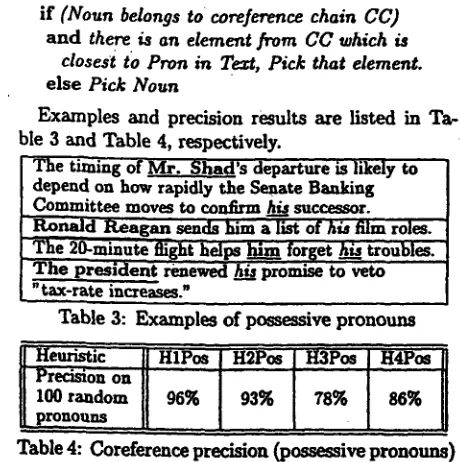
Examples and precision results are listed in Ta- ble 3 and Table 4, respectively.
The timing of Mr. Shad's departure is likely to depend on how rapidly the Senate Banking Committee moves to confirm his successor. Ronald Reagan sends him-a list of h/s film roles. The 20-minute tiigfit )~elps him forget h/s troubles. The president renewed h/s promise to veto
"tax-rate increases."
Table 3: Examples of possessive pronouns
Precision on
100 random 96% 93% 78% 86%
pronouns
Table 4: Coreference precision (possessive pronouns)
Given a possessive pronotm in a sequence [Pron Noon0], the antecedent Ante of Pron is semanti. cal]y consistent if the same possessive relationship can be established between Ante and Noono. the problem is that the possessive relation semantically corresponds to an open list of relations. For exam- ple, Nouno may be a feature of Ante. Ante may own Noono or Ante may have pe, formed the action lex- ical/zed by the nominali~-~on Nouno.
COCKTAIL's test of semantic consistency blends to- gerber information available from WordNet and on statistics gathered from ~ e b a n k . Different consis- tency checks are modeled for each of the heuristics. We detail here the check that applies to heuristic HIPos, that resolves the possessive from the first ex- ample listed in Table 3. For this heuristic, we have to test whether from the possessive [Ante Nount] we can grant the pos~_~ve [Ante Noone] as well. There axe three cases that allow us to do so: • ~ase 1 Nount and Nouno corder.
• Case ~Theceis ase~se ss of Nounx and asense so of Nouno such that a synonym of Noun~ i or of its immediate hypernym is found in the gloss of N o o n ~ or vicevers&
• ~ There is a sense st o f Nounx and a sense So of Nouno such that a common concept is found in their glosses.
Cases 2 and 3 extend to synsets obtained through derivational morphology as well (e.g. nominaliza- tions). For cases 2 and 3 COCKTAIL reinforces the coreference hypothesis by using a possessive. similarity metric based on Resuik's similarity mea- sures for noun groups (B___,~m_ i_k, 1995). From a subset of Treebank, we collect all possessives, and measure
whether the similarity~clam of Nouno, Noun1 and their eventual common concept is above a threshold produced off-line.
Other pronominal coreference heuristics employ Search2, a search procedure that enhances Searchx, since it prefers antecedents that are immediately succeeded by relative pronouns. This search is in. corporated in COCKTAIL's heuristics that resolve 3rd person pronominal coreference:
o Heuristic 1-Prono.un_(HIPron)
Search2 in the same sentence for the s a m e 5rd person pronoun Pron'
if (Pron' belongs to coreference chain CC) and there is an element from CC which is
closest to Pron in Text, Pick that dement. else Pick Pron"
oHeuristic ~-Prenoon(H2Pron)
Search2 for PN, the closest proper name from Pron if (PN agrees in number and gender with'Pron)
if (PN belongs" to coreference chain CC) t h e n Pick the element from CC which is
closest to Pron in. Text. else Pick PN.
oHeuristic 3-Prenoon(H3Pron)
if Pron collocates with a communication verb t h e n Searcht for pronoon Pron'--I i f (Pron" belongs to ¢oreference chain CC)
and there is an clement from CC e~hich is closest to Iron in Tezt, Pick that d e m e n t else Pick Pron"
oHeuristic ~-Pronoun(H4Pron)
i f Pron collocates with a communication verb thell Search] communicator Noun
i f (#oun belongs to coreyeren~ chain CC) - and there im an clement from CC u#sich is
clos/Jt to Pmn in Te.zt, Pick that dement. else Pick Noo~
o Heuristic 5-Pmnoon(HSPron)
. Searcha for Pron', the closest pronoun from Pron i f (Pron' agrees in number and gender with Pron)
if (Pron' belonga to ¢oneference chain CC)
and there is an dement from CC tnhich is do, eat to Pron in Teffit, Pick that d e m e n t else Pick Pren"
o H f u ~ 6-Proooen(H6Pron)
Search2 for Noun, the closest noun from.Pron if (Noun agrees in number and gender with Pron)
if (Noon belongs to coreferen~ chain CC)
and there is an element from CC which is dosest to Iron in Tezt, Pick that dement. else Pick Noun
COCKTAIL doesn't employ semantic consistency checks for this form of pronominal coreference res-
32
[image:4.612.78.308.76.307.2] [image:4.612.56.577.78.744.2]olution. F Y o m our initial experiments, w e do not see the need for special semantic consistency checks, since all heuristics performed with precision in ex- cess of 9 0 % Part of this is explained b y our usage of pleonastic filters and of recognizers of idiomatic us- age. Table 5 illustrates some of the successful coref- erence resolutions.
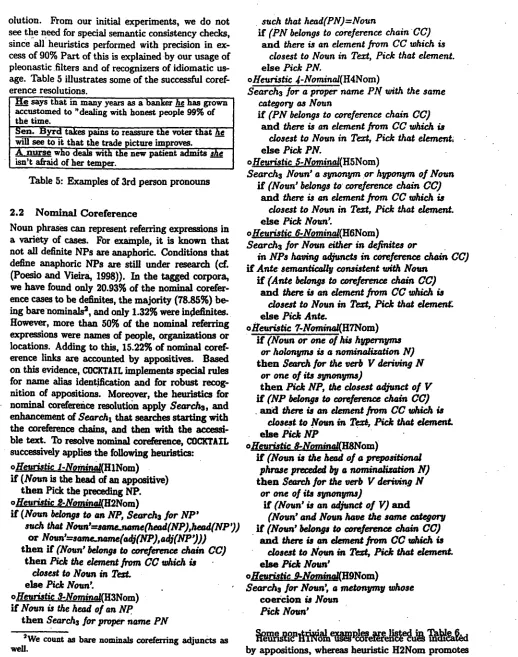
H_qe says that in m a n y years as a banker he has grown accustomed to "dealing with honest people 9 9 % of the time.
sen. Byrd takes pains to reassure the voter that he will see to it that the trade picture improves.
A..nurse who deals with the new patient ~Jmits sh.._~e isn't afraid of her temper.
Table 5: Examples of 3rd person pronouns
2.2 N o m i n a l Coreference
Noun phrases can represent referring expressions in a variety of cases. For example, it is known that not all definite NPs are anaphoric. Conditions that define anaphoric NPs are still under research (cf. (Poesio and Vieira, 1998)). In the tagged corpora, we have found only 20.93% of the nominal corefer- ence cases to be definites, the majority (78.85%) be- ing bare nominals 2, and only 1.32% were inclefiuites. However, more than 50% of the nominal referring expressions were names of people, org~n!-~tions or locations. Adding to this, 15.22% of nominal coref- erence links are accounted by appositives. Based on this evidence, COCKTtIL implements special rules for name alias identification and for robust recog- nition of appositions. Moreover, the heuristics for nominal coreference resolution apply Senrchs, and enhancement of Search~ that searches starting with the coreference chains, and then with the accessi- ble text. To resolve nominal coref~eace, COCKTAIL successively applies the following heuristics:
oHeuristic l.Nominal(H1Nom) if (Noun is the head of an appositive)
t h e n Pick the preceding NP. o Heuristic P..Nor~inal(H2Nom)
i f (Noun belongs to an NP, Searchs /or NP'
such that Noun'ffiaame_name(head(NP),head(NP')) or Noun'--same.name(adj(NP),adj(Ne'))) t h e n if (Noun' belongs to core/erence chain CO)
t h e n Pick the element ~vm CC which is closest to Noun in Text.
else Pick Noun:
oHeuristif. 3-Nominal(H3Nom) i f Noun is the head of an NP
t h e n Searchs for proper name P N
2We count as bare nominals coreferring adjuncts as well.
such that head(PN)-Noun
if (PN belongs to coreference chain CG) and there is an element from CC which is
closest to Noun in Text, Pick that element. else Pick PN.
o Houristie 4-Nominal( H 4N om)
Searchs ]or a proper name P N with the same category as Noun
i f (PN belongs to core-ference chain CC) and there is an element from CO which is
closest to Noun in Tezt, Pick that element. else Pick PN.
oHeuristic 5-Nominai(H5Nom)
Searchs Noun" a spnenym or hyponyrn of Noun i f (Noun' belongs to core/erence chain CC)
and there is an element fl'om CO which is closest to Noun in Text, Pick that dement. else Pick Noun'.
oH. euristic 6-Nominal(H6Nom )
Searchs for Noun either in definites or
in NPs having adjuncts in coreyerence chain CU) i f Ante 8emantieally consistent with Noun
i f (Ante belongs to core/erenee chain UC) and there is an dement from UU which is
closest to Noun in Text, Pick that element: else Pick Ante.
oHeuristic 7-Nomine/(H7Nom)
i f (Noun or one ol his hz~n~nrts or holonyms is a nominalization N) t h e n Search/or the verb V deriving N
or one o/ its synen~ns)
t h e n P/ok NP, the closest adjunct o / V i f (NP belongs to ¢ore!erence chain 0 0 )
az~d there is an dement from CO which is closest to Noun in Te~, Pick that element. else Pick NP
oHeuristi¢ &N0m/na/(H8Nom)
i f (Noun is the head o/a prepositional phrase preceded by a nominalization N) t h e n Search/or the verb V deriving N
or one oI its s~um~ns)
i f (Noun" is on adjunct o/ V) and
(Noun" and Noun have the same category • i f (Noun' belongs to ¢ore/erenea chain CC)
a n d there is an dement from CC which is closest to ~Voen in Text, Pick that dement~ else Pick Noun"
oHouristi~ 9-Nominal(H9Nom)
Searchs Jar Noun', a metonymp whose c o e r c i o n is Noun
Pick Noun'
m e o p. e s l
by appositions, whereas heuristic H2Nom promotes
[image:5.612.55.573.54.711.2]IMB and Mr. York would;t discuss his compensation package which could easily reach into seven figures.
~ e c t is sensitive at a time when IMB is !aying off thousands of employees
Mr Iacocca led Chrysler through one of the 'largest stock sales ever for a U.S. industrial company, raising .$1.78 billion. Chrysler is using most of the proceeds to reduce its $4.4. billion unfunded pension liability. We read where the Clinton White House is seeking a deputy to chief of staff Mack McLarty to impose some disciplined coherence on the p/ace's • ambunctious young staff.
Table 6: Examples of nominal coreference
the term repetition indicator, when consistency checks apply. For this heuristic, consistency checks are conservative, imposing that either the adjuncts be identical, coreferring or the adjunct of the ref- erent be less specific than the antecedent. Speci- ficity principles apply also to HSNom, where hy- ponymy is promoted, similarly to (Poesio and Vieirs, 1998). Heuristic H3Nom allows coreference between "the Securities and F_,z~ange Commission n and .~he commission ~ but it bans links between ~Reardon Steel Co." and "tons of steal".
Many times coreferring nomln~l~ share a~o se- mantic relations (e.g. synonym#). Heuristic HSNom identifies such cases, by applying consistency checks. Based on experiments with the coreference module of FASTUS, where this heuristic was initially imple- mented, we require that most frequent senses of nouns be promoted. The same precedence of f ~ - quent senses is implemented in the assi~ment of categories, defined as the immediate WordN~
h~
pernTpn. The category of proper names is dictated by the proper name recognizer, ~qlo~ing such cate- gories m Person, Organization orI n this way, coreference between "IBM ~ and ~he
wo,mded computer 9lent ~ can be estab!|~bed, since sense 3 of noun #/ant is Organim6on, the category
of ~IBM~. Simi!m- ~tegory-based semaatic cheCkS
allow the recognition of the antecedent of proceeds from the second example listed in Table 6. The h~l~ern~ of ~eceezk is ga/n, whose glou genus is amount, the category of $1.78 biUio~ Semantic checks are also required in H?Nom and HSNom, heuristic that rely on derivational morphology. The first example from Table 6 is resolved by HTNom, since d/scass/on the nominalization of d/scuss b~_q the category communication, a hypernym of subject, The antecedent is the object of the verb d/scuss.
The last heuristic, H9Nom identifies coreferring links with coerced entities of nominals. Coercions are obtained as paths of meronyms or hypernyms.
(Harabagiu, 1998) discusses a coercion methodol- ogy based on WordNet and Treebank. Since in our test corpus there we very few cases of metonymic anaphors, Table 7 lists the precision of the other heuristics only.
I Heuristic I[ H1Nom i H2Nom H3Nom j H4Nom 1
Precision on [[ 98% 95% 82% 88%
100 random [['HSNo.m He~om ti7Nom HSNom
Table 7: Nom!~nal coreference precision
The empirical • methods employed in COCKTAIL are an alternative to the inductive approaches described in (Cardie and Wagstatf, 1999) and (McCarthy and Lehnert, 1995). Our results show that high-precision empirical techniques can be ported from pronominal coreference resolution to the more difficult problem of nominal coreference.
3 L e x i c a l C o h e s i o n
The heuristics encoded i n COCKTAIL make light use of textual cohesion, i.e. the property of texts to Ustick t o g e t h e r s by using related words. Both pronominal and nominal coherence resolution heuristics use cohesion cues indicated by term rep- etition while nominal corofexence relies on semantic relations between anaphors and their antecedents. In addition, coreference chains are a form of textual cohesion, known as referential cohesion (d. (Halli- day and Haesan, 1976)).
Until now, lex/m/cohes/on, arising from semantic connections between words, was successfully used as t h e only form of textual cohesive structure, known as • lez/cd chdn& At present there are three methods of generating lexical chains. The first one, imple- mented in the TextTning algorithm (Hearst, 1997), counts the f~lUencies of term repetitions and is an ideal, lightweight tool for segmenting texts. The sec- ond method, adds knowledge from semantic dictio- naries (e.g. Roget's Thesaurus in the work of (Mor- ris and Hirst, 1991) or WordNet in the methods presented in ( B ~ y and Elhadad, 1997), (Hirst and St-Onge, 1998)). Besides term repetition, this approach reco~i,~s relations between text words that are connected in the dictionaries with prede- fined patterns. This method was applied for gen- eration of text ~lmmm'ies, the recognition of the intentional structure of texts and in the detection of malapropism. The third method is based on a path-finding algorithm detailed in (Harabagiu and Moldovan, 1998). This method creates a richer SDefiuition introduced in (Halliday and Ha.man, 1976) and (Morris and Hirst, 1991)
34
O
O
O
O
O
O
O
O
O
O
O
@
O
O
O
0
O
O
O
O
O
O
O
@
O
0
O
@
O
O
O
O
@
O
O
O
O
O
@
O
@
O
O
@
structure, useful for the al~duction of coherer~e re- lations from the knowledge encoded in WordNet.
Here we describe a new cohesion structure that (a) incorporates both lexical and referential cohesion and (b) produces a unique chain that contains not only single words, but also textual entities encom- passing head-adjunct lists. We use the finite-state parses of FaSTU$ (Appelt et al., 1993) for recogniz- ing these entities, but the method extends to any basic phrasal parser 4.
We produce this novel cohesive structure to ex- ploit the close relation between text cohesion and coherence. It is known (cf. (Harabagiih 1999)) that cohesion, as a surface indicator of the text coherence, can indicate the lexico-semantic knowledge upon which coherence is inferred. Our aim is to use this cohesive chain for producing axiomatic knowledge for CICERO, a TACITUS-like system that abducts co- herence relations. TACITU$ (Hobbs etal., 1993) is a successful abductive system when provided with ex- tensive pra£~n~ic and linguistic knowledge. CICERO is des~ned as a Jightwe~t version of TACITUS, that performs reliable abductions, with minimal knowl-
edge and effective searches. Translating all the lexi-
cal, morphological, synta~'c and semantic ambigu- ities from texts would make the search intractable. Out solution for CICERO is to use a cohesive chain to create manageable knowledge upon which the ab- duction can be performed. Section 4 describes this knowledge and the operation of CICERO.
Our cohesive chain is a link~! structure consist- ing of three parts: (1) the connected text entity, (2) its incoming and outgoing pointers and (3) a fez/co-
semantic. ~ph~ containing paths of WordNet con-- cepts and relations. The lexico-semantic structure is later translated in the axiomatic knowledge that supports coherence inference. To exemplify the co- hesion chain, we use the following text, spanned by the coreference chains produced with COCKTAIL:
[Toys R Us]~ named Midmd Goldstein [chief ezecut/ve
o ~ , ending ymrs o l ~eculation~ about ~oho
u,~/l
s u ~ d
[6'horla,/,aw~]s,
[the
[to~ retaaer],
'sfounder and chief architetrt.]s
[Robert Nalmsone]4, [former vice chairman and udddy regarded a s t ~ other st~riou~ cont~ufer for [the top ezecuti~e]~ '8 job]4, ~ m named president
and chief opueting o~=r, both ne~ positions.
The indexes indicate the four coreference chains. This text has only two repeating terms, the verb name and the noun executive, thus it generates little information with the TeztTiling algorithm. The co- hesion method detailed in (Barzilay and Elhadad, 4Such a parser operates on part-of-speech tagged text, with several noun and verb grouping rules.
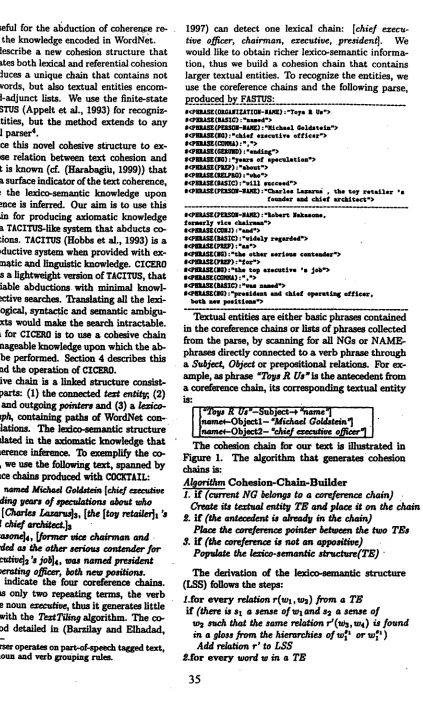
1997) can detect one lexical chain: [chief execu- tive o~cer, chairman, executive, .president]. We would like to obtain richer lexico-semantic informa- tion, thus we build a cohesion chain that contains larger textual entities. To recognize the entities, we use the coreference chains and the following parse, pro duc.ecl, b y FASTUS:
# < P ~ ( O R ~ I S l Z A T I O N - N A N E ) : " T o y s R g s " > J<PBBISE (B~5I¢) : ~named'>
#<PHKASE(PERSOIJ-g~) : "Nicl~el ~ l ~ t e l n " >
8<PHRISE(|G):mch/ef e x e c u t i v e o f f i c e r " >
8 < P ~ 5 ~ ( ~ ) : -oadlag'>
8 e ~ J ~ U ~ ( | ~ ) : ~ y t ~ Of epOCl~latiOIlw~
#<pna=~=(pKEp) : " s h o u t S >
8<PHUSEfB~SIC) :"~iZ1 succeed">
IcPRRISE(PELS~I-NIM~) : ' C h a r l e s L a z a r u , t h e t o y r e t a i l e r " s f o u n d e r a n d c h / e f e r c h i g e c t " >
S<PHRISE(PEP, S m I - J I ~ ) : " 1 o b o r ~ N a k a s o u .
f o r m r l y vice c h s i r n u " > |<pNltA~(COLI) : walMl">
8<Pwst~_(BISIC) : " g i d e l y r o g s r d o d " > 8 < P n t ~ ( P R ~ ) : " u " >
8<PH~SE(i~) : ' t h e o t h e r s o r i o a s c o n t e n d e r S >
8<l~mt-~_fJ~):%ho t o p e x e c u t i v e J8 Jo]}m> 8 < P n a ~ ( C O ~ A ) : " . ">
8~qLt~E(BLSIC) : ~ n u e d ' >
#<PHIJ~E(B~) : ' p r e s i d e n t a n d c h i e f o p e r a t i n K o f f i c e r . b o t h n e e p o e i t i c m 8 " >
[image:7.612.116.539.50.752.2]Textual entities are either basic phrases contained in the coreference chaln.q or lists of phrases collected from the parse, by scanning for all NGs or NAME- phrases directly connected to a verb phrase through a S~bject, Ob3ect or prepositional relations. For ex- ample, as phrase "Toys R (.ramie the antecedent from a coreference chain, its corresponding textual entity is:
|a~oys R Us"-Subject-+
'%ame"]
[ | n m ~ - O b j e c t l - "Mid~d GoMste/n~ . 1 " [ n ~ - O b j e c t 2 - "cA/e/e~cuffve offu~,~
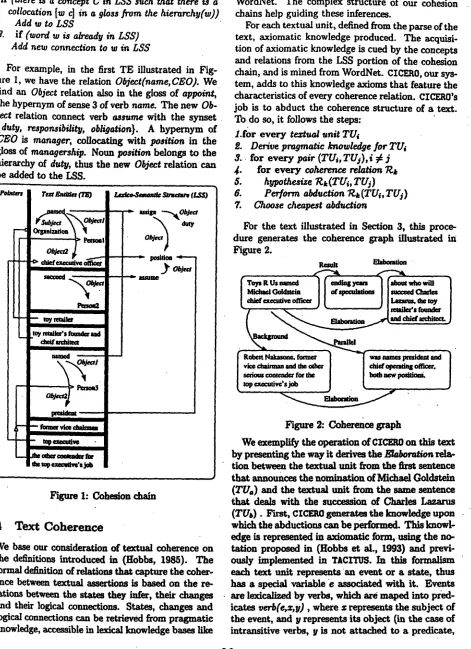
The cohesion chain for our. text is illustrated in Figure 1. The algorithm that generates cohesion chains is:
Algorithm C o h e s i o n - C h a l n - B u i l d e r
I. i f (current N@ belongs to a core/erenc~ chain) .
Create its te.z'htal entity T E and place .it on the Chain ~,. i f (the an ~__dent @ already/in the chain)
Place the c o r e f e r ~ pointer bet~eea the two TEs
3. i f (the ooreferen~ is n o t an appositive)
Populate the lezico-semantic s~ctu~(TE) "
The derivation of the lexico-semantic structure (LSS) follows the steps:
Lfor every re/at/on r(wt,,n2) from
aTE
if(there is st a sense of wl a . d s2 a sense of wa such that the same relation r'(ws,w4)/8 found
in a gtoss ~ the hierorchies of ,z~' or
w~' )
Add relation r" to LS$ ~.for e v e r y word tv in a TE
if (there is a concept C in LSS such that there is a collocation [~1 c] in a gloss from the hierarchy(w))
Add to to LSS
3. if (word w is already in LSS) Add ne~a connection to w in LSS
For example, in the first TE illustrated in Fig- ure I, we have the relation Object(name, CEO). We find art Object relation also in the gloss of appoint,
the hypernym of sense 3 of verb name. The new Obo ]ect relation connect verb assume with the synset
{duty, responsibility, obligation}. A hypernym of
CEO is manager, collocating with position in the gloss of managership. Noun position belongs to the hierarchy of duty, thus the new Object relation can be added to the LSS.
+ n r e a ~ o l D
~ L ~ t ~ . 5 ~ Smmmre (LSS)
I W+.,.'*'
1
"x
l ~ n ~ l " Obj¢,¢'l
I
i +
,.+,j
I
--II
I
T I~ M_-.-,*j~ .
$ h mp e.~m~'*.l~
Figure 1: Cohesion chain
4 T e x t C o h e r e n c e
We base our consideration of textual coherence on the definitions introduced in (Hobbs, 1985). The formal definition of relations that capture the coher- ence between textual assertious is based on the re- lations between the states they infer, their changes and their logical connections. States, changes and logical connections can be retrieved from pragmatic knowledge, accessible in lexical knowledge bases like
WordNet. The complex structure of our cohesion
chains help guiding these inferences. 0
For each textual unit, defined from the parse of the O text, axiomatic knowledge produced. The acquisi-
tion of axiomatic knowledge is cued by the concepts O
and relations from the LSS portion of the cohesion O chain, and is mined from WordNet. CICERO, our sys-
tem, adds to this knowledge axioms that feature the O
characteristics of every coherence relation. CICER0's O job is to abduct the coherence structure of a text.
To do so, it follows the steps:
0
/.for e v e r y textual unit TUi @
~. Derive pragmatic knowledge for TUi @
3 . for e v e r y pair (TUi,TUj),i ~ j
4- for e v e r y coherence relation 7~k O
5. hypothesize
R~(TU.
TUj)6. Perform abduction R~ (TU. TUj) O
7. Choose cheapest abduction @
For the text illustrated in Section 3, this proce- O dure generates the coherence graph illustrated in @ Figure 2.
Remit Elab, m~en e
',,im,m.immwnd~oma" I l ~ o l m m i ~ o m o + ,
J
" J t " 'Figure 2: Coherence graph
We exemplify the operation of CICERO on this text by presenting the way it derives the Elaboration rela- tion between the textual unit from the first sentence that announces the nomination of Michael Goldstein
(TU.)
and the textual unit from the same sentence that deals with the succession of Charles Lazarus(TUb).
l~st, CICERO generates the
knowledge upon which the abductions can be performed. This knowl- edge is represented in axiomatic form, using the no- tation proposed in (Hobbs et al., 1993) and previ- ously implemented in TACITUS. In this formalism each text unit represents a n event or a state, thus has a special variable e associated with it. Events are lexicalized by verbs, which are reaped into pred- [image:8.612.101.572.94.743.2]e
o
o
@
o
o
o
o
o
o
o
@
o
o
@
o
@
o
@
o
@
o
o
@
o
o
@
@
o
o
o
e
@
o
o
o
@
o
@
o
@
o
o
e
whereas in the case of bitransitive verbs, y is mapped" into Yl and l~2)."Moreover, predicates from the text are related to other predicates, derived from a knowl- edge base. These relations are captured in first or- der predicate calculus. For example, the pragmatic knowledge used for the derivation of the Elaboration
relation between T U a and TUbis:
TU,:
assiqn( e~ , z~ )&positionz~ =~
vac'ant-position( el ) ~ aJsign( e~ , z l )& Positionz l
TUb: . .
I l~e(e~, zl, z2),t'l~rson(zl)&~jmon(z2) =~ I ~acanLposition(e~)
[ lea~'e(et , z h z~)k~rs(m(z~ )&position(z,)&
[ a~sume(e2, zs, z2)&person(zs) =~
In the next step, ~!1 coherence relations are hy- pothesized, and the cost of their abduction is ob-
tained. The appendix lists the LISP function cre-
ated on the fly by CICERO that produces the ab-
duction of the Elaboration function. Because of the
computational expense, an intermediary Step sim- plifies the axiomatic knowledge. The appendix lists also the full abduciton and its cost. CICERO is a sys- tem still under development, and at present we did not evaluate the precision of its results.
5 C o n c l u s i o n
We have introduced a new empirical method for
coreference resolution, implemented in the COCgTtIL system. The results of this algorithm are used to
• guide the abduction of coherence relations, as per-
formed in our ClC~0 system. In an intermediary step, a rich cohesion structure is produced. This novel relation between coreference and coherence contrasts with the traditional view that coreference is a by-product of coherence resolution. Moreover, we reiterate the belief that coherence builds up from cohesion.
R e f e r e n c e s
Chinatsu Aone and Scott W. Bennett. 1997. Evaluating automated and mam~ acqui~tioa of anaphom res-
olution strat~e& In Proceedings of the $Sth Annual
Meeting of the A~odation for Computational f, ingu~. tics (ACL.gT), pages 122-129, Madrid, Spain.
Douglas E. Appelt, Jerry R. Hobbs, John Beat, David Israel, Megumi Kameyama and Mabry Tyson. 1993. The SRI MUC-5 JV-FASTUS Information Extraction
System. In Proceedings of the Fifth Me.uage Under- standing Conference
(MOC-5).
Nicholas Asher and Henri Wad& 1988. A computational account of syntactic, semantic and discourse principles
for anap.hora resolution. Journal of Semantics, 6:309-
344.
Brack Baldwin. 1997. CogNIAC: high precision corefer- ence with limited knowledge and linguistic resources. In Proceedings of the A CL '97/EA CL '97 Workshop on Operutional factors in practical, robust anaphora reJ-
olution, pages 38-45, Madrid, Spain.
Regina Barzilay and Michael Elhadad. 1997. Using Lex-
ical Chains for Text Summarization. In Proceedinga of
the A CL '97/BA CL '97 Workshop on Intelligent Scal-
able Text Summarization, Madrid, Spain.
Susan E. Brennan, Marilyn Walker Friedman and Carl J. Pollard. 1987. A centering approach to pronouns.
In Proceedings of the P.Sth Annual Meeting of the ACL (ACL-87), pages 155-162.
Jaime Carbonell and Richard Brown. 1988. Anaphora Resolution: A Multi-Strategy Approach. In Proceed-
ings of the l ~ h International Conference on Com.m~-
rational Linguistics, pages 96-101.
Claire Cardie and Kiri Wagstaff. 1999. Noun phrase
coreference as clustering. In Proceed imJs of the Joint
Conference on Bmpirical Methods in NI, P and Very Large Corpor¢
Niyu Ge, John Gale and Eugene Charuiak. 1998.
Anaphora Resolution: A Multi-Strategy Approach. In
Proceedings of the 6th Workshop on Very Large CoP. pore, ( c o L n v G / A C L 'gS).
Barbara J. g r c a , Aravind K. Joshi and Scott Weinstein. 1995. Centering. A Framework for Modeling the Local
Coherence of Discourse. Computational Linguistics,
21(2).
M.A.K. Halliday and 1~ Hassan. 1976. Cohesion in Eno glisk Longman, London.
Sanda M. Harabagiu. 1998. Deriving metonymic coer-
dons from WordNet. In Proceedings of the Worlc~hop
of the OsmJe of WordaVet in Natural .Language Pro- ce~ir~ SysternJ, CO LING.A CI, "gs, pages 142-148.
Sanda M. Harabagiu and Dan I. Moldovan. 1998. A Par-
allel System for Text Inference Using Marker Propaga-
tions. IBB8 Tmnaactions on Pandlel a n d ' D ~ i b ~
,ff/sl~s, 9(8):729--747.
Sands M. Harabagiu. 1999. From Lexical Cohesion to Textual Coherence:. A Data Driven Persoective. lm
ternational Journal of Pattern Recofnition and Arti- tidal Intelligence,
13(2):1-18.
M a ~ A. Hearst. 1997. TextTiling: Segmenting Text
into Multi-paragraph Subtopic Passages. Computa-
tional L i n ~ t i c s , 23(1):33--64.
Lynette Hirslunan and Nancy Chinchor. 1997. MUC-7 Coreference Task D,~nition.
Lynette Itirshman, Patricia Robinson, John Burger and Marc Vilain. 1998. The role of Annotated Training Data.
Graeme Hirst and David St-Onge. 1998. Lexical Chains as Representations of Context for the Detection and Correction of Malapropism. In WordNet - An Elec. tronic Lexical Databaze, Edited by Christiane Fell- baum, MIT Press.
J e r r y R. Hobbs. Resolving pronoun references. Lingua,
44:311-338.
Jerry R. Hobbs. 1979. Coherence and coreferen'ce. Cog- nitive Science, 3(1):67-90.
J e r r y R. Hobbs. 1985. O n the coherence and s t r u c t u r e o f discourse Technical R e p o r t CSLI-85-37, S t a n f o r d U n i v e r s i t y .
Jerry I t . Hobbs, M a r k Stickel, D o u g . E . A p p e l t , and P a u l M a r t i n . 1993. I n t e r p r e t a t i o n as a b d u c t i o n . Artificial
InteUigence; 63:69--142.
Shalom LapPin and Herbert Learn. 1994. An algorithm for pronominal anaphora resolution. Computational Linguistics, 20(4)'535-662.
Megumi Kameyama. 1997. Recognizing Re~erential Li, I~: An Information Extraction Perspective. In
Proe~-~-inos o/the Workshop on Operational Factorm in Practica~ Robu~rt Anaphom Resolution for Un- re.drict~d Texts, (A CL-97/BA OL. 97), pages 46-53,
Madrid, Spa=.
Andrew Kehler. 1997. ProbabilLstic Coreference in In- formation Extraction. In Pro,:ee~_ings of the Second Con/erenc~ on Empirical Methods in Natural Lan- guage PreceJsin9 ($IGDA T), pages 163-173.
Christopher Kennedy end Braulmir Bagure~v. 1996.
Aaaphora for everyone: Pronomln~d anaphora reso- lution without a parser. In Proc_eedings of the 16th International Conferenc~ on Computational Linguis- tic~ (COLhVQ.96).
William (2. Mann and Sandra A. Thompson 1988.
Rhetorical Structure ~ I Toward a functional
theory of text organization. T e ~ 8:243-281.
M. Marcus, B. Santorini and M.A. Mar~/-t~ewics. 1993. Building & large annotated corpm of En- glish: The Penn Tteebank. Computational Linguis-
19(2):313-330, 1993.
Joseph F. McCarthy and Weady Lelmert. 1995. Us- Lug ded~'on trees f-~ corefereace resolution. In Pro-
eenlin~ o/the IJth l n t m m t i o r ~ Joint Con/.~,.-.~e on Artificial Intdligen~ (IJOAI-95), pages 1050-1055.
Kathy McKeown. 198,5. Discourm~ strategies for gem-
eragmg natural-language text. Artificial Intdligenee,
27:1--41, 1985.
George A. Miller. 1995. WordNet: A L e ~ d Database.
Communication of the A CM, 38(11):39-41.
Ruslan Mitkov. 1 9 9 8 . Robust pronoun resolution with limited knowledge. In ProeePdings of COLING- A 0L'98, pages 869-875.
Jane Morris and Graeme Hirst. 1991. Lexieal cohesion computed by thesaura] relations as an indicator of t h e • structure of text. Computational Linguistics, 17:21-
48.
Massimo Poesio and Renata VieLra. 1998. A corpus- baaed investigation of definite description use. Com. putational Linguistics, 24(2):183-216.
Philip Resnik. 1995. Using information content to evalu- ate semantic similarity in a taxonomy. In Proceedings of the 14th lnt~natiomd Joint Conference on Artifi. cial Intdligenee (IJCAI-95), pages 448-453.
Elaine Rich and Susan Luperfoy. 1988. An architecture for anaphora resolution. In Proceedin9s of the £6th Annual Meeting of the Association for Computational Linguistics (ACL-88), pages 18-24.
Bonnie Webber. Discourse deixis: Reference to discourse
segments. In Prveeedings of the ,~6th Annual Meet- ing of the Association for Computational Linguistics (ACI,.88), pages 113-121.
R o b e r t W'flensky. 1987. Understondin90oal.B~ed Sto-
r/¢J. Phi) thesis, Yale University, New Haven, CT.
Appendix
(def~m n u e - n c c u d O (ccmplle-uAms
~ ( ( ( ( ~ 1 e l l ~A)l.2))((u~mmJ-posL~JLon e21 zl)
(~Laboral~i~ e21 e11)) O )
((((asmma-~sitlm .22 z2).IS)
((e~ty-posi~ioa *22 z2).6))
((nO-Sl~¢~la~Imm ,22 x2)) O ) ( ( ( ( l ~ L ~ . l m s ,2~ e13)1.2))
((Co1~1 .13 *23 e 1 3 ) ) O )
( O ((mine1.1 4 ) O ) ) six ' ( e l a ) ) (41*~e~ret (complIo-loK'X col-.~orm
• ( C ( ~ l t e l e l e2 e) lO)((no-specula~:l.oa~ 02 8)10)) n i l nlZ)))
• Cna=e-,mcc,,.U
O Corn:: 20 /n/l:tal losical toz-a:
((C0ML FA Z2 EJoI0.00o0)((II0-SN~(~Z.&TZ01S E2 A).I0.00o0)
I Cost: 22.0 fraa e .z.~-~,;~ nm,~. i n 0 us4q; ,-,Los 3.0: ( ( n ~wJ~12011 E! ~ ) , I 2 . 0 0 , 1 ) ( ( X O - S ~ I ~ O X S ~ 1 ) , 1 0 . 0 0 , 0 )
( C O ~ [1 i ~ El)
Con: 22.0 2ro8 . e ~ IIO-SPECI~'rZOIIS :1~ 0 ~:rmg u:lLeo 2.0: ((CO~lJ~ FA E2 F.).I0.00.0)((ASSOI~-FOSZTZ~ E2 l),S.00,1) (0~pl'Yoposrrza E2 A), 6.00o 1)
cIm-s~q~cuu'l~lnls E2 A)
3 Cost: 24.400002 fz~8 e ~ ~_ltrquLT1/H i n I uJLng mrA~ 1.1:
(L~ilIME-P0$XI'XUM El A)(U, AII011ATXOM E2 Z44)(M0-SPECOLITXO~J E2 A)
( c o ~ E1 E2 £1)
S Cost: 10 tz~m ezpiadJa 8 ~ i x 3 using a z l ~ 4.0:
((ll0-MPEC0UTI0ml E2 A), 10.00. 0)
01AM~ I~. A ) ~ . ' J r x 0 g E! i~.)(J~-P0SI'rxIMI !~ A) (Cling. El El Zl)
9 Co~: 8.0 ~rm eZlXUd/q ]I0-~Ur..AI'ZUS/a 8 u t z ~ aztcm 2.0: (ORetY-p0~l~J~ !~ 1).e.00.1)
( 1 0 - S P E C N A ~ I~ 13 ( ~ IU, A)(EL~WIUIT'J[ml Z2 El)
(L~qOME-P0~Frx011 I~ A)(~m~n El. !~ El)
10 Cost: 211.400002 # o a e x p u d / q IIO--SI~,ODL~I"208 :i~ 3
u h ~ az/~.. 2.0:
( ( ~ F.A X42), 14.o40o 2) ( ( J ~ ' ~ - i ~ I ~ Z O M E2 a)06.00, 1) ((exP~r-i,0~lTzl~l E! i ) , S.00, t)
OIO-SPi~TZmlS I~ ~ ) C I ~ T Z B E2 [1)
2
38