Can t e x t s t r u c t u r e be i n c o m p a t i b l e w i t h rhetorical s t r u c t u r e ?
N a d j e t B o u a y a d - A g h a , R i c h a r d P o w e r and D o n i a S c o t t
Information Technology Research Institute
University of Brighton
Lewes Road
Brighton BN2 4G J, UK
first name. lastname@it ri.bton.ac.uk
A b s t r a c t
Scott and Souza (1990) have posed the problem of how a rhetorical s t r u c t u r e (in which proposi- tions are linked by rhetorical relations, but not yet arranged in a linear order) can be realized by a text structure (in which propositions are ordered and linked u p by appropriate discourse connectives). Almost all work on this problem assumes, implicitly or explicitly, that this map- ping is governed by a constraint on compatibil- ity of structure. We show how this constraint can be stated precisely, and present some coun- terexamples which s e e m acceptable even though they violate compatibility. The examples are based on a p h e n o m e n o n we call
extraposition,
in which complex e m b e d d e d constituents of a rhetorical structure are extracted and realized separately.
1
I n t r o d u c t i o n
Text planning (or more broadly, d o c u m e n t plan- ning) can be divided into two stages. In the first stage, material is selected, perhaps from a knowledge base, and organized rhetorically. In the second stage, the rhetorical s t r u c t u r e is re- alized by a text s t r u c t u r e (or d o c u m e n t struc- ture), through which the material is distributed among sentences, paragraphs, vertical lists, and perhaps even diagrams. The RAtS (1999) pro- posal for a standard N L G architecture distin- guishes tile outputs of these two phases by the data types l:l.hetRep (rhetorical representation) and DocRep (document representation).
We focus in this p a p e r on t h e second stage of text planning - - the passage from RhetRep to DocRep. NLG researchers have addressed this issue in various ways, b u t everyone as- sumes some kind of s t r u c t u r a l compatibility be- tween rhetorical s t r u c t u r e and text structure. The most popular discourse framework in NLG is R ST (Mann a.nd T h o m p s o n . 1988). which
makes the crucial distinction between nucleus, which is the most i m p o r t a n t part of a message, and satellite, which is the peripheral part of the message. Scott and Souza (1990) provide guide- lines for the realisation of R S T trees into a co- herent text. One of t h e m is to avoid dangling sentences, that is, to avoid p u t t i n g "information that is only weakly relevant to the message" in a separate sentence because it will feel as if it has been introduced as an afterthought or as introducing a new topic which is then a b r u p t l y abandoned, disrupting the comprehensibility of the text. As an example, the authors provide the attributive satellite of an elaboration rela- tion.
Marcu (1996), in order to build a valid text plan from a set of rhetorical assertions, uses the "nuclearity principle", that is the observa- tion in Mann and T h o m p s o n ' s framework that "whenever two large text spans are connected through a rhetorical relation, that rhetorical re- lation holds also between the most i m p o r t a n t parts of the constituent spans". Therefore, the resulting text plans are valid in the sense that they are isomorphic with one of the rhetorical structures that can be built from the rhetorical assertions using this nuclearity principle.
ture ordered. Section 3 then defines a notion o f . s t r u c t u r a l compatibility that:is weaker than isomorphism; section 4 shows t h a t we can find plausible counterexamples even to this weaker formulation, and discusses why these passages occur. Section 5 discusses s o m e implications for NLG, and finally, section 6 raises further impor- tant issues.
2
R h e t o r i c a l s t r u c t u r e a n d
t e x t s t r u c t u r e
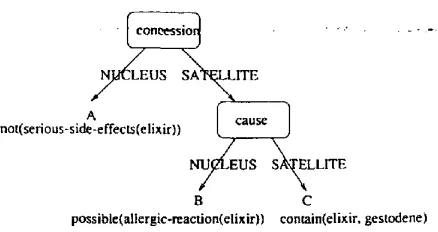
To distinguish clearly between FthetRep and DocRep, we need to define the kinds of infor- mation that should be included in the two rep- resentations. B a t e m a n and Rondhius (1997) compare several approaches to rhetorical rep- resentation, citing in particular RST (Mann and Thompson, 1988) a n d Segmented Discourse Representation T h e o r y (Asher, 1993). These approaches share the idea that rhetorical repre- sentations are composed of propositions linked by rhetorical relations; SDRT includes as well the logical apparatus of DRT, thus covering notions like necessity a n d logical scope which are missing from RST. For the most part, NLG applications have used the RST frame- work, adapted in various ways; the most com- mon representation, proposed also as the RAGS standard, is that of a tree in which terminal nodes represent elementary propositions, while non-terminal nodes represent rhetorical rela- tionships. This representation, proposed for ex- ample by Scott and Souza (1990), is illustrated by figure 1, which might be realized by the fol- lowing passage:
(1) Elixir occasionally provokes a mild allergic reaction B, because it contains gestodene C. However, Elixir has no serious side- effects A .
Assuming an RST-based framework, an im- portant issue is w h e t h e r the rhetorical represen- . tation should already.imply a linear order. Most researchers have followed Scott and Souza in as- suming that linear order should be left unspeci- fied; i t is during the transition to the document representation that the material is distributed among linguistic units (or perhaps diagrams, in a multimedia d o c u m e n t ) arranged in a specific order. Thus the c a u s e relation in figure 1. for example, could be realized with nucleus first, or satellite first, or satellite embedded within nu- cleus:
not(serious-side -e ffe~ts(elixir))
NU~EUS S,~LLITE
B C
possible(allergic-reaction(elixir)) contain(elixir, gestodene)
F i g u r e 1: R h e t o r i c a l r e p r e s e n t a t i o n
(2a) Elixir occasionally provokes a mild allergic reaction B, because it contains gestodene c.
(2b) Because it contains gestodene C, Elixir occasionally provokes a mild allergic reaction B.
(2c) Elixir, because it contains gestodene C, occasionally provokes a mild allergic reaction B .
In the RAGS proposal, which aims to extract a useful common approach from current work in NLG, the DocRep comprises an ordered tree corresponding roughly to the 'logical m a r k u p ' in notations like HTML and LaTeX. More pre- cisely, a distinction is m a d e between abstract
and concrete levels of representation, where the abstract representation corresponds to logical markup (e.g., concepts like 'paragraph' and :em- phasis'), while the concrete representation also covers graphical m a r k u p (concepts like ~vertical space' and 'bold face'). In terms of this dis- tinction, it is the AbsDocRep that is specified during text planning; graphical markup can be deferred to a later formatting stage.
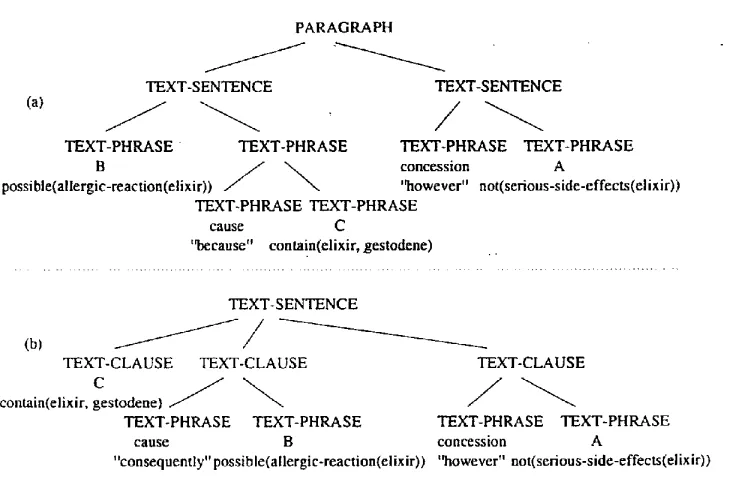
Figure 2 shows two alternative document rep- resentations expressing the rhetorical content in figure 1. Following Power (2000), the nodes of the tree are labelled with 'text-categories' us- ing a system that extends the 'text g r a m m a r ' proposed by Nunberg (1990). 1 These document
[image:2.596.348.567.78.194.2]PARAGRAPH
TEXT-SENTENCE
TEXT-PHRASE " TEXT-PHRASE
B
possible(allergic-reaction(elixir)) /
TEXT-SENTENCE
TEXT-PHRASE TEXT-PHRASE concession A
"however" not(serious-side-effects(elixir)) TEXT-PHRASE TEXT-PHRASE
cause C
"because" contain(elixir, gestodene)
TEXT-SENTENCE
(b) ~ ~ /
TEXT-CLAUSE TEXT-CLAUSE TEXT-CLAUSE
C
TEXT-PHRASE TEXT-PHRASE TEXT-PHRASE TEXT-PHRASE
cause B concession A
"consequently"possible(allergic-reaction(elixir)) "however" not(serious-side-effects(elixir))
F i g u r e 2: D o c u m e n t r e p r e s e n t a t i o n s
representations can now be passed to the tac- tical generator for the syntactic realization of the elementary propositions; the resulting texts might be as follows:
(3a) Elixir occasionally provokes a mild allergic reaction B, because i t contains gestodene C. However, Elixir has no serious side- effects A .
(3b) Elixir contains gestodeneC; consequently, it occasionally provokes a mild allergic reactionS; however, Elixir has no serious side-effects A .
3
S t r u c t u r a l c o m p a t i b i l i t y
Summarising the argument so far. we have made three main points:o Rhetorical s t r u c t u r e has typically been represented by unordered R S T trees such as figure 1.
o Document structure, which conveys in- formation similar to logical m a r k u p in HTML~ can be represented by ordered trees in which nodes are labelled with text- categories (figure 2).
c o n s t i t u e n t s of t e x t - c l a u s e s , s o m e t i m e s s e p a r a t e d by
commas, although within text-clauses the hierarchi- cal- structture is expressed mainly through syntax.
A given rhetorical representation can be expressed by a variety of different docu- ment representations, in which the propo- sitions occur in different orders, and in different text-category configurations, and the rhetorical relations are expressed by different connectives.
This formulation of the problem raises an obvi- ous question: how can we characterize the set of document representations that adequately real- ize a given rhetorical representation? Elsewhere (Power, 2000), we have argued that an a d e q u a t e realization must meet three conditions:
C o r r e c t c o n t e n t :
All propositions and nmst be expressed.
rhetorical relations
W e l l - f o r m e d s t r u c t u r e :
General formation rules for d o c u m e n t structure must be respected (e.g. a text- s e n t e n c e c a n n o t contain a paragraph, un- less tile paragraph is indented).
S t r u c t u r a l c o m p a t i b i l i t y :
[image:3.596.164.529.61.303.2]The first two conditions are relatively straight- forward, but what is meant,exactly .by 'struc- tural compatibility'?
Assuming that we are comparing two trees, the strongest notion of compatibility is isomor- phism, which can be defined for our purposes as follows:
DocRep is isomorphic with RhetRep if they group the elementary propo- sitions in exactly the same way.
More formally, every set of proposi- tions that is dominated by a node in DocRep should be dominated by a node in RhetRep, and vice-versa.
Under this definition, the rhetorical representa- tion in figure 1 is isomorphic with the document representation in figure 2a, but not with that in figure 2b:
* Proceeding top-down and left-to-right, the five nodes in figure 1 dominate the proposi- tion sets { A , B , C}, {A}, { S , C } , {B}, and
{c}.
o Ignoring nodes t h a t express discourse con- nectives, the nodes in figure 2a dominate the proposition sets { A , B , C } , { B , C } , {B}, {C} (twice), and {A} (twice). These are exactly the same sets that were ob- tained for figure 1.
* Tile corresponding sets for figure 2b are { A , B , C } , {C}, {B} (twice), and {A} (twice). Since the set { B , C } is missing from this list, there is a grouping in figure 1 that is not realized in figure 2b, so these representations are not isomorphic.
Since structures like figure 2b are common, iso- tnorphism seems too strong a constraint; we have therefore proposed (Power, 2000) the fol- lowing weaker notion of compatibility:
DocRep is compatible with RhetRep if every grouping of the elementary propositions in Docgep is also found in R.hetRep.
Formally, every set of propositionS that is dominated by a node in DocRep sh.ould be dominated by a node in RhetRep -- bat the converse is not re- quired.
Under this constraint, we allow tim document representation t.o omit rhetorical groupings, but
"you forfA~ T~ITE to take C ~
your tablet" S U S _ 1 NUC~USD 2
"Go on as before" ~,~J~ L E U S _ I N U C~.E~ S _ 2
B C
"take another as soon "wait until it is time as you remember" to take your next dose"
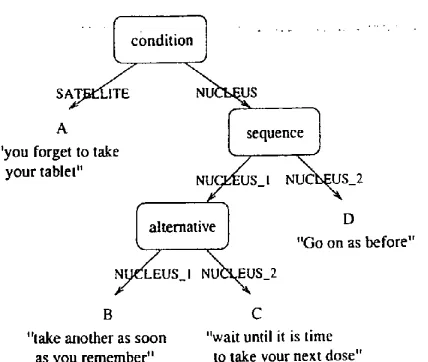
F i g u r e 3: R h e t o r i c a l r e p r e s e n t a t i o n o f in- s t r u c t i o n
not to introduce new ones. The resulting struc- tures may be ambiguous, but this will not mat- ter if the unexpressed rhetorical relationships can .be inferred from the content.
4
Extraposition
The compatibility rule may be a useful text- planning heuristic, but as a constraint on ade- quacy it still seems too strong. Looking through our corpus of patient information leaflets, we have noticed some exceptions, especially in pas- sages giving conditional instructions:
(4) If you forget to take your tablet A, take an- other as soon as you remember B or wait until it is time to take your next dose C. T h e n go on as before D.
From the point of view of document structure, this passage is a paragraph comprising two text- sentences: thns the proposition D is separated from the other three propositions, which are g r o u p e d in tile .first sentence. However, rhetor- ically speaking, D belongs to the consequent of the conditional: it is the final step of the plan t h a t should be activated .if_the patient forgets to take a dose (figure 3). Compatibility is vio- lated because tile DocRep contains a node (the first text-sentence) dominating the proposition set {A, B, C}. which is not dominated by any node in figure 3.
[image:4.596.338.552.78.259.2]through imitation of the patterns of conversa- tion, in which extra:.materi~! is_often ~tagged. on- as an afterthought. T h u s proposition D remains grouped with B and C - - they occur consecu- tively - - but through a minor relaxation of nor- mal p u n c t u a t i o n it has been separated by a full- stop rather than a comma. However, this expla- nation fails to cover variations of the example in which the propositions in the consequent are not realized consecutively in the DocRep:
(5) Consult your d o c t o r immediately A if a rash develops B. It might become seriously infected C.
In this example, A must be grouped rhetori- cally with C rather t h a n with B, unless we take the radical step of allowing rhetorical structure to contradict logical structure. The proposition C cannot be logically conjoined with the con- ditional because it contains a hypothetical dis- course referent (the rash) that is b o u n d to the antecedent, and is therefore inaccessible outside the conditional.
If passages of this kind are not artifacts of loose punctuation, why do they occur? A plau- sible reason, we suggest, is that some com- plex rhetorical p a t t e r n s cannot easily be real- ized in a way that maintains structural com- patibility, usually because text-clauses are over- loaded. Conditionals are especially prone to this problem because the only common discourse connective ('if') is a subordinating conjunction which can only link spans within a syntactic sentence (and thus within a text-clause). If ei- ther the antecedent or the consequent is com- plex, the author is faced with a tricky problem. We have found examples in patient informa- tion leaflets of conditional sentences so long that they are ahnost incomprehensible. More skilled authors, however, succeed in presenting the ma- terial clearly either by using layout (e.g., a com- plex antecedent is presented as an indented list), or by a trick of rhetorical reorganization that we will call eztraposition. It is this trick that intro- duces an incompatibility between RhetRep and DocRep.
Extraposition typically occurs when a rhetor- ical representation R contains a complex em- b e d d e d constituent C. To respect structural compatibility, R should be realized by a doc- ument unit that contains the realization of C: instead, in extraposition, a document unit real- ising/?. - C is coordinated with one realizing C. so that the extraposed material C is raised in
the DocRep to the same level as R. To recon- ... struct ~:the:.: meanings.of .the:-.whole:. passage, .the reader has to plug C back into R. In most cases, the author facilitates this task through an explicit deictic reference to the extraposed material (Bouayad-Agha et al., 2000):
(6) If you have any of the following, tell your doctor:
difficulty in b r e a t h i n g . . . al)dominal..Dains
nausea or vomiting
Occasionally, however, the a u t h o r leaves the extraposition implicit, assuming that the reader can infer the correct location of C within R from the propositional content. In such cases, the ex- traposition looks like an afterthought, because the unit realizing R - C contains no signal that a gap in its content will b e filled in later.
We have also come across rare examples of another kind of incompatibility in which Marcu's (1996) principle of nuclearity is vio- lated by grouping together two satellites which have the same nucleus. S u p p o s e that the rhetor- ical representation in figure 1 is realized by the following passage, in a context in which the reader knows nothing a b o u t gestodene:
(7) Although Elixir has no serious side- effects A, it contains gestodene c. Conse- quently, it occasionally provokes a mild al- lergic reaction 8.
The apparent concession relation between A and C here is paradoxical, since in rhetorical structure they are unrelated. Of course a con- trast between A and C nfight be perceived by a medical expert; however, one can construct similar examples in which the apparent relation is even less plausible:
(8a) Although we usually work fl'om nine' to five A, today is Friday C. Consequently, we can go home early B.
This may be rather loose, b u t many people find it acceptable. It could be explained as a rhetor- ical trick in which the sheer paradox of the con- cession serves as a signal that it is incomplete. The device might be spelled out as follows:
Although Elixir has no serious side- effects A, there exists a contrasting state of a~hirs resulting fl'om the flzct
that it contains gestodene c. This
Unlike the conditional examples above, this de- vice works o n l y . w h e n t he-.rhetorically g r o u p e d propositions B and C are consecutive in the DocRep. Thus whatever view is taken of exam- ple (Sa) , everyone finds its variant (Sb) much worse:
(Sb) # Today is Friday C although we usually work from nine to five A. Consequently, we can go home early s .
5
Implications for NLG
For many NLG applications, the notion of com- patibility defined above is a useful hard con- straint; even if violations of this constraint are sometimes acceptable, they are not essential. However, for some kinds of material (e.g., com- plex instructions), extraposition is a convenient rhetorical device which might improve the read- ability of the generated texts, so it is worth con- sidering how a text planner might be configured so as to allow solutions t h a t violate compatibil- ity.
In terms of the RAGS framework, there are broadly two possible approaches. First, we could introduce incompatibility by defin- ing
transformations
on the RhetRep; alterna- tively, we could relax the constraints govern- ing the transition from RhetRep to DocRep. The RAGS proposal (1999) allows for rhetorical transformations through a distinction between a b s t r a c t and concrete rhetorical representa- tions. The abstract representation AbsRhetRep expresses the rhetorical content of the under- lying message, while the concrete RhetRep ex- presses the rhetorical structure directly realized in the text and corresponds to the representa- tion used by Scott and Souza (1990) to discuss textual realisation. If KhetRep is incompati- ble with AbsRhetRep, the text structure DocRep will also be incompatible with AbsRhetRep, even though the rules for realizing rhetorical s t r u c t u r e by document structure are themselves compatibility-preserving, qYaalsformation oper- ations are also used by Marcu (2000) to map J a p a n e s e rhetorical structures onto English-like rhetorical structures, b u t t h e s e are mappings between two PdaetReps rather than from anA b s R h e t R e p to a RhetRep.
If transformations are allowed, there are obvi- ous dangers that the message will be expressed in such a distorted way that the reader cannot recover the original intention. For this reason, rhetori(:al transformations must be defined with
care. A fairly safe option would appear to be .... -the ..extraposition-iof.:a ,proposition. ~lab6rai~ing the antecedent of a conditional - - . e v e n though such a transformation would violate Marcu's (1996) 'nuclearity principle' (assuming that the antecedent is regarded as the satellite). The fop - lowing examples show that this transformation leads to acceptable texts regardless of the order of nucleus and satellite within the conditional:
(9a)~ Dcr.uot" use :Elixirif you :have had' an al: " lergic reaction to Elixir. An allergic reac- tion may be recognised as a rash, itching or shortness of breath.
(9b) If you have had an allergic reaction to Elixir, do not use Elixir. An allergic re- action may be recognised as a rash, itching or shortness of'breath.
However, the approach based on rhetorical transformations leads to difficulties when the acceptability of the resulting text depends on linear order as well as grouping. For instance, suppose that we try extraposing the elabora- tion of a satellite when the main relation is not a conditional, but a concession. The following passages show two texts that might result, but in this case the second version sounds anoma- lous: even if they are not grouped together in the DocRep, the satellite and its elaboration at least need to be consecutive.
(10a) You should not stop taking Elixir, even though you might experience some mild effects. For example, feelings of dizziness and nausea are very common at the begin- ning of treatment.
(lOb) # Even though you might experience some mild effects at tile beginning of tile treat- ment, you should not stop taking Elixir. For example, feelings of dizziness and nau- sea are very common at the beginning of treatment.
6
C o n c l u s i o n
We have discussed various examples Of extra- position. This phenomenon is due to various factors: the complexity of the material (exam- ple 4), the presence of logical information (5), the use of referring expressions to access infor- mation at various degrees of accessibility in the text structure (5,6,9), and the use of particular rhetorical strategies (7,8). This last group of ex- amples concerns.a concession constr.uction sim- ilar to the one discussed by Grote et al. (1997), namely the substitution concession. This type of concession groups together the conceded part A and the explanation C but leaves the conclu- sion B unverbalised. The difference in the case of examples 7 and 8 is that A and C are grouped together but B is required to follow them be- cause there is not enough information for the reader to infer B from A and C.
T h e extraposition phenomenon shows that the nucleus-satellite distinction is not the only factor influencing the segmentation of the mes- sage. In example 10, the injunction you should
not stop taking Elixir obviously expresses the
main intention of the author. However, the fact that the subordinated concession is placed after its main clause makes it available for further expansion. The sometimes compet- ing informational and intentional roles of dis- course segments have been at the centre of the debate over the nucleus-satellite distinction (Moore and Pollack, 1992; Moser and Moore, 1996; Bateman and Rondhius, 1997); the acces- sibility of discourse segments on the right fron- tier of a discourse structure is a phenomenon that has already been discussed by several re- searchers (Webber, 1991; Asher, 1993). Extra- position provides a useful and sometimes im- portant means of rearranging complex material in an abstract discourse representation in order to satisfy the constraints posed by linearisation into text.
R e f e r e n c e s
N. Asher. 1993. Reference to Abstract Objects
in Discourse. Kluwer Academic Publishers,
Netherlands.
J. Bateman and K. Rondhius. 1997. Coher- ence relations: Towards a general specifica- tion. Discourse Processes, 24(1):3-50.
N. Bouayad-Agha, D. Scott, and R. Power. 2000. Integrating content and style in doc- mnents: a case study of patient informa-
tion leaflets. Information Design Journal,
-9(2):161~176. - - • : - ' . : : - B. Grote, N. Lenke, and Stede M. 1997.
Ma(r)king concessions in english and german.
Discourse Processes, 24( 1):87-117.
W. Mann and S. Thompson. 1988. Rhetorical structure theory: towards a functional theory of text organization. Text, 8(3):243-281. D. Marcu, L. Carlson, and M. Watanabe. 2000.
The automatic translation of discourse struc- tures. In Proceedings of the North Ameri- can Chapter of the Association for Comptu-
ational Linguistics (NAACL'2000), Seattle,
Washington.
D. Marcu. 1996. Building up rhetorical struc- ture trees. In Proceedings of AAAI-96. Amer- ican Association for Artificial Intelligence. D.J Moore and M.E. Pollack. 1992. A prob-
lem for rst: The need for multi-level dis- course analysis. Computational Linguistics,
18(4):537-544.
M. Moser and J.D. Moore. 1996. Towards a synthesis of two accounts of discourse struc- ture. Computational Linguistics, 22(3):409- 419.
G. Nunberg. 1990. The Linguistics of Punctu-
ation. CSLI, Stanford, USA.
R. Power. 2000. Mapping rhetorical struc- tures to text structures by constraint satis- faction. Technical report, ITRI, University of Brighton.
RAGS. 1999. The RAGS project: towards a reference architecture for natural lan- guage generation systems. Technical report, Information Technology Research Institute, Brighton, UK.
D. Scott and C. de Souza. 1990. Getting the message across in RST-based text generation. In R. Dale, C. Mellish, and M. Zock, editors,
Current Research in Natural Language Gen-
eration. Cognitive Science Series, Academic
Press.
B.L Webber. 1991. Structure and ostension in the interpretation of discourse deixis. Lan-