27
Taguchi
b
ased optimization of machining parameters for surface
roughness in CNC turning of EN19 and EN31 steel
Venkatesh B, Udhay S Yargambalimath, Vishwas C J Gajanan M Naik, Sachin B
Dept. of Mechanical Engineering Dept. of Mechanical Engineering Mangalore Institute of Technology & Engg National Institute of Technology
Moodabidri Suratkal India India
[email protected] [email protected]
Abstract-In this work, the machining parameters are optimized in turning based on Taguchi method. The experiments have been carried out in dry condition using L9 orthogonal array. The machining parameters are selected for operations are spindle speed, feed rate and depth of cut with each three levels in CNC turning of EN19 and EN31 steel. As a result Feed rate was found to be dominantly affecting the surface roughness for both materials. This paper also estimates the contribution and significance of process parameters through analysis of variance (ANOVA) technique. The optimal setting parameters of surface roughness for EN-19 and EN-31 is A3-B1-C3 (1200rpm, 0.25mm/rev-0.6mm) and A2-B1-C2 (800rpm, 0.25mm/rev-0.4mm) respectively.
Keywords-Ra, CNC Turning, ANOVA, EN-19, EN-31.
1. INTRODUCTION
Metal cutting is one of the vital processes and widely used manufacturing processes in engineering industries. Highly competitive market requires high quality products at minimum cost. Products are manufactured by the transformation of raw materials [1]. Industries in which the cost of raw material is a big percentage of the cost of finished goods, higher productivity can be achieved through proper selection and use of the materials. To improve productivity with good quality of the machined parts is the main challenges of metal industry; there has been more concern about monitoring all aspects of the machining process. Surface finish is an important parameter in manufacturing engineering and it can influence the performance of mechanical parts and the production costs [2]. The ratio of costs and quality of products in each production phase has to be monitored and quick corrective actions have to be taken in case of deviation from desired output. Surface properties such as roughness are critical to the functional ability of machine components. Increased understanding of the surface generation mechanisms can be used to optimize machining process and to improve functional ability of the component. D. ManivelR. Gandhinathan [3] have
28 rate, depth of cut and cutting environment.
Experimental works have been carried out on the above mentioned parameters for EN19 and EN31 steels.
2. EXPERIMENTATION
Based on the properties and their application in the manufacturing industry the EN-19 and EN-31 steel materialsof 20mm diameter and
150mm length rolled rod is used for this research work and the machining has been carried out with ACE-CNC Turning experimental setup under dry condition. The tool used for the process is carbide tip tool, the CNC turning setup and turned components of EN-19 and EN-31have been shown in Fig.1. For this study L9 OA experiments were used.
Fig 1. Experimental setup and machined component
A. Design of Experiments:
In full factorial design several experiments to be carried out which consumes execution time. In order to overcome this problem Taguchi method is employed to reduce the experiments. This study gives an attention to three control
parameters, and each parameters have three levels which are shown in Table 1.Therefore, an L9 (34) orthogonal array (OA) experimental design was used. Table 2 presents L9 experiments with response [8-10].
Table 1: Control Parameters and their levels
Parameter Factor Level81 Level82 Level83
Spindle speed(rpm) A 400 800 1200
Feed8rate (mm/rev) B 0.25 0.50 0.75
Depth8of cut(mm) C 0.2 0.4 0.6
Table2: L9 Orthogonal design and response parameters
Sl No
Rotational Speed (rpm)
Feed rate (mm/rev)
Depth of Cut(mm)
Ra(µm)
EN-19 EN-31
1 400 0.25 0.2 10.2 1.12
2 400 0.50 0.4 12.56 6.36
3 400 0.75 0.6 8.96 10.86
4 800 0.25 0.4 4.56 2.41
5 800 0.50 0.6 8.09 5.63
6 800 0.75 0.2 14.6 10.16
29
8 1200 0.50 0.2 9.28 7.11
9 1200 0.75 0.4 9.22 9.18
3.
RESULTS AND DISCUSSION
A. Optimization of Machining Parametersof EN 19 Steel.
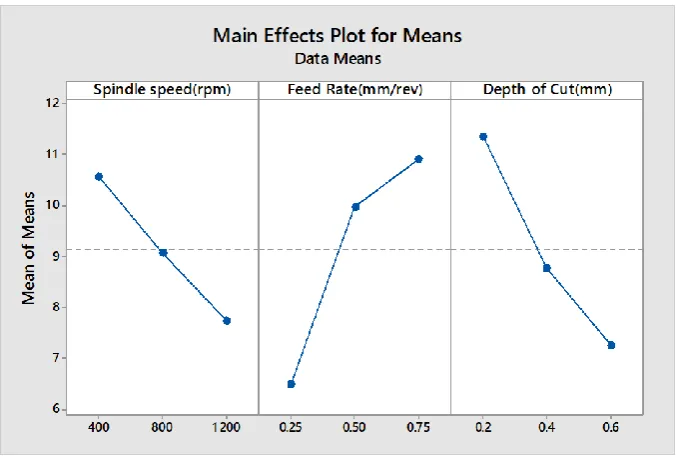
The main effect plots for surface roughness of EN-19 steel have been shown in Fig 2.From the Fig 2 it was observed that spindle speed
[image:3.595.128.468.261.489.2]and depth of cut has inverse effect and feed rate has direct effect on surface roughness, which means by increasing rotational speed and depth of cut the surface roughness decreases and also by increasing feed rate increases the surface roughness. Further, from the mean plot A3-B1-C3 (1200rpm, 0.25mm/rev-0.6mm) is considered as optimal process parameters for getting minimum surface roughness.
Fig. 2 EN-19 Main effects plot for surface roughness
B. Optimization of Machining Parameter of EN-31 Steel.
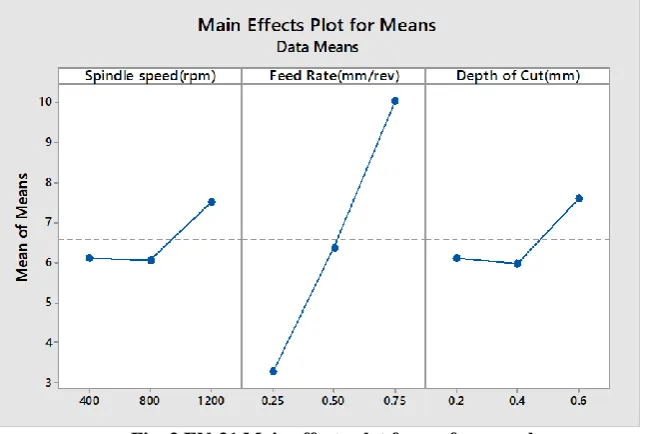
The main effect plots of surface roughness for EN-31 steel have been shown in Fig 3. From the Fig 3 it was observed that rotational speed feed rate and depth of cut has
30
Fig. 3 EN-31 Main effects plot for surface roughness
C. Analysis of Variance (ANOVA):
The analysis of variance estimates the significance of machining parameters on surface roughness. The significance of process parameters are identified by comparing α=0.05 level of 95% confidence level with p-value column, if p-value is less than 0.05 then the process parameter is said to be significant and p value is more than 0.05, then the process parameters is said to be insignificant
and also ANOVA table gives the influencing parameters on response [5, 7].
The analysis of variance presents the significance of process parameter on response variable for EN-19 material, From Table 3 it is conclude that rotational speed,feed rate and depth of cuthas shown insignificant effect on surface roughness, also from the F- test value can conclude that feed rate is most influencing parameters followed by depth of cut and rotational speed.
Table 3: Analysis8of variance of surface roughness for EN-19 steel
Source DF Adj SS Adj MS F-Value P-Value Remark Rotational speed 2 11.91 5.957 0.86 0.538 Insignificant
Feed Rate 2 32.43 16.214 2.33 0.300 Insignificant
Depth of cut 2 25.63 12.814 1.84 0.350 Insignificant
Error 2 13.90 6.949 - - -
Total 8 83.87 - - - -
The analysis of8variance for EN-31 steel materials are presents the significance of8process parameter on response variable, From Table 4 it
can be seen that none of the parameter significant on surface roughness, also from the F- test value can conclude that feed rate is most influencing parameters followed by depth of cut and rotational speed.
Table 4: Analysis8of variance of surface roughness for EN-31 steel
Source DF Adj SS Adj MS F-Value P-Value Remark Rotational speed 2 4.208 2.104 0.51 0.661 Insignificant
Feed Rate 2 68.145 34.572 8.43 0.106 Insignificant
Depth of cut 2 4.837 2.419 0.59 0.629 Insignificant
Error 2 8.199 4.099 - - -
Total 8 86.389 - - - -
[image:4.595.84.515.655.731.2]31 0.00
2.00 4.00 6.00 8.00 10.00 12.00
400 800 1200 0.25 0.5 0.75 0.2 0.4 0.6
spindle Speed(rpm) Feed Rate (mm/rev) Depth of Cut(mm)
Ra
(
µm
)
Machining Parameters
Ra vs Machining parameters for EN-19 and EN-31 Steel
Ra(µm) EN-19
Ra(µm) EN-31 The regression models to predict the
theoretical surface roughness have derived from the experimental data by using MINITAB 17 software.The theoreticalsurface roughness equations for EN-19 and EN-31 steel materials are given below.
Surface roughness (µm) for EN19 = 11.62 0.00352 Spindle speed (rpm) + 8.83 Feed Rate (mm/rev)- 10.22 Depth of Cut(mm)
Surface roughness (µm) for EN31 = -3.11 + 0.00178 Spindle speed(rpm) + 13.56 Feed Rate (mm/rev)+ 3.69 Depth of Cut(mm)
4. Confirmation Test
The Taguchi’s L9 type orthogonal8array experiments have been carried out on EN19 and EN 31 steel by considering the spindle speed, feed rate and depth of cut as input parameters, surface roughness as output response. From the analysis optimal process parameters have8been identified to minimize surface
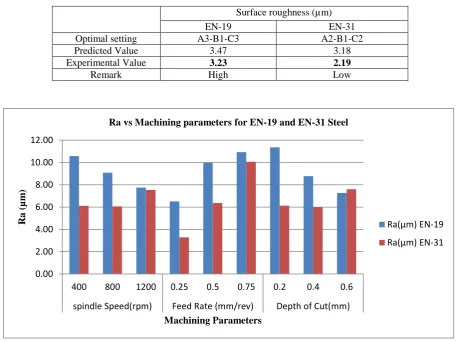
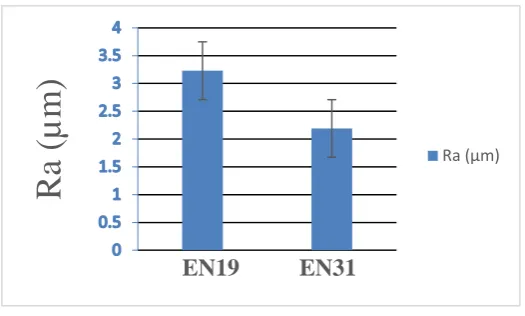
[image:5.595.67.524.324.665.2]roughness. The optimum8setting parameters of CNC turning and confirmation test results of Ra presents in Table 5. From the results it is conclude that the surface roughness is lower in EN-31 steel compare to EN-19 steel shown in Fig 5, also the Fig 4 have been shown the Ra versus machining parameters for EN-19 and EN-31 steel.
Table 5: Confirmation test results
Surface roughness (µm)
EN-19 EN-31
Optimal setting A3-B1-C3 A2-B1-C2
Predicted Value 3.47 3.18
Experimental Value 3.23 2.19
Remark High Low
32
Fig 5 Experimental Ra for EN-19 and EN-31 steel
5. CONCLUSION
The CNC turning investigation on surface roughness has been carried out for 19 and EN-31 steel , in this research work the effect of spindle speed, feed rate and depth of cut on response have been studied through L9 Taguchi’s orthogonal array and significance of process parameters are analyzed through ANOVA. The following important conclusions were drawn.
1. The surface roughness increases with increase in feed rate for both EN-19 and EN-31 materials.
2. The optimal setting parameters of surface roughness for EN-19 and EN-31 is A3-B1-C3 (1200rpm, 0.25mm/rev-0.6mm) and A2-B1-C2 (800rpm, 0.25mm/rev-0.4mm) respectively. 3. Feed rate is most influencing parameters
followed by depth of cut and rotational speed on surface roughness for both the materials. 4. EN-31 steel has shown lower surface
roughness compared to EN-19 steel.
REFERENCES
[1] R.A. Mahdavinejad, H. Sharifi Bidgoli, “Optimization of surface roughness parameters in dry turning,” Journal of achievements in Materials and Manufacturing Engineering 37/2 (2009) 571-577.
[2] Harsh Y Valeraa, Sanket N Bhavsara, “Experimental investigation of surface roughness and power consumption in turning operation of EN 31 alloy steel,” Procedia Technology 14 ( 2014 ) 528 – 534.
[3] D. Manivel, R. Gandhinathan, “Optimization of surface roughness and tool wear in hard turning of austempered
ductile iron (grade 3) using Taguchi method,”Measurement 93 (2016) 108– 116.
[4] Patole P. B , Kulkarni V. V, “Optimization of process parameters based on surface roughness and cutting force in MQL turning of AISI 4340 using nano fluid,” Materials Today: Proceedings 5 (2018) 104–112.
[5] Abhishek S Shetty, Akshar K S, Prashanth B Y, Gajanan M Naik, “Optimization of machining parameters on MRR for EN19 & EN31 steel using Taguchi Method,” International Journal of Emerging Research in Management &Technology ISSN: 2278-9359 (Volume-6, Issue-5). [6] Diptikanta Das, Ratish Kumar Thakur,
Anil Chaubey, Ashok Kumar Sahoo, “Optimization of machining parameters and development of surface roughness models during turning Al-based metal matrix composite,”Materials Today: Proceedings 5 (2018) 4431–4437.
[7] Gajanan M. Naik, S. Narendranath,“A parametric optimization of wire-ED turning process parameters on material removal rate of INCONEL 718,”Journal of Mechanical Engineering and Biomechanics, Volume 2, Issue 2, Page 8-14, 2017 ISSN- 2456-219X, DOI: https:/doi.org/10/24243/JMEB.
[8] R. Meshkabadi, G. Faraji, A. Javdani, V. Pouyafar, “Combined effects of ECAP and subsequent heating parameters on semi-solid microstructure of 7075 aluminum alloy,”Trans. Nonferrous Met. Soc. China. 26 (2016) 3091–3101. doi:10.1016/S1003-6326(16)64441-2.
Ra (µ
m
)
EN19 EN31
33 [9] A. Azimi, A. Shokuhfar, O. Nejadseyfi, H.
Fallahdoost, S. Salehi, “Optimizing consolidation behavior of Al 7068 − TiC nano composites using Taguchi statistical analysis,” Trans. Nonferrous Met. Soc. China. 25 (2015) 2499–2508. doi:10.1016/S1003-6326(15)63868-7. [10] Gajanan M Naik , S. Narendranath,