Automatic Negation and Speculation Detection in Veterinary Clinical Text
Katharine Cheng Timothy Baldwin Karin Verspoor
School of Computing and Information Systems The University of Melbourne
Australia
[email protected] [email protected]
Abstract
The automatic detection of negation and speculation in clinical notes is vital when searching for genuine instances of a given phenomenon. This paper describes a new corpus of negation and speculation data, in the veterinary clinical note domain, and describes a series of experiments whereby we port a CRF-based method across from the BioScope corpus to this novel domain.
1 Introduction
Negation and speculation are common in clinical texts, yet pose a challenge for natural language processing of these texts. Negation indicates the absence or opposite of something, and is defined within the previously released BioScope corpus (a collection of biomedical and clinical documents annotated for the task of negation/speculation de-tection) to be the “implication of the non-existence of something” (Szarvas et al., 2008). For exam-ple, the statement no abnormalities were found in the patient indicates the absence of abnormal-ities in the patient. Speculation is used to indi-cate uncertainty or the possibility of something, and is defined within BioScope to be statements of “the possible existence of something”. For ex-ample, there is possible bacterial infection indi-cates that an infection might be present, without any certainty that it is. Both are commonly used in clinical texts as a means of ruling out diagnos-tic possibilities and hypothesising.
This paper will discuss a method for detect-ing negation and speculation over clinical records from the Veterinary Companion Animal Surveil-lance System (VetCompass) project.1 The
Vet-Compass project is a database of veterinary clin-ical records for tracking animal health. The database may be used for research on the effects
1http://www.rvc.ac.uk/vetcompass
and usage of a particular drug, or the prevalence and distribution of a disease. Such studies are typ-ically performed by querying for terms relevant to a drug or disease of interest, and analysing the re-trieved clinical records. However, results identi-fied using keyword matching are often speculative or negated mentions rather than true occurrences. By automatically detecting negation and specula-tion, we aim to suppress these results, and provide a higher-utility set of documents to the user.
The task of negation/speculation detection is often defined in terms of two subtasks: (1) sig-nal (or cue) detection; and (2) scope detection. Negation/speculation signal (or cue) detection in-volves determining which words in a sentence indicate that a negation/speculation is occurring. Negation/speculation scope detection involves de-termining which words in a sentence the nega-tion/speculation applies to, under the constraints that: (a) the cue word is contained within the span of the scope; and (b) the span is contiguous. Con-sider two examples from the clinical notes subset of the BioScope corpus:
(1) The lungs are well expanded, but [[NEGnot
hyperin-flatedNEG]].
(2) Mild thoracic curvature, [[SPEC possibly positional SPEC]].
The cues here for negation and speculation arenot
and possibly, respectively, and the words inside the brackets are within the scope of the cues.
meaning that clinical notes are largely for personal consumption, and thus are highly idiosyncratic in nature. Second, while radiology clinical notes are often professionally transcribed from an oral ac-count by the clinician, in the veterinary general practice context, notes are authored directly by the clinician as text. Inevitably, this is done under time pressure, meaning that the text is often un-grammatical and lacks punctuation. Examples (3) and (4) exemplify negation and speculation in Vet-Compass:
(3) Mm - moist [[NEGno skin tentNEG]]
(4) Adv [[SPEC poss bacterial infectionSPEC]], adv [[SPEC
can be allergy in originSPEC]]
Such differences in usage between veterinary clin-icians and other medical professionals such as ra-diologists are a major focus of this work, in adapt-ing the annotation framework from BioScope to this new domain.
This paper attempts to address the following research questions: (1) Can the task of nega-tion/speculation detection be applied to veterinary clinical records? (2) Are models trained over the human clinical records of the BioScope corpus ap-plicable to veterinary clinical notes?
This paper describes the process of annotat-ing negation and speculation in veterinary clini-cal records. We then demonstrate that the task of negation and speculation detection can be success-fully applied to veterinary clinical notes using a simple conditional random field (CRF) model. We additionally show that models trained on a related out-of-domain corpus such as the BioScope have utility over veterinary clinical records, in particu-lar for negation detection.
2 Literature Review
2.1 Previous Work in Negation and Speculation Detection
Most work on negation and speculation detection has focused on biomedical documents such as bio-logical research papers and clinical notes, with the latter being most relevant to this research.
Early approaches to negation detection were primarily rule-based. One of the best-known sys-tems for negation detection is NegEx (Chapman et al.,2001), which is based on regular expressions containing a negation cue term (such asnoornot). Another rule-based negation detection system is NegFinder (Mutalik et al.,2001).
More recently, machine learning approaches have become popular. Morante et al.(2008) pro-posed a machine learning approach that consists of two phases: (1) classification of whether each token in a sentence is a negation cue, and (2) clas-sification of whether each token is part of the nega-tion scope of a given cue. Both phases used a memory-based classifier using features such as the the wordform of the token, part-of-speech (POS) tag, and chunk tags of the token and neighbour-ing tokens. The approach was also applied to speculation detection (Morante and Daelemans,
2009a), and incorporated into a meta-learning ap-proach to the second phase of negation scope de-tection (Morante and Daelemans, 2009b). Other approaches that use machine learning include the work ofAgarwal and Yu(2010a,b) that uses con-ditional random fields (CRFs) to detect negation and speculation, andCruz D´ıaz et al.(2012) who experimented with the use of decision trees and support vector machines.
Most work on negation and speculation detec-tion has focused on a specific corpus and domain, with some exceptions. Wu et al.(2014) investi-gated the generalisability of different negation de-tection methods over different domains, and found that performance often suffers without in-domain training data.Miller et al.(2017) also investigated the use of different unsupervised domain adapta-tion algorithms for negaadapta-tion detecadapta-tion in the clin-ical domain and found that such algorithms only achieved marginal increase in performance com-pared to systems that use in-domain training data.
2.2 Veterinary NLP
We are only aware of a few papers that have ap-plied natural language processing in the veterinary domain. Ding and Riloff(2015) conducted work on detecting mentions of medication usage in a discussion forum for veterinarians, and categoriz-ing the usage of the medication. A classifier deter-mines whether each word is part of a medication mention using features such as the POS tags and neighbouring words The output of the medication mention detector is used by another classifier to determine its usage category such as whether the clinician prescribed the medication or changed it.
cases of enteric syndrome.Lam et al.(2007) used clinical records of racing horses to categorise their reason for retirement.Duz et al.(2017) used clas-sification to identify cases of certain conditions and drug use in clinical records from equine vet-erinary practices. In each of these studies, a dictio-nary was compiled to identify and detect phrases that indicate a certain category.
2.3 BioScope Corpus
Currently, there is no publicly available corpus for training models over veterinary clinical notes. However, the BioScope corpus (Szarvas et al.,
2008) provides a relevant dataset from which to train out-of-domain models. It is a publicly avail-able collection of biomedical documents that have been annotated for both negation and speculation, in the form of cue words and their scope (see Sec-tion1). BioScope consists of three subcollections: clinical radiology notes, biological papers, and ab-stracts of biological papers from the GENIA cor-pus (Collier et al.,1999).
3 VetCompass Corpus
The VetCompass project is a collection of clinical records of veterinary consultations from several participating practices, to support analysis of ani-mal health trends (McGreevy et al.,2017). To con-duct these studies, clinicians use an information retrieval (IR) front-end to retrieve clinical records related to their particular information need, based on Boolean searches. A major bottleneck for the naive IR setup of returning all matching docu-ments is the prevalence of term occurrences in negated or speculative contexts, which dominate the results for many queries. This is the primary motivation for this research: to improve the qual-ity of the search results by filtering out document matches where the component term only occurs in negated or speculative context. The major chal-lenge here is that the language used in the vet-erinary clinical notes of VetCompass differs from that used in related publicly available datasets such as the BioScope radiology clinical notes.
3.1 Discussion of VetCompass Corpus
The corpus used in this work was constructed from a random sample of 1 million clinical records from VetCompass UK.2 VetCompass clinical records
2http://www.rvc.ac.uk/VetCOMPASS
contain a wide variety of text. Many records con-tain free text describing the clinician’s observa-tions, hypotheses, and descriptions of treatments and future actions. However, there are also records that contain only billing information, document the weight of the patient, or are reminders to per-form certain actions like sending an invoice to the owner of the patient.
Compared to the BioScope radiology clinical notes, VetCompass clinical notes are much more informal, possibly due to the fact that they are largely “notes to self” (see Section1). As such, ad hoc abbreviations and shortening of terms as shown in Examples (3) and (4) are very common, and informal speculative expressions such asfeels likeandlooks likeare prevalent:
(5) Skin [[NEGnot quite so erythematousNEG]] but some
scurf and [[SPEC looks like superficial pyoderma SPEC]].
(6) [[SPEC Feels like lipomaSPEC]], but [[NEGcannot
con-firm without lab testsNEG]].
(7) Adv [[SPECsounds like colitisSPEC]] so disp emds btu
adv o if no improvement resee and bring in sample.
There are certain negation and speculation cue terms that appear only in the VetCompass corpus such as:
(8) Examination: v lively, [[NEGnad on oral examNEG]]
and ghc all fine.
(9) Assessment: [[SPECgastritis??SPEC]]
The term nad is often used in place of no acute distress or no abnormalities detected, and is an instance of negation. Question marks were of-ten used as speculative cue terms such as in Ex-ample (9). The use of domain-specific cue terms presents a challenge for applying models that were trained on a corpus like BioScope clinical notes.
Misspellings, grammatical errors and lack of punctuation are also common in the text of the vet-erinary general practice clinical notes, e.g.:
(10) But depressed last 4 days and srop preds 2.5mg abruptly 4 days ago and sneezing [[NEG wuithout
nasla dischargeNEG]] 2 days too.
(11) Gave deepest sympathies; [[SPEC unsure of cause SPEC]] [[SPEC poss underlying condition causing gut
stasis or non-specific abdominal pain symptoms or acute embolus this morningSPEC]]
In terms of annotation, while some abbrevia-tions, shorthands, misspellings, and punctuation errors are easy to interpret, others are more dif-ficult to understand:
(12) - other poss: renal diz (given that had low sg + proteinuria, ˆBUN/ˆPhosp BUT N - creat)/liver diz (given hepatomegally on rads + ˆALP, Bile acids, Cholest, ? low sod/K+ ratio - could be related to kids or addisonian crisis BUT no hx of pu/pd
Symbols likeˆ require domain expertise to inter-pret. The appearance of terms likepossindicates that the sentence contains speculation but the ir-regular use of punctuation makes determining the correct boundaries of the speculation scope diffi-cult. In fact, the absence of certain punctuation marks such as full stops can make it difficult for sentence tokenizers to work correctly.
In the VetCompass corpus, a single statement of speculation is sometimes expressed using multiple speculation cue terms, e.g.:
(13) History- o concerned swollen lower lip, [[SPECthinks
poss stungSPEC]], been there 2d
Here, the clinician is reporting that the owner of the patient (shortened too) speculated that the pa-tient was stung, as indicated by two cue terms,
thinksandposs, presumably to indicate their lack of confidence in the statement. Such instances of “double hedging” are very rare in BioScope, pre-senting an extra point of differentiation.
3.2 Annotation Guidelines
Here, we outline the annotation guidelines for the VetCompass corpus, which borrow heavily from the BioScope annotation guidelines. As per the BioScope annotation guidelines, sentences from VetCompass are annotated for speculation if they express uncertainty or speculation, and annotated for negation if they express the non-existence of something. The min-max strategy of Bio-Scope annotation is also followed (Szarvas et al.,
2008). Negation/speculation cues are annotated such that the minimal unit that expresses nega-tion/speculation by itself is marked. Scopes are then annotated relative to cue words, to have max-imal size or the largest syntactic unit possible. Be-low, we detail important deviations from the Bio-Scope annotation guidelines, which are motivated in part by the usage of the negation/speculation de-tection system in an information retrieval context. 3.2.1 Annotation of Cues
The VetCompass annotation guidelines use the same set of cue words as BioScope, with the
addi-tion ofNAD(a negation cue — see above), ques-tion marks (which are potentially speculaques-tion cues — see above), and shortened and misspelled vari-ants of cue words (likepossforpossible).
As with BioScope, not all occurrences of a negation or speculation keyword indicate negation or speculation. For instance, occurrences of nega-tion or speculanega-tion keywords in descripnega-tions of proposed actions are generally not annotated for negation or speculation. Examples of such cases are:
(14) Advised to not give last onsior due to d+.
(15) Suggested FNA if increase in size
In Example (14),not is not annotated as a nega-tion cue since the sentence is stating a recommen-dation rather than expressing the absence or op-posite of anything. In Example (15),suggestedis not annotated since it is being used in the sense of proposing an action rather than hypothesising. These examples are also not annotated because of the utility they might provide for a clinician. If a clinician was researchingFNA, the document con-taining Example (15) would be potentially useful for understanding situations where such a proce-dure was proposed. However, actions that were performed in the past that contains negation or speculation would be annotated such ascannotin Example (6) which is clearly expressing the oppo-site of the ability to perform that action.
Conditionals are another situation where nega-tion or speculanega-tion keywords may not always be annotated as cues. If a negation or speculation keyword appears in the clause expressing the con-dition (clause containing theif), then they should not be annotated as cues as demonstrated in the following examples:
(16) Adv if O not wanting to consider euthanasia then need to get a veterinary behaviourist involved ASAP
(17) Stop treatment immediately if vomiting or diar-rhoea occurs
Here, there is not clear negation or speculation, but rather the lack of something in the conditional (e.g. consider euthanasia) or consequent (e.g.
inside of a conditional, there is usually other formation in the clinical record that provides in-structions about what to do in non-negated circum-stances which is useful for a clinician. In the case of a term being speculated inside of a conditional, the consequences of the term occurring is certain even if the condition had not occurred.
3.2.2 Annotation of Scopes
In many cases, negation and speculation scopes start at cue terms and end at the end of the clause or sentence. However, punctuation is often omit-ted, meaning that boundaries of clauses and sen-tences can be unclear. The annotator must use their own judgement and interpretation of the sen-tence in order to create a suitable annotation. The following example demonstrates a sentence where an annotator must interpret the sentence to under-stand where the clause boundaries are:
(18) Abdo palpation ok [[NEG no painNEG]] [[SPEC poss a
little bloatedSPEC]] [[NEGno fluidNEG]] thrill
abdomi-nally temp normal has had ongoing GI issues occa-sional use of steroids.
Unlike the BioScope annotations, VetCompass clinical records were not annotated to contain nested speculation scopes, i.e. speculation scopes are never contained within other speculation scopes. This decision was motivated by the ex-pected retrieval usage of the negation/speculation system: such information does not provide ad-ditional information to help filter out negated or speculated mentions of certain terms from search results. An example of the implication of this guideline is shown in the following sentence that is annotated with one negation scope and one specu-lation scope:
(19) [[NEG No obvious mass NEG]], [[SPEC suspect poss
trichobezoars?SPEC]]
The above sentence would have been annotated as three nested speculation scopes under the Bio-Scope annotation guidelines. However, using the VetCompass annotation guidelines, only a single speculation scope will be annotated, containing three separate speculations cues. If a user had wanted to search for documents with trichobe-zoars, this sentence will not be retrieved regardless of whether the nested structure is annotated or not. However, nested negation scopes in VetCompass are annotated. Moreover, speculation scopes that are nested within a negation scope and vice versa are also annotated.
F1-score
Negation Cue 0.80 80.3
Speculation Cue 0.65 65.5
Negation Scope 0.73 54.8
[image:5.595.336.491.62.124.2]Speculation Scope 0.73 63.3
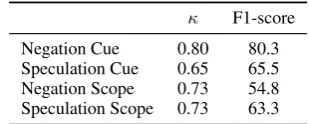
Table 1: Inter-annotator agreemenent rates
3.3 Annotation Process
1041 records were randomly selected for annota-tion. These were divided into a training set, devel-opment set and test set, comprising 624, 208 and 209 records, respectively. The data was single-annotated by the first author using the BRAT anno-tation tool (Stenetorp et al.,2012), in consultation with the other authors in instances of doubt.
100 records (containing 586 sentences) from the test set were selected and annotated by one of the other authors, following the guidelines in Section3.1. The agreement between the two an-notators was calculated using Cohen’s kappa ()
and F1-score (obtained by treating the annota-tions made by the main annotator as the gold-standard). We measure the amount that the two annotators agreed that a particular token is a nega-tion/speculation cue or scope. The inter-annotator agreement is described in Table1.
The values in Table1demonstrate a
reason-able amount of agreement between the two anno-tators. However, there is still some subjectivity, particularly for the speculation cues.
There are several reasons for the discrepancy in annotations between the two annotators: (1) the limited experience in linguistics and text analysis on the part of the main annotator of VetCompass; (2) the lack of pre-training for annotating the Vet-Compass corpus for the other annotator, beyond receiving the annotation guidelines; and (3) the different levels of familiarity with the datasets of BioScope and VetCompass.
3.4 Preparation of corpus
Sentence tokenization was performed to prepare the corpus for usage, based on the findings of
nega-Total documents 1041
Total sentences 6582
Total words 50222
Avg. sentence length 10.06±8.38
% negated documents 41.59
% negated sentences 11.21
Avg. neg. span length 3.69±1.97
% speculated documents 20.65
% speculated sentences 5.15
[image:6.595.105.256.63.169.2]Avg. spec. span length 5.60±3.57
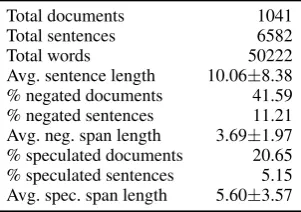
Table 2: VetCompass NegSpec Corpus Statistics
tion/speculation scopes had the potential to cross sentence boundaries or in clear instances where correct sentence boundaries were not added. Only about 10% of the corpus underwent correction for sentence tokenization.
3.5 Summary of Corpus
Table 2provides details of the annotated corpus. In general, large variations in sentence length can be observed: some sentences are as short as two words (e.g. reporting the patient weight), while others contain long detailed descriptions of the consultation.
The annotated VetCompass corpus contains a slightly lower proportion of negated sentences compared to those in the BioScope clinical notes (where 13.55% of the sentences were annotated as negated), and a much lower proportion of specula-tive sentences (compared to 13.39% in BioScope).
4 Methodology 4.1 Model Description
To evaluate whether the task of negation and spec-ulation detection can be applied to the veterinary clinical notes of VetCompass, a simple linear-chain conditional random field (CRF: Lafferty et al. (2001)) model was trained, in the form of a re-implementation of the negation and specula-tion detecspecula-tion methods proposed byAgarwal and Yu(2010a,b).
The negation detection system consists of two parts: a cue detection system, and a scope detec-tion system. The cue detecdetec-tion system is a CRF that classifies whether or not a given token is a negation cue. A CRF was used for cue detection to be able to model contexts in which cues appear in both negation and non-negation contexts, and to model multiword cues. The scope detection sys-tem is also a CRF, and classifies whether or not a token in a sentence is part of a negation scope.
The negation cue CRF uses only the words of the sentence as features. For the negation scope CRF, both the words of the sentence and the POS tags were used. When POS tags are used, the words that are part of a negation cue (that were detected by the negation cue CRF model) were either re-tained or replaced with a special CUE tag. The speculation detection system has a similar setup, except the system classifies a token as being the inside or outside of a speculation cue or scope.
The cue detection system is based on the follow-ing features: the target word, and the two words to the left and right of the target word. The scope detection system determines if a token is inside or outside a negation or speculation signal using either the words and POS tags of the token, five tokens to the left and right.
Our experiments are based on the corpus de-scribed in Section 3.4. The size of the context window for the CRF model was selected based on preliminary experiments with the development set. The parameter that achieved the best F-score over that set was chosen. NLTK3 was used to
to-kenise the sentence and obtain the POS tags. As our CRF learner, we used CRF++ v0.58.4 In our
experiments, CRF models were either trained on BioScope clinical dataset, VetCompass, or both.
4.2 Baselines
We used NegEx system and LingScope as base-lines. LingScope is a Java implementation of the CRF models developed by Agarwal and Yu
(2010a,b). It contains models that were pre-trained using the BioScope clinical data. Though our CRF model and LingScope were based on the same paper, LingScope differs from our models through the use of a different CRF implementa-tion (using the CRF model provided by the Abner tool (Settles, 2005)), the size of context window used for the classification, and the POS tagger (the Stanford POS tagger).
We used a Python implementation of NegEx.5
This version of NegEx detects negation scopes to be between a trigger term/phrase identified by NegEx and either a conjunction, start or end of a sentence (which can be longer than the limit of five tokens in the original version of NegEx by Chap-man et al.(2001)).
3http://www.nltk.org/
4https://taku910.github.io/crfpp/ 5https://code.google.com/archive/p/
4.3 Experimental Setup
Our experiments were based on the fixed split of the corpus described in Section3.3. We evaluate both the cue detection and scope detection sys-tem using precision (P), recall (R) and micro-average F-score (F). Evaluation was performed on a token-level based on whether it is inside or outside of any negation/speculation cue or scope.
We experimented with using different training data to determine whether models trained on out-of-domain data such as BioScope clinical data are suitable for veterinary clinical notes. Since Bio-Scope clinical dataset is much larger than Vet-Compass, we also experimented with oversam-pling of instances from the VetCompass training data when both corpora were used for training (at oversampling rates of 1, 2 and 5). When an over-sampling rate of 2 is used, we use two duplicates of each VetCompass training record during the training process, and similarly for oversampling rate of 5.
5 Results
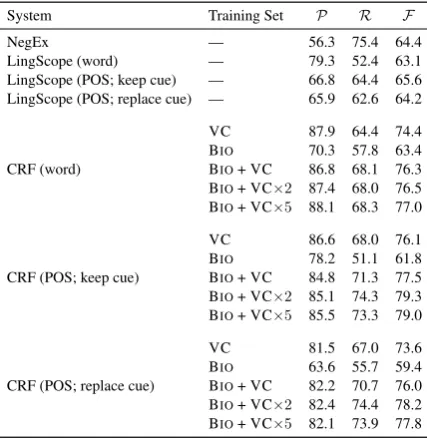
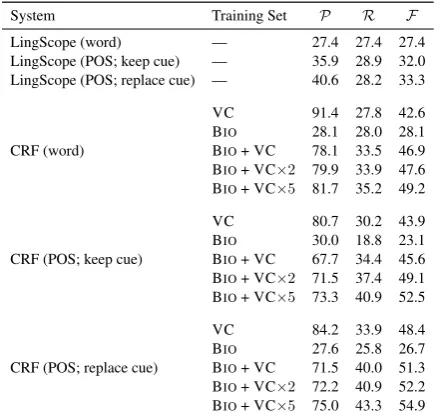
Results for negation cue detection and negation scope detection are presented in Table 3 and Ta-ble 4, respectively. Results for speculation cue detection and speculation scope detection are pre-sented in Table5and Table6, respectively.
When trained only on BioScope clinical data, the CRF systems (for both cue detection and scope detection) performed worse than their re-spective baselines. The model only outperforms the baselines when VetCompass training data is used. For negation cue detection and scope de-tection, incorporating both BioScope clinical data with VetCompass records as training instances helps improves the F-scores for most cases. Fur-ther marginal improvements can be achieved with oversampling of the VetCompass training in-stances as well in most cases.
However, for speculation cue and scope detec-tion, the inclusion of BioScope clinical data with VetCompass training data helps improve the recall but reduces the precision, leading to only marginal improvements in F-scores. Oversampling Vet-Compass helps to improve the precision, recall and F-score slightly, but the precision is still lower than when the BioScope clinical data was not included in the training set. In both speculation cue detec-tion and scope detecdetec-tion results, the recall is con-sistently much lower than the precision. The
re-P R F
NegEx 73.2 73.2 73.2
LingScope 89.1 71.1 79.1
CRF (VC) 89.3 78.5 83.6
CRF (BIO) 75.2 63.1 68.6
CRF (BIO+ VC) 90.2 80.5 85.1
CRF (BIO+ VC⇥2) 89.4 85.2 87.3 CRF (BIO+ VC⇥5) 89.5 85.9 87.7
Table 3: Results for Negation Cue Detection Training data used for CRF models are either Bio-Scope (BIO) and VetCompass (VC) or both
System Training Set P R F
NegEx — 56.3 75.4 64.4
LingScope (word) — 79.3 52.4 63.1
LingScope (POS; keep cue) — 66.8 64.4 65.6 LingScope (POS; replace cue) — 65.9 62.6 64.2
CRF (word)
VC 87.9 64.4 74.4 BIO 70.3 57.8 63.4 BIO+ VC 86.8 68.1 76.3 BIO+ VC⇥2 87.4 68.0 76.5 BIO+ VC⇥5 88.1 68.3 77.0
CRF (POS; keep cue)
VC 86.6 68.0 76.1 BIO 78.2 51.1 61.8 BIO+ VC 84.8 71.3 77.5 BIO+ VC⇥2 85.1 74.3 79.3 BIO+ VC⇥5 85.5 73.3 79.0
CRF (POS; replace cue)
[image:7.595.331.502.62.154.2]VC 81.5 67.0 73.6 BIO 63.6 55.7 59.4 BIO+ VC 82.2 70.7 76.0 BIO+ VC⇥2 82.4 74.4 78.2 BIO+ VC⇥5 82.1 73.9 77.8
Table 4: Results for Negation Scope Detection Training data used for CRF models are either Bio-Scope (BIO) and VetCompass (VC) or both
P R F
LingScope 43.3 27.6 33.7
CRF (VC) 88.7 44.8 59.5
CRF (BIO) 19.7 24.8 21.9
CRF (BIO+ VC) 76.5 49.5 60.1
CRF (BIO+ VC⇥2) 79.7 52.4 63.2 CRF (BIO+ VC⇥5) 81.4 54.3 65.1
Table 5: Results for Speculation Cue Detection Training data used for CRF models are either Bio-Scope (BIO) and VetCompass (VC) or both
sults achieved for speculation detection are also much lower than those achieved for negation de-tection.
5.1 Error Analysis
[image:7.595.308.522.214.434.2] [image:7.595.331.502.493.577.2]in-System Training Set P R F
LingScope (word) — 27.4 27.4 27.4
LingScope (POS; keep cue) — 35.9 28.9 32.0 LingScope (POS; replace cue) — 40.6 28.2 33.3
CRF (word)
VC 91.4 27.8 42.6 BIO 28.1 28.0 28.1 BIO+ VC 78.1 33.5 46.9 BIO+ VC⇥2 79.9 33.9 47.6 BIO+ VC⇥5 81.7 35.2 49.2
CRF (POS; keep cue)
VC 80.7 30.2 43.9 BIO 30.0 18.8 23.1 BIO+ VC 67.7 34.4 45.6 BIO+ VC⇥2 71.5 37.4 49.1 BIO+ VC⇥5 73.3 40.9 52.5
CRF (POS; replace cue)
[image:8.595.71.289.62.271.2]VC 84.2 33.9 48.4 BIO 27.6 25.8 26.7 BIO+ VC 71.5 40.0 51.3 BIO+ VC⇥2 72.2 40.9 52.2 BIO+ VC⇥5 75.0 43.3 54.9
Table 6: Results for Speculation Scope Detection. Training data used for CRF models are either Bio-Scope (BIO) and VetCompass (VC) or both
clude NAD, unable, and contractions such as
doesn’t. For speculation, these cues include ques-tion marks,possandthink. In speculation cue de-tection, it was particularly important to have in-domain training data as there are more in- domain-specific speculation cues.
However, even with VetCompass training data, the cue detection systems (particularly speculation cue detection) still have difficulty detecting all of the cues. Some of this was caused by cue words being misspelled (e.g. doestn instead of doesn’t) or a variant not seen in the training data (such as
suspforsuspect). A useful feature could be to use word or string similarity to known cue terms to overcome this issue. Author or patient metadata could also be useful, since some of this is con-sistent across consultations for a given individual. Such data could be used as additional features for a classifier or by having separate models for dif-ferent authors/patients.
However, even cues where the form appears in the training data are still sometimes not detected by our system, particularly for speculation cues. This may be because the system was not able to generalise from the limited training data. There was also a greater variety of speculation cues than negation cues. This observation, combined with the smaller proportion of sentences that were spec-ulative, means that there were less training in-stances for each possible speculation cue.
Both negation and speculation cues also have
false-positives that resulted from identifying negation-like or speculation-like terms, such as
not bad. The speculation cue detection system also often did not detect speculation cues that con-tained negation-like terms such asnot sure, while the negation cue detection system incorrectly clas-sifies thenotin this example as a negation cue.
The errors in cue detection create further errors in the associated scope detection system. How-ever, even with correctly detected cues, the scope detection system still has problems with recall. In most of these cases, the system does not correctly determine one token at the start or end of the scope as being part of it. If the scope is very long, the system will often only detect the first few tokens as being part of the scope and miss the remaining tokens. Scopes where the cues are question marks are also often smaller than the reference annota-tion, as the system usually only includes the token directly to the left or right of the question mark as part of the speculation scope.
6 Conclusions and Further Work
This paper describes the annotation of a new dataset for negation and speculation detection over veterinary clinical notes. We reimplemented a simple CRF approach for detecting negation and speculation cues and scope, and trained the model over VetCompass training data, BioScope, or both. Our results demonstrated that while datasets such as the BioScope clinical corpus have utility, in-domain training data is often necessary to at-tain reasonable performance levels, particularly for speculation detection.
Further work will focus on improving the recall of negation and speculation detection systems for veterinary clinical notes. Improving the recall is important for the IR use case that the system will be deployed in. We will also focus on expanding the features used for classification, and experiment with different classifiers. Another focus could be on learning features that are particular to the dif-ferent authors of notes, and using these to improve negation and speculation detection.
References
Shashank Agarwal and Hong Yu. 2010b. Detecting hedge cues and their scope in biomedical text with conditional random fields. Journal of Biomedical Informatics43(6):953–961.
R Michele Anholt, John Berezowski, Iqbal Jamal, Carl Ribble, and Craig Stephen. 2014. Mining free-text medical records for companion animal enteric syn-drome surveillance. Preventive Veterinary Medicine 113(4):417–422.
Wendy W Chapman, Will Bridewell, Paul Hanbury, Gregory F Cooper, and Bruce G Buchanan. 2001. A simple algorithm for identifying negated findings and diseases in discharge summaries. Journal of biomedical informatics34(5):301–310.
Nigel Collier, Hyun Seok Park, Norihiro Ogata, Yuka Tateishi, Chikashi Nobata, Tomoko Ohta, Tateshi Sekimizu, Hisao Imai, Katsutoshi Ibushi, and Jun-ichi Tsujii. 1999. The genia project: corpus-based knowledge acquisition and information extraction from genome research papers. InProceedings of the ninth conference on European chapter of the Associ-ation for ComputAssoci-ational Linguistics. AssociAssoci-ation for Computational Linguistics, pages 271–272.
Noa P Cruz D´ıaz, Manuel J Ma˜na L´opez, Jacinto Mata V´azquez, and Victoria Pach´on ´Alvarez. 2012. A machine-learning approach to negation and specula-tion detecspecula-tion in clinical texts. Journal of the As-sociation for Information Science and Technology 63(7):1398–1410.
Haibo Ding and Ellen Riloff. 2015. Extracting infor-mation about medication use from veterinary discus-sions. InHuman Language Technologies: The 2015 Annual Conference of the North American Chapter of the ACL. pages 1452–1458.
Marco Duz, John F Marshall, and Tim Parkin. 2017. Validation of an improved computer-assisted technique for mining free-text electronic medical records.JMIR Medical Informatics5(2):e17. John Lafferty, Andrew McCallum, and Fernando CN
Pereira. 2001. Conditional random fields: Prob-abilistic models for segmenting and labeling se-quence data. In Proceedings of the 18th Interna-tional Conference on Machine Learning. pages 282– 289.
K Lam, Tim Parkin, Christopher Riggs, and Kenton Morgan. 2007. Use of free text clinical records in identifying syndromes and analysing health data. Veterinary Record161(16):547–51.
Paul McGreevy, Peter Thomson, Navneet Dhand, David Raubenheimer, Sophie Masters, Caroline Mansfield, Tim Baldwin, Ricardo Soares Magal-haes, Jacquie Rand, Peter Hill, Anne Peaston, James Gilkerson, Martin Combs, Shane Raidal, Peter Ir-win, Peter Irons, Richard Squires, David Brodbelt, and Jeremy Hammond. 2017. VetCompass Aus-tralia: Big data and real-time surveillance for vet-erinary science. Animals7(10).
Timothy Miller, Steven Bethard, Hadi Amiri, and Guergana Savova. 2017. Unsupervised domain adaptation for clinical negation detection. BioNLP 2017pages 165–170.
Roser Morante and Walter Daelemans. 2009a. Learn-ing the scope of hedge cues in biomedical texts. In Proceedings of the Workshop on Current Trends in Biomedical Natural Language Processing. Associa-tion for ComputaAssocia-tional Linguistics, pages 28–36.
Roser Morante and Walter Daelemans. 2009b. A met-alearning approach to processing the scope of nega-tion. In Proceedings of the Thirteenth Conference on Computational Natural Language Learning. As-sociation for Computational Linguistics, pages 21– 29.
Roser Morante, Anthony Liekens, and Walter Daele-mans. 2008. Learning the scope of negation in biomedical texts. InProceedings of the Conference on Empirical Methods in Natural Language Pro-cessing. Association for Computational Linguistics, pages 715–724.
Pradeep G Mutalik, Aniruddha Deshpande, and Prakash M Nadkarni. 2001. Use of general-purpose negation detection to augment concept indexing of medical documents: a quantitative study using the umls. Journal of the American Medical Informatics Association8(6):598–609.
Jonathon Read, Rebecca Dridan, Stephan Oepen, and Lars Jørgen Solberg. 2012. Sentence boundary de-tection: A long solved problem? COLING (Posters) 12:985–994.
Burr Settles. 2005. Abner: an open source tool for au-tomatically tagging genes, proteins and other entity names in text. Bioinformatics21(14):3191–3192.
Pontus Stenetorp, Sampo Pyysalo, Goran Topi´c, Tomoko Ohta, Sophia Ananiadou, and Jun’ichi Tsu-jii. 2012. Brat: a web-based tool for nlp-assisted text annotation. InProceedings of the Demonstrations at the 13th Conference of the European Chapter of the Association for Computational Linguistics. Associa-tion for ComputaAssocia-tional Linguistics, pages 102–107. Gy¨orgy Szarvas, Veronika Vincze, Rich´ard Farkas, and
J´anos Csirik. 2008. The bioscope corpus: anno-tation for negation, uncertainty and their scope in biomedical texts. InProceedings of the Workshop on Current Trends in Biomedical Natural Language Processing. Association for Computational Linguis-tics, pages 38–45.