1156
Adversarial Multi-lingual Neural Relation Extraction
Xiaozhi Wang1∗, Xu Han1∗, Yankai Lin1, Zhiyuan Liu1†, Maosong Sun1,2 1Department of Computer Science and Technology,
State Key Lab on Intelligent Technology and Systems,
Beijing National Research Center for Information Science and Technology, Tsinghua University, Beijing, China
2Beijing Advanced Innovation Center for Imaging Technology,
Capital Normal University, Beijing, China
Abstract
Multi-lingual relation extraction aims to find unknown relational facts from text in various lan-guages. Existing models cannot well capture the consistency and diversity of relation patterns in different languages. To address these issues, we propose an adversarial multi-lingual neural rela-tion extracrela-tion (AMNRE) model, which builds both consistent and individual representarela-tions for each sentence to consider the consistency and diversity among languages. Further, we adopt an adversarial training strategy to ensure those consistent sentence representations could effectively extract the language-consistent relation patterns. The experimental results on real-world datasets demonstrate that our AMNRE model significantly outperforms the state-of-the-art models. The source code of this paper can be obtained fromhttps://github.com/thunlp/AMNRE.
1 Introduction
Relation extraction (RE) is a crucial task in NLP, which aims to extract semantic relations between entity pairs from the sentences containing them. For example, given an entity pair (Bill Gates, Microsoft) and a sentence “Bill Gatesis the co-founder and CEO ofMicrosoft”, we want to figure out the relation
Founderbetween the two entities. RE can potentially benefit many applications, such as knowledge base construction (Zhong et al., 2015; Han et al., 2018) and question answering (Xiang et al., 2017).
Recently, neural models have shown their great abilities in RE. Zeng et al. (2014) introduce a convolu-tional neural network (CNN) to extract relaconvolu-tional facts with automatically learning features from text. To address the issue of lack of data, Zeng et al. (2015) incorporate multi-instance learning with a piece-wise convolutional neural network (PCNN) to extract relations in distantly supervised data. Because distant supervision suffer from wrong labeling problems, Lin et al. (2016) further employ a sentence-level selec-tive attention to filter out those noisy sentences in distantly supervised data and achieve state-of-the-art performance. All these neural relation extraction (NRE) models merely focus on extracting relational facts from mono-lingual data, ignoring the rich information in multi-lingual data.
Lin et al. (2017) propose a multi-lingual attention-based neural relation extraction (MNRE) model, which considers the consistency and complementarity in multi-lingual data. MNRE builds a sentence representation for each sentence in various languages and employs a multi-lingual attention to capture the pattern consistency and complementarity among languages.
Although MNRE achieves great success in multi-lingual RE, it still has some problems. MNRE learns a single representation for each sentence in various languages, which cannot well capture both the con-sistency and diversity of relation patterns in different languages. Moreover, MNRE simply utilizes a multi-lingual attention mechanism and a global relation predictor to capture the consistent relation pat-terns among multiple languages. From the experimental data, we find that the sentence representations in different languages are still far from each other and linearly separable. Therefore, it is hard for the
multi-∗
indicates equal contribution
† Corresponding author: Zhiyuan Liu ([email protected]).
x1
x2
x1
x1 1
EI
1 EI 1 EC E 1C
x2
x2 xx12
EI 2
EC 2
EC
2 E 2I
𝒚12
𝒚11 𝒚12 𝒚22 𝒚12
s1 𝒔 s2
Language 1 Language 2
Individual Semantic Space
(Language1) Consistent Semantic Space Individual Semantic Space (Language2)
Textual Relation Representation
Multi-lingual Attention
Sentence Embedding
Sentence Encoder
Input Embedding
D
𝒚11 𝒚22 𝒚21
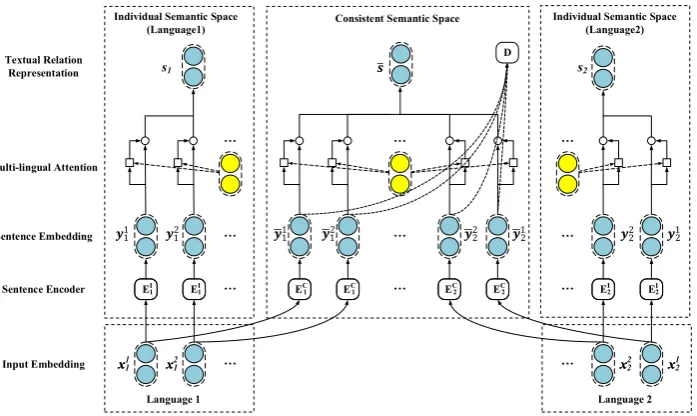
Figure 1: Overall architecture of our adversarial multi-lingual neural relation extraction (AMNRE) which contains two languages.
lingual attention mechanism and global relation predictor to extract relation consistency from distinct sentence representations.
To address these issues, we propose an adversarial multi-lingual NRE (AMNRE) model. As shown in Figure 1, for an entity pair, we encode its corresponding sentences in various languages through neural sentence encoders. For each sentence, we build an individual representation to grasp its indi-vidual language features and a consistent representation to encode its substantially consistent features among languages. Further, we adopt an adversarial training strategy to ensure AMNRE can extract the language-consistent relation patterns from the consistent representations. Orthogonality constraints are also adopted to enhance differences between individual representations and consistent representations for each language.
In experiments, we take Chinese and English to show the effectiveness of AMNRE. The experimen-tal results show that AMNRE outperforms all baseline models significantly by explicitly encoding the consistency and diversity among languages. And we further give a case study and an ablation study to demonstrate the adversarial training strategy could help AMNRE to capture language-consistent relation patterns.
2 Related Works
2.1 Relation Extraction
Traditional supervised RE models (Zelenko et al., 2003; Socher et al., 2012; Santos et al., 2015) heavily rely on abundant amounts of high-quality annotated data. Hence, Mintz et al. (2009) propose a distantly supervised model for RE. Distant supervision aligns knowledge bases (KBs) and text to automatically annotate data, and thus distantly supervised models inevitably suffer from wrong labeling problems.
models on a new language for existing KBs, without fully leveraging semantic information in text. Then, Lin et al. (2017) construct a multi-lingual NRE (MNRE) model to jointly represent text of multiple languages to enhance RE. In this paper, we propose a novel multi-lingual NRE framework to explic-itly encode language consistency and diversity into different semantic spaces, which can achieve more effective representations for RE.
2.2 Adversarial Training
Goodfellow et al. (2015) propose adversarial training for image classification tasks. Afterwards, Good-fellow et al. (2014) propose a mature adversarial training framework and use the framework to train generative models. Adversarial networks have recently been used as methods to narrow probability dis-tributions and proven effective in some tasks. In domain adaptation, Ganin et al. (2016) and Bousmalis et al. (2016) adopt adverarial training strategies to transfer the features of one source domain to its cor-responding target domain.
Inspired by Ganin et al. (2016), adversarial training has also been explored in some typical NLP tasks for multi-feature fusion. Park and Im (2016) propose a multi-modal representation learning model based on adversarial training. Then, Liu et al. (2017a) employ adversarial training to construct a multi-task learning model for text classification by extending the original binary adversarial training to the multi-class version. And a similar adversarial framework is also adapted by Chen et al. (2017) to learn features from different datasets for chinese word segmentation. In this paper, we adopt adversarial training to boost feature fusion to grasp the consistency among different languages.
3 Methodology
In this section, we introduce the overall framework of our proposed AMNRE in detail. As shown in Figure 1, for each entity pair, AMNRE encodes its corresponding sentences in different languages into several semantic spaces to grasp their individual language patterns. Meanwhile, a unified space is also set up to encode consistent features among languages. By explicitly encoding the consistency and diversity among languages, AMNRE can achieve better extraction results in the multi-lingual scenario.
For each given entity pair, we define its corresponding sentences in ndifferent languages as T =
{S1, . . . ,Sn}, where Sj = {x1j, . . . , x
|Sj|
j } denotes the sentence set in the j-th language. All these
sentences are labeled with the relationr ∈ Rby heuristical labeling algorithms in distant supervision (Mintz et al., 2009). Our model aims to learn a relation extractor by maximizing the conditional proba-bilityp(r|T)with the following three components:
Sentence Encoder. Given a sentence and its target entity pair, we employ neural networks to encode the sentence into a embedding. In this paper, we implement the sentence encoder with both convolutional (CNN) and recurrent (RNN) architectures. Specifically, we set the encodersEjI andEjC to encode each sentence in thej-th language into its individual and consistent embeddings respectively, and expect these embeddings to capture the diversity and consistency among languages.
Multi-lingual Attention. Since not all sentences are labeled correctly in distant supervision, we adopt multi-lingual attention mechanisms to capture those informative sentences. In practice, we ap-ply language-individual and language-consistent attentions to compute local and global textual relation representations respectively for final prediction.
Adversarial Training. Under the framework of AMNRE, we encode the sentences in various lan-guages into a unified consistent semantic space. We further adopt adversarial training to ensure these sentences are well fused in the unified space after encoding so that our model can effectively extract the language-consistent relation patterns.
We will introduce the three components in detail as follows.
3.1 Sentence Encoder
Given a sentencex={w1, w2, . . .}containing two entities, we apply neural architectures including both
3.1.1 Input Layer
The input layer transforms all input words in the sentence into corresponding input embeddings by concatenating their word embeddings and position embeddings. The word embeddings are pre-trained by Skip-Gram (Mikolov et al., 2013). The position embeddings are a widely-used technique in RE proposed by Zeng et al. (2014), representing each word’s relative distances to the two entities into two
kp-dimensional vectors. The input layer represents the input sentence as aki-dimensional embedding
sequencex={w1,w2, . . .}, whereki =kw+kp×2,kwandkpare the dimensions of word embeddings
and position embeddings respectively.
3.1.2 Encoding Layer
After representing the input sentence as a ki-dimensional embedding sequence, we select both CNN
(Zeng et al., 2014) and RNN (Zhang and Wang, 2015) to encode the input embedding sequence x =
{w1,w2, . . .}to its sentence embedding.
CNNslides a convolution kernel with the window sizemto extract thekh-dimensional local features,
hi=CNN wi−m−1
A max-pooling is then adopted to obtain the final sentence embeddingyas follows,
[y]j= max{[h1]j, . . . ,[hn]j}. (2)
RNN is mainly designed for modeling sequential data. In this paper, we adopt bidirectional RNN (Bi-RNN) to incorporate information from both sides of the sentence sequence as follows,
−
hi are the kh-dimensional hidden states at the positioniof the forward and backward
RNN respectively. RNN(·) is the recurrent unit and we select gated recurrent unit (GRU) (Cho et al., 2014) as the recurrent unit in this paper. We concatenate both the forward and backward hidden states as the sentence embeddingy,
y= [−→hn;
←−
h1]. (4)
For simplicity, we denote such a sentence encoding operation as the following equation,
y=E(x). (5)
For each sentencexij ∈ Sj, we adopt the individual sentence encoder EIj and the consistent sentence
encoder ECj to embed the sentence into its individual and consistent representations respectively,
{yj1,y
For each given entity pair, AMNRE adopts multi-lingual selective attention mechanisms to exploit in-formative sentences inT. We explicitly encode languages’ consistency and diversity into individual and consistent representations, thus our attentions are more simple than those proposed in Lin et al. (2017).
3.2.1 Language-individual Attention
Since it is intuitive that each language has its own characteristic, we set language-individual attention mechanisms for different languages. In the individual semantic space of thej-th language, we assign a query vectorrj to each relationr ∈ R. The attention score for each sentence inSj = {x1j, x2j, . . .}is
The attention scores can be used to compute language-individual textual relation representations,
sj=
|Sj|
X
k=1
3.2.2 Language-consistent Attention
Besides language-individual attention mechanisms, we also adopt a language-consistent attention to take all sentences in all languages into consideration. In the consistent semantic space, we also assign a query vector¯rto each relationr∈ Rand the attention score for each sentence is defined as follows,
βji=
The attention scores can be used to compute language-consistent textual relation representations,
¯s=
With the language-individual textual relation representations{s1,s2, . . .} and the language-consistent
textual relation representation¯s, we can estimate the probabilityp(r|T)over each relationr∈ R,
p(r|T) =p(r|¯s)
wheredj andd¯ are bias vectors, Rj is the specific relation matrix of thej-th language, andR¯ is the
consistent relation matrix. We define the objective function to train the relation extractor as follows,
min
θ Lnre(θ) =−
X
l
logp(rl|Tl), (13)
whereθis all parameters in the framework. In the training phase,p(r|T)is computed using the labeled relations as the attention queries. In the test phase, we need to use each possible relation as attention queries to computep(r|T)for relation prediction since the relations are unknown in advance.
3.4 Adversarial Training
In our framework, we encode sentences of various languages into a consistent semantic space to grasp the consistency among languages. One possible situation is that sentences of different languages are aggregated in different places of the space and linearly separable. In this case, our purpose of mining substantially consistent relation patterns in different languages is difficult to be reached. Inspired by Ganin et al. (2016), we adopt adversarial training into our framework to address this problem.
In the adversarial training, we define a discriminator to estimate which kind of languages the sentences from. The probability distributions over these sentences are formalized as follows,
D(¯sij) =softmax(MLP(¯sij)), (14)
where MLP is a two-layer multilayer perceptron network.
Contrary to the discriminator, the consistent sentence encoders are expected to produce sentence em-beddings that cannot be reliably predicted by the discriminator. Hence, the adversarial training process is a min-max game and can be formalized as follows,
min
tries its best to predict the language of the sentence according to the sentence embedding. After sufficient training, the encoders and the discriminator reach a balance, and sentences of different languages con-taining similar semantic information can be well encoded into adjacent places of the space. In training, we optimize the following loss functions instead of Eq. 15,
min
whereθCE andθDare all parameters of the consistent sentence encoders and the discriminator.
We notice that language-individual semantics could be wrongly encoded into the consistent semantic space, and may have negative effects on extracting language-consistent features. Inspired by Bousmalis et al. (2016), we adopt orthogonality constraints to alleviate this issue. We minimize the following penalty function:
whereIjandCjare two matrices whose row vectors are the embeddings of sentences in thej-th language
encoded by EIj and ECj respectively. θE is parameters of the all encoders. And k·kF is the squared
Frobenius norm.
3.5 Implementation Details
During training process, we combine the extraction and adversarial objective functions as follows,
L=Lnre(θ) +λ1LDadv(θD) +λ2LEadv(θ C
E) +λ3Lpenalty(θE), (18)
whereλ1,λ2, andλ3 are harmonic factors. All models are optimized using stochastic gradient descent
(SGD). In practice, we integrateλ1 andλ2 into the alternating ratio among the loss functions, and we
calibrate a 1:1:5 ratio amongLnre(θ) +λ3Lpenalty(θE),LDadv(θD)andLEadv(θEC).λ3is set as0.02.
4 Experiments
4.1 Datasets and Evaluation
We evaluate our models on a multi-lingual relation extraction dataset developed by Lin et al. (2017). The dataset consists of English and Chinese data, and has176relations including a special relationNA
indicating that there is no relation between entities. The whole dataset is divided into three parts for training, validation and test. The statistics of the dataset are listed in Table 1.
Dataset #Rel #Sent #Fact Dataset #Rel #Sent #Fact
English
Training 176 1,022,239 47,638
Chinese
Training 176 940,595 42,536
Validation 176 80,191 2,192 Validation 176 82,699 2,192
Test 176 162,018 4,326 Test 176 167,224 4,326
Table 1: Statistics of the dataset
We evaluate all models by the held-out evaluation following previous works (Mintz et al., 2009; Lin et al., 2017). In experiments, we report precision-recall curves of recall under0.3since we focus more on the performance of those top-ranked results. To give a complete view of the performance, we also report the area under the curve (AUC).
4.2 Experiment Settings
Batch SizeB 160 Convolution Kernel Sizem 3
Learning Rateα 0.002 Dropout Probabilitypfor CNN and RNN 0.5
Hidden Layer Dimensionkhfor CNN 230 Dropout Probabilitypdfor the Discriminator 0.1
Hidden Layer Dimensionkhfor RNN 200 Word Dimensionkw 50
Hidden Layer Dimensionkdfor the Discriminator 2048 Position Dimensionkp 5
Table 2: Parameter settings.
0.00 0.05 0.10 0.15 0.20 0.25 0.30 Recall
0.00 0.05 0.10 0.15 0.20 0.25 0.30 Recall
Figure 2: The aggregated precision-recall curves for proposed models and various baseline models. Left: models with CNN as sentence encoders. Right: models with RNN as sentence encoders.
4.3 Overall Evaluation Results
To evaluate the effectiveness of our proposed modelsAMNRE-CNNandAMNRE-RNN, we compare the proposed models with various neural methods: MNRE-CNNand MNRE-RNNare multi-lingual attention-based NRE models with CNN and RNN sentence encoders respectively (Lin et al., 2017);
CNN-ENandRNN-ENare vanilla selective-attention NRE models trained with English data, which are the state-of-the-art models in mono-lingual RE (Lin et al., 2016); CNN-CNandRNN-CNare trained with Chinese data;CNN-JointandRNN-Jointare naive joint models which predict relations by directly summing up ranking scores of both English and Chinese;CNN-ShareandRNN-Shareare another naive joint models which train English and Chinese models with shared relation embeddings. The results of precision-recall curves are shown in Figure 2 and the results of AUC are shown in Table 3.
From the results, we have the following observations:
(1) Both for CNN and RNN, the models jointly utilizing English and Chinese sentences outperform the models only using mono-lingual sentences. This demonstrates that the rich information in multi-lingual data is useful and can significantly enhance existing NRE models.
(2) The-Jointmodels achieve similar performance with the-Sharemodels, and both of them under-perform theMNREandAMNREmodels. They all benefit from the multi-lingual information, but the models with multi-lingual attentions can better take advantage of multi-lingual data. It indicates that designing targeted schemes to extract rich multi-lingual information is crucial.
(3)AMNREachieves the best results among all the baseline models over the entire range of recall in Figure 2, even as compared withMNRE.AMNREalso outperformsMNREwith3percentage points increasing in the AUC results. It indicates our proposed framework which explicitly encodes language-consistent and language-individual semantics better extract multi-lingual information, and therefore lead to the significant improvement in RE performance.
Models CNN-EN CNN-CN CNN-Joint CNN-Share MNRE-CNN AMNRE-CNN
AUC 36.6 33.2 37.1 37.0 43.4 46.2
Models RNN-EN RNN-CN RNN-Joint RNN-Share MNRE-RNN AMNRE-RNN
AUC 34.5 34.4 36.5 37.6 44.2 47.3
0.00 0.05 0.10 0.15 0.20 0.25 0.30
0.00 0.05 0.10 0.15 0.20 0.25 0.30 Recall
Figure 3: The aggregated precision-recall curves for proposed models and various baseline models in the mono-lingual scenario. Left: models with CNN as sentence encoders. Right: models with RNN as sentence encoders.
Models CNN-EN MNRE-EN AMNRE-EN RNN-EN MNRE-EN AMNRE-EN
AUC 36.6 39.6 42.7 34.5 42.2 43.2
Models CNN-CN MNRE-CN AMNRE-CN RNN-CN MNRE-CN AMNRE-CN
AUC 33.2 34.6 37.9 33.5 34.8 36.4
Table 4: The AUC results of different models in the mono-lingual scenario (%).
4.4 Mono-lingual Evaluation Results
To further verify that every mono-lingual RE models can benefit from our proposed framework, which explicitly consider language-consistent relation patterns, we train models with multi-lingual data and evaluate the performance of these models in the mono-lingual RE scenario. To show the results clearly, we report the precision-recall curves in Figure 3 and the AUC results in Table 4.
From the results, we can observe that:
(1) As compared with the models directly learned with the mono-lingual data, the models exploiting the multi-lingual information perform better in the mono-lingual scenario. This demonstrates that there is latent consistency among languages, and grasping this consistency from multi-lingual data can provide additional information for models in each language to enhance their results in the mono-lingual scenario. (2) Our proposed models achieve the best precision over the entire range of recall and also significantly improve the AUC results as compared with both MNRE and mono-lingual RE models. It indicates that due to the consistent semantic space in our framework, language-consistent information lying in the multi-lingual data is better mined and serve the mono-lingual scenario.
4.5 Effectiveness of Adversarial Training and Orthogonality Constraints
We adopt an adversarial training strategy to fuse the features from different languages to extract consis-tent relation patterns. Orthogonality constraints are also adopted to separate the consisconsis-tent and individual feature spaces. To measure the effectiveness of them, we conduct an ablation study which compares the proposed models with the similar models but without adversarial training strategy (AMNRE-noA), with-out orthogonality constraints (AMNRE-noO), and without both of them (AMNRE-noBoth). The AUC results are shown in Table 5.
We can observe that both the adversarial training strategy and orthogonality constraints have sig-nificant influence on the performance of our proposed model. This demonstrates the effectiveness of adversarial training strategy and orthogonality constraints for multi-lingual RE. To give a more intuitive picture of the effect of these two mechanisms, we visualize the distribution of sentence feature embed-dings encoded by the individual and consistent encoders using t-SNE (Maaten and Hinton, 2008). The results are shown in Figure 4.
(a) The same English sentences en-coded by the consistent encoder (yel-low) and individual encoder (blue).
(b) The English sentences (yellow) and the Chinese sentences (blue) encoded by their own consistent encoders with-out adversarial training.
(c) The English sentences (yellow) and the Chinese sentences (blue) encoded by their own consistent encoders with adversarial training.
Figure 4: The visualization of sentence feature embeddings with different mechanisms.
Models AMNRE-CNN AMNRE-CNN-noA AMNRE-CNN-noO AMNRE-CNN-noBoth
AUC 46.2 44.1 43.9 41.3
Models AMNRE-RNN AMNRE-RNN-noA AMNRE-RNN-noO AMNRE-RNN-noBoth
AUC 47.3 43.5 43.5 42.2
Table 5: The AUC results of the proposed models and ablated models.(%)
4(b) and Figure 4(c), we can observe that the feature embeddings from different languages are well-mixed due to the adversarial training strategy. We can more easily to grasp latent consistency among languages after multi-feature fusion.
5 Case Study
To further show the effectiveness of our proposed model to extract the language-consistent semantic information, we give an example in Table 6. We adopt the cosine similarity to measure the similarity between sentence embeddings encoded by consistent encoders. The first sentence in the middle column is the standard Chinese translation of the left sentence, thus they share the same semantic information. We observe that in our proposed model, the feature embedding similarity between these two sentences are significantly higher than the other English sentences sharing entity pair and relational fact but differing in semantics. It indicates that sentences in different languages containing similar semantics can be indeed encoded into adjacent places of the consistent space in our framework.
Relation :Located in Cosine Similarity
There are eighteen small glaciers in theNorth Island
onMount Ruapehu.
北北北岛岛岛的鲁鲁鲁阿阿阿佩佩胡佩胡胡山山山上有十八个小冰川。 0.584 . . . the bottom of theNorth Islandof
New Zealand up to the area ofMount Ruapehu. 0.3538 It is located on the south-easternNorth Island
volcanic plateau, . . . south-east ofMount Ruapehu. 0.342
Table 6: The example highlighting entities for the case study by measuring the cosine similarities be-tween the sentence in the left column and each sentence in the middle column.
6 Conclusion and Future Work
our AMNRE could effectively encode the consistency and diversity among languages, and achieves state-of-the-art performance in relation extraction.
We will explore the following directions as our future work: (1) AMNRE can be also implemented in the scenario of multiple languages, and this paper shows the effectiveness of AMNRE on the dataset with two languages (English and Chinese). In the future, we will explore AMNRE in much more other languages such as French, Spanish, and so on. (2) AMNRE simply aligns the sentences with similar semantics in different languages with an adversarial training strategy. In fact, machine translation is a typical approach to align sentences in various languages. In the future, we will combine machine translation with our model to further improve the extraction performance.
Acknowledgments
We thank Jiacheng Zhang for his help. This work is supported by the National Natural Science Foun-dation of China (NSFC No. 61621136008, 61772302) and Tsinghua University Initiative Scientific Re-search Program (20151080406). This reRe-search is part of the NExT++ project, supported by the National Research Foundation, Prime Minister’s Office, Singapore under its IRC@Singapore Funding Initiative.
References
Konstantinos Bousmalis, George Trigeorgis, Nathan Silberman, Dilip Krishnan, and Dumitru Erhan. 2016.
Do-main separation networks. InProceedings of NIPS, pages 343–351.
Xinchi Chen, Zhan Shi, Xipeng Qiu, and Xuanjing Huang. 2017. Adversarial multi-criteria learning for chinese
word segmentation. InProceedings of ACL, pages 1193–1203.
Kyunghyun Cho, Bart Van Merri¨enboer, Dzmitry Bahdanau, and Yoshua Bengio. 2014. On the properties of
neural machine translation: encoder-decoder approaches. InProceedings of SSST-8.
Manaal Faruqui and Shankar Kumar. 2015. Multilingual open relation extraction using cross-lingual projection. InProceedings of NAACL, pages 1351–1356.
Jun Feng, Minlie Huang, Li Zhao, Yang Yang, and Xiaoyan Zhu. 2018. Reinforcement learning for relation
classification from noisy data. InProceedings of AAAI.
Yaroslav Ganin, Evgeniya Ustinova, Hana Ajakan, Pascal Germain, Hugo Larochelle, Mario Marchand, and Victor
Lempitsky. 2016. Domain-adversarial training of neural networks. JMLR, 17(1):2096–2030.
Ian J Goodfellow, Jean Pouget-Abadie, Mehdi Mirza, Bing Xu, David Warde-Farley, Sherjil Ozair, Aaron
Courville, and Yoshua Bengio. 2014. Generative adversarial nets. InProceedings of NIPS, pages 2672–2680.
Ian J Goodfellow, Jonathon Shlens, and Christian Szegedy. 2015. Explaining and harnessing adversarial examples. InProceedings of ICML, pages 1–10.
Xu Han, Zhiyuan Liu, and Maosong Sun. 2018. Neural knowledge acquisition via mutual attention between
knowledge graph and text. InProceedings of AAAI.
Raphael Hoffmann, Congle Zhang, Xiao Ling, Luke Zettlemoyer, and Daniel S. Weld. 2011. Knowledge-based
weak supervision for information extraction of overlapping relations. InProceedings of ACL, pages 541–550.
Guoliang Ji, Kang Liu, Shizhu He, Jun Zhao, et al. 2017. Distant supervision for relation extraction with
sentence-level attention and entity descriptions. InProceedings of AAAI, pages 3060–3066.
Yankai Lin, Shiqi Shen, Zhiyuan Liu, Huanbo Luan, and Maosong Sun. 2016. Neural relation extraction with
selective attention over instances. InProceedings of ACL, pages 2124–2133.
Yankai Lin, Zhiyuan Liu, and Maosong Sun. 2017. Neural relation extraction with multi-lingual attention. In
Proceedings of ACL, pages 34–43.
Pengfei Liu, Xipeng Qiu, and Xuanjing Huang. 2017a. Adversarial multi-task learning for text classification. In
Proceedings of ACL, pages 1–10.
Tianyu Liu, Kexiang Wang, Baobao Chang, and Zhifang Sui. 2017b. A soft-label method for noise-tolerant
Laurens Van Der Maaten and Geoffrey Hinton. 2008. Visualizing data using t-sne.JMLR, 9(12):2579–2605.
Tomas Mikolov, Kai Chen, Greg Corrado, and Jeffrey Dean. 2013. Efficient estimation of word representations in
vector space. InProceedings of ICLR, pages 1–12.
Mintz, Mike, Steven, Jurafsky, and Dan. 2009. Distant supervision for relation extraction without labeled data. In
Proceedings of ACL, pages 1003–1011.
Gwangbeen Park and Woobin Im. 2016. Image-text multi-modal representation learning by adversarial
backprop-agation.arXiv preprint arXiv:1612.08354.
Sebastian Riedel, Limin Yao, and Andrew Mccallum. 2010. Modeling relations and their mentions without labeled
text. InProceedings of ECML-PKDD, pages 148–163.
Cicero Nogueira Dos Santos, Bing Xiang, and Bowen Zhou. 2015. Classifying relations by ranking with
convo-lutional neural networks. InProceedings of ACL, pages 626–634.
Richard Socher, Brody Huval, Christopher D Manning, and Andrew Y Ng. 2012. Semantic compositionality
through recursive matrix-vector spaces. InProceedings of EMNLP, pages 1201–1211.
Patrick Verga, David Belanger, Emma Strubell, Benjamin Roth, and Andrew Mccallum. 2016. Multilingual
relation extraction using compositional universal schema. InNAACL, pages 886–896.
Yi Wu, David Bamman, and Stuart Russell. 2017. Adversarial training for relation extraction. InProceedings of
EMNLP, pages 1778–1783.
Yang Xiang, Qingcai Chen, Xiaolong Wang, and Yang Qin. 2017. Answer selection in community question
answering via attentive neural networks. IEEE SPL, 24(4):505–509.
Dmitry Zelenko, Chinatsu Aone, and Anthony Richardella. 2003. Kernel methods for relation extraction. JMLR,
3(2):1083–1106.
Daojian Zeng, Kang Liu, Siwei Lai, Guangyou Zhou, and Jun Zhao. 2014. Relation classification via
convolu-tional deep neural network. InProceedings of COLING, pages 2335–2344.
Daojian Zeng, Kang Liu, Yubo Chen, and Jun Zhao. 2015. Distant supervision for relation extraction via piecewise
convolutional neural networks. InProceedings of EMNLP, pages 1753–1762.
Wenyuan Zeng, Yankai Lin, Zhiyuan Liu, and Maosong Sun. 2017. Incorporating relation paths in neural relation
extraction. InProceedings of EMNLP.
Xiangrong Zeng, Shizhu He, Kang Liu, and Jun Zhao. 2018. Large scaled relation extraction with reinforcement
learning. InProceedings of AAAI.
Dongxu Zhang and Dong Wang. 2015. Relation classification via recurrent neural network. arXiv preprint
arXiv:1508.01006.
Huaping Zhong, Jianwen Zhang, Zhen Wang, Hai Wan, and Zheng Chen. 2015. Aligning knowledge and text