A multi-constraint structured hinge loss for named-entity recognition
Hanieh Poostchi Nine Entertainment Co. Willoughby NSW 2068, Australia
Massimo Piccardi
FEIT, University of Technology Sydney Broadway NSW 2007, Australia [email protected]
Abstract
The negative log-likelihood or cross entropy is the usual training objective of NLP mod-els owing to its versatility and empirical per-formance. However, training objectives which directly target the performance measure used to evaluate the task have the potential to lead to higher empirical accuracy. For this rea-son, in this short paper we propose using a multi-constraint structured hinge loss as the training objective of a contemporary named-entity recognition (NER) model. Experimen-tal results over the challenging OntoNotes 5.0 dataset have shown that the proposed objective has been able to achieve an improvement of 0.62CoNLL score points at a complete parity of testing set-up.
1 Introduction
All NLP models utilise a loss function as minimi-sation objective for model training. Choosing the most appropriate loss function for a particular task can play an important role in the performance of the trained models at test time and in-field. How-ever, almost invariably the utilised loss function is the negative log-likelihood (NLL), also known as cross entropy. This is due to a number of at-tractive properties of the NLL such as its smooth-ness and differentiability in large regions of the parameter space. In addition, training with min-imum NLL often leads to models of high empiri-cal accuracy. However, this function is not exempt from shortcomings. To name two, 1) the NLL only rewards the probability of the ground-truth class and does not distinguish between the other classes, and 2) it does not impose explicit mar-gins (or ratios) between the probability assigned to the ground-truth class and those assigned to the other classes. For this reason, other differentiable loss functions are regarded as appealing alterna-tives or complements to the NLL. Amongst them
are the hinge loss (Cortes and Vapnik,1995) and the REINFORCE loss (Williams, 1992; Ranzato et al., 2016) which both attempt to directly op-timise the performance measure used to evaluate the model’s accuracy (e.g., the Hamming loss, the CoNLL score, the BLEU score etc). Both these losses can be used for the usual classification at token level or for the joint classification of all the tokens in a sentence (i.e., structured prediction) (Tsochantaridis et al.,2005). Given that targeting the evaluation loss during training may lead to im-proved performance at test time, in this short paper we explore the use of a structured hinge loss for named-entity recognition (NER). Our main contri-bution is the introduction of additional constraints between specific labelings aimed at increasing the accuracy of the learned model. Experimental re-sults over a challenging NER dataset (OntoNotes 5.0, which is still far from accuracy saturation) show that the proposed approach has been able to achieve higher accuracy than both the NLL and a conventional structured hinge loss.
2 Related Work
In this section we briefly review the main literature on NER architectures and on structural loss func-tions. For a broader review of deep learning for NER, the reader can refer to (Li et al.,2018).
character-by-character to also capture the regularities at charac-ter level. More recently, Pecharac-ters et al. (2017;2018) have proposed tagLM and ELMo to take advan-tage of the contextualised embeddings provided by pre-trained neural language models. Several other variants have been proposed since, includ-ing the Flair embedddinclud-ings of Akbik et al. (2018) which currently hold the state-of-the-art accuracy over OntoNotes 5.0 (NB: besides a system hat uses gazetteers as extra resources to increase accu-racy (Liu et al., 2019)). However, a bidirectional LSTM-CRF with ELMo embeddings can still be regarded as a very strong baseline for NER and, for this reason, it is used in the rest of this paper.
For what concerns alternative training objec-tives to the negative log-likelihood, Zhang at al. (2016) have proposed training an LSTM addi-tioned with a linear output layer by using an SVM objective. In their model, the parameters of both the LSTM and the output layer have been learned jointly using a combination of sequence-level and frame-level regularised hinge losses. Similarly, Shi et al. (2016) have proposed adding a structural SVM output layer (Tsochantaridis et al., 2005) to an RNN to improve its discriminative capabil-ity. In 2012, Gimpel and Smith (2012) have pro-posed a structured ramp loss that leverages vari-ous styles of margins between predicted labelings. Recently, Edunov et al. (2018) have carried out an extensive review of structured loss functions, including hinge losses, cost-weighted likelihoods and reinforcement learning objectives. In a 2015 computer vision paper, Zhang and Piccardi (2015) have proposed adding extra constraints to a struc-tured hinge loss to increase its accuracy in a task of activity segmentation in video. Inspired by that approach, in this paper we explore its application to NER, proposing three original combinations of dedicated constraints and margins.
3 Methodology
In this section, we first briefly review the struc-tured hinge loss (3.1) and the utilised scoring func-tion (3.2), and then introduce the proposed ap-proach (3.3).
3.1 Structured hinge loss
Given a token sequence, x = {x1. . . xt. . . xT}, we note withy={y1. . . yt. . . yT}a labeling, i.e. a sequence of corresponding labels, one per to-ken. We also assume to have a scoring function,
F(x, y;w) or F(x, y) for brevity, which is able to assign a compatibility score to any such(x, y)
pair. This function is completely defined by its set of parameters,w, and it is a structured predictor if the score of a labeling is computed jointly rather than independently for each label. Given these as-sumptions, the goal of astructured hinge loss is simply to ensure that the ground-truth labeling,yg, for a givenxis assigned a score larger than that of any other labeling,y 6= yg, by a chosen margin,
K:
F(x, yg)−F(x, y)≥K ∀y6=yg (1)
It is often useful to impose a margin that is the larger the more the labeling differs from the ground truth, and this can be achieved by set-ting the margin to be the evaluation loss (“margin rescaling” (Tsochantaridis et al.,2005)):
F(x, yg)−F(x, y)≥∆(yg, y) ∀y6=yg (2)
However, the number of distinct labelings is ex-ponential in the length of the sequence and it may not be possible to find a set of parameters which is able to satisfy all the constraints. In that case, the constraints are relaxed by introducing a non-negative term,ξ≥0, in Eq.2to minimally satisfy all the constraints:
F(x, yg)−F(x, y)≥∆(yg, y)−ξ ∀y6=yg
It is easy to see that the value ofξ is set by the most violated of the constraints, withy∗its corre-sponding labeling:
where we have omitted the first term in Eq. 4
objec-While the minimisation in Eq. 5 can be easily entertained by automated differentiation, the infer-ence of the most-violating labelings must be per-formed externally with a dedicated algorithm.
3.2 Scoring function
The scoring function,F(x, y;w), has been imple-mented as a BiLSTM-CRF (Lample et al.,2016), a popular NER model using a bidirectional LSTM as its feature layer and a CRF as its output layer. Its scoring function can be expressed as:
F(x, y;w) =
T
X
t=2
wyt−1,yt +
T
X
t=1
f(yt;w) (6)
where wi,j are the transition weights for transi-tioning from label yt−1 = i to label yt = j, and f(yt;w) denotes the score assigned to label
yt by the BiLSTM layer. At its turn, the BiL-STM layer is organised as a bidirectional LBiL-STM with trainable word and character embeddings as its inputs. At initialisation, the word embeddings can be assigned with either random or pre-trained values. At inference time,argmaxyF(x, y;w)is provided by the Viterbi algorithm. For further de-tails, please refer to (Lample et al.,2016).
3.3 The proposed multi-constraint structured hinge loss
Rather than constraining the optimisation prob-lem with an exponential number of constraints, the structured hinge loss minimisation only considers the constraint setting the value of the loss:
ξ= [−F(x, yg) +F(x, y∗) + ∆(yg, y∗)] (7)
While such an approach makes the constrained minimisation feasible, we speculate that the ad-dition of other constraints – either between the ground-truth labeling and other labelings, or be-tween the other labelings themselves – may even-tuate in a more performing model. To this aim, we have created a new set of labelings by arbitrarily introducing false positives in the ground-truth la-belings of the training set. As false positives, we have decided to change the “Outside” label im-mediately preceding the first ground-truth entity of the training sentences into a “B-ORG” label. This is an altogether arbitrary change that creates mildly incorrect labelings: as such, we expect the scoring function to assign them scores lower than the corresponding ground truths, yet higher than
more incorrect labelings. We note these new la-belings asui, i= 1. . . N, reserving the subscript position for the sample index henceforth. Given these extra labelings, we propose three versions of a multi-constraint training loss:
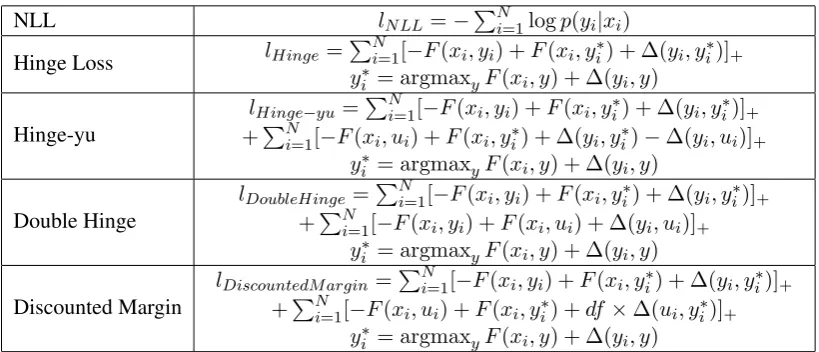
• Hinge-yu: in this loss, we impose an ex-tra consex-traint between the altered ground-truth labeling, ui, and the remaining label-ings. However, function∆(ui, y) cannot be used as margin since it expects to have a true labeling as its first argument. Therefore, fol-lowing (Zhang and Piccardi,2015) we set the margin to be(∆(yi, y)−∆(yi, ui)). The la-beling returned by the loss-augmented infer-ence with this margin is the same as in the standard case (y∗i) since the the second term in the margin (∆(yi, ui)) does not depend on
y.
• Double Hinge: in this loss, we instead im-pose an extra constraint between the ground-truth labeling, yi, and the altered ground truth, ui. As margin, we can naturally use
∆(yi, ui).
• Discounted Margin: in this loss, we again impose an extra constraint between the al-tered ground-truth labeling, ui, and the re-maining labelings. As margin, we use the regular loss function, ∆(ui, y), but “dis-counted” by a small discount factor sinceui is not an actual ground truth.
As evaluation loss for the margin, we have sim-ply used the Hamming loss, since it naturally de-composes over the individual tokens of its argu-ments and it allows us to easily touch up the standard Viterbi algorithm to provide the required loss-augmented inference. Extending the loss-augmented inference to other, more specialised evaluation measures such as the CoNLL and MUC scores (Nadeau and Sekine, 2007) could be the scope of future work.
4 Experiments and results
4.1 Experimental set-up
Table 1: The compared training objectives.
NLL lN LL=−
PN
i=1logp(yi|xi)
Hinge Loss lHinge=
PN
i=1[−F(xi, yi) +F(xi, y∗i) + ∆(yi, yi∗)]+ yi∗ = argmaxyF(xi, y) + ∆(yi, y)
Hinge-yu
lHinge−yu=PNi=1[−F(xi, yi) +F(xi, y∗i) + ∆(yi, yi∗)]+
+PN
i=1[−F(xi, ui) +F(xi, yi∗) + ∆(yi, yi∗)−∆(yi, ui)]+ yi∗ = argmaxyF(xi, y) + ∆(yi, y)
Double Hinge
lDoubleHinge =
PN
i=1[−F(xi, yi) +F(xi, yi∗) + ∆(yi, y∗i)]+
+PN
i=1[−F(xi, yi) +F(xi, ui) + ∆(yi, ui)]+ yi∗ = argmaxyF(xi, y) + ∆(yi, y)
Discounted Margin
lDiscountedM argin =PNi=1[−F(xi, yi) +F(xi, yi∗) + ∆(yi, yi∗)]+
+PN
i=1[−F(xi, ui) +F(xi, yi∗) +df×∆(ui, yi∗)]+ yi∗ = argmaxyF(xi, y) + ∆(yi, y)
Table 2: Comparison of the CoNLL scores for the OntoNotes 5.0 dataset with the different training objectives.
Training objective CoNLL score
NLL 88.54±0.13
Hinge Loss 88.81±0.06
Hinge-yu 88.88±0.10
Double Hinge 88.85±0.13
Discounted Margin (df = 0.925) 89.16±0.03
organisation, location, product, event, law, date and time, and is split over a training, validations and test sets. For the experiments, we have con-verted it to the IOB2 tagging scheme.
The experiments have been carried out using the DeLFT1 implementation of the BiLSTM-CRF. In the experiments, the word embeddings have been initialised with a concatenation of fastText-300d2 and ELMo-1024d3 (DeLFT’s default). All hyper-parameters have also been left to their default val-ues. Each training session has been run until con-vergence of the evaluation loss over the validation set or a maximum of 20 epochs. In the experi-ments, we have compared the following training objectives: 1) the NLL/cross entropy; 2) a stan-dard structured hinge loss using the Hamming loss as margin (“Hinge Loss”), with no additional con-straints; and 3-5) the three versions of the pro-posed multi-constraint structured hinge loss pre-sented in Section3.3. The discount factor,df, for
1
https://github.com/kermitt2/delft
2https://dl.fbaipublicfiles.com/
fasttext/vectors-english/crawl-300d-2M. vec.zip
3https://s3-us-west-2.amazonaws.com/
allennlp/models/elmo/2x4096_512_2048cnn_ 2xhighway_5.5B/elmo_2x4096_512_2048cnn_ 2xhighway_5.5B_options.json
the Discounted Margin approach has been chosen in range[0.85,0.95]in0.025steps over the valida-tion set. All the training objectives are displayed in Table1.
For evaluation, we have used the CoNLL score, an entity-oriented variant of the F1score which is
the standard evaluation measure for NER (Nadeau and Sekine,2007). For every experiment, we have run three independent runs from different random seeds and reported their average score. In addition, for the most noteworthy pairwise comparisons, we have run one-tailed Welch’s t-tests to test statis-tical significance (Hintze, 2019). As shown in (Colas et al., 2019), the Welch’s t-test enjoys a good balance between Type I and Type II errors under a variety of assumptions for the underlying score distributions (beyond Gaussian), especially for small sample sizes.
4.2 Results and analysis
three runs are small and the p-value from a one-tailed Welch’s t-test is < 0.05, showing that the improvement is statistically significant. In turn, all the versions of the proposed multi-constraint hinge loss have achieved higher scores than both the NLL and the standard structured hinge loss, with the Discounted Margin achieving the high-est score. The improvement of the Discounted Margin over the NLL has been +0.62 percent-age points, with a one-tailed Welch’st-testp-value
<0.01. While this improvement is still somehow limited, we wish to remark that it has leveraged only changes to the loss function in the code, and at a complete parity of model.
5 Conclusion
In this short paper, we have proposed a multi-constraint structured hinge loss to be used as training objective for a named-entity recognition model. The proposed loss enforces additional constraints with respect to the standard structured hinge loss with the aim of improving the test ac-curacy of the trained model. Experimental results over a challenging NER dataset (OntoNotes 5.0) have showed that the proposed loss has been able to achieve an improvement of0.62CoNLL score percentage points over the common negative log-likelihood. In the future, we aim to explore further combinations of constraints and margins, and pos-sibly extend the proposed approach to other tasks.
References
Alan Akbik, Duncan Blythe, and Roland Vollgraf. 2018. Contextual string embeddings for sequence labeling. In Proceedings of the 27th International Conference on Computational Linguistics, pages 1638–1649.
C´edric Colas, Olivier Sigaud, and Pierre-Yves Oudeyer. 2019. A hitchhiker’s guide to statistical comparisons of reinforcement learning algorithms. InReproducibility in Machine Learning, ICLR 2019 Workshop, pages 1–23.
Corinna Cortes and Vladimir Vapnik. 1995. Support-vector networks. Machine Learning, 20(3):273– 297.
Sergey Edunov, Myle Ott, Michael Auli, David Grang-ier, and Marc’Aurelio Ranzato. 2018. Classical structured prediction losses for sequence to se-quence learning. In Proceedings of the 2018 Con-ference of the North American Chapter of the Asso-ciation for Computational Linguistics: Human Lan-guage Technologies, pages 355–364.
Kevin Gimpel and Noah A. Smith. 2012. Struc-tured ramp loss minimization for machine transla-tion. InProceedings of the 2012 Annual Conference of the North American Chapter of the Association for Computational Linguistics: Human Language Technologies, pages 221–231.
Jerry Hintze. 2019. T-test – two-sample. In NCSS User’s Guide II, Chapter 206, pages 1–18.
Zhiheng Huang, Wei Xu, and Kai Yu. 2015. Bidi-rectional LSTM-CRF models for sequence tagging.
CoRR, abs/1508.01991.
Guillaume Lample, Miguel Ballesteros, Sandeep Sub-ramanian, Kazuya Kawakami, Chris DyerRemi Le-bret, and Ronan Collobert. 2016. Neural architec-tures for named entity recognition. In Proceed-ings of the 2016 Conference of the North Ameri-can Chapter of the Association for Computational Linguistics: Human Language Technologies, pages 260–270.
Jing Li, Aixin Sun, Jianglei Han, and Chenliang Li. 2018. A survey on deep learning for named entity recognition.CoRR, abs/1812.09449.
Tianyu Liu, Jin-Ge Yao, and Chin-Yew Lin. 2019. To-wards improving neural named entity recognition with gazetteers. InProceedings of the 57th Confer-ence of the Association for Computational Linguis-tics, pages 5301–5307.
David Nadeau and Satoshi Sekine. 2007. A survey of named entity recognition and classification. Lin-guisticae Investigationes, 30(1):3–26.
Matthew Peters, Waleed Ammar, Chandra Bhagavat-ula, and Russell Power. 2017. Semi-supervised se-quence tagging with bidirectional language models. In Proceedings of the 55th Annual Meeting of the Association for Computational Linguistics, pages 1756–1765.
Matthew Peters, Mark Neumann, Mohit Iyyer, Matt Gardner, Christopher Clark, Kenton Lee, and Luke Zettlemoyer. 2018. Deep contextualized word repre-sentations. InProceedings of the 2018 Conference of the North American Chapter of the Association for Computational Linguistics: Human Language Technologies, pages 2227–2237.
Sameer Pradhan, Alessandro Moschitti, Nianwen Xue, Hwee Tou Ng, Anders Bj¨orkelund, Olga Uryupina, Yuchen Zhang, and Zhi Zhong. 2013. Towards ro-bust linguistic analysis using OntoNotes. In Pro-ceedings of the Seventeenth Conference on Com-putational Natural Language Learning, pages 143– 152, Sofia, Bulgaria. Association for Computational Linguistics.
Marc’Aurelio Ranzato, Sumit Chopra, Michael Auli, and Wojciech Zaremba. 2016. Sequence level train-ing with recurrent neural networks. In 4th Inter-national Conference on Learning Representations, pages 1–16.
Yangyang Shi, Kaisheng Yao, Hu Chen, Dong Yu, Yi-Cheng Pan, and Mei-Yuh Hwang. 2016. Recurrent support vector machines for slot tagging in spoken language understanding. InProceedings of the 2016 Conference of the North American Chapter of the Association for Computational Linguistics: Human Language Technologies, pages 393–399.
Ioannis Tsochantaridis, Thorsten Joachims, Thomas Hofmann, and Yasemin Altun. 2005. Large margin methods for structured and interdependent output variables. Journal of Machine Learning Research, 6:1453–1484.
Ronald J. Williams. 1992. Simple statistical gradient-following algorithms for connectionist reinforce-ment learning. Machine Learning, 8:229–256.
Guopeng Zhang and Massimo Piccardi. 2015. Struc-tural SVM with partial ranking for activity segmen-tation and classification. IEEE Signal Process. Lett., 22(12):2344–2348.