Towards R e l i a b l e P a r t i a l A n a p h o r a R e s o l u t i o n
S a b i n e B e r g l e r *
Computer Science Department, Concordia University 1455 de Maisonneuve Blvd. W., Montrgal, Qugbec, H3G 1M8
bergler@cs, concordia, ca
A b s t r a c t
This paper assumes that currently, anaphora resolution at a desired level of reliability has to remain partial. It presents the thesis that multiple small ("expert") proce- dures of known reliability t h a t are conceived for partial analysis have to be developed and combined in order to increase coverage. These resolution experts will be specific to style, domain, task, etc. The paper describes corpus analysis that suggests such experts and their po- tential ordering. A quick and partial implementation of the ideas is evaluated on Wall Street Journal articles.
I n t r o d u c t i o n
Totally correct anaphora resolution requires full nat- ural language understanding, since anaphoric relations could be hidden in the context. At present, only partial natural language understanding is possible. This paper claims that one way to increase the reliability (or at least in assessing the reliability) of anaphora resolution lies in acknowledging and making use of this limitation. Strategies of anaphora resolution depend on the genre and style of text under consideration, as the different style manuals for m a j o r newspapers show. Since many practical applications are limited to a certain genre, it is legitimate to optimize results by studying peculiarities of the genre.
We focus our attention on the Wall Street Journal corpus available on CD-ROM from the Association for C o m p u t a t i o n a l Linguistics. Our main interest at the outset was in assessing the lexical complexity of NP coreference to guide us in our development of a lexi- con. We reported initial corpus analysis results that show the relative frequency of semantic relations that hold between elements in eoreference chains [Bergler and Knoll, 1996]. Analyzing the reference chains 1 of
*This work is funded in part by the Natural Sciences and Engineering Research Council of Canada and Fonds pour la formation de chercheurs et l'aide k la recherche.
1 Reference chains in this study contain all (partial) noun phrases that corefer in a text. They are thus different from [Morris and Hirst, 1991], who do not limit their reference chains to NPs.
62
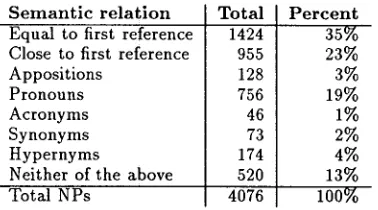
79 articles (28,798 words) from the Wall Street Jour- nal we found t h a t 35% of the subsequent references are actually equal to the first reference of that entity, 23% are close variations of the first reference (i.e. retain at least the same headword). Pronouns and appositions account for 22% and systematic lexical relation (syn- onymy and h y p o n y m y ) for 7%. We consider the re- maining 13% to be tough cases that might require full syntactic, lexical, and semantic processing. T h e other 87% we expect can be addressed with a subset of these tools.
This paper presents further results of this corpus analysis which lead to some resolution strategies and presents an experiment in implementing some of these aspects in a knowledge poor system.
C o r p u s A n a l y s i s R e s u l t s
The corpus study of 79 articles from the Wall Street Journal was performed manually by a single analyst, thus the results are as consistent as possible for a man- ual analysis. T h e analyst separated all NPs from the text, when appropriate separating referring sub-NPs from larger NPs, and for each NP placed it in a chain that contained a coreferent when possible or started a new chain. Chains were additionally annotated for a few features of interest, such as length of the article (short or long), the textual designator (see below), and whether the chain was p a r t of the topic of the article (see next Section.) These annotations were ultimately left to the j u d g e m e n t of the analyst within a strict set of rules.
Particularly encouraging are the first two lines in Fig- ure 1. It turns out t h a t over a third of the coreferring NPs are identical and can therefore be recovered reli- ably and correctly w i t h o u t linguistic tools. Almost a quarter of the coreferring NPs are very close to the first NP in the reference chain, t h a t is they share at least the headword, if not a larger substring with the first refer- ence. Thus in theory almost 60% of coreferring NPs should be identifiable with very simple techniques once the NPs have been identified.
S e m a n t i c r e l a t i o n Total Equal to first reference 1424 Close to first reference 955
Appositions 128
Pronouns 756
Acronyms 46
Synonyms 73
Hypernyms 174
Neither of the above 520
Total NPs 4076
Percent 35% 23~o 3% 19% 1% 2% 4% 13% 100%
Figure 1: Semantic relations between elements in coref- erence chains
T h e 4076 NPs analyzed there constitute roughly half of the NPs counted in total in t h a t collection of texts, namely 8,027. T h e 3,951 NPs t h a t are not analyzed in Figure 1 are NPs t h a t do not corefer with any other NP in the text. These singular occurrences account for 49% of all NPs. One obvious question is: can singular occurrences of entities be singled out? This is an open question. We address the easier problem of: how can we determine NPs which are likely to corefer and which are most i m p o r t a n t to the text overall?
T o p i c a l i t y
T h e same study showed t h a t NP chains considered to be in the topic of an article usually require a n a p h o r a reso- lution and are lexically more complex than non-topical reference chains. For this study we defined a topic to be one of the NPs t h a t occur in the headline or the first sentence 2 (see [Lundquist, 1989] for a motivation of this heuristic.) A text can have no more t h a n 4 topics (this n u m b e r was chosen intuitively.) T h e analyst decided how m a n y topics there were in each article according to her understanding of it. T h e text in Figure 3 was assigned a single topical chain containing NPs 1, 2.1, 10, and 11. There are 185 topical chains in 79 articles, averaging 2.4 topics per article. 17% of the topical ref- erence chains are singular occurrences, i.e. NPs t h a t do not corefer. 3 T h a t establishes t h a t the topic of an article is usually referred to more than once. Intuitively we assume t h a t the topic of an artice is more i m p o r t a n t to resolve t h a n non-topical NPs. One partial strategy, consequently, is to establish potentially topical NPs in the first n sentences of a newspaper article and to re- solve coreference only to these NPs. This strategy has the advantage of reducing the search space considerably and of focusing on i m p o r t a n t (topical) chains.
2The heuristic to find potential topics of an article is easy to implement: consider all NPs in the headline and the first sentence.
3There are two possible explanations why this number is relatively high: the Wall Street Journal contains several very short segments of very few sentences, thus a topic that is mentioned only once is a possibility. Also, headlines often use a summarizing term that never corefers with another NP, but rather corefers with the article as a whole.
63
T e x t u a l D e s i g n a t o r s
We feel t h a t NP resolution in newspaper articles is straightforward ( b y design) for h u m a n readers because of recurrent t e r m s t h a t designate an entity. To as- sess this intuition quantitatively, [Bergler and Knoll, 1996] report the s u m of distinct words within a chain over all non-singular chains. T h i s count eliminates the recurrent words, whether e m p t y (the) or descriptive (company). 4 T h e results show the significance of this phenomenon which we call textual designator. A tex- tual designator in this s t u d y is the first non-pronominal reference to an entity. Consider the text in Figure 3. One chain consists of two identical NPs, its Houston work force (NPs 3 and 15.) O t h e r textual designators of t h a t text are NP1, NP6, and NP16. Counting the n u m b e r of different words in each chain allows us to as- sess the lexical diversity within a chain and the contri- bution of the t e x t u a l designator to t h a t diversity. T h e results are s u m m a r i z e d in Figure 2.
C h a i n T o t a l t y p e c h a i n s
Topic 1,632
Not topic 19,449
N o n - s i n g u l a r chains
1,544 5,672
E x c l u d i n g d e s i g n a t o r
981 2,808
Figure 2: N u m b e r of different words per reference chain.
We find 1,632 different words in topical chains and 19,449 different words in non-topical chains. When we consider only the chains t h a t actually involve coref- erence, the s u m s reduce to 1,544 different words for topical chains and 5,672 different words for non-topical chains. R e m o v i n g the words t h a t are part of the textual designator, we observe a drastic reduction to 981 differ- ent words for topical chains and 2,808 different words for non-topical chains.
T h e 185 topical chains average about 9 different words per chain while non-topical chains average 4. R e m o v i n g the words of the textual designator reduces the different word count by 40% for topical and 86% for non-topical chains when counting all chains. If we count only chains t h a t involve coreference the reduc- tions are 36% for topical chains and 50% for non-topical chains. T h e n u m b e r of different words excluding the words of the textual designator on average are 5 for topical chains and .6 for non-topical chains. 5
These n u m b e r s suggest t h a t the textual designator defined as the first reference to an entity leads to a strong resolution heuristic, one t h a t is in fact stronger for non-topical chains. T h e numbers also show how surprisingly small the lexical diversity of words outside
4Note that the same word could potentially be counted in every single chain, as the recurrence is only eliminated within a chain.
[image:2.596.65.254.146.251.2] [image:2.596.313.532.376.426.2]a textual designator are. T h e sum for both types of chains is 3,789. The textual designators are made up of 563 different words for topical non-singular chains and 2864 different words for non-topical, non-singular chains. T h e total number of different words for singular chains is 13,865. Thus the sum total of different words for first references is 17,292, a surprisingly high num- ber considering that the overall corpus has only 28,798 words, which includes all duplicates.
Resolution Strategies
While we are still mining the results of our study for more data, some strategies for resolution in general are already emerging.
We believe that there is strong evidence for an ap- proach to anaphora resolution in multiple passes, where earlier passes implement more reliable 6, less knowledge- intensive, and computationally less complex strategies with faster tools than later ones. For each pass, an expected reliability should ideally be known.
T h e expectation is that early, knowledge-poor, and highly reliable passes can be used for almost any task. Matching equal NPs, for instance, can be done with basic, fast tools independently of further linguistic pro- cessing. Anaphora resolution could then be tailored to particular needs by determining which levels of reliabil- ity are acceptable to the task and using the passes 7 up to that threshold. For the remaining resolution task, a domain- and genre-specific set of procedures has to be developed.
We argue that such a multi-pass approach has advan- tages to a monolithic approach, be it statistical or sym- bolic. While most symbolic anaphora resolution sys- tems probably correctly identify identical NPs as core- letting, making this a first step and using very fast, low level tools can pre-process a text faster. The modular approach allows for use of the tools of choice at each level. Moreover, a text can be left partly resolved, po- tentially allowing anaphora resolution to be interleaved with other linguistic processing as required.
Another interesting result of our study is the fact that m a n y NPs correctly resolve to more than one coreferring NP, and often resolve to the first reference. This provides support for the viability of partial pars- ing methods, because a missing link does not mean the rest of the chain is unresolvable. As mentioned above, this also allows for a focused partial resolution strategy that a t t e m p t s to resolve subsequent NPs only to a set of NPs determined at the outset (e.g., topical NPs, pre- determined subjects or persons, . . . ). This provides the basis for a series of principled heuristics. These partial resolution strategies are of great importance where the a m o u n t of text to be processed is large but the depth
6 Refiability here is with respect to errors of commission. 7An appropriate subset of the following heuristics can of course be combined into a single pass, which is the case in our experimental system presented below.
64
of processing is shallow, as for certain text a n n o t a t i o n tasks.
T h e study presented above suggests the following strategies:
1. I d e n t i c a l N P s
Prerequisites: NP boundaries Procedure: string matching
2. F o c u s e d p a r t i a l r e s o l u t i o n
Prerequisites: NP boundaries, identification proce- dures of the NP chains of interest
Procedure: according to desired resolution strategies
3. C o m m o n h e a d
Prerequisites: parsed NPs
Procedure: matching head positions
4. A p p o s i t i o n s
Prerequisites: parsed NPs
Procedure: matching syntactic pattern of apposition
5. E x t e n d e d h e a d m a t c h i n g
Prerequisites: parsed NPs, lexicon or thesaurus Procedure: compare heads for synonymy, h y p e r n o m y
6. P r o n o u n r e s o l u t i o n Prerequisites: parsed text
Procedure: as described in the literature
These resolution strategies are not exhaustive, nor can an optimal ordering be assigned in general; the de- sired level of reliability, the genre and style features, and any possible additional linguistic processing will deter- mine different combinations, extensions, and orderings.
K n o w l e d g e P o o r R e s o l u t i o n
We implemented an experimental resolution system (ERS) based on these ideas. T h e system uses as input the parse trees provided by the Penn Treebank on the ACL CD-ROM. These parse trees have been corrected manually for inconsistencies.
T h e system includes a (partial) implementation of all of the six strategies except for Focused Partial Resolu- tion. T h e most carefully worked out strategy is pronoun resolution. Pronoun resolution makes use of the parse trees and follows the ideas in [Lappin and Leass, 1994, Hobbs, 1978]. T h e other strategies have only been partially or crudely implemented. T h e C o m m o n Head strategy, for instance, uses a crude heuristic to deter- mine the head of a complex noun phrase t h a t fails in certain cases. Extended Head Matching is limited to very few lexical items such as company, which receive special t r e a t m e n t . No lexicon is used, the required lex- ical knowledge has been provided in a list of gendered items. An additional limitation is the fact that the sys- tem considers coreference only within a sentence and between adjacent sentences.
A l g o r i t h m
(1 Telxon Corp. a) said (2 (2.1<<ref=l its 2.a) vice president for manufacturing 2) resigned and (3 (3.,<re/=1 its 3.1) Houston work force 3) has been trimmed by (4 40 people 4), or about
(5<tel=4 15% 5) •
(6<rey=a The maker of hand-held computers and computer systems 6) said (7 the personnel changes r) were needed to improve (s the efficiency s) of (9 (9.a<rey=s its 9.1) manufac- turing operation 9).
(lO<<ref=l The company 10) said (ll<<re/=lo it aa) hasn't named (12 a successor 12) to (a3>re$=a4 Ronald Burton 13),
04<re]=2 the vice president a4) who resigned. (15<re/=3 (15.1<ref=l Its 15.1) Houston work force as) now totals (as 230 as).
Figure 3: Manually determined coreference in a short text f r o m the Wall Street Journal
1. Determine candidate referents within the sentence. If none are found (i.e. lack of agreement), determine candidate referents in previous sentence.
2. Test each candidate referent for actual coreference using:
(a) C o m m o n Head (with slight modifications) (b) Extended Head Matching (limited to few cases)
(c) Appositions (d) C o p u l a
3. If there is m o r e t h a n one possible coreference, select best.
4. Merge the new coreference pair with existing refer- ence chains or s t a r t a new chain.
S a m p l e O u t p u t
This algorithms is clearly too constrained to ever achieve full resolution, but except for the pronoun res- olution, it was quickly implemented and performs sur- prisingly well.
Both strengths and limitations are best illustrated on a short example. Consider the text in Figure 3, which has been a n n o t a t e d with manually determined corefer- ence links following the Lancaster notation [Fligelstone, 1992] with slight modifications
T h e a n n o t a t i o n (2.1<re/=1 means t h a t NP2.1 (a sub- NP of NP2) s t a r t s at this point and t h a t it refers back- wards to NP1. T h e << sign indicates t h a t this reference has also been detected by ERS.
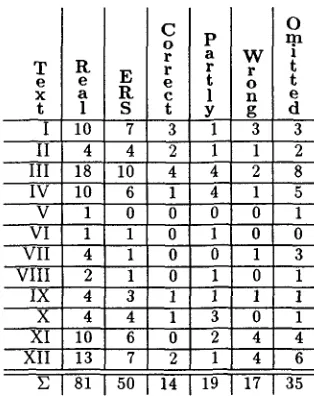
ERS determined 4 reference chains in this article. T h e first chain consists of NPs 1, 2.1, 10, and 11. T h e second chain contains NPs 6 and 9.1, the third contains NPs 3 and 15, and chain number four contains NPs 16 and 15.1. T h e coreference link stipulated for chain four is wrong (an artifact of a strong bias towards in- trasentential resolution.) All other stipulated corefer- ence links are correct. There are six coreferring NPs whose coreference link has not been identified. T w o of the stipulated chains could be merged (chains one and two.)
65
P r e l i m i n a r y R e s u l t s
We evaluated ERS on a set of twelve short articles from the Wall Street Journal which had also been part of the corpus study described above. T h e chains of the study were compared to the chains stipulated by ERS and both were examined for correctness by a person not involved in the development of either.
T e x t Sent. NPs I
II III IV V VI VII VIII IX X XI XII
11 61 4 20 14 85 8 53 4 14 3 15 3 17 2 13 3 16 7 30 7 38 10 49
W r o n g O m i t t e d
4 7% 13 21%
1 5% 6 30%
2 2% 20 24%
1 2% 17 32%
0 0% 2 14%
0 0% 1 7%
1 6% 4 24%
0 0% 3 23%
1 6% 3 19%
0 0% 5 17%
16 42% 13 34%
20 41% 18 37%
76 411 [ 46 [ 11% 105 [ 26%
Figure 4: Evaluation of NP coreference
Figure 4 shows the length of the articles in number of sentences, the n u m b e r of NPs per article, the num- ber of NPs t h a t have been placed in the wrong chain ( w r o n g ) and the n u m b e r of coreference links t h a t have not been identified ( o m i t t e d . ) ERS showed an error rate of 11% (wrongly dereferenced NPs) and an omis- sion rate of 26%. Interestingly, the error rates for in- dividual articles fluctuates between 0% and 7% for all but two articles. The two articles with over 40% error rate are both very typical Wall Street J o u r n a l articles t h a t cover earnings of a particular company. T h e arti- cles are very similar and the high error rate is due to the same shortcoming of ERS: it has no special treat- m e n t for a m o u n t terms and currency t e r m s and thus creates chains t h a t contain all NPs with headword yen
or million (in these articles a b o u t J a p a n e s e companies
18.32 billion yen are also expressed as $128.9 million.)
Since none of these NPs should corefer, the error rate is extremely high but could be fixed with shallow lexical knowledge.
[image:4.596.322.526.241.396.2]T
e x
t I
II III
iv
V VI VII VIII IX X XI XII E
10 4 18 10 1 1 4 2 4 4 10 13
7 3 1 3
4 2 i"' 1 10 4 4 2
6 1 4 1
0 0 0 0
1 0 1 0
1 0 0 1
1 0 1 0
3 1 1 1
4 1 3 0
6 0 2' 4
7 2 4 81 50 14 19 17
O m
1
t t
e
d 3 2 8 5 1 0 3 1 1 1 4 6
35
Figure 5: Evaluation of reference chains
a chain the entire chain is discounted. Correct chains are those were ERS picked up all the NPs t h a t the an- alysts determined as belonging to that chain. Partly correct chains are those were every coreference link is correct but some are missing. Wrong chains are those t h a t include an incorrect coreference link and omitted chains are those that the analysts determined to exist but which have no counterpart in ERS's output, s
C a u s e s o f E r r o r s
An i m p o r t a n t first observation is that the h u m a n an- alysts did not agree in all cases, which reminds us to take figures and percentages with a grain of salt. Dis- agreements between the analysts are of course few. The m a j o r i t y of ERS's errors stem from three sources: lack of a lexicon, lack of syntactic finesse, and simplistic head matching for the C o m m o n Head heuristic.
The lack of any lexicon tricks ERS into matching all a m o u n t s measured in yen as possessing the same head and thus coreferring. A lexicon could also avoid pro- noun agreement mistakes to a larger extent.
ERS lacks syntactic finesse even though it uses the rather sophisticated Penn Treebank parse trees, be- cause its extraction of the head is based on heuristics rather than syntactic knowledge.
Most mistakes, by far, are due to matching identi- cal heads where the modifying information in the NP makes it clear that no coreference exists, such as an is-
s Note that the columns for correct, partly correct, wrong, and omitted chains do not add up to the number of real chains. This is due to several factors. Take for instance Text II, given in Figure 3, where two partly correct chains should have been merged and ERS's incorrect chain does not correspond to any real chain, thus there is an overcount of two chains. For the entire test set there is an overcount of 4 chains from three articles.
sue price of $849 . . . and a conversion price of $25 . . . .
These, as well as omissions, would be r e ~ c e d by con- sidering the compositional semantics of the NPs. Omis- sions would also be reduced by implementing the res- olution strategies fully (acronyms, h y p o n y m i c relations of head nouns, etc.)
C o n c l u s i o n
This paper reviews results from previous corpus analy- sis and presents new d a t a t h a t show that simple resolu- tion procedures based on lexical similarity can achieve partial a n a p h o r a resolution. We advocate a multi- pass approach, sequencing appropriate simple resolu- tion strategies for any given application. These passes can be interleaved with other linguistic processing and thus afford more flexibility than a monolithic a n a p h o r a resolution strategy.
We have tested these ideas with a crude experimental system that had an error rate of 11% and an omission rate of 26%. This result confirms the estimate from our corpus analysis and error analysis indicates refinements required for a robust system.
A c k n o w l e d g e m e n t s
The manual corpus analysis was done by Sonja Knoll. ERS has been implemented by Dr. Xiaobin Li. Jennifer Scott did the evaluation. T h a n k s also to the a n o n y m o u s reviewers, whose c o m m e n t s helped to improve the pa- per.
R e f e r e n c e s
[Bergler and Knoll, 1996] S. Bergler and S. Knoll. Coref- erence patterns in the wall street journal. In C. Percy, C.F. Meyer, and I. Lancashire, editors, Synchronic corpus linguistics. Papers from the sixteenth International Con- ference on English Language Research on Computerized
Corpora (1CAME 16). Rodopi, Amsterdam, 1996. [Fligelstone, 1992] S. Fligelstone. Developing a scheme for
annotating text to show anaphoric relations. In G. Leit- net, editor, New Directions in English Language Corpora.
Mouton deGruyter, Berlin, 1992.
[Hobbs, 1978] .I.R. Hobbs. Resolving pronoun references.
Lingua, 44:311-338, 1978.
[Lappin and Leass, 1994] S. Lappin and H.J. Leass. An al- gorithm for pronominal anaphora resolution. Computa- tional Linguistics, 20(4):535-561, 1994.
[Lundquist, 1989] L. Lundquist. Modality and text consti- tution. In M-E. Conte, J.S. PetSfi, and E. SSzer, editors,
Text and Discourse Connectedness. Proceedings of the Conference on Connexity and Coherence, Urbino, July 1984. John Benjamins Publishing Co., Amsterdam, 1989. [Morris and Hirst, 1991] J. Morris and G. Hirst. Lexical cohesion computed by thesaural relations as an indica- tor of the structure of text. Computational Linguistics,
17(1):21-48, 1991.
[image:5.596.86.243.142.340.2]