Applying Discourse Analysis and Data Mining Methods to
Spoken OSCE Assessments
Meladel Mistica, Timothy Baldwin
The University of Melbourne CSSE
{mmistica,tim}
@csse.unimelb.edu.au
Marisa Cordella, Simon Musgrave
Monash University
School of Languages, Cultures and Linguistics
{marisa.cordella,simon.musgrave}
@arts.monash.edu.au
Abstract
This paper looks at the transcribed data of patient-doctor consultations in an exami-nation setting. The doctors are interna-tionally qualified and enrolled in a bridg-ing course as preparation for their Aus-tralian Medical Council examination. In this study, we attempt to ascertain if there are measurable linguistic features of the consultations, and to investigate whether there is any relevant information about the communicative styles of the qualify-ing doctors that may predict satisfactory or non-satisfactory examination outcomes. We have taken a discourse analysis ap-proach in this study, where the core unit of analysis is a ‘turn’. We approach this prob-lem as a binary classification task and em-ploy data mining methods to see whether the application of which to richly anno-tated dialogues can produce a system with an adequate predictive capacity.
1 Introduction
This paper describes our experimentation with ap-plying data mining methods to transcribed doctor– patient consultations. It is in essence a discovery project: we apply methods to a field and task that is not ordinarily associated with such approaches in order to ascertain whether this could make for a tractable learning task.
The task involves the extraction of dis-course features from doctor–patient consultations performed by international medical graduates
c
°2008. Licensed under the Creative Commons Attribution-Noncommercial-Share Alike 3.0 Unported li-cense (http://creativecommons.org/licenses/by-nc-sa/3.0/). Some rights reserved.
(IMGs), and what is known as ‘simulated pa-tients’ (Vu et al., 1994), respectively. The IMGs are enrolled in a bridging course in Melbourne as preparation for their Australian Medical Council (AMC) examination, the successful completion of which is one of the pre-requisites to becoming a fully accredited practitioner in Australia. This par-tially replicates the AMC examination by studying in detail how IMGs perform two objective struc-tured clinical examinations (OSCEs). See Sec-tion 2 for full details of the examinaSec-tion environ-ment and participants involved.
The main questions raised when initiating this study were:
• How objective is the testing?
• What is the importance placed on language skills in OSCE environments?
• What makes for a successful OSCE?
In this research, we aim to build classifiers that make reasonable predictions of the data being tested, and possibly point us in the right direction with respect to the questions above. From the clas-sifiers we build, we also hope to ascertain which of our features best predict a successful examination. We organise the paper as follows. In Section 2, we briefly describe the examination environment and process, the marking scheme, and the partic-ipants involved in the testing of the IMGs. We also outline some of the issues that have arisen with regard to the current methods of IMG testing. In Section 3, we present details of the data used. Section 4 describes the features we develop for the task and discusses the reasoning behind the selec-tion of features from a discourse analysis perspec-tive. Section 5 discusses the results of the exper-iments, with further examination of the data. The
last two sections, Sections 6 and 7, comprise a dis-cussion of the results and concluding remarks.
2 Background
With Western nations becoming increasingly re-liant on medical professionals trained overseas, there is, in turn, a growing need to develop a re-liable means of objectively assessing IMGs. The shortage of medical doctors is a worldwide phe-nomenon currently affecting many Western so-cieties such as the UK, Canada, US and New Zealand, which compete for the best medical prac-titioners available around the world. Australia is not immune to this global phenomenon, and in the last two decades the shortage of local medi-cal practitioners in Australia has worsened (Bir-rell et al., 2004). Challenges to the healthcare system in the country are particularly evident in the areas of providing medical care for a grow-ing elderly population and of servicgrow-ing rural ar-eas, where locally trained doctors do not feel par-ticularly attracted to practise medicine (Han et al., 2006). Currently 35% of the rural medical force and 20% of the total national medical work-force consist of IMGs (Flynn, 2006). These figures may increase even further in some regions (Spike, 2006), as preparation of fully educated and trained local medical graduates takes up to thirteen years to complete.
There is considerable disparity among IMGs in their background training, clinical skills, under-standing of the health system and communication skills (McGrath, 2004). In order to be registered to practice in Australia, IMGs must successfully complete the Australian Medical Council exami-nations and a period of supervised training. The medical knowledge of IMGs is assessed in two ways: by multiple choice examinations and by clinical examinations. This second form of ex-amination consists of a series of simulated medi-cal consultations in which a role-player takes the part of the patient, and the IMG’s professional knowledge, lay-cultural knowledge, socio-cultural assumptions, institutional norms, and values and personal experiences are all in full display during the unfolding of the medical event (Roberts et al., 2003). Whenever cultural factors are not shared with their patients, the interpretative schema and therefore the comprehension of speech are affected by this lack of commonality in the participants’ inferences and contextual cues (Gumperz, 1999).
Such effects are likely to cause miscommunica-tion in medical visits and have a potential nega-tive effect on patients’ satisfaction in the consul-tation. Identification of the communication diffi-culties faced by IMGs can therefore inform mod-ifications to the training provided to IMGs when they prepare for the Australian Medical Council examinations, as well as suggesting more nuanced and targeted procedures for assessing communica-tive skills within those examinations, all with the goal of working toward a better equipped medical workforce for the future. The use of automated an-alytic procedures to try to establish objective crite-ria for communicative success is an important step in this process.
Assessing language knowledge and competence quantitatively is not a novel concept in second lan-guage learning assessment. However, the applica-tion of data mining methods to automatically as-sess language proficiency in a discourse setting is novel. Levow et al. (1999) propose an architec-ture to automatically assess language proficiency. In their paper, they propose an architecture that employs data mining methods, but do not build classifiers over their spoken data to test this pro-posal. A closely related line of research is on the automatic classification of discourse elements to assess the quality of a written genre (Burstein et al., 2001). Like this work, it focuses on extracting features from the discourse as a whole. But unlike this study, the authors extract high level features, such as rhetorical structure, of written discourse. The study we present in this paper is rather unique in its approach to language assessment.
3 Data
The data is taken from transcribed recordings of examinations from students enrolled in a bridg-ing course at Box Hill Hospital in Melbourne, Australia. Each candidate was video-recorded en-acting medical consultation scenarios with what is known as a standardised or simulated patient (SP). This method of testing is known as an ob-jective structured clinical examination (OSCE), which is an emulation of a doctor–patient consul-tation, much like a role-play setting.
interaction between the candidate and the SP is un-cued and free-form. They simply present the infor-mation in a standardised manner across all candi-dates and perform the role of the patient as felici-tously as possible.
For this set of examinations there are 2 types of OSCE stations referred to as STD (sexually trans-mitted disease – genital herpes) and BC (bowel cancer). The SP for the STD station is played by a female doctor. The patient she plays has genital herpes and is concerned about how this will affect her chances of falling pregnant, and how this con-dition may also affect her baby. The SP for the BC station is played by an older male. A tumour is discovered in his bowel lining and he is reluctant to undergo any treatment because one of his good friends suffered a similar condition and his quality of life was severely diminished.
Even though the consultation is free to be nego-tiated between doctor (candidate) and patient (sim-ulated patient), each of the OSCEs cannot exceed
8minutes, and is terminated by the examiner if it does so.
3.1 Transcription
The recordings are transcribed in ELAN, a multi-media annotation tool developed at the Max Planck Institute, to help encode low-level linguistic fea-tures such as overlapping and timing information. The information and features extracted from the discourse are largely based on a ‘turn’.
Here we consider a turn as being normally domi-nated by one speaker. It can be made up of multiple intonation units. When there is backchannelling, overlapping, or any interruption by the other par-ticipant, then the turn is encoded as ending at the end of the interrupted intonation unit. Otherwise, transition pauses commonly signal turn changes, unless latching occurs.
Given that the OSCE setting aims to emulate as close as possible a real medical consultation, this interaction, like all uncued spoken dialogues, also has evidence of complicated turn-taking ne-gotiations, disfluent and unintelligible speech, in-terrupted speech, challenges for the floor, and the like, all of which must be encoded and noted in ELAN. Transcribing such data is not a trivial mat-ter. In addition, transcribing the data in order to extract these features is also a demanding task in itself, which makes creating data for such tasks an involved process.
Disfluencies and repairs are encoded in a limited way, only by way of marking up truncated or un-finished words. We also do not take a fine-grained approach in encoding delaying strategies (Clark et al., 2002), that is we do not differentiate whether theuh or ah encoded represents lexical search, a wish to hold the floor, a wish to give up the floor or buying time to construct what to say next.
3.2 OSCE scoring
In an OSCE setting, candidates are given an over-all pass or fail rating for each station by an OSCE examiner observing the interaction. This overall evaluation can be based on a number of perfor-mance criteria which tests the candidates medical, clinical and communication skills (Grand’Maison et al., 1992). The OSCE marking scheme used for this study consists of 5 assessable categories, as follows:
APPROACH: the ability of the candidate to
com-municate with the patient;
HISTORY: the ability of the candidate to collect
medical history;
INTERPRETATION: how well does the candidate
interpret his or her investigation in order to formulate an appropriate diagnosis;
MANAGEMENT: how well does the candidate
formulate a management plan for the diagno-sis;
COUNSELLING: is the candidate able to give
ap-propriate counselling to the patient.
The first category tests language knowledge and competency both at the lexical and discourse level, while the remaining four categories test medical knowledge and clinical competency.
4 Feature Engineering
which include ‘lexical introduction’, and ‘lexical repeat’.
In encoding features of conversational dominance, we focus on participatory domi-nance (Itakura, 2000), which looks at which speaker contributes most to the dialogue in terms of content.
Lexical introduction refers to a non-stop word that is introduced by the doctor (IMG) or the pa-tient (SP), whilelexical repeatencodes how many times a word introduced by the other interlocutor is repeated by the speaker.
Almost all of the features developed are contin-uous, based on timing information or word counts. The only binary feature used encodes whether the doctor initiates the consultation or not.
As mentioned in the previous section, the fea-tures developed were largely based on turns. This is to capture, along with other features such as overlapping and pauses, the interactional aspect of the communication. For example, conversational cooperation and speaker reassurance can be cap-tured with these features. Another aspect to the development of these features, particularly for the lexical-based features, is whether the IMG has a suitable vocabularly and if they employ it appro-priately in the interaction.
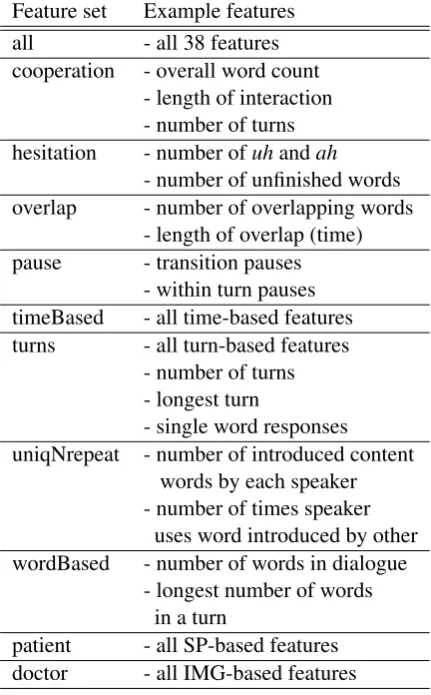
We arrive at 11 feature sets from which we build our classifiers, as described in Table 1.
Not all features are exclusive to any one feature set, that is, it is possible for a single feature to be-long to a number of feature sets.
The sets were designed to isolate possible char-acteristics of not only the discourse as a whole, but how the participants negotiated their interaction. These features sets were developed from observ-ing each of the consultations with the expectation that these were salient and determining features of a successful examination.
5 Experiments
There was a total of 11 OSCE candidates, all of whom performed an STD and a BC station, giv-ing us in total 22 instances for this binary classi-fication task to predict a pass or fail examination result. Of the 22 instances, we had 5 failures and 17 passes. Given the small number of instances, we maximised our dataset by employing 10-fold stratified cross-validation, as well as leave-one-out cross-validation which uses all but one instance in training and the held-out instance for testing.
Feature set Example features all - all 38 features cooperation - overall word count
- length of interaction - number of turns hesitation - number ofuhandah
- number of unfinished words overlap - number of overlapping words
- length of overlap (time) pause - transition pauses
- within turn pauses timeBased - all time-based features turns - all turn-based features
- number of turns - longest turn
- single word responses uniqNrepeat - number of introduced content
words by each speaker - number of times speaker
uses word introduced by other wordBased - number of words in dialogue
- longest number of words in a turn
[image:4.595.308.524.73.421.2]patient - all SP-based features doctor - all IMG-based features
Table 1: The 11 feature sets developed
The baseline system we use for comparison is zero-R, or majority vote. For our supervised clas-sifier, we employ a lazy learner in the form of the IB1 algorithm implemented in WEKA.
5.1 Results for Feature Sets
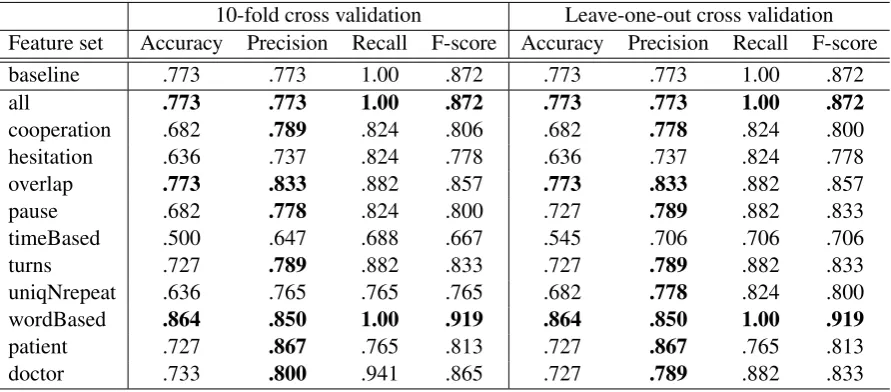
Our initial classifiers held some promise. The clas-sifier built from all of the features was equivalent to the baseline system, and the combination of the word-based features surpassed the baseline’s re-sults, as shown in Table 2.
To evaluate our system, we employ simple clas-sification accuracy, in addition to precision, recall and F-score. Classification accuracy is the propor-tion of correct predicpropor-tions by the classifier, irre-spective of class. Precision gauges how successful the pass predictions of a given classifier are, while recall gives us an indication of how successful a given classifier is at identifying the candidates who actually passed. Finally, F-score is a composite of precision and recall, and gives us an overall perfor-mance rating relative to passed candidates.
10-fold cross validation Leave-one-out cross validation Feature set Accuracy Precision Recall F-score Accuracy Precision Recall F-score
baseline .773 .773 1.00 .872 .773 .773 1.00 .872
all .773 .773 1.00 .872 .773 .773 1.00 .872
cooperation .682 .789 .824 .806 .682 .778 .824 .800
hesitation .636 .737 .824 .778 .636 .737 .824 .778
overlap .773 .833 .882 .857 .773 .833 .882 .857
pause .682 .778 .824 .800 .727 .789 .882 .833
timeBased .500 .647 .688 .667 .545 .706 .706 .706
turns .727 .789 .882 .833 .727 .789 .882 .833
uniqNrepeat .636 .765 .765 .765 .682 .778 .824 .800
wordBased .864 .850 1.00 .919 .864 .850 1.00 .919
patient .727 .867 .765 .813 .727 .867 .765 .813
[image:5.595.77.523.71.267.2]doctor .733 .800 .941 .865 .727 .789 .882 .833
Table 2: Classification results for STD and BC
feature set based on timing, which contains in-formation such as the overall length of the dia-logue, the overall length of transition pauses, in-turn pauses and other time-based features. This was most surprising because as a general observa-tion, candidates who allowed extended pauses and uncomfortable silences were those who seemed to perform poorly, and those who did not leave too many silences, and could maintain the flow of the dialogue, seemed to perform well.
Given the small number of training instances each classifier is based on, these first results were somewhat encouraging. With respect to the base-line, the overall performance of two of the sys-tems equalled or surpassed the baseline in terms of F-score. Most of the classifiers performed well in terms of precision but less well in terms of re-call, i.e. when the classifiers predicted a pass they were generally correct, but there were significant numbers of candidates who were predicted to have failed but passed in practice.
5.2 Data Introspection Retrospectively
Although the results show promise, it was ex-pected that more of the feature sets would return more favourable results. The possible reasons why the time-based features, and many of the other fea-ture sets developed, did not perform as well as ex-pected may have been because the features used in building the classifiers could have been combined in a better way, or because the data itself had too many anomalies or was too disparate. We would expect that extra data could iron out such anoma-lies, but developing additional data is expensive
and more recordings are not always available. The advantage of having a small dataset is that we are able to do fine-grained annotation of the data, but the obvious disadvantage is that we cannot easily generate extra amounts of training data.
One very noticeable feature of the OSCE sta-tions was that the STD SP had a very different communicative style to that of the the BC SP. Based on this observation we conducted tests given the hypothesis that the possible bias in the data could have stemmed from having two very differ-ent testing approaches from the two SPs. In gen-eral, the BC SP was more leading and in a sense more forgiving with the candidates. In contrast to this, the STD SP tended to be more felicitous in her role as a patient, allowing awkward silences and not prompting the candidates for further ex-ploration.
We conduct the Mann-Whitney test, a rank sum test, over the data in order to diagnose whether the poor results were due to the distribution of the data or whether the classifiers built with the selected features were simply poor predictors. The Mann-Whitney test ascertains whether there is a differ-ence in the population mean of the two samples given, without making any assumptions about the distribution of the data.
test-Category OVERALL APPROACH HISTORY INTERPRETATION MANAGEMENT COUNSELLING
z-score 1.84 1.21 -0.03 2.53 0.85 1.64
Table 3: Mann-Whitney z-score for BC and STD samples (OVERALLis the cumulative total of all 5
categories)
Category OVERALL APPROACH HISTORY INTERPRETATION MANAGEMENT COUNSELLING
z-score -3.29 -3.13 -2.43 -2.31 -2.31 -1.57
Table 4: Mann-Whitney z-score for failed and passed samples
ing was conducted between the BC and STD sta-tions.
BCvs. STD
We use the ranking from the 5 assessable cate-gories outlined in Section 3 and obtain the Mann-Whitney z-score for each category. The z-score gives us an indication of how disparate the two separated datasets, BC and STD, are. The further away from 0 the z-score is, the greater the evidence that BC and STD data are not from the same pop-ulation, and should be treated as such. The results of this test, as seen in Table 3, show that these two groups differ quite markedly: the candidates were consistently marked differently for all assessable categories except HISTORY. This is a striking
pe-culiarity because each candidate was tested in both the STD and BC stations.
Based on the above, we can posit that the dis-tinct testing styles of the STD and BC SPs were the reason for our original lacklustre results, and that the two data samples need to be treated sepa-rately for the classifiers to perform consistently.
FAILvs. PASS
In addition to the BC vs. STD test, we also test how the failing candidates differ from the passing candidates across the evaluation criteria.
The main idea behind this test is to see which of the assessable categories contributed the most in the overall outcome of the examination. For this test, we would not expect the absolute z-score of any of the assessment components to exceed the absolute z-score of the OVERALL category given
that it is the cumulative scores of all categories. The results in Table 4 suggest that APPROACH
correlates most highly with the pass/fail divide in the OSCE assessments, followed by HISTORY,
then INTERPRETATION and MANAGEMENT, and
finally COUNSELLING. Recall that APPROACHis
the component that assesses language and commu-nication skills. In particular, it assesses the style and appropriateness of the way candidates con-vey information, from lexical choice to display-ing empathy through communication style. Given that APPROACHcorrelates most strongly with the
assessment result, the decision to focus our fea-ture engineering efforts on linguistic aspects of the doctor–patient interaction would appear justified.
5.3 Results for STD & BC Data
Given the results from the Mann-Whitney tests re-ported in the previous section, we separate the data into two lots: those from the STD station, and those from the BC station.
Even though there were very few instances in the original dataset, we aim to see in these experi-ments whether this separation improves the perfor-mance of the classifiers. We build classifiers over each dataset using the same features as before.
The results of the tests performed over the sep-arated datasets, as shown in Table 5, show a big improvement over the baseline for STD, while the BC dataset is more problematic.
In the STD group, we see that four feature sets, all,turns,wordBasedandpatientequal or surpass the baseline F-score.
In contrast to this, upon examination of the performance of the classifiers built over the BC dataset, we do not observe any improvements over the baseline and the results are markedly worse than those for the combined dataset. Having said this, when we combine the outputs of the two com-ponent classifiers, the F-score for all features is 0.882, an improvement over the original combined system.
6 Discussion
as-BC STD
Feature Set Accuracy Precision Recall F-score Accuracy Precision Recall F-score
baseline .818 .818 1.00 .900 .727 .727 1.00 .842
all .727 .875 .778 .824 .909 .889 1.00 .941
cooperation .727 .800 .889 .842 .364 .571 .500 .533
hesitation .636 .778 .778 .778 .636 .700 .875 .778
overlap .727 .800 .889 .842 .636 .700 .875 .778
pause .818 .889 .889 .889 .545 .667 .750 .706
timeBased .636 .857 .667 .750 .545 .667 .750 .706
turns .636 .778 .778 .778 .818 .800 1.00 .889
uniqNrepeat .727 .800 .889 .842 .727 .778 .875 .824
wordBased .636 .778 .778 .778 .909 .889 1.00 .941
patient .727 .875 .778 .824 .818 .875 .875 .875
doctor .818 .818 1.00 .900 .455 .625 .625 .625
Table 5: Results for separated BC and STD datasets (leave-one-out)
sesses the efficacy of their communication skills in conveying correct and accurate medical informa-tion within a clinical setting. It can be seen from Table 4 that there is a high correlation between the overall pass or fail and the assessable category AP -PROACH.
The examiners’ subjectivity of overall perfor-mance is minimised by the highly structured exam-ination setup and well-defined assessment criteria. However, as shown in Table 3, the communicative style of the SP is a contributing factor to the per-ception of successful clinical and communication skills. The Mann-Whitney tests suggest that an SP’s approach and their apparent satisfaction dur-ing the clinical encounter can affect the judgement of the examiner.
Additional inspection of the data revealed that the assessment criteria which focused on language and communication skills correlated highly with an overall pass grade, moreso than the other cri-teria. This seems to suggest that more emphasis should be placed on language skills and communi-cation style in the assessment of the candidates.
Assessing language competency is no trivial matter, and capturing the linguistic features of di-alogues in an attempt to define competence, as we have done here, is a demanding task in itself. Al-though many of our features were focused on turn-taking, speaker response and interaction, we did not develop features that encompass the informa-tion structure of the communicative event.
It is assumed that miscommunication between non-native and native speakers of a language is due to a lack of language knowledge pertaining to
syn-tax, morphology or lexical semantics. However many of these communication difficulties arise not because of this lack of grammatical knowledge, but through a difference in discourse styles or in-formation structure as governed by different cul-tures (Wiberg, 2003; Li, 1999).
Given that the word-based feature sets were the most successful predictors of an OSCE out-come, future work of this kind could make use of medical-based lexicons to gauge whether technical or non-technical word usage in such environments is judged favourably. In addition, further work should be done to test the hypothesis that informa-tion structure or rhetorical structure does impact on overall perception of a successful communication, such as a variation on the methods employed by Burstein et al. (2001).
One obvious improvement to this study would be to reduce the expense in producing the anno-tated data. Future work could also be done in auto-matically extracting features from non-transcribed data, such as timing information based on pause length and the turn length of each speaker.
7 Conclusions
In this research, we have built classifiers over transcribed doctor–patient consultations in an at-tempt to predict OSCE outcomes. We achieved encouraging results based on a range of lexical and discourse-oriented features.
indicated both that success in the APPROACH
cat-egory correlates strongly with an overall success-ful OSCE, and that the data for the two stations is markedly different in nature. Based on this find-ing, we conduct tests over the data for the individ-ual stations with noticeable improvements to the results.
The results of this exploratory study have been quite encouraging, given the novel domain and limited data. We have shown that a data mining approach to OSCE assessment is feasible, which we hope will open the way to increased interest in automated medical assessment based on linguistic analysis.
References
Birrell, Bob, Lesleyanne Hawthorne. 2004. Medicare Plus and overseas trained doctors.People and Place, 12(2):83–99.
ten Bosch, Louis, Nelleke Oostdijk, Lou Boves. 2005. On temporal aspects of turn taking in conversational dialogues. Speech Communication, 47(2005):80– 86.
Burstein, Jill, Daniel Marcu, Slava Andreyev, Martin Chodorow. 2001. Towards Automatic Classification of Discourse Elements in Essays. ACL, 90-97. Clark, Herber H., Jean E. Fox Tree. 2002. Using
uh and um in spontaneous speaking. Cognition, 84(2002):73–111.
Flynn, Joanna. 2006. Medical Release. Australian Medical Council, 17(August 2006).
Grand’Maison, Paul, Jo¨elle Lescop, Paul Rainsberry, Carlos A. Brailovsky. 1992. Large-scale use of an objective, structured clinical examination for licens-ing family physicians. Canadian Medical Associa-tion, 146(10):1735–1740.
Gumperz, John. 1999. On Interactional Sociolinguis-tic Method. In Talk, Work and Institutional Order. Discourse in Medical, Mediation and Management SettingsS. Sarangi and C. Robers (eds), 453–471. Han, Gil-Soo, John .S Humphreys. 2006. Integratoin
and retention of international medical graduates in rural communities. A typological analysis. The Aus-tralian Sociological Association, 42(2):189–207. Itakura, Hiroko. 2000. Describing conversational
dominance. Journal of Pragmatics, 33(2001):1859– 1880.
Levow, Gina-Anne, Mari Broman Olsen. 1999. Mod-eling the language assessment process and result: Proposed architecture for an automatic oral profi-ciency assessment. Workshop On Computer Medi-ated Language Assessment And Evaluation In Natu-ral Language Processing.
Li, Han Zao. 1999. Comunication Information in Con-versations: A Cross-cultural Comparison. Interna-tional Journal of Intercultural Relations, 23(3):387– 409.
McGrath, Barry. 2004. Overseas-trained doctors. Inte-gration of overseas-trained doctors in the Australian medical workforce. The Medical Journal of Aus-tralia, 181(11/12):640–642.
Roberts, Celia, Val Wass, Roger Jones, Srikant Sarangi, Annie Gillett. 2003. A discourse analysis study of ‘good’ and ‘poor’ communication in an OSCE: a proposed new framework for teaching students.
Medical Education, 50:192–201.
Sacks, Harvey, Emanuel A. Schegloff, Gail Jefferson. 1974. A Simplest Systematics for the Organiza-tion of Turn-Taking for ConversaOrganiza-tion. Language, 50(4):696–735.
Spike, Neil. 2006. International Medical Graduates: The Australian perspective. Acad Med, 81):842– 846.
Vu, Nu Viet, Howard S. Barrows. 1994. Use of Stan-dardized Patients in Clinical Assessments: Recents Developments and Measurement Findings. Educa-tional Researcher, 23(3):23–30.