Dependency-Based N-Gram Models for
General Purpose Sentence Realisation
Yuqing Guo
NCLT, School of Computing Dublin City University
Dublin 9, Ireland [email protected]
Josef van Genabith NCLT, School of Computing
Dublin City University IBM CAS, Dublin, Ireland
Haifeng Wang Toshiba (China)
Research & Development Center Beijing, 100738, China [email protected]
Abstract
We present dependency-based n-gram models for general-purpose, wide-coverage, probabilistic sentence realisa-tion. Our method linearises unordered dependencies in input representations
directly rather than via the application
of grammar rules, as in traditional chart-based generators. The method is simple, efficient, and achieves competitive accu-racy and complete coverage on standard English (Penn-II, 0.7440 BLEU, 0.05 sec/sent) and Chinese (CTB6, 0.7123 BLEU, 0.14 sec/sent) test data.
1 Introduction
Sentence generation,1or surface realisation can be described as the problem of producing syntacti-cally, morphologisyntacti-cally, and orthographically cor-rect sentences from a given semantic or syntactic representation.
Most general-purpose realisation systems de-veloped to date transform the input into sur-face form via the application of a set of gram-mar rules based on particular linguistic theories, e.g. Lexical Functional Grammar (LFG), Head-Driven Phrase Structure Grammar (HPSG), Com-binatory Categorial Grammar (CCG), Tree Ad-joining Grammar (TAG) etc. These grammar rules are either carefully handcrafted, as those used in FUF/SURGE (Elhadad, 1991), LKB (Carroll et al.,
c
2008. Licensed under the Creative Commons Attribution-Noncommercial-Share Alike 3.0 Unported li-cense (http://creativecommons.org/licenses/by-nc-sa/3.0/). Some rights reserved.
1
In this paper, the term “generation” is used generally for what is more strictly referred to by the term “tactical genera-tion” or “surface realisagenera-tion”.
1999), OpenCCG (White, 2004) and XLE (Crouch et al., 2007), or created semi-automatically (Belz, 2007), or fully automatically extracted from an-notated corpora, like the HPSG (Nakanishi et al., 2005), LFG (Cahill and van Genabith, 2006; Hogan et al., 2007) and CCG (White et al., 2007) resources derived from the Penn-II Treebank (PTB) (Marcus et al., 1993).
Over the last decade, probabilistic models have become widely used in the field of natural lan-guage generation (NLG), often in the form of a re-alisation ranker in a two-stage generation architec-ture. The two-stage methodology is characterised by a separation between generation and selection, in which rule-based methods are used to generate a space of possible paraphrases, and statistical meth-ods are used to select the most likely realisation from the space. By and large, two statistical mod-els are used in the rankers to choose output strings:
• N-gram language models over different units, such as word-level bigram/trigram mod-els (Bangalore and Rambow, 2000; Langk-ilde, 2000), or factored language models inte-grated with syntactic tags (White et al., 2007).
• Log-linear models with different syntactic and semantic features (Velldal and Oepen, 2005; Nakanishi et al., 2005; Cahill et al., 2007).
To date, however, probabilistic models learn-ing direct mapplearn-ings from generation input to sur-face strings, without the effort to construct a gram-mar, have rarely been explored. An exception is Ratnaparkhi (2000), who presents maximum en-tropy models to learn attribute ordering and lexi-cal choice for sentence generation from a semantic representation of attribute-value pairs, restricted to an air travel domain.
S NP PRP We VP VBP believe PP IN in NP NP DT the NN law PP IN of NP NNS averages f1 PRED ‘believe’ TENSE pres
SUBJ f2
PRED ‘pro’ PERS 1 NUM pl
OBL f3
PFORM ‘in’
OBJ f4
PRED ‘law’ PERS 3 NUM sg
SPEC f5
DET f6hPRED ‘the’i
ADJ f7 PFORM ‘of’
OBJ f8
PRED ‘average’ PERS 3 NUM pl
(a.) c-structure (b.) f-structure
string We believe in the law of averages
position 1 2 3 4 5 6 7
f1 SUBJ PRED OBL
f3 PFORM OBJ
f4 SPEC PRED ADJ
f7 PFORM OBJ
[image:2.595.71.476.70.319.2](c.) linearised grammatical functions / bilexical dependencies
Figure 1: C- and f-structures for the sentence We believe in the law of averages.
In this paper, we develop an efficient, wide-coverage generator based on simple n-gram mod-els to directly linearise dependency relations from the input representations. Our work is aimed at general-purpose sentence generation but couched in the framework of Lexical Functional Grammar. We give an overview of LFG and the dependency representations we use in Section 2. We describe the general idea of our dependency-based gener-ation in Section 3 and give details of the n-gram generation models in Section 4. Section 5 explains the experiments and provides results for both En-glish and Chinese data. Section 6 compares the re-sults with previous work and between languages. Finally we conclude with a summary and outline future work.
2 LFG-Based Generation
2.1 Lexical Functional Grammar
Lexical Functional Grammar (Kaplan and Bres-nan, 1982) is a constraint-based grammar for-malism which postulates (minimally) two lev-els of representation: c(onstituent)-structure and f(unctional)-structure. As illustrated in Figure 1, a c-structure is a conventional phrase structure tree and captures surface grammatical configu-rations. The f-structure encodes more abstract functional relations like SUBJ(ect), OBJ(ect) and ADJ(unct). F-structures are hierarchical
attribute-value matrix representations of bilexical labelled dependencies, approximating to basic predicate-argument/adjunct structures.2 Attributes in f-structure come in two different types:
• Grammatical Functions (GFs) indicate the re-lationship between the predicate and depen-dents. GFs can be divided into:
– arguments are subcategorised for by the
predicate, such as SUBJ(ect), OBJ(ect), and thus can only occur once in each lo-cal f-structure.
– modifiers like ADJ(unct), COORD(inate) are not subcategorised for by the predi-cate, and can occur any number of times in a local f-structure.
• Atomic-valued features describe linguistic properties of the predicate, such as TENSE, ASPECT,MOOD,PERS,NUM,CASEetc.
2.2 Generation from F-Structures
Work on generation in LFG generally assumes that the generation task is to determine the set of strings of the language that corresponds to a specified f-structure, given a particular grammar (Kaplan and Wedekind, 2000). Previous work on generation
2
within LFG includes the XLE,3 Cahill and van Genabith (2006), Hogan et al. (2007) and Cahill et al. (2007). The XLE generates sentences from f-structures according to parallel handcrafted gram-mars for English, French, German, Norwegian, Japanese, and Urdu. Based on the German XLE resources, Cahill et al. (2007) describe a two-stage, log-linear generation model. Cahill and van Gen-abith (2006) and Hogan et al. (2007) present a chart generator using wide-coverage PCFG-based LFG approximations automatically acquired from treebanks (Cahill et al., 2004).
3 Dependency-Based Generation: the Basic Idea
Traditional LFG generation models can be re-garded as the reverse process of parsing, and use bi-directional f-structure-annotated CFG rules. In a sense, the generation process is driven by an input dependency (or f-structure) representa-tion, but proceeds through the “detour” of us-ing dependency-annotated CFG (or PCFG) gram-mars and chart-based generators. In this paper, we develop a simple n-gram and dependency-based, wide-coverage, robust, probabilistic gener-ation model, which cuts out the middle-man from previous approaches: the CFG-component.
Our approach is data-driven: following the methodology in (Cahill et al., 2004; Guo et al., 2007), we automatically convert the English Penn-II treebank and the Chinese Penn Treebank (Xue et al., 2005) into f-structure banks. F-structures such as Figure 1(b.) are unordered, i.e. they do
not carry information on to the relative surface
or-der of local GFs. In oror-der to generate a string from an f-structure, we need to linearise the GFs (at each level of embedding) in the f-structure (and map lemmas and features to surface forms). We do this in terms of n-gram models over GFs. In or-der to build the n-gram models, we linearise the f-structures automatically produced from treebanks by associating the numerical string position (word offset from start of the sentence) with the predicate in each local f-structure, producing GF sequences as in Figure 1(c.).
Even though the n-gram models are exemplified using LFG f-structures, they are general-purpose models and thus suitable for any bilexical labelled dependency (Nivre, 2006) or predicate-argument type representations, such as the labelled
feature-3http://www2.parc.com/isl/groups/nltt/xle/
value structures used in HALogen and the func-tional descriptions in the FUF/SURGE system.
4 N-Gram Models for Dependency-Based Generation
4.1 Basic N-Gram Model
The primary task of a sentence generator is to de-termine the linear order of constituents and words, represented as lemmas in predicates in f-structures. At a particular local f-structure, the task of gen-erating a string covered by the local f-structure is equivalent to linearising all the GFs present at that local f-structure. E.g. in f4 in Figure 1, the unordered set of local GFs {SPEC, PRED, ADJ} generates the surface sequence “the law of aver-ages”. We linearise the GFs in the set by com-puting n-gram models, similar to traditional word-based language models, except using the names of GFs (including PRED) instead of words. Given a (sub-) f-structure F containing m GFs, the n-gram model searches for the best surface sequence
Sm
1 =s1...sm generated by the GF linearisation
GFm
1 = GF1...GFm, which maximises the
prob-abilityP(GF1m). Using n-gram models,P(GF1m) is calculated according to Eq.(1).
P(GF1m) = P(GF1...GFm)
= Ym
k=1
P(GFk|GFkk−−n1+1) (1)
4.2 Factored N-Gram Models
In addition to the basic n-gram model over bare GFs, we integrate contextual and fine-grained lexical information into several factored models. Eq.(2) additionally conditions the probability of the n-gram on the parent GF label of the cur-rent local f-structure fi, Eq.(3) on the instantiated PRED of the local f-structure fi, and Eq.(4) lexi-calises the model, where each GF is augmented with its own predicate lemma.
Pg(GF1m) =
m
Y
k=1
P(GFk|GFkk−−n1+1, GFi) (2)
Pp(GFm
1 ) =
m
Y
k=1
P(GFk|GFkk−−n1+1, P redi) (3)
Pl(GF1m) =
m
Y
k=1
To avoid data sparseness, the factored n-gram modelsPf are smoothed by linearly interpolating the basic n-gram modelP, as in Eq.(5).
ˆ
Pf(GFm
1 ) =λPf(GF1m) + (1−λ)P(GF1m) (5)
Additionally, the lexicalised n-gram models Pl are combined with the other two models con-ditioned on the additional parent GF Pg and PREDPp, as shown in Eqs. (6) & (7), respectively.
ˆ
Plg(GFm
1 ) =λ1Pl(GF1m) +λ2Pg(GF1m)
+λ3P(GF1m) (6)
ˆ
Plp(GF1m) =λ1Pl(GF1m) +λ2Pp(GF1m)
+λ3P(GF1m) (7)
where Pλi= 1
Table 1 exemplifies the different n-gram models for the local f-structuref4in Figure 1.
Model N-grams Cond.
basic(P) SPEC PRED ADJ
gf(Pg) SPEC PRED ADJ OBL
pred(Pp) SPEC PRED ADJ ‘law’
lex(Pl) SPEC PRED[‘law’] ADJ[‘of’]
Table 1: Examples of n-grams forf4in Figure 1
Besides grammatical functions, we also make use of atomic-valued features like TENSE, PERS, NUM(etc.) to aid linearisation. The attributes and values of these features are integrated into the GF n-grams for disambiguation (see Section 5.2).
4.3 Generation Algorithm
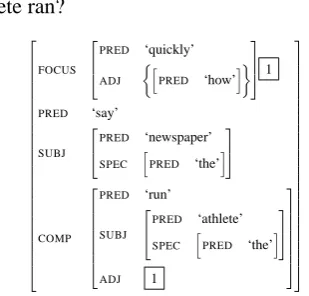
Our basic n-gram based generation model im-plements the simplifying assumption that lineari-sation at one sub-f-structure is independent of linearisation at any other sub-f-structures. This assumption is feasible for projective dependen-cies. In most cases (at least in English and Chinese), non-projective dependencies are only used to account for Long-Distance Dependen-cies (LDDs). Consider sentence (1) discussed in Carroll et al. (1999) and its corresponding f-structure in Figure 2. In LFG f-f-structures, LDDs are represented via reentrancies between “dislo-cated” TOPIC, TOPIC REL, FOCUS (etc.) GFs and “source” GFs subcategorised for by local predi-cates, but only the dislocated GFs are instantiated in generation. Therefore traces of the source GFs in input f-structures are removed before genera-tion, and non-projective dependencies are trans-formed into simple projective dependencies.
(1) How quickly did the newspapers say the ath-lete ran?
FOCUS
PRED ‘quickly’
ADJ
h
PRED ‘how’i
1
PRED ‘say’
SUBJ
PRED ‘newspaper’
SPEC
h
PRED ‘the’i
COMP
PRED ‘run’
SUBJ
PRED ‘athlete’
SPEC
h
PRED ‘the’i
ADJ 1
[image:4.595.324.479.84.232.2]
Figure 2: schematic f-structure for How quickly
did the newspapers say the athlete ran?
In summary, given an input f-structure f, the core algorithm of the generator recursively tra-versesf and at each sub-f-structurefi:
1. instantiates the local predicate at fi and per-forms inflections/declensions if necessary
2. calculates the GF linearisations present at fi by n-gram models
3. finds the most probable GF sequence among all possibilities by Viterbi search
4. generates the string covered by fi according to the linearised GFs
5 Experiments and Evaluation
To test the performance and coverage of our n-gram-based generation models, experiments are carried out for both English and Chinese, two lan-guages with distinct properties.
5.1 Experiment Design
Experiments on English data are carried out on the WSJ portion of the PTB, using standard train-ing/test/development splits, viz 39,832 sentences from sections 02-21 are used for training, 2,416 sentences from section 23 for testing, while 1,700 sentences from section 22 are held out for develop-ment. The latest version of the Penn Chinese Tree-bank 6.0 (CTB6), excluding the portion of ACE broadcast news, is used for experiments on Chi-nese data.4 We follow the recommended splits (in the list-of-file of CTB6) to divide the data into test set, development set and training set. The training set includes 756 files with a total of 15,663 sen-tences. The test set includes 84 files with 1,708
4
sentences. The development set includes 50 files with 1,116 sentences. Table 2 shows some of the characteristics of the English and Chinese data ob-tained from the development sets.
Development Set English Chinese
num of sent 1,700 1,116
max length of sent (#words) 110 145
ave length of sent (#words) 23 31
num of local fstr 23,289 15,847
[image:5.595.73.274.137.220.2]num of local fstr per sent 13.70 14.20 max length of local fstr (#gfs) 12 16 ave length of local fstr (#gfs) 2.56 2.90
Table 2: Comparison English and Chinese data
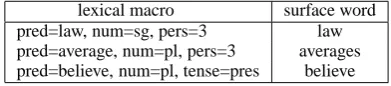
The n-gram models are created using the SRILM toolkit (Stolcke, 2002) with Good-Turning smoothing for both the Chinese and English data. For morphological realisation of English, a set of lexical macros is automatically extracted from the training data. This is not required for Chinese sur-face realisation as Chinese has very little morphol-ogy. Lexical macro examples are listed in Table 3.
lexical macro surface word
pred=law, num=sg, pers=3 law
pred=average, num=pl, pers=3 averages pred=believe, num=pl, tense=pres believe
Table 3: Examples of lexical macros
The input to our generator are unordered f-structures automatically derived from the develop-ment and test set trees of our treebanks, which do
not contain any string position information. But,
due to the particulars of the automatic f-structure annotation algorithm, the order of sub-f-structures in set-valued GFs, such as ADJ, COORD, happens to correspond to their surface order. To avoid un-fairly inflating evaluation results, we lexically re-order the GFs in each sub-f-structure of the devel-opment and test input before the generation pro-cess. This resembles the “permute, no dir” type experiment in (Langkilde, 2002).
5.2 Experimental Results
Following (Langkilde, 2002) and other work on general-purpose generators, BLEU score (Pa-pineni et al., 2002), average NIST simple string accuracy (SSA) and percentage of exactly matched sentences are adopted as evaluation met-rics. As our system guarantees that all input f-structures can generate a complete sentence, spe-cial coverage-dependent evaluation (as has been
adopted in most grammar-based generation sys-tems) is not necessary in our experiments.
Experiments are carried out on an Intel Pentium 4 server, with a 3.80GHz CPU and 3GB mem-ory. It takes less than 2 minutes to generate all 2,416 sentences (with average sentence length of 21 words) of WSJ section 23 (average 0.05 sec per sentence), and approximately 4 minutes to gener-ate 1,708 sentences (with average sentence length of 30 words) of CTB test data (average 0.14 sec per sentence), using 4-gram models in all experi-ments. Our evaluation results for English and Chi-nese data are shown in Tables 4 and 5, respectively.
Different n-gram models perform nearly consis-tently in all the experiments on both English and Chinese data. The results show that factored n-gram models outperform the basic n-n-gram models, and in turn the combined n-gram models outper-form single n-gram models. The combined model interpolating grams over lexicalised GFs with n-grams conditioned on PRED achieves the best re-sults in both experiments on English (with feature names) and Chinese (with feature names & val-ues), with BLEU scores of 0.7440 and 0.7123 re-spectively, and full coverage.
Lexicalisation plays an important role in both English and Chinese, boosting the BLEU score without features from 0.5074 to 0.6741 for En-glish, and from 0.5752 to 0.6639 for Chinese.
[image:5.595.75.271.377.420.2]WSJ Sec23 Without Features Feature Names Feature Names & Values
Model ExMatch BLEU SSA ExMatch BLEU SSA ExMatch BLEU SSA
baseline 5.30% 0.5074 57.29% 15.27% 0.6842 69.48% 15.15% 0.6829 69.15%
gf 6.62% 0.5318 60.06% 16.76% 0.6969 71.51% 16.68% 0.6977 71.55%
pred 8.03% 0.5697 60.73% 16.72% 0.7035 70.12% 16.76% 0.7042 71.08%
lex 12.87% 0.6741 69.43% 19.41% 0.7384 74.76% 18.96% 0.7375 74.12%
lex+gf 12.62% 0.6611 69.41% 19.70% 0.7388 74.98% 19.74% 0.7405 75.08%
lex+pred 12.25% 0.6569 68.04% 19.83% 0.7440 75.34% 19.58% 0.7422 75.04%
Table 4: Results for English Penn-II WSJ section 23
Test Without Features Feature Names Feature Names & Values
Model ExMatch BLEU SSA ExMatch BLEU SSA ExMatch BLEU SSA
baseline 8.96% 0.5752 51.92% 11.77% 0.6160 54.64% 12.30% 0.6239 55.20%
gf 9.54% 0.6009 53.02% 12.53% 0.6391 55.78% 13.47% 0.6486 56.60%
pred 10.07% 0.6180 53.80% 13.35% 0.6608 56.72% 14.46% 0.6720 57.67%
lex 13.93% 0.6639 59.61% 15.16% 0.6770 60.44% 15.98% 0.6804 60.20%
lex+gf 14.81% 0.6773 59.92% 15.52% 0.6911 60.97% 16.80% 0.6957 61.07%
lex+pred 16.04% 0.6952 60.82% 16.22% 0.7060 61.45% 17.51% 0.7123 61.54%
Table 5: Results for Chinese CTB6 test data
WSJ Sec23 Sentence length≤20words All sentences
Coverage ExMatch BLEU SSA Coverage ExMatch BLEU SSA
Langkilde(2002) 82.7% 28.2% 0.757 69.6%
Callaway(2003) 98.7% 49.0% 88.84%
Nakanishi(2005) 90.75% 0.7733 83.6% 0.705
Cahill(2006) 98.65% 0.7077 73.73% 98.05% 0.6651 68.08%
Hogan(2007) 100% 0.7139 99.96% 0.6882 70.92%
White(2007) 94.3% 6.9% 0.5768
[image:6.595.79.502.68.151.2]this paper 100% 35.40% 0.7625 81.09% 100% 19.83% 0.7440 75.34%
Table 6: Cross system comparison of results for English WSJ section 23
6 Discussion
6.1 Comparison to Previous Work
It is very difficult to compare sentence generators since the information contained in the input rep-resentation varies greatly between systems. The most direct comparison is between our system and those presented in Cahill and van Genabith (2006) and Hogan et al. (2007), as they also use treebank-based automatically generated f-structures as the generator inputs. The labelled feature-value struc-tures used in HALogen (Langkilde, 2002) and functional descriptions in FUF/SURGE (Callaway, 2003) also bear some broad similarities to our f-structures. A number of systems using different input but adopting the same evaluation metrics and testing on the same data are listed in Table 6.
Surprisingly (or not), the best results are achieved by a purely symbolic generation system—FUF/SURGE (Callaway, 2003). How-ever the approach uses handcrafted grammars which are very time-consuming to produce and adapt to different languages and domains. Langk-ilde (2002) reports results for experiments with varying levels of linguistic detail in the input
6.2 Error Analysis and Differences Between the Languages
Though our dependency-based n-gram models per-form well in both the English and Chinese exper-iments, we are surprised that experiments on En-glish data produce better results than those for Chi-nese. It is widely accepted that English generation is more difficult than Chinese, due to morpholog-ical inflections and the somewhat less predictable word order of English compared to Chinese. This is reflected by the results of the baseline models. Chinese has a BLEU score of 0.5752 and 8.96% exact match, both are higher than those of English. However with feature augmentation and lexicali-sation, the results for English data exceed Chinese. This is probably because of the following reasons:
Data size of the English training set is more than twice that of Chinese.
Grammatical functions are more fine-grained in English f-structures than those in Chinese. There are 32 GFs defined for English compared to 20 for Chinese in our input f-structures.
Properties of the languages and data sets are different. For example, due to lack of inflection and case markers, many sequences of VPs in Chi-nese have to be treated as coordinates, whereas their counterparts in English act as different gram-matical functions, e.g. (2).
(2) Ý℄ z ,ïùó§
invest million build this construction ‘invest million yuan to build the construction’
This results in a total of 7,377 coordinates (4.32 per sentence) in the Chinese development data, compared to 2,699 (1.12 per sentence) in the En-glish data. The most extreme case in the Chinese data features 14 coordinates of country names in a local f-structure. This may account for the low SSA score for the Chinese experiments, as many coordinates are tied in the n-gram scoring method and can not be ordered correctly. Examining the development data shows different types of coordi-nation errors:
• syntactic coordinates, but not semantic coor-dinates, as in sentence (2).
• syntactic and semantic coordinates, but usu-ally expressed in a fixed order, e.g. (3).
(3) U m
reform opening-up ‘reform and opening up’
• syntactic and semantic coordinates, which can freely swap positions, e.g. (4).
(4) ¿ °å Ú ¯$g
plentiful energy and quick thinking ‘energetic and agile’
At the current stage, our n-gram generation model only keeps the most likely realisation for each local f-structure. We believe that packing all equivalent elements, like coordinates in a local f-structure into equivalent classes, and outputing n-best candidate realisations will greatly increase the SSA score and may also further benefit the effi-ciency of the algorithm.
7 Conclusions and Further Work
We have described a number of increasingly so-phisticated n-gram models for sentence genera-tion from labelled bilexical dependencies, in the form of LFG f-structures. The models include additional conditioning on parent GFs and differ-ent degrees of lexicalisation. Our method is sim-ple, highly efficient, broad coverage and accurate in practice. We present experiments on English and Chinese, showing that the method generalises well to different languages and data sets. We are currently exploring further combinations of con-ditioning context and lexicalisation, application to different languages and to dependency represen-tations used to train state-of-the-art dependency parsers (Nivre, 2006).
Acknowledgments
This research is funded by Science Foundation Ire-land grant 04/IN/I527. We thank Aoife Cahill for providing the treebank-based LFG resources for the English data. We gratefully acknowledge the feedback provided by our anonymous reviewers.
References
Bangalore, Srinivas and Rambow, Owen. 2000. Ex-ploiting a Probabilistic Hierarchical Model for Gen-eration. Proceedings of the 18th International Conference on Computational Linguistics, 42–48.
Saarbr¨ucken, Germany.
Belz, Anja. 2007. Probabilistic Generation of Weather Forecast Texts. Proceedings of the Conference of the
North American Chapter of the Association for Com-putational Linguistics, 164–171. New York.
Acquired Wide-Coverage PCFG-Based LFG Ap-proximations. In Proceedings of the 42nd Annual
Meeting of the Association for Computational Lin-guistics, 320-327. Barcelona, Spain.
Cahill, Aoife and van Genabith, Josef. 2006. Ro-bust PCFG-Based Generation Using Automatically Acquired LFG Approximations. Proceedings of the 21st International Conference on Computational Linguistics and 44th Annual Meeting of the Asso-ciation for Computational Linguistics, 1033–1040.
Sydney, Australia.
Cahill, Aoife, Forst, Martin and Rohrer, Christian. 2007. Stochastic Realisation Ranking for a Free Word Order Language. Proceedings of the 11th
Eu-ropean Workshop on Natural Language Generation,
17–24. Schloss Dagstuhl, Germany.
Callaway, Charles B.. 2003. Evaluating Coverage for Large Symbolic NLG Grammars. Proceedings of the
Eighteenth International Joint Conference on Artifi-cial Intelligence, 811–817. Acapulco, Mexico.
Carroll, John, Copestake, Ann, Flickinger, Dan and Poznanski, Victor. 1999. An efficient chart gen-erator for (semi-)lexicalist grammars. Proceedings
of the 7th European Workshop on Natural Language Generation, 86–95. Toulouse, France.
Crouch, Dick, Dalrymple, Mary, Kaplan, Ron, King, Tracy, Maxwell, John and Newman, Paula. 2007. XLE Documentation. Palo Alto Research Center, CA.
Elhadad, Michael. 1991. FUF: The universal unifier user manual version 5.0. Technical Report CUCS-038-91. Dept. of Computer Science, Columbia Uni-versity.
Guo, Yuqing and van Genabith, Josef and Wang, Haifeng. 2007. Treebank-based Acquisition of LFG Resources for Chinese. Proceedings of LFG07
Con-ference, 214–232. Stanford, CA, USA.
Hogan, Deirdre Cafferkey, Conor Cahill, Aoife and van Genabith, Josef. 2007. Exploiting Multi-Word Units in History-Based Probabilistic Generation. Pro-ceedings of the 2007 Joint Conference on Empiri-cal Methods in Natural Language Processing and CoNLL, 267–276. Prague, Czech Republic.
Kaplan, Ronald and Bresnan, Joan. 1982. Lexical Functional Grammar: a Formal System for Gram-matical Representation. The Mental Representation
of Grammatical Relations, 173–282. MIT Press, Cambridge.
Kaplan, Ronald and Wedekind, Jurgen. 2000. LFG Generation Produces Context-free Languages.
Pro-ceedings of the 18th International Conference on Computational Linguistics, 425–431. Saarbr¨ucken,
Germany.
Langkilde, Irene. 2000. Forest-Based Statistical Sen-tence Generation. Proceedings of 1st Meeting of the
North American Chapter of the Association for Com-putational Linguistics, 170–177. Seattle, WA.
Langkilde, Irene. 2002. An Empirical Verification of Coverage and Correctness for a General-Purpose Sentence Generator. Proceedings of the Second
In-ternational Conference on Natural Language Gener-ation, 17–24. New York, USA.
Marcus, Mitchell P., Santorini, Beatrice and Marcinkiewicz, Mary Ann. 1993. Building a large annotated corpus of English: The Penn Treebank. Computational Linguistics, 19(2).
Nakanishi, Hiroko and Nakanishi, Yusuke and Tsu-jii, Jun’ichi. 2005. Probabilistic Models for Dis-ambiguation of an HPSG-Based Chart Generator.
Proceedings of the 9th International Workshop on Parsing Technology, 93–102. Vancouver, British Columbia.
Nivre, Joakim. 2006. Inductive Dependency Parsing. Springer.
Papineni, Kishore, Roukos, Salim, Ward, Todd and Zhu, Wei-Jing. 2002. Bleu: a Method for Automatic Evaluation of Machine Translation. Proceedings of
the 40th Annual Meeting of the Association for Com-putational Linguistics, 311-318. Philadelphia, USA.
Ratnaparkhi, Adwait. 2000. Trainable methods for nat-ural language generation. Proceedings of NAACL
2000, 194–201. Seattle, WA.
Stolcke, Andreas. 2002. SRILM-An Extensible Lan-guage Modeling Toolkit. Proceedings of
Interna-tional Conference of Spoken Language Processing.
Denver, Colorado.
van Genabith, Josef and Crouch, Dick. 1996. Di-rect and underspecified interpretations of LFG f-structures. Proceedings of the 16th conference on
Computational linguistics, 262–267. Copenhagen,
Denmark
Velldal, Erik and Oepen, Stephan. 2005. Maximum entropy models for realization ranking. Proceedings
of the MTSummit ’05.
White, Michael. 2004. Reining in CCG Chart Realiza-tion. Proceedings of the third International Natural
Language Generation Conference. Hampshire, UK.
White, Michael, Rajkumar, Rajakrishnan and Martin, Scott. 2007. Towards Broad Coverage Surface Re-alization with CCG. Proceedings of the MT Summit
XI Workshop, 22–30. Copenhagen, Danmark.
Xue, Nianwen, Xia, Fei, Chiou, Fu dong and Palmer, Martha. 2005. The Penn Chinese TreeBank: Phrase Structure Annotation of a Large Corpus. Natural