Composition of Semantic Relations: Model and Applications
Eduardo Blanco, Hakki C. Cankaya and Dan Moldovan
Human Language Technology Research Institute The University of Texas at Dallas
{eduardo,candan,moldovan}@hlt.utdallas.edu
Abstract
This paper presents a framework for com-bining semantic relations extracted from text to reveal even more semantics that otherwise would be missed. A set of 26 re-lations is introduced, with their arguments defined on an ontology of sorts. A seman-tic parser is used to extract these relations from noun phrases and verb argument structures. The method was successfully used in two applications: rapid customiza-tion of semantic relacustomiza-tions to arbitrary do-mains and recognizing entailments.
1 Introduction
Semantic representation of text facilitates infer-ences, reasoning, and greatly improves the per-formance of Question Answering, Information Extraction, Machine Translation and other NLP applications. Broadly speaking, semantic rela-tions are unidirectional underlying connecrela-tions between concepts. For example, the noun phrase
the car engine encodes a PART-WHOLE relation: the engine is a part of the car.
Semantic relations are the building blocks for creating a semantic structure of a sentence. There is a growing interest in text semantics fueled by the new wave of semantic technologies and on-tologies that aim at transforming unstructured text into structured knowledge. More and more enter-prises and academic organizations have adopted the World Wide Web Consortium (W3C) Re-source Description Framework (RDF) specifica-tion as a standard representaspecifica-tion of text knowl-edge. This is based on semantic triples, which can be used to represent semantic relations.
The work reported in this paper aims at extract-ing as many semantic relations from text as
possi-ble. Semantic parsers (SP) extract semantic rela-tions from text. Typically they detect relarela-tions be-tween adjacent concepts or verb argument struc-tures, leaving considerable semantics unrevealed. For example, given John is a rich man, a typical SP extracts John is a man and man is rich, but not
John is rich. The third relation can be extracted
by combining the two relations detected by the parser. The observation that combining elemen-tary semantic relations yields more relations is the starting point and the motivation for this work.
2 Related Work
In Computational Linguistics, WordNet (Miller, 1995), FrameNet (Baker et al., 1998) and Prop-Bank (Palmer et al., 2005) are probably the most used semantic resources. Like our approach and unlike PropBank, FrameNet annotates semantics between concepts regardless of their position in a parse tree. Unlike us, they use a predefined set of frames to be filled. PropBank adds semantic an-notation on top of the Penn TreeBank and it con-tains only annotations between a verb and its ar-guments. Moreover, the semantics of a given label depends on the verb. For example, ARG2 is used
forINSTRUMENTandVALUE.
pro-posals to detect a particular relation, e.g., CAUSE
(Chang and Choi, 2006),INTENT(Tatu, 2005) and
PART-WHOLE(Girju et al., 2006).
Researchers have also worked on combining se-mantic relations. Harabagiu and Moldovan (1998) combine WordNet relations and Helbig (2005) transforms chains of relations into theoretical ax-ioms. Some use logic as the underlying formal-ism (Lakoff, 1970; S´anchez Valencia, 1991), more ideas can be found in (Copestake et al., 2001).
3 Approach
In contrast to First Order Logic used in AI to rep-resent text knowledge, we believe text semantics should be represented using a fixed set of rela-tions. This facilitates a more standard represen-tation and extraction automation which in turn al-lows reasoning. The fewer the relation types, the easier it is to reason and perform inferences. Thus, a compromise has to be made between having enough relation types to adequately represent text knowledge and yet keeping the number small for making the extraction and manipulation feasible.
The main contributions of this paper are: (i) an extended definition of a set of 26 semantic rela-tions resulted after many iterarela-tions and pragmatic considerations; (ii) definition of a semantic calcu-lus, a framework to manipulate and compose se-mantic relations (CSR); (iii) use of CSR to rapidly customize a set of semantic relations; and (iv) use of CSR to detect entailments. The adoption of CSR to other semantic projects does not require any modification of existing tools while being able to detect relations ignored by such tools.
4 Semantic Relations
Formally, a semantic relation is represented as
R(x, y), where R is the relation type and x and y the first and second argument. R(x, y) should be read asx isRofy. The sentence “John painted his
truck” yields AGENT(John, painted ), THEME(his
truck, painted ) andPOSSESSION(truck, John).
Extended definition Given a semantic relationR,
DOMAIN(R) and RANGE(R) are defined as the set
of sorts of concepts that can be part of the first and second argument. A semantic relation R(x, y) is defined by its: (i) relation type R; (ii) DO
-MAIN(R); and (iii) RANGE(R). Stating restric-tions for DOMAINand RANGEhas several advan-tages: it (i) helps distinguishing between relations, e.g., [tall]ql and [John]aco can be linked through
VALUE, but not POSSESSION; (ii) helps discard-ing potential relations that do not hold, e.g., ab-stract objectsdo not haveINTENT; and (iii) helps combining semantic relations (Section 5).
Ontology of Sorts In order to define DOMAIN(R)
and RANGE(R), we use a customized ontology
of sorts (Figure 1) modified from (Helbig, 2005). The root corresponds toentities, which refers to all
things about which something can be said.
Objects can be either concreteor abstract. The former occupy space, are touchable and tangi-ble. The latter are intangible; they are somehow a product of human reasoning. Concrete objectsare further divided intoanimateorinanimate. The for-mer have life, vigor or spirit; the later are dull, without life. Abstract objectsare divided into tem-poralornon temporal. The first corresponds to ab-stractions regarding points or periods of time (e.g.
July, last week); the second to any other
abstrac-tion (e.g. disease, justice). Abstract objectscan be sensually perceived, e.g., pain, odor.
Situations are anything that happens at a time and place. Simply put, if one can think of the time and location of an entity, it is a situation. Events (e.g. mix, grow) imply a change in the status of other entities, states (e.g. standing next to the door) do not.Situationscan be expressed by verbs (e.g. move, print) or nouns (e.g. party, hurricane). Descriptorscomplemententitiesby stating prop-erties about their spatial or temporal context. They are composed of an optional non-content word signaling thelocalortemporalcontext and another entity. Local descriptors are further composed of aconcrete objectorsituation, e.g., [above]prep [the roof]co; temporal descriptorsby a temporal abstract objectorsituation, e.g., [during]prep [the party]ev. The non-content word signaling thelocalor tempo-ralcontext is usually present, but not always, e.g.,
“The [birthplace]evof his mother is [Ankara]loc”.
Qualities represent characteristics than can be assigned toentities. They can be quantifiable like
Entity [ent]
Situation [si]
State [st] Event [ev]
Quantity [qn] Object [o]
Concrete [co]
Animate [aco] Inanimate [ico]
Abstract [ao]
Temporal [tao] Non temporal [ntao]
Quality [ql] Descriptor [des]
[image:3.595.102.486.69.150.2]Temporal [tmp] Local [loc]
Figure 1: The ontology of sorts of concepts and their acronyms.
Properties
Cluster Relation type Abr. Class. r s t DOMAIN×RANGE Example
Reason
CAUSE CAU iv - - √ [si]×[si] CAU(earthquake, tsunami ) JUSTIFICATION JST iv - - √ [si∪ntao]×[si] JST(it is forbidden, don’t smoke) INFLUENCE IFL iv - - √ [si]×[si] IFL(missing classes, poor grade )
Goal INTENT INT i - - - [si]×[aco] INT(teach, professor)
PURPOSE PRP v - - √ [si∪ntao]×[si∪co∪ntao] PRP(storage, garage)
Object modifiers VALUE VAL v - - - [ql]×[o∪si] VAL(smart, kids)
SOURCE SRC ii - - √ [loc∪ql∪ntao∪ico]×[o] SRC(Mexican, students)
Syntactic subjects
AGENT AGT iii - - - [aco]×[si] AGT(John, bought ) EXPERIENCER EXP iii - - - [o]×[si] EXP(John, heard ) INSTRUMENT INS iii - - - [co∪ntao]×[si] INS(the hammer, broke)
Direct objects
THEME THM iii - - - [o]×[ev] THM(a car, bought ) TOPIC TPC iii - - - [o∪si]×[ev] TPC(flowers, gave) STIMULUS STI iii - - - [o]×[ev] STI(the train, heard )
Association ASSOCIATION ASO v
√ √ √
[ent]×[ent] ASO(fork, knife) KINSHIP KIN ii √ √ √ [aco]×[aco] KIN(John, his wife)
None
[image:3.595.71.521.185.415.2]IS-A ISA ii - - √ [o]×[o] ISA(gas guzzler, car) PART-WHOLE PW ii - - * [o]×[o]∪[l]×[l]∪[t]×[t] PW(engine, car) MAKE MAK ii - - - [co∪ntao]×[co∪ntao] MAK(cars, BMW ) POSSESSION POS ii - - √ [co]×[co] POS(Ford F-150, John) MANNER MNR iii - - - [ql∪st∪ntao]×[si] MNR(quick, delivery) RECIPIENT RCP iii - - - [co]×[ev] RCP(Mary, gave) SYNONYMY SYN v √ √ √ [ent]×[ent] SYN(a dozen, twelve) AT-LOCATION AT-L v √ - * [o∪si]×[loc] AT-L(party, John’s house) AT-TIME AT-T v √ - * [o∪si]×[tmp] AT-T(party, last Saturday) PROPERTY PRO v - - - [ntao]×[o∪si] PRO(height, John) QUANTIFICATION QNT v - - - [qn]×[si∪o] QNT(a dozen, eggs)
Table 1: The set of 26 relations clustered and classified with their properties (reflexive, symmetric, transitive) and examples. An asterisk indicates that the property holds under certain conditions.
4.1 Semantic Relation Types
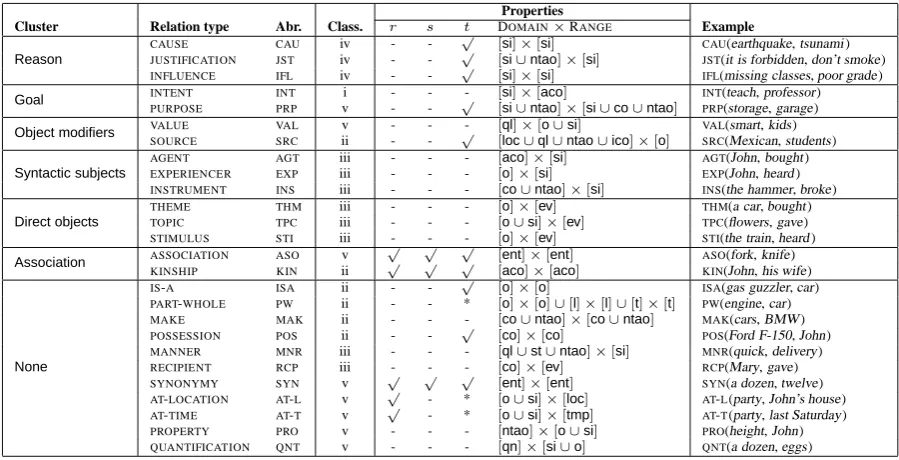
This work focuses on the set of 26 semantic rela-tions depicted in Table 1. We found this set spe-cific enough to capture the most frequent seman-tics of text without bringing unnecessary overspe-cialization. The set is inspired by several pre-vious proposals. Fillmore introduced the notion of case frames and proposed a set of nine roles:
AGENT, EXPERIENCER, INSTRUMENT, OBJECT, SOURCE, GOAL, LOCATION, TIME and PATH
(Fillmore, 1971). Fillmore’s work was extended to FrameNet (Baker et al., 1998). PropBank (Palmer et al., 2005) annotates a set of 17 seman-tic roles in a per-verb basis.
We aim to encode relations not only between a verb and its arguments, but also between and within noun phrases and adjective phrases. There-fore, more relations are added to the set. It
includes relations present in WordNet (Miller, 1995), such as IS-A, PART-WHOLE and CAUSE. Szpakowicz et al. (1995) proposed a set of nine relations and Turney (2006) a set of five. Rosario and Hearst (2004) proposed a set of 38 relations including standard case roles and a set of specific relations for medical domain. Helbig (2005) pro-posed a set of 89 relations, includingANTONYMY
and several TEMPORAL relations, e.g. SUCCES
-SION,EXTENSION,END.
Our set clusters some of the previous propos-als (e.g. we only considerAT-TIME) and discards relations proposed elsewhere when they did not occur frequently enough in our experiments. For example, even though ANTONYMYand ENTAIL
-MENT are semantically grounded, they are very
How-ever, we show (Section 7.1) that our set can be easily customized to a specific domain.
The 26 relations are clustered such that rela-tions belonging to the same cluster are close in meaning. Working with clusters is useful because it allows us to: (i) map to other proposed relations, justifying the chosen set of relations; (ii) work with different levels of specificity; and (iii) reason with the relations in a per cluster basis.
Thereasoncluster includes relations between a concept having a direct impact on another. CAU(x, y) holds if y would not hold if x did not happen.
JST(x, y) encodes a moral cause, motive or so-cially convened norm. If IFL(x, y), x affects the
intensity ofy, but it does not affect its occurrence. Thegoalcluster includes INT and PRP. INT(x, y) encodes intended consequences, which are vo-litional. PRP(x, y) is a broader relation and can be
defined forinanimate objects.
Theobject modifierscluster encodes descriptions ofobjectsand situations: SRC(x, y) holds if x
ex-presses the origin of y. VAL(x, y) holds for any other attribute, e.g. heavy, handsome.
The syntactic subjectscluster includes relations linking a syntactic subject and asituation. The dif-ferences rely on the characteristics of the subject and the connection per se. AGT(x, y) encodes an intentional doer, x must be volitional. If EXP(x,
y), x does not change the situation, it only expe-riencesy; it does not participate intentionally in y either. IfINS(x, y), x is used to perform y, x is a
tool or device that facilitatesy.
The direct objectscluster includes relations en-coding syntactic direct objects. THM(x, y) holds ifx is affected or directly involved by y.TPC(x, y)
holds if y is a communication verb, like talk and
argue. STI(x, y) holds if y is a perception verb andx a stimulus that makes y happen.
The associationcluster includes ASO and KIN.
ASOis a broad relation between any pair of enti-ties;KINencodes a relation between relatives.
The rest of the relations do not fall into any cluster. ISA, PW, SYN, AT-L and AT-T have been widely studied in the literature. MAK(x, y) holds if y makes or produces x; POS(x, y) holds if y
owns x;MNR encodes the way a situationoccurs.
RCPcaptures the connection between aneventand an objectwhich is the receiver of the event. PRO
describes links between a situation or object and its characteristics, e.g., height, age. Values to the characteristics are given through VAL. QNT(x, y)
holds ify is quantitatively determined by x. Relations can also be classified depending on the kind of concepts they describe and their
in-tra or inter nature into: (i) Inin-tra-Object; (ii)
Inter-Objects; (iii) Intra-Situation; (iv) Inter-Situations; and (v) for Object and Situation description.
4.2 Detection of Semantic Relations
Relations are extracted by an in-house SP from a wide variety of syntactic realizations. For ex-ample, the compound nominal steel knife con-tainsPW(steel, knife), whereas carving knife
con-tainsPRP(carving, knife); the genitive Mary’s toy containsPOS(toy, Mary), whereas Mary’s brother containsKIN(brother, Mary), and eyes of the baby
contains aPW(eyes, baby). Relations are also ex-tracted from a verb and its arguments (NP verb, verb NP, verb PP, verb ADVP and verb S), adjec-tive phrases and adjecadjec-tive clauses.
The SP first uses a combination of state-of-the-art text processing tools, namely, pstate-of-the-art-of-speech tagging, named entity recognition, syntactic pars-ing and word sense disambiguation. After a can-didate syntactic pattern has been found, a series of machine learning classifiers are applied to decide if a relation holds. Four different algorithms are used: decision trees, Naive Bayes, SVM and Se-mantic Scattering combined in a hybrid approach. Some algorithms use a per-relation approach (i.e., decide whether or not a given relation holds) and others a per-pattern approach (i.e., which relation, if any, holds for a particular pattern). Additionally, human-coded rules are used for a few unambigu-ous cases. The SP participated in the SemEval 2007 Task 4 (Badulescu and Srikanth, 2007).
5 Composition of Semantic Relations
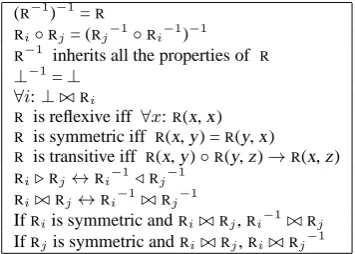
The goal of semantic calculus (SC) is to provide a formal framework for manipulating semantic re-lations. CSR is a part of this, its goal is to apply
inference axioms over already identified relations
in text in order to infer more relations.
Semantic Calculus: Operators and Properties
(R−1)−1=R
Ri◦Rj= (Rj−1◦Ri−1)−1
R−1 inherits all the properties of R
⊥−1=
⊥ ∀i:⊥⊲⊳Ri
R is reflexive iff ∀x:R(x, x)
R is symmetric iff R(x, y) =R(y, x)
R is transitive iff R(x, y)◦R(y, z)→R(x, z)
Ri⊲Rj↔Ri−1⊳Rj−1
Ri⊲⊳Rj↔Ri−1⊲⊳Rj−1
[image:5.595.92.270.70.197.2]IfRiis symmetric andRi⊲⊳Rj,Ri−1⊲⊳Rj IfRjis symmetric andRi⊲⊳Rj,Ri⊲⊳Rj−1
Table 2: Semantic calculus properties
symbol ◦. It combines two relations and yields a third one. Formally, we denote R1◦R2 →R3.
The inverse ofRis denotedR−1 and can be
ob-tained by simply switching its arguments. Given
R(x, y),R−1(y, x) always holds. The easiest way to readR−1(y, x) is x isRofy.
R1 left dominates R2, denoted by R1 ⊲ R2, iff the composition of R1 and R2 yields R1, i.e.,
R1⊲R2 iffR1◦R2 → R1. R1 right dominatesR2, denoted byR1 ⊳R2, iff the composition ofR2and
R1 yields R1, i.e., R1 ⊳R2iffR2 ◦R1 → R1. R1 completely dominatesR2, denoted byR1⊲⊳R2, iff
R1 ⊲R2 andR1⊳ R2, i.e.,R1 ⊲⊳ R2iffR1◦R2 → R1andR2◦R1 →R1.
AnOTHER(⊥) relation holds betweenx and y if no relation from the given set holds. Formally, ⊥(x,y)iff¬∃Risuch thatRi(x,y).
Using the notation above, the properties de-picted in Table 2 follow.
Necessary conditions for Combining Relations
Axioms can be defined only for compatible rela-tions as premises. R1 and R2 are compatible if it is possible, from a theoretical point of view, to ap-ply the composition operator to them. Formally, RANGE(R1)∩DOMAIN(R2)6=∅
If R1 and R2 are compatible but not equal a
restriction occurs. Let us denote RANGE(R1) ∩ DOMAIN(R2) = I. A backward restriction takes place if RANGE(R1) 6= I and a forward restric-tion if DOMAIN(R2) 6= I. In the former case RANGE(R1) is reduced; in the later DOMAIN(R2) is reduced. A forward and backward restriction can be found with the same pair of relations.
It is important to note that two compatible rela-tions may not be the premises for a valid axiom.
For example,KINandAT-Lare compatible but do not yield any valid inference.
Another necessary condition for combining two relationsR1(x, y) andR2(y, z) is that they have to have a common argument,y.
5.1 Unique axioms
An axiom is defined as a set of relations called premises and a conclusion. Given the premises it unequivocally yields a relation that holds as con-clusion. The composition operator is the basic way of combining two relations to form an axiom. In general, for n relations there are n2 =
n(n−1)
2 different pairs. For each pair, taking into account the two relations and their inverses, there are4×4 = 16 different possible combinations. Applying property Ri ◦ Rj = (Rj−1 ◦Ri−1)−1, only 10 combinations are unique: (i) 4 combine
R1, R2 and their inverses; (ii) 3 combine R1 and
R1−1; and (iii) 3 combineR2 andR2−1. The most interesting axioms fall into category (i), since the other two can be resolved by the transitivity prop-erty of a relation and its inverse.
Fornrelations there are2n2 +npotential ax-ioms: n2×4+3n= 2×n(n−1)+3n= 2n2+n. Forn= 26, there are 1300 potential axioms in (i), 820 of which are compatible.
The number can be further reduced. After man-ual examination of combinations ofASOand KIN
with other relations, we conclude that they do not yield any valid inferences, invalidating 150 poten-tial axioms. This is due to the broad meaning of these relations. QNTcan be discarded as well, in-validating 45 more potential axioms.
Some axioms can be easily validated. Because synonymous concepts are interchangeable,SYNis easily combined with any other relation: SYN(x,
y)◦R(y, z)→R(x, z) andR(x, y)◦SYN(y, z)→
R(x, z). Because hyponyms inherit relations from their hypernyms, ISA(x, y) ◦ R(y, z) → R(x, z)
andR(x, y)◦ISA−1(y, z)→ R(x, z) hold. These observations allow us to validate 138 of the 625 potential axioms left, still leaving 487.
(1)reason◦goal (2)reason−1◦goal
x reason//
IFL ? ? ? ? ? ? ? ? y goal z x PRP ? ? ? ? ? ? ? ? y goal reason o o z (3)goal◦reason (4)goal◦reason−1
x goal IFL ? ? ? ? ? ? ? ? y
reason//z
x
IFL−1
[image:6.595.105.254.70.192.2]? ? ? ? ? ? ? ? goal y z reason o o
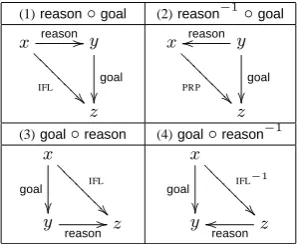
Table 3: The four axioms taking as premises rea-son and goal clusters. Diagonal arrows indicate inferred relations.
number of axioms to be examined down to 370. Out of the 370 axioms left, we have extensively analyzed and defined the 35 involving AT-L, the 43 involvingreasonand the 58 involvinggoal. Be-cause of space constraints, in this paper we only fully introduce the axioms for reason and goal (Section 6), as well as a variety of axioms useful to recognize textual entailments (Section 7.2).
6 Case Study: Reason and Goal
In this section, we present the four unique axioms forreasonandgoalrelations (Table 3).
(1) REA(x, y) ◦ GOA(y, z) → IFL(x, z): an
event is influenced by the reason of its goal. For example: Bill saves money because he is unemployed; he spends far less than he used to. Therefore, being unemployed can lead to spend far less.
P REA(be unemployed, save money)
GOA(save money, spend far less)
C IFL(be unemployed, spend far less)
(2) REA−1(x, y) ◦ GOA(y, z) → PRP(x, z):
events have as their purpose the effects of their goals. This is a strong relation.
For example: Since they have a better view, they can see the mountain range. They cut the tree to have a better view. Therefore, they cut the tree to see the mountain range.
P REA−1(see the mountain range, better view )
GOA(better view, cut the tree)
C PRP(see the mountain range, cut the tree)
Note that possible unintended effects of cutting the tree (e.g. homeowners’ association complains) are caused by the event cut the tree, not by its ef-fectget a better view.
(3) GOA(x, y) ◦ REA(y, z) → IFL(x, z): the
goal of an action influences its effects.
For example: John crossed the street carelessly to get there faster. He got run over by a propane truck. Therefore, John got run over by a propane truck influenced by (having the goal of) getting there faster.
P GOA(get there faster, crossed carelessly )
REA(crossed carelessly, got run over )
C IFL(get there faster, got run over )
(4) GOA(x, y) ◦ REA−1(y, z) → IFL−1(x, z).
Events influence the goals of its effects.
For example: Jane exercises to lose weight. She exercised because of the good weather. Therefore, good weather helps to lose weight.
P GOA(lose weight, exercise)
REA−1(exercise, good weather)
C IFL−1(lose weight, good weather)
The axioms have been evaluated using manu-ally annotated data. PropBank CAUand PNCare used asreasonandgoal.Reasonannotation is fur-ther collected from a corpus which adds causal annotation to the Penn TreeBank (Bethard et al., 2008). A total of 5 and 29 instances for axioms 3 and 4 were found. For all of them, the ax-ioms yield a valid inference. For example, Buick
[approached]y American express about [a joint promotion]x because [its card holders generally have a good credit history]z. PropBank annota-tion states GOA(x, y) and REA−1(y, z), axiom 4 makes the implicit relationIFL−1(x, z) explicit.
7 Applications and Results
7.1 Customization of Semantic Relations
Problem There is no agreement on a set of
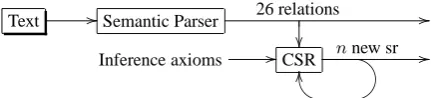
rela-tions that best represent text semantics. This is rightfully so since different applications and do-mains call for different relations. CSR can be used to rapidly customize a set of relations without hav-ing to train a new SP or modify any other tool. Given a text, the SP extracts 26 elementary se-mantic relations. Axioms within the framework of CSR yieldnnew relations, resulting in a richer semantic representation (Figure 2).
CSR axioms Two ways to get new relations are:
Axiom Rest. on y Example
[image:7.595.71.523.145.467.2]AGT(x, y)◦THM−1(y, z)→ARRESTED(x, z) arrested concept [Police]x[apprehended]y51 [football fans]z. THM(x, y)◦AT-L(y, z)→ARRESTED-AT(x, z) arrested concept Police [apprehended]y51 [fans]x[near the Dome]z. AGT(x, y)◦AT-L(y, z)→BANKS-AT(x, z) banking activity [John]x[withdrew]y$20 [at the nearest Chase]z. POS(x, y)◦AT-L(y, z)→BANKS-AT(x, z) account concept [John]xgot a [checkbook]yat [Chase]z.
Table 4: Examples of semantic relation customization using CSR.
Pair TextT HypothesisH
113
Belknap married and lost his first two wives, Cora LeRoy and Carrie Tomlinson, and married Mrs. John Bower, his second wife’s sister.
Belknap was married to Carrie Tomlinson.
T1 AGT(Belknap, married ) H1 AGT(Belknap, was married )
T2 THM(wives, married ) H2 THM(Carrie Tomlinson, was married )
T3 QNT(first two, wives)
T4 ISA(Carrie Tomlinson, wives)
429
India’s yearly pilgrimage to the Ganges river, worshiped by Hindus as the goddess Ganga, is the world’s largest gathering of people, . . .
Ganga is a Hindu goddess.
T1 AGT(Hindus, worship) H1 ISA(Ganga, goddess)
T2 THM(Ganga, worship) H2 VAL(Hindu, goddess)
T3 ISA(Ganga, goddess)
445
[. . . ] At present day YouTube represents the most popular site sharing on-line video.
YouTube is a video website.
T1 ISA(YouTube, site) H1 ISA(YouTube, website)
T2 EXP(site, sharing) H2 VAL(video, website)
T3 THM(video, sharing)
716
The Czech and Slovak republics have been unable to agree a political basis for their future coexistence in one country.
The Czech and Slovak republics do not agree to coexist in one country.
T1 AGT(The Czech and Slovak republics, have been unable to agree)
H1 AGT(The Czech and Slovak republics, do not agree)
T2 THM(political basis, have been unable to agree) H2 PRP(coexist in one country, do not agree)
T3 PRP(their future coexistence in one country, po-litical basis)
771
In 2003, Yunus brought the microcredit revolution to the streets of Bangladesh to support more than 50,000 beggars, whom the Grameen Bank respectfully calls Struggling Members.
Yunus supported more than 50,000 Struggling Members.
T1 AGT(Yunus, brought ) H1 AGT(Yunus, supported )
T2 PRP(support, brought )
T3 RCP(beggars, support ) H2 RCP(Struggling Members, support )
T4 QNT(more than 50,000, beggars) H3 QNT(more than 50,000, Struggling Members )
T5 SYN(beggars, Struggling Members )
Table 5: RTE3 examples and their elementary semantic relations (i.e., the ones the SP detects). Only relevant semantic relations for entailment detection are shown forT.
Text //Semantic Parser 26 relations //
Inference axioms //CSR nnew sr // ED BC @A
O
O
Figure 2: Flowchart for obtaining customized se-mantic relations using CSR.
(ii) Combinations of two elementary relations yield new specialized relations. In this case, re-strictions on the arguments must be fulfilled.
Consider we need the new relation AR -RESTED(x, y), which encodes the relation be-tween twoanimate concrete objectsx and y, where x arrested y. We can infer this relation by using
the following axiom:AGENT(x, y)◦THEME−1(y, z)→ ARRESTED(x, z) provided that y is an ar-rested concept. A simple way of checking if a
given concept is of a certain kind is to check WordNet. Collecting all the words belonging the the synset arrest.v.1, we get the following list of
arrested concepts: collar, nail, apprehend, pick up, nab and cop. Using lexical chains the list
could be further improved.
More examples of axioms for generating cus-tomized semantic relations are shown in Table 4.
Results Virtually any domain could be covered
[image:7.595.71.287.519.568.2]Ax-ioms for a total of 37 new relations were de-fined and implemented. Among others, ax-ioms to infer IS-EMPLOYER, IS-COWORKER, IS
-PARAMOUR, IS-INTERPRETER, WAS-ASSASSIN,
ATTENDS-SCHOOL-AT, JAILED-AT, COHABITS
-WITH, AFFILIATED-TO, MARRIED-TO, RENTED -BY, KIDNAPPED-BY and the relations in Table 4 were defined. Note that a relation can be inferred by several axioms. This customization effort to add 37 new specialized relations took a person only a few days and without modifying the SP.
7.2 Textual Entailment
Problem An application of CSR is recognizing
entailments. Given textT and hypothesisH, the task consists on determining whether or notHcan be inferred byT (Giampiccolo et al., 2007).
CSR axioms Several examples of the RTE3
chal-lenge can be solved by applying CSR (Table 5). The rest of this section depicts the axioms in-volved in detecting entailment for each pair.
Pair 113 is a simple one. A perfect match
forH inT can be obtained by an axiom reading
all concepts inherit the semantic relations of their hypernyms. Formally, ISA(x, y) ◦ THM(y, z) →
THM(x, z), T2 and T4 are the premises and the
conclusion matchesH2.T1matchesH1.
Pair 429 can be solved by an axiom
read-ing agents are values for their themes. Formally,
AGT(x, y) ◦ THM−1(y, z) → VAL(x, z); T1 and T2 yield VAL(Hindu, Ganga), which combined
withT3results in a match betweenT andH.
Pair 445 follows a similar pattern, but the way
an EXP combines with its THM differs from the way an AGT does. The theme is a value of the
experiencer, THM(x, y)◦ EXP−1(y, z)→ VAL(x, z). Given T2 and T3, the axiom yields T4:
VAL(video, site). Assuming that SYN(site, web-site),T1andT4matchH.
Pair 716 also requires only one inference step.
Using T3 and T2, an axiom reading situations
have as their purpose the purpose of its theme
in-fersH2, yielding a perfect match betweenT and H. Formally,PRP(x, y)◦THM(y, z)→PRP(x, z).
Pair 771 Using as premisesT1andT2, an
ax-iom reading an agent performs the purposes of its
actions infers H1. Using T3 and T5, and T4
and T5 as premises, an axiom reading
synony-mous concepts are interchangeable infersH2and H3, resulting in a perfect match between T and H. Formally,AGT(x, y)◦PRP−1(y, z)→AGT(x,
z), RCP−1(x, y)◦ SYN(y, z)→ RCP−1(x, z) and
QNT(x, y)◦SYN(y, z)→QNT(x, z).
Results We conducted two experiments to
quan-tify the impact of CSR in detecting entailments. First, 60 pairs were randomly selected from the RTE3 challenge and parsed with the SP. 14 of them (23%) could be solved by simply matching the elementary relations inT andH. After apply-ing CSR, 21 more pairs (35%) were solved. Thus, adding CSR on top of the SP clearly improves en-tailment detection. Out of the 25 pairs not solved, 5 (8%) need coreference resolution and 20 (34%) require commonsense knowledge or fairly com-plicated reasoning methods (e.g. a shipwreck is a
ship that sank).
CSR has also been added to a state of the art system for detecting textual entailment (Tatu and Moldovan, 2007). Prior to the addition, the sys-tem made 222 errors consisting of 46 false nega-tives (examples in Table 5) and 176 false posinega-tives. CSR was able to correctly solve 18 (39%) of the 46 false negatives.
8 Conclusions
Although the idea of chaining semantic relations has been proposed before, this paper provides a formal framework establishing necessary condi-tions for composition of semantic relacondi-tions. The CSR presented here can be used to rapidly cus-tomize a set of relations to any arbitrary domain. In addition to the customization of an informa-tion extracinforma-tion tool and recognizing textual entail-ments, CSR has the potential to contribute to other applications. For example, it can help improve a semantic parser, it can be used to acquire com-monsense knowledge axioms and more.
When an axiom that results from combining two relations does not always hold, it may be pos-sible to add constraints that limit the arguments of the premises to only some concepts.
References
Badulescu, Adriana and Munirathnam Srikanth. 2007. LCC-SRN: LCC’s SRN System for SemEval 2007 Task 4. In Proceedings of the Fourth International
Workshop on Semantic Evaluations, pages 215–218.
Baker, Collin F., Charles J. Fillmore, and John B. Lowe. 1998. The Berkeley FrameNet Project. In
Proceedings of the 17th international conference on Computational Linguistics, Montreal, Canada.
Bethard, Steven, William Corvey, Sara Klingenstein, and James H. Martin. 2008. Building a Corpus of Temporal-Causal Structure. In Proceedings of the
Sixth International Language Resources and Evalu-ation Conference, Marrakech, Morocco.
Chang, Du S. and Key S. Choi. 2006. Incremental cue phrase learning and bootstrapping method for causality extraction using cue phrase and word pair probabilities. Information Processing &
Manage-ment, 42(3):662–678.
Copestake, Ann, Alex Lascarides, and Dan Flickinger. 2001. An Algebra for Semantic Construction in Constraint-based Grammars. In Proceedings of
39th Annual Meeting of the ACL, pages 140–147.
Davidov, Dmitry and Ari Rappoport. 2008. Classifi-cation of Semantic Relationships between Nominals Using Pattern Clusters. In Proceedings of ACL-08:
HLT, pages 227–235, Columbus, Ohio.
Fillmore, Charles J. 1971. Some Problems for Case Grammar. Monograph Series on Languages and Linguistics, 24:35–36.
Giampiccolo, Danilo, Bernardo Magnini, Ido Dagan, and Bill Dolan. 2007. The Third PASCAL Recog-nizing Textual Entailment Challenge. In
Proceed-ings of the ACL-PASCAL Workshop on Textual En-tailment and Paraphrasing, pages 1–9.
Girju, Roxana, Adriana Badulescu, and Dan Moldovan. 2006. Automatic Discovery of Part-Whole Relations. Computational Linguistics, 32(1):83–135.
Girju, Roxana, Preslav Nakov, Vivi Nastase, Stan Sz-pakowicz, Peter Turney, and Deniz Yuret. 2007. SemEval-2007 Task 04: Classification of Semantic Relations between Nominals. In Proceedings of the
Fourth International Workshop on Semantic Evalu-ations, pages 13–18, Prague, Czech Republic.
Harabagiu, Sanda and Dan Moldovan. 1998. Knowl-edge Processing on an Extended WordNet. In Fell-baum, Christiane, editor, WordNet: An Electronic
Lexical Database and Some of its Applications,
chapter 17, pages 684–714. The MIT Press.
Helbig, Hermann. 2005. Knowledge Representation
and the Semantics of Natural Language. Springer.
Hirano, Toru, Yoshihiro Matsuo, and Genichiro Kikui. 2007. Detecting Semantic Relations between Named Entities in Text Using Contextual Features. In Proceedings of the 45th Annual Meeting of the
ACL, Demo and Poster Sessions, pages 157–160.
Lakoff, George. 1970. Linguistics and Natural Logic.
Synthese, 22(1):151–271.
M`arquez, Llu´ıs, Xavier Carreras, Kenneth C. Litkowski, and Suzanne Stevenson. 2008. Seman-tic Role Labeling: An Introduction to the Special Issue. Computational Linguistics, 34(2):145–159.
Miller, George A. 1995. WordNet: A Lexical Database for English. Communications of the ACM, 38:39–41.
Moldovan, Dan, Adriana Badulescu, Marta Tatu, Daniel Antohe, and Roxana Girju. 2004. Mod-els for the Semantic Classification of Noun Phrases. In HLT-NAACL 2004: Workshop on Computational
Lexical Semantics, pages 60–67.
Palmer, Martha, Daniel Gildea, and Paul Kingsbury. 2005. The Proposition Bank: An Annotated Cor-pus of Semantic Roles. Computational Linguistics, 31(1):71–106.
Rosario, Barbara and Marti Hearst. 2004. Classifying Semantic Relations in Bioscience Texts. In Proc. of
the 42nd Meeting of the ACL, pages 430–437.
S´anchez Valencia, Victor. 1991. Studies on Natural
Logic and Categorial Grammar. Ph.D. thesis,
Uni-versity of Amsterdam.
Szpakowicz, Barker, Ken Barker, and Stan Szpakow-icz. 1995. Interactive semantic analysis of Clause-Level Relationships. In Proceedings of the Second
Conference of the Pacific ACL, pages 22–30.
Tatu, Marta and Dan Moldovan. 2007. COGEX at RTE 3. In Proceedings of the ACL-PASCAL
Workshop on Textual Entailment and Paraphrasing,
pages 22–27, Prague, Czech Republic.
Tatu, Marta. 2005. Automatic Discovery of Intentions in Text and its Application to Question Answering. In Proceedings of the ACL Student Research
Work-shop, pages 31–36, Ann Arbor, Michigan.
Turney, Peter D. 2006. Expressing Implicit Seman-tic Relations without Supervision. In Proceedings