Learning Summary Content Units with Topic Modeling
Leonhard Hennig Ernesto William De Luca
Distributed Artificial Intelligence Laboratory (DAI-Lab) Technische Universit¨at Berlin
{leonhard.hennig,ernesto.deluca,sahin.albayrak}@dai-labor.de Sahin Albayrak
Abstract
In the field of multi-document summa-rization, the Pyramid method has be-come an important approach for evaluat-ing machine-generated summaries. The method is based on the manual annotation of text spans with the same meaning in a set of human model summaries. In this paper, we present an unsupervised, prob-abilistic topic modeling approach for au-tomatically identifying such semantically similar text spans. Our approach reveals some of the structure of model summaries and identifies topics that are good approx-imations of the Summary Content Units (SCU) used in the Pyramid method. Our results show that the topic model identi-fies topic-sentence associations that corre-spond to the contributors of SCUs, sug-gesting that the topic modeling approach can generate a viable set of candidate SCUs for facilitating the creation of Pyra-mids.
1 Introduction
In the field of multi-document summariza-tion (MDS), the Pyramid method has become an important approach for evaluating machine-generated summaries (Nenkova and Passonneau, 2004; Passonneau et al., 2005; Nenkova et al., 2007). The method rewards automatic summaries for conveying content that has the same meaning as content represented in a set of human model summaries. This approach allows for variation in the way the content is expressed, which contrasts
the Pyramid method with other evaluation meth-ods such as ROUGE that measure word n-gram overlap (Lin and Hovy, 2003).
The Pyramid method groups content with the same meaning into Summary Content Units (SCU). Shared content needs to be identified man-ually by human inspection of summaries, adding yet another level of human effort (on top of creating model summaries) to the task of sum-mary evaluation. However, Nenkova and Passon-neau (2004) as well as Harnly et al. (2005) ob-serve that semantically similar text spans writ-ten by different human summarizers are ofwrit-ten ex-pressed with a similar choice of words, albeit with differences e.g. in word variants, word order and paraphrasing (Section 2).
In this paper, we present an approach for au-tomatically identifying semantically similar text spans in human model summaries on the basis of such re-occurring word patterns. We utilize a method known as probabilistic topic model-ing (Steyvers and Griffiths, 2007). Topic models are claimed to derive semantic information from text in an unsupervised fashion, using only the ob-served word distributions (Section 3).
• We train a probabilistic topic model based on Latent Dirichlet Allocation (Blei et al., 2003) on the term-sentence matrix of human model summaries used in the Document Un-derstanding Conference (DUC) 2007 Pyra-mid evaluation1. We analyze the resulting model to evaluate whether a topic model cap-tures useful struccap-tures of these summaries (Section 4.1).
• Given the model, we compare the automati-cally identified topics with SCUs on the ba-sis of their word distributions (Sections 4.2 and 4.3). We discover a clear correspondence between topics and SCUs, which suggests that many automatically identified topics are good approximations of manually annotated SCUs.
• We analyze the distribution of topics over summary sentences in Section 4.4, and pare the topic-sentence associations com-puted by our model with the SCU-sentence associations given by the Pyramid annota-tion. Our results suggest that the topic model finds many SCU-like topics, and associates a given topic with the same summary sen-tences in which a human annotator identifies the corresponding SCU.
Automatically identifying topics that approxi-mate SCUs has clear practical applications: The topics can be used as a candidate set of SCUs for human annotators to speed up the process of SCU creation. Topics can also be identified in machine-generated summaries using standard statistical in-ference techniques (Asuncion et al., 2009). 2 Summary Content Units
In this section, we briefly introduce the Pyramid method and the properties of Summary Content Units that we intend to exploit in our approach.
A Pyramid is a model predicting the distribu-tion of informadistribu-tion content in summaries, as re-flected in the summaries humans write (Passon-neau et al., 2005; Nenkova et al., 2007). Simi-lar information content is identified by inspection of similar sentences, and parts of these, in differ-ent human model summaries. Typically, the text spans which express the same semantic content are not longer than a clause. An SCU consists of a collection of text spans with the same meaning (contributors) and a defining label specified by the annotator.
Each SCU is weighted by the number of hu-man model summaries it occurs in (i.e. the num-ber of contributors). The Pyramid metric assumes that an SCU with a high number of contributors is
more informative than an SCU with few contrib-utors. An optimal summary, in terms of content selection, is obtained by maximizing the sum of SCU weights, given a maximum number of SCUs that can be included for a predefined summary length (Nenkova and Passonneau, 2004).
Two example SCUs are given in Table 1. SCU 18 has a weight of 3, since three model sum-maries contribute to it, SCU 21 has a weight of 2. SCU 18 aggregates contributors which share some key phrases such as “Air National Guard” and “search”, but otherwise exhibit a quite heteroge-neous word usage. Contributor 3 gives details on the aircraft type, and specifies a time when the first sea vessel was launched to search for the missing plane. Only contributor 1 gives information about the location of the search. In SCU 21, the first contributor contains additional information about communication with the Kennedy family, which is not expressed in the SCU label and therefore not part of the meaning of the SCU. Both contributors contain key terms such as “officials”, “search” and “recovery”, but vary in word order and verb usage. Passonneau et al. (2005) discuss this observation, and argue that SCUs emerge from the judgment of annotators, and are thus independent of what words are used, or how many.
However, an analysis of typical SCUs shows that contributors written by different human sum-marizers are often expressed with a similar choice of words or even phrases. Contributors vary in using different forms of the same words (inflec-tional or deriva(inflec-tional variants), different word or-der, syntactic structure, and paraphrases (Harnly et al., 2005; Nenkova et al., 2007).
3 Probabilistic Topic Models
SCU 18 The US Coast Guard with help from the Air National Guard then began a massive search-and-rescue mission, searching waters along the presumed flight path Contributor 1: The US Coast Guard with help from the Air National Guard then began a massive
search-and-rescue mission, searching waters along the presumed flight path Contributor 2: A multi-agency search and rescue mission began at 3:28 a.m., with the Coast
Guard and Air National Guard participating
Contributor 3: The first search vessel was launched at about 4:30am. An Air National Guard C-130 and many Civil Air Patrol aircraft joined the search
SCU 21 Federal officials shifted the mission to search and recovery
Contributor 1: Federal officials shifted the mission to search and recovery and communicated the Kennedy and Bessette families
[image:3.595.72.289.291.409.2]Contributor 2: federal officials ended the search for survivors and began a search-and-recovery mission
Table 1: Example SCUs from topic D0742 of DUC 2007.
M N
w
z θ
β
α
φ
T
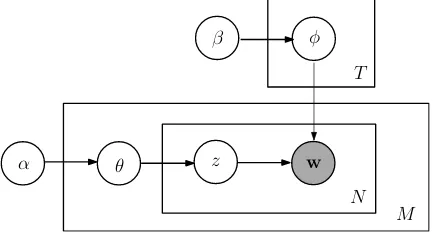
Figure 1: Graphical model representation of LDA for N words, T topics and a corpus of M docu-ments.
over words. For example, a news article describ-ing a meetdescrib-ing of the International Monetary Fund may in equal parts discuss economic and politi-cal issues. Topic models discover in a completely unsupervised fashion meaningful topics as well as intra- and inter-document statistical structure us-ing no information except the distribution of the words themselves (Griffiths and Steyvers, 2004).
For our analysis, we use the Latent Dirichlet Allocation (LDA) model introduced by Blei et al. (2003). In this model, each document is gen-erated by first choosing a distribution over topics θ(d), parametrized by a conjugate Dirichlet prior α. Subsequently, each word of this document is generated by drawing a topic zk from θ(d), and
then drawing a word wi from topic zk’s
distri-bution over words φ(k). We follow Griffiths et
al. (2004) and place a conjugate Dirichlet priorβ overφ(k) as well. Figure 1 shows the graphical
model representation of LDA.
ForT topics, the matrixΦspecifies the proba-bilityp(w|z)of words given topics, andΘ spec-ifies the probabilityp(z|d) of topics given
docu-ments. p(w|z)indicates which words are
impor-tant in a topic, andp(z|d)tells us which topics are
dominant in a document. We employ Gibbs sam-pling (Griffiths and Steyvers, 2004) to estimate the posterior distribution overz(the assignment of word tokens to topics), given the observed words wof the document set. From this estimate we can approximate the distributions for the matricesΦ andΘ.
4 Experiments
Can a topic model reveal some of the structure of human model summaries and learn topics that are approximations of manually annotated SCUs? To answer these questions, we train a topic model on the human model summaries of each of the 23 document clusters of the DUC 2007 dataset that were used in Pyramid evaluation2. There are 4 human model summaries available for each docu-ment cluster. On average, the summary sets con-tain 52.4 sentences, with a vocabulary of 260.5
terms, which occur a total of 549.7 times. The
Pyramids of these summary sets consist of 68.8
SCUs on average. The number of SCUs per SCU
weight follows a Zipfian distribution, i.e. there are typically very few SCUs of weight 4, and very many SCUs of weight 1 (see also Passonneau et al. (2005)).
4.1 Topic model training
Since we are interested in modeling topics for sen-tences, we treat each sentence as a document3. We construct a matrix A of term-sentence co-occurrence observations for each set of human model summariesS. Each entryAij corresponds
to the frequency of word i in sentence j, and j ranges over the union of the sentences contained in S. We preprocess terms using stemming and removing a standard list of stop words with the NLTK toolkit4.
We run the Gibbs sampling algorithm on A, setting the parameterT, the number of latent top-ics to learn, equal to the number of SCUs con-tained in the Pyramid ofS. We use this particular value forT since we want to learn a topic model with a structure that reflects the SCUs and the dis-tribution of SCUs of the corresponding Pyramid. For an unannotated set of summaries, determining an optimal value forT is a Bayesian model selec-tion problem (Kass and Raftery, 1995).
The topic distribution for each sentence should be peaked toward a single or only very few top-ics. To ensure that the topic-specific word dis-tributionsp(w|z)as well as the sentence-specific
topic distributionsp(z|d)behave as intended, we
set the Dirichlet priors α = 0.01 andβ = 0.01. This enforces a bias toward sparsity, resulting in distributions that are more peaked (Steyvers and Griffiths, 2007). A low value of β also favors more fine-grained topics (Griffiths and Steyvers, 2004). We run the Gibbs sampler for 2000 itera-tions, and collect a single sample from the result-ing posterior distribution over topic assignments for words. From this sample we compute the con-ditional distributionsp(w|z)andp(z|d).
During our experiments, we observed that the Gibbs Sampler did not always use all the topics available. Instead, some topics had a uniform distribution over words, i.e. no words were
as-3We will use the words document and sentence
inter-changeably from here on.
4http://www.nltk.org
signed to these topics during the sampling pro-cess. We assume this is due to the relatively low priorα= 0.01we use in our experiments. We ex-plore the consequences of varying the LDA priors andT in Section 4.4.
This observation indicates that the topic model cannot learn as many distinct topics from a given set of summaries as there are SCUs in the Pyra-mid of these summaries. On average,24.4%(σ= 17.4) of the sampled topics had a uniform word distribution, but the fraction of such topics varied. For some summary sets, it was very low (D0701, D0706 with0%), whereas for others it was very high (D0704, D0728 with52%). Both of the
lat-ter summary sets contain many SCUs with very similar labels and often only a single contributor, e.g. about ‘Amnesty International’:
• AI criticism frequently involves genocide • AI criticism frequently involves intimidation • AI criticism frequently involves police
vio-lence
These SCUs are derived from summary sen-tences that contain enumerations: “AI criticism frequently involves political prisoners, torture, in-timidation, police violence, the death penalty, no alternative service for conscientious objectors, and interference with the judiciary.” A topic model is based on word-document co-occurrence data, and cannot distinguish between the different grammatical objects in this case. Instead, it treats these phrases as semantically similar since they occur in the same sentence.
4.2 SCU word distributions and SCU-sentence associations
In order to evaluate the quality of the LDA top-ics, we compare their word distributions to the word distributions of SCUs. This allows us to an-alyze if the LDA topics capture similar word pat-terns as SCUs. We approximate the distribution over words p(w|sl) for each SCU sl as the
rel-ative frequency of word wi in the bag-of-words
constructed from the texts ofsl’s label and
(a) DUC Topic D0706 (b) DUC Topic D0742 (c) DUC Topic D0743
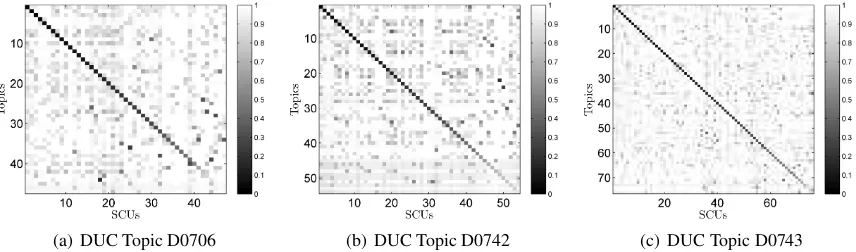
Figure 2: Pairwise Jensen-Shannon divergence of word distributions of LDA topics and Summary Content Units (SCUs), for 3 DUC 2007 Pyramids. Topic-SCU matches are ordered by increasing divergence along the diagonal, using a simple greedy algorithm. The examples suggest that many of the automatically identified LDA topics correspond to manually annotated SCUs.
Topic 17 SCU 31 Topic 5 SCU 32 Topic 9 SCU 25 Topic 8 SCU 36 pilot pilot analysi analysi bodi bodi kennedi kennedi kennedi condit control control diver diver edward edward condit conduc corkscrew corkscrew entomb entomb recoveri recoveri conduc dark descent descent floor floor son son
dark disorient fall fall found found wit wit Table 2: Top terms of best matching LDA topics and SCUs for summary set D0742
In addition, we can compare the topic-sentence associations computed by the model to the SCU-sentence associations given by the Pyramid anno-tation. If the probability of a given topic is high in those sentences which contribute to a particular SCU, this would suggest that the topic model can automatically learn topics which not only have a word distribution similar to a specific SCU, but also a similar distribution over contributing sen-tences.
SCU contributors are typically annotated as a set of contiguous sequences of words within a sin-gle sentence. In the DUC 2007 data, there are only a few cases where a contributor spans more than one sentence. The DUCView annotation tool5 stores the start and end character position of the phrases marked as contributors of an SCU. We can utilize this information to define which sentences an SCU is associated with. We store the associa-tions in a matrixΘb, whereΘbij = 1if SCU iis
associated with sentence j. Sentences may con-tain multiple SCUs, and SCUs are associated with
5
http://www1.cs.columbia.edu/˜becky/DUC2006/2006-pyramid-guidelines.html
as many sentences as their number of contributors. 4.3 Matching SCUs and LDA topics
Before we can compare the topic-sentence asso-ciations computed by the LDA topic model with the SCU-sentence associations, we need to match SCUs to LDA topics. We consider a topic to be similar to an SCU if their word distributions are similar. We discard all LDA topics with a uni-form word distribution (see Section 4.1) before the matching step.
We then compute the pair-wise Jensen-Shannon (JS) divergence between columnsjofΦandkof
b
Φ:
JS(Φj,Φbk) =
1
2DKL(Φj||M)
+1
2DKL(Φbk||M)
, (1)
whereM = 1/2(Φj +Φbk). SCUs from Φb are
SCU-(a) Precision, recall and fraction of Topic-SCU matches for different settings ofγ
(b) F1 and MAP for different values ofT as a fractionδof the number of SCUs
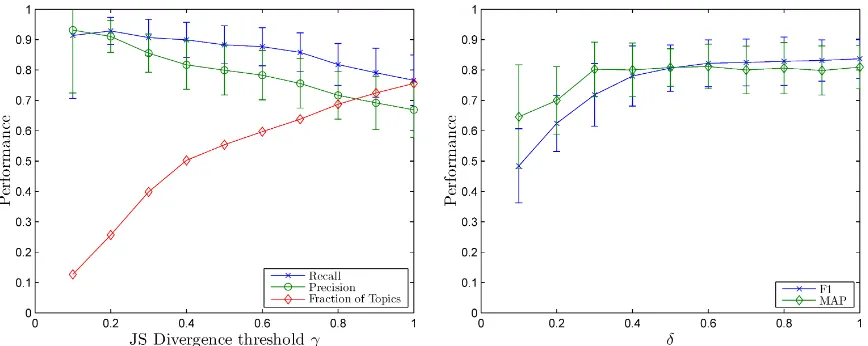
Figure 3: (a) Precision, Recall and the fraction of LDA topics matched to SCUs for different settings of parameterγ, averaged over all summary sets with Pyramid annotations from DUC 2007. Error bars show the standard deviation. Only topic-SCU matches with JS(Φj,Φbk) ≤ γ are considered when
computing precision and recall. Both are very high, suggesting that the model identifies topics that are very similar to SCUs. (b)F1measure and Mean Average Precision (MAP) for different settings of the
number of latent topicsT as a fraction of the number of SCUs in the corresponding Pyramid (γ = 0.5).
topic pair. We reorder the rows ofΘaccording to the computed matching.
Figure 2 shows some example SCU-topic matches for three different DUC 2007 summary sets. Each cell displays the JS divergence of the word distributions of an LDA topic (rows) com-pared to an SCU (columns). On the diagonal, the best matches of LDA topics and SCUs are ordered by increasing JS divergence. Multiple points with low JS divergence in a single column indicate that more than one LDA topic was very similar to this SCU. Overall, the graphs show a clear correspon-dence of LDA topics to the SCUs. The plots sug-gest that a large percentage of topics have simi-lar distributions over words as the corresponding SCUs. Table 2 shows the most likely terms for some example topic-SCU matches. For each of these matches, the top terms are almost identical. 4.4 Evaluation
To compare the topic distributions Θ with the SCU-sentence assignments Θ, we binarizeb Θ to giveΘ0by setting all entriesΘ0ij = 1ifΘij > ,
and 0 otherwise. We set = 0.1 in our
experi-ments6. Θ0
ij is therefore equal to 1 if a topicihas
a high probability sentencej. We can now eval-uate if a given topic occurs in the same sentences as the corresponding SCU (recall), and if it occurs in no other sentences (precision).
We compute precision and recall for each topic-SCU match with JS(Φj,Φbk) ≤ γ. Averaged
over matches, these measures give us an indica-tion of how well the LDA model approximates the set of SCUs. The parameter γ allows us to tune the performance of the model with respect to the quality and number of topic-SCU matches. Settingγ to a low value will consider only topic-SCU matches with a low JS divergence, which generally results in higher precision and recall. In-creasingγwill include more topic-SCU matches, namely those with a larger JS divergence, which will therefore introduce some noise.
Figure 3(a) shows the precision and recall
6Since the LDA algorithm learns very peaked
distribu-tions, the actual value of this threshold does not have a large impact on the resulting binary matrix and subsequent eval-uation results. We evaluated a range of settings for in
[0.001−0.5], all with similar performance. This
[image:6.595.78.512.72.245.2]curves for different values of the parameterγ, av-eraged over all summary sets. The plots show that both the precision and recall of the discov-ered topic-sentence associations are quite high, suggesting that the model automatically identifies topics which are very similar to manually anno-tated SCUs. With increasingγ, precision and re-call scores decrease: The word distributions of the topic-SCU pairs are increasingly dissimilar, and hence the sentences associated with a topic do not necessarily overlap anymore with the sen-tences of the paired SCU. The figure also shows the fraction of topic matches that are considered in the evaluation of precision and recall. There is a clear trade off between performance and the number of matches retrieved. However, many of the topic-SCU matches (≈50%) have a JS
diver-gence ≤ 0.4, suggesting that the word
distribu-tions of many LDA topics are very similar to SCU word distributions.
Since we observed that the Gibbs sampling does not always utilize the full set of topics, we repeat our experiments to evaluate how the per-formance of the model changes when varying the LDA priors and T. Figure 3(b) shows F1 and
Mean Average Precision (MAP)7 results of the topic model for different values of the parameter δ, whereT =δ∗ |SCU|. For example, a value of
0.6means that for each summary set,T was set to
60%of the number of SCUs in the corresponding
Pyramid. We see that the MAP score increases quickly, and reaches a plateau forδ ≥ 0.3. The
F1score increases more slowly, and levels out for
δ ≥ 0.6. The model’s performance is relatively robust with respect toδ. This observation can be helpful when training models for new summary sets without an existing Pyramid, and which there-fore considerT as a parameter to be optimized.
When varying the LDA priors, we observe that for 0.01 ≤ α ≤ 0.05, F1 and MAP scores are
consistently high, whereas for other settings, per-formance decreases significantly. Similarly,β ≥
0.05 results in lower F1 and MAP scores. The
7MAP is a rank-based measure, which avoids the need
for introducing a threshold to binarizeΘ(Baeza-Yates and
Ribeiro-Neto, 1999). For each topic, we create a ranked list of sentences according to the transposed matrixΘT. This gives high ranks to sentences for which a particular topic has a high probability.
fraction of uniform topics decreases with higher α, e.g. for α = 0.1 it is close to zero. In
con-trast, higher settings ofβ increase the fraction of uniform topics.8
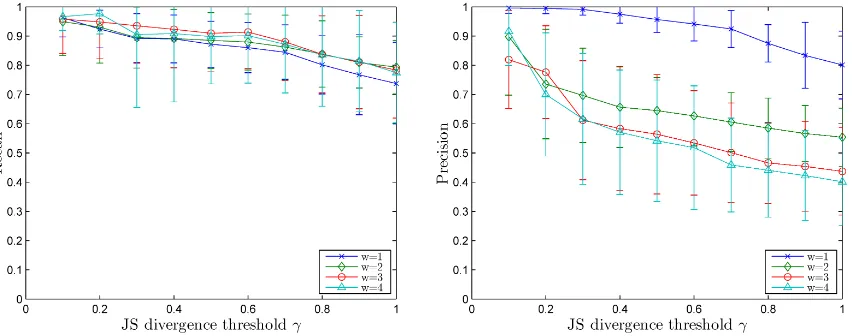
Finally, Figure 4 shows separate precision and recall curves for SCUs of different weights, and for different settings of parameterγ. Results are again averaged over all summary sets. In 4(a), we see that the recall of topic-sentence associa-tions is very similar for all SCUs, with SCUs of higher weight exhibiting a slightly better recall. However, as Figure 4(b) shows, the average pre-cision of SCUs with lower weight is much higher. Intuitively, this is expectable as SCUs of higher weight tend to have a larger vocabulary due to the higher number of contributors. This results in a larger word overlap with non-relevant sentences. The fraction of topic-SCU matches retrieved for SCUs of different weight is similar for all types of SCUs (not shown here).
5 Related Work
The Pyramid approach was introduced by Nenkova and Passonneau (2004) as a method for evaluating machine-generated summaries based on a set of human model summaries. The authors address a number of shortcomings of manual and automatic summary evaluation methods such as ROUGE (Lin and Hovy, 2003), and argue that the Pyramid method is reliable, diagnostic and predic-tive.
Passonneau and et al. (2005) give an account of the results of applying the Pyramid method during the DUC 2005 summarization evaluation, and dis-cuss the annotation process. In subsequent work, Nenkova et al. (2007) describe in more detail the incorporation of human variation in the Pyramid method, the reliability of content annotation, and the correlation of Pyramid scores with other eval-uation measures.
Harnly et al. (2005) present an approach for au-tomatically scoring a machine summary given an existing Pyramid. Their method searches for an optimal set of candidate contributors created auto-matically from the machine summary and matches candidates to SCUs using a clustering approach.
(a) Recall of Topic-SCU matches for SCUs by weight (b) Precision of Topic-SCU matches for SCUs by weight
Figure 4: (a) Recall of topic-SCU matches for SCUs of different weights, and settings of parameterγ, averaged over all summary sets. Recall is similar for SCUs of all weights. (b) Precision of the same topic-SCU matches. SCUs with a lower weight have a higher average precision. (Error bars show the standard deviation.)
The method assumes the existence of a Pyramid, whereas our approach aims to discover candidate SCUs from a set of human model summaries in an unsupervised fashion.
Recently, Louis and Nenkova (2009) presented an approach for fully automatic, model-free eval-uation of machine-generated summaries. The method assumes that the distribution of words in the input and an informative summary should be similar. We think that it could be an interesting idea to combine the proposed method with our approach, in an attempt to exploit both the model-free evaluation and the shallow semantics of latent topics.
Probabilistic topic models have been success-fully applied to a variety of tasks (Hofmann, 1999; Blei et al., 2003; Griffiths and Steyvers, 2004; Hall et al., 2008). In text summarization, most topic modeling approaches utilize a term-sentence co-occurrence matrix to discover topics in the set of input documents. Each sentence is typically as-signed to a single topic, and a topic is a cluster of multiple sentences (Wang et al., 2009; Tang et al., 2009; Hennig, 2009).
6 Conclusions and future work
We presented a probabilistic topic modeling ap-proach that reveals some of the structure of human
model summaries. The topic model is trained on the term-sentence matrix of a set of human sum-maries, and discovers semantic topics in a com-pletely unsupervised fashion. Many of the topics identified by our model for a given set of sum-maries show a similar distribution over words as the manually annotated Summary Content Units of the summaries’ Pyramid.
We utilized the word distributions of SCUs and topics to match topics to similar SCUs, and showed that the topics identified by the model of-ten occur in the same senof-tences as the contribu-tors of the corresponding SCU. Precision and re-call of these topic-sentence assignments are very high when compared to the SCU-sentence associ-ations, indicating that many of the automatically acquired topics are good approximations of SCUs. Our results suggest that a topic model can be used to learn a candidate set of SCUs to facilitate the process of Pyramid creation.
[image:8.595.87.513.73.241.2]References
Asuncion, Arthur, Max Welling, Padhraic Smyth, and Yee Whye Teh. 2009. On smoothing and infer-ence for topic models. InUAI ’09: Proceedings of the Twenty-Fifth Conference on Uncertainty in Arti-ficial Intelligence, pages 27–34.
Baeza-Yates, Ricardo A. and Berthier Ribeiro-Neto. 1999. Modern Information Retrieval. Addison-Wesley Longman Publishing Co., Inc., Boston, MA, USA.
Blei, David M., Andrew Y. Ng, and Michael I. Jordan. 2003. Latent dirichlet allocation. J. Mach. Learn. Res., 3:993–1022.
Griffiths, T. L. and M. Steyvers. 2004. Finding scien-tific topics. Proceedings of the National Academy of Sciences, 101(Suppl. 1):5228–5235.
Hall, David, Daniel Jurafsky, and Christopher D. Man-ning. 2008. Studying the history of ideas using topic models. InEMNLP ’08: Proceedings of the Conference on Empirical Methods in Natural Lan-guage Processing, pages 363–371.
Harnly, A., A. Nenkova, R. Passonneau, and O. Ram-bow. 2005. Automation of summary evaluation by the Pyramid method. In Proceedings of the Con-ference on Recent Advances in Natural Language Processing (RANLP).
Hennig, Leonhard. 2009. Topic-based multi-document summarization with probabilistic latent semantic analysis. InInternational Conference on Recent Advances in Natural Language Processing (RANLP).
Hofmann, Thomas. 1999. Probabilistic latent seman-tic indexing. InSIGIR ’99: Proceedings of the 22nd annual international ACM SIGIR conference on Re-search and development in information retrieval, pages 50–57.
Kass, R. E. and A. E. Raftery. 1995. Bayes fac-tors. Journal of the American Statistical Associa-tion, 90:773–795.
Lin, Chin-Yew and Eduard Hovy. 2003. Auto-matic evaluation of summaries using N-gram co-occurrence statistics. In NAACL ’03: Proceed-ings of the 2003 Conference of the North Ameri-can Chapter of the Association for Computational Linguistics on Human Language Technology, pages 71–78.
Louis, Annie and Ani Nenkova. 2009. Automatically evaluating content selection in summarization with-out human models. InEMNLP ’09: Proceedings of the 2009 Conference on Empirical Methods in Nat-ural Language Processing, pages 306–314.
Nenkova, Ani and Rebecca Passonneau. 2004. Eval-uating Content Selection in Summarization: The Pyramid Method. In Susan Dumais, Daniel Marcu and Salim Roukos, editors, HLT-NAACL 2004: Main Proceedings, pages 145–152.
Nenkova, Ani, Rebecca Passonneau, and Kathleen McKeown. 2007. The Pyramid Method: Incorpo-rating human content selection variation in summa-rization evaluation. ACM Trans. Speech Lang. Pro-cess., 4(2):4.
Passonneau, R. J, A. Nenkova, K. McKeown, and S. Sigelman. 2005. Applying the Pyramid method in DUC 2005. InProceedings of the Document Un-derstanding Conference (DUC’05).
Steyvers, Mark and Tom Griffiths. 2007. Probabilis-tic topic models. In Landauer, T., S. Dennis Mc-Namara, and W. Kintsch, editors, Latent Semantic Analysis: A Road to Meaning. Laurence Erlbaum.
Tang, J., L. Yao, and D. Chen. 2009. Multi-topic based query-oriented summarization. In Proceedings of the Siam International Conference on Data Mining.
Wallach, Hanna M. 2006. Topic modeling: beyond bag-of-words. In ICML ’06: Proceedings of the 23rd international conference on Machine learning, pages 977–984.