Two-Phased Event Relation Acquisition:
Coupling the Relation-Oriented and Argument-Oriented Approaches
Shuya Abe Kentaro Inui Yuji Matsumoto
Graduate School of Information Science, Nara Institute of Science and Technology
{shuya-a,inui,matsu}@is.naist.jp
Abstract
Addressing the task of acquiring semantic relations between events from a large cor-pus, we first argue the complementarity be-tween the pattern-based relation-oriented approach and the anchor-based argument-oriented approach. We then propose a two-phased approach, which first uses lexico-syntactic patterns to acquire predicate pairs and then uses two types of anchors to iden-tify shared arguments. The present results of our empirical evaluation on a large-scale Japanese Web corpus have shown that (a) the anchor-based filtering extensively im-proves the accuracy of predicate pair ac-quisition, (b) the two types of anchors are almost equally contributive and combining them improves recall without losing accu-racy, and (c) the anchor-based method also achieves high accuracy in shared argument identification.
1 Introduction
The growing interest in practical NLP applications such as question answering, information extrac-tion and multi-document summarizaextrac-tion places in-creasing demands on the processing of relations between textual fragments such as entailment and causal relations. Such applications often need to rely on a large amount of lexical semantic knowl-edge. For example, a causal (and entailment) rela-tion holds between the verb phrases wash some-thing and something is clean, which reflects the commonsense notion that if someone has washed
c
2008. Licensed under the Creative Commons Attribution-Noncommercial-Share Alike 3.0 Unported li-cense (http://creativecommons.org/licenses/by-nc-sa/3.0/). Some rights reserved.
something, this object is clean as a result of the washing event. A crucial issue is how to ob-tain and mainob-tain a potentially huge collection of such event relation instances. This paper addresses the issue of how to automatically acquire such in-stances of relations between events (henceforth, event relation instances) from a large-scale text collection.
Motivated by this issue, several research groups have reported their experiments on automatic ac-quisition of causal, temporal and entailment rela-tions between event expressions (typically verbs or verb phrases) (Lin and Pantel, 2001; Inui et al., 2003; Chklovski and Pantel, 2005; Torisawa, 2006; Pekar, 2006; Zanzotto et al., 2006; Abe et al., 2008, etc.). As we explain below, however, none of these studies fully achieves the goal we pursue in this paper.
An important aspect to consider in event relation acquisition is that each event has arguments. For example, the causal relation betweenwash some-thing and something is clean can be represented naturally as:
(1) wash(obj:X)→causeis clean(subj:X), where X is a logical variable denoting that the filler of the object slot of thewashevent should be shared (i.e. identical) with the filler of the subject slot of theis cleanevent.
To be more general, an instance of a given rela-tionRcan be represented as:
(2) pred1(arg1:X)→Rpred2(arg2:X),
wherepredi is a natural language predicate, typ-ically a verb or adjective, andX is a logical vari-able denoting which argument of one predicate and which argument of the other are shared. The goal we pursue in this paper is therefore not only (a) to find predicate pairs that are of a given relation
type, but also (b) to identify the arguments shared between the predicates if any. We call the for-mer subtaskpredicate pair acquisitionand the lat-tershared argument identification. As we review in the next section, however, existing state-of-the-art methods for event relation acquisition are de-signed to achieve only either of these two subtasks but not both. In this paper, we propose a two-phased method, which first uses lexico-syntactic patterns to acquire predicate pairs for a given re-lation type and then uses two kinds of anchors to identify shared arguments.
2 Previous work
Existing methods for event relation acquisition can be classified into two approaches, which we call thepattern-based approachandanchor-based ap-proachin this paper.
The common idea behind the pattern-based ap-proach is to use a small number of manually se-lected generic lexico-syntactic co-occurrence pat-terns (LSPs or simply patpat-terns). Perhaps the sim-plest way of using LSPs for event relation acqui-sition can be seen in the method Chklovski and Pantel (2005) employ to develop their knowledge resource called VerbOcean. Their method uses a small number of manually selected generic LSPs such astoVerb-Xand thenVerb-Y1to obtain
six types of semantic relations includingstrength (e.g. taint – poison) and happens-before (e.g. marry – divorce). The use of such generic patterns, however, tends to be high recall but low precision. Chklovski and Pantel (2005), for example, report that their method obtains about 29,000 verb pairs with 65.5% precision.
This low-precision problem requires an addi-tional component for pruning extracted relations. This issue has been addressed from a variety of angles. For example, some devise heuristic sta-tistical scores and report their impact on preci-sion (Chklovski and Pantel, 2005; Torisawa, 2006; Zanzotto et al., 2006). Another way is to incor-porate a classifier trained with supervision. Inui et al. (2003), for example, use a Japanese generic causal connective marker tame (because) and a supervised classifier learner to separately obtain four types of causal relations: cause, precondi-tion, effect and means. More recently, Abe et al. (2008) propose to extend Pantel and Pennac-1Aincluded in an LSP denotes, throughout this paper, a variable slot to be filled with an event expression. The filler ofdenotes either the lexical or syntactic constraints on the slot or an example that is to fill the slot.
chiotti (2006)’s Espresso algorithm, which induces specific reliable LSPs in a bootstrapping man-ner for entity-entity relation extraction, so that the extended algorithm can apply to event rela-tions. Their method learns a large number of rel-atively specific patterns such as cannotfind out (something)due to the lack ofinvestigationin a boot-strapping fashion, which produces a remark-able improvement on precision.
The anchor-based approach, on the other hand, has emerged mainly in the context of paraphrase and entailment acquisition. This approach uses in-formation of argument fillers (i.e. anchors) of each event expression as a useful clue for identifying event relations. A popular way of using such ar-gument information relies on the distributional hy-pothesis (Harris, 1968) and identifies synonymous event expressions by seeking a set of event expres-sions whose argument fillers have a similar distri-bution. Such algorithms as DIRT (Lin and Pantel, 2001) and TE/ASE (Szpektor et al., 2004) repre-sent this line of research.
Another way of using argument information is proposed by Pekar (2006), which identifies candi-date verb pairs for the entailment relation by im-posing criteria: (a) the two verbs must appear in the same local discourse-related context and (b) their arguments need to refer to the same par-ticipant, i.e. anchor. For example, if a pair of clausesMary bought a house. andThe house be-longs to Mary. appear in a single local discourse-related context, two pairs of verbs, buy(obj:X) – belong(subj:X) andbuy(subj:X) –belong(to:X) are identified as candidate entailment pairs.
specific relations such as causality and backward presupposition. To sum up, the pattern-based ap-proach tends to be rather relation-oriented while the anchor-based approach tends to be argument-oriented.
In spite of this complementarity, however, to our best knowledge, the issue of how to benefit from both approaches has never been paid enough at-tention. An interesting exception could be found in Torisawa (2006)’s method of combining verb pairs extracted with a highly generic connective pattern Verb-X and Verb-Y together with the co-occurrence statistics between verbs and their ar-guments. While the reported results for inference rules with temporal ordering look promising, it is not clear yet, however, whether the method ap-plies to other types of relations because it relies on relation-specific heuristics.
3 Two-phased event relation acquisition
3.1 The basic idea
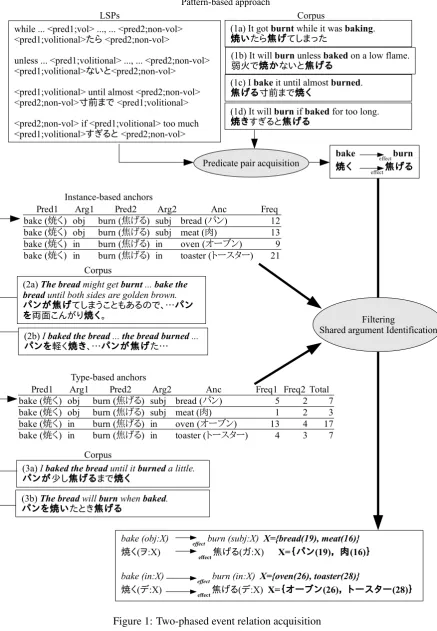
The complementarity between the pattern-based relation-oriented approach and the anchor-based argument-oriented approach as discussed above naturally leads us to consider combining them. The method we explore in this paper is illustrated in Figure 1. The overall process has two phrases: predicate pair acquisition followed by shared ar-gument identification. Given a relation type for ac-quisition, we first acquire candidate predicate pairs that are likely to be of the given relation exploiting a state-of-the-art pattern-based method. We then, in the second phase, seek anchors indicative of the shared argument for each acquired predicate pair. We consider two kinds of anchors: instance-based anchors and type-based anchors. If anchors are found, the predicate pair is verified and the asso-ciated argument pair is identified as the shared ar-gument; otherwise, the predicate pair is discarded. As we demonstrate in the section for empirical evaluation, this verification process boosts the ac-curacy as well as identifying shared arguments.
3.2 Predicate pair acquisition
For predicate pair acquisition, we can choose one from a range of state-of-the-art pattern-based methods. Among others, in our experiments, we adopted Abe et al. (2008)’s method because it had an advantage in that it was capable of learning pat-terns as well as relation instances.
Abe et al. (2008)’s method is based on Pan-tel and Pennacchiotti (2006)’sEspressoalgorithm,
which is originally designed to acquire relations between entities. Espresso takes as input a small number of seed instances of a given target rela-tion and iteratively learns co-occurrence patterns and relation instances in a bootstrapping manner. Abe et al. have made several extensions to it so that it can be applied to event relations. Since the details of this phase are not the focus of this paper, we refer the reader to (Abe et al., 2008) for further information.
3.3 Shared argument identification
For each of the predicate pairs acquired in the pre-vious phase, in shared argument identification, we use anchors to identify which argument is shared between the predicate pair. To find anchors indica-tive of shared arguments, we have so far examined two methods. We detail each below.
3.3.1 Instance-based anchors
Inspired by Pekar (2006)’s way of using an-chors for verb entailment acquisition, we assume that if two related predicates have a shared argu-ment, they must tend to appear in the same local discourse-related context with the shared argument filled with the same noun phrase (i.e. anchor). As an example, let us consider discourse (2a) in Figure 1. In this local discourse context, the noun breadappears twice, and onebreadfills the subject slot ofburnwhile the other fills the object slot of bake. In such a case, we assume the twobreads re-fer to the same object, namely anchor, and the sub-ject ofburnand the object ofbakeare shared with each other. We call such anchorsinstance-based anchors for the sake of contrast with type-based anchors, which we describe in 3.3.2.
We implement this assumption in the following way. Given a pair of predicatesPred1 andPred2,
we search a corpus for tuplesPred1-Arg1;Pred2,
Arg2;Ancsatisfying the following conditions:
(a) Anchor wordAncis the head of a noun phrase filling argumentArg1ofPred1 appearing in a
Web page.
(b) Ancalso fills argumentArg2ofPred2
appear-ing in the same Web page as above.
“͜ͱ(thing)”, “ͷ(thing)” and “ͱ͖(time)”.
pmi(Predi,Argi)in condition (d) is the point-wise mutual information betweenPrediandArgi. This condition is imposed for pruning wrong anchors misidentified due to parsing errors.
While Pekar carefully defines boundaries of lo-cal discourse-related context, we simply assume that every pair of predicates sharing an anchor in a Web page is somewhat related — unlike Pekar, we do not impose such constraints as paragraph boundaries. Nevertheless, as we show later in the evaluation section, our assumption works pre-cisely enough because the looseness of our dis-course boundary constraint is compensated by the constraints imposed by lexico-syntactic patterns.
We finally calculate an anchor set for each argu-ment pairPred1-Arg1 andPred2-Arg2 by
accumu-lating the obtained tuples:
AnchorSet(Pred1-Arg1,Pred2-Arg2)
={Arg|Pred1-Arg1;Pred2-Arg2;Anc}.
3.3.2 Type-based anchors
Let us consider sentences (3a) and (3b) in Figure 1. These two sentences both contain pred-icatesbakeandburn. In (3a), the nounbreadfills the object slot ofbake, while in (3b) the same noun breadfills the subject slot ofburn. In such a case, we assume the noun bread to be an anchor indi-cating that the object of bake and the subject of burnare shared with each other. We call such an-chors type-based anchors because bread in (3a) andbreadin (3b) do not refer to the same object but are identical just as type.
Given a pair of predicatesPred1 andPred2, we
search a corpus for sentences where Pred1 and
Pred2co-occur, and calculate the frequency counts
of their argument fillers appearing in those sen-tences:
• If argument Arg1 ofPred1 is filled by noun
Anc, increment the count of Pred1-Arg1;
Pred2;Anc.
• If argument Arg2 ofPred2 is filled by noun
Anc, increment the count of Pred1; Pred2
-Arg2;Anc.
We then identify the intersection between the filler sets ofPred1-Arg1 andPred2-Arg2 as the anchor
set of that argument pair. Namely,
AnchSet(Pred1-Arg1,Pred2-Arg2) =S1∩S2,
where
S1 ={Arg|Pred1-Arg1;Pred2;Anc},
S2 ={Arg|Pred1;Pred2-Arg2;Anc}.
3.3.3 Application of anchor sets
We say an argument pair covered by anchors only if any anchor is found for it. Analogously, we say a predicate paircovered by anchorsonly if any argument pair associated with it is covered by anchors. In the phase of shared argument identifi-cation, for each given predicate pair, we carry out the following procedure:
1. Discard the predicate pair if it is not covered by anchors.
2. Choose maximallyk-most frequent argument pairs associated with the predicate pair (k= 3 in our experiments).
3. Choose maximally l-most frequent anchors for each chosen argument pair (l= 3).
4 Experiments
4.1 Settings
For an empirical evaluation, we used a sample of approximately 500M sentences taken from the Web corpus collected by Kawahara and Kuro-hashi (2006). The sentences were dependency-parsed with CaboCha (Kudo and Matsumoto, 2002), and co-occurrence samples of event men-tions were extracted. Event menmen-tions with patterns whose frequency was less than 20 were discarded in order to reduce computational costs.
In our experiments, we considered two of Inui et al. (2003)’s four types of causal relations: action-effectrelations (Effect in Inui et al.’s terminology) andaction-means relations (Means). An action-effectrelation holds between eventsxandyif and only if non-volitional eventyis likely to happen as either a direct or indirect effect of volitional action
case a event-pair isX-ga hashiru(X runs) is con-sidered as a typical action that is often done as a part of the actionX-ga undou-suru(X exercises).
For our experiments, we manually built a lex-icon of over 12,000 verbs with volitionality la-bels, obtaining 8,968 volitional verbs, 3,597 non-volitional and 547 ambiguous. Volitional verbs include taberu (eat) and kenkyu-suru (research), while non-volitional verbs includeatatamaru(get warm),kowareru(to break-vi) andkanashimu(be sad). Volitionality information was used as a fea-ture of predicate slots in pattern-based predicate pair acquisition.
4.2 Results and discussion 4.2.1 Predicate pair acquisition
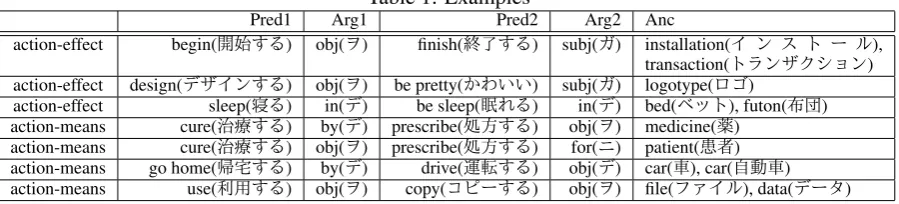
We ran the extended Espresso algorithm start-ing with 25 positive and 4 negative seed rela-tion instances for theaction-effectrelation and 174 positive and 131 negative seed relations for the action-means relation. As a result, we obtained 9,511 patterns with 22,489 relation instances for action-effect and 14,119 co-occurrence patterns with 13,121 relation instances for action-means after 40 iterations of pattern and instance rank-ing/selection. The threshold parameters for select-ing patterns and instances were decided in a pre-liminary trial. Some of the acquired instances are shown in Table 1.
We next randomly sampled 100 predicate pairs from each of four sections (1–500, 501–1500, 1501–3500 and 3500–7500) of the ranks of the ac-quired pairs for each relation class. Two annotators were asked to judge the correctness of each pred-icate pair (i.e. 800 pairs in total). They judged a predicate pair to be correct if they could produce an appropriate relation instance from that pair by adding some shared argument. For example, the pair͔͚Δ(hang/put/call) andͭͳ͕Δ(connect)
was judged correct because it could constitute such a relation instance as:
(3) ͔͚Δ(Λ:X)→effectͭͳ͕Δ(͕:X)
(X∈ {ి})
make(obj:X)→effect go-through(subj:X) (X∈ {phone-call})
Unfortunately, the two annotators did not agree with each other very much. out of the 400 sam-ples, they agreed only on 294 foraction-effectand 297 for action-means. However, a closer look at the results revealed that the judgements of the one annotator were considerably but very consistently
Table 2: Accuracy and recall of relation classifica-tion
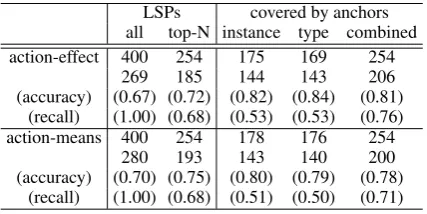
LSPs covered by anchors all top-N instance type combined action-effect 400 254 175 169 254
269 185 144 143 206
(accuracy) (0.67) (0.72) (0.82) (0.84) (0.81) (recall) (1.00) (0.68) (0.53) (0.53) (0.76) action-means 400 254 178 176 254
280 193 143 140 200
(accuracy) (0.70) (0.75) (0.80) (0.79) (0.78) (recall) (1.00) (0.68) (0.51) (0.50) (0.71)
more tolerant than the other. Assuming that the judgements of the latter correct, the precision and recall of those of the former would be 0.71 and 0.97 foraction-effect, and 0.75 and 0.99 for action-means. These figures indicate that the two annota-tors agreed quite well with respect to the “good-ness” of a sample, while having different criteria for strictness. For our evaluation, we decided to lean to the strict side and considered a sample cor-rect only if it was judged corcor-rect by both anno-tators. The accuracy and recall achieved by the pattern-based model is shown in the column “all” under “LSPs” in Table 2.
We then applied the anchor-based methods de-scribed in Section 3.3 to the above 800 sampled predicate pairs. The results are shown in the col-umn “covered by anchors” of Table 2. Since the tendency for both relation classes is more or less the same, let us focus only on the results for action-effect.
Table 1: Examples
Pred1 Arg1 Pred2 Arg2 Anc
action-effect begin(։࢝͢Δ) obj(Ϯ) finish(ऴྃ͢Δ) subj(Ψ) installation(Π ϯ ε τ ʔ ϧ),
transaction(τϥϯβΫγϣϯ)
action-effect design(σβΠϯ͢Δ) obj(Ϯ) be pretty(͔Θ͍͍) subj(Ψ) logotype(ϩΰ)
action-effect sleep(৸Δ) in(σ) be sleep(ΕΔ) in(σ) bed(ϕοτ), futon(ஂ)
action-means cure(࣏ྍ͢Δ) by(σ) prescribe(ॲํ͢Δ) obj(Ϯ) medicine(ༀ)
action-means cure(࣏ྍ͢Δ) obj(Ϯ) prescribe(ॲํ͢Δ) for(χ) patient(ױऀ)
action-means go home(ؼ͢Δ) by(σ) drive(ӡస͢Δ) obj(σ) car(ं), car(ࣗಈं)
action-means use(ར༻͢Δ) obj(Ϯ) copy(ίϐʔ͢Δ) obj(Ϯ) file(ϑΝΠϧ), data(σʔλ)
and low recall), their coverage reasonably differed from each other, which contributed to the improve-ment of recall.
To summarize so far, the pattern-based method we adopted in the experiment generated a sub-stantial number of predicate pairs with a accuracy comparative to the state of the art. The accuracy was, however, further boosted by applying both instance-based and type-based anchors. This ef-fect is particularly important because, to our best knowledge, very few pattern-based relation acqui-sition models have been reported to achieve as high a accuracy as what we achieved. In the case of our pattern-based model, for reference, the 254 highly ranked pairs of the 400 samples included only 185 correct pairs, which is worse than the 206 pairs covered by anchors for both accuracy and recall (see the “top-N” column under “LSPs” in Table 2. This difference also leads us to consider incor-porating our anchor-based filtering into the boot-strapping cycles of pattern-based predicate pair ac-quisition.
4.2.2 Shared argument identification
We next investigated the accuracy of shared ar-gument identification. For each of the aforemen-tioned predicate pairs covered by anchors (the 254 pairs foraction-effectand 254 for action-means), we asked the same two annotators as above to judge the correctness of the shared argument in-formation. The results of combination are shown in Table 3.
“arg-strict” shows the results of the strict judg-ments where the shared argument was considered to be correctly identified only when the most fre-quent argument pair was judged correct, while “arg-lenient” shows the results of the lenient judg-ments where the shared argument was considered to be correctly identified when either of the three most frequent argument pairs was judged correct. For judging the correctness of an argument pair, we had three degrees of strictness. In the most strict criterion (“anc-strict”), an argument pair was
judged correct only when its maximally three an-chor words were all correct, while in “anc-lenient”, an argument pair was judged correct when any of the three most frequent anchor words was correct. In “anc-any”, an argument pair was judged correct as far as an annotator could think of any appropri-ate anchor word for it. While the inter-annotator agreement was not very high, with the kappa co-efficient in the “arg-strict” and “anc-any” setting 0.47 for action-effect and 0.42 for action-effect), one was again consistently more tolerant than the other. For the same reason as argued in 4.2.1, we considered an acquired relation correct only if both annotators judged it correct.
In this experiment, predicate pairs that had been judged wrong with respect to relation types were all considered wrong in all the settings. The upper bounds of accuracy, therefore, are given by those in Table 2. For “arg-∗” with the “combined” an-chors, for example, the upper bound of accuracy is 0.81. Since “arg-lenient” with “combined” and “anc-lenient” achieved 0.76 accuracy, our method turned out to be reasonably precise in identifying argument pairs and their fillers. Paying attention to “arg-strict” and “anc-strict”, on the other hand, one can see a considerable drop from the lenient case, which needs to be further investigated.
5 Conclusion and future work
los-Table 3: Accuracy of shared argument identification
action-effect action-means
anc-strict anc-lenient anc-any anc-strict anc-lenient anc-any
instance 0.64 0.71 0.71 0.61 0.66 0.66
arg-strict type 0.60 0.63 0.65 0.61 0.65 0.67
combined 0.60 0.65 0.66 0.58 0.62 0.64
instance 0.78 0.80 0.80 0.73 0.75 0.76
arg-lenient type 0.68 0.71 0.72 0.67 0.69 0.71
combined 0.74 0.76 0.77 0.71 0.73 0.74
ing accuracy, and (c) the anchor-based method also achieves high accuracy in shared argument identi-fication.
Our future direction will be two-fold. One is evaluation. Clearly, more comprehensive evalu-ation needs to be done. For example, the ac-quired relation instances should be evaluated in some task-oriented manner. The other intriguing issue is how our anchor-based method for shared argument identification can benefit from recent ad-vances in coreference and zero-anaphora resolu-tion (Iida et al., 2006; Komachi et al., 2007, etc.).
References
Abe, Shuya, Kentaro Inui, and Yuji Matsumoto. 2008. Acquiring event relation knowledge by learning cooccurrence patterns and fertilizing cooccurrence
samples with verbal nouns. In Proceedings of the
3rd International Joint Conference on Natural Lan-guage Processing, pages 497–504.
Chklovski, Timothy and Patrick Pantel. 2005. Global path-based refinement of noisy graphs applied to
verb semantics. InProceedings of Joint Conference
on Natural Language Processing.
Harris, Zelling. 1968. Mathematical structures of
language. Interscience Tracts in Pure and Applied
Mathematics.
Iida, Ryu, Kentaro Inui, and Yuji Matsumoto. 2006. Exploiting syntactic patterns as clues in zero-anaphora resolution. InProceedings of the 21st In-ternational Conference on Computational Linguis-tics and the 44th annual meeting of the ACL, pages 625–632. Association for Computational Linguis-tics.
Inui, Takashi, Kentaro Inui, and Yuji Matsumoto. 2003. What kinds and amounts of causal knowledge can be acquired from text by using connective markers
as clues? In Proceedings of the 6th International
Conference on Discovery Science,, pages 180–193. Kawahara, Daisuke and Sadao Kurohashi. 2006. A
fully-lexicalized probabilistic model for japanese syntactic and case structure analysis. InProceedings of the Human Language Technology Conference of the North American Chapter of the Association for Computational Linguistics, pages 176–183.
Komachi, Mamoru, Ryu Iida, Kentaro Inui, and Yuji Matsumoto. 2007. Learning based argument struc-ture analysis of event-nouns in japanese. In Proceed-ings of the Conference of the Pacific Association for Computational Linguistics, pages 120–128.
Kudo, Taku and Yuji Matsumoto. 2002. Japanese
de-pendency analysis using cascaded chunking. In
Pro-ceedings of the 6th Conference on Natural Language Learning 2002 (COLING 2002 Post-Conference Workshops), pages 63–69.
Lin, Dekang and Patrick Pantel. 2001. Dirt: discovery of inference rules from text. InProceedings of the seventh ACM SIGKDD international conference on Knowledge discovery and data mining, pages 323– 328.
Pantel, Patrick and Marco Pennacchiotti. 2006.
Espresso: Leveraging generic patterns for automat-ically harvesting semantic relations. InProceedings of the 21st International Conference on Computa-tional Linguistics and 44th Annual Meeting of the
ACL, pages 113–120.
Pekar, Viktor. 2006. Acquisition of verb entailment
from text. InProceedings of the Human Language
Technology Conference of the NAACL, Main Confer-ence, pages 49–56.
Szpektor, Idan, Hristo Tanev, Ido Dagan, and Bonaven-tura Coppola. 2004. Scaling web-based acquisition of entailment relations. In Lin, Dekang and Dekai
Wu, editors, Proceedings of EMNLP 2004, pages
41–48, Barcelona, Spain. Association for Computa-tional Linguistics.
Torisawa, Kentaro. 2006. Acquiring inference rules with temporal constraints by using japanese coordi-nated sentences and noun-verb co-occurrences. In
Proceedings of Human Language Technology Con-ference/North American chapter of the Association for Computational Linguistics annual meeting (HLT-NAACL06), pages 57–64.