An Evaluation Framework for Plagiarism Detection
Martin Potthast Benno Stein
Web Technology & Information Systems Bauhaus-Universität Weimar
{martin.potthast, benno.stein}@uni-weimar.de
Alberto Barrón-Cedeño Paolo Rosso
Natural Language Engineering Lab—ELiRF Universidad Politécnica de Valencia
{lbarron, prosso}@dsic.upv.es
Abstract
We present an evaluation framework for plagiarism detection.1 The framework provides performance measures that ad-dress the specifics of plagiarism detec-tion, and the PAN-PC-10 corpus, which contains 64 558 artificial and 4 000 sim-ulated plagiarism cases, the latter gener-ated via Amazon’s Mechanical Turk. We discuss the construction principles behind the measures and the corpus, and we com-pare the quality of our corpus to exist-ing corpora. Our analysis gives empirical evidence that the construction of tailored training corpora for plagiarism detection can be automated, and hence be done on a large scale.
1 Introduction
The lack of an evaluation framework is a seri-ous problem for every empirical research field. In the case of plagiarism detection this short-coming has recently been addressed for the first time in the context of our benchmarking work-shop PAN [15, 16]. This paper presents the eval-uation framework developed in the course of the workshop. But before going into details, we sur-vey the state of the art in evaluating plagiarism de-tection, which has not been studied systematically until now.
1.1 A Survey of Evaluation Methods
We have queried academic databases and search engines to get an overview of all kinds of con-tributions to automatic plagiarism detection. Al-together 275 papers were retrieved, from which 139 deal with plagiarism detection in text,
1
The framework is available free of charge at http://www.webis.de/research/corpora.
Table 1: Summary of the plagiarism detection evaluations in 205 papers, from which 104 deal with text and 101 deal with code.
Evaluation Aspect Text Code
Experiment Task
local collection 80% 95% Web retrieval 15% 0%
other 5% 5%
Performance Measure
precision, recall 43% 18% manual, similarity 35% 69% runtime only 15% 1%
other 7% 12%
Comparison
none 46% 51%
parameter settings 19% 9% other algorithms 35% 40%
Evaluation Aspect Text Code
Corpus Acquisition
existing corpus 20% 18% homemade corpus 80% 82%
Corpus Size [# documents]
[1,10) 11% 10%
[10,102) 19% 30%
[102,103) 38% 33%
[103,104) 8% 11%
[104,105) 16% 4%
[105,106) 8% 0%
123 deal with plagiarism detection in code, and 13 deal with other media types. From the pa-pers related to text and code we analyzed the 205 which present evaluations. Our analysis covers the following aspects: experiment tasks, performance measures, underlying corpora, and, whether comparisons to other plagiarism detec-tion approaches were conducted. Table 1 summa-rizes our findings.
de-tection runtime. This indicates that precision and recall may not be well-defined in the context of plagiarism detection. Moreover, comparisons to existing research are conducted in less than half of the papers, a fact that underlines the lack of an evaluation framework.
The right-hand side of Table 1 overviews two corpus-related aspects: the use of existing cor-pora versus the use of handmade corcor-pora, and the size distribution of the used corpora. In particu-lar, we found that researchers follow two strate-gies to compile a corpus. Small corpora (<1 000 documents) are built from student courseworks or from arbitrary documents into which plagiarism-alike overlap is manually inserted. Large corpora (>1 000 documents) are collected from sources where overlap occurs more frequently, such as rewritten versions of news wire articles, or from consecutive versions of open source software. Al-together, we see a need for an open, commonly used plagiarism detection corpus.
1.2 Related Work
There are a few surveys about automatic plagia-rism detection in text [7, 8, 14] and in code [12, 17, 19, 20]. These papers, as well as nearly all papers of our survey, omit a discussion of evalua-tion methodologies; the following 4 papers are an exception.
In [21] the authors introduce graph-based per-formance measures for code plagiarism detection that are intended for unsupervised evaluations. We argue that evaluations in this field should be done in a supervised manner. An aside: the pro-posed measures have not been adopted since their first publication. In [15] we introduce preliminary parts of our framework. However, the focus of that paper is less on methodology but on the com-parison of the detection approaches that were sub-mitted to the first PAN benchmarking workshop. In [9, 10] the authors report on an unnamed cor-pus that comprises 57 cases of simulated plagia-rism. We refer to this corpus as the Clough09 cor-pus; a comparison to our approach is given later on. Finally, a kind of related corpus is the ME-TER corpus, which has been the only alternative for the text domain up to now [11]. It comprises 445 cases of text reuse among 1 716 news articles.
Although the corpus can be used to evaluate pla-giarism detection its design does not support this task. This is maybe the reason why it has not been used more often. Furthermore, it is an open ques-tion whether or not cases of news reuse differ from plagiarism cases where the plagiarists strive to re-main undetected.
1.3 Contributions
Besides the above survey, the contributions of our paper are threefold: Section 2 presents formal foundations for the evaluation of plagiarism detec-tion and introduces three performance measures. Section 3 introduces methods to create artificial and simulated plagiarism cases on a large scale, and the PAN-PC-10 corpus in which these meth-ods have been operationalized. Section 4 then compares our corpus with the Clough09 corpus and the METER corpus. The comparison reveals important insights for the different kinds of text reuse in these corpora.
2 Plagiarism Detection Performance
This section introduces measures to quantify the precision and recall performance of a plagiarism detection algorithm; we present a micro-averaged and a macro-averaged variant. Moreover, the so-called detection granularity is introduced, which quantifies whether the contiguity between plagia-rized text passages is properly recognized. This concept is important: a low granularity simpli-fies both the human inspection of algorithmically detected passages as well as an algorithmic style analysis within a potential post-process. The three measures can be applied in isolation but also be combined into a single, overall performance score. A reference implementation of the perfor-mance measures is distributed with our corpus.
2.1 Precision, Recall, and Granularity
Let dplg denote a document that contains
pla-giarism. A plagiarism case in dplg is a 4-tuple
s= splg, dplg, ssrc, dsrc, wheresplg is a
plagia-rized passage indplg, andssrcis its original
coun-terpart in some source documentdsrc. Likewise,
a plagiarism detection for document dplg is
de-noted as r = rplg, dplg, rsrc, dsrc; r associates
a passagersrcindsrc. We say thatrdetects s iff
rplg∩splg =∅,rsrc∩ssrc =∅, anddsrc =dsrc.
With regard to a plagiarized documentdplgit is
as-sumed that different plagiarized passages of dplg
do not intersect; with regard to detections fordplg
no such restriction applies. Finally, S andR de-note sets of plagiarism cases and detections.
While the above 4-tuples resemble an intu-itive view of plagiarism detection we resort to an equivalent, more concise view to simplify the subsequent notations: a document d is repre-sented as a set of references to its charactersd =
{(1, d), . . . ,(|d|, d)}, where (i, d) refers to the i-th character ind. A plagiarism casescan then be represented ass=splg∪ssrc, wheresplg ⊆dplg
andssrc ⊆dsrc. The characters referred to insplg
andssrcform the passagessplgandssrc. Likewise,
a detectionrcan be represented asr=rplg∪rsrc.
It follows that r detectssiffrplg ∩splg = ∅and
rsrc∩ssrc=∅. Based on these representations, the
micro-averaged precision and recall ofRunderS are defined as follows:
precmicro(S, R) = |
(s,r)∈(S×R)(s r)| |r∈Rr|
, (1)
recmicro(S, R) = |
(s,r)∈(S×R)(s r)| |s∈Ss|
, (2)
where s r=
s∩r ifrdetectss,
∅ otherwise.
The macro-averaged precision and recall are unaffected by the length of a plagiarism case; they are defined as follows:
precmacro(S, R) = 1
|R|
r∈R
|s∈S(s r)|
|r| , (3)
recmacro(S, R) =
1
|S|
s∈S
|r∈R(s r)|
|s| , (4)
Besides precision and recall there is another concept that characterizes the power of a detec-tion algorithm, namely, whether a plagiarism case s∈ Sis detected as a whole or in several pieces. The latter can be observed in today’s commercial plagiarism detectors, and the user is left to com-bine these pieces to a consistent approximation of s. Ideally, an algorithm should report detec-tionsRin a one-to-one manner to the true casesS.
To capture this characteristic we define the detec-tion granularity ofRunderS:
gran(S, R) = 1
|SR|
s∈SR
|Rs|, (5)
where SR ⊆ S are cases detected by detections
inR, andRs ⊆Rare the detections of a givens:
SR={s|s∈S∧ ∃r∈R:rdetectss},
Rs={r |r∈R∧rdetectss}.
The domain of gran(S, R) is [1,|R|], with 1 indicating the desired one-to-one correspondence and|R|indicating the worst case, where a single s∈S is detected over and over again.
Precision, recall, and granularity allow for a partial ordering among plagiarism detection algo-rithms. To obtain an absolute order they must be combined to an overall score:
plagdet(S, R) = Fα
log2(1 +gran(S, R)), (6)
where Fα denotes the Fα-Measure, i.e., the
weighted harmonic mean of precision and recall. We suggest using α = 1 (precision and recall equally weighted) since there is currently no indi-cation that either of the two is more important. We take the logarithm of the granularity to decrease its impact on the overall score.
2.2 Discussion
passage representations eliminate duplicate detec-tions of characters. The macro-averaged vari-ants allot equal weight to each plagiarism case, regardless of its length. Conversely, the micro-averaged variants favor the detection of long pla-giarism passages, which are generally easier to be detected. Which of both is to be preferred, how-ever, is still an open question.
3 Plagiarism Corpus Construction
This section organizes and analyzes the practices that are employed—most of the time implicitly— for the construction of plagiarism corpora. We introduce three levels of plagiarism authentic-ity, namely, real plagiarism, simulated plagiarism, and artificial plagiarism. It turns out that simu-lated plagiarism and artificial plagiarism are the only viable alternatives for corpus construction. We propose a new approach to scale up the gen-eration of simulated plagiarism based on crowd-sourcing, and heuristics to generate artificial pla-giarism. Moreover, based on these methods, we compile the PAN plagiarism corpus 2010 (PAN-PC-10) which is the first corpus of its kind that contains both a large number and a high diversity of artificial and simulated plagiarism cases.
3.1 Real, Simulated, and Artificial Plagiarism
Syntactically, a plagiarism case is the result of copying a passage ssrc from a source document
into another document dplg. Since verbatim
copies can be detected easily, plagiarists often rewrite ssrc to obfuscate their illegitimate act.
This behavior must be modeled when constructing a training corpus for plagiarism detection, which can be done at three levels of authenticity. Ide-ally, one would secretly observe a large number of plagiarists and use their real plagiarism cases; at least, one could resort to plagiarism cases which have been detected in the past. The following as-pects object against this approach:
• The distribution of detected real plagiarism is skewed towards ease of detectability.
• The acquisition of real plagiarism is expen-sive since it is often concealed.
• Publishing real cases requires the consents from the plagiarist and the original author.
• A public corpus with real cases is question-able from an ethical and legal viewpoint.
• The anonymization of real plagiarism is dif-ficult due to Web search engines and author-ship attribution technology.
It is hence more practical to let people create plagiarism cases by “purposeful” modifications, or to tap resources that contain similar kinds of text reuse. We subsume these strategies under the term simulated plagiarism. The first strategy has often been applied in the past, though on a small scale and without a public release of the corpora; the second strategy comes in the form of the ME-TER corpus [11]. Note that, from a psycholog-ical viewpoint, people who simulate plagiarism act under a different mental attitude than plagia-rists. From a linguistic viewpoint, however, it is unclear whether real plagiarism differs from sim-ulated plagiarism.
A third possibility is to generate plagiarism al-gorithmically [6, 15, 18], which we call artificial plagiarism. Generating artificial plagiarism cases is a non-trivial task if one requires semantic equiv-alence between a source passagessrcand the
pas-sagesplgthat is obtained by an automatic
obfus-cation of ssrc. Such semantics-preserving
algo-rithms are still in their infancy; however, the sim-ilarity computation between texts is usually done on the basis of document models like the bag of words model and not on the basis of the original text, which makes obfuscation amenable to sim-pler approaches.
3.2 Creating Simulated Plagiarism
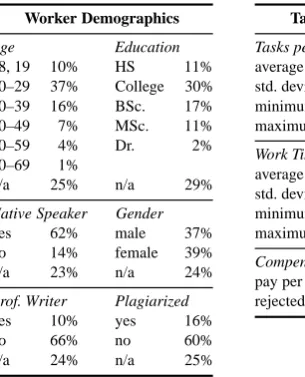
Table 2: Summary of 4 000 Mechanical Turk tasks completed by 907 workers.
Worker Demographics
Age Education
18, 19 10% HS 11% 20–29 37% College 30% 30–39 16% BSc. 17% 40–49 7% MSc. 11% 50–59 4% Dr. 2% 60–69 1%
n/a 25% n/a 29%
Native Speaker Gender
yes 62% male 37% no 14% female 39% n/a 23% n/a 24%
Prof. Writer Plagiarized
yes 10% yes 16%
no 66% no 60%
n/a 24% n/a 25%
Task Statistics
Tasks per Worker
average 15
std. deviation 20
minimum 1
maximum 103
Work Time (minutes)
average 14
std. deviation 21
minimum 1
maximum 180
Compensation
pay per task 0.5 US$ rejected results 25%
original text without proper citation.
Workers were required to be fluent in English reading and writing, and they were informed that every result was to be reviewed. A questionnaire displayed alongside the task description asked about the worker’s age, education, gender, and na-tive speaking ability. Further we asked whether the worker is a professional writer, and whether he or she has ever plagiarized. Completing the questionnaire was optional in order to minimize false answers, but still, these numbers have to be taken with a grain of salt: the Mechanical Turk is not the best environment for such sur-veys. Table 2 overviews the worker demographics and task statistics. The average worker appears to be a well-educated male or female in the twen-ties, whose mother tongue is English. 16% of the
workers claim to have plagiarized at least once, and if at least the order of magnitude of the lat-ter number can be taken seriously this shows that plagiarism is a prevalent problem.
A number of pilot experiments were conducted to determine the pay per task, depending on the text length and the task completion time: for 50 US-cents about 500 words get rewritten in about half an hour. We observed that decreasing or increasing the pay per task has proportional ef-fect on the task completion time, but not on the result quality. This observation is in concordance with earlier research [13]. Table 3 contrasts a source passagessrc and its rewritten, plagiarized
passagesplgobtained via the Mechanical Turk.
3.3 Creating Artificial Plagiarism
To create artificial plagiarism, we propose three obfuscation strategies. Given a source passage ssrc a plagiarized passage splg can be created as
follows (see Table 4):
• Random Text Operations. splg is created
from ssrc by shuffling, removing, inserting,
or replacing words or short phrases at ran-dom. Insertions and replacements are taken from the document dplg where splg is to be
inserted.
• Semantic Word Variation. splg is created
fromssrcby replacing words by one of their
synonyms, antonyms, hyponyms, or hyper-nyms, chosen at random. A word is kept if none of them is available.
Table 3: Example of a simulated plagiarism cases, generated with Mechanical Turk.
Source Passagessrc Plagiarized Passagesplg
The emigrants who sailed with Gilbert were better fitted for a crusade than a colony, and, disappointed at not at once find-ing mines of gold and silver, many deserted; and soon there were not enough sailors to man all the four ships. Accord-ingly, the Swallow was sent back to England with the sick; and with the remainder of the fleet, well supplied at St. John’s with fish and other necessaries, Gilbert (August 20) sailed south as far as forty-four degrees north latitude. Off Sable Island a storm assailed them, and the largest of the ves-sels, called the Delight, carrying most of the provisions, was driven on a rock and went to pieces.
[Excerpt from “Abraham Lincoln: A History” by John Nicolay and John Hay.]
Table 4: Examples of the obfuscation strategies.
Obfuscation Examples
Original Text
The quick brown fox jumps over the lazy dog.
Manual Obfuscation (by a human)
Over the dog which is lazy jumps quickly the fox which is brown. Dogs are lazy which is why brown foxes quickly jump over them. A fast auburn vulpine hops over an idle canine.
Random Text Operations
over The. the quick lazy dog <context word> jumps brown fox over jumps quick brown fox The lazy. the
brown jumps the. quick dog The lazy fox over
Semantic Word Variation
The quick brown dodger leaps over the lazy canine. The quick brown canine jumps over the lazy canine. The quick brown vixen leaps over the lazy puppy.
POS-preserving Word Shuffling
The brown lazy fox jumps over the quick dog. The lazy quick dog jumps over the brown fox. The brown lazy dog jumps over the quick fox.
• POS-preserving Word Shuffling. The se-quence of parts of speech in ssrc is
deter-mined andsplgis created by shuffling words
at random while retaining the original POS sequence.
To generate different degrees of obfuscation the strategies can be adjusted by varying the number of operations made on ssrc, and by limiting the
range of affected phrases withinssrc. For our
cor-pus, the strategies were combined and adjusted to match an intuitive understanding of a “low” and a “high” obfuscation. Of course other obfusca-tion strategies are conceivable, e.g., based on au-tomatic paraphrasing methods [4], but for perfor-mance reasons simple strategies are preferred at the expense of readability of the obfuscated text.
3.4 Overview of the PAN-PC-10
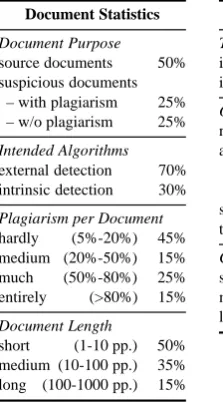
To compile the PAN plagiarism corpus 2010, sev-eral other parameters besides the above plagiarism obfuscation methods have been varied. Table 5 gives an overview.
The documents used in the corpus are derived from books from the Project Gutenberg.2 Every document in the corpus serves one of two pur-poses: it is either used as a source for plagiarism or as a document suspicious of plagiarism. The latter documents divide into documents that actu-ally contain plagiarism and documents that don’t.
2http://www.gutenberg.org
Table 5: Corpus statistics of the PAN-PC-10 for its 27 073 documents and 68 558 plagiarism cases.
Document Statistics
Document Purpose
source documents 50% suspicious documents
– with plagiarism 25% – w/o plagiarism 25%
Intended Algorithms
external detection 70% intrinsic detection 30%
Plagiarism per Document
hardly (5%-20%) 45% medium (20%-50%) 15% much (50%-80%) 25% entirely (>80%) 15%
Document Length
short (1-10 pp.) 50% medium (10-100 pp.) 35% long (100-1000 pp.) 15%
Plagiarism Case Statistics
Topic Match
intra-topic cases 50% inter-topic cases 50%
Obfuscation
none 40%
artificial
– low obfuscation 20% – high obfuscation 20% simulated (AMT) 6% translated ({de,es}to en) 14%
Case Length
short (50-150 words) 34% medium (300-500 words) 33% long (3000-5000 words) 33%
The documents without plagiarism allow to deter-mine whether or not a detector can distinguish pla-giarism cases from overlaps that occur naturally between random documents.
The corpus is split into two parts, correspond-ing to the two paradigms of plagiarism detection, namely external plagiarism detection and intrinsic plagiarism detection. Note that in the case of in-trinsic plagiarism detection the source documents used to generate the plagiarism cases are omitted: intrinsic detection algorithms are expected to de-tect plagiarism in a suspicious document by an-alyzing the document in isolation. Moreover, the intrinsic plagiarism cases are not obfuscated in or-der to preserve the writing style of the original au-thor; the 40% of unobfuscated plagiarism cases in the corpus include the 30% of the cases belonging to the intrinsic part.
estimations were made for the corpus. E.g., there are more simple plagiarism cases than complex ones, where “simple” refers to short cases, hardly plagiarism per document, and less obfuscation.
Finally, plagiarism cases were generated be-tween topically related documents and bebe-tween unrelated documents. To this end, the source doc-uments and the suspicious docdoc-uments were clus-tered into k = 30 clusters using bisecting k-means [22]. Then an equal share of plagiarism cases were generated for pairs of source docu-ments and suspicious docudocu-ments within as well as between clusters. Presuming the clusters cor-respond to (broad) topics, we thus obtained intra-topic plagiarism and inter-intra-topic plagiarism.
4 Corpus Validation
This section reports on validation results about the “quality” of the plagiarism cases created for our corpus. We compare both artificial plagia-rism cases and simulated plagiaplagia-rism cases to cases of the two corpora Clough09 and METER. Pre-suming that the authors of these corpora put their best efforts into case construction and annotation, the comparison gives insights whether our scale-up strategies are reasonable in terms of case qual-ity. To foreclose the results, we observe that sim-ulated plagiarism and, in particular, artificial
pla-giarism behave similar to the two handmade cor-pora. In the light of the employed strategies to construct plagiarism this result may or may not be surprising—however, we argue that it is neces-sary to run such a comparison in order to provide a broadly accepted evaluation framework in this sensitive area.
The experimental setup is as follows: given a plagiarism cases=splg, dplg, ssrc, dsrc, the
pla-giarized passage splg is compared to the source
passage ssrc using 10 different retrieval models.
Each model is an n-gram vector space model (VSM) where n ranges from 1 to 10 words, employing stemming, stop word removal, tf -weighting, and the cosine similarity. Similarity values are computed for all cases found in each corpus, but since the corpora are of different sizes, 100 similarities are sampled from each corpus to ensure comparability.
The rationale of this setup is as follows: a well-known fact from near-duplicate detection is that if two documents share only a few 8-grams—so-called shingles—it is highly probable that they are duplicates [5]. Another well-known fact is that two documents which are longer than a few sen-tences and which are exactly about the same topic will, with a high probability, share a considerable portion of their vocabulary. I.e., they have a high
1
0.8
0.6
0.4
0.2
0
n = 1 2 3 4 5 6 7 8 9 10
Similar
ity
n-gram VSM
Clough09 Artificial
Median
25% Quartile 75% Quartile Simulated (AMT) METER
Left to right:
similarity under a 1-gram VSM. It follows for pla-giarism detection that a common shingle between splg andssrc pinpoints very accurately an
unob-fuscated portion ofsplg, while it is inevitable that
even a highly obfuscatedsplgwill share a portion
of its vocabulary withssrc. The same holds for all
other kinds of text reuse.
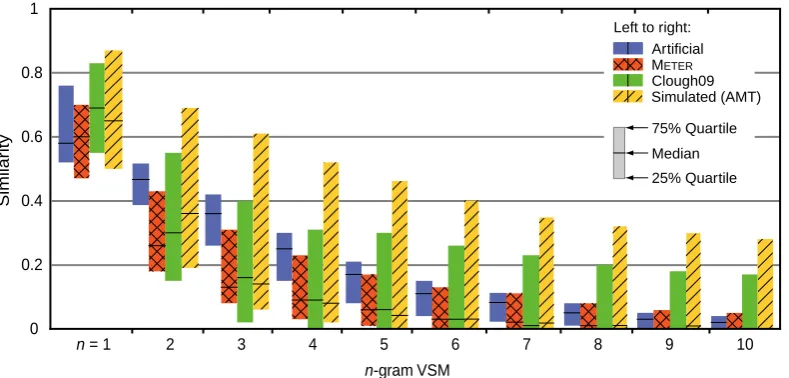
Figure 1 shows the obtained similarities, con-trasting eachn-gram VSM and each corpus. The box plots show the middle 50% of the respective similarity distributions as well as median similar-ities. The corpora divide into groups with compa-rable behavior: in terms of the similarity ranges covered, the artificial plagiarism compares to the METER corpus, except forn ∈ {2,3}, while the simulated plagiarism from the Clough09 corpus behaves like that from our corpus, but with a dif-ferent amplitude. In terms of median similarity, METER, Clough09, and our simulated plagiarism behave almost identical, while the artificial rism differs. Also note that our simulated plagia-rism as well as the Clough09 corpus contain some cases which are hardly obfuscated.
We interpret these results as follows: (1) Dif-ferent kinds of plagiarism and text reuse do not differ very much under n-gram models. (2) Ar-tificial plagiarism, if carefully generated, is a vi-able alternative to simulated plagiarism cases and real text reuse cases. (3) Our strategies to scale-up the construction of plagiarism corpora works well compared to existing, handmade corpora.
5 Summary
Current evaluation methodologies in the field of plagiarism detection research have conceptual shortcomings and allow only for a limited compa-rability. Our research contributes right here: we present tailored performance measures for plagia-rism detection and the large-scale corpus PAN-PC-10 for the controlled evaluation of detection algorithms. The corpus features various kinds of plagiarism cases, including obfuscated cases that have been generated automatically and man-ually. An evaluation of the corpus in relation to previous corpora reveals a high degree of matu-rity. Until now, 31 plagiarism detectors have been compared using our evaluation framework. This high number of systems has been achieved based
on two benchmarking workshops in which the framework was employed and developed, namely PAN’09 [15] and PAN’10 [16]. We hope that our framework will be beneficial as a challenging and yet realistic test bed for researchers in order to pin-point the room for the development of better pla-giarism detection systems.
Acknowledgements
We thank Andreas Eiselt for his devoted work on the corpus over the past two years. This work is partially funded by CONACYT-Mexico and the MICINN project TEXT-ENTERPRISE 2.0 TIN2009-13391-C04-03 (Plan I+D+i).
Bibliography
[1] Omar Alonso and Stefano Mizzaro. Can We Get Rid of TREC Assessors? Using Mechanical Turk for Relevance
Assessment. In SIGIR’09: Proceedings of the Workshop on The Future of IR
Evaluation, 2009.
[2] Vamshi Ambati, Stephan Vogel, and Jaime Carbonell. Active learning and
crowd-sourcing for machine translation. In Nicoletta Calzolari (Conference Chair), Khalid Choukri, Bente Maegaard, Joseph Mariani, Jan Odijk, Stelios Piperidis, Mike Rosner, and Daniel Tapias, editors,
Proceedings of the Seventh conference on International Language Resources and Evaluation (LREC’10), Valletta, Malta, may 2010. European Language Resources Association (ELRA). ISBN 2-9517408-6-7. [3] Jeff Barr and Luis Felipe Cabrera. AI Gets
a Brain. Queue, 4(4):24–29, 2006. ISSN 1542-7730. doi:
10.1145/1142055.1142067.
[4] Regina Barzilay and Lillian Lee. Learning to Paraphrase: An Unsupervised Approach Using Multiple-Sequence Alignment. In NAACL’03: Proceedings of the 2003 Conference of the North American Chapter of the Association for Computational Linguistics on Human Language
Technology, pages 16–23, Morristown, NJ, USA, 2003. Association for Computational Linguistics. doi:
10.3115/1073445.1073448.
1–10, London, UK, 2000. Springer-Verlag. ISBN 3-540-67633-3.
[6] Manuel Cebrian, Manuel Alfonseca, and Alfonso Ortega. Towards the Validation of Plagiarism Detection Tools by Means of Grammar Evolution. IEEE Transactions on Evolutionary Computation, 13(3):477–485, June 2009. ISSN 1089-778X.
[7] Paul Clough. Plagiarism in Natural and Programming Languages: An Overview of Current Tools and Technologies. Internal Report CS-00-05, University of Sheffield, 2000.
[8] Paul Clough. Old and New Challenges in Automatic Plagiarism Detection. National UK Plagiarism Advisory Service,
http://ir.shef.ac.uk/cloughie/papers/pas_plagiarism.pdf, 2003.
[9] Paul Clough and Mark Stevenson. Creating a Corpus of Plagiarised Academic Texts. In Proceedings of Corpus Linguistics
Conference, CL’09 (to appear), 2009. [10] Paul Clough and Mark Stevenson.
Developing A Corpus of Plagiarised Short Answers. Language Resources and Evaluation: Special Issue on Plagiarism and Authorship Analysis (in press), 2010. [11] Paul Clough, Robert Gaizauskas, and S. L.
Piao. Building and Annotating a Corpus for the Study of Journalistic Text Reuse. In Proceedings of the 3rd International Conference on Language Resources and Evaluation (LREC-02), pages 1678–1691, 2002.
[12] Wiebe Hordijk, María L. Ponisio, and Roel Wieringa. Structured Review of Code Clone Literature. Technical Report
TR-CTIT-08-33, Centre for Telematics and Information Technology, University of Twente, Enschede, 2008.
[13] Winter Mason and Duncan J. Watts. Financial Incentives and the "Performance of Crowds". In HCOMP’09: Proceedings of the ACM SIGKDD Workshop on Human Computation, pages 77–85, New York, NY, USA, 2009. ACM. ISBN
978-1-60558-672-4. doi: 10.1145/1600150.1600175.
[14] Hermann Maurer, Frank Kappe, and Bilal Zaka. Plagiarism - A Survey. Journal of Universal Computer Science, 12(8): 1050–1084, 2006.
[15] Martin Potthast, Benno Stein, Andreas Eiselt, Alberto Barrón-Cedeño, and Paolo
Rosso. Overview of the 1st International Competition on Plagiarism Detection. In Benno Stein, Paolo Rosso, Efstathios Stamatatos, Moshe Koppel, and Eneko Agirre, editors, SEPLN 2009 Workshop on Uncovering Plagiarism, Authorship, and Social Software Misuse (PAN 09), pages 1–9. CEUR-WS.org, September 2009. URL
http://ceur-ws.org/Vol-502.
[16] Martin Potthast, Benno Stein, Andreas Eiselt, Alberto Barrón-Cedeño, and Paolo Rosso. Overview of the 2nd International Benchmarking Workshop on Plagiarism Detection. In Benno Stein, Paolo Rosso, Efstathios Stamatatos, and Moshe Koppel, editors, Proceedings of PAN at CLEF 2010: Uncovering Plagiarism, Authorship, and Social Software Misuse, September 2010. [17] Chanchal K. Roy and James R. Cordy.
Scenario-Based Comparison of Clone Detection Techniques. In ICPC ’08: Proceedings of the 2008 The 16th IEEE International Conference on Program Comprehension, pages 153–162, Washington, DC, USA, 2008. IEEE Computer Society. ISBN
978-0-7695-3176-2.
[18] Chanchal K. Roy and James R. Cordy. Towards a Mutation-based Automatic Framework for Evaluating Code Clone Detection Tools. In C3S2E ’08:
Proceedings of the 2008 C3S2E conference, pages 137–140, New York, NY, USA, 2008. ACM. ISBN 978-1-60558-101-9.
[19] Chanchal K. Roy, James R. Cordy, and Rainer Koschke. Comparison and Evaluation of Code Clone Detection Techniques and Tools: A Qualitative Approach. Sci. Comput. Program., 74(7): 470–495, 2009. ISSN 0167-6423. [20] Chanchal K. Roy and James R. Cordy. A
survey on software clone detection research. Technical Report 2007-541, School of Computing, Queen’s University at Kingston, Ontario, Canada, 2007. [21] Geoffrey R. Whale. Identification of
Program Similarity in Large Populations. The Computer Journal, 33(2):140–146, 1990. doi: 10.1093/comjnl/33.2.140. [22] Ying Zhao, George Karypis, and Usama
Fayyad. Hierarchical Clustering Algorithms for Document Datasets. Data Min. Knowl. Discov., 10(2):141–168, 2005. ISSN 1384-5810. doi: