A Comparative Study on Ranking and Selection Strategies for
Multi-Document Summarization
Feng Jin, Minlie Huang, Xiaoyan Zhu
State Key Laboratory of Intelligent Technology and Systems
Tsinghua National Laboratory for Information Science and Technology
Dept. of Computer Science and Technology, Tsinghua University
[email protected],{aihuang,zxy-dcs}@tsinghua.edu.cn
Abstract
This paper presents a comparative study on two key problems existing in extrac-tive summarization: the ranking problem and the selection problem. To this end, we presented a systematic study of comparing different learning-to-rank al-gorithms and comparing different selec-tion strategies. This is the first work of providing systematic analysis on these problems. Experimental results on two benchmark datasets demonstrate three findings: (1) pairwise and listwise learn-ing-to-rank algorithms outperform the baselines significantly; (2) there is no significant difference among the learn-ing-to-rank algorithms; and (3) the in-teger linear programming selection strategy generally outperformed Maxi-mum Marginal Relevance and Diversity Penalty strategies.
1
Introduction
As the rapid development of the Internet, docu-ment summarization has become an important task since document collections are growing larger and larger. Document summarization, which aims at producing a condensed version of the original document(s), helps users to acquire information that is both important and relevant to their information need. So far, researchers have mainly focused on extractive methods which choose a set of salient textual units to form a summary. Such textual units are typical-ly sentences, sub-sentences (Gillick and Favre, 2009), or excerpts (Sauper and Barzilay, 2009).
Almost all extractive summarization methods face two key problems: the first problem is how to rank textual units, and the second one is how
to select a subset of those ranked units. The ranking problem requires systems model the relevance of a textual unit to a topic or a query. In this paper, the ranking problem refers to ei-ther sentence ranking or concept ranking. Con-cepts can be unigrams, bigrams, semantic con-tent units, etc., although in our experiment, only bigrams are used as concepts. The selection problem requires systems improve diversity or remove redundancy so that more relevant in-formation can be covered by the summary as its length is limited. As our paper focuses on ex-tractive summarization, the selection problem refers to selecting sentences. However, the se-lection framework presented here is universal for selecting arbitrary textual units, as discussed in Section 4.
There have been a variety of studies to ap-proach the ranking problem. These include both unsupervised sentence ranking (Luhn, 1958; Radev and Jing, 2004, Erkan and Radev, 2004), and supervised methods (Ouyang et al., 2007; Shen et al., 2007; Li et al., 2009). Even given a list of ranked sentences, it is not trivial to select a subset of sentences to form a good summary which includes diverse information within a length limit. Three common selection strategies have been studied to address this problem: Max-imum Marginal Relevance (MMR) (Carbonell and Goldstein, 1998), Diversity Penalty (DiP) (Wan, 2007), and integer linear programming (ILP) (McDonald, 2007; Gillick and Favre, 2009). As different methods were often eva-luated on different datasets, it is of great value to systematically compare ranking and selection strategies on the same dataset. However, to the best of our knowledge, there is still no work to compare different ranking strategies or compare different selection strategies.
problem for extractive summarization. We compared three genres of learning-to-rank me-thods for ranking sentences or concepts: SVR, a pointwise ranking algorithm; RankNet, a pair-wise learning-to-rank algorithm; and ListNet, a listwise learning-to-rank algorithm. We adopted an ILP framework that is able to select sen-tences based on sentence ranking or concept ranking. We compared it with other selection strategies such as MMR and Diversity Penalty. We conducted our comparative experiments on the TAC 2008 and TAC 2009 datasets, respec-tively. Our contributions are two-fold: First, to the best of our knowledge, this is the first work of presenting systematic and in-depth analysis on comparing ranking strategies and comparing selection strategies. Second, this is the first work using pairwise and liswise learning-to-rank algorithms to perform concept (word bi-gram) ranking for extractive summarization.
The rest of this paper is organized as follows. We introduce the related work in Section 2. In Section 3, we present three ranking algorithms, SVR, RankNet, and ListNet. We describe the sentence selection problem with an ILP frame-work described in Section 4. We introduce fea-tures in Section 5. Evaluation and experiments are presented in Section 6. Finally, we conclude this paper in Section 7.
2
Related Work
A number of extractive summarization studies used unsupervised methods with surface fea-tures, linguistic feafea-tures, and statistical features to guide sentence ranking (Edmundson, 1969; McKeown and Radev, 1995; Radev et al., 2004; Nekova et al., 2006). Recently, graph-based ranking methods have been proposed for sen-tence ranking and scoring, such as LexRank (Erkan and Radev, 2004) and TextRank (Mihal-cea and Tarau, 2004).
There are also a variety of studies on su-pervised learning methods for sentence ranking and selection. Kupiec et al. (1995) developed a naive Bayes classifier to decide whether a sen-tence is worthy to extract. Recently, Conditional Random Field (CRF) and Structural SVM have been employed for single document summariza-tion (Shen et al., 2007; Li et al., 2009).
Besides ranking sentences directly, there are some approaches that select sentences based on
concept ranking. Radev et al. (2004) used cen-troid words whose tf*idf scores are above a threshold. Filatova and Hatzivassiloglou (2004) used atomic event as concept. Moreover, sum-marization evaluation metrics such as Basic Element (Hovy et al., 2006), ROUGE (Lin and Hovy, 2003) and Pyramid (Passonneau et al., 2005) are all counting the concept overlap be-tween generated summaries and human-written summaries.
Another important issue existing in extractive summarization is to find an optimal sentence subset which can cover diverse information. Maximal Marginal Relevance (MMR) (Carbo-nell and Goldstein, 1998) and Diversity Penalty (Wan, 2007) are most widely used approaches to reduce redundancy. The two methods are es-sentially based on greedy search. By contrast, ILP based approaches view summary generation as a global optimization problem. McDonald (2007) proposed a sentence-level ILP solution. Sauper and Barzilay (2009) presented an ex-cerpt-level ILP method to generate Wikipedia articles. Gillick and Favre (2009) proposed a concept-level ILP, but they used document fre-quency to score concepts (bigrams), without any learning process. Some recent studies (Gillick and Favre, 2009; Martins and Smith, 2009) also modeled sentence selection and compression jointly using ILP. Our ILP framework proposed here is based on these studies. Although various selection strategies have been proposed, there is no work to systematically compare these strate-gies yet.
3
Ranking Sentences or Concepts
Given a query and a collection of relevant doc-uments, an extractive summarization system is required to generate a summary consisting of a set of text units (usually sentences). The first problem we need to consider is to determine the importance of these sentences according to the input query. We approach this ranking problem in two ways: the first way is to score sentences directly using learning-to-rank algorithms, and thus the goal of summarization is to select a subset of sentences, considering both relevance and redundancy. The second way is to score concepts within the document collection, and then the summarization task is to select a sen-tence subset that can cover those important con-cepts maximally. The problem of sentence se-lection will be described in Section 4.
Suppose the relevant document collection for a query q is Dq. From this collection, we obtain a set of sentences or concepts (e.g., word bi-grams), S={s1,s2,…,sn} or C={c1,c2,…, cn}. Be-fore training, each si or ci is associated with a gold standard score, yi. A feature vector, xj=
Φ(sj/cj,q,Dq), is constructed for each sentence or concept. The learning algorithm will learn a ranking function f(xj) from a collection of query-document pairs {(qi,Dqi)|i= 1, 2,…,m}.
We investigated three learning-to-rank me-thods to learn f(xj). The first one is a pointwise ranking algorithm, support vector regression (SVR). This algorithm treats sentences (or con-cepts) independently. The second method is a pairwise ranking algorithm, RankNet, which learns a ranking function from a list of sentence (or concept) pairs. Each pair is labeled as 1 if the first sentence si (or concept ci) ranks ahead of the second sj (or cj), and 0 otherwise.
The listwise ranking algorithm, ListNet, learns the ranking function f(xj) in a different way. A list of sentences (or concepts) is treated as a whole. Both RankNet and ListNet take into account the dependency between sentences (or concepts).
3.1 Support Vector Regression
Support Vector Regression (SVR), a generaliza-tion of the classical SVM formulageneraliza-tion, attempts to learn a regression model. SVR has been ap-plied to summarization in (Ouyang et al., 2007; Metzler and Kanungo, 2008). In our work, we
train the SVR model to fit the gold standard score of each sentence or concept.
Formally, the objective of SVR is to minim-ize the following objective:
2 , ,
1 1
|| || ( ( ))
2 xi i i
w b
w C v L y f x
N ξ
ξ
ℑ( ) =
⎧ ⎛ ⎞⎫
⎪ ⎪
+ ⎜ ⋅ + − ⎟
⎨ ⎬
⎪ ⎝ ⎠⎪
⎩
∑
⎭(1)
where L(x)=|x|-ξ if x > ξand otherwise L(x)=0; yi is the gold standard score of xi; f(x) =wTx+b, the predicted score of x; C and v are two para-meters; and N is the total number of training examples.
3.2 RankNet
RankNet is a pairwise learning-to-rank method (Burges et al., 2005). In this algorithm, training examples are handled pair by pair. Given a pair of feature vectors (xi, xj), the gold standard probability Pijis set to be 1 if the label of the pair is 1, which means xi ranks ahead of xj. The gold standard probability is 0 if the label of the pair is 0. Then the predicted probability Pij, which defines the probability of xi ranking ahead of xj by the model, is represented as a lo-gistic function:
exp( ( ) ( )) 1 exp( ( ) ( ))
i j
ij
i j
f x f x P
f x f x
− =
+ − (2)
where f(x) is the ranking function. The objective of the algorithm is to minimize the cross entro-py between the gold standard probability and the predicted probability, which is defined as follows:
( ) log (1 )log(1 )
ij ij ij ij ij
C f = −P P − −P −P (3) A three-layer neural network is used as the ranking function, as follows:
3 32 2 21 2 3
( )n ( ij ( jk nk j) i)
j k
f x =g
∑
w g∑
w x +b +b (4)where for weights w and bias b, the superscripts indicate the node layer while the subscripts in-dicate the node indexes within each layer. And xnk is the k-th component of input feature vector xn. Then a gradient descent method is used to learn the parameters. For details, refer to (Burges et al., 2005).
3.3 ListNet
a list of feature vectors (x1, x2,…, xn) and each feature vector xi has an gold standard score yi, which has been assigned before training. Ac-cordingly, we have a list of gold standard scores (y1, y2,…,yn). We also have a list of scores as-signed by the algorithm during training, say, (f(x1), f(x2),…, f(xn)). Given a score list S={s1,s2,…,sn}, the probability that xj will rank the first place among the n items is defined as follows:
1 1
( ) exp( )
( )
( ) exp( )
j j
s n n
k k k k s s P j s s = = Φ = = Φ
∑
∑
(5)It is easy to prove that (Ps(1), Ps(2), …, Ps(n))is a probability distribution, as the sum of them equals to 1. Therefore, the cross entropy can be used to define the loss between the gold stan-dard distribution Py(j) and the distribution Pf(j), as follows:
1
( , ) n y( ) log f( ) j
L y f P j P j
=
= −
∑
(6)where y represents the gold standard score list (y1, y2,…,yn) and f=(f(x1), f(x2),…, f(xn)) is the score list output by the ranking algorithm.
The function f is defined as a linear function, as follows:
( )
Tw i i
f x
=
w x
(7) Then the gradient of loss function L(y,f) with respect to the parameter vector w can be calcu-lated as follows:1 1 1 ( ) ( , ) ( ) ( ) 1
exp( ( )) exp( ( ))
n w j w y j j n w j w j n j w j j f x L y f
w P x
w w f x f x w f x = = = ∂ ∂
Δ = = −
∂ ∂ ∂ + ∂
∑
∑
∑
(8)During training, w is updated in a gradient des-cent manner: w=w -η∆w and η is the learning rate. For details, refer to (Cao et al., 2007).
4
ILP-based Selection Framework
After we have a way of ranking sentences or concepts, we face a sentence selection problem: selecting an optimal subset of sentences as the final summary. To integrate sentence/concept ranking, we adopted an integer linear program-ming (ILP) framework to find the optimal sen-tence subset (Filatova and Hatzivassiloglou, 2004; McDonald, 2007; Gillick and Favre, 2009; Takamura and Okumura, 2009). ILP is a global
optimization problem whose objective and con-straints are linear in a set of integer variables.
Formally, we define the problem of sentence selection as follows:
maximize: ( )* x i i i
f x z
⎧ ⎫
⎨ ⎬
⎩
∑
⎭ (9). . u*| | j j
j
z u Lim
s t
∑
≤u* ( , ) x,
j i
j
z I i j ≥z ∀i
∑
( x x)* ( , ) ,
i j i j
z +z sim x x <
δ
∀i j,x u {0,1}, , i j
z z ∈ ∀i j
where:
xi – the representation unit, such as a sentence
or a concept. We term it representation unit be-cause the summary quality is represented by the set of included xi;
f(xi) - the ranking function given by the
learn-ing-to-rank algorithms;
uj- the selection unit, for instance, a sentence in
this paper. |uj| is the number of words in uj;
x i
z
- the indicator variable which denotes the presence or absence of xi in the summary;u j
z - the indicator variable which denotes inclu-sion or excluinclu-sion of uj;
I(i, j)- a binary constant indicating that wheth-er xi appears in uj. It is either 1 or 0;
Lim - the length limit;
sim(xi, xj) - a similarity measure for considering
the redundancy;
δ- the redundancy threshold.
The first constraint indicates the length limit. The second constraint asserts that if a represen-tation unit xi is included in a summary, at least one selection unit that contains xi must be se-lected. The third constraint considers redundan-cy. If the representation unit is sentence, the similarity measure is defined as tf*idf similarity, and
δ/2
is the similarity threshold, which was set to be 1 here. For concepts, the similarity measure can be defined as1,
( , )
0, otherwise
i j
i j
x
x
sim x x
=
⎧
⎨
=
⎩
.Note that this framework is very general. If the representation unit xi is a sentence, the rank-ing function is defined on sentence. Thus the ILP framework will find a set of sentences that can optimize the total scores of selected sen-tences, subject to several constraints. If the re-presentation unit is a concept, the ranking func-tion measures the importance of a concept to be included in a summary. Thus the goal of ILP is to find a set of sentences by maximizing the scores of concepts covered by those selected sentences.
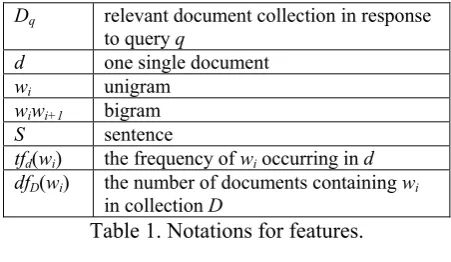
Dq relevant document collection in response to query q
d one single document wi unigram
wiwi+1 bigram
S sentence
tfd(wi) the frequency of wi occurring in d
[image:5.595.70.296.234.365.2]dfD(wi) the number of documents containing wi in collection D
Table 1. Notations for features.
5
Features
To facilitate the following description, some notations are defined in Table 1. In our dataset, each query has a title and narrative to precisely define an information need. The following is a query example from the TAC 2008 test dataset:
<topic id = "D0801A"> <title> Airbus A380 </title> <narrative>
Describe developments in the production and launch of the Airbus A380.
</narrative> </topic>
Features for sentence ranking and concept ranking are listed in the following. We use word bigrams as concept here.
Sentence Features
(1) Cluster frequency:
( )
qi D i
w S∈
tf
w
∑
(2) Title frequency:
( )
i d iw S∈
tf w
∑
where d is a new document that consists of all the titles of documents in Dq.(3) Query frequency:
( )
i d iw S∈
tf w
∑
where d is a document consisting of the title and narrative fields of the current topic.(4) Theme frequency:
( )
q
i i D i
w S w T∈ ∧ ∈
tf
w
∑
where T is the top 10% frequent unigram words in Dq.
(5) Document frequency of bigrams in the sen-tence:
1
(
1)
i i D i i
w w+∈S
df w w
+∑
.(6) PageRank score: as described in (Mihalcea and Tarau, 2004), each sentence in Dq is a node in the graph and the cosine similarity between a pair of sentences is used as edge weight.
Concept Features
(1) Cluster frequency: ( 1) q
D i i
tf w w+ , the fre-quency of
w w
i i+1occurring in Dq.(2) Title frequency:
tf w w
d(
i i+1)
, where d is a document consisting of all the titles of docu-ments in Dq.(3) Query Frequency: the frequency of the bi-gram occurring in the topic title and narrative. (4) Average term frequency:
1
(
)/ |
|
q d i i q
d D∈
tf w w
+D
∑
. |Dq| is the number of documents in the set.(5) Document frequency: the document fre-quency of this bigram.
(6) Minimal position: the minimal position of this bigram relative to the document length. (7) Average position: the average position of this bigram in collection Dq .
6
Experimental Results
6.1 Data Preprocessing
We conducted experiments on the TAC 2008 and TAC 2009 datasets. The task requires pro-ducing a 100-word summary for each query (al-so termed topic (al-sometimes). There are 48 que-ries in TAC 2008 and 44 queque-ries in TAC 2009. A query example has been given in Section 5. Relevant documents for these queries have been specified. And four human-written summaries were supplied as reference summaries for each query.
We segmented the relevant documents into sentences using the LingPipe toolkit 1 and
stemmed words using the Porter Stemmer. Word bigrams are used as concepts in this paper. If the two words in a bigram are both stop-words, the bigram will be discarded. The
tence features and bigram features are then cal-culated. As our focus is on comparing different ranking strategies and selection strategies, we did not apply any sophisticated linguistic or se-mantic processing techniques (as pre- or post-processing). Thus we did not compare our re-sults to those submitted to the TAC conferences.
We train the learning algorithms on one data-set and then evaluate the algorithms on the other. The generated summaries are evaluated using the ROUGE toolkit (Lin and Hovy, 2003).
6.2 Preparing Training Samples
As our work includes both sentence ranking and concept ranking, we need to establish two types of training data. Fortunately, we are able to do this based on the reference summaries and an-notation results provided by the TAC confe-rences.
For the sentence ranking problem, we com-pute the average ROUGE-1 score for each sen-tence by comparing it to the four reference summaries for each query. This score is treated as the gold-standard score. In ListNet, these scores are directly used (see formula (5)). While in RankNet, the sentences for a query are grouped into 10 bins according to their ROUGE-1 scores, and then we extract sentences from different bins respectively to form a pair. We assume that a sentence in a higher scored bin should rank ahead of those sentences in lower scored bins.
As for the concept ranking problem, gold-standard scores are obtained from the human annotated Pyramid data. The weight of each semantic content unit (SCU) is the number of reference summaries in which the SCU appears. So straightforwardly, the gold-standard score of a bigram is the largest weight of all SCUs that contain the bigram. And if a bigram does not occur in any SCU, its score will be 0. Thus the bigram scores belong to the set {0,1,2,3,4} as there are four human-written summaries for each query. These scores are directly used in ListNet (see formula (5)). And in RankNet, bi-gram pairs are constructed according to the gold-standard scores.
6.3 Learning Parameters
For SVR, the radial basis kernel function is em-ployed and the optimal values for parameters C, v and g (for the kernel) are found using the
gri-dregression.py tool provided by LibSVM (Chang and Lin, 2001) with a 5-fold cross vali-dation on the training set.
RankNet applies a three-layer (one hidden layer) neural network with only one node in the output layer, as described in (Burges et al., 2005). The number of hidden neurons was em-pirically set to be 10. The learning rate was set to 0.001 for sentence ranking and 0.01 for bi-gram ranking.
As for ListNet, the learning rate for sentence ranking and concept ranking are both set to be 0.1 empirically.
6.4 Comparing Ranking Strategies
In this section, we compared different ranking strategies for both sentence ranking and concept ranking. The sentence selection strategies were fixed to the ILP selection framework as shown in Section 4. We chose ILP as the selection strategy because we want to compare our sys-tem with the following two methods (as base-lines):
(1) SENT_ILP: A sentence-level method pro-posed by McDonald (2007) with ILP formula-tion. We implemented the query-focused ver-sion of the formulae as TAC 2008 and 2009 required query-focused summarization.
(2) DF_ILP: A concept-level ILP method using document frequency to score word bigrams (Gillick and Favre, 2009), without any learning process.
The differences between our framework and SENT_ILP are: a) SENT_ILP used a redundan-cy factor in the objective function whereas we modeled redundancy as constraints; b) SENT_ILP used tf*idf similarity to compute relevance scores whereas we used learning algo-rithms.
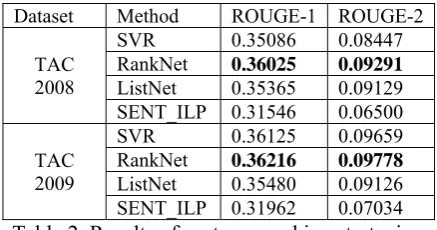
DF_ILP. This infers that considering more fea-tures will have better results than using docu-ment frequency to score concepts. The Wilcox-on signed-rank test (WilcoxWilcox-on, 1945) is used for significance tests in our experiment. A good ranking strategy for modeling relevance is im-portant for extractive summarization. RankNet which used a three-layer network (non-linear function) as the ranking function performs slightly better than ListNet which is based on a linear ranking function.
Dataset Method ROUGE-1 ROUGE-2
TAC 2008
SVR 0.35086 0.08447 RankNet 0.36025 0.09291
ListNet 0.35365 0.09129 SENT_ILP 0.31546 0.06500
TAC 2009
SVR 0.36125 0.09659 RankNet 0.36216 0.09778
ListNet 0.35480 0.09126 SENT_ILP 0.31962 0.07034 Table 2. Results of sentence ranking strategies.
Dataset Method ROUGE-1 ROUGE-2
TAC 2008
SVR 0.36555 0.10291 RankNet 0.37564 0.11213
ListNet 0.36863 0.10660 DF_ILP 0.36922 0.10373
TAC 2009
SVR 0.37126 0.10698 RankNet 0.37513 0.11364
[image:7.595.74.293.221.336.2]ListNet 0.37499 0.11313 DF_ILP 0.36347 0.10156 Table 3. Results of concept ranking strategies.
It is worth noting that Pyramid annotations may not cover all important bigrams, partly be-cause SCUs in reference summaries have been rephrased by human annotators. Note that we simply extract original sentences to form a summary, thus it is possible that a bigram which is important in the original sentences does not appear in any rephrased SCUs at all. Such bi-grams will have a gold-standard score of 0, which is erroneous supervision. For example, the bigrams hurricane katrina in topic D0804A about Katrina pet rescue and life support in D0806A about Terri Schiavo case are not anno-tated in any SCUs, but these bigrams are both key terms for the topics.
6.5 Comparing Selection Strategies
In order to study the influence of different selec-tion strategies, we compare the ILP selecselec-tion
strategy (as introduced in Section 4) with other popular selection strategies, based on the same sentence ranking algorithm (we chose sentence-level RankNet). The baselines to be compared are as follows:
(1) MMR: As shown in (Carbonell and Goldstein, 1998), the formula of MMR is:
{
1 2}
arg max ( , ) (1 ) max ( , )
i i j i j
s R S s S
MMR λD q s λ D s s
∈ − ∈
= − −
where q is the given query; R is the set of all sentences; S is the set of already included sen-tences; D1 is the normalized ranking score f(xi) of si, and D2 is the cosine similarity of the fea-ture vectors for si and sj. Our implementation was similar to the MMR strategy in the MEAD2summarizer.
(2) DiP: Diversity penalty which penalizes the score of candidate sentences according to the already selected ones (Wan, 2007).
Dataset Method ROUGE-1 ROUGE-2
TAC 2008
ILP 0.36025 0.09291
MMR 0.35459 0.09086 DiP 0.35263 0.08689
TAC 2009
ILP 0.36216 0.09778
MMR 0.35148 0.08881 DiP 0.34714 0.08672 Table 4. Comparing selection strategies.
The corresponding ROUGE scores are pre-sented in Table 4. ILP outperforms other selec-tion strategies significantly on the TAC 2009 dataset (both ILP vs. MMR and ILP vs. DiP). Although improvements are observed with ILP on the TAC 2008 dataset, the difference is not significant (using ILP vs. using MMR). MMR is comparable to DiP as they are both based on greedy search in nature.
To investigate the difference between these strategies, we present in-depth analysis here. First, the average length of summaries generat-ed by ILP is 97.1, while that by MMR and DiP are 95.5 and 92.7, respectively. Note that the required summary length is 100 and that more words can potentially cover more information. Thus, ILP can generate summaries with more information. This is because ILP is a global op-timization algorithm, subject to the length con-straint. Second, the average rank of sentences selected by ILP is 12.6, while that by MMR and
DiP is about 5, which is substantially different. ILP can search down the ranked list while the other two methods tend to only select the very top sentences. Third, there are 4.1 sentences on average in each ILP-generated summary, while the number for MMR and DiP generated sum-maries are 2.7 and 2.5, respectively. Thus ILP tend to select shorter sentences than MMR and DiP. This may help reduce redundancy as long-er sentences may contain more topic irrelevant clauses or phrases.
6.6 Discussions
Interestingly, although the learning-to-rank al-gorithms combined with the ILP selection strat-egy perform well in summarization, the perfor-mance is still far from that of manual summari-zation. In this study, we investigate the upper bound performance. We used the presented ILP framework to generate summaries based on the gold-standard scores, rather than the scores giv-en by the learning algorithms. In other words, f(xi) in formula (9) is replaced by the gold-standard scores. The ROUGE results are shown in Table 5. We also listed the best/worst/average ROUGE scores of human summaries in TAC by comparing one human summary (as generated summary) to the other three human summaries (as reference summaries). These results are sub-stantially better than those by the learning algo-rithms. Sentence- and concept- level ranking produces very close results to best human sum-maries. Some ROUGE-2 scores are even higher than those of human summaries. This is reason-able as human annotators may have difficulty in organizing content when there are many docu-ments and sentences. The results reflect that there is a remarkable gap between the gold-standard scores and the learned scores.
Dataset Method ROUGE-1 ROUGE-2
TAC 2008
Sentence-level 0.44216 0.14842
Concept-level 0.42222 0.16018 Human Best 0.44220 0.13079 Human Average 0.41417 0.11606
Human Worst 0.38005 0.10736
TAC 2009
Sentence-level 0.45500 0.15565
Concept-level 0.43526 0.17118 Human Best 0.45663 0.14864 Human Average 0.44443 0.12680
Human Worst 0.39652 0.11109 Table 5. Upper bound performance.
7
Conclusion and Future Work
We presented systematic and extensive analysis on studying two key problems in extractive summarization: the ranking problem and the selection problem. We compared three genres of learning-to-rank algorithms for the ranking problem, and investigated ILP, MMR, and Di-versity Penalty strategies for the selection prob-lem. To the best of our knowledge, this is the first work of presenting systematic comparison and analysis on studying these problems. We also at the first time proposed to use learning-to-rank algorithms to perform concept learning-to-ranking for extractive summarization.
Our future work will focus on: (1) exploiting more features that can reflect summary quality; (2) optimizing summarization evaluation me-trics directly with new learning algorithms.
Acknowledgments
This work was partly supported by the Chinese Natural Science Foundation under grant No. 60973104 and No. 60803075, and with the aid of a grant from the International Development Research Center, Ottawa, Canada IRCI project from the International Development.
References
Chris Burges, Tal Shaked, Erin Renshaw, Ari Lazier, Matt Deeds, Nicole Hamilton and Greg Hullender. 2005. Learning to Rank Using Gradient Descent. In Proceedings of the 22nd International Confe-rence on Machine Learning.
Zhe Cao, Tao Qin, Tie-Yan Liu, Ming-Feng Tsai and Hang Li. 2007. Learning to Rank: from Pairwise Approach to Listwise Approach. In Proceedings of ICML 2007.
Jaime Carbonell and Jade Goldstein. 1998. The Use of MMR, Diversity-Based Reranking for Reorder-ing Documents and ProducReorder-ing Summaries. In Proceedings of SIGIR, August 1998, pp. 335 - 336. Chih-Chung Chang and Chih-Jen Lin. 2001.
LIBSVM: a Library for Support Vector Machines.
Software available at http://www.csie.ntu.edu.tw/~cjlin/libsvm
H. P. Edmundson. 1969. New Methods in Automatic Extracting. Journal of the ACM (JACM) Archive, Volume 16, Issue 2 (April 1969) Pages: 264 - 285. G. Erkan and Dragomir R. Radev. 2004.
Summa-rization. In Proceedings of EMNLP 2004, Barce-lona, Spain.
Elena Filatova and Vasileios Hatzivassiloglou. 2004. Event-based Extractive Summarization. In Pro-ceedings of ACL Workshop on Summarization, volume 111.
Dan Gillick and Benoit Favre. 2009. A Scalable Global Model for Summarization. In Proceedings of the Workshop on Integer Linear Programming for Natural Language Processing.
Eduard Hovy, Chin-yew Lin, Liang Zhou and Juni-chi Fukumoto. 2006. Automated Summarization Evaluation with Basic Elements. In Proceedings of the Fifth Conference on Language Resources and Evaluation.
Julian Kupiec, Jan Pedersen and Francine Chen. 1995. A Trainable Document Summarizer. In Proceedings of SIGIR'95, pages 68 - 73, New York, USA.
Liangda Li, Ke Zhou, Gui-Rong Xue, Hongyuan Zha and Yong Yu. 2009. Enhancing Diversity, Cover-age and Balance for Summarization through Structure Learning. In Proceedings of the 18th In-ternational Conference on World Wide Web. Chin-Yew Lin and Eduard Hovy. 2003. Automatic
Evaluation of Summaries Using N-gram Co-Occurrence Statistics. In Proceedings of HLT-NAACL, pages 71-78.
Tie-Yan Liu. 2009. Learning to Rank for Informa-tion Retrieval, FoundaInforma-tion and Trends on Infor-mation Retrieval. Now Publishers.
H.P. Luhn. 1958. The Automatic Creation of Litera-ture Abstracts. In IBM Journal of Research and Development, Vol. 2, No. 2, pp. 159-165, April 1958.
André F. T. Martins and Noah A. Smith. 2009. Summarization with a Joint Model for Sentence Extraction and Compression. In Proceedings of the Workshop on Integer Linear Programming for Natural Langauge Processing\.
Ryan McDonald. 2007. A Study of Global Inference Algorithms in Multi-Document Summarization. In Proceedings of the 29th ECIR.
Kathleen McKeown and Dragomir R. Radev. 1995. Generating Summaries of Multiple News Articles. In Proceedings of SIGIR'95, pages 74–82. Donald Metzler and Tapas Kanungo. 2008. Machine
Learned Sentence Selection Strategies for Query-Biased Summarization. SIGIR Learning to Rank Workshop.
Rada Mihalcea and Paul Tarau. 2004. TextRank: Bringing Order into Texts. In Proceedings of EMNLP 2004, Barcelona, Spain, July 2004. Ani Nenkova, Lucy Vanderwende and Kathleen
McKeown. 2006. A Compositional Context Sensi-tive Multi-document Summarizer: Exploring the Factors that Influence Summarization. In Pro-ceedings of SIGIR 2006.
You Ouyang, Sujian Li, Wenjie Li. 2007. Develop-ing LearnDevelop-ing Strategies for Topic-based Summa-rization. In Proceedings of the sixteenth ACM Conference on Information and Knowledge Man-agement, 2007.
Rebecca J. Passonneau, Ani Nenkova, Kathleen McKeown and Sergey Sigelman. 2005. Applying the Pyramid Method in DUC 2005. DUC 2005 Workshop.
Dragomir R. Radev, Hongyan Jing, Malgorzata Stys, and Daniel Tam. 2004. Centroid-based Summari-zation of Multiple Documents. Information Processing and Management, 40:919–938. Christina Sauper and Regina Barzilay. 2009.
Auto-matically Generating Wikipedia Articles: A Struc-ture-Aware Approach. In Proceedings of ACL 2009.
Dou Shen, Jian-Tao Sun, Hua Li, QiangYang and Zheng Chen. 2007. Document Summarization Us-ing Conditional Random Fields. In IJCAI, pages 2862 - 2867, 2007.
Krysta Svore, Lucy Vanderwende, and Chris Burges. 2007. Enhancing Single-Document Summariza-tion by Combining RankNet and Third-Party Sources. In Proceedings of EMNLP-CoNLL (2007), pp. 448-457..
Hiroya Takamura and Manabu Okumura. Text Summarization Model Based on Maximum Cov-erage Problem and its Variant. In Proceedings EACL, 2009.
Xiaojun Wan and Jianguo Xiao. 2007. Towards a Unified Approach Based on Affinity Graph to Various Multi-document Summarizations. ECDL 2007, 297-308.
Changhu Wang, Feng Jing, Lei Zhang and Hong-Jiang Zhang. 2007. Learning Query-Biased Web Page Summarization. In Proceedings of the six-teenth ACM Conference on Information and Knowledge Management.