KySS 1.0: a Framework for Automatic Evaluation
of Chinese Input Method Engines
∗Zhongye Jia and Hai Zhao†
MOE-Microsoft Key Laboratory for Intelligent Computing and Intelligent Systems, Center for Brain-Like Computing and Machine Intelligence
Department of Computer Science and Engineering, Shanghai Jiao Tong University 800 Dongchuan Road, Shanghai 200240, China
[email protected], [email protected]
Abstract
Chinese Input Method Engine (IME) plays an important role in Chinese language pro-cessing. However, it has been subjected to lacking a proper evaluation metric for a long time. The natural metric for IME is user experience, which is a rather vague goal for research purpose. We propose a novel approach of quantifying user expe-rience by using keystroke count and then correspondingly develop a framework of IME evaluation, which is fast and accu-rate. With the underlying linguistic back-ground, the proposed evaluation frame-work can properly model the user behavior as Chinese is input through English key-board. It is helpful to point out a way to improve the current Chinese IME
perfor-mance.1
1 Introduction
Chinese IME is a software solution that enables user to input Chinese into computer with a reason-able size keyboard, by mapping Chinese characters into English letter combinations. Nowadays the majority of Chinese IMEs are pinyin based. Pinyin is originally designed as the phonetic symbol of a Chinese character, using Latin letters as its syllable notation. For example, the pinyin of the Chinese
character “爱”(love) is “ài”.2 There are only less
∗This work was partially supported by the National
Nat-ural Science Foundation of China (Grant No.60903119, Grant No.61170114, and Grant No.61272248), and the National Ba-sic Research Program of China (Grant No.2009CB320901 and Grant No.2013CB329401).
†Corresponding author
1
KySS is the abbreviation for:KeyStrokeScore
2Chinese is a language with tone, but for nearly all pinyin
IMEs, tone marks are omitted since it is inconvenient to input.
than 500 pinyin syllables in standard modern Chi-nese, compared with over 6,000 commonly used Chinese characters, which leads to serious ambigu-ity for pinyin-to-character mapping. Other IMEs using various mapping scheme more or less share this same ambiguity problem, although some of
them such as five-stroke IME3, may have lower
ambiguity but they are very difficult to learn. So at present pinyin IMEs are the most popular, we focus on them in this paper. Modern IMEs are sentence-based(Chen and Lee, 2000) to reduce the ambiguity, which means that the IME generates a character sequence upon a sequence of English letter inputs, e.g. pinyin syllables. This is a non-typical sequence labeling task, as English alphabet input is the original sequence and Chinese charac-ters are target labels. IMEs usually utilize beam search incorporated with language model initial-ized by (Chen and Lee, 2000), then later extended by (Liu and Wang, 2002), (Lee, 2003), and (Zhang, 2007). There are also various methods using con-ventional sequence labeling techniques such as: support vector machine (Jiang et al., 2007), max-imum entropy model (Wang et al., 2006), condi-tional random field model (Li et al., 2009) and ma-chine translation (Yang et al., 2012a), etc. IME also attracts attention from major software and internet
corporations, Microsoft4, Google5 and many
oth-ers developed their own IME products.
Note that “sentence” from an IME’s viewpoint is
not the linguistic “sentence”. It is actually theMax
Input Unit (MIU), the longest consecutive
Chi-nese character sequence inside a sentence. For
ex-ample, the sentence “第51届ACL年会即将召开”
(The 51st annual meeting of ACL will open soon)
3
http://www.wangma.com.cn/
4
http://bing.msn.cn/pinyin/
5http://www.google.com/intl/zh-CN/ime/pinyin/
has 3 MIUs: “第”, “届” and “年会即将召开”. For more precise expression, we will use “MIU” or “character sequence” throughout this paper as far as possible, instead of “sentence”.
Chinese is used by the largest population in the world, and IME is necessary for all Chinese com-puter users. However according to our best knowl-edge there are no comprehensive and quantified metrics for evaluating its performance. The ex-isting evaluation metrics for IME (Chen and Lee, 2000; Yang et al., 2012a) only focus on the char-acter sequence generation, by adopting typical se-quence labeling measurements such as character-wise precision and recall, sequence error rate and so on. However IME is an application deeply in-volving human-computer interaction, user behav-ior ought to be taken into account for IME evalua-tion(Zheng et al., 2011). Rather than merely judg-ing the performance of character sequence gener-ation, a good IME evaluation system should prop-erly model the user behavior.
Compared with other typical evaluation systems for NLP tasks, such as the well known machine translation evaluation system BLEU (Papineni et al., 2002) and the summarization evaluation sys-tem ROUGE (Lin, 2004), they measure the close-ness of machine translation/summarization and
hu-man results, using some n-gram co-occurrence
statistics (Lin and Hovy, 2003), while our IME evaluation framework tries to quantify user experi-ence during inputting Chinese. Existing keystroke based methods mostly focus on the keystroke dura-tion and frequency pattern for biometric authenti-cate system security (Giot et al., 2009; El-Abed et al., 2012), instead of user experience modeling.
2 The Evaluation System
2.1 The User-IME Interaction
As introduced in Section 1, nearly all IMEs nowa-days are “sentence based”. However, IME does not always succeed to exactly generate the entire expected character sequence for an input letter
se-quence. Thus IMEs output a list of all
possi-ble candidatecharacter sequences corresponding
to the input sequence.
Suppose that the input pinyin sequence is
S1S2...Sn where Si is a pinyin syllable with
in-dexiandnis number of pinyin syllables. Thebest
character sequencehas the same length as the
in-put pinyin sequence, and is always in the first posi-tion of the list. Other output character sequences in
the candidate list is given according toS1S2...Sn′
where n′ is usually less than n. As n is usually
large, it is unlikely that the best character sequence is completely correct, but for those shorter charac-ter sequences in the candidate list, user can always find that one of them may partially match his/her input target. If user has selected a candidate from the list to partially complete the input, for example,
the character sequence forS1S2...Sj has been
de-termined by this selection, then IME will dynam-ically output a new list of character sequences for
the rest pinyin sequenceSj+1Sj+2...Sn. User can
continue to make the selection from the list until the desired input is accomplished. For a candidate,
we define its position in candidate list as itsrank,r.
The best character sequence hasr = 0. The
can-didate at thej-th position in the list hasr =j−1.
There are often dozens of candidates for a pinyin sequence, as the space of input interface is limited, candidates have to be shown in multiple pages. A
pageis part of the candidate list. User can make
the choice from the page by pressing candidate ID
1,2, . . . , m in the current page. If the expected word/character does not occur in the current page,
user has to press a “next-page”6 key to see more
candidates.
Suppose that one wants to input the MIU “年
会即将召开”(The annual meeting will open soon) by typing the pinyin sequence “nian hui ji jiang zhao kai”, a typical IME prompt window is like Figure 1a.
As shown in Figure 1a, the best character se-quence is not completely correct for the input
pur-pose. User has to pick up the 2nd candidate
“年会”(annual meeting). Then the IME will
up-date the window as Figure 1b. User can select the
3rd candidate “即将”(soon). The IME will update
for the rest as shown in Figure 1c. The first candi-date exactly completes the expected character se-quence.
In the real world, user behavior is very diffi-cult to predict. In order to alleviate the diffidiffi-culty of user behavior modeling, an abstract assumption for user-IME interaction is proposed: all user in-put actions are only restricted to pinyin sequence input, candidate ID selection and page turning. In this manner, user inputs a sequence of pinyin then make a choice from the candidate list in the current page given by the IME, if the desired character
se-6Usually this “next-page” key is not the PageDown key,
nian hui ji jiang zhao kai 1.年会激将召开 2.年会 3.年 4.念 5.粘
(a) The first IME window
年会ji jiang zhao kai
1.激将召开 2.激将 3.即将 4.即 5.及
(b) The second IME window
年会即将zhao kai
1.召开 2.找 3.赵 4.照 5.招
(c) The third IME window
Figure 1: IME windows for inputting an MIU
quence is not presented in the current page, then user has to press “next-page” and goes on until the target is met.
Under this proposed user behavior model, user input is divided in to two parts: 1. a sequence of alphabet keys for pinyin and 2. a selection action sequence of “next-page” and candidate ID keys. The first part of inputting alphabet keys for dif-ferent IMEs will be always the same, thus it can be ignored for evaluation metric. The second part would be the essential difference among different IMEs. We define the sequence of ranks of
candi-dates asRank Sequence, For an ideal rank sequence
, it is always just{0}. For our previous example in
this section, the actual rank sequence is{1,2,0}.
2.2 Evaluating IME
To make use of the rank sequence, i.e. keystroke count, as the metric to evaluate an IME, we define a few terms as follows:
• L: It is the length of MIU in characters.
• P: It is the length of rank sequence. It
mea-sures how many parts the MIU is split into to accomplish the input. In the previous
exam-ple,P = 3for “年会”, “即将” and “召开”.
In the ideal situation, P for any MIU is 1
since the exactly expected character sequence is rank at the top.
• R: It is the sum of all the elements in the rank
sequence, i.e. the sum of ranks of candidates
for each part. In our previous example,R =
1 + 2 + 0 = 3. For the ideal situation,Ris
always0.
• RW: It is the total keystroke without
alpha-bet keys, by using the weighted sum of rank sequence:
RW = k−1
∑
i=1
ω(ri) + 1. (1)
The weight functionω(·)reflects the cost of
pressing “next-page” and candidate ID keys.
In the rest of this paper we will assume there are 5 candidates on each page which is the de-fault setting for most existing IMEs. We also assume the keystroke cost of pressing numeric
keys for candidate ID is1and the keystroke
cost of pressing “next-page” is also1, then the
weight function is
ω(r) =⌊r 5⌋+ 1.
For example the 1st candidate on 3rd page has
RW = 1×2 + 1 = 3. RW measures how many keys the user has to press i.e. how much effort the user has to make to accomplish in-putting an MIU.
• KySS: It is the final evaluation score of an
IME. Consider an evaluation corpus Cwith
MIUs{m1, m2, . . . , mc}, for a certain IME,
thei-th MIUmi hasRW(i), then the KySS
score for the actual IME on the corpus is
de-fined as the ratio between the total RW for
the ideal IME and the totalRW given by the
actual IME:
KySS=
∑
mi∈CR
ideal
W (i)
∑
mi∈CRW(i)
(2)
= ∑ ∥C∥
mi∈CRW(i)
. (3)
For an ideal IME, we have KySS = 1. For
actual IMEs,0 < KySS < 1. An IME with
higher KySS is supposed to performan better.
3 Analysis on IMEs
3.1 Corpus
To build a corpus for evaluation, we extract
100,000 sentences fromChina Dailycorpus7. We
annotate it with pinyin sequence using the method in (Yang et al., 2012b). The corpus contains over 4 million characters, 87.6% of which are Chinese
characters, other 12.4% are foreign letters, dig-its and punctuation. At last, a corpus with over 420,000 MIUs is built.
The IME for evaluation is sunpinyin8 which
is the state-of-the-art open-source Chinese pinyin
IME on Linux developed by the former Sun
Mi-crosystems, Inc..
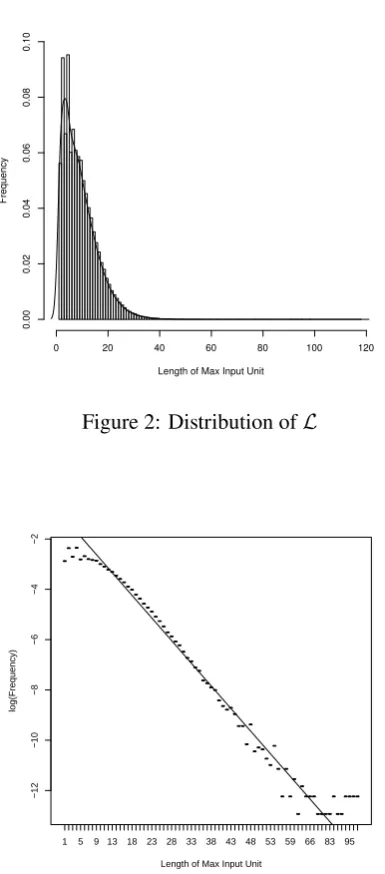
The distribution ofLfor the evaluation corpus is
shown in Figure 2. It can be seen that the length of
Length of Max Input Unit
Fr
eq
uen
cy
0 20 40 60 80 100 120
0.
00
0.0
2
0.
04
0.
06
0.0
8
0.
[image:4.595.322.503.79.252.2]10
Figure 2: Distribution ofL
1 5 9 13 18 23 28 33 38 43 48 53 59 66 83 95
−12
−10
−8
−6
−4
−2
Length of Max Input Unit
log(Frequency)
Figure 3: Linear fit on log-frequency overL
MIUs roughly follows an exponential function dis-tribution in statistics. A linear regression on log-frequency is made and it fits the actual data well. The result is shown in Figure 3.
8http://code.google.com/p/sunpinyin/
● ● ● ● ● ● ● ● ● ● ● ● ● ● ● ● ● ●●
●
●●●●●●●●●●●●●●●●●●●●●●●●●●●●●●●●●●●●● ●● ●● ●●●●● ● ● ● ●● ●●● ●
0 20 40 60 80 100 120
0.2
0.4
0.6
0.8
1.0
Length of Max Input Unit
Density
7 14 26
[image:4.595.81.274.209.647.2]50% 80% 98%
Figure 4: Cumulative distribution ofL
● ●
● ●
● ●
● ●
● ● ●
● ●
● ● ●
● ● ●●
● ● ●
● ● ●
0 5 10 15 20 25
0.3
0.4
0.5
0.6
0.7
Length of Max Input Unit
[image:4.595.321.503.323.492.2]Frequency
Figure 5: Rate of successful MIU generation
Although there are very long MIUs in the cor-pus, it can be observed from the cumulative
distri-bution ofLin Figure 4 that most MIUs are short
ones.
Paying so much attention to the length statis-tics of MIUs is necessary, because the core task of IME, character sequence generation, is heavily af-fected by the sequence length. The rate of success-ful character sequence generation decays linearly
with the increment ofLas shown in Figure 5.
[image:4.595.85.270.414.642.2]3.2 Position Matters: How Character Sequence Generation Fails
From our empirical observation over those cases in which IME fails to generate the completely correct MIU, we found something interesting. The
his-tograms of P andR of MIUs withL = 10 are
shown in Figure 6, note that only unsuccessful re-sults are plotted in the figure.
The interesting point is that a peak appears at
L/2in the histograms, as is shown in dotted lines
in Figure 6. All the cases that we observed with length ranging from 7 to 26 demonstrate this “error peak” property.
We extract MIUs, IME generated best character sequences and rank sequences of those cases. The underlying reason is discovered after a manual in-spection: in those best character sequences, the last error is at the rear of MIU. In such cases user has to select candidate words one by one until the end of the MIU.
For example, while inputting the MIU “大理
航站是个年轻的航站”(Dali airport is a new air-port), the best character sequence generated by
IME is “大力航展是个年轻的航展”(STRONG
air show is a new air show). Its L = 11. The
selected candidates are: “大理”(Dali), “航站
”(air-port), “是个”(is), “年轻”(new), “的”(meaningless
function word), and “航站”; soP = 6. And the
rank sequence is {2,1,1,1,1,1}so R = 7. So
when errors occur at the rear of MIU, we have
P ≈ NW, where NW is the number of words in MIU. For most of the real circumstances, those correctly generated words in the front part of MIU
achieve a very high rankr, often the highest among
candidates, i.e., r = 1 soR ≈ P ≈ NW. In
sunpinyin, candidates except for the best character sequence are words queried from a internal dictio-nary. An important linguistic issue is that average length of Chinese words is about 1.8 characters, nearly two character long (Zhao et al., 2006). At
last we obtainNW ≈ L/2, which explains the
“er-ror peak” at the middle position.
3.3 Improving IMEs with Evaluation Results
We propose a method to make use of the “error
peak” for better IME performance. Among all
those MIUs with the “error peak” problem, we can see an annoying situation is that all words except for the last few ones are successfully generated. In order to correct one or two words, user has to select word by word all the way through the character
se-quence. To avoid unnecessary selection, the IME can cut the front part of the generated character se-quence and make it an independent candidate so that user can accomplish inputting as many words in one selection as possible. We suggest five cut-ting policies as the following:
• Weakest: Cut at the position where the con-ditional probability is smallest.
• Mean, LtoR: Cut at the position where the probability is lower than the mean of condi-tional probabilities of the sequence, scanning from left to right.
• Mean, RtoL: Similar as previous but scan-ning from right to left.
• Halfway: Cut at exactly at the middle posi-tion.
• Fixed: Cut a fixed length sequence. We ex-periment on length from 1 to 10 and found the best length is 3.
The KySS for each policy is shown in Table 1. The baseline is the original algorithm used by
sun-Policy KySS Baseline 27.67% Weakest 29.41% Mean, LtoR 29.21% Mean, RtoL 29.06% Halfway 30.71% Fixed-3 31.30%
Table 1: KySS of each policy
pinyin without any cutting. To our surprise, the
dummy Fixed-3 and Halfway cutting performs
best with a more than 10% boost over the baseline
due to its robustness. TheFixed-3 andHalfway
policy can always stably cut out a reasonable length
of MIU. The problem withMean, RtoL is that it
is likely to cut at the end of MIU thus the head that it cuts out may still include errors. On the
con-trast, theMean, LtoRpolicy tends to cut out too
few words. And theWeakestpolicy is easy to fail
because it often cuts a sequence with a low condi-tional probability but actually being correct.
4 Conclusion and Future Work
Frequency
2 4 6 8 10
0.00
0.05
0.10
0.15
0.20
(a) Histogram ofP
Frequency
0 50 100 150
0.00
0.02
0.04
0.06
0.08
[image:6.595.98.489.83.271.2](b) Histogram ofR
Figure 6: Histogram ofP andR, withL= 10
With the help of the framework we preliminarily propose a sequence cutting strategy to enhance the current IME.
The real world IME and user behavior can be very complicated. In this paper, we make a simpli-fied assumption that all user input is correct. Un-fortunately it may contains typos. And the IME may have prediction feature, i.e. generating char-acter sequence longer than the input pinyin se-quence. We may include those in our future work.
References
Zheng Chen and Kai-Fu Lee. 2000. A New Statisti-cal Approach To Chinese Pinyin Input. In Proceed-ings of the 38th Annual Meeting of the Association for Computational Linguistics, pages 241–247, Hong Kong, October.
Mohamad El-Abed, Patrick Lacharme, and Christophe Rosenberger. 2012. Security evabio: An analysis tool for the security evaluation of biometric authenti-cation systems. InBiometrics (ICB), 2012 5th IAPR International Conference on, pages 460–465. IEEE.
Romain Giot, Mohamad El-Abed, and Christophe Rosenberger. 2009. Greyc keystroke: a benchmark for keystroke dynamics biometric systems. In Bio-metrics: Theory, Applications, and Systems, 2009. BTAS’09. IEEE 3rd International Conference on, pages 1–6. IEEE.
W. Jiang, Y. Guan, XL Wang, and BQ Liu. 2007. Pinyin-to-character conversion model based on sup-port vector machines. Journal of Chinese informa-tion processing, 21(2):100–105.
Y.S. Lee. 2003. Task adaptation in stochastic lan-guage model for chinese homophone disambigua-tion. ACM Transactions on Asian Language Infor-mation Processing, 2(1):49–62.
L. Li, X. Wang, X.L. Wang, and Y.B. Yu. 2009. A con-ditional random fields approach to chinese pinyin-to-character conversion. Journal of Communication and Computer, 6(4):25–31.
Chin-Yew Lin and Eduard Hovy. 2003. Auto-matic evaluation of summaries using n-gram co-occurrence statistics. In Proceedings of the 2003 Conference of the North American Chapter of the Association for Computational Linguistics on Hu-man Language Technology - Volume 1, NAACL ’03, pages 71–78, Stroudsburg, PA, USA. Association for Computational Linguistics.
Chin-Yew Lin. 2004. Rouge: A package for auto-matic evaluation of summaries. In Stan Szpakowicz Marie-Francine Moens, editor,Text Summarization Branches Out: Proceedings of the ACL-04 Work-shop, pages 74–81, Barcelona, Spain, July. Associ-ation for ComputAssoci-ational Linguistics.
B.Q. Liu and X.L. Wang. 2002. An approach to ma-chine learning of ma-chinese pinyin-to-character con-version for small-memory application. InMachine Learning and Cybernetics, 2002. Proceedings. 2002 International Conference on, volume 3, pages 1287– 1291. IEEE.
X. Wang, L. Li, L. Yao, and W. Anwar. 2006. A maximum entropy approach to chinese pin yin-to-character conversion. InSystems, Man and Cyber-netics, 2006. SMC’06. IEEE International Confer-ence on, volume 4, pages 2956–2959. IEEE.
S. Yang, H. Zhao, and B. Lu. 2012a. A machine trans-lation approach for chinese whole-sentence pinyin-to-character conversion. InPacific Asia Conference on Language Information and Computation, pages 367–376, Bali, Indonesia, November.
S. Yang, H. Zhao, X. Wang, and B. Lu. 2012b. Spell checking for chinese. InInternational Conference on Language Resources and Evaluation, pages 730– 736, Istanbul, Turkey, May.
S. Zhang. 2007. Solving the pinyin-to-chinese-character conversion problem based on hybrid word lattice. CHINESE JOURNAL OF COMPUTERS-CHINESE EDITION-, 30(7):1145.
Hai Zhao, Chang-Ning Huang, Mu Li, and Bao-Liang Lu. 2006. Effective tag set selection in chinese word segmentation via conditional random field model-ing. InProceedings of PACLIC, volume 20, pages 87–94.