Detecting and Correcting Learner Korean Particle Omission Errors
Ross Israel Indiana University [email protected]
Markus Dickinson Indiana University [email protected]
Sun-Hee Lee Wellesley College [email protected]
Abstract
We detect errors in Korean post-positional particle usage, focusing on optimizing omission detection, as omissions are the single-biggest factor in particle errors for learners of Korean. We also develop a sys-tem for predicting the correct choice of a particle. For omission detection, we model the task largely on English grammatical er-ror detection, but employ Korean-specific features and filters; likewise, output analy-sis and the omission correction system il-lustrate how unique properties of Korean, such as the distinct types of particles used, need to be accounted for in adapting the system, thereby moving the field one step closer to robust multi-lingual methods.
1 Introduction
Grammatical error detection is useful to produce an improved final document for writing assistance, provide feedback to language learners, provide features for automatic essay scoring, and post-edit machine translation output (see references in Chodorow et al., 2012, sec. 2). Within this grow-ing field, most of the work has focused on En-glish, but there has been a small community of researchers working on other languages. We con-tinue this trend by advancing the state-of-the-art in detecting errors in Korean particle usage.
Expanding to other languages and language families obviously presents new challenges, such as being able to handle word segmentation and greater morphological complexity (e.g., Basque (de Ilarraza et al., 2008), Korean (Lee et al., 2012), Hungarian (Dickinson and Ledbetter, 2012), Japanese (Mizumoto et al., 2011)); greater vari-eties of word order (Czech (Hana et al., 2010),
German (Boyd, 2012)); case ending errors (Czech, German, Hungarian); differing definitions of func-tion words (Korean, Japanese, Basque); and so forth. Investing in methods which apply across languages will make techniques more robust and applicable for even more languages.
An additional challenge for many of these lan-guages is the lack of resources. Much previous work on detecting errors in Korean, for example, focused less on techniques and more on acquiring training data (Dickinson et al., 2011) and evalu-ation data (Lee et al., 2012). We thus desire tech-niques that work using smaller and/or unannotated data sets that may be less reliable than some of the corpora for better-resourced languages.
We focus on detecting errors in the presence or absence of Korean postpositional particles. Korean is a Less Commonly Taught Language (LCTL) needing proficient speakers and more pedagogical research (see Dickinson et al., 2008, sec. 2), making computational tools for Korean language learning important. Particles are used to mark properties akin to prepositions and also to case markers, as discussed in section 2. This makes our task applicable to similar languages like Japanese and more generally to agglutinative lan-guages like Basque, Hungarian, and Turkish, as discussed in section 3 on related work. Particles are our focus because of the high prevalence of particle errors in learner data, accounting for 20– 30% of learner errors (section 2).
One of the most frequent errors relating to par-ticles is not using them when required (section 4); thus, simply detecting whether a particle is nec-essary can pinpoint nearly half the particle errors language learners make. In the interest of extend-ing methods to new languages, we develop an omission error detection system rooted in work on
English preposition error detection (section 5), ac-counting for Korean-specific properties in the fea-tures and filtering of results (section 6). We then see the impact of such error detection on predict-ing the specific omitted particles (section 7).
We make the following contributions in this paper: 1) We present a functional Korean parti-cle omission error detection system, adapted from previous English preposition work but tailored to-wards Korean in its morpheme-based approach and its novel features. 2) We outline system mis-takes, highlighting unique properties of Korean, and point towards how to fix them. 3) We pro-vide an error correction system—incorporating new discourse-based features and optimized sep-arately from the first-stage classifier—which cor-rects a high percentage of omission errors. In so doing, we also discover that accounting for dis-tinctions in types of Korean particles opens the door to further improvements. The overall lesson is that work from English can be adapted, but only if incorporating the nuances of the new language.
2 Korean Particles
Korean postpositional particles are units that ap-pear after a nominal to indicate different linguistic functions, including grammatical functions, e.g., subject and object; semantic roles; and discourse functions. In (1), for instance,가 (ka) marks the subject (function) and agent (semantic role).1
(1) 그래서
‘Thus, I really want to learn Korean’
Similar to English prepositions, particles can also have modifier functions, adding meanings of time, location, instrument, possession, and so forth. For further discussion of Korean particles, see, e.g., chapter 3 of Yeon and Brown (2011).
Learner Errors Particle errors are very frequent for Korean language learners, accounting for 28% of beginner errors in one corpus study (Ko et al., 2004). In (2a), for instance, a learner omitted a subject particle after the word것(kes,‘thing’). The error has beencorrected in (2b).
(2) a. 각
1Examples come from the learner corpus; see section 4.2.
b. 각
‘There are many good things’
3 Related Work
While there is much related work on detecting preposition and article errors in English, e.g., the 2012 Helping Our Own (HOO) shared task (Dale et al., 2012), we will focus here on work on detect-ing errors in functional items in agglutinative lan-guages (Korean, Japanese, Basque), as we most di-rectly build from this. Roughly, agglutinative lan-guages here are ones which “glue” syntactic cate-gories, in the form of affixes, onto a word.
For Korean particle error detection, Dickinson and Lee (2009) train two parser models, one with particles included and one without, to compare mismatches. Their main purpose is to adapt tree-bank annotation to be more particle-aware, and they did not evaluate on real learner data.
We build more directly from Dickinson et al. (2011), who build web corpora of Korean in or-der to train machine learning models for particle prediction. They obtain 81.6% accuracy for parti-cle presence. While the work is similar, compar-ing the current work to their results is problematic for a number of reasons. First, the work in Dickin-son et al. (2011) was very preliminary, focusing on acquiring training data, and did not examine dif-ferent levels of learners. Also, they used a differ-ent learner corpus with differdiffer-ent annotation guide-lines (see comparison in Lee et al., 2012), along with training data that was specifically tailored for the domains in the test corpus. Finally, for particle presence, they focus on overall system accuracy, rather than error detection, making direct compar-ison of results difficult (cf. Chodorow et al., 2012). There has been more work in the comparable language of Japanese, which we review briefly. To begin with, Oyama (2010) uses a basic SVM model trained on well-formed Japanese to detect particle errors, focusing on eight different case particles and finding that the particle frequency distribution in the training corpus affects accuracy, ultimately evaluating on 200 learner particle in-stances of a single particle (wo).
cor-pus of ill-formed and correctly-formed Japanese, based on correction logs from a collaborative lan-guage learning website. Our paradigm is much dif-ferent, basing our method only on a correct model of the target language, given a relative lack of cor-rected data available in Korean and other lesser-resourced languages. We are, however, able to use some correction logs for building confusion sets (section 7.1). Imamura et al. (2012) correct Japanese particle errors using an approach similar to SMT ones, relying on a corpus of generated er-rors to learn a model of alignment to correct forms. We could explore generated errors in the future, but rely only on a model of correct Korean here.
Suzuki and Toutanova (2006) predict case markers in Japanese for an MT system, basing their techniques on semantic role labeling. They predict 18 case particles, a subset of all Japanese particles. They use a two-stage classifier, first identifying whether case is needed and then as-signing the particular case ending, training the second classifier only on instances where a case marker was required. This breakdown and parts of their feature sets are similar to ours, but: a) they use (gold standard) parse features and treat the problem as one of predicting markers forphrases; and b) they correct machine errors, while we cor-rect learner errors, allowing us to investigate meth-ods such as using learner-based filters.
Turning to Basque, de Ilarraza et al. (2008) de-tect errors in five complex postpositions, where the postposition itself has a suffix, by developing 30 constraint grammar rules which use morpholog-ical, syntactic, and semantic information. While the rule-based system can work well, we pursue a strategy which incorporates different types of lin-guistic information through contextual features.
4 Data
4.1 Training Data: Collecting Web Data
In order to control the data for domain speci-ficity, we follow the recommendations laid out in Dickinson et al. (2010) and extended in Dickin-son et al. (2011). Namely, we use data collected from the web using search terms based on topics likely to be discussed in a learner corpus, in order to find semantically-relevant instances. This data is passed through an encoding filter to ensure that at least 90% of any document retrieved is written using Hangul (the Korean writing system). The re-sultant corpus is over 23 million words.
4.2 Testing Data: A Learner Korean Corpus
For testing data, we use a corpus of learner Ko-rean (Lee et al., 2012, 2013) featuring 100 error-annotated essays from learners evenly split into four different categories: beginning (B) vs. inter-mediate (I) learners, and foreign (F) vs. heritage (H) learners, whereheritagerefers to learners who had Korean spoken at home.2 We split the corpus into development and test sets by taking ≈20% of each subcorpus for development, and using the rest as testing. Table 1 gives the numbers of sen-tences, tokens, nouns, particles, total errors, and omission errors in the development and testing sets.
Sen. Tok. Noun Part. Err. Om.
Dev 331 2673 955 849 103 51
Test 1079 8987 3266 2872 430 234
All 1410 11660 4221 3721 533 285
Table 1: Annotated corpus statistics (sentences,
tokens,nouns,particles,errors,omissions)
Particle errors are marked as omissions, inser-tions (comissions), or substituinser-tions, in a multi-layered framework. Spacing and spelling errors are corrected before the target form and correct segmentation are marked, segmentation being nec-essary since nouns and particles are written as a single orthographic unit. For our experiments, we use the correctly-spelled layer, mitigating the ef-fect of spelling errors for testing an error detec-tion system, as done for English (e.g., Tetreault and Chodorow, 2008; Chodorow et al., 2007).
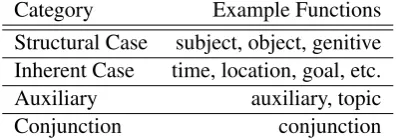
All particles (erroneous or correct) are labeled as to their function (e.g., locative), allowing us to group particles into categories, to see how classi-fier performance differs. Figure 1 provides the four groups we consider (cf. tables 5 and 6). Addition-ally, some nominals require multiple particles in sequence (Seq.), and some of the annotations al-low for particles from more than one category as a correct answer, i.e., a set of correct answers (Set).
4.3 Learner Error Analysis
Lee et al. (2009) annotate another corpus of learner Korean, divided using the same four-way split among learner level and type as the corpus described in section 4.2. We examine this corpus
Category Example Functions
Structural Case subject, object, genitive Inherent Case time, location, goal, etc. Auxiliary auxiliary, topic
Conjunction conjunction
Figure 1: Particle Categories
to get a sense of the types of errors that learners of Korean make in essays. In this corpus, omission errors, i.e., instances where the learner has mistak-enly omitted a particle, make up the biggest propo-tion of the errors (47.6%). The next most common are replacement errors, where the learner has used the wrong particle (44.6%). Comission errors— using a particle where none is necessary—make up the remainder of the errors (7.8%).
5 Approach
Particles have a range of functions, including case marking and preposition-like functions, but, since they are a closed class of functional elements, we can adapt techniques from English for other closed class functional items, namely prepositions and ar-ticles, to detect errors in usage.
We view the task of detecting and correcting errors as two steps (cf. Gamon et al., 2008). The first step is a binary choice that only involves de-termining whether or not a particle is required, a so-calledpresence(yes/no) classifier. The second classifier, the particlechoiceclassifier, attempts to guess the best particle, once it has been established that a particle is needed. We actually treat the first step as a particle omission detection system be-cause the expected rate of errors of comission is so low, and thus we specify that the classifier cannot reject a particle that is already present. Comission errors may require their own system.
We utilize the omission classifier as it nicely performs two functions. First, because it posits stances requiring particles, it also filters out in-stances that do not need a particle to be grammat-ical. Thus, the particle choice classifier does not need to includeNULLas a possible class, cutting down on training size and complexity. Secondly, many errors can be found at this stage, as a lot of errors stem from learners omitting necessary par-ticles (see section 4.3). Nearly half of the learner errors could be detected with an accurate omission particle detection system at this step. Thus, this classifier can provide useful feedback to learners,
especially higher-level ones who may know the correct particle once its omission is highlighted.
6 Particle Omission Error Detection
We describe the particle presence classifier here, treating it as a task of particle omission detection. Any particle a learner uses is passed on, while we posit where a particle should have been used.
6.1 CRF Classifier
Conditional Random Fields (CRFs) have been uti-lized in a variety of NLP tasks in the last few years, and have been used recently for leaner error detec-tion tasks, especially those which can be seen as sequence labeling tasks (e.g., Israel et al., 2012; Tajiri et al., 2012; Imamura et al., 2012). We use the comma error detection work in Israel et al. (2012) as a basis, and employ CRF++3 to set up a binary classifier at this step based on 1.5 million instances from our web corpus. Here we consider all nominals, as annotated in the corpus, as pos-sible candidates for particle insertion. When we derive features based on POS tags (section 6.2), however, we rely on an automatic POS tagger.
6.2 Features
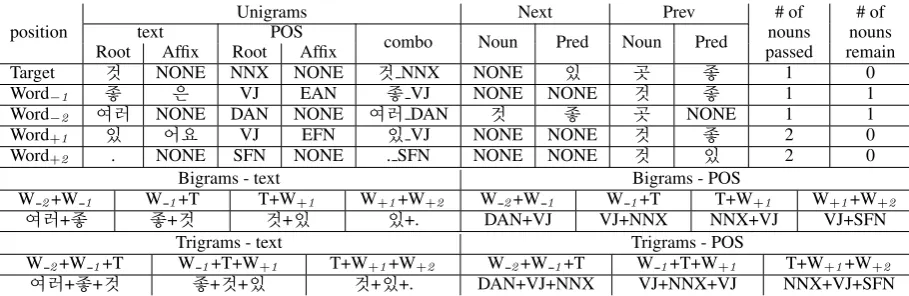
The feature set for particle omission detection is mainly composed of words and POS tags in the surrounding context, where tags are derived from a POS tagger (Han and Palmer, 2004). We use a five-word sliding window, processing each token in the document, although only nominals are pos-sible candidates for particle insertion. The five-word window includes the target five-word and two words on either side for context; the feature set, with examples, is given in table 2.
We break all words into their root and a string of affixes, each with its own POS tag (or tags, for multiple affixes) to better handle the morpho-logical complexity of Korean and avoid sparsity issues. Particles are removed when extracting af-fixes, so as not to include what we are trying to guess. For the text and POS of the root, we use unigram, bigram, and trigram features, as shown in the table; for the affixes, we use only unigrams. We also have a feature (combo) for each root that combines the text and POS into a single string.
In addition to these adjacency-based features, we also encode the previous and following nouns
position
Unigrams Next Prev # of # of
text POS
combo Noun Pred Noun Pred nouns nouns
Root Affix Root Affix passed remain
Target 것 NONE NNX NONE 것 NNX NONE 있 곳 좋 1 0
Word−1 좋 은 VJ EAN 좋 VJ NONE NONE 것 좋 1 1
Word−2 여러 NONE DAN NONE 여러 DAN 것 좋 곳 NONE 1 1
Word+1 있 어요 VJ EFN 있 VJ NONE NONE 것 좋 2 0
Word+2 . NONE SFN NONE . SFN NONE NONE 것 있 2 0
Bigrams - text Bigrams - POS
W2+W1 W1+T T+W+1 W+1+W+2 W2+W1 W1+T T+W+1 W+1+W+2
여러+좋 좋+것 것+있 있+. DAN+VJ VJ+NNX NNX+VJ VJ+SFN
Trigrams - text Trigrams - POS
W2+W1+T W1+T+W+1 T+W+1+W+2 W2+W1+T W1+T+W+1 T+W+1+W+2
여러+좋+것 좋+것+있 것+있+. DAN+VJ+NNX VJ+NNX+VJ NNX+VJ+SFN
Table 2: Features and examples for것in (2b) - ’각 곳에 여러좋은것이 있어요’
and predicates, to approximate syntactic parent features. The predicates can be verbs, adjectives that function like verbs in Korean, and auxiliary verbs. Finally, we use two features to encode the amount of nouns that have already occured in the sentence, as well as how many still remain. The usage of topic particles, for instance, relies in part on knowing where in the sentence a noun occurs, with respect to other nouns.
6.3 Filtering
Because learners are more often correct than erro-neous in their usage of particles, we want to en-sure that the output of classifier does not predict errors in too many instances. To this end, we have built a filter into the classifier. For these errors of omission, we check how confident the classifier is in its answer and only posit omission errors if the classifier’s confidence is above a certain threshold. Tuning on the development corpus (section 6.4), we tried a variety of thresholds, in a hill-climbing approach, and found 85% to be the best.
6.4 Results
For all results in this paper, we follow the rec-ommendations from Chodorow et al. (2012). We evaluate by comparing the writer, annotator, and system’s answer for each instance; true positives (TP), for example, are cases where the annotator (gold standard) and system agree, but the writer (learner) disagrees. In our case, positives are cases where the system posits a particle while the learner did not. We count only instances of nominals with-out particles in the writer’s data, as these are the only ones which could have omission errors. Along with precision (P), recall (R), and an F-score (F0.5), we provide the number of errors (n),
true positives (TP), true negatives (TN), false pos-tives (FP), and false negapos-tives (FN), for the sake of clarity and future comparison. As a baseline, we use the majority class, i.e., guessing a particle for every nominal in the corpus.
Table 3 provides the results for particle omis-sion detection on our development corpus. Here we present the baseline, the results based only on the classifier’s decision (no filter), and the results for the best filter. We use precision-weighted F0.5 rather than the traditional F1 because precision is more important than recall for most error detec-tion applicadetec-tions. As the 85% threshold results in the best F0.5, we use this system on the test data.
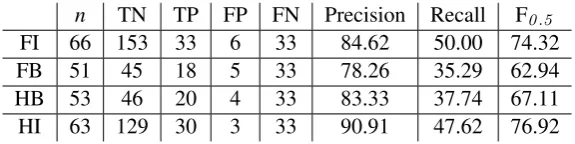
Table 4 provides the results for particle omis-sion detection broken down by subcorpus. The FB (foreign beginner) subcorpus has the worst per-formance, most likely due to their language being most distant from the well-formed Korean of the training corpus, as well as the most distant from the development set. Overall, however, the system has a solid 84.9% precision on all test subcorpora.
6.5 Analysis
In looking over some FPs, i.e., cases where the system predicted a particle not in the gold stan-dard, we discovered that some of these cases in-volved the optionality of particles. For example, in (3), the system posits a particle after 사람들 (salamtul, ‘people’). This is a case of a nominal being used in a genitive fashion, and so a genitive particle could be used here, but it is not required. In some sense, the system rightly points to parti-cle usage beinglicensedin this setting. However, the corpus annotation only marks particles that are
n TN TP FP FN Precision Recall F0.5
Dev baseline 51 0 51 98 0 34.23 100.00 39.41
Test baseline 233 0 233 391 0 37.34 100.00 42.69
Dev no filter 51 64 43 34 8 55.84 84.31 59.89
Dev 85% filter 51 90 27 8 24 77.14 52.94 70.68
Test 85% filter 233 373 101 18 132 84.87 43.35 71.23
Table 3: Particle omission error detection results
n TN TP FP FN Precision Recall F0.5
FI 66 153 33 6 33 84.62 50.00 74.32
FB 51 45 18 5 33 78.26 35.29 62.94
HB 53 46 20 4 33 83.33 37.74 67.11
HI 63 129 30 3 33 90.91 47.62 76.92
Table 4: Particle omission error detection results by learner type (test data)
requirement requires more thorough discussion of when particle dropping is permitted.
(3) 특히
particularly 외국 foreign
사람들 people
눈에는 eye
더욱 more 그렇습니다.
is-so.
‘In particular, it is thus for the eyes of foreign people.’
Other cases do not license particles, but the nominals still have particle-like functions. In (4), for instance, the nominal phrase이때(i ttay, ‘this time’) carries a temporal meaning—much like that conveyed in the temporal particle 에 (ey), but no particle is allowed here, because the function is more like an adverb (cf.todayin English).
(4) 이
this
때
time
너무 too
감정에 feeling-at
치우치지 give-way-to 않도록
don’t
주의하어야 pay-attention-to
해. must.
‘This time, you must pay attention to not giving way to feeling.’
Regarding false negatives, i.e., cases where we do not posit a particle when we should, one major problem we observe involves verb and noun-noun sequences. If a learner views a noun-noun and a following word like a compound, it conceals the fact that the noun requires a particle. For instance, in (5) (learner-omitted particles in curly brackets), the word 성격 (sengkyek, ‘personality’) needs a subject particle, but it forms a compound with좋 (choh, ‘good’), obscuring the noun’s role.
(5) 성격{이}
personality{-SBJ}
좋은
good-REL
아{가}
kid{-SBJ}
태어날 born
때 time
환경이
environment-SBJ
나쁘다면 bad-if
... ...
‘When a child who has good personality is born, if the environment is bad ...’
Another complication is the variability of par-ticle requirements due to minor changes in the amount of information presented, for example, the addition of one prepositional phrase changing whether a particle is necessary or not. Combined with misclassifications resulting from segmenta-tion errors from the POS tagger, it seems like the false negative set can be reduced with better lin-guistic preprocessing fed into the system.
7 Particle Choice for Omission Errors
Once we have established that there is a missing particle, the next step is to select the best particle to be placed in the given context. Thus, we send all instances classified as missing a particle to a second classifier that makes this selection.
7.1 Confusion Set for Particle Omission
ex-pected to appear when the learner has omitted one. Utilizing similar methodology to Mizumoto et al. (2011), we build a confusion set from data col-lected from the language learing and social net-working website, Lang-8.4
To build the set, we searched the user-edited versions of the essays for any word corrected by appending text resembling a particle. Due to the somewhat ambiguous nature of particles with re-spect to other morphemes and root endings, we cannot be certain that all of these edits are in fact particles, but can be confident that a majority are.
After compiling all possible insertion candi-dates, we prune the list by requiring a particle’s frequency to be at least 10% of the most frequent particle. For example, if가 appears 100 times as the most frequently inserted particle, any particle appearing less than 10 times would be removed.
7.2 TiMBL
For this task, we use memory-based learning, namely TiMBL (Daelemans and van den Bosch, 2005). The nearest neighbor algorithm is desirable as training data is sparse, and there are a variety of possible classes to choose from. After filtering the web-corpus to only include instances based on the confusion set extracted from the Lang-8 data, we have 5.7 million instances for training.
7.3 Features
For the particle selection system, we build upon the particle omission detection features (cf. sec-tion 6): we use unigrams, bigrams, and tri-grams of the words and POS tags, a combination word+POS unigram, the previous and following verbs and nouns, and the count of nouns passed and remaining in the sentence. We only use nomi-nals as targets for instances, using a five-word win-dow for context. Some of then-gram features with high numbers of possible values are less helpful, and we remove them, namely the unigram features for the two words farthest from the target, as well as the bigrams that do not include the target.
We then extend this information by adding fea-tures, some of which provide discourse informa-tion. 1) Knowing if there is already a subject, ob-ject, or topic particle in the sentence often means that there should not be another of the same type used; thus, we add binary features encoding if any of these have occured yet. 2) We also add binary
4http://lang-8.com
features relating to the usage of the target word in the previous sentence, encoding if the target was marked as the topic, subject, or object, or if it was in the previous sentence at all. 3) A numeric fea-ture is used that tracks how far along we are in the sentence, based on the idea that certain parti-cles, e.g. subjects, are more likely to occur earlier in the sentence, whereas others, e.g. objects, occur later. 4) Finally, we include the previous particle used by the learner, again because some particles are not likely to be reused in a sentence.
7.4 Results and Analysis
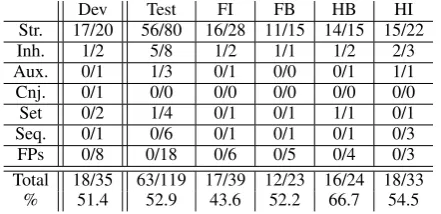
Here we present the results for the selection clas-sifier in terms of the accuracy of the clasclas-sifier on choosing the best particle for an instance already defined as erroneous. By the definition of this task—selecting the correct particle for anerror— there are no FNs or TNs. Thus, recall is rather meaningless, and accuracy and precision reduce to the same metric (T PT P+F P). Additionally, as men-tioned in section 4.2, the particles in the test corpus can be grouped into different categories, and we provide results broken down by category and sub-corpus. Instances that require a sequence of multi-ple particles to be correct (Seq.) are not currently handled, but we leave them in the results for clar-ity and completeness. FPs from the error detection step are also included, although the system clearly cannot select a correct particle for them.
Table 5 shows the performance of the selection classifier on the instances identified as omission errors by the binary classifier (i.e., TPs and FPs identified by thepipeline). Overall, this classifier selects the correct particle 52.9% (63/119) of the time in the test data when presented with instances from the previous classifier.
Dev Test FI FB HB HI
Str. 17/20 56/80 16/28 11/15 14/15 15/22
Inh. 1/2 5/8 1/2 1/1 1/2 2/3
Aux. 0/1 1/3 0/1 0/0 0/1 1/1
Cnj. 0/1 0/0 0/0 0/0 0/0 0/0
Set 0/2 1/4 0/1 0/1 1/1 0/1
Seq. 0/1 0/6 0/1 0/1 0/1 0/3
FPs 0/8 0/18 0/6 0/5 0/4 0/3
Total 18/35 63/119 17/39 12/23 16/24 18/33 % 51.4 52.9 43.6 52.2 66.7 54.5
Table 5: Results for particle selection on instances from binary omission classifier (pipeline)
standard), i.e., including the FN instances from the binary omission classifier mistakenly marked as correct, but not FPs. For all corpora combined, the classifier selects the best particle 58.4% (136/233) of the time in the test data. The overall accuracy gleaned from Tables 5 and 6 is encouraging as we move forward, as it means that the classifier performs reasonably well on cases where it has a chance of selecting the best particle in both the
pipelineandgoldexperimental environments.
Dev Test FI FB HB HI
Str. 23/29 112/164 34/51 17/31 29/36 32/46
Inh. 3/8 11/30 1/7 2/7 3/6 5/10
Aux. 3/6 10/16 1/3 2/4 5/7 2/2
Cnj. 0/1 0/0 0/0 0/0 0/0 0/0
Set 0/3 3/7 1/2 0/1 2/2 0/2
Seq. 0/4 0/16 0/3 0/8 0/2 0/3
Total 29/51 136/233 37/66 21/51 39/53 39/63 % 56.9 58.4 56.1 41.1 73.6 61.9
Table 6: Results for particle selection on all in-stances of particle omission (gold)
7.5 Further Restricting the Task
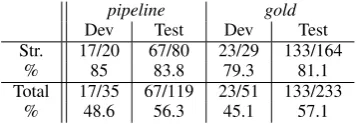
It is clear from the number of errors for each par-ticle category that structural parpar-ticles are the type most often omitted by learners of Korean, account-ing for 68% (193/284) of omission errors in all subcorpora combined. Based on this finding, we ran a set of experiments in which we trained a clas-sifier to only insert structural case particles.
pipeline gold
Dev Test Dev Test
Str. 17/20 67/80 23/29 133/164
% 85 83.8 79.3 81.1
Total 17/35 67/119 23/51 133/233
% 48.6 56.3 45.1 57.1
Table 7: Results for particle selection using a structural case-only classifier
This classifier actually performs better than when restricting selection to the particles from the confusion set for the pipelineexperiment setting (cf. Table 5, 56%>52%), though there is a slight drop in performance as compared to the confu-sion set classifier in thegoldexperiments (cf. Ta-ble 6, 57%<58%). In both cases, however, there are significant gains made when only examining structural particles; this classifier correctly identi-fies the best particle over 80% of the time in both the pipeline and gold test settings. These results show the potential in handling specific linguistic
types of particles in Korean differently.
8 Conclusion and Outlook
We have presented a system for detecting and cor-recting learner Korean particle omission errors. We used a two-stage pipeline utilizing CRFs to make a binary decision as to whether or not a nom-inal without a particle should be followed by a par-ticle, followed by a memory-based learner to se-lect the best particle in the case of an omission. The binary classifier performs with 85% precision and 44% recall in the testing data, for an F0.5 -score of 71%; these results could lead to a use-ful error detection tool for learners and/or teach-ers. The selection classifier is also fairly accu-rate, choosing the best particle close to 60% of the time to correct omission errors. These results com-pare favorably with English preposition and deter-miner error correction work (cf. Dale et al., 2012), though those results involve all error types, not just omissions.
Our experiments for the selection task using specific particle types indicate that constraining the set of particles for a given context helps greatly. We saw improvement in choice accuracy by using only structural case particles to train a classifier for selecting structural case. This encour-aging result can help direct research moving for-ward. One could build a classifier to identify what category of particle is most likely for a given con-text after determining a particle is missing and be-fore sending it to a final selection classifier.
References
Adriane Boyd. 2012.Detecting and Diagnosing Gram-matical Errors for Beginning Learners of German: From Learner Corpus Annotation to Constraint Sat-isfaction Problems. Ph.D. thesis, The Ohio State University.
Martin Chodorow, Markus Dickinson, Ross Israel, and Joel Tetreault. 2012. Problems in evaluating gram-matical error detection systems. In Proceedings of COLING-12.
Martin Chodorow, Joel Tetreault, and Na-Rae Han. 2007. Detection of grammatical errors involv-ing prepositions. In Proceedings of the 4th ACL-SIGSEM Workshop on Prepositions, pages 25–30. Prague.
Walter Daelemans and Antal van den Bosch. 2005. Memory-Based Language Processing. Studies in Natural Language Processing. Cambridge Univer-sity Press, Cambridge, UK.
Robert Dale, Ilya Anisimoff, and George Narroway. 2012. HOO 2012: A report on the preposition and determiner error correction shared task. In Pro-ceedings of the Seventh Workshop on Building Ed-ucational Applications Using NLP, pages 54–62. Montr´eal.
Arantza D´ıaz de Ilarraza, Koldo Gojenola, and Maite Oronoz. 2008. Detecting erroneous uses of complex postpositions in an agglutinative language. In Pro-ceedings of COLING-08. Manchester.
Markus Dickinson, Soojeong Eom, Yunkyoung Kang, Chong Min Lee, and Rebecca Sachs. 2008. A bal-ancing act: How can intelligent computer-generated feedback be provided in learner-to-learner inter-actions. Computer Assisted Language Learning, 21(5):369–382.
Markus Dickinson, Ross Israel, and Sun-Hee Lee. 2010. Building a Korean web corpus for analyzing learner language. InProceedings of the 6th Work-shop on the Web as Corpus (WAC-6). Los Angeles. Markus Dickinson, Ross Israel, and Sun-Hee Lee.
2011. Developing methodology for Korean particle error detection. In Proceedings of the Sixth Work-shop on Innovative Use of NLP for Building Educa-tional Applications, pages 81–86. Portland, OR. Markus Dickinson and Scott Ledbetter. 2012.
Anno-tating errors in a Hungarian learner corpus. In Pro-ceedings of LREC 2012. Istanbul.
Markus Dickinson and Chong Min Lee. 2009. Mod-ifying corpus annotation to support the analysis of learner language. CALICO Journal, 26(3).
Michael Gamon, Jianfeng Gao, Chris Brockett, Alexander Klementiev, William Dolan, Dmitriy Be-lenko, and Lucy Vanderwende. 2008. Using contex-tual speller techniques and language modeling for esl error correction. InProceedings of IJCNLP-08. Hyderabad, India.
Chung-Hye Han and Martha Palmer. 2004. A morpho-logical tagger for korean: Statistical tagging com-bined with corpus-based morphological rule appli-cation. Machine Translation, 18(4):275–297.
Jirka Hana, Alexandr Rosen, Svatava ˇSkodov´a, and Barbora ˇStindlov´a. 2010. Error-tagged learner cor-pus of Czech. In Proceedings of the Fourth Lin-guistic Annotation Workshop, pages 11–19. Upp-sala, Sweden.
Kenji Imamura, Kuniko Saito, Kugatsu Sadamitsu, and Hitoshi Nishikawa. 2012. Grammar error correc-tion using pseudo-error sentences and domain adap-tation. InProceedings of ACL-12 - Volume 2, ACL ’12, pages 388–392. Stroudsburg, PA, USA. Ross Israel, Joel Tetreault, and Martin Chodorow.
2012. Correcting comma errors in learner essays, and restoring commas in newswire text. In Proceed-ings of NAACL-HLT 2012.
Seung-Shik Kang. 2002. Korean Morpheme Analysis and Information Retrieval (in Korean). Hongrung Publishing Company.
S. Ko, M. Kim, J. Kim, S. Seo, H. Chung, and S. Han. 2004. An analysis of Korean learner corpora and errors. Hanguk Publishing Co.
Sun-Hee Lee, Markus Dickinson, and Ross Israel. 2012. Developing learner corpus annotation for Ko-rean particle errors. InProceedings of the Sixth Lin-guistic Annotation Workshop, pages 129–133. Jeju, Republic of Korea.
Sun-Hee Lee, Markus Dickinson, and Ross Israel. 2013. Challenges in annotating korean particle er-rors. In20 years of learner corpus research: looking back, moving ahead (LCR 2011).
Sun-Hee Lee, Seok Bae Jang, and Jae-Young Song. 2009. Particle errors in an annotated Korean learner corpus - a comparative analysis of heritage learners & non-heritage learners-. InProceedings of Annual Conference of American Association of Teachers of Korean. Seattle, USA.
Tomoya Mizumoto, Mamoru Komachi, Masaaki Na-gata, and Yuji Matsumoto. 2011. Mining Revi-sion Log of Language Learning SNS for Auto-mated Japanese Error Correction of Second Lan-guage Learners. In Proceedings of IJCNLP-12, pages 147–155. Chiang Mai, Thailand.
Hiromi Oyama. 2010. Automatic error detection method for japanese particles. Polyglossia, 18. Alla Rozovskaya and Dan Roth. 2010. Generating
con-fusion sets for context-sensitive error correction. In Proceedings of EMNLP-10, pages 961–970. Cam-bridge, MA.
Hisami Suzuki and Kristina Toutanova. 2006. Learning to predict case markers in japanese. InProceedings of COLING-ACL-06, pages 1049–1056. Sydney.
Toshikazu Tajiri, Mamoru Komachi, and Yuji Mat-sumoto. 2012. Tense and aspect error correction for esl learners using global context. InProceedings of ACL-12: Short Papers - Volume 2, ACL ’12, pages 198–202. Stroudsburg, PA, USA.
Joel Tetreault and Martin Chodorow. 2008. The ups and downs of preposition error detection in ESL writing. InProceedings of COLING-08. Manchester. Jaehoon Yeon and Lucien Brown. 2011. Korean: A