Repurposing Theoretical Linguistic Data
for Tool Development and Search
Fei Xia
University of Washington
Seattle, WA 98195
William D. Lewis
∗Microsoft Research
Redmond, WA 98052-6399
Abstract
For the majority of the world’s languages, the number of linguistic resources (e.g., an-notated corpora and parallel data) is very limited. Consequently, supervised methods, as well as many unsupervised methods, can-not be applied directly, leaving these lan-guages largely untouched and unnoticed. In this paper, we describe the construction of a resource that taps the large body of linguisti-cally analyzed language data that has made its way to the Web, and propose using this resource to bootstrap NLP tool development.
1
Introduction
Until fairly recently, most NLP research has focused on the ten or so majority languages of the world, the canonical high density languages. Low density, or resource poor languages (RPLs), have more recently captured the interest of NLP research, mostly be-cause of recent advances in computational technolo-gies and computing power. As indicated by their name, RPLs suffer from a lack of resources, namely data. Supervised learning techniques generally re-quire large amounts of annotated data, something that is nonexistent or scare for most RPLs. A greater number of RPLs, however, have raw data that is available, and the amount and availability of this raw data is increasing every day as more of it makes its way to the Web. Likewise, advances in un- and semi-supervised learning techniques have made raw data more readily viable for tool development. Still, how-ever, such techniques often require “seeds”, or “pro-totypes” (c.f., (Haghighi and Klein, 2006)) which are used to prune search spaces or direct learners.
An important question is how to create such seeds for the hundreds to thousands of RPLs. We describe the construction of a resource that taps the large body of linguistically analyzed language data that has made its way to the Web, and propose using this
∗
The work described in this document was done while Lewis was faculty at the University of Washington.
resource as a means to bootstrap NLP tool devel-opment. Interlinear Glossed Text, or IGT, a semi-structured data type quite common to the field of linguistics, is used to present data and analysis for a language and is generally embedded in scholarly lin-guistic documents as part of a larger analysis. IGT’s unique structure — effectively each instance consists of a bitext between English and some target language — can be easily enriched through alignment and pro-jection (e.g., (Yarowsky and Ngai, 2001), (Hwa et al., 2002)). The reader will note that the IGT instance in Example (1) consists of a bitext between some tar-get language on the first line, or the target line (in this case in Welsh), and a third line in English, the translation line. The canonical IGT form, which this example is representative of, has intervening linguis-tic annotations and glosses on a second line, thegloss line. Because the gloss line aligns with words and morphemes on the target line, and contains glosses that are similar to words on the translation line, it can serve as a bridge between the target and transla-tion lines; high word alignment accuracy between the three lines can be achieved without requiring parallel data or bilingual dictionaries (Xia and Lewis, 2007). Furthermore, the gloss line provides additional in-formation about the target language data, such as a variety of grammatical annotations, including ver-bal and tense markers (e.g., 3sg), case markers, etc., all of which can provide useful knowledge about the language.
(1) Rhoddodd yr athro lyfr i’r bachgen ddoe gave-3sg the teacher book to-the boy yesterday “The teacher gave a book to the boy yesterday” (Bailyn, 2001)
Table 1: The numbers of languages in ODIN
Range of # of # of % of IGT instances languages instances instances 1000-2891 10 15019 36.11 500-999 11 8111 19.50 250-499 18 6274 15.08 100-249 22 3303 7.94 50-99 38 2812 6.76 25-49 60 2089 5.02 10-24 127 1934 4.65 1-9 658 2039 4.91
Japanese), and the overall number per language may appear small, it is still possible to harvest significant value from IGT for targeted RPLs. In this paper, we present the ODIN database and methods used to create it. We also present methods we have employed to enrich IGT in order to make it more readily useful for bootstrapping NLP tools. Because the canon of knowledge embodied in the hundred or so years of linguistic analysis remains virtually untapped by the NLP community, we provide a bridge between the communities by providing linguistic data in a way that NLP researchers will find useful. Likewise, be-cause IGT is a common linguistic data type, we pro-vide a search facility over these data, which has al-ready been found to be quite useful to the theoretical linguistics community.
2
Building ODIN
ODIN currently has 41,581 IGT instances for 944 languages. Table 1 shows the number of languages that fall into buckets defined by the number of IGT instances for each language. For instance, the fourth row (“bucket”) says that 22 languages each have 100 to 249 IGT instances, and the 3,303 instances in this bucket account for 7.94% of all instances. ODIN is built in three steps, as described below.1
2.1 Crawling for IGT documents
Because a large number of instances of IGT exist on the Web,2 we have focused on searching for these
1The work of creating ODIN, in some ways, speaks
to the need of standardizing IGT (perhaps along with other linguistic data types) such that both humans and machines can more readily consume the data. Some re-cent efforts to develop standards for encoding IGT (e.g., (Hughes et al., 2003), (Bickel et al., 2004)) have met with limited success, however, since they have not been widely recognized and even less frequently adopted. Over time it is our hope that these or other standards will see wider use thus eliminating the need for much of the work pro-posed here.
2Although we have no direct data about the total
number of IGT instances that exist on the Web, we
hy-instances. The major difficulty with locating docu-ments that contain IGT, however, is reducing the size of the search space. We decided very early in the de-velopment of ODIN that unconstrained Web crawl-ing was too time and resource intensive a process to be feasible, mostly due to the Web’s massive size. We discovered that highly focused metacrawls were far more fruitful. Metacrawling essentially involves throwing queries against an existing search engine, such as Google, Yahoo or MSN Live, and crawling only the pages returned by those queries. We found that the most successful queries were those that used strings contained within IGT itself, e.g. grammatical annotations, orgrams, such as 3sg, NOM, ACC, etc. In addition, we found precision increased when we included two or more search terms per query, with the most successful queries being those which com-bined grams and language names. Thus, for exam-ple, although NOM alone returned a large number of linguistic documents, NOM combined with ACC (or any other high frequency term), or a language name, returned a far less noisy and far more relevant set of documents.
Other queries we have developed include: queries by language names and language codes (drawn from the Ethnologue database (Gordon, 2005), which con-tains about 40,000 language names and their vari-ants), by linguists’ names and the languages they work on (drawn from the Linguist List’s linguist database), by linguistically relevant terms (drawn from the SIL linguistic glossary), and by particular words or morphemes found in IGT and their gram-matical markup. Table 2 shows the statistics for the most successful crawls and their related search term “types”. Calculated from the top 100 queries for each type, the table presents the most successful query types, the average number of documents returned for each, the average number of documents in which IGT was actually found, and the average number of IGT instances netted by each query. The most relevant measure of success is the number of IGT instances returned (the obvious focus of our crawling); in turn, the most successful query types are those which con-tain a combination of grams and language names.3
pothesize that the total supply is at least several hundred thousand instances. Given that ODIN contains 41,581 instances which have been extracted from approximately 3,000 documents, and given that we have located at least 60,000 more documents that might contain IGT, we feel our estimate to be reasonable.
3Note that target documents are often returned by
Table 2: The Most Successful Query Types
QueryType Avg # Avg # docs Avg #
docs w/ IGT IGTs Gram(s) 1184 239 50 Language name(s) 1314 259 33 Both grams 1536 289 77 and names
Language words 1159 193 0
2.2 IGT detection
After crawling, the next step is to identify IGT in-stances in the retrieved documents. This is a dif-ficult task for which machine learning methods are well suited.
2.2.1 Difficulty in IGT detection
The canonical form of IGT, as presented in Sec-tion 1, consists of three parts and each part is on a single line. However, many IGT instances do not fol-low the canonical format for several reasons. First, when IGT examples appear in a group, very often the translation or glosses are dropped for some examples in the group because the missing parts can be recov-ered from the context, resulting in two-partIGT. In other cases, some IGT examples include multiple tar-get transcriptions (e.g., one part in the native script, and another in a latin transliteration) or even, in rare cases, multiple translations.
Second, dictated by formatting constraints, long IGT examples may need to be wrapped one or more times, and there are no conventions on how wrapping should be done, nor how many times it can be done. For short IGT examples, sometimes linguists put the translation to the right of the target line rather than below it. As a result, each part of IGT examples may appear on multiple lines and multiple parts can appear on a single line.
Third, most IGT-bearing documents on the Web are in PDF, and the PDF-to-text conversion tools will sometimes corrupt IGT instances (most often on the target line). In some instances, some words or morphemes on the target line are inadvertently dropped in the conversion, or are displaced up or down a line. Finally, an IGT instance could fall into multiple categories. For instance, a two-part IGT instance could have a corrupted target line. All of this makes the detection task difficult.
2.2.2 Applying machine learning methods
The first system that we designed for IGT detec-tion used regular expression “templates”, effectively looking for text that resembled IGT. An example is shown in (2), which matches any three-line instance (e.g., the IGT instance in (1)) such that the first line
starts with an example number (e.g., (1)) and the third line starts with a quotation mark.
(2) \s*\(\d+\).*\n \s*.*\n \s*\[‘’"].*\n
Unfortunately, this approach tends to over-select when applied to the documents crawled from the Web. Further, many true IGT instances do not match any of hand-written templates due to the is-sues mentioned in the previous section. As a result, both precision and recall are quite low (see Table 4). Given the irregular structure of IGT instances, a statistical system is likely to outperform a rule-based system. In our second system, we treat the IGT de-tection task as a sequence labeling problem, and ap-ply machine learning methods to the task: first, we train a learner and use it to tag each line in a doc-ument with a tag in a pre-defined tag set; then we convert the best tag sequence into a span sequence. A span is a (start, end) pair, which indicates the be-ginning and ending line numbers of an IGT instance. Among all the tagging schemes we experimented with (including the standard BIO tagging scheme), the following 5-tag scheme works the best on the de-velopment set: The five tags are BL (any blank line), O (outside IGT that is not a BL), B (the first line in an IGT), E (the last line in an IGT), I (inside an IGT that is not a B, E, or BL).
For machine learning, we use four types of features:
F1: The words that appear on the current line.
These are the features typically used in a text classification task.
F2: Sixteen features that look at various cues for the
presence of an IGT. For example, whether the line starts with a quotation, whether the line starts with an example number (e.g., (1)), and whether the line contains a large portion of hy-phenated or non-English tokens.
F3: In order to find good tag sequences, we include
features for the tags of the previous two lines.
F4: The same features as inF2, but they are checked
against the neighboring lines. For instance, if a featuref5in F2 checks whether the current line
contains a citation,f5+1checks whether the next
line contains a citation.
After the lines in a document are tagged by the learner, we identify IGT instances by finding all the spans in the document that match the “B [I|BL]∗ E” pattern; that is, the span starts with a B, ends with an E, and has zero or more I or BL in between.4
4Other heuristics for converting tag sequences to span
Table 3: Data sets for the IGT detection experiments
# files # lines # IGTs Training data 41 39127 1573 Dev data 10 8932 447 Test data 10 14592 843
2.2.3 Experimental results
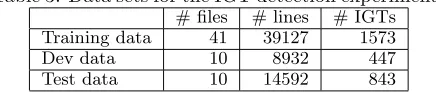
To evaluate the two detectors, we randomly se-lected 61 ODIN documents and manually marked the occurrence of IGT instances. The files were then split into training, development, and test sets, and the size of each set is shown in Table 3. The annota-tion speed was about four thousand lines per hour. Each file in the development and test sets was an-notated independently by two annotators, and the inter-annotator agreement (f-score) on IGT bound-ary was 93.74% when using exact match (i.e., two spans match iff they are identical). When partial match (i.e., two spans match iff they overlap) was used, the f-score increased to 98.66%.
We used four machine learning algorithms imple-mented in Mallet (McCallum, 2002): decision tree, Naive Bayes, maximum entropy (MaxEnt), and con-ditional random field (CRF).5 Table 4 shows the
MaxEnt model’s performance on the development set with different combinations of features: the highest f-score for exact match in each group is marked in boldface.6
In addition to exact and partial match results, we also list the number of spans produced by the system (cf. the span number in the gold stan-dard is 447) and the classification accuracy (i.e., the percent of lines receiving correct labels). The results for CRF are very similar to those for MaxEnt, and both outperform decision tree and Naive Bayes.
Several observations are in order. First, as ex-pected, the machine learning approach outperforms the regular expression approach. Second, although
F2contains only sixteen features, it works much
bet-ter thanF1, which uses all the words occurring in the
training data. Third,F4works much better thanF3
in capturing contextual information, mainly because
F4allows the learner to take into account the
infor-mation that appears on both the preceding lines and the succeeding lines.7 Last, adding
F1 and F3 to
5For the first three methods, we implemented beam
search to find the best tag sequences; and for CRF, we used features in F1, F2, and F4, as the model itself in-corporates the information about previous tags already.
6F
4 is an extension ofF2, so every combination with F4should includeF2as well. Also,F3should not be used
alone. Therefore, Table 4 in fact lists all the possible feature combinations.
7The window forF
4 is set empirically to [-2,3]; that
is,F4 uses the information from the preceding two lines
theF2+F4 system offers a modest but statistically
significant gain.
Table 5 shows the results on the test data. The performance of MaxEnt on this data set is slightly worse than on the development set mainly because the test set contains much more corrupted data (due to pdf-to-text conversion) than both the training and development sets.8
Nevertheless, the machine learn-ing approach outperforms the regex approach signifi-cantly, reducing the error rate by 52.3%. In addition, the partial match results are much better than ex-act match results, indicating that many span errors could be potentially fixed by postprocessing.
2.3 Manual review and language ID
About 45% of IGT instances in the current ODIN database were manually checked to verify IGT boundaries and to identify the language names of the target lines. Subsequently, we trained several language ID algorithms with the labeled data, and used them to label the remaining 55% of the IGT instances in ODIN automatically.
The language ID task in this context is different from a typical language ID task in several ways. First, the number of languages in IGT is close to a thousand or even more. In contrast, the amount of training data for many of the languages is very limited; for instance, hundreds of languages have less than 10 sentences, as shown in Table 1. Second, some languages in the test data might never occur in the training data, a problem that we shall call the un-known language problem. Third, the target sentences in IGT are very short (e.g., a few words), making the task more challenging. Fourth, for languages that do not use a latin-based writing system, the target sen-tences are often transliterated, making the character encoding scheme less informative. Last, the context, such as the language names occurring in the docu-ment, provides important cues for the language ID of IGT instances.
Given these properties, applying common lan-guage ID algorithms directly will not produce sat-isfactory results. For instance, Cavnar and Tren-kle’s N-gram-based algorithm yields an accuracy of as high as 99.8% when tested on newsgroup arti-cles in eight languages (Cavnar and Trenkle, 1994).9
and the succeeding three lines.
8The corruption not only affects the target lines, but
also the layout of IGT (e.g., the indentation of the three lines). As a result, features inF2 andF4are not as
effec-tive as for the development set. Since the regex template approach uses fewer layout features, its performance is not affected as much.
9The accuracy ranges from 92.9% to 99.8% depending
Table 4: Performance on the development set (the span number in the gold standard is 447)
Features System Classification Exact match Partial match span num accuracy prec recall fscore prec recall fscore
Regex templates 269 N/A 68.40 41.16 51.40 99.26 59.73 74.58 F1 130 81.50 68.46 19.91 30.85 97.69 28.41 44.02 F2 405 93.28 58.27 52.80 55.40 95.56 86.58 90.85 F1+F3 180 80.26 61.67 24.83 35.40 81.11 32.66 46.57 F1+F2 420 94.42 63.09 59.28 61.13 93.81 88.14 90.88 F2+F3 339 92.68 75.81 57.49 65.39 93.21 70.69 80.40 F2+F4 456 96.91 80.92 82.55 81.73 93.64 95.53 94.57 F1+F2+F3 370 93.39 75.14 62.20 68.05 93.51 77.40 84.70 F1+F2+F4 444 97.00 84.68 84.11 84.40 95.95 95.30 95.62 F2+F3+F4 431 97.79 86.77 83.67 85.19 97.68 94.18 95.90 F1+F2+F3+F4 431 98.00 90.02 86.80 88.38 97.22 93.74 95.44
Table 5: Performance on the test set (the span number in the gold standard is 843)
Features System Classification Exact match Partial match span num accuracy prec recall fscore prec recall fscore
Regex templates 587 N/A 74.95 52.19 61.54 98.64 68.68 80.98 F2 719 92.45 57.02 48.64 52.50 94.02 80.19 86.56 F2+F4 849 95.66 75.50 76.04 75.77 93.76 94.42 94.09 F2+F3+F4 831 95.95 77.14 76.04 76.58 95.19 93.83 94.50 F1+F2+F3+F4 830 96.83 82.29 81.02 81.65 96.51 95.02 95.76
However, when we ran the same algorithm on the IGT data, the accuracy was only 50.2%.10 In
con-trast, a heuristic approach that predicts the language ID according to the language names occurring in the document yields an accuracy of 65.6%.
Because the language name associated with an IGT instance almost always appears somewhere in the document, we propose to treat the language ID task as a reference resolution problem, where IGT instances are the mentions and the language names appearing in the document are theentities. A lan-guage identifier simply needs to link the mentions to the entities, allowing us to apply any good res-olution algorithms such as (Soon et al., 2001; Ng, 2005; Luo, 2007) and to provide an elegant solution to the unknown language problem. More detail on this approach will be reported elsewhere.
3
Using ODIN
We see ODIN being used in a number of different ways. In another study (Lewis and Xia, 2008), we demonstrated a method for using ODIN to discover interesting and computationally relevant typological features for hundreds of the world’s languages auto-matically. In this section we present two more uses
length.
10The setting for our preliminary experiments is as
fol-lows: there are 10,415 IGT instances over 549 languages in the training data, and 3064 instances in the test data. The language names of about 12.2% of IGT instances in the test data never appear in the training data.
for ODIN’s data: bootstrapping NLP tools (specif-ically taggers), and providing search over ODIN’s data (as a kind of large-scale multi-lingual search).
3.1 IGT for bootstrapping NLP tools
Since the target line in IGT data does not come with annotations (e.g., POS tags), it is first necessary to enrich it. Once enriched, the data can be used as a bootstrap for tools such as taggers.
3.1.1 Enriching IGT
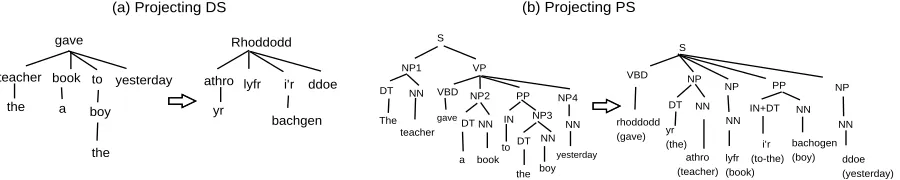
In a previous study (Xia and Lewis, 2007), we pro-posed a three-step process to enrich IGT data: (1) parse the English translation with an English parser and convert English phrase structures (PS) into de-pendency structures (DS) with a head percolation table (Magerman, 1995), (2) align the target line and the English translation using the gloss line, and (3) project the syntactic structures (both PS and DS) from English onto the target line. For instance, given the IGT example in Ex (1), the enrichment algorithm will produce the word alignment in Figure 1 and the syntactic structures in Figure 2.
T h e t e a c h e r g a v e a b o o k t o t h e b o y y e s t e r d a y R h o d d o d d y r a t h r o l y f r i ’ r b a c h g e n d d o e
G l o s s l i n e :
T r a n s l a t i o n : T a r g e t l i n e :
g a v e - 3 s g t h e t e a c h e r b o o k t o - t h e b o y y e s t e r d a y
gave
Figure 2: Projecting syntactic structure from English to the target language
We evaluated the algorithm on a small set of 538 IGT instances for several languages. On average, the accuracy of the English DS (i.e., the percentage of correct dependency links in the DS) is 93.48%; the f-score of the word alignment links between the translation and target lines is 94.03%, and the ac-curacy of the target DS produced by the projection algorithm is 81.45%. When we replace the automati-cally generated English DS and word alignment with the ones in the gold standard, the accuracy of target DS increases significantly, from 81.45% to 90.64%. The details on the algorithms and the experiments can be found in (Xia and Lewis, 2007).
3.1.2 Bootstrapping NLP tools
The enriched data produced by the projection al-gorithms contains (1) the English DS and PS pro-duced by an English parser, (2) the word alignment among the three parts of IGT data, and (3) the tar-get DS and PS produced by the projection algorithm. From the enriched data, various kinds of information can be extracted. For instance, the target syntactic structures form small monolingual treebanks, from which grammars in various formalisms can be ex-tracted (e.g., (Charniak, 1996)). The English and target syntactic structures form parallel treebanks, from which transfer rules and translation lexicon can be extracted and used for machine translation (e.g., (Meyers et al., 2000; Menezes, 2002; Xia and Mc-Cord, 2004)).
There are many ways of using the enriched data to bootstrap NLP tools. Suppose we want to build a POS tagger. Previous studies on unsupervised POS tagging can be divided into several categories accord-ing to the kind of information available to the learner. The first category (e.g., (Kupiec, 1992; Merialdo, 1994; Banko and Moore, 2004; Wang and Schuur-mans, 2005)) assumes there is a lexicon that lists the allowable tags for each word in the text. The common approach is to use the lexicon to initialize the emission probability in a Hidden Markov Model (HMM), and run the Baum-Welch algorithm (Baum et al., 1970) on a large amount of unlabeled data
to re-estimate transition and emission probability. The second category uses unlabeled data only (e.g., (Sch¨utze, 1995; Clark, 2003; Biemann, 2006; Das-gupta and Ng, 2007)). The idea is to cluster words based on morphological and/or distributional cues. Haghighi and Klein (2006) showed that adding a small set of prototypes to the unlabeled data can improve tagging accuracy significantly.
The tagged target lines in the enriched IGT data can be incorporated in each category of work men-tioned above. For instance, the frequency collected from the data can be used to bias initial transi-tion and emission probabilities in an HMM model; the tagged words in IGT can be used to label the resulting clusters produced by the word clustering approach; the frequent and unambiguous words in the target lines can serve as prototype examples in the prototype-driven approach (Haghighi and Klein, 2006). Finally, we can apply semi-supervised learn-ing algorithms (e.g., self-trainlearn-ing (Yarowsky, 1995), co-training (Blum and Mitchell, 1998), and transduc-tive support vector machines (Vapnik, 1998)), using the tagged sentences as seeds.
3.2 Search
used by linguists (the GOLD ontology, (Farrar and Langendoen, 2003)).11
The final query type, the Construction Search is the most powerful and most innovative of the query facilities currently provided by ODIN. Rather than limiting search to just the content and markup na-tively contained within IGT, Construction Search searches overenrichedcontent. For instance, a search for relative clauses can look for either the POS tag sequences that contain a noun followed by an ap-propriate relativizer, or the parse trees that contain an NP node with an NP child and a clause child. Currently, 15 construction queries have been imple-mented, with some 40 additional queries being eval-uated and built. Note that currently construction queries are performed on the English translation, not on the target language data. As syntactic projection becomes more reliable, we will allow construction queries on the target language data and even queries on both the English and the target (e.g., for com-parative linguistic analyses). For example, a query could be something likeFind examples where the tar-get line uses imperfective aspect and is in active voice and the English translation uses passive voice.
4
Conclusion and Future Directions
In this paper, we introduce Interlinear Glossed Text (IGT), a data type that has been rarely tapped by the NLP community, and describe the process of cre-ating ODIN, a database of IGT data. We show that using machine learning methods can significantly im-prove the performance of IGT detection. We then demonstrate how IGT instances can be enriched and discuss several ways of using enriched data to boot-strap NLP tools such as POS taggers. Finally, we review the four types of linguistic search that are cur-rently implemented in ODIN. All of the above show the value of ODIN as a resource for both NLP re-searchers and linguists. In the future, we plan to im-prove the IGT detection and language ID algorithms and will apply them to all the crawled documents. We expect the size of ODIN to grow dramatically. We also plan to use the enriched data to bootstrap taggers and parsers, starting with the ideas outlined in Section 3.1.2.
Acknowledgements
This work has been sup-ported, in part, by the Royalty Research Fund at the University of Washington. We would also like to thank Dan Jinguji for providing the preliminary11Most gram-to-concept mapping has been done by
hand. We are currently exploring methods to use ma-chine learning to enhance our ability to identify and map additional unknown grams (to be discussed elsewhere).
results on language ID expriments, and three anony-mous reviewers for their valuable comments.
References
John Frederick Bailyn. 2001. Inversion, dislocation and optionality in Russian. In Gerhild Zybatow, editor, Current Issues in Formal Slavic Linguis-tics.
Michele Banko and Robert C. Moore. 2004. Part of Speech Tagging in Context. In Proc. of the 20th International Conference on Computational Linguistics (Coling 2004), pages 556–561, Geneva, Switzerland.
L. E. Baum, T. Petrie, G. Soules, and N. Weiss. 1970. A maximization technique occurring in the statistical analysis of probabilistic functions of Markov chains. Ann. Math. Statistics, 41(1):164– 171.
Balthasar Bickel, Bernard Comrie, and Martin Haspelmath. 2004. The Leipzig Glossing Rules: Conventions for interlinear morpheme-by-morpheme glosses (revised version). Technical re-port, Max Planck Institute for Evolutionary An-thropology and the Department of Linguistics of the University of Leipzig.
Chris Biemann. 2006. Unsupervised part-of-speech tagging employing efficient graph clustering. In Proceedings of the COLING/ACL 2006 Student Research Workshop, pages 7–12, Sydney, Aus-tralia, July.
Avrim Blum and Tom Mitchell. 1998. Combining Labeled and Unlabeled Data with Co-training. In Proc. of the Workshop on Computational Learning Theory (COLT-1998).
William B. Cavnar and John M. Trenkle. 1994. N-gram-based text categorization. InProceedings of SDAIR-94, 3rd Annual Symposium on Document Analysis and Information Retrieval, pages 161– 175, Las Vegas, US.
Eugene Charniak. 1996. Treebank Grammars. In Proc. of the 13th National Conference on Artificial Intelligence (AAAI-1996).
Alexander Clark. 2003. Combining distributional and morphological information for part of speech induction. InProc. of the 10th Conference of the European Chapter of the Association for Compu-tational Linguistics (EACL-2003).
Processing and Computational Natural Language Learning (EMNLP-CoNLL), pages 218–227.
Scott Farrar and D. Terence Langendoen. 2003. A linguistic ontology for the Semantic Web. GLOT International, 7(3):97–100.
Raymond G. Gordon, editor. 2005. Ethnologue: Languages of the World. SIL International, Dallas, TX, fifteenth edition.
Aria Haghighi and Dan Klein. 2006. Prototype-driven learning for sequence models. In Proceed-ings of the Human Language Technology Confer-ence of the NAACL (HLT/NAACL 2006), pages 320–327, New York City, USA.
Baden Hughes, Steven Bird, and Cathy Bow. 2003. Interlinear text facilities. InE-MELD 2003, Michi-gan State University.
Rebecca Hwa, Philip Resnik, Amy Weinberg, and Okan Kolak. 2002. Evaluating translational cor-respondence using annotation projection. In Pro-ceedings of the 40th Annual Meeting of the ACL, Philadelphia, Pennsylvania.
J. Kupiec. 1992. Robust part-of-speech tagging us-ing a hidden Markov model. Computer Speech and Language, 6.
William Lewis and Fei Xia. 2008. Automatically Identifying Computationally Relevant Typologi-cal Features. In Proc. of the Third International Joint Conference on Natural Language Processing (IJCNLP-2008), Hyderabad, India.
William Lewis. 2006. ODIN: A Model for Adapt-ing and EnrichAdapt-ing Legacy Infrastructure. InProc. of the e-Humanities Workshop, held in cooperation with e-Science 2006: 2nd IEEE International Con-ference on e-Science and Grid Computing, Ams-terdam.
Xiaoqiang Luo. 2007. Coreference or not: A twin model for coreference resolution. In Proc. of the Conference on Human Language Technologies (HLT/NAACL 2007), pages 73–80, Rochester, New York.
David M. Magerman. 1995. Statistical Decision-Tree Models for Parsing. In Proc. of the 33rd Annual Meeting of the Association for Computa-tional Linguistics (ACL-1995), Cambridge, Mas-sachusetts, USA.
Andrew Kachites McCallum. 2002. Mal-let: A machine learning for language toolkit. http://mallet.cs.umass.edu.
Arul Menezes. 2002. Better contextual translation using machine learning. In Proc. of the 5th con-ference of the Association for Machine Translation in the Americas (AMTA 2002).
Bernard Merialdo. 1994. Tagging English text with a probabilistic model. Computational Linguistics, 20(2).
Adam Meyers, Michiko Kosaka, and Ralph Grish-man. 2000. Chart-based transfer rule application in machine translation. InProc. of the 18th Inter-national Conference on Computational Linguistics (COLING 2000).
Vincent Ng. 2005. Machine learning for coreference resolution: From local classification to global rank-ing. In Proc. of the 43rd Annual Meeting of the Association for Computational Linguistics (ACL 2005), pages 157–164, Ann Arbor, Michigan.
Hinrich Sch¨utze. 1995. Distributional part-of-speech tagging. InProc. of the EACL, pages 141–148.
Wee Meng Soon, Hwee Tou Ng, and Daniel Chung Yong Lim. 2001. A machine learning ap-proach to coreference resolution of noun phrases. Computational Linguistics, 27(4).
V. Vapnik. 1998. Statistical learning theory. Wiley-Interscience.
Qin Iris Wang and Dale Schuurmans. 2005. Improved Estimation for Unsupervised Part-of-Speech Tagging. In Proc. of IEEE International Conference on Natural Language Processing and Knowledge Engineering (IEEE NLP-KE 2005).
Fei Xia and William Lewis. 2007. Multilingual struc-tural projection across interlinear text. InProc. of the Conference on Human Language Technologies (HLT/NAACL 2007), pages 452–459, Rochester, New York.
Fei Xia and Michael McCord. 2004. Improv-ing a Statistical MT System with Automatically Learned Rewrite Patterns. In Proc. of the 20th International Conference on Computational Lin-guistics (COLING 2004), Geneva, Switzerland.
David Yarowsky and Grace Ngai. 2001. Induc-ing MultilInduc-ingual POS Taggers and NP Bracketers via Robust Projection across Aligned Corpora. In Proc. of the 2001 Meeting of the North American chapter of the Association for Computational Lin-guistics (NAACL-2001), pages 200–207.