Acquiring Event Relation Knowledge by Learning Cooccurrence Patterns
and Fertilizing Cooccurrence Samples with Verbal Nouns
Shuya Abe Kentaro Inui Yuji Matsumoto
Graduate School of Information Science, Nara Institute of Science and Technology
{shuya-a,inui,matsu}@is.naist.jp
Abstract
Aiming at acquiring semantic relations be-tween events from a large corpus, this paper proposes several extensions to a state-of-the-art method originally designed for entity lation extraction, reporting on the present re-sults of our experiments on a Japanese Web corpus. The results show that (a) there are indeed specific cooccurrence patterns use-ful for event relation acquisition, (b) the use of cooccurrence samples involving ver-bal nouns has positive impacts on both re-call and precision, and (c) over five thou-sand relation instances are acquired from a 500M-sentence Web corpus with a precision
of about 66% foraction-effectrelations.
1 Introduction
The growing interest in practical NLP applications such as question answering, information extraction and multi-document summarization places increas-ing demands on the processincreas-ing of relations between textual fragments such as entailment and causal rela-tions. Such applications often need to rely on a large amount of lexical semantic knowledge. For exam-ple, a causal (and entailment) relation holds between
the verb phrases wash somethingandsomething is
clean, which reflects the commonsense notion that if someone has washed something, this object is clean as a result of the washing event. A crucial issue is how to obtain and maintain a potentially huge col-lection of such event relations instances.
Motivated by this background, several research groups have reported their experiments on automatic
acquisition of causal, temporal and entailment re-lations between event mentions (typically verbs or verb phrases) (Lin and Pantel, 2001; Inui et al., 2003; Chklovski and Pantel, 2005; Torisawa, 2006; Pekar, 2006; Zanzotto et al., 2006, etc.). The com-mon idea behind them is to use a small number of manually selected generic lexico-syntactic
cooccur-rence patterns (LSPs or simply patterns). to Verb-X
and then Verb-Y, for example, is used to obtain
tem-poral relations such asmarryanddivorce(Chklovski
and Pantel, 2005). The use of such generic patterns, however, tends to be high recall but low precision, which requires an additional component for pruning extracted relations. This issue has been addressed in basically two approaches, either by devising heuris-tic statisheuris-tical scores (Chklovski and Pantel, 2005; Torisawa, 2006; Zanzotto et al., 2006) or training classifiers for disambiguation with heavy supervi-sion (Inui et al., 2003).
This paper explores a third way for enhancing present LSP-based methods for event relation acqui-sition. The basic idea is inspired by the following recent findings in relation extraction (Ravichandran and Hovy, 2002; Pantel and Pennacchiotti, 2006, etc.), which aims at extracting semantic relations
be-tweenentities(as opposed toevents) from texts. (a)
pre-cision and recall. Such specific patterns can be ac-quired from a very large corpus with seeds.
Given these insights, an intriguing question is whether the same story applies to event relation ac-quisition as well or not. In this paper, we explore this issue through the following steps. First, while previ-ous methods use only verb-verb cooccurrences, we use cooccurrences between verbal nouns and verbs
such as cannot hfind out (something)i due to the
lack of hinvestigationi as well as verb-verb cooc-currences. This extension dramatically enlarge the pool of potential candidate LSPs (Section 4.1). Sec-ond, we extend Pantel and Pennacchiotti (2006)’s Espresso algorithm, which induces specific reliable LSPs in a bootstrapping manner for entity relation extraction, so that the extended algorithm can apply to event relations (Sections 4.2 to 4.4). Third, we report on the present results of our empirical experi-ments, where the extended algorithm is applied to a Japanese 500M-sentence Web corpus to acquire two
types of event relations, action-effect and
action-meansrelations (Section 5)
2 Related work
Perhaps a simplest way of using LSPs for event rela-tion acquisirela-tion can be seen in the method Chklovski and Pantel (2005) employ to develop VerbOcean. Their method uses a small number of manually
se-lected generic LSPs such asto X and then
Verb-Yto obtain six types of semantic relations including
strength (e.g. taint – poison) and happens-before
(e.g.marry – divorce) and obtain about 29,000 verb
pairs with 65.5% precision.
One way for pruning extracted relations is to in-corporate a classifier trained with supervision. Inui et al. (2003), for example, use a Japanese generic
causal connective markertame (because) and a
su-pervised classifier learner to separately obtain four
types of causal relations:cause,precondition,effect
andmeans.
Torisawa (2006), on the other hand, acquires en-tailment relations by combining the verb pairs ex-tracted with a highly generic connective pattern
Verb-X and Verb-Y together with the cooccurrence statistics between verbs and their arguments. While the results Torisawa reports look promising, it is not clear yet if the method applies to other types of
rela-tions because it relies on relation-specific heuristics. Another direction from (Chklovski and Pantel, 2005) is in the use of LSPs involving nominalized verbs. Zanzotto et al. (2006) obtain, for example, an
entailment relationX wins → X plays from such a
pattern asplayer wins. However, their way of using
nominalized verbs is highly limited compared with our way of using verbal nouns.
3 Espresso
This section overviews Pantel and Pennacchiotti (2006)’s Espresso algorithm. Espresso takes as input a small number of seed instances of a given target relation and iteratively learns cooccurrence patterns and relation instances in a bootstrapping manner.
Ranking cooccurrence patterns For each given
relation instance{x, y}, Espresso retrieves the
sen-tences including both x and y from a corpus and
extracts from them cooccurrence samples. For
ex-ample, given an instance of the is-a relation such
ashItaly,countryi, Espresso may find cooccurrence
samples such ascountries such as Italyand extract
such a pattern asY such as X. Espresso defines the
reliabilityrπ(p)of patternpas the average strength
of its association with each relation instance i in
the current instance setI, where each instance iis
weighted by its reliabilityrι(i):
rπ(p) = |1I|
X
i∈I
pmi(i, p)
maxpmi ×rι(i) (1)
wherepmi(i, p)is the pointwise mutual information
betweeniandp, andmaxpmiis the maximum PMI
between all patterns and all instances.
Ranking relation instances Intuitively, a reliable relation instance is one that is highly associated with multiple reliable patterns. Hence, analogously to the above pattern reliability measure, Espresso defines the reliabilityrι(i)of instanceias:
rι(i) = 1
|P|
X
p∈P
pmi(i, p)
maxpmi
×rπ(p) (2)
where rπ(p) is the reliability of pattern p, defined
above in (1), and maxpmi is as before. rι(i) and
rπ(p) are recursively defined, where rι(i) = 1for
each manually supplied seed instancei1.
1For our extension,r
ι(i) =−1for each manually supplied
4 Event relation acquisition
Our primary concerns are whether there are in-deed specific cooccurrence patterns useful for ac-quiring event relations and whether such patterns can be found in a bootstrapping manner analogous to Espresso. To address these issues, we make several extensions to Espresso, which is originally designed for entity relations (not scoping event relations).
4.1 Cooccurences with verbal nouns
Most previous methods for event relation acquisition rely on verb-verb cooccurrences because verbs (or verb phrases) are the most typical device for refer-ring to events. However, languages have another large class of words for event reference, namely verbal nouns or nominalized forms of verbs. In
Japanese, for example, verbal nouns such askenkyu
(research) constitute the largest morphological cate-gory used for event reference.
Japanese verbal nouns have dual statuses, as verbs
and nouns. When occurring with the verbsuru
(do-PRES), verbal nouns function as a verb as in (1a).
On the other hand, when accompanied by case
mark-ers such asga(NOMINATIVE) ando(ACCUSATIVE),
they function as a noun as in (1b). Finally, but even more importantly, when accompanied by a large va-riety of suffixes, verbal nouns constitute compound nouns highly productively as in (1c).
(1) a. Ken-ga gengo-o kenkyu-suru
Ken-NOM language-ACC research-PRES Ken researches on language.
b. Ken-ga gengo-no kenkyu-o yame-ta Ken-NOM language-on research-ACC quit-PAST Ken quitted research on language.
c. -sha(person):
e.g.kenkyu-sha(researcher)
-shitsu(place):
e.g.kenkyu-shitsu(laboratory)
-go(after):
e.g.kenkyu-go(after research)
These characteristics of verbal nouns can be made use of to substantially increase both cooccurrence instances and candidate cooccurrence patterns (see Section 5.1 for statistics). For example, the verbal nounkenkyu(research) often cooccurs with the verb
jikken (experiment) in the pattern of (2a). From
those cooccurrences, one may learn thatjikken-suru
(to experiment) is an action that is often taken as a
part ofkenkyu-suru(to research). In such a case, we
may consider a pattern as shown in (2b) useful for
acquiringpart-of relations between actions.
(2) a. kenkyu-shitsu-de jikken-suru
research-place-in experiment-VERB conduct experiments in the laboratory
b. (Act-X)-shitsu-de (Act-Y)-suru (Act-X)-place-in (Act-X)-VERB (Act-Y) is often done in doing (Act-X)
When functioning as a noun, verbal nouns are po-tentially ambiguous between the event reading and the entity/object reading. For example, the
ver-bal noun denwa (phone) in the context denwa-de
(phone-by) may refer to either a phone-call event or a physical phone. While, ideally, such event-hood ambiguities should be resolved before collect-ing cooccurrence samples with verbal nouns, we simply use all the occurrences of verbal nouns in collecting cooccurrences in our experiments. It is an interesting issue for future work whether event-hood determination would have a strong impact on the performance of event relation extraction.
4.2 Selection of arguments
One major step from the extraction of entity rela-tions to the extraction of event relarela-tions is how to
address the issue of generalization. In entity
rela-tion extracrela-tion, relarela-tions are typically assumed to hold between chunks like named entities or simply between one-word terms, where the issue of deter-mining the appropriate level of the generality of ex-tracted relations has not been salient. In event rela-tion extracrela-tion, on the other hand, this issue imme-diately arises. For example, the cooccurrence
sam-ple in (3) suggests theaction-effectrelation between
niku-o yaku(grill the meat) and(niku-ni) kogeme-ga tsuku((the meat) gets brown)2.
(3) ( kogeme-ga tsuku ) -kurai niku-o yaku a burn-NOM get -so that meat-ACC grill
grill the meat so that it gets brown (grill the meat to a deep brown)
In this relation, the argument niku (meat) of the
verb yaku (grill) can be dropped and generalized
2The parenthesis in the first row of (3) indicates a
tosomething to grill; namely theaction-effect
rela-tion still holds betweenX-o yaku(grill X) andX-ni
kogeme-ga tsuku(X gets brown). On the other hand,
however, the argumentkogeme(a burn) of the verb
tsuku(get) cannot be dropped; otherwise, the rela-tion would no longer hold.
One straightforward way to address this problem is to expand each cooccurrence sample to those cor-responding to different degrees of generalization and feed them to the relation extraction model so that its scoring function can select appropriate event pairs from expanded samples. For example, cooccurrence sample (3) is expanded to those as in (4):
(4) a. ( kogeme-ga tsuku ) -kurai niku-o yaku
a burn-NOM get -so that meat-ACC grill
b. ( tsuku ) -kurai niku-o yaku get -so that meat-ACC grill
c. ( kogeme-ga tsuku ) -kurai yaku a burn-NOM get -so that grill
d. ( tsuku ) -kurai yaku get -so that grill
In practice, in our experiments (Section 5), we re-strict the number of arguments for each event up to one to avoid the explosion of the types of infrequent candidate relation instances.
4.3 Volitionality of events
Inui et al. (2003) discuss how causal rela-tions between events should be typologized for the purpose of semantic inference and classify causal relations basically into four types — Ef-fect, Means, Precondition and Cause relations — based primarily on the volitionality of in-volved events. For example, Effect relations hold between volitional actions and their resultative non-volitional states/happenings/experiences, while Cause relations hold between only non-volitional states/happenings/experiences.
Following this typology, we are concerned with the volitionality of each event mention. For our experiments, we manually built a lexicon of over 12,000 verbs (including verbal nouns) with volition-ality labels, obtaining 8,968 volitional verbs, 3,597 non-volitional and 547 ambiguous. Volitional verbs
include taberu (eat) and kenkyu-suru (research),
while non-volitional verbs include atatamaru (get
warm), kowareru (to break-vi) and kanashimu (be
sad). We discarded the ambiguous verbs in the ex-periments.
4.4 Dependency-based cooccurrence patterns
The original Espresso encodes patterns simply as a word sequence because entity mentions in the rela-tions it scopes tend to cooccur locally in a single phrase or clause. In event relation extraction, how-ever, cooccurrence patterns of event mentions in the relations we consider (causal relations, temporal re-lations, etc.) can be captured better as a path on a syntactic dependency tree because (i) such men-tion pairs tend to cooccur in a longer dependency path and (ii) as discussed in Section 4.2, we want to exclude the arguments of event mentions from cooccurrence patterns, which would be difficult with word sequence-based representations of patterns.
A Japanese sentence can be analyzed as a
se-quence of base phrase (BP) chunks calledbunsetsu
chunks, each which typically consists of one con-tent (multi-)word followed by functional words. We assume each sentence of our corpus is given a de-pendency parse tree over its BP chunks. Let us call a BP chunk containing a verb or verbal noun an
event chunk. We create a cooccurrence sample from any pair of event chunks that cooccur if either (a) one event chunk depends directly on the other, or (b) one event chunk depends indirectly on the other via one intermediate chunk. Additionally, we apply the Japanese functional expressions dictionary (Mat-suyoshi et al., 2006) to a cooccurrence pattern for generalization.
In (5), for example, the two event chunks,
taishoku-go-ni (after retirement) andhajimeru (be-gin), meet the condition (b) above and the depen-dency path designated by bold font is identified as a
candidate cooccurrence pattern. The argumentPC-o
of the verbhajimeruis excluded from the path.
(5) (taishoku-go-no tanoshimi)-ni PC-o hajimeru retirement-after as a hobby PC-ACC begin
begin a PC as a hobby after retirement
5 Experiments
5.1 Settings
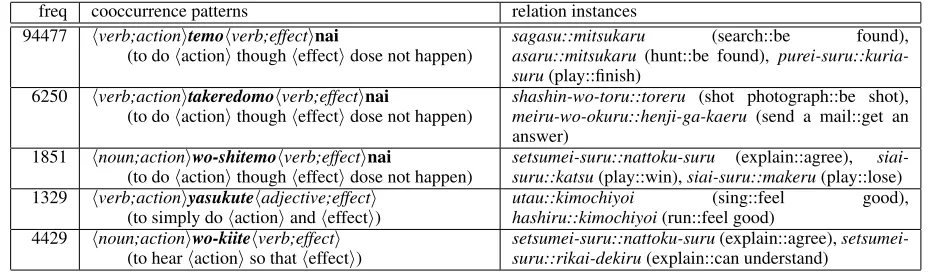
Table 1: Examples of acuired cooccurrence patterns and relatio instances for the action-effect relation freq cooccurrence patterns relation instances
94477 hverb;actionitemohverb;effectinai
(to dohactionithoughheffectidose not happen)
sagasu::mitsukaru (search::be found), asaru::mitsukaru (hunt::be found), purei-suru::kuria-suru(play::finish)
6250 hverb;actionitakeredomohverb;effectinai
(to dohactionithoughheffectidose not happen)
shashin-wo-toru::toreru (shot photograph::be shot), meiru-wo-okuru::henji-ga-kaeru (send a mail::get an answer)
1851 hnoun;actioniwo-shitemohverb;effectinai
(to dohactionithoughheffectidose not happen)
setsumei-suru::nattoku-suru (explain::agree), siai-suru::katsu(play::win),siai-suru::makeru(play::lose) 1329 hverb;actioniyasukutehadjective;effecti
(to simply dohactioniandheffecti)
utau::kimochiyoi (sing::feel good), hashiru::kimochiyoi(run::feel good)
4429 hnoun;actioniwo-kiitehverb;effecti
(to hearhactioniso thatheffecti)
setsumei-suru::nattoku-suru(explain::agree), setsumei-suru::rikai-dekiru(explain::can understand)
Web corpus collected by Kawahara and
Kuro-hashi (2006). The sentences were
dependency-parsed with Cabocha (Kudo and Matsumoto, 2002), and cooccurrence samples of event mentions were extracted. Event mentions with patterns whose fre-quency was less than 20 were discarded in order to reduce computational costs. As a result, we obtained 34M cooccurrence tokens with 11M types. Note that among those cooccurrence samples 15M tokens (44%) with 4.8M types (43%) are those with ver-bal nouns, suggesting the potential impacts of using verbal nouns.
In our experiments, we considered two of Inui et
al. (2003)’s four types of causal relations:
action-effect relations (Effect in Inui et al.’s terminology) and action-means relations (Means). An action-effect relation holds between eventsx andy if and
only if non-volitional eventyis likely to happen as
either a direct or indirect effect of volitional action
x. For example, the actionX-ga undou-suru(X
exer-cises) and the eventX-ga ase-o kaku(X sweats) are
considered to be in this type of relation. A
action-meansrelation holds between eventsxandyif and
only if volitional action y is likely to be done as a
part/means of volitional action x. For example, if
case a event-pair isX-ga hashiru(X runs) is
consid-ered as a typical action that is often done as a part of
the actionX-ga undou-suru(X exercises).
Note that in these experiments we do not differ-entiate between relations with the same subject and those with a different subject. However we plan to conduct further experiments in the future that make use of this distinction.
In addition, we have collected action-effect
rela-tion instances for a baseline measure. The baseline
consists of instances that cooccur with eleven
pat-terns that indicate action-effect relation. The
dif-ference between the extended Espresso and baseline is caused by the low number and constant scores of patterns.
5.2 Results
We ran the extended Espresso algorithm starting with 971 positive and 1069 negative seed relation
instances foraction-effectrelation and 860 positive
and 74 negative seed relations foraction-means
re-lation. As a result, we obtained 34,993 cooccurrence patterns with 173,806 relation instances for the
action-effect relation and 23,281 coocurrence
rela-tions with 237,476 relation instances for the
action-means relation after 20 iterations of pattern rank-ing/selection and instance rankrank-ing/selection. The threshold parameters for selecting patterns and in-stances were decided in a preliminary trial. Some
of the acquired patterns and instances for the
action-effectrelation are shown in Table 1.
5.2.1 Precision
To estimate precision, 100 relation instances were randomly sampled from each of four sections of the ranks of the acquired instances for each of the two relations (1–500, 501–1500, 1501–3500 and 3500– 7500), and the correctness of each sampled instance was judged by two graduate students (i.e. 800 rela-tion instances in total were judged).
Note that in these experiments we asked the asses-sors to both (a) the degree of the likeliness that the effect/means takes place and (b) which arguments are shared between the two events. For example,
futsukayoi-ni naru (have a hangover), the assessors judged this pair correct because one can at least say
that the lattersometimes happensas a result of the
former. For criterion (b), as shown in Table 1, the
relation instances judged correct include both the
X-ga VP1::X-ga VP2type (i.e. two subjects are shared)
and theX-o VP1::X-ga VP2 type (the object of the
former and the subject of the latter are shared). The issue of how to control patterns of argument sharing is left for future work.
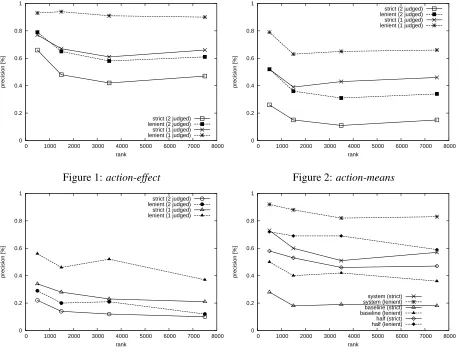
The precision for the assessed samples are shown in Figures 1 to 3. “2 judges” means that an instance is acceptable to both judges. “1 judges” means that it is an acceptable instance to at least one of the two judges. “strict” indicates correct instance relations
while “lenient”3 indicates correct instance relations
– when a judge appends the right cases.
As a result of this strictness in judgement, the inter-assessor agreement turned out to be poor. The
kappa statistics was 0.53 for the action-effect
rela-tions, 0.49 for theaction-effectrelations (=baseline)
and 0.55 foraction-meansrelations.
The figures show that both types of relations were acquired with reasonable precision not only for the higher-ranked instances but also for lower-ranked instances. It may seem strange that the precision
of the lower-rankedaction-meansinstances is
some-times even better than the higher-ranked ones, which may mean that the scoring function given in Section 3 did not work properly. While further investiga-tion is clearly needed, it should also be noted that higher-ranked instances tended to be more specific than lower-ranked ones.
5.2.2 Effects of seed number
We reran the extended Espresso algorithm for the
action-effectrelation, starting with 500 positive and 500 negative seed relation instances. The
preci-sion is shown in Figure 44. This precision is fairly
lower than that of action-effect relations with all
seed instances. Additionally, the number of seed in-stances affects the precision of both higher-ranked and lower-ranked instances. This result indicates that while the proposed algorithm is designed to work with a small seed set, in reality its performance
3If an instance is judged as “strict” by one assessor and
“le-nient” by the other, then the instance is assessed as “le“le-nient”.
4It was only judged by one assessor.
severely depends on the number of seeds.
5.2.3 Effects of using verbal nouns
We also examine the effect of using verbal nouns.
Of the 500 highest scored patterns for the
action-effect relation, 128 patterns include verbal noun
slots, and for action-means, 495 patterns. Hence,
the presence of verbal nouns greatly effects some acquired instances. Additionally, to see the influ-ence of frequency, of the 500 high frequent patterns selected from the 2000 highest scored patterns for
action-effectrelation, 177 include verbal noun slots,
and foraction-means, 407 patterns. This result
pro-vides further evidence that the inclusion of verbal nouns has a positive effect in this task.
5.2.4 Argument selection
According to our further investigation on argu-ment selection, 49 instances (12%) of the correct
action-effectrelation instances that are judged cor-rect have a specific argument in at least one event, and all of them would be judged incorrect (i.e. over-generalized) if they did not have those arguments
(Recall the example ofkogeme-ga tsuku(get brown)
in Section 4.2). This figure indicates that our method for argument selection works to a reasonable degree. However, clearly there is still much room for im-provement. According to our investigation, up to 26% of the instances that are judged incorrect could be saved if appropriate arguments were selected. For
example, X-ga taberu (X eats) and X-ga shinu (X
dies) would constitute anaction-effectrelation if the
former event took such an argument as
dokukinoko-o (toadstool-ACC). The overall precision could be
boosted if an effective method for argument selec-tion method were devised.
6 Conclusion and future work
0 0.2 0.4 0.6 0.8 1
0 1000 2000 3000 4000 5000 6000 7000 8000
precision [%]
rank
[image:7.595.81.540.209.556.2]strict (2 judged) lenient (2 judged) strict (1 judged) lenient (1 judged)
Figure 1:action-effect
0 0.2 0.4 0.6 0.8 1
0 1000 2000 3000 4000 5000 6000 7000 8000
precision [%]
rank
strict (2 judged) lenient (2 judged) strict (1 judged) lenient (1 judged)
Figure 2:action-means
0 0.2 0.4 0.6 0.8 1
0 1000 2000 3000 4000 5000 6000 7000 8000
precision [%]
rank
strict (2 judged) lenient (2 judged) strict (1 judged) lenient (1 judged)
Figure 3:action-effect(baseline)
0 0.2 0.4 0.6 0.8 1
0 1000 2000 3000 4000 5000 6000 7000 8000
precision [%]
rank
system (strict) system (lenient) baseline (strict) baseline (lenient) half (strict) half (lenient)
itive impacts on both recall and precision, and (c) over five thousand relation instances are acquired from the 500M-sentence Web corpus with a
preci-sion of about 66% foraction-effectrelations.
Clearly, there is still much room for exploration and improvement. First of all, more comprehensive evaluations need to be done. For example, the ac-quired relations should be evaluated in terms of re-call and usefulness. A deep error analysis is also needed. Second, the experiments have revealed that one major problem to challenge is how to optimize argument selection. We are seeking a way to incor-porate a probabilistic model of predicate-argument cooccurrences into the ranking function for relation instances. Related to this issue, it is also crucial to devise a method for controlling argument shar-ing patterns. One possible approach is to employ state-of-the-art techniques for coreference and zero-anaphora resolution (Iida et al., 2006; Komachi et al., 2007, etc.) in preprocessing cooccurrence sam-ples.
References
Timothy Chklovski and Patrick Pantel. 2005. Global path-based refinement of noisy graphs applied to verb semantics. InProceedings of Joint Conference on Nat-ural Language Processing (IJCNLP-05), pages 792– 803.
Ryu Iida, Kentaro Inui, and Yuji Matsumoto. 2006. Ex-ploiting syntactic patterns as clues in zero-anaphora resolution. In Proceedings of the 21st International Conference on Computational Linguistics and the 44th annual meeting of the ACL, pages 625–632.
Takashi Inui, Kentaro Inui, and Yuji Matsumoto. 2003. What kinds and amounts of causal knowledge can be acquired from text by using connective markers as clues? In Proceedings of the 6th International Con-ference on Discovery Science, pages 180–193. An ex-tended version: Takashi Inui, Kentaro Inui, and Yuji Matsumoto (2005). Acquiring causal knowledge from text using the connective marker tame. ACM Trans-actions on Asian Language Information Processing (TALIP), 4(4):435–474.
Daisuke Kawahara and Sadao Kurohashi. 2006. A fully-lexicalized probabilistic model for japanese syntactic and case structure analysis. InProceedings of the Hu-man Language Technology Conference of the NAACL, Main Conference, pages 176–183.
Mamoru Komachi, Ryu Iida, Kentaro Inui, and Yuji Mat-sumoto. 2007. Learning based argument structure
analysis of event-nouns in japanese. In Proceedings of the Conference of the Pacific Association for Com-putational Linguistics (PACLING), pages 120–128.
Taku Kudo and Yuji Matsumoto. 2002. Japanese depen-dency analysis using cascaded chunking. In CoNLL 2002: Proceedings of the 6th Conference on Natu-ral Language Learning 2002 (COLING 2002 Post-Conference Workshops), pages 63–69.
Dekang Lin and Patrick Pantel. 2001. DIRT - discov-ery of inference rules from text. In Proceedings of ACM SIGKDD Conference on Knowledge Discovery and Data Mining 2001, pages 323–328.
Suguru Matsuyoshi, Satoshi Sato, and Takehito Utsuro. 2006. Compilation of a dictionary of japanese func-tional expressions with hierarchical organization. In
Proceedings of the 21st International Conference on Computer Processing of Oriental Languages, pages 395–402.
Patric Pantel and Marco Pennacchiotti. 2006. Espresso: Leveraging generic patterns for automatically harvest-ing semantic relations. Inthe 21st International Con-ference on Computational Linguistics and 44th Annual Meeting of the ACL, pages 113–120.
Viktor Pekar. 2006. Acquisition of verb entailment from text. In Proceedings of the Human Language Tech-nology Conference of the NAACL, Main Conference, pages 49–56.
Deepak Ravichandran and Eduard Hovy. 2002. Learning surface text patterns for a question answering system. In Proceedings of the 21st International Conference on Computational Linguistics and 40th Annual Meet-ing of the Association for Computational LMeet-inguistics, pages 41–47.
Kentaro Torisawa. 2006. Acquiring inference rules with temporal constraints by using japanese coordinated sentences and noun-verb co-occurrences. In Proceed-ings of the Human Language Technology Conference of the NAACL, Main Conference, pages 57–64.