IJEDR1402140
International Journal of Engineering Development and Research (www.ijedr.org)2155
Illumination Invariant Face Recognition based on
PCA (Eigenface)
1
P.T. Chavda,
2S.Solanki
1PG student, 2Assistant ProfessorDepartment of Information Technology, Shantilal Shah Engineering College, Bhavanagar, Gujarat, India
________________________________________________________________________________________________________ Abstract - Human face recognition is one of the research areas in the current era of the research. It is different from other biometric recognition because faces are complex, multidimensional and almost all human faces have a similar construction. One of the most robust face recognition is varying illumination condition in uncontrolled environment is still major challenge. In this thesis we discuss the some normalized methods to solve the common problems in face images, due to a real capture system i.e. lighting variations. We have collected various preprocessing technique suggested by different authors and shown their results. After pre-processing we can use the feature extraction. We have studied a face recognition system using the Principal Component Analysis (PCA) algorithm with Euclidean distance as a classifier. The experimented results are tested on the ORL database and Yale database.
Keywords - Principal Component Analysis (PCA) , single scale Quotient Image, Weberface, homomorphic filtering Illumination Normalization, DCT technique
________________________________________________________________________________________________________ I.INTRODUCTION
Automatic face recognition has a wide scope in applications like authentication, security, mug shot data base matching and surveillance. The lighting condition changes from day to night and also between indoor and outdoor environments. These variations severely affect the appearance of the face [1]-[2]. The potential change caused by intra personal variation (variation within the same class) is much larger compared to that of inter-personal variations (variation between classes)
Face recognition has been an active research area over the last 30 years. It has been studied by scientists from different areas of psychophysical sciences and those from different areas of computer sciences. Psychologists and neuroscientists mainly deal with the human perception part of the topic, whereas engineers studying on machine recognition of human faces deal with the computational aspects of face recognition.
Face recognition has applications mainly in the fields of biometrics, access control, law enforcement, and security and surveillance systems. Biometrics are methods to automatically verify or identify individuals using their physiological or behavioral characteristics [1]. Biometric technologies include [2]:
Face recognition algorithms try to solve the problem of both verification and identification [3]. When verification is on demand, the face recognition system is given a face image and it is given a claimed identity. The system is expected to either reject or accept the claim. On the other hand, in the identification problem, the system is trained by some images of known individuals and given a test image. It decides which individual the test image belongs to.
The problem of face recognition can be stated as follows: Given still images or video of a scene, identifying one or more persons in the scene by using a stored database of faces [4]. The problem is mainly a classification problem. Training the face recognition system with images from the known individuals and classifying the newly coming test images into one of the classe s is the main aspect of the face recognition systems.
1.1 Challenges to face recognition
The topic seems to be easy for a human, where limited memory can be a main problem; whereas the problems in machine recognition are manifold. Some of possible problems for a machine face recognition system are mainly;
1. Facial expression change: A smiling face, a crying face, a face with closed eyes, even a small nuance in the facial expression can affect facial recognition system significantly.
2. Illumination change: The direction where the individual in the image has been illuminated greatly effects face recognition success. A study on illumination effects on face recognition showed that lighting the face bottom up makes face recognition a hard task [5].
3. Aging: Images taken some time apart varying from 5 minutes to 5 years changes the system accuracy seriously.
IJEDR1402140
International Journal of Engineering Development and Research (www.ijedr.org)2156
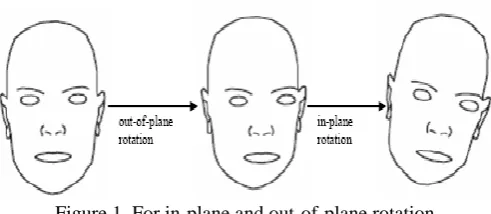
Figure 1. For in-plane and out-of-plane rotation5. Size of the image: A test image of size 20x20 may be hard to classify if original class of the image was 100x100. 6. Frontal vs. Profile: The angle in which the photo of the individual was taken with respect to the camera changes the
system accuracy.
Face recognition system is the next step of a face detection system. In this paper, it is assumed that all the images used to train or test the system are face images. The problem of determination of the exact location of the face is out of the scope of this paper, but some preprocessing techniques had to be applied to ensure that all the faces were oriented in the same location in all the images.
1.2 Illumination Normalization Processing
Illumination variation is one of the main challenging problem in any face recognition system. There are two main approaches for illumination processing.[6] Active approach and Passive approach. Active approaches apply active sensing techniques to capture face images which are invariant to environment illumination. Passive approach attempt to overcome illumination variance in face images due to environment illumination change.
1.3 Typical Preprocessing Methods
The methods based on image processing techniques for illumination problem commonly attempt to normalize all the face images to a canonical illumination in order to compare them under the “identical” lighting condition. These methods can be formulated as a uniform:
I‟=T(I)
Where „I‟ is the original image, T is the transformation operator and I‟ is the after the transform. The transform T is expected to weaken the negative effect of the varying illumination and the image I‟ can be used as a canonical form for face recognition system. Therefore, the recognition system is expected to be insensitive to the varying lighting condition. Dog filtering, homomorphic filtering ,DCT based normalization, gradientface and weberface are most commonly used methods for gray-scale transform. All these techniques are briefly introduced in the following sections and compared with the proposed method.
A. The Homomorphic Filtering based Normalization technique
Homomorphic filtering (HOMO) is a well known normalization technique where the input image is first transformed into the logarithm and then into the frequency domain. Here, the high frequency components are emphasized and the low-frequency components are reduced. As a final step the image is transformed back into the spatial domain by applying the inverse Fourier transform and taking the exponential of the result. Here, X denotes the input grey-scale image to be processe. We have applied the above technique to several images from the YaleB database.[7][8]
B. The Gradientfaces normalization technique
The technique computes the orientation of the image gradients in each pixel of the face images and uses the computed face representation as an illumination invariant version of the input image. This method converts the image from pixel domain to gradient domain. Gradient domain considers the relationship between the neighboring pixel and it reveals underlying inherent structure of the image.[7][8]
C. Dynamic Morphological Quotioent Image
Various smoothing filters and smoothing methods have been proposed to estimate the luminance L(x, y), which results in different illumination normalization algorithms. Inspired by the good performance and low-complexity offered by the MQI for luminance estimation, we adopt the MQI with an adaptive template size, i.e. DMQI, to compensate the illumination fluctuation. Dynamic Morphological Quotient Image (DMQI) method in which mathematical morphology operation is employed to smooth the original image to obtain a better luminance estimate. However, in DMQI, there is some pepper noise in dark area.[7][8]
D. The DCT based normalization technique
In a face image, illumination usually changes slowly compared with the reflectance except some casting shadows and secularities on the face. As a result, illumination variations mainly lie in the low-frequency band. Therefore, we can remove the low frequency part to reduce illumination variation. The low frequency DCT coefficients are set to zero to eliminate illumination variations.[9]
II.METHODOLOGY
Principle Component Analysis (PCA)
IJEDR1402140
International Journal of Engineering Development and Research (www.ijedr.org)2157
images by projecting them to the eigenface space which is composed of eigenvectors obtained by the variance of the face images. Eigenface recognition derives its name from the German prefix eigen, meaning own or individual. The Eigenface method of facial recognition is considered the first working facial recognition technology.Principal component analysis (PCA) is standard technique used in statistical pattern recognition and signal processing for data reduction and Feature extraction. As the pattern often contains redundant information, mapping it to a feature vector can get rid of this redundancy and yet preserve most of the intrinsic information content of the pattern. These extracted features have great role in distinguishing input patterns. PCA is also known as eigenface method.
Eigenface Method
An image space can be thought of as a space having dimensions equal to the number of pixels making up the image and having values in the range of the pixels values. Thus, for example for a grey scale image of size (Nx x Ny), the dimension of the image space is P, P being Nx times Ny. For the case of gray scale images, in each dimension the image could have a value in between 0 and 255.
An image can be thought as a point in the image space by converting the image to a long vector by concatenating each column of the image one after the other. When all the face images are converted into vectors, they will group at a certain location in the image space as they have similar structure, having eye, nose and mouth in common and their relative position correlated. This correlation is the main point to start the eigenface analysis.
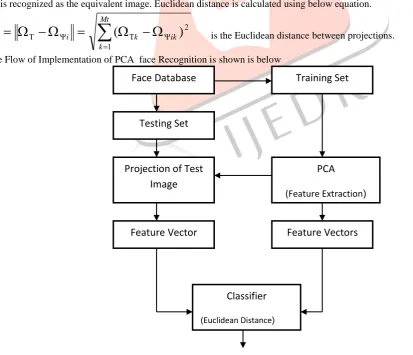
The Eigenface method tries to find a lower dimensional space for the representation of the face images by eliminating the variance due to non-face images; that is, it tries to focus on the variation just coming out of the variation between the face images. Eigenface method is the implementation of Principal Component Analysis (PCA) over images. In this method, the features of the studied images are obtained by looking for the maximum deviation of each image from the mean image. This variance is obtained by getting the eigenvectors of the covariance matrix of all the images. The eigenface space is obtained by applying the eigenface method to the training images. Later, the training images are projected into the eigenface space. Next, the test image is projected into this new space and the distance of the projected test image to the training images is used to classify the test image. Euclidean distance is used for the classification of test images.
The implementation steps of PCA based eigenface is as follows:
Step 1. Image I : (Nx x Ny) pixels. The image matrix I of size (Nx x Ny) pixels is converted to the image vector Γ of size (P x 1) where P = (Nx x Ny); that is the image matrix is reconstructed by adding each column one after the other. Training Se
[
1
2...
mt]
is the training set of image vectors and its size is (P x Mt) where Mt is the number of the training images.Step 2. Mean Face
Mti i
M
11
is the arithmetic average of the training image vectors at each pixel point and its size is (P x 1).
Step 3. Mean subtracted image Φ = Γ − Ψ is the difference of the training image from the mean image (size P x 1).
Step 4. Difference Matrix Α = [ Φ1 Φ2 ... ΦMt ] is the matrix of the entire mean subtracted training image vectors and its size is (P x Mt).
Step 5. Covariance Matrix
iM i i t t 1
1
is the covariance matrix of the training image vectors of size (P x P).(sample covariance matrix, N*N, characterizes the scatter of the data)
An important property of the Eigenface method is obtaining the eigenvectors of the covariance matrix. For a face image of size (Nx x Ny) pixels, the covariance matrix is of size (P x P), P being (Nx x Ny). This covariance matrix is very hard to work with due to its huge dimension causing computational complexity. On the other hand, Eigenface method calculates the eigenvectors of the (Mt x Mt) matrix, Mt being the number of face images, and obtains (P x P) matrix using the eigenvectors of the (Mt x Mt) matrix.
Initially, a matrix Y is defined as,
i M i i t t
11
which is of size (Mt x Mt).
Then, the eigenvectors vi and the eigenvalues μi of Y are obtained,
v
i
i
v
i The value of Y is put in this equation,
v
i
i
v
i Both sides are left multiplied by AIJEDR1402140
International Journal of Engineering Development and Research (www.ijedr.org)2158
v
i
i
v
i(as μi is a scalar, this arrangement can be done)
v
i
i
v
iNow group Α ⋅νi and call a variable υi = Α ⋅νi. It is easy to see that
i
i
v
v
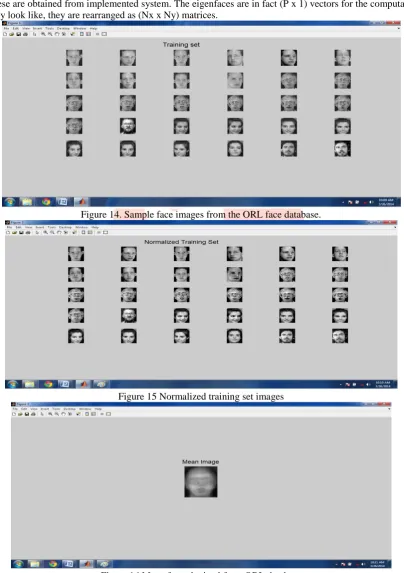
is one of the eigenvectors of Χ = Α ⋅ ΑT and its size is (P x 1).Thus it is possible to obtain the eigenvectors of X by using the eigenvectors of Y. A matrix of size (Mt x Mt) is utilized instead of a matrix of size (P x P) (i.e. [{Nx x Ny} x {Nx x Ny}]). This formulation brings substantial computational efficiency. In Figure 14 some sample images and in figure 15 normalized training set images from the ORL database and in figure 16 mean image of the images from the ORL database are given. In Figure 17 some characteristic eigenfaces obtained from this database can be seen these are obtained from implemented system. The eigenfaces are in fact (P x 1) vectors for the computations; in order to see what they look like, they are rearranged as (Nx x Ny) matrices.
Figure 14. Sample face images from the ORL face database.
Figure 15 Normalized training set images
IJEDR1402140
International Journal of Engineering Development and Research (www.ijedr.org)2159
Figure 17. Eigenfaces obtained from ORL database.In the next step, the training images are projected into the eigenface space and thus the weight of each eigenvector to represent the image in the eigenface space is calculated. This weight is simply the dot product of each image with each of the eigenvectors. Projection
k
V
k
V
k
is the projection of a training image on each of the eigenvectors where k = 1, 2, …, M′ where M‟<<Mt. Weight Matrix
1 2...
'
M
is the representation of the training image in the eigenface space and its size is (M′ x 1).When a test image is given as an input to the system first we represent it onto the eigenface space then we find minimum Euclidean distance by comparing test image with all the images in the training set. The minimum distance image in the training set is recognized as the equivalent image. Euclidean distance is calculated using below equation.
2
1
)
(
ikMt
k
k i
i
is the Euclidean distance between projections.The Flow of Implementation of PCA face Recognition is shown is below
Face Database
Testing Set
Projection of Test
Image
Image
Feature Vector
Training Set
PCA
(Feature Extraction)
Feature Vectors
Classifier
IJEDR1402140
International Journal of Engineering Development and Research (www.ijedr.org)2160
III.EXPERIMENTAL RESULTSIn this way basic PCA face recognition technique and Pre-Processing techniques has been implemented and test with ORL databases and Yale databases. The experimented was carried out using MATLAB R2007b platform for implementing the algorithm because this is only the platform by which we can get very accurate result and implementation is also somewhat easy. The experiment are performed with 2.00GHz Intel Core 2 Duo T5870 CPU and 1GB of RAM. Experimented results are analyzed by carrying on Gray scale image .
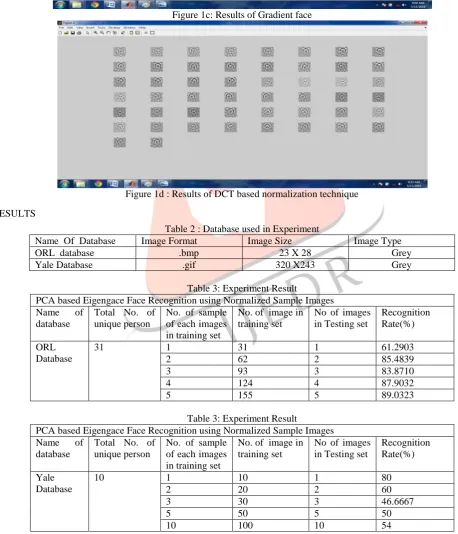
The performances of the systems are measured by varying the number of faces of each subject in the training and test faces. Table 3 shows the success rates using different training and test images for PCA approach and the result shows that in ORL database the recognition rate is increased when the number of sample is increased, the recognition rate also gets increased and for almost all databases the recognition rate is best for around five to ten images per individual in the training set
Figure 1 shows the sample images of Yale Database.
Figure 1a : Results of Homomorphic filtering based Technique
IJEDR1402140
International Journal of Engineering Development and Research (www.ijedr.org)2161
Figure 1c: Results of Gradient faceFigure 1d : Results of DCT based normalization technique IV.RESULTS
Table 2 : Database used in Experiment
Name Of Database Image Format Image Size Image Type
ORL database .bmp 23 X 28 Grey
Yale Database .gif 320 X243 Grey
Table 3: Experiment Result
PCA based Eigengace Face Recognition using Normalized Sample Images Name of
database
Total No. of unique person
No. of sample of each images in training set
No. of image in training set
No of images in Testing set
Recognition Rate(%) ORL
Database
31 1 31 1 61.2903
2 62 2 85.4839
3 93 3 83.8710
4 124 4 87.9032
5 155 5 89.0323
Table 3: Experiment Result
PCA based Eigengace Face Recognition using Normalized Sample Images Name of
database
Total No. of unique person
No. of sample of each images in training set
No. of image in training set
No of images in Testing set
Recognition Rate(%) Yale
Database
10 1 10 1 80
2 20 2 60
3 30 3 46.6667
5 50 5 50
IJEDR1402140
International Journal of Engineering Development and Research (www.ijedr.org)2162
V.CONCLUSIONVarious illumination normalization methods for face recognition have been implemented and their performance has been evaluated. We have presented many methods for face recognition under uncontrolled lighting based on robust preprocessing and an extension of the PCA eigenface descriptor. The experiment has been performed by considering the center portion of the face. The proposed techniques is tested with Yale database and ORL databases each images created as normal, bright, very bright, dark and very dark. Then each images are tested with the proposed PCA eigenface algorithm.
REFERENCES
[1] P. S. Huang, C. J. Harris, and M. S. Nixon, “Human Gait Recognition in Canonical Space using Temporal Templates”, IEEE Proc.-Vis. Image Signal Process, Vol. 146, No. 2, April 1999.
[2] J. Huang, “Detection Strategies For Face Recognition Using Learning and Evolution”, PhD. Thesis, George Mason University, May 1998.
[3] S.A. Rizvi, P.J. Phillips, and H. Moon, “A verification protocol and statistical performance analysis for face recognition algorithms”, pp. 833-838, IEEE Proc. Conf. Computer Vision and Pattern Recognition (CVPR), Santa Barbara, June 1998.
[4] R. Chellappa, C. L. Wilson and S. Sirohey, “Human and Machine Recognition of Faces: A Survey”, Proceedings of the IEEE, Vol. 83, No. 5, May 1995.
[5] W. Zhao, R. Chellappa, A. Rosenfeld, and P.J. Phillips, “Face Recognition: A literature Survey”, Technical Report, Univ. of Maryland, 2000.
[6] Gonzales R.C & woods, R.E (1992). Digital Iamge Processing ,second ed., Prentice Hall, ISBN-10: 0201180758, Upper saddle River.
[7] V. Struc and N Pave si´c, ”Photometric normalization techniques for illumination invariance” , In: Y.J. Zhang (Ed.), Advances in Face Image Analysis: Techniques and Technologies. IGI Global, 2011, pp. 279–300.
[8] V. Struc and N. Pave si´c, ”Gabor-Based Kernel Partial-Least-Squares Discrimination Features for Face Recognition”, Informatica (Vilnius), vol. 20, no. 1, pp. 115–138, 2009.
[9] X.G. He, J. Tian, L.F. Wu, Y.Y. Zhang, X. Yang l. llumaination Normalization with Morphological Quotient Image,” Journal ofSoftware, Vol.18(9) pp.2318-2325, 2007.
[10] M. A. Turk, and A. P. Pentland, “Face Recognition using Eigenfaces”, pp. 586-591, IEEE, 1991.
[11] L. Sirovich, and M. Kirby, “Low-dimensional Procedure for the Characterization of Human Faces”, pp. 519-524, Journal of the Optical Society of America, Vol. 4, No. 3, March 1987
[12] Olivetti & Oracle Research Laboratory, The Olivetti & Oracle Research Laboratory Face Database of Faces, http://www.camorl.co.uk/facedatabase.html
[13] Yale Database, http://cvc.yale.edu/ projects/yalefaces/yalefaces.html