Table 1. Employed search-terms and limits
Search strategy for the systematic review of literature on the bioaerosols and standard dental practice protocol in
post-COVID-19 era
Search history
Search (Database/s)
( January 01, 1985, and April 30, 2020)
Cochrane Library databases
Bioaerosol and rubber dam
(rubber dam OR dental dam) AND (aerosol OR bioaerosol) AND (bacterial reduction OR microbial reduction) AND (dental operatory OR dental clinic) AND (dry field OR moisture control) AND (saliva OR blood)
Bioaerosol and high-volume evacuator (HVE)
(aerosol OR bioaerosol) AND (extraoral suction OR extra oral evacuator) AND (bacterial reduction OR microbial reduction) AND (dental operatory OR dental clinic) AND (high volume evacuator OR high volume suction) AND (saliva OR blood) AND (evacuators OR suction)
Bioaerosol and preprocedural oral rinse
(aerosol OR bioaerosol) AND (mouth rinse OR oral rinse) AND (mouth wash OR prophylactic mouth wash) AND (dental operatory OR dental clinic) AND (anti-microbial OR antibacterial) AND (anti-viral OR anti-fungal) AND (Chlorhexidine OR CHX OR Essential Oil) AND (Cetylpyridinium chloride OR CPC) AND (scaling OR ultrasonic) AND (high-speed rotary OR high-speed handpiece)
AND (microbial reduction OR bacterial reduction) AND (preprocedural oral rinse OR preprocedural mouth rinse)
PubMed via OVID
Bioaerosol and rubber dam
Heading (MeSH) and text words: (aerosol OR bioaerosol) AND (rubber dam OR dental dam) AND (bacterial reduction OR microbial reduction) AND (dental operatory OR dental clinic) AND (dry field OR moisture control) AND (saliva OR blood)
Bioaerosol and high-volume evacuator (HVE)
Heading (MeSH) and text words: (aerosol OR bioaerosol) AND (extraoral suction OR extra oral evacuator) AND (bacterial reduction OR microbial reduction) AND (dental operatory OR dental clinic) AND (high volume evacuator OR high volume suction) AND (saliva OR blood) AND (evacuators OR suction) AND (high volume OR low volume)
Bioaerosol and preprocedural oral rinse
Heading (MeSH) and text words: (aerosol OR bioaerosol) AND (mouth rinse OR oral rinse) AND (mouth wash OR prophylactic mouth wash) AND (Chlorhexidine OR CHX OR Essential Oil) AND (Cetylpyridinium chloride OR CPC) AND (scaling OR ultrasonic) AND (high-speed rotary OR high-speed handpiece) AND (dental operatory OR dental clinic) AND (anti-microbial OR antibacterial) AND (anti-viral OR anti-fungal) AND (microbial reduction OR bacterial reduction) AND (preprocedural oral rinse OR preprocedural mouth rinse)
EBSCO host Bioaerosol and rubber dam
(aerosol OR bioaerosol) AND (rubber dam OR dental dam) AND (bacterial reduction OR microbial reduction) AND (dental operatory OR dental clinic) AND (dry field OR moisture control) AND (saliva OR blood)
Bioaerosol and high-volume evacuator (HVE)
(aerosol OR bioaerosol) AND (extraoral suction OR extra oral evacuator) AND (bacterial reduction OR microbial reduction) AND (dental operatory OR dental clinic) AND (high volume evacuator OR high volume suction) AND (saliva OR blood) AND (evacuators OR suction)
Bioaerosol and preprocedural oral rinse
(aerosol OR bioaerosol) AND (Chlorhexidine OR CHX OR Essential Oil) AND (Cetylpyridinium chloride OR CPC) AND (scaling OR ultrasonic) AND (high-speed rotary OR high-speed handpiece)
AND (mouth rinse OR oral rinse) AND (mouth wash OR prophylactic mouth wash) AND (dental operatory OR dental clinic) AND (anti-microbial OR antibacterial) AND (anti-viral OR anti-fungal) AND (microbial reduction OR bacterial reduction) AND (preprocedural oral rinse OR preprocedural mouth rinse)
Web of Science
Bioaerosol and rubber dam
(aerosol OR bioaerosol) AND (rubber dam OR dental dam) AND (bacterial reduction OR microbial reduction) AND (dental operatory OR dental clinic) AND (dry field OR moisture control) AND (saliva OR blood)
Bioaerosol and high-volume evacuator (HVE)
Bioaerosol and preprocedural oral rinse
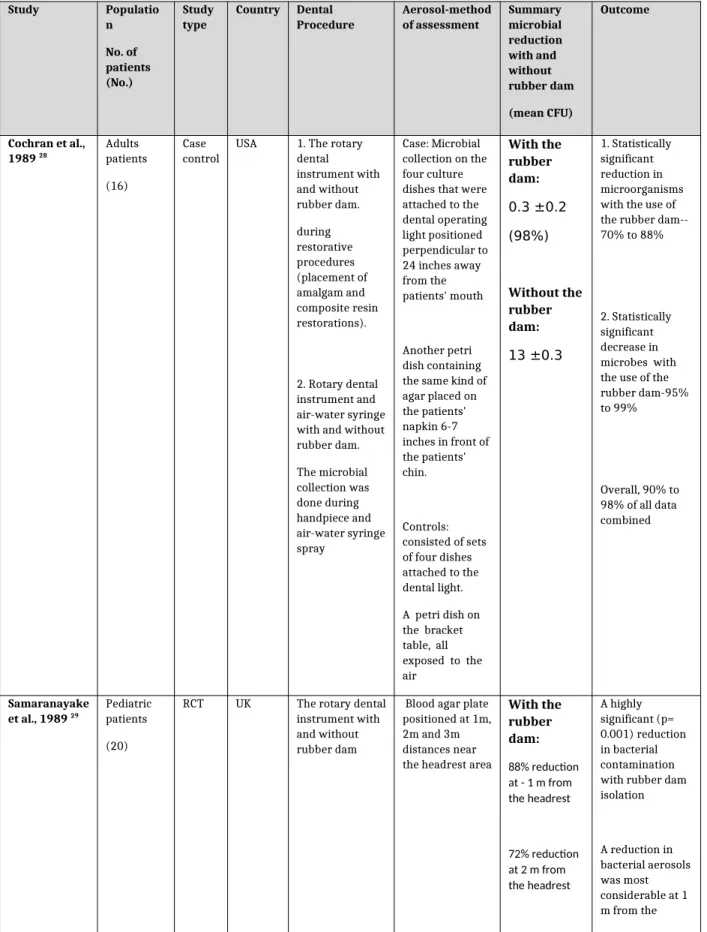
Table 2: Included Studies (Efficacy of rubber dam isolation and bio-aerosol)
Study Populatio
n No. of patients (No.) Study type Country Dental Procedure Aerosol-method of assessment Summary microbial reduction with and without rubber dam (mean CFU) Outcome
Cochran et al., 1989 28
Adults patients
(16)
Case control
USA 1. The rotary dental instrument with and without rubber dam. during restorative procedures (placement of amalgam and composite resin restorations).
2. Rotary dental instrument and air-water syringe with and without rubber dam. The microbial collection was done during handpiece and air-water syringe spray Case: Microbial collection on the four culture dishes that were attached to the dental operating light positioned perpendicular to 24 inches away from the patients' mouth
Another petri dish containing the same kind of agar placed on the patients' napkin 6-7 inches in front of the patients' chin.
Controls: consisted of sets of four dishes attached to the dental light. A petri dish on the bracket table, all exposed to the air With the rubber dam: 0.3 ±0.2 (98%) Without the rubber dam: 13 ±0.3 1. Statistically significant reduction in microorganisms with the use of the rubber dam--70% to 88%
2. Statistically significant decrease in microbes with the use of the rubber dam-95% to 99%
Overall, 90% to 98% of all data combined
Samaranayake et al., 1989 29
Pediatric patients
(20)
RCT UK The rotary dental
instrument with and without rubber dam
Blood agar plate positioned at 1m, 2m and 3m distances near the headrest area
With the rubber dam:
88% reduction at - 1 m from the headrest
72% reduction at 2 m from the headrest A highly significant (p= 0.001) reduction in bacterial contamination with rubber dam isolation
0 % - No reduction at 3 m from the headrest
headrest
Tag El-Din et al., 1997 30
Pediatric patients (20)
RCT Egypt Rotary
instrument (air-turbine-driven handpiece) Standard restorative procedures performed under rubber dam isolation Standard procedures without rubber dam isolation Use of chlorhexidine mouth rinse 30 minutes before the procedure Use of chlorhexidine mouth rinse before
application of the rubber dam
Four blood agar culture plates placed equidistantly from the child's head
One each on the chest left and right sides, and behind the patient.
Another two plates placed at 1 and 2 meters from the headrest of the dental chair, respectively With the rubber dam: 7.9 ±2.8 Rubber dam + Antiseptic mouth rinse: 5.9±2.0 Without the rubber dam:
19.5 ± 5.8
The bacterial reduction was 98.8% at 1 meter when the rubber dam was used.
The bacterial reduction increased when antiseptic mouth rinse was used before rubber dam application
The reduction in CFUs at one meter was 98.8%, 73.8%, and 99.4% in the rubber dam group, the antiseptic group, and the antiseptic with rubber dam group,
respectively.
The highest bacterial contamination was on the agar plates positioned on the patient's chest
Al- Amad et al., 2017 31
Adult patients
(52)
RCT UAE The rotary dental instrument with and without rubber dam, during the standard restorative dental procedure Fifty-two unused (autoclaved) cotton-polyester scarves (head covers). Cotton swabs moistened with sterile normal saline for sample collection With the rubber dam: NA Without the rubber dam: NA Statistically significant bacterial reduction (mean CFU=
Table 3: Included Studies related to high-volume evacuation(HVE) and bio-aerosols
Study Population
No. of patients (No.) Study type Country Dental Procedure Aerosol-method of assessment Summary microbial reduction with and without high volume evacuation (HVE) (mean CFU) Outcome
Efficacy of High-volume evacuation and bio-aerosol
King et al., 199734 Adults patients (12) In vivo (Split mouth design) USA Ultrasonic scaling for 5-minutes with the aerosol reduction device
Ultrasonic scaling for 5- minutes without the aerosol reduction device Samples were collected on blood agar plates placed 6 inches from the subject's mouth
With HVE
2.6 +/- 3.6
Without HVE
45.1 +/- 28.9
Low CFU count on the face shield with or without HVE
Significantly higher reduction in the quantity of mean colony forming units (CFUs) with HVE
However, no significant
differences in the number of CFUs found on the
investigator's face shield due to operators' position at 9 am and 12 pm operating position
Muzzin et al., 199935
Adults patients (30)
In vivo USA All subjects underwent two minutes of air polishing.
With the aerosol reduction device on one side of the mouth
Without the aerosol reduction device on the opposite side Microbial samples were collected on blood agar plates positioned 12 inches from the subject's mouth
One plate blood agar plate attached to the face mask
With HVE
20.10 +/- 53.90
Without HVE
148.00 +/- 145.00
HVE + Face mask
8.80 +/- 15.10 CFUs
Without HVE +
Face mask
40.90 +/- 33.80 CFUs
Timmerma n et al., 200432
Adults patients (06)
In vivo Netherland Ultrasonic scaler with either high-volume evacuation (HVE) or conventional dental suction (CDS) 17 treatment sessions, consisting of a 40-min episode
Two plates (blood agar) placed at 40 cm for 5 min After 20 min, the procedure was repeated.
Two plates (blood agar) placed at 150 cm for 20 min. This was followed by exposure to two new Petri dishes for the rest of the session.
The plates were cultured aerobically and anaerobically for 3 and 7 days, respectively.
Mean CFU before treatment never exceeded 0.6 colonies per plate.
At 40 cm, the mean CFU, at 40 mins, was 8.0 for HVE and 17.0 for CDS.
The mean CFU at 150 cm at 40 mins was 8.1 with HVE and 10.3 with the CDS
The use of a high volume ‐
evacuator may, however, help to minimize risks of microbial air contamination HVE Mean Aerobic microbes 0.9 (1.3) Mean Anaerobic microbes 1.1 (1.2) CDS (conventional dental suction) Mean Aerobic microbes 1.0 (1.2) Mean Anaerobic microbes 3.3 (2.7) Desarda et al., 2014 36
Adults patients (80)
In vivo India Piezoelectric ultrasonic scaling with or without high-volume evacuator. Nutrient agar plate placed on patient's chest at 20 inches and another plate was set at 12 inches on the dental assistant side
Scaling was carried out for 10 minutes
Nutrient agar plates (4) were exposed for 20 minutes for microbial sampling
With HVE:
12.14 ± 1.93
Without HVE:
11.08 ± 2.25
There found no statistically significant differences in colony-forming units (CFU) with and without high-volume suction placed at 12 and 20- inches from the oral cavity
Bio-aerosol reduction-Efficacy of HVE + standard oral hygiene (tooth brushing, flossing)
Bentley et al., 1994 37
Adult patient (2)
using handpiece and high-volume evacuator for 30 minutes Ultrasonic scaling with conventional salivary ejector for 30 minutes
placed with on the six spokes of the headrest extension device at 12 and 24 inches from patients' mouth Also, on operators face mask, disposable gowns, head caps. streptococci High-volume evacuation during all the restorative procedures shows negligible bacterial counts reaching plates at 24 inches from the mouth
Higher bacterial counts inpatient, who did not brush, or floss for 24 hours compared to the second patient who had brushed and flossed before treatment preoperative toothbrushing and flossing may reduce bacterial contamination and
dissemination
Efficacy of High-volume evacuation and bio-aerosol
Yamada et al., 2011 39
Adult patients (281)
At 50 cm single evacuator (n = 102)
At 100 cm (n =124)
At 100 cm double evacuator
(n=55)
In vivo Japan At 50 cm and 100 cm from the mouth of the patient with single HVE: Third molar surgery Full-crown preparation, Inlay cavity (Black Class II) preparation, Scaling with an ultrasonic scaler
At 100 cm from the mouth of the patient with two HVE:
Test filter At 50 cm from patients' mouth (n=102) with single HVE: Third molar surgery 92% (12/13) Full-crown preparation 70% (21/30) Inlay cavity (Black Class II) preparation 35% (9/26) Ultrasonic scaling 33% (11/33)
Third molar surgery
surgery 90% (35/39) Full-crown preparation, 48% (15/31) Inlay cavity (Black Class II) 29% (6/21),
Ultrasonic scaling 12% (4/33)
At 100 cm from the patient's mouth (n=55) with two HVE:
Table 4: Pre-procedural oral rinse and bio-aerosols
Study Populatio
n No. of patients (No.) Study type Countr y Dental Procedur e Aerosol-method of assessmen t Microbial Assay Summary microbial reduction with and without pre-oral rinse Outcome Fine et al., 1992 42 Adults patients (18) Double-blind, controlle d, cross-over, clinical study
USA A
10-minute ultrasonic scaling
Antiseptic mouthwash (EO) or a control (20 ml) for 30 seconds Aerosolized bacteria were collected on a sterile filter. Filter was Incubated on trypticase soy agar, aerobically at 370C for
24 to 72 hours. Counting the colony-forming units (CFU) Counting of total CFU with a dissecting microscope EO: reduction of 1.23 CFU (log-transformed ) Placebo: reduction of 0.18 CFU (log transformed ) Difference between groups: EO: reduced 1.05 more CFU (log-transformed ) Rinsing with the antiseptic mouthwash (EO) produced a 94.1% reduction in CFUs Fine et al., 1993 43 Adults patients (18) Double-blind, controlle d, cross-over, clinical study USA Full-mouth dental prophylaxis with ultrasonic scaler for 5 min
Antiseptic mouthwash (EO) or a control Aerosolized bacteria were collected on a sterile filter. positioned in front of the participant’s mouth at a distance of 2 inches
Counting the colony-forming
units (CFU) between groups: EO: reduced 1.02 more CFU (log-transformed ) Logotheti s et al., 1995 44
Adults patients
(18)
RCT USA Air polish
device for 3 min
Antiseptic mouthwash (EO) and (CHX) or a control
Mask of the operator and at 2, 3, 5, 6, and 9 feet from a reference point (patient’s head) Culture grown on eight blood agar plates Counting the colony-forming units (CFU) Anaerobic culture Counting of total CFU with colony counter CHX versus control, 93.10% reduction EO versus control, 1% reduction Pre-rinse with CHX can effectively reduce most of the bacterial aerosols generated via the use of the air-polishing device, Pre-rinse reduces Aerosol as far as 9 feet from the patients’ head Klyn et al., 2001 45 Adults patients (15)
RCT USA Full-mouth
dental prophylaxis with ultrasonic scaler for 5 min Antiseptic mouthwash (CHX vs. control) Bio-aerosols were collected on four blood agar plates. Three agar plates were placed at 6 inches from the oral cavity,
One agar plate was placed 2 feet from the oral cavity Counting of CFU CHX versus control, 51.43% reduction
The use of preoperative CHX
mouth rinse reduces the disseminatio n of bacteria
Feres et al., 201046 Adults patients (60)
10 minutes
Antiseptic mouthwash (CHX) and (CPC) or a control
Three on the support board,
One on the participant’s chest One on the clinician’s forehead Anaerobic culture: counting of CFU with colony counter water, 68% microbial reduction CHX versus no-rinse, 78% microbial reduction CPC versus no-rinse, 77% microbial reduction effective in reducing the levels of spatter containing microbes generated during ultrasonic scaling Dawson et al., 201648 Adults patients (18)
RCT UK Low-speed
handpiece Antiseptic mouthwash (CHX) and a control (water) Petri dish with anaerobe agar The extension tube was positioned at the level of the patient’s mouth at a distance of 30 centimeters Anaerobic culture Polymerase chain reaction (PCR) using universal primer) for total bacterial count CXH versus no-rinse, a 77% increase CHX versus water, a 25.3% increase
The use of preprocedur al 0.2% CHX mouth rinse increases in the numbers and diversity of airborne microbes Retamel -Valdez et al., 201747 Adults patients (60)
RCT Brazil Full-mouth dental prophylaxis using ultrasonic scaler for 10 min Bio-aerosols were collected on five agar plates:
Three on the support board, One on the participant’s chest, and One on the clinician’s forehead Anaerobic culture: counting of CFU with colony counter Checkerboar d DNA-DNA hybridizatio n (40 species)
Table 5. Risk of Bias of the included studies
Study Selection bias
Baseline characteristics similarity/ appropriate control selection
Selection bias
Allocation concealment
Selection bias
Randomization
Performance bias
Blinding of Researchers
Detection bias
Blinding of outcome assessors
Reporting bias
Selective outcome reporting
Incomplete outcome data
Rubber dam- Bioaerosol
Cochran et al.,
1989 28
+
+
?
+
?
+
+
Samaranayake
et al., 1989 29
+
+
?
+
?
+
+
Tag El-Din et
al., 1997 30
+
?
+
-
?
+
+
Al- Amad et al.,
2017 31
+
?
?
?
?
-
+
High volume evacuator (HVE) -Bioaerosol
Bentley et al.,
1994 37
+
+
-
+
?
+
+
King et al.,
1997 34
+
?
?
?
?
+
+
Muzzin et al.,
1999 35
+
?
?
?
?
+
+
Timmerman et
al., 2004 32
+
?
+
?
+
+
+
Yamada et al.,
2011 39
+
+
+
+
?
+
+
Desarda et al.,
2014 36
+
?
+
?
?
+
?
Pre-procedural mouth rinse -Bioaerosol
Fine et al.,
1992 42
+
?
?
+
+
+
+
Fine et al.,
1993 43
+
?
?
+
+
+
+
Logothetis et
al., 1995 44
+
+
?
-
-
+
+
Klyn et al.,
Feres et al.,
2010 46
?
?
?
+
+
+
+
Dawson et al.,
2016 48
-
?
-
+
+
?
?
Retamel -Valdez et al., 2017 47