University of South Carolina
Scholar Commons
Theses and Dissertations
2015
Testing An Ecological Model Of Parent
Involvement In Head Start: A Replication Study
Rebecca C. HorwitzUniversity of South Carolina
Follow this and additional works at:https://scholarcommons.sc.edu/etd
Part of theClinical Psychology Commons, and theCommunity Psychology Commons
This Open Access Thesis is brought to you by Scholar Commons. It has been accepted for inclusion in Theses and Dissertations by an authorized administrator of Scholar Commons. For more information, please [email protected].
Recommended Citation
TESTING AN ECOLOGICAL MODEL OF PARENT INVOLVEMENT IN HEAD START: A REPLICATION STUDY
by
Rebecca C. Horwitz Bachelor of Arts
Johns Hopkins University, 1996
Submitted in Partial Fulfillment of the Requirements For the Degree of Master of Arts in
Clinical-Community Psychology College of Arts and Sciences University of South Carolina
2015 Accepted by:
Jean Ann Linney, Director of Thesis Suzanne Swan, Reader
D
EDICATIONA
CKNOWLEDGEMENTSA
BSTRACTParent involvement has been understood to elicit positive outcomes for school-age children, especially minority children and children from low socioeconomic families. Understanding the process by which parents engage in their child’s education may provide school staff with tools to develop interventions to increase parent involvement.
This investigation replicates a study that tested an ecological model of parent involvement in two Head Start programs (Waanders, 2002). Participants in the current study were 213 parents and/or caregivers of children who attended three Head Start programs in South Carolina. Two of the programs were located in a medium-sized city, while the third was located in a small-sized town.
T
ABLE OFC
ONTENTSDEDICATION ... iii
ACKNOWLEDGEMENTS ... iv
ABSTRACT ... v
LIST OF TABLES ... vii
LIST OF SYMBOLS... viii
LIST OF ABBREVIATIONS ... ix
CHAPTER 1:INTRODUCTION AND LITERATURE REVIEW ... 1
CHAPTER 2:METHODOLOGY ... 12
CHAPTER 3:RESULTS ... 18
CHAPTER 4:DISCUSSION ... 32
REFERENCES ... 39
APPENDIX A–CENTER FOR EPIDEMIOLOGICAL STUDIES-DEPRESSION SCALE ... 46
APPENDIX B–ABOUT BEING A PARENT SCALE ... 47
APPENDIX C–DIFFICULTY MAKING ENDS MEET AND DIFFICULTY MEETING MATERIAL NEEDS SCALES ... 48
APPENDIX D–NEIGHBORHOOD CHARACTERISTICS QUESTIONNAIRE ... 50
APPENDIX E–PARENTS,CHILDREN, AND EDUCATION SCALE ... 54
L
IST OFT
ABLESTable 3.1 Descriptive Statistics for Measures ... 20
Table 3.2 Correlations among Study Variables ... 22
Table 3.3 Hierarchical Regression Analysis Summary for School Involvement ... 25
Table 3.4 Hierarchical Regression Analysis Summary for Home Involvement ... 27
L
IST OFS
YMBOLSF F score
L
IST OFA
BBREVIATIONSABPS ... About Being a Parent Scale CESD ... Center for Epidemiological Studies-Depression Scale CONF ... Home-School Conferencing subscale of the Family Involvement Questionnaire DIS ... Disorder subscale of the Neighborhood Characteristics Questionnaire DMEM ... Difficulty Making Ends Meet scale DMMN ... Difficulty Meeting Material Needs Scale FULL ... Full scale score of the Family Involvement Questionnaire HOME ... Home-Based Involvement subscale of the Family Involvement Questionnaire LSN . Local Social Networks subscale of the Neighborhood Characteristics Questionnaire NCQ... Neighborhood Characteristics Questionnaire QSORT ... Parent Connectedness Q-sort SCHL ... School-Based Involvement subscale of the Family Involvement Questionnaire SCNQ ... Street Crime and Neighborhood Quality subscale of the Neighborhood
CHAPTER
1
I
NTRODUCTION ANDL
ITERATURER
EVIEWThe importance of parent involvement in children’s education has been the focus of research and intervention for many years. Researchers define parent involvement based on a variety of elements. These elements tend to fall within three defining themes (Comer and Haynes, 1991): general involvement; contributing to classroom activities; and working with school committees.
Berger (1991) describes the history of parent involvement by noting that even in prehistoric times, parents were children’s first and most significant instructors, even when formal schooling was added later in the lives of children. The connection between formal school learning and parental involvement in the learning process is clearly understood in light of this context. She later goes on to stress the importance of parent involvement today consisting of at least one of the following five types:
1) parent as an active partner and educational leader at home and school; 2) parent as decision maker;
3) parent as a school volunteer or paid employer;
Epstein (1995) describes six types of parent involvement in the education process that educators may use when thinking about parent involvement. These types include: Parenting; Communication; Volunteering; Learning at Home; Decision Making; and Collaborating with Community (p. 704). Like Comer & Haynes and Berger, Epstein includes a full range of activities at home and at school that define the concept of parent involvement.
Why is Parent Involvement Important?
Research outcomes have supported the notion that parent involvement in
children’s schooling is an important factor in children’s achievement. Henderson (1988) reviewed an annotated bibliography of 35 studies (National Committee for Citizens in Education’s (NCCE), (1981) and found that strong school-family connections led to positive outcomes. The studies indicated that any parent involvement seems to generate significant gains in student success. In 1987, the NCCE examined eighteen additional studies, each of which supported Henderson’s earlier findings (Henderson, p. 149).
These findings advance seven major themes that indicate how the effects of parent involvement are seen long term. First, the attitudes that children develop about
and high school levels. Fourth, involving parents when their children are young has beneficial effects that persist throughout the child’s academic career. Preschool programs that had high levels of parent involvement serving minority and low-income students produced graduates who continued to surpass their peers in achievement through high school. Fifth, parent involvement is most effective when it is comprehensive, well-planned, and long lasting. Sixth, involving parents in their children’s formal education improves the children’s achievement. And seventh, the family unit provides the primary educational environment for the child. The primary theme in the studies examined by the NCCE is that parent involvement is fundamental to the perpetuation of a healthy public education system (Henderson, p. 153).
A discussion of the importance of parent involvement is particularly relevant when working with minority and less-privileged populations. Clark, as cited by Garmezy (1991), discusses the patterns that are consistent among high achieving children in poor minority families. Two of the most effective patterns Clark found explicitly refer to (1) the need for parents to take a strong role in their child’s education and (2) to initiate contact with the school. These patterns, along with those that reflect social-emotional support from parents, are the primary features that distinguish high achieving children from their low achieving counterparts (Shumow, Vandell, and Posner, 1999). These findings provide further evidence of the importance of parental involvement in school, specifically for this population.
Multidimensional Nature of Parent Involvement
(1998) this definition is inadequate and restrictive. A more expansive and comprehensive definition included 1) introducing the child to intellectual and cognitive activities, 2) the child’s experience of the parent’s availability, and 3) the parent’s behavior and attitude about school (Grolnick and Slowiaczek, 1994)
Multidimensional Bidirectional Model of Parent Involvement
The school-family relationship must be considered within a context that is flexible and encompasses a broad range of circumstances (e.g., families that come from different socioeconomic strata, family structures, etc). Similarly, all school systems do not operate in the same manner, particularly when policies from other institutions such as
government agencies vary from state to state.
Bronfenbrenner’s (1979) ecological model of the environment is a logical choice when examining the issue of school-family relationships. This model perceives the child’s world as a progression of nested structures that includes school, family,
Epstein (2001, 1987) discusses three perspectives that currently guide practitioners and researchers when thinking about the family-school connection.
1. Separate responsibilities of families and schools. 2. Shared responsibilities of families and schools. 3. Sequential responsibilities of families and schools.
The first of these, separate responsibilities of families and schools, assumes that there is a difference in goals in these two institutions, and the roles of each are best held separately. The second, shared responsibilities of families and schools, assumes that family shares the responsibility for socialization and education of the child with the school. This perspective emphasizes cooperation and communication as necessary components of the process. The third perspective, sequential responsibilities of families and schools, emphasizes each institution’s contribution to the child’s development through critical stages of development. This viewpoint is based on the belief that the early years, 0-5, which are mostly spent with parents, are critical to the child’s later academic success as the child’s attitudes toward learning are established by age 5 – 6.
Four trends commencing in the past half century explain why changes are needed in our theories of family-school relations (Epstein, 2001). First, today’s mothers are completing a college education at higher rates than mothers did in the past. This change influences the expectations between the parent and the teacher and shifts their
relationship from hierarchical to one with greater parity. Second, increased knowledge has been made available to the general public on baby and childcare topics. This availability of information provides resources on the importance of the home
in the past. Third, federal regulations and funding for parent involvement like Head Start and the Education for all Handicapped Children Act stipulate that a parent involvement component be implemented in the education plan. Finally, Epstein discusses the changing family structure in America today, most particularly noting changes in availability of caretakers to participate in school activities. Increasing numbers of single parents, step-parents, biracial and alternative partnerships need to be recognized. School programming requires more flexibility in activity planning when reaching out to parents in diverse family groupings for ongoing involvement in the school.
By viewing Epstein’s four trends through the lens of Bronfenbrenner’s ecosystem model, shifts in micro, meso, and exosystems can be understood. Changes in the
microsystem level are apparent in the increased knowledge obtained by parents, mothers in particular. The mesosystem is affected by mothers’ increased knowledge, which forms the basis for a new relationship with teachers and the school system. Additionally,
increased parental knowledge about childcare and their children’s learning also causes a shift in the relationship between the family and the school system. This would be
placements that account for step-siblings, scheduling of school conferences, values education).
The changing governmental policies on the issue of parent involvement in the school represent an exosystem change. Like the macrosystem change, these policies mandate changes on the other levels in the model. For example, more and more programs require parental involvement as a criterion for a child’s acceptance to the school’s
program.
Studies have been published suggesting strategies to best develop and/or improve the school-family connection with the belief that strengthening this connection results in positive outcomes for child achievement. Summarizing these papers, three themes emerge. The first is inclusion of the parents in decision making processes (Foster, 1994; Hall, 1989). The second is the use of diverse communication methods to reach the parents to engage in positive contact (Brand, 1996; Helm, 1994; Stamp and Groves, 1994). The third theme involves the teachers’ awareness of their perceptions and biases regarding the parents and the role of parent involvement (Brand, 1996; Stamp and Groves, 1994). Most of these suggest seemingly good ideas but employ a small sample size. Furthermore, these papers do not provide a description of assessment methods used, or if assessment occurred. The studies do, however, provide examples of preschool parent involvement programs that have been nominally successful in reaching the parents.
Determinants of Parent Involvement as an Ecological Model
beliefs for both teachers and parents are general views about the role of parents, self-efficacies, values, and knowledge as well as beliefs about the child (e.g., goals, efficacy, relationships). More distal influences on parent involvement in Eccles’ and Harold’s model include school, teacher, child, parent/family, and neighborhood characteristics.
Krishnakumar and Black (2002) demonstrated that both proximal and distal risk factors may lead to increased behavior problems and decreased cognitive performance for African American children by age five. Maternal depression and home environment quality were included as the proximal variables. Maternal alcohol abuse, negative life event intensity, neighborhood danger, and household economic strain were the distal variables. This study further supports an ecological approach when thinking about parental involvement in children’s education.
Pinderhughes et al. (2001) provided a third example of using an ecological model to study parent participation in their children’s lives. Their analyses included
neighborhood characteristics (e.g., danger, social networks, public services, residential stability, and poverty), family characteristics (e.g., parent occupation, parent behavior, single parent, number of children, and parent age), and child behavior. The authors used hierarchical regression to analyze these variables’ influence on parental warmth,
Influences on Parent Involvement
Other researchers suggest various determinants that influence parent involvement: demographics, parent identity factors, school and/or teacher factors, and neighborhood factors.
Demographics. Many studies have used demographic factors such as race, employment status, parental educational level and socioeconomic status (SES) (Pinderhughes et al., 2001; Coulton, Korbin, Su, & Chow, 1995 and others). Studies demonstrated that parents with lower SES did not participate as fully as parents with higher SES (e.g., Bhagwanji & McCollum, 1998). Studies examining parental education level showed that parents with lower education levels are not as involved in their
children’s education (West, Denton, & Germino-Hausken, 2000; Fantuzzo et al., 2000).
School/teacher factors.The importance of schools and teachers encouraging parent involvement was discussed at length above. Henderson’s (1988) review of the NCCE’s 1981 annotated bibliography and the 1987 follow-up clearly reflected this importance. Eccles and Harold’s (1996) ecological model includes school and teacher characteristics. Teacher beliefs were found to be critical to this model. Marcon (1999) and others cited above provided suggestions for schools and teachers to increase parent involvement.
Neighborhood factors. Different studies have focused on aspects of the
neighborhood that may be related to parent involvement in children’s schooling. Some of the themes that cross these studies are social disorganization (Coulton, Korbin, Su, & Chow, 1995; Roosa, Jones, Tein, & Cree, 2003), levels of crime including child abuse and neglect (Belsky, 1980; Coulton, Korbin, Su, & Chow, 1995), and neighborhood poverty (Wilson, 1987; Caughy, O’Campo, & Brodsky, 1999).
Waanders’ (2002) study attempted to differentiate the relative contributions from the various identified determinants of parent involvement in a Head Start sample.
Significant differences between types of parent involvement were observed as well as significant predictors of parent involvement. These significant predictors included parent education level, connection to local social networks, parent sense of efficacy about their child’s education, and level of economic stress. This study showed support for an ecological model of parent involvement by demonstrating a significant relationship between the set of neighborhood and parent variables and parent involvement.
would be replicated three years later with an expanded sample. The question from her study tested in this replication is, “How do parent characteristics and contextual variables, including parent role concept, parenting efficacy, economic stress, and perceptions of their neighborhoods relate to parent involvement in Head Start?” (Waanders, 2002, p. 18).
The primary purpose of replicating this study was to identify the influence that determinants of parent involvement exert in a Head Start sample. Addressing this target population adds to an existing literature, discussed above, that investigated these issues in the general population, or in a small population of African Americans. This study
CHAPTER 2
M
ETHODOLOGYParticipants
The participants in this study were 213 parents/caregivers of Head Start children and 20 Head Start teachers. The participants came from two centers in a medium-sized city and one center in a small-sized town in South Carolina. The two centers in the medium-sized city served approximately 160 students each while the center in the small-sized city served 80 children. Over 98% of the parent/caregiver participants in all centers are African American. All of the teachers were African-American women, ranging in years of teaching experience from one to 30-plus years. These families and teachers were invited to participate because they wereconnected with centers that are associated with a larger intervention project. Both parent/caregivers and teachers were compensated for the data collection by the larger intervention project.
Measures
Family Microsystem. Parent/caregivers were asked questions relating to their education level, employment status, marital status, ethnicity, and their relationship to the Head Start child. Depression was measured using the twelve-item depressive affect factor from the Center for Epidemiological Studies-Depression Scale (CES-D) (Radloff, 1977). The measure demonstrated an alpha of .82 for the current sample. This measure is offered in Appendix A.
Wentzel’s (1993) About Being a Parent Scale (ABPS) was used to measure parent/caregiver’s perception of efficacy in their child’s education. This five-item six-point Likert scale was modified from a teacher efficacy measure by Hoy and Woolfolk (1993). Lower scores indicate higher levels of parent/caregiver efficacy. ABPS has shown high reliability with a Cronbach’s alpha of .86 (Seefeldt, Denton, Galper, and Younoszai, 1998). Good internal consistency was also demonstrated for the current sample with an alpha of .70. ABPS is included in Appendix B.
acceptable alpha of .83. For both measures, higher scores indicate lower economic distress. Both measures are presented in Appendix C.
Family-neighbor mesosystem. The Neighborhood Characteristics Questionnaire (NCQ) was used to measure how parents/caregivers feel about their neighborhoods. The NCQ is a modified version of Simcha-Fagan and Schwartz’s (1986) Neighborhood Questionnaire. Barnes McGuire (1997) developed this modified version of the
Neighborhood Questionnaire to measure perceptions of the neighborhood on social and structural dimensions. The NCQ contains 44 items that map onto four scales:
Neighborhood Attachment, Disorder (Dis), Local Social Networks (LSN), and Street Crime and Neighborhood Quality (SCNQ). The NCQ was developed for use with parents of young children, which makes it appropriate for this study. To maintain consistency with Waanders’ study, the Neighborhood Attachment subscale was not collected in this study. By eliminating the attachment dimension, the measure was reduced to 31 items.
Barnes McGuire (1997) demonstrated that the NCQ’s subscales had strong internal consistency. The Disorder subscale exhibited a Cronbach’s alpha of .77, the Local Social Networks subscale had a Cronbach’s alpha of .82, and the Street Crime and Neighborhood Quality subscale had a Cronbach’s alpha of .85. For the current sample, strong internal consistency was also observed as the Disorder subscale demonstrated a Cronbach’s alpha of .72, the Local Social Networks subscale had a Cronbach’s alpha of .87, and the Street Crime and Neighborhood Quality subscale had a Cronbach’s alpha of .85.
subscale indicated that the parent/caregiver is more actively involved in local social networks. A higher score on the Street Crime and Neighborhood Quality denoted a higher level of crime and lower neighborhood quality as reported by the parent/caregiver. NCQ is displayed in Appendix D.
School-family mesosystem. Parent involvement was measured using two sources for this study: a parent self-report measure and Q-sort teacher ratings. The Family
Involvement Questionnaire (FIQ) (Fantuzzo et al., 2000) was the parent self-report measure. This measure was designed for use with low-income families with pre-school children, making it appropriate to use in this study. The FIQ has 42 items forming three subscales: Home-School Conferencing, Home-Based Involvement, and School-Based Involvement. Fantuzzo et al. reported that these three subscales demonstrated high internal consistency with a Cronbach’s alpha greater than .80 for each. This was
consistent with the current sample. The Home-School Conferencing subscale exhibited an alpha of .87, the Home-Based Involvement subscale had an alpha of .84, and the School-Based Involvement had an alpha of .83. The Full scale score demonstrated a Cronbach’s alpha of .92 for the current sample. FIQ is available in Appendix E.
and Not Connected. The descriptions for each category were provided on the instruction sheet, which was made available to the teacher at each data collection.
Procedure for data analysis
The primary research question, determining whether a multidimensional
ecological model of parent involvement would be found with this sample, was examined with hierarchical regression. Multiple regression allows one to learn about the
relationship between several independent/predictor variables and a dependent/criterion variable. A limitation of regression is that it can identify the relationships between the variables, but it does not provide causal information. For hierarchical regression, variables are entered in an order based on their presumed causal priority (Cohen & Cohen, 1983). This is done to avoid finding spurious relationships in the data. Using hierarchical regression for this study allowed a clearer understanding of which predictor variables had a significant impact on the criterion variable of parent involvement.
Predictor variables. The predictor variables in this study were entered in the following order: the Disorder subscale of the NCQ and Street Crimes and Neighborhood Quality subscale of the NCQ were entered as a block; the Local Social Networks subscale of the NCQ; parent/caregiver education level; parent/caregiver depression;
predictor variables have been excluded. These include race, income, and single parent status. Race was not included because the sample is homogeneous at approximately 98% African-American. Income was not included as the sample is from Head Start which by definition is a low income sample. Difficulty Making Ends Meet and Difficulty Meeting Material Needs was used instead of a precise point of income as these provided more information on economic stress for this sample. Whether the parent/caregiver is a single parent or not was not included in the analyses as defining a single parent was difficult with this sample.
CHAPTER 3
R
ESULTSDescriptive Statistics
Parent/Caregiver demographic variables. Five demographic variables were recorded to describe the parents or primary caregiver participants of the Head Start children. These variables were:
1. Relationship to Head Start child, 2. Ethnicity,
3. Marital status,
4. Employment status, and
5. Highest level of school achieved.
The results are described in the following paragraphs.
Ninety-two percent of the respondents were the biological mother of the Head Start child. One percent of the caregivers were the adoptive mother of the Head Start child. Biological fathers made up 1% of the respondents. Five percent were biological grandmothers of the Head Start child. Less than 1% of the caregivers were female non-relative legal guardians of the Head Start child.
Sixty-four percent of the participants were single/never married, eleven percent separated, and 3% divorced. One percent of the participants were widowed. Seventeen percent were married. Three percent were not asked this question.
Forty-four percent of the caregivers were working full-time; sixteen percent part-time. Seventeen percent of the participants were looking for work, and 17% were not working outside of the home. Five percent of the respondents were not asked about their employment status.
The highest education level of the participants ranged from up to 8th grade to a Masters degree. Two percent reported, “up to 8th
grade,” as their highest level of education. Twenty percent reported having some high school education without graduating. Forty-three percent had a secondary school diploma, either by completing high school or completing the GED. One percent had some vocational/technical education experience without a diploma. Thirty-one percent completed some college and/or an Associates degree. Three percent completed a Bachelors degree and less than 1% had a Masters degree.
20
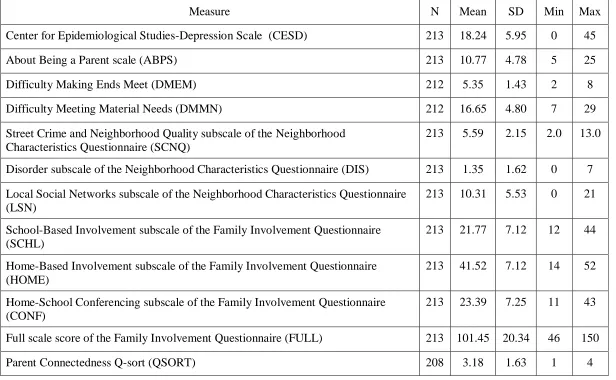
Table 3.1 Descriptive Statistics for Measures
Measure N Mean SD Min Max Center for Epidemiological Studies-Depression Scale (CESD) 213 18.24 5.95 0 45 About Being a Parent scale (ABPS) 213 10.77 4.78 5 25 Difficulty Making Ends Meet (DMEM) 212 5.35 1.43 2 8 Difficulty Meeting Material Needs (DMMN) 212 16.65 4.80 7 29 Street Crime and Neighborhood Quality subscale of the Neighborhood
Characteristics Questionnaire (SCNQ)
213 5.59 2.15 2.0 13.0
Disorder subscale of the Neighborhood Characteristics Questionnaire (DIS) 213 1.35 1.62 0 7 Local Social Networks subscale of the Neighborhood Characteristics Questionnaire
(LSN)
213 10.31 5.53 0 21
School-Based Involvement subscale of the Family Involvement Questionnaire (SCHL)
213 21.77 7.12 12 44
Home-Based Involvement subscale of the Family Involvement Questionnaire (HOME)
213 41.52 7.12 14 52
Home-School Conferencing subscale of the Family Involvement Questionnaire (CONF)
213 23.39 7.25 11 43
Bivariate correlations
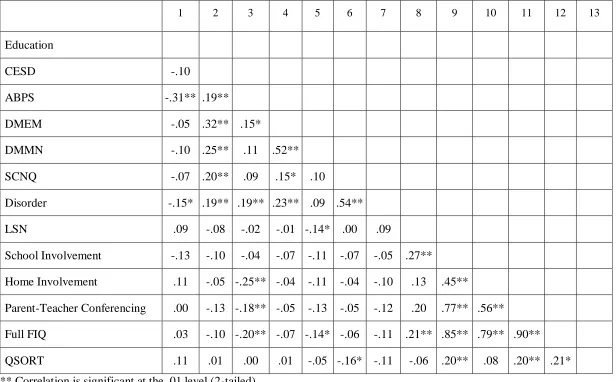
The correlations among study variables are shown in Table 3.2. The correlations between the variables were low to moderate with the highest reporting a .54 relationship between the Disorder and the Street Crime and Neighborhood Quality subscales of the NCQ. This finding suggests that the measures are not redundant and no composite scores needed to be created for the predictor variables.
The school involvement outcome measure of parent involvement was
significantly correlated with Local Social Networks. Higher levels of school involvement were associated with higher levels of local social networks. The outcome measure of home involvement was significantly correlated with parental efficacy. Higher levels of home involvement were associated with higher levels of parental efficacy regarding their child’s education. The parent-teacher conferencing outcome measure was also
22
Table 3.2 Correlations among Study Variables
1 2 3 4 5 6 7 8 9 10 11 12 13
Education
CESD -.10
ABPS -.31** .19** DMEM -.05 .32** .15*
DMMN -.10 .25** .11 .52** SCNQ -.07 .20** .09 .15* .10
Disorder -.15* .19** .19** .23** .09 .54** LSN .09 -.08 -.02 -.01 -.14* .00 .09
School Involvement -.13 -.10 -.04 -.07 -.11 -.07 -.05 .27**
Home Involvement .11 -.05 -.25** -.04 -.11 -.04 -.10 .13 .45**
Parent-Teacher Conferencing .00 -.13 -.18** -.05 -.13 -.05 -.12 .20 .77** .56**
Full FIQ .03 -.10 -.20** -.07 -.14* -.06 -.11 .21** .85** .79** .90** QSORT .11 .01 .00 .01 -.05 -.16* -.11 -.06 .20** .08 .20** .21* ** Correlation is significant at the .01 level (2-tailed)
Hierarchical Regression
The three FIQ subscale scores and the Parent Connectedness Q-sort were the criterion measures for this hierarchical regression. The predictor variables were entered for each analysis in the following order: Disorder subscale of the NCQ and Street Crimes and Neighborhood Quality subscale of the NCQ; Local Social Networks subscale of the NCQ; parent/caregiver education level; parent/caregiver depression; parent/caregiver sense of efficacy regarding their children’s education; and the Difficulty Making Ends Meet and Difficulty Meeting Material Needs scales. The results of the hierarchical regressions are presented in Tables 3.3 – 3.6. The standardized regression coefficients at each step, the F score, degrees of freedom, R2, and adjusted R2 are included on each table.
Hierarchical Regression Analysis Summary for School Involvement
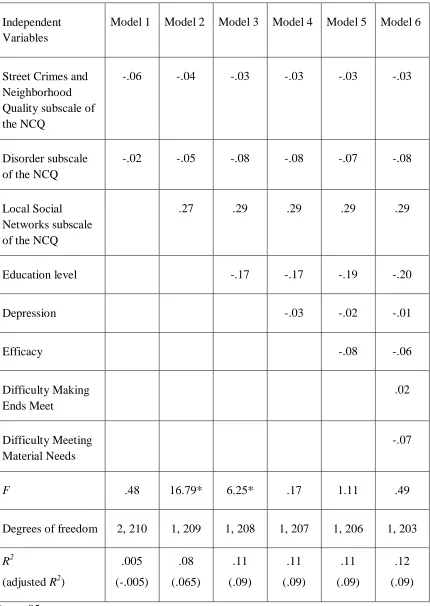
Model 1 examined the role of street crime and neighborhood quality and the amount of disorder in the neighborhood on the school involvement score. This model was not significant.
Model 2 included the local social networks subscale. This model produced a significant F statistic of F(1, 209) = 16.79, p <.001. The local social networks variable accounted for 7.5% of the total variance.
Model 3 added parent//caregiver education level. This model also produced a significant F statistic, F(1, 208) = 6.25, p = .01. Three percent more of the variance was explained by this model.
The addition of parental efficacy levels in Model 5 also did not account for any additional variance, failing to produce a significant F statistic.
Adding the economic distress variables, difficulty making ends meet and difficulty meeting material needs, for Model 6 did not generate a significant F statistic. With this final model, 10.5% of the total variance of school involvement was explained.
Table 3.3 Hierarchical Regression Analysis Summary for School Involvement
Independent Variables
Model 1 Model 2 Model 3 Model 4 Model 5 Model 6
Street Crimes and Neighborhood Quality subscale of the NCQ
-.06 -.04 -.03 -.03 -.03 -.03
Disorder subscale of the NCQ
-.02 -.05 -.08 -.08 -.07 -.08
Local Social Networks subscale of the NCQ
.27 .29 .29 .29 .29
Education level -.17 -.17 -.19 -.20
Depression -.03 -.02 -.01
Efficacy -.08 -.06
Difficulty Making Ends Meet .02 Difficulty Meeting Material Needs -.07
F .48 16.79* 6.25* .17 1.11 .49
Degrees of freedom 2, 210 1, 209 1, 208 1, 207 1, 206 1, 203
R2
(adjusted R2)
Hierarchical Regression Analysis Summary for Home Involvement
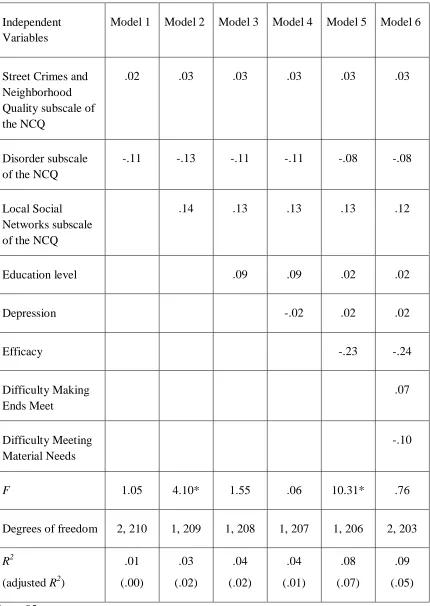
The first model examined the role of street crime and neighborhood quality and the amount of disorder in the neighborhood in relation to home involvement. This model was not significant.
Model 2 included the local social networks subscale. This model did produce a significant F statistic of F(1, 209) = 4.10, p =.04. The local social networks variable accounted for 2% of the total variance.
Model 3 added parent/caregiver education level and Model 4 included the parent/caregiver depression score. These models explained no additional variance.
The addition of parental efficacy levels generated a significant F statistic F(1, 206) = 10.31, p =.002. This fifth model accounted for 4% more of the total variance.
Model 6 added the economic distress variables, difficulty making ends meet and difficulty meeting material needs. This model was not significant. With this final model, 6% of the total variance of home involvement was explained.
Higher levels of contact with local social networks and higher levels of
parent/caregiver efficacy contributed to explain home-based parent involvement. Lower amounts of neighborhood disorder, lower street crime and higher neighborhood quality, higher parent/caregiver education levels, and lower amounts of economic distress may have contributed to the overall explanation of home-based parent involvement but did not produce significant results. Parent/caregiver depression did not explain any part of home-based involvement. These findings support home-home-based involvement as a second
Table 3.4 Hierarchical Regression Analysis Summary for Home Involvement
Independent Variables
Model 1 Model 2 Model 3 Model 4 Model 5 Model 6
Street Crimes and Neighborhood Quality subscale of the NCQ
.02 .03 .03 .03 .03 .03
Disorder subscale of the NCQ
-.11 -.13 -.11 -.11 -.08 -.08
Local Social Networks subscale of the NCQ
.14 .13 .13 .13 .12
Education level .09 .09 .02 .02
Depression -.02 .02 .02
Efficacy -.23 -.24
Difficulty Making Ends Meet .07 Difficulty Meeting Material Needs -.10
F 1.05 4.10* 1.55 .06 10.31* .76
Degrees of freedom 2, 210 1, 209 1, 208 1, 207 1, 206 2, 203
R2
(adjusted R2)
Hierarchical Regression Analysis Summary for Home-School Conferencing
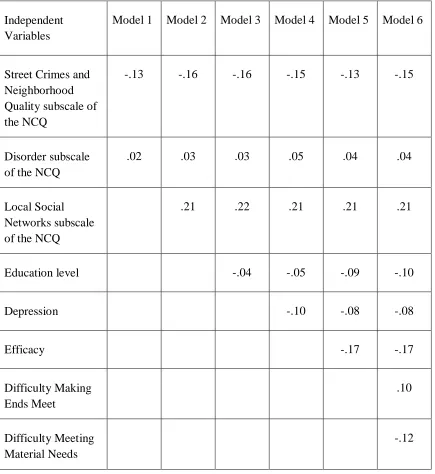
The first model examined the role of street crime and neighborhood quality and the amount of disorder in the neighborhood level on the parent-teacher conferencing score. This model was not significant.
The second model included the local social networks subscale. This model
produced a significant F statistic of F(1, 209) = 10.00, p = .002. The local social networks variable accounted for 5% of the total variance.
Model 3 added parent caregiver education level. This model did not produce a significant F statistic, accounting for no additional variance.
Model 4 included the parent/caregiver depression score. This model was also not significant.
Model 5 added parental efficacy levels which generated a significant F statistic
F(1, 206) = 5.90, p = .02. This model accounted for 3% more of the total variance. Adding the economic distress variables, difficulty making ends meet and difficulty meeting material needs, in Model 6 did not generate a significant F statistic. With this final model, 8% of the total variance of parent-school conferencing was explained.
Higher levels of contact with local social networks and higher levels of
have contributed to the explanation of home-school conferencing parent involvement, but the findings may be due to chance. Education did not add to the overall explanation. The results suggest that home-school conferencing is a third dimension of parent involvement. Like the previous two, home-school conferencing activity seems to occur in an ecological context with both proximal and distal variables.
Table 3.5 Hierarchical Regression Analysis Summary for Home-School Conferencing
Independent Variables
Model 1 Model 2 Model 3 Model 4 Model 5 Model 6
Street Crimes and Neighborhood Quality subscale of the NCQ
-.13 -.16 -.16 -.15 -.13 -.15
Disorder subscale of the NCQ
.02 .03 .03 .05 .04 .04
Local Social Networks subscale of the NCQ
.21 .22 .21 .21 .21
Education level -.04 -.05 -.09 -.10
Depression -.10 -.08 -.08
Efficacy -.17 -.17
Difficulty Making Ends Meet
.10
Difficulty Meeting Material Needs
F 1.54 10.00* .32 2.19 5.90* 1.28
Degrees of freedom 2, 210 1, 209 1, 208 1, 207 1, 206 2, 203
R2
(adjusted R2)
.01 (.01) .06 (.05) .06 (.04) .07 (.05) .10 (.07) .11 (.08) * p < .05
Hierarchical Regression Analysis Summary for Q-Sort
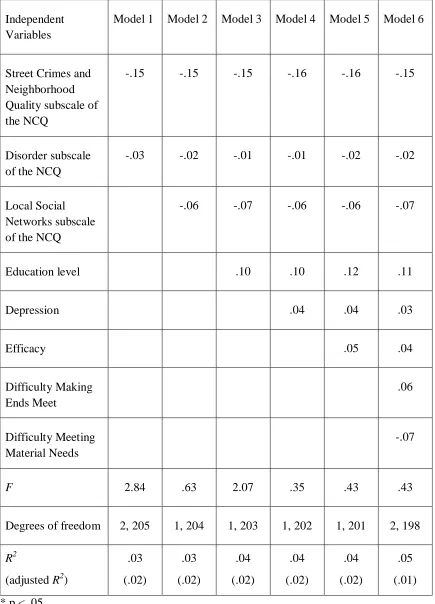
The first model examined the role of street crime and neighborhood quality and the amount of disorder in the neighborhood level on the parent connectedness Q-Sort score. This model approached significance but did not produce a significant F statistic.
The second model included the local social networks subscale. This model did not generate a significant F statistic, accounting for no variance.
The third model added parent//caregiver education level and Model 4 included the parent/caregiver depression score. These models explained no additional variance.
The fifth model including the efficacy scale also explained no additional variance. Model 6, adding the economic distress variables, difficulty making ends meet and difficulty meeting material needs, did not generate a significant F statistic. With this final model, none of the total variance for teacher perception of parented connectedness Q-Sort was explained.
Table 3.6 Hierarchical Regression Analysis Summary for Q-Sort
Independent Variables
Model 1 Model 2 Model 3 Model 4 Model 5 Model 6
Street Crimes and Neighborhood Quality subscale of the NCQ
-.15 -.15 -.15 -.16 -.16 -.15
Disorder subscale of the NCQ
-.03 -.02 -.01 -.01 -.02 -.02
Local Social Networks subscale of the NCQ
-.06 -.07 -.06 -.06 -.07
Education level .10 .10 .12 .11
Depression .04 .04 .03
Efficacy .05 .04
Difficulty Making Ends Meet .06 Difficulty Meeting Material Needs -.07
F 2.84 .63 2.07 .35 .43 .43
Degrees of freedom 2, 205 1, 204 1, 203 1, 202 1, 201 2, 198
R2
(adjusted R2)
CHAPTER
4
D
ISCUSSIONDifferent types of parent involvement is a long-standing idea. Berger (1991) noted that current definitions of parent involvement fall under five types: parent as 1) active partner for education at home; 2) decision maker; 3) school staff/volunteer; 4) home-school liaison; and 5) advocate of home-school educational goals. Research specifying different types of parent involvement however, is not plentiful. This study adds to parent
involvement literature by demonstrating support for three dimensions of parent involvement.
The current study was designed to examine a multidimensional ecological model of parent involvement with a Head Start sample. This question was explored using
determinants of parent involvement identified in the literature (e.g., role concept, parental education, parental depression level, parenting efficacy, economic stress, and perceptions of their neighborhoods). These determinants explained 5% - 12% of the variance. The proximal and distal variables studied in this sample suggest that parent involvement does occur in an ecological context. Support was also given for a multidimensional
Eccles and Harold’s (1996) ecological framework asserted the most proximal influences on parent involvement are parent and teacher beliefs, including beliefs about self-efficacies. Parental self-efficacy was found to significantly explain home
involvement and home-school conferencing in this study. Teacher beliefs about parent involvement were crucial to Eccles and Harold’s model. This study did not find support for this dimension.
Pinderhughes et al.’s (2001) ecological model included neighborhood
characteristics similar to those used in the current study. These variables were used by Pinderhughes et al. to explain parent participation in their children’s lives in terms of parental warmth, consistent parental discipline, and harsh interactions, as opposed to parent involvement in education. Neighborhood characteristics were found in their study to significantly impact the models, supporting the need to include them in the current study. Parental connection to local social networks was the most significant determinant explaining school involvement and home-school conferencing in the current study. It was also a significant determinant explaining home involvement. Disorder and street crime and neighborhood quality added to the explanation of all three dimensions. Neighborhood characteristics then are essential to our understanding of parent involvement.
Relationships between local social networks and parent involvement in children’s education appear to be strong. This has implications for how schools think of garnering parent involvement. Social networks are in place for many Head Start parents.
involvement in this study. Parents less involved in social networks were then less
involved in their children’s education. Higher levels of depression might be expected for those more isolated; however, parental depression was not a significant predictor for any dimension of parent involvement in this study. The correlation between depression and local social networks was in the expected direction, those with higher local social networks reported lower feelings of depression, but the finding was not significant. Potential reasons for this disconnect are discussed below.
Economic distress, found by Caughy, O’Campo, and Brodsky (1999) and Wilson (1987) to be related to parent involvement, did not significantly add to any of the
dimensions in this study. Being the final variable entered may have affected this, but the reasons listed under future directions are more likely.
Limitations of the Study
Waanders’ (2002) study used data that was collected at the end of the school year. The current study used data that was collected in the fall within the first two months of the school year. The decision to use fall data rather than spring data was due to a parent involvement intervention occurring throughout the year at two of the centers. This intervention may have affected comparability between and among centers. The parent involvement scores reported in the fall may reflect what parents intended to do, rather than demonstrating actual participation levels through the year. Using fall data may have affected the variance by not accounting for actual parent involvement.
It is conceivable that the factor was not sensitive enough to determine depression on its own.
Approximately 55% of parents invited to participate in the study did participate. Since the study was voluntary, self-selection bias may have limited valuable information. Those parents/caregivers who selected not to participate in the study may also refuse or be unable to participate in parent involvement activities. Not having them in this study limits what can be concluded about non-participants.
How this Study Links with Waanders’ (2002) Study
Like Waanders’ (2002) study, this investigation hypothesized that Head Start parent involvement is influenced by a combination of determinants from different ecological levels. In addition, both studies hypothesized that there is a multidimensional nature to parent involvement and that the dimensions are affected by different
determinants to varying degrees. The current study supported all of the significant findings from Waanders’ (2002) study for the School-Based, Based, and Home-School Conferencing dimensions of parent involvement. Multidimensionality of parent involvement occurring within multiple ecological levels is then reinforced by this study.
Little support for Waanders’ (2002) results relating to the teacher perception of parent connectedness Q-sort was found in the current study, however. While all distal variables included in the current study and the proximal variable of parent/caregiver education level contributed, there were no significant explanations of teacher perception of parent connectedness in the current study. Waanders (2002) found these same
variables (i.e., Street Crimes and Neighborhood Quality, Neighborhood Disorder,
included as a variable in this study provided a clear explanation for teacher perception of parent connectedness. These contrasting results may be due to the Fall timing of data collection for the current study. Teacher perceptions of parent involvement may have been collected before their perceptions had adequate time to form.
This investigation added to Waanders’ work by looking at the influence of the various determinants more specifically. The hierarchical regression analyses chosen for this paper allowed for a clearer understanding of how the determinants’ influences built upon one another to explain the studied dimensions of parent involvement. To increase generalizability, the sample size for this study was larger than Waanders’ study and included participants from a rural Head Start center. Based on the literature cited in the introduction, parent/caregiver depression was added to the list of investigated
determinants.
It was puzzling that the determinants selected for this study, which were all supported in the literature, did not furnish a more comprehensive explanation (beyond 5% - 12%) of parent involvement dimensions. The sample was not homogeneous, as demonstrated by acceptable variability within each determinant. This study may have excluded core elements, but, more likely, there are several additional determinants each of which would have added a small piece to the overall explanation. The author
Other Future Directions
Future studies attempting to identify the influence of determinants of parent involvement should include the size of the community as a distal variable. Neighborhood variables such as disorder, street crime, and local social networks exist in the context of the community-at-large. This is not to suggest that disorder and street crime do not exist in smaller communities, but there may be significant differences between an urban and a rural community.
Future studies may include the full 20-item CES-D scale instead of the 12-item depressive affect factor for the reasons mentioned in the study limitations. The economic distress scales used in this study, Difficulty Making Ends Meet and Difficulty Meeting Material Needs, may not have been sensitive enough to assess different levels of
economic distress in this sample. Because it is a low-income sample by definition, a more precise tool may be warranted for future studies.
Finally, the literature asserts the value of parent involvement on children’s achievement. Future work may look at the effect that the various dimensions of parent involvement have on child outcomes.
Conclusion
R
EFERENCESBarnes McGuire, J. (1997). The reliability and validity of a questionnaire describing neighborhood characteristics relevant to families and young children living in urban areas. Journal of Community Psychology, 25(6), 551 - 566.
Belsky, J. (1984). The determinants of parenting: A process model. Child Development, 55, 83 - 96.
Berger, E.H. (1991). Parent involvement: Yesterday and today. Elementary School Journal, 91(3), 209 - 219.
Berger, E.H. (1991). Parents as partners in education: The school and home working together. Columbus, OH: Merrill.
Bhagwanji & McCollum. (1998). Parent involvement in preschool programs for children at risk for academic failure. Infant-Toddler Intervention, 8(1), 53 - 66.
Brand, S. (1996). Making parent involvement a reality: Helping teachers develop partnerships with parents. Young Children, 51, 76 - 81.
Bronfenbrenner, U. (1979). The ecology of human development. Cambridge, MA: Harvard University Press.
Brooks-Gunn, J., Duncan, G.J., & Maritato, N. (1997). Poor families, poor outcomes: The well-being of children and youth. In G.J. Duncan & J. Brooks-Gunn (Eds.),
Consequences of growing up poor (pp. 1 - 17). New York, NY: Russell Sage
Caughy, M.O., O’Campo, P., & Brodsky, A.E. (1999). Neighborhoods, families, and children: Implications for policy and practice. Journal of Community Psychology, 27(5), 615 - 633.
Coleman, J.S. (1987). Families and schools. Educational Researcher, 32 - 38.
Comer, J.P. & Haynes, N.M. (1991). Parent involvement in the schools: An ecological approach. Elementary School Journal, 91(3), 271 - 278.
Conduct Problems Prevention Research Group. (1992). A developmental and clinical model for the prevention of conduct disorder. Development and Psychopathology, 4, 509 - 527.
Conger, R.D., Conger, K.J., Elder, G.H., Jr., Lorenz, F.O., Simons, R.L., & Whitbeck, L.B. (1992). A family process model of economic hardship and adjustment of early adolescent boys. Child Development, 63, 526 - 541.
Connors, L.J. & Epstein, J.L. (1995). Parent and school partnerships. In M.H. Bornstein (Ed.), Handbook of parenting, Vol. 4: Applied and practical parenting (pp. 437-458). Hillsdale, NJ, US: Lawrence Erlbaum Associates, Inc.
Coulton, C.J., Korbin, J.E., Su, M., & Chow, J. (1995). Community level factors and child maltreatment rates. Child Development, 66, 1262 - 1276.
Davis, J.C. (1986). Statistics and data analysis in geology, 2nd edition. New York, NY: John Wiley & Sons.
Epstein, J.L. (1987). Toward a theory of family-school connections: Teacher practices and parent involvement. In K. Hurrelmann, F. Kaufmann, and F. Losel (Eds.),
Social intervention: Potential and constraints (pp. 121 - 136). New York/Berlin: de Gruyter.
Epstein, J.L. (1995). School/family/community partnerships: Caring for the children we share. Phi Delta Kappan, 77, 701 - 712.
Epstein, J.L., Coates, L., Salinas, K.C., Sanders, M.G., & Simon, B.S. (1997). School,
family, and community partnerships: Your handbook for action. Thousand Oaks,
CA: Corwin Press, Inc.
Epstein, J.L. (2001). School, family, and community partnerships: Preparing educators
and improving schools. Boulder, Colorado: Westview Press.
Fantuzzo, J., Tighe, E. & Childs, S. (2000). Family involvement questionnaire: A multivariate assessment of family participation in early childhood education.
Journal of Educational Psychology, 92, 367 - 376.
Foster, S.M. (1994). Successful parent meetings. Young Children, 50, 78 - 80.
Garmezy, N. (1991). Resiliency and culnerability to adverse developmental outcomes associated with poverty. American Behavioral Scientist, 34(4), 416 – 430. Grolnick, W.S. & Slowiaczek, M.L. (1994). Parents’ involvement in children’s
schooling: A multidimensional conceptualization and motivational model. Child Development, 65, 237 - 252.
Helm, J. (1994). Family theme bags: An innovative approach to family involvement in the school. Young Children, 49, 48 - 53.
Henderson, A.T. (1988). Parents are a school’s best friends. Phi Delta Kappan, 70(2), 148 - 153.
Hoover-Dempsey, K.V., Bassler, O.C., & Brissie, J.S. (1992). Explorations in parent-school relations. Journal of Educational Research, 85, 287 - 294.
Hoover-Dempsey, K.V. & Sandler, H.DM. (1995). Parental involvement in children’s education: Why does it make a difference? Teachers College Record, 97(2), 310 - 331.
Hoy, W.K. & Woolfolk, A.E. (1993). Teachers’ sense of efficacy and the organizational health of schools. The Elementary School Journal, 93, 356 - 372.
Krishnakumar, A. & Black, M.M. (2002). Longitudinal predictors of competence among african american children: The role of distal and proximal risk factors. Applied Developmental Psychology, 23, 237 - 266.
Lamb-Parker, F., Piotrkowski, C.S., Baker, A.J.L., Kessler-Sklar, S., Clark, B., & Peay, L. (2001). Understanding barriers to parent involvement in head start: A research-community partnership. Early Childhood Research Quarterly, 16, 35-51.
Linney, J.A. (2000). Assessing ecological constructs and community context. In J. Rappaport and E. Seidman (Eds.), Handbook of community psychology (pp.647 - 668). New York: Kluwer Academic/Plenum Publishers.
Marcon, R.A. (1999). Positive relationships between parent school involvement and public school inner-city preschoolers’ development and academic performance.
McGillicuddy-Delisi, A.V. & Sigel, I.E. (1995). Parental beliefs. In M.H. Bornstein (Ed.), Handbook of Parenting, Volume 3: Status and Social Conditions of
Parenting (Pp. 333-358). Mahwah, NJ: Lawrence Erlbum Associates, Publishers.
Okazaki, L. and Divecha, D. J. (1993). Development of parental beliefs. In Tom luster and Lynn Okagani Eds. Parenting: An Ecological Perspective (Pp. 35-67). Hillsdale NJ: Lawrence Erlbaum Associates, Inc.
Pinderhughes, E.E., Nix, R., Foster, E.M., Jones, D., & The Conduct Problems
Prevention Research Group. (2001). Parenting in context: Impact of neighborhood poverty, residential stability, public services, social networks, and danger on parental behaviors. Journal of Marriage and Family, 63, 941 - 953.
Radloff, L.S. (1977). The CES-D scale: A self-report depression scale for research in the general population. Applied Psychological measurement, 1, 385 - 401.
Radloff, L. (1975). Sex differences in depression: The effects of occupation and marital status. Sex Roles: A Journal of Research, I 249 - 266
Roosa, M.W., Jones, S., Tein, J., & Cree, W. (2003). Prevention science and
neighborhood influences on low-income children’s development: Theoretical and methodological issues. American Journal of Community Psychology, 31(1/2), 55 - 72.
Schaefer. E.S. (1991). Goals for parent and future-parent education: Research on parental beliefs and behavior. The Elementary School Journal, 91(3), 239 - 247.
Seefeldt, C., Denton, K., Galper, A. & Younoszai, T. (1999). The relation between head start parents’ participation in a transition demonstration, education, efficacy, and their children’s academic abilities. Early Childhood Research Quarterly, 14(1), 99 - 109.
Shumow, L, Vandell, D.L. & Posner, J. (1999). Risk and resilience in the urban neighborhood: Predictors of academic performance among low-income elementary school children. Merrill-Palmer Quarterly, 45(2), 309 - 331. Simcha-Fagan, O. & Schwartz, J.E. (1986). Neighborhood and delinquency: An
assessment of contextual effects. Criminology, 24(4), 667 - 703.
Springate, K.W. & Stegelin, D.A. (1999). Building school and community partnerships through parent involvement. New Jersey: Prentice Hall, Inc.
Stamp, L.N. & Groves, M.M. (1994). Strengthening the ethic of care: Planning and supporting family involvement. Dimensions of Early Childhood, 22(2), 5 - 9. Swick, K.J. (1991). Teacher-parent partnerships to enhance school success in early
childhood education. Washington, D.C.: National Education Association of the United States.
Swick, K. (1994). Family involvement: An empowerment perspective. Dimensions of Early Childhood, 22. 10 - 13.
Webster-Stratton, C. (1997). From parent training to community building. Families in Society: The Journal of Contemporary Human Services, 78(2), 156 - 171. West, J., Denton, K., & Germino-Hausken E. (2000). America’s Kindergartners.
Retrieved April, 2004, from http://nces.ed.gov/pubs2000/2000070.pdf
A
PPENDIXA
–
C
ENTER FORE
PIDEMIOLOGICALS
TUDIES-D
EPRESSION SCALEI am going to read a list of ways you may have felt or behaved. Please tell me how often you have felt this way during the past week: rarely or never, some or a little, occasionally or a moderate amount of time or most or all of the time? (Circle one response for each item.)
Rarely or Never
Some or a Little
Occasionally or Moderate
Most or All Bothered by things that usually don’t bother you 1 2 3 4 You did not feel like eating; your appetite was
poor
1 2 3 4
That you could not shake off the blues, even with help from your family and friends
1 2 3 4
You had trouble keeping your mind on what you were doing
1 2 3 4
Depressed 1 2 3 4
That everything you did was an effort 1 2 3 4
Fearful 1 2 3 4
You sleep was restless 1 2 3 4 You talked less than usual 1 2 3 4
Lonely 1 2 3 4
Sad 1 2 3 4
A
PPENDIXB
–
A
BOUTB
EING AP
ARENT SCALEAbout Being A Parent
Please circle the answer that shows how much you agree or disagree with these statements.
Strongly Disagree
Disagree Sort of Disagree
Sort of Agree
Agree Strongly Agree
1. Parents are very limited in how much they can teach their children because a child’s teacher has a large influence on learning.
1 2 3 4 5 6
2. When it comes right down to it, a parent can’t do much to help their children at school because most of a child’s motivation and school performance depends on the teacher and classroom environment.
1 2 3 4 5 6
3. If teachers would do more for their students, parents could do more for their children.
1 2 3 4 5 6
4. Parents do not have a powerful influence on
children’s achievement when all factors are considered
1 2 3 4 5 6
5. Even a parent with good teaching abilities cannot teach their child as well as a classroom teacher.
A
PPENDIXC
–
D
IFFICULTYM
AKINGE
NDSM
EETA
NDD
IFFICULTYM
EETINGM
ATERIALN
EEDS SCALESDifficulty Making Ends Meet
Household Resources. Please circle the answer that best describes your situation: 1. How much difficulty do you have paying bills each month?
1 2 3 4
No difficulty at all A little difficulty Some difficulty A great deal of difficulty
2. In general, how much money do you have left over at the end of the month?
1 2 3 4
More than enough money left over
Some money left over
Just enough to make ends meet
Not enough to make ends meet
Difficulty Meeting Material Needs
3. We have the money we need for housing.
1 2 3 4 5
Strongly Agree Agree Neither Agree nor Disagree
Disagree Strongly Disagree
4. We have the money we need for transportation.
1 2 3 4 5
Strongly Agree Agree Neither Agree nor Disagree
5. We have the money we need for clothes.
1 2 3 4 5
Strongly Agree Agree Neither Agree nor Disagree
Disagree Strongly Disagree
6. We have the money we need for household items.
1 2 3 4 5
Strongly Agree Agree Neither Agree nor Disagree
Disagree Strongly Disagree
7. We have the money we need for food.
1 2 3 4 5
Strongly Agree Agree Neither Agree nor Disagree
Disagree Strongly Disagree
8. We have the money we need for medical care.
1 2 3 4 5
Strongly Agree Agree Neither Agree nor Disagree
Disagree Strongly Disagree
9. We have the money we need for recreational activities (for example, fun outings for the family).
1 2 3 4 5
Strongly Agree Agree Neither Agree nor Disagree
A
PPENDIXD
–
N
EIGHBORHOODC
HARACTERISTICSQ
UESTIONNAIREWe would like to learn about your neighborhood. Please mark your answers to the following questions with an X.
1. How do you feel about your neighborhood as a place to live? Would you say it is… ___ Excellent ___ Good ___ Average ___ Bad ___ Very
Bad 2. How do you feel about your neighborhood as a place to bring up children? Would
you say it is…
___ Excellent ___ Good ___ Average ___ Bad ___ Very Bad 3. How easy is it to notice strangers in your neighborhood?
___ Very easy ___ Somewhat easy ___ Somewhat difficult ___ Very difficult 4. How many adults do you know who live in your neighborhood?
___ None ___ A few ___ Many ___ Very many 5. How many children do you know who live in your neighborhood? ___ None ___ A few ___ Many ___ Very many 6. About how many adult friends do you have in the neighborhood?
___ None ___ 1 or 2 ___ 3 to 5 ___ 6 to 9 ___ 10 or more 7. How many adult relatives and in-laws do you have in this neighborhood (NOT
including those in your household)?
How often do you and your neighbors do the following things? Please mark your answers with an X.
Often Sometimes Never 8. Do favors for each other ______ ______ ______ 9. Share information about things like
school or children’s programs ______ ______ ______ 10. Watch each other’s property when
at work or on vacation ______ ______ ______ 11. Ask advice about personal things ______ ______ ______ 12. Have parties together ______ ______ ______ 13. Visit in each other’s homes ______ ______ ______
During the past few months, how often have you heard fo these things happening in your neighborhood? Please mark your answer with an X.
Often Sometimes Never 14. A fight in which a weapon was
used
_____ _____ _____
15. Youth gang violence _____ _____ _____ 16. People being hit by the police _____ _____ _____ 17. Someone badly hurt. _____ _____ _____
18. In general, would you say that your neighborhood has changed for the better,
changed for the worse, or stayed the same in the past couple of years? Please mark your answer with an X.
19. How do you think your neighborhood compares with most other neighborhoods in this city? Would you say it is…
Less dangerous About the same More dangerous ___________ ___________ ______________
Are the following true or false in your neighborhood?
True False 20. Many people in this neighborhood are afraid to go out at
night
____ ____
21. You’re taking a chance if you walk in the neighborhood after dark.
____ ____
Here are some problems that happen in neighborhood. Do these problems happen in your neighborhood?
Yes No 22. Litter or trash on the sidewalks and streets _____ _____ 23. Graffiti on buildings and walls _____ _____ 24. Drug addicts in the neighborhood? _____ _____ 25. Alcoholics and excessive drinking in public? _____ _____ 26. Empty or abandoned houses or buildings? _____ _____ 27. Burned down buildings? _____ _____ 28. Unemployed men hanging out in the streets? _____ _____ Are these crimes a problem in your neighborhood?
A
PPENDIXE
–
P
ARENTS,
C
HILDREN,
ANDE
DUCATION SCALEParents, Children, and Education
How often do you do these things? Please fill in the circle.
Rarely Sometimes Often Always 1. I attend conferences with the teacher to
talk about my child’s learning or behavior.
o
o
o
o
2. I schedule meetings with administratorsto talk about problems or to gain information.
o
o
o
o
3. I talk to my child’s teacher about his/her
daily school routine.
o
o
o
o
4. I limit my child’s TV and videowatching.
o
o
o
o
5. I review my child’s school work.
o
o
o
o
6. I take my child to the public library.o
o
o
o
7. I participate in planning classroomactivities with the teacher.
o
o
o
o
8. I attend parent workshops or trainingoffered by my child’s school.
o
o
o
o
9. I talk to my child’s teacher about theclassroom rules.
o
o
o
o
10. I take my child to school in the
morning.
o
o
o
o
11. I keep a regular morning and bedtime
12. I praise my child for his/her school
work in front of the teacher.
o
o
o
o
13. I share stories with my child aboutwhen I was in school.
o
o
o
o
14. I take my child places in the communityto learn special things.
o
o
o
o
15. I talk to my child’s teacher on thetelephone.
o
o
o
o
16. I participate in planning school trips for
my child.
o
o
o
o
17. I talk to the teacher about how my child
gets along with his/her classmates in school.
o
o
o
o
18. I check to see that my child has a placeat home where books or school materials are kept.
o
o
o
o
19. I volunteer in my child’s classroom.
o
o
o
o
20. I participate in fundraising activities atmy child’s school
o
o
o
o
21. The teacher and I write notes to each
other about my child or school activities.
o
o
o
o
22. I talk to my child’s teacher about mychild’s accomplishments.
o
o
o
o
23. I talk about my child’s learning effortsin front of friends and relatives.
o
o
o
o
24. I talk with my child about how much Ilove learning new things.
o
o
o
o
25. I bring home learning material for my27. I participate in parent and family social
activities at my child’s school.
o
o
o
o
28. I hear teachers tell my child how muchthey love learning.
o
o
o
o
29. I maintain clear rules at home that my
child should obey.
o
o
o
o
30. I talk to my child’s teacher about
his/her difficulties at school.
o
o
o
o
31. I spend time with my child working onreading and writing skills.
o
o
o
o
32. I arrange times at home when mychild’s classmates can come and play.
o
o
o
o
33. I talk with other parents about schoolmeetings and events.
o
o
o
o
34. I pick my child up from school in theafternoon.
o
o
o
o
35. I talk with people at my child’s school about training or career development opportunities for myself.
o
o
o
o
36. I talk with my child’s teacher about school work he/she is expected to practice at home.
o
o
o
o
37. I talk with my child’s teacher about our
personal and family matters.
o
o
o
o
38. I meet with other parents from mychild’s classroom outside of school.
o
o
o
o
39. I feel that teachers and administratorswelcome and encourage parents to be involved at school.
o
o
o
o
40. I feel that parents in my child’s
41. I spend time with my child working on creative activities (like singing, dancing, drawing, storytelling)
o
o
o
o
42. I spend time with my child working on