University of South Carolina
Scholar Commons
Theses and Dissertations
2016
Exclusive π− Electroproduction off the Neutron in
Deuterium in the Resonance Region
Ye Tian
University of South Carolina
Follow this and additional works at:https://scholarcommons.sc.edu/etd
Part of thePhysics Commons
This Open Access Dissertation is brought to you by Scholar Commons. It has been accepted for inclusion in Theses and Dissertations by an authorized administrator of Scholar Commons. For more information, please [email protected].
Recommended Citation
Tian, Y.(2016).Exclusive π− Electroproduction off the Neutron in Deuterium in the Resonance Region.(Doctoral dissertation). Retrieved
Exclusive π− Electroproduction off the Neutron in Deuterium in the Resonance Region
by
Ye Tian
Bachelor of Science Lanzhou University 2005
Master of Science Lanzhou University 2008
Submitted in Partial Fulfillment of the Requirements
for the Degree of Doctor of Philosphy in
Physics
College of Arts and Sciences
University of South Carolina
2016
Accepted by:
Ralf Gothe, Major Professor
Yordanka Ilieva, Committee Member
Kijun Park, Committee Member
Matthias Schindler, Committee Member
c
Copyright by Ye Tian, 2016
Dedication
To my grandparents Yonggen Tian and Baozhi Yin, as well as my parents Xiaogang
Acknowledgments
First of all, I wish to express my sincere gratitude to my advisor, Prof. Ralf Gothe,
without whose guidance this dissertation would never have been possible. He has
always been extremely helpful and encouraging. His patience, motivation, and
im-mense knowledge influenced every aspect of my PhD study. Beside, he always helped
me to improve my English skills whenever he got a chance. I could not have imagined
having a better advisor and mentor for my PhD study.
I would also like to thank the other members of my PhD committee, Yordanka
Ilieva, Matthias Schindler, and Kijun Park, for their great help with my PhD research
and job search. Also a special thanks goes to Viktor Mokeev, for offering a lot of
advice on my research and help with my job search.
My sincere thanks also goes to my former and present peers and colleagues. Evan
Phelps showed me how to use “ROOT” to analyze data and also helped me to debug
my codes despite his busy schedule. Arjun Trivedi worked together with me along
this amazing trip. His encouragement and help gave me a lot of strength. Gleb
Fedo-tov guided me through the complex and confusing simulation, cooking and analysis
related software. Zhiwen Zhao and Haiyun Lu helped me make a smooth transition
at the beginning of my PhD study and offered me many useful information for my job
search. Iuliia Skorodumina, Gary Hollis, Nick Tyler, and Chris McLauchlin carefully
read an early draft of this dissertation and offered me a lot of helpful and constructive
suggestions.
I would like to thank my parents Zhi Li and Xiaogang Tian, my grandparents,
taking care of my daughter Melody. I also want to thank my friends Tongtong Cao,
Yajie Ni, Jing Li, Hongyue Duyang, Manlai Liang, and Shu Yan, for their friendship
and support.
Last but not the least, I cannot express how grateful I am to my husband Honghai
Xu for his continuous encouragement and unconditional support and help, without
Abstract
This dissertation focuses on extracting the exclusive γ∗n(p)→pπ−(p) reaction cross
section from deuterium data. The existingγ∗n →pπ− event generator is modified to
include the spectator (proton) information based on the CD-Bonn potential [28] to
simulate the real data process. With this method, the exclusive quasi-free process is
isolated successfully as demonstrated by the comparison of the spectator momentum
distribution of the simulation with the missing momentum distribution of the data,
and the kinematical final-state-interaction contribution factor RF SI is extracted
di-rectly from the data according to the ratio between the exclusive quasi-free and full
cross sections. The results of this dissertation are new the exclusive and quasi-free
cross sections off neutrons bound in deuterium. Furthermore, the corresponding
structure functions are extracted from those cross sections as well. The experiment
was done in Hall B at the Thomas Jefferson National Laboratory (JLab) by using the
CEBAF Large Acceptance Spectrometer (CLAS) detector, the “e1e” run data off a
liquid deuterium target will provide these final results with a kinematic coverage for
the hadronic invariant mass (W) up to 1.9 GeV and in the momentum transfer (Q2)
Table of Contents
Dedication . . . iii
Acknowledgments . . . iv
Abstract . . . vi
List of Tables . . . x
List of Figures . . . xi
Chapter 1 Introduction and Overview . . . 1
1.1 QCD and Non-Perturbative Approaches . . . 3
1.2 Single-Pion Electroproduction off the Moving Neutron . . . 8
1.3 Reaction Models . . . 20
1.4 Summary . . . 22
Chapter 2 Experimental Facility . . . 23
2.1 Continuous Electron Beam Accelerator Facility (CEBAF) . . . 23
2.2 CEBAF Large Acceptance Spectrometer (CLAS) . . . 24
2.3 Superconducting Toroidal Magnet . . . 25
2.4 Drift Chambers . . . 26
2.5 Cherenkov Detector . . . 26
2.7 Electromagnetic Calorimeter . . . 30
2.8 Triggering and Data Acquisition . . . 32
2.9 Experiment Condition . . . 32
Chapter 3 Data Analysis . . . 33
3.1 Data Processing . . . 33
3.2 Quality Check . . . 34
3.3 Electron Identification . . . 35
3.4 Pion Identification . . . 40
3.5 Proton Identification . . . 44
3.6 Kinematic Corrections . . . 46
3.7 Electron Fiducial Cuts . . . 50
3.8 Pion Fiducial Cuts . . . 54
3.9 Proton Fiducial Cuts . . . 59
3.10 Event Selection . . . 62
Chapter 4 Simulation . . . 66
4.1 Introduction . . . 66
4.2 Event Generator . . . 67
4.3 GSIM . . . 68
4.4 GPP . . . 69
4.5 RECSIS . . . 71
5.1 Kinematic Binning . . . 73
5.2 Bin Centering Corrections . . . 75
5.3 Luminosity . . . 76
5.4 Empty-Target Background Subtraction . . . 77
5.5 Acceptance Corrections . . . 79
5.6 Radiative Corrections . . . 80
5.7 Background Subtraction . . . 81
5.8 Inclusive Cross Section . . . 82
Chapter 6 Results . . . 86
6.1 Cross Sections . . . 86
6.2 Kinematical Final State Interaction Contribution . . . 92
6.3 Structure Functions . . . 95
6.4 Legendre Polynomials Expansion . . . 97
6.5 Systematic Uncertainty . . . 100
Chapter 7 Summary and Conclusions . . . 114
Bibliography . . . 116
List of Tables
Table 1.1 Summary of quark properties. . . 4
Table 1.2 Summary of the single-pion electronproduction data off bound neutron in the deuterium target. . . 9
Table 5.1 W and Q2 binning of the analysis. . . 74
Table 5.2 cosθπ∗− and φ∗π− binning of the analysis. . . 75
Table 6.1 Summary of sources of the average systematical uncertainty. . . 112
Table A.1 Parameters of pion θ versus pcut functions. . . 122
Table A.2 Parameters of proton θ versus p cut functions. . . 122
Table A.3 ∆T shift parameters. . . 123
Table A.4 ∆T shift parameters continued. . . 124
Table A.5 Parameters of the proton momentum correction function. . . 125
Table A.6 Parameters of pion θ versus φ cut functions. . . 125
List of Figures
Figure 1.1 The fundamental interaction diagrams of QCD [56]: (a)
emis-sion of a gluon by a quark, (b) splitting of a gluon into a
quark-antiquark pair, (c) and (d) self-coupling of gluons. . . 4
Figure 1.2 The resonance process of single-pion electroproduction off a
neutron in deuterium. The initial proton in the deuteron is
treated as the spectator, named as Ps. . . 10
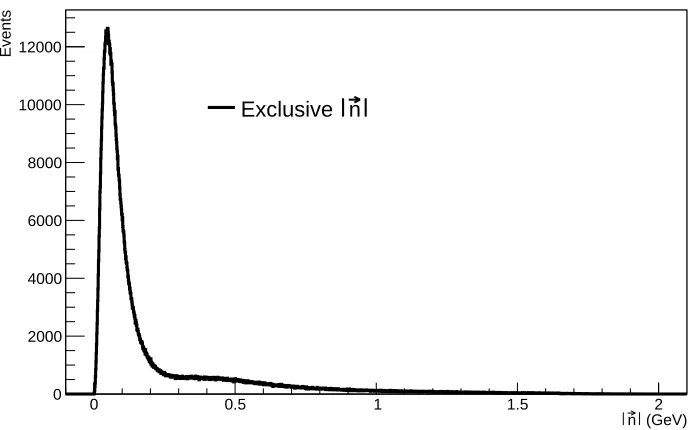
Figure 1.3 The momentum distribution of initial neutron in the exclusive
γ∗n(p)→ pπ−(p) process, which is moving in the deuteron in
the lab frame. . . 13
Figure 1.4 (Color online) The comparison of W distributions. Black line
presents Wf, blue line shows Wi calculated by setting nµ =
(−P~s, En) (En with Eq. (1.20)). The other colors present the
Wi distribution by settingnµ to (−P~s, mn) (cyan), (0, mn)
(ma-genta), (−P~s, mn+2 k
2
n
2mn+2MeV) (blue), (−
~
Ps, mn+ k
2
n
2mn+1MeV)
(orange), and (−P~s, mn− k2
n
2mn −1MeV) (green). . . 14
Figure 1.5 Kinematic sketch as in the text for the three leading terms in
γ∗+D→π−+p+pprocess (a) quasi-free, (b) pp re-scattering,
and (c) pπ− re-scattering. Diagrams (b) and (c) are two main
sources of kinematical final state interactions. . . 15
Figure 1.6 Kinematics of π− electroproducton off a moving neutron. The
leptonic neutron rest frame plane is formed byeµandeµ0, where
k, E, k0, and E0 are corresponding momentum and energy of
the incoming and outgoing electrons. qµ is the virtual photon
four momentum and ν is the transfered energy. The hadronic
CM frame plane is determined by final particles p and π, here
θ∗p and θπ∗ are their polar angles andφ∗π the azimuthal angle of
π−. . . 16
Figure 1.7 The X and Y projections of the ˆznrest in the CM frame are
Figure 1.8 The X and Y projections of the ˆznrest in the CM frame are
plotted against each other for final-state-interaction dominated
events. . . 18
Figure 2.1 Schematic diagram of the CEBAF accelerator shows the
injec-tor (serves as a source of electrons), linear accelerainjec-tors (LINAC),
recirculation arcs and three experimental halls. . . 23
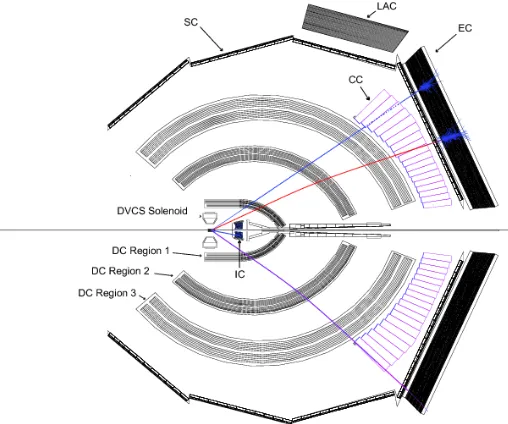
Figure 2.2 Schematic view of the CLAS detector . . . 24
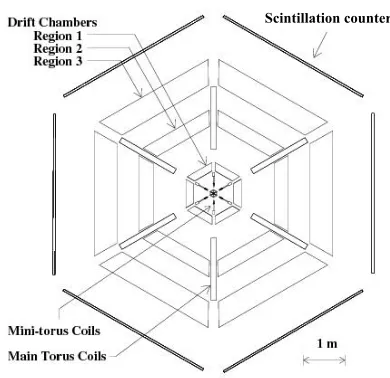
Figure 2.3 The azimuthal view of the CLAS with six independent sectors.
The corresponding magnetic field configuration is shown in
Fig-ure 2.4b . . . 25
Figure 2.4 (a) Contours of constant absolute magnetic field for the CLAS
toroid in the mid-plane between two coils. The projection of the coils onto the mid-plane is shown for reference (b) Magnetic field vectors for the CLAS toroid transverse to the beam in a plane centered on the target. The length of each line segment is proportional to the field strength at that point. The six coils
are seen in cross section [46]. . . 27
Figure 2.5 Optical arrangement of one of the 216 optical modules of the
CLAS Cherenkov detector, showing the optical and light
col-lection components. . . 28
Figure 2.6 A schematic diagram of the CC detector in one of the six sectors. 29
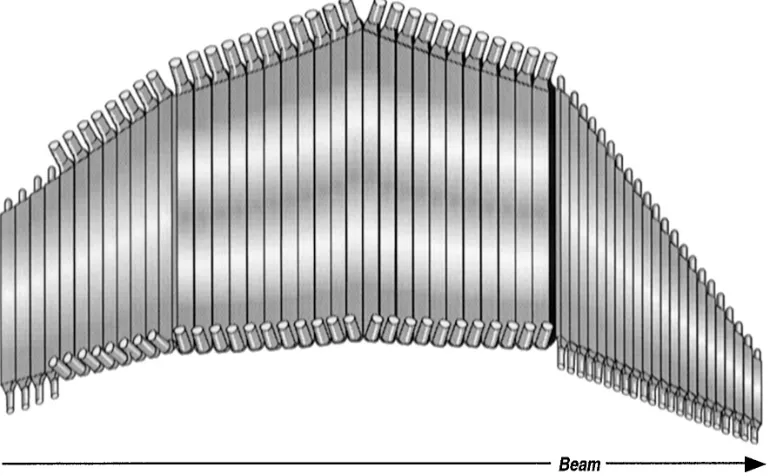
Figure 2.7 A schematic diagram of the SC system in one sector of CLAS. . . 30
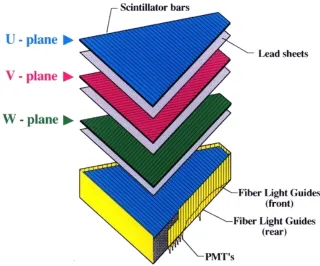
Figure 2.8 Expanded view of one of the six CLAS electromagnetic
calorime-ter modules. . . 31
Figure 2.9 A schematic diagram of “e1e” target. . . 32
Figure 3.1 (a) shows the exclusive number of events normalized to the
live-time corrected charge for each file, and (b) shows it versus the scaled run number. Here the red curve shows Gaussian fit
function, and two blue lines show the 3σ upper/lower cut limits. . 35
Figure 3.3 (a) Example θCC distribution of the 8th CC segment in sector
2, where the blue curve shows the Gaussian fit function, and the
fitting parameters µ and σ are shown in the statistic box. (b)
The θCC versus segment number in sector 2 is plotted, where
µ, µ+ 3σ, and µ−4σ are marked as black stars and fit by a
second degree polynomial functions, which are shown as blue
curves. . . 37
Figure 3.4 Example Nphe×10 distributions of left and right PMTs in the
CC 10th segment of sector 2 plotted separately and fit by the
Poisson function Eq. (3.5) marked as red curve. . . 39
Figure 3.5 (a) An example of anEtotal/pdistribution is fit with a Gaussian
function (blue line). (b) Etotal/p versus p distribution, where
the black lines show the upper/lower Etotal/p cut limits. (c)
Etotal/p versus p distribution after all experimental data event
selections. (d)Etotal/pversuspdistribution after all simulation
event selections. . . 40
Figure 3.6 (a)Pion ∆T distribution with fitted Gaussian function (red curve)
at 0.4 GeV/c< pπ <0.6 GeV/c for sector 3. (b)Pion ∆T versus
pπ distribution with upper/lower ∆T cut limits for sector 3. . . . 42
Figure 3.7 (a) The pion ∆T distribution in counter 40 of sector 3 shows two
peaks at 0.1 ns and 3.9ns (side band peaks), which are fit by
two Gaussian functions (red curves) to get the shift parameters.
(b) The same ∆T distribution with ∆T shift correction. . . 43
Figure 3.8 The pion ∆T versus pπ distribution with upper/lower ∆T cut
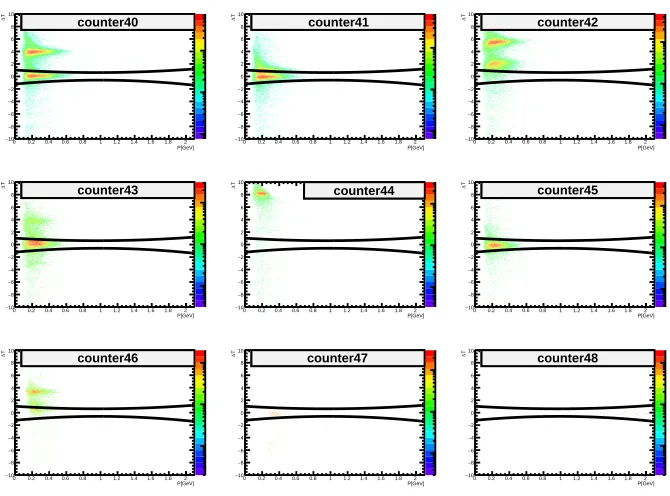
limits from counter 40 to 48 of sector 3. . . 43
Figure 3.9 The pion ∆T versus pπ distribution with upper/lower ∆T cut
limits from counter 40 to 48 of sector 3 after the ∆T shift
cor-rection. . . 44
Figure 3.10 (a) Proton ∆T distribution with Gaussian fit function (red
curve) at 0.4 GeV/c< pπ <0.6 GeV/c for sector 3. (b) Proton
∆T versus pproton distribution with upper/lower ∆T cut limits
for sector 3. . . 45
Figure 3.11 The proton ∆T versus pπ distribution with upper/lower ∆T
Figure 3.12 The proton ∆T versus pπ distribution with upper/lower ∆T
cut limits for counter 40 to 48 of sector 3 after the ∆T shift
correction. . . 47
Figure 3.13 The differences between generated and reconstructed protons
are presented by the black distributions for differentpp atθp =
15◦. The blue lines indicate the Gaussian fits. . . 48
Figure 3.14 The ratio between Gaussian fit peak positions (in Fig. 3.13) and
corresponding reconstructed momentum values, δp/p, plotted
against the reconstructed proton momentum (p) is presented
by the black circles, and the blue lines show the corresponding
fit functions. . . 49
Figure 3.15 Fit parameters of δp/p versus (p) distributions plotted against
the reconstructed protonθis presented by the black points, and
the blue lines show the corresponding fit functions. Here par[0],
par[1], and par[2] correspond to the fit parameters in Eq. (3.14). 50
Figure 3.16 The example missing mass squared distributions of the spec-tator without any kinematic corrections (black line), with only electron momentum corrections (blue line), and with both elec-tron momentum and proton energy loss corrections (red line) are plotted for sector 4, where the fit parameters in the statis-tics legend box correspond to the red-line Gaussian function
fit. . . 51
Figure 3.17 The µ2mismspector versus detector sectors without any kinematic
corrections (black squares), with only electron momentum cor-rections (red triangles), and with both electron momentum and
proton energy loss corrections (blue dots). . . 52
Figure 3.18 The U, V, and W coordinate distributions in the
electromag-netic calorimeter. The green area represents the selected events
after the cuts. . . 52
Figure 3.19 TheV coordinate distribution in the electromagnetic
calorime-ter. Red lines represent the hole cut limits. . . 53
Figure 3.20 θe versusφe distributions of electrons are plotted for six sectors
for experiment (left) and simulation (right) reconstructed data each side by side within the 0.8 GeV<|p~e|<1.0 GeV
momen-tum interval. The blue lines show the fiducial cut boundaries
Figure 3.21 Example φe distributions of electrons in sector 4 for data with
0.8 GeV< |~pe| <1.0 GeV before (blue) and after (green)
fidu-cial cuts. . . 55
Figure 3.22 θe versus p distributions of electrons in all six sectors are
com-pared for experiment (left) and simulation (right) reconstructed data simultaneously each side by side. The top and bottom
black lines show the θe cut boundaries, and the middle paired
black lines show removed regions, which are reflected in Fig. 3.20
by the low event-rate bands. . . 56
Figure 3.23 (a) Typical exampleφ distribution of pions from the 0.2 GeV<
|~pπ−| < 0.4 GeV and 28◦ < θπ− < 30◦ intervals in sector 1, which are fit by the function (Eq. (3.18)) shown by the red
line, where the corresponding fit parametersP4,P5, andP6 are
heights of the corresponding plateau regions of the trapezoid
function and P0, P1, P2, and P3 are corresponding φ values of
the inflection points. (b) Example φ versus θ distribution for
pions in sector 1 within the same momentum interval.
Corre-sponding fit parametersP0 and P1 of eachθ bin are marked as
stars and fit by the function (Eq. (3.19)) shown by the back line. 57
Figure 3.24 Exampleφversusθdistributions of pions after event selection in
sector 1 for 0.2 GeV< pπ− <1.2 GeV within 0.2 GeV increasing steps, and the fiducial cuts (blue lines) are plotted here for
sector 1. . . 58
Figure 3.25 φversusθ distributions of pions in differentpπ− bins after event
selection are plotted for sector 1 for experiment (left) and sim-ulation (right) reconstructed data each side by side. The black
lines represent the fiducial-cut boundaries. . . 58
Figure 3.26 θ versus p distributions of pions in six sectors are compared
for experiment (left) and simulation (right) reconstructed data each side by side. The middle paired black lines show the re-moved regions, which are reflected in Fig. 3.25 by the verti-cal low event-rate bands, and the bottom black lines represent
θ > θπ−
Figure 3.27 (a) Typical example for a φ distribution of protons from the 0.2 GeV < |~pproton| < 0.4 GeV and 28◦ < θproton < 30◦
in-tervals in sector 1, which is fit by the function Eq. (3.18) and
plotted as the red line. The corresponding fit parameters P4,
P5, and P6 are heights of the corresponding plateau regions of
the trapezoid function, and P0, P1, P2, and P3 are the
corre-sponding φ values of the inflection points. (b) The φ versus θ
distribution of protons for sector 1 within the same momentum
interval. Corresponding fit parametersP0 and P1 of eachθ bin
are marked as stars, fit by the function Eq. (3.19), and shown
by the black lines. . . 60
Figure 3.28 Example φ versus θ distributions for protons in sector 1 for
0.2 GeV < pproton < 1.8 GeV within 0.2 GeV increasing steps
and the fiducial cuts (blue lines) for sector 1. . . 61
Figure 3.29 φ versus θ distributions of protons plotted for six sectors for
experimental experiment (left) and simulation (right) recon-structed data each side by side. The blue lines represent
fiducial-cut boundaries. . . 62
Figure 3.30 θversuspdistributions of protons in all six sectors are compared
for experimental (left) and simulation (right) reconstructed data each side by side. The middle paired black lines show the re-moved regions, which are reflected in Fig. 3.29 by the vertical
low event-rate bands. . . 63
Figure 3.31 TheMs2 distribution with the two cut limits represented by the
red lines illustrates the exclusive event selection process. . . 64
Figure 3.32 (Color online) The|P~s|distribution of experimental data (black
line) and simulation (blue line) where “green” and “red” filled areas represent the integral of the blue distribution from 0 MeV
to 200 MeV and above 200 MeV, respectively. . . 65
Figure 3.33 (a)(Color online) The black line represents the missing
momen-tum distribution (|P~s|) of the unmeasured proton from
experi-mental data. Based on the CD-Bonn potential [28], the Monte Carlo simulated scaled proton momentum distribution leads to the red line and the detector-smeared simulated scaled distribu-tion to the blue line.(b) The zoomed plot of (a) to investigates
Figure 4.1 Flowchart showing the main steps of the detector and reaction
simulation process. γ∗n(p)→pπ−(p) events are generated by a
realistic event generator, passed through GSIM [1] and GPP [2],
and cooked by RECSIS [3]. . . 66
Figure 4.2 (a) W distributions of exclusive quasi-free events of
experi-mental data (black) and the corresponding simulated distribu-tion for the MAID98 (blue), MAID2000 (magenta), MAID2003
(green), and MAID2007 (red) versions. (b) Q2 distributions
for the experimental events and the corresponding simulatied
events of (a). . . 68
Figure 4.3 Event start time (t0) distributions of the exclusive quasi-free
events for experimental data (left) and simulation with smear-ing factor f=0.9 (right) are fit by Gaussian functions (red curves). The corresponding fit parameters are listed in the statistic boxes,
respectively. . . 70
Figure 4.4 The σ of t0 versus f from the simulation events are fit by a
linear function (blue), and the red line corresponds to the theσ
oft0from the measured exclusive quasi-free events. Thef value
corresponding to the cross point is used to smear the simulated
detector SC resolution. . . 71
Figure 4.5 The fitted σ values of Ms2 distributions depending on different
a = b = c values are plotted as black points. These are fit
by a linear function (blue). The red horizontal line represents
the fitted σ values of Ms2 distributions from the experimental
reconstructed events. The value of a = b = c corresponding
to the cross point is used to smear the simulated detector DC
resolution. . . 72
Figure 4.6 The M2
s distributions of the exclusive quasi-free events for
ex-perimental data (left) and simulation with smearing factors
f = 0.9 and a = b = c = 2.5 (right) are fit by Gaussian
functions (red). The corresponding fit parameters are shown in
their statistics legend boxes. . . 72
Figure 5.1 W and Q2 binning for the π− electroproduction events, where
vertical and horizontal lines are shown as the lower and upper
Figure 5.2 Example cosθ∗ and φ∗ binning for the π− electroproduction
events in 1.2 GeV < W < 1.225 GeV and 0.4 GeV2 < Q2 <
0.6 GeV2 bin, where vertical and horizontal lines show the lower
and the upper bin limits. . . 75
Figure 5.3 Bin centering corrections RBC as a function of cosθ∗ and φ∗ in
the W = 1.2125 GeV and Q2 = 0.5 GeV2 bin. . . . . 77
Figure 5.4 (a) Measured electron vertex (Ze) distributions for full target
events (black) and scaled empty target events (red). (b)The black distribution is kept the same as (a), and the vertex
distri-bution for scaled empty target events is shifted to (Ze−1.5 mm)
(red). . . 79
Figure 5.5 Ze distributions for full-LD2-target (black) and scaled
empty-target events (red) are plotted together in one canvas and
com-pared with these of the empty target subtracted fullLD2 target
events sector by sector. . . 79
Figure 5.6 Feynman diagrams of the radiative effects in theπ−
electropro-duction. (a) and (b) Brehmsstrahlung, (c) Vertex correction,
and (e) Vacuum polarization, as used by [48]. . . 81
Figure 5.7 M2
s distributions for measured (black) and simulatedγ∗n(p)→
pπ−(p) (blue), as well as simulated γ∗p → pπ−π+ events are
plotted with theM2
s cut limits. . . 82
Figure 5.8 Ms2distributions for measured (black) and simulatedγ∗n(p)→
pπ−(p) (red) events are plotted with theM2
s cut limits forW =
1.2125 GeV, Q2 = 0.5 GeV, and cosθ∗ = −0.3 in φ∗
π− = 100◦,
140◦, 180◦, 220◦, 260◦, and 300◦ bins individually. . . . 83
Figure 5.9 W dependent normalized yield distributions in the eD → e0X
process are presented for data with black stars and for Os-ipenko’s world-data parameterization with magenta stars in
individual Q2 bins from 0.4 GeV2
to 1.7 GeV2 in steps of
∆Q2 = 0.1 GeV2. . . 85
Figure 6.1 The whole analysis process flowchart . . . 87
Figure 6.2 Exclusive (black points) and quasi-free (green squares) cross
sections in µb/sr are represented for W = 1.2125 GeV and
Figure 6.3 Exclusive (black points) and quasi-free (green squares) cross
sections in µb/sr are represented for W = 1.2125 GeV and
Q2 = 0.7 GeV2
. . . 90
Figure 6.4 Exclusive (black points) and quasi-free (green squares) cross
sections in µb/sr are represented for W = 1.2125 GeV and
Q2 = 0.9 GeV2. . . . 91
Figure 6.5 Exclusive (black points) and quasi-free (green squares) cross
sections in µb/sr are represented for W = 1.4875 GeV and
Q2 = 0.5 GeV2. . . . 92
Figure 6.6 Exclusive (black points) and quasi-free (green squares) cross
sections in µb/sr are represented for W = 1.6625 GeV and
Q2 = 0.5 GeV2
. . . 93
Figure 6.7 The ratios ofRF SI(Wi, Q2,cosθπ∗−, φπ∗−) overRF SI(Wi, Q2,cosθπ∗−)
are represented by Blue points for different φ∗π− at 1.2 GeV <
Wi < 1.225 GeV and 0.6 GeV2 < Q2 < 0.8 GeV2. The
in-dividual plot shows the ratios for different cosθ∗π− bins. The
three lines from bottom to top correspond to 0.95, 1, and 1.05,
respectively. . . 94
Figure 6.8 The ratios ofRF SI(Wi, Q2,cosθπ∗−, φπ∗−) overRF SI(Wi, Q2,cosθπ∗−)
are represented by Blue points for different φ∗π− at 1.2 GeV <
W < 1.225 GeV and 0.6 GeV2 < Q2 <0.8 GeV2. The
individ-ual plot shows the ratios for different cosθ∗π− bins. The three
lines from bottom to top correspond to 0.95, 1, and 1.05, respectively. 95
Figure 6.9 RF SI versus θ∗π− distribution example for individual W bins,
which are increasing by 0.025 GeV in the range of 1.1 GeV <
W < 1.725 GeV for 0.4 GeV2 < Q2 < 0.6 GeV2. The red
and black points correspond to RF SI binned in Wi and Wf,
respectively. . . 96
Figure 6.10 RF SI versus θπ∗− distributions example for individual W bins,
which are increasing by 0.025 GeV in the range of 1.1 GeV <
W < 1.725 GeV for 0.6 GeV2 < Q2 < 0.8 GeV2. The red and
black points correspond toRF SI binned in Wi and Wf, respectively. 97
Figure 6.11 RF SI versus θπ∗− distributions example for individual W bins,
which are increasing by 0.025 GeV in the range of 1.125 GeV<
W < 1.6 GeV for 0.8 GeV2 < Q2 < 1.0 GeV2. The red and
Figure 6.12 Example of the cosθπ∗− dependent structure functionsσT +σL
(top row), σT T (middle row), and σT L (bottom row ) for W =
1.2125 GeV at Q2 = 0.5 GeV2
(left column), Q2 = 0.7 GeV2
(middle column), and Q2 = 0.9 GeV2 (right column) that are
extracted for the exclusive (black points) and quasi-free (green squares) cross sections and compared with the predictions of the SAID (magenta points) and MAID2000 (blue points) mod-els. The solid black bars represent the corresponding systematic uncertainties. The Legendre polynomial expansions are fitted
to the corresponding structure function data for π− angular
momenta up tol = 2. . . 99
Figure 6.13 The ∆T distribution of pions in six sectors. The black, blue,
and red lines represent the 4σ, 3σ, and 2σ cut boundaries,
re-spectively. . . 103
Figure 6.14 The ∆T distribution of protons in six sectors. The black, blue,
and red lines represent the 4σ, 3σ, and 2σ cut boundaries,
re-spectively. . . 104
Figure 6.15 (Color online) The φp versus θp distributions for six sectors
without proton fiducial cuts. The magenta, blue, and black lines represent loose, chosen, and tight proton fiducial cuts,
re-spectively. . . 105
Figure 6.16 (Color online) The spectator missing mass squared M2
s
distri-butions for data (black curve) and simulation (blue curve). The black, red, and blue vertical lines represent loose, chosen, and
tightM2
s cuts, respectively. . . 105
Figure 6.17 (Color online) The spectator missing momentum |P~s|
distribu-tions for data (black curve) and simulation (blue curve). The black, red, and blue vertical lines represent loose, chosen, and
tight|P~s| cuts, respectively. . . 106
Figure 6.18 The normalized cumulative “spectator” proton momentum dis-tributions from different deuteron potentials. The black, blue, and red points represent the CD-Bonn, Paris, and Hulthen
Figure 6.19 The φ∗π− dependence of the exclusive cross sections with and without radiative correction are marked as red points and black
squares, respectively for an example at W = 1.2125 GeV and
Q2 = 0.7 GeV2. The individual plots correspond to different
cosθπ∗− bins. . . 110
Figure 6.20 The ratios of W integrated inclusive cross sections of σOsipenko
overσY e marked as black stars are plotted againstQ2. The red
dot lines represent the Q2 averaged ratios. . . . 111
Figure 6.21 The ratios of Q2 integrated inclusive cross sections of σ
Osipenko
overσY e marked as black stars are plotted against W. The red
Chapter 1
Introduction and Overview
What’s the origin of more than 98% of the visible mass - that’s everything in the
universe, we sense and see around us? Visible matter is everything made of atoms,
which get their mass mainly from the atomic nucleus. The nuclei of atoms are
com-posed of nucleons, namely protons and neutrons. The proton and neutron, each made
of three valence quarks, are much more massive than the sum of their constituents.
Where does all this “extra” mass come from? In order to answer this question, we
have to understand how the quarks interact via the exchange of gluons, how quarks
bind together via strong interaction, and how gluons interact with each other. The
fundamental theory of the strong interaction is Quantum Chromodynamics (QCD),
which is very successful at predicting reactions with large momentum transfer, Q2,
within the perturbative regime with current quarks and gauge gluons as the
funda-mental degrees of freedom. However when Q2 drops down to the non-perturbative
regime, there is a transition to completely different degrees of freedom, the dressed
quarks and gluons as well as the mesons and nucleons, which prevents us from having
a direct QCD description of the phenomena corresponding to hadronic physics, such
as the structure of the nucleon and its excitations (N∗).
The most fundamental approach to resolve this difficulty is to develop accurate
numerical simulations of QCD on to a four-dimensional Euclidean space-time lattice
(LQCD) [35], which is the only way to rigorously test QCD at present. LQCD makes
significant progress on calculating some basic properties of baryons, such as masses
challenging issues. Therefore, it is equally important to develop other complementary
nonperturbative methods based on the QCD approach to interpret the real world
properties, and the Dyson-Schwinger equations (DSEs) are such an approach. It is
based on infinite tower of coupled integral equations [60], which is discussed later.
Alternatively, hadron models with effective degrees of freedom have been constructed
to interpret data, such as constituent quark models [20], MIT-bag models [36], and
Nambu-Jona-Lasinio (NJL) models [41].
All these non-perturbative approaches need experimental data to test and
im-prove their predictions. Therefore we need to accumulate sufficient and precise data
on meson electroproduction reactions to pin down the distance-dependent structure
of the nucleon and its excitations, in order to push the development of quark models
and QCD-based calculations forward. Due to the short lifetimes of N s∗, it is
im-possible to observe these excitation states directly. In the experiment, we can study
N s∗ via products of their decays. There are a couple ways to study N s∗ production,
i.e., electroproduction and photoproduction of pseudo-scalar or vector mesons. The
electromagnetic vertex of the meson electroproduction is well described by Quantum
Electrodynamics (QED), while the hadron scattering governed by the strong
inter-action is the only unknown part in the electroproduction process. Furthermore, the
virtual photon exchange of the electroproduciton allows us to study hadronic
proper-ties at differentQ2regimes, which is crucial in understanding of the internal dynamics
of the strong interaction in the non-perturbative regime. In reactions of meson
elec-troproduction off nucleons, we are interested in the resonance processes, in which a
virtual photon excites the nucleon to its excitated state (N∗), with then decays to
one meson or more and nucleon. Beside this, the non-resonance processes in this
reaction are treated as background in the reaction models to extract the resonance
information.
elec-troproduction off the proton in the hydrogen target. Hence flavor-dependent analyses
of excited light-quark baryons are lacking experimental data off the neutron, which is
due to the fact that there is no free neutron target. Deuterium becomes to be one of
the best alternate targets for neutrons, whose nucleus consists of one proton and one
neutron, because it is the simplest and most loosely bound system of neutron.
How-ever, due to the neutron being bound in the deuteron, a few effects must be studied
in order to extract the neutron information, such as, Fermi motion, off-shell effects,
and final state interactions (FSI). The goal of this work is to provide the exclusive
and quasi-freeγ∗n(p)→pπ−(p) reaction cross sections from deuterium target, as well
as kinematical FSI contribution factor RF SI that can be determined from the data
itself. This thesis work concentrates on the study of the bound neutron resonance
via meson electroproduction, which will improve our knowledge of the Q2 evolution
of the resonance states off the bound nucleon system and aid our understanding of
the structure and interaction of hadrons.
1.1 QCD and Non-Perturbative Approaches
QCD
QCD describes the interaction between quarks and gluons, which we believe are the
fundamental degrees of freedom that make up hadronic matter. Quarks are one type
of fundamental particles, it means that they are not composed of any other particles.
There are six known, electrically-charged, different-flavored quarks, which are listed
in the Tab. 1.1. Each quark has its own antiquark.
Quarks interact with each other only through intermediate agents “gluons”, which
are the exchange particles that couple to the color charge in QCD. This is analogous
to the electromagnetic interaction in which photons are exchanged between
Table 1.1: Summary of quark properties.
Name Symbol Charge Isospin (I3) Mass (MeV/c2)
Up u +2/3 +1/2 2.3±1.2
Down d −1/3 −1/2 4.8±0.8
Charm c +2/3 0 1275±25
Strange s −1/3 0 95±5
Top t +2/3 0 173210±510
Bottom b −1/3 0 4180±30
gluons simultaneously carry color and anticolor charge. Since gluons are vectors in
the adjoint representation of color gauge group SU(3), there are eight gluons. By
their exchange the eight gluons mediate the interaction between particles carrying
color charge, i.e., not only the quarks but also the gluons themselves. This is an
important difference to QED, where the electromagnetic field quanta have no charge,
and therefore cannot couple at lowest order with each other. The elementary
pro-cesses of QCD include emission and absorption of gluons (Fig. 1.1(a)); production
and annihilation of quark-antiquark pairs (Fig. 1.1(b)); and coupling three or four
gluons to each other (Fig. 1.1(c) and (d)). QCD is a non-abelian gauge theory whose
Figure 1.1: The fundamental interaction diagrams of QCD [56]: (a) emission of a gluon by a quark, (b) splitting of a gluon into a quark-antiquark pair, (c) and (d) self-coupling of gluons.
dynamics are governed by the Lagrangian [52], which is represented by
LQCD =
X
q
¯
ψq,a(iγµ∂µδab−mqδab)ψq,b−
X
q
¯
ψq,agsγµtCabA C µψq,b−
1
4F
A µνF
Aµν
where γµ are the Dirac γ matrices. The ψ
q,a are quark-field spinors for a quark of
flavor q and mass mq, with a color-index a (a = 1 to 3, quarks have three “colors”).
AC
µ correspond to the gluon fields, with C running from 1 to 8 (there are 8 kinds of
gluons). Furthermore,tC
ab (tCab ≡λCab/2) are eight 3×3 matrices that are the generators
of the SU(3) group. The field tensor FA
µν is given by
FµνA =∂µAAν −∂νAAµ −gsfABCABµA C
ν, (1.2)
where the fABC are the structure constants of the SU(3) group, and gs is the QCD
coupling constant calculated by
αs(Q) =g2s/4π, (1.3)
αs(Q) =
2π β0ln(Q/ΛQCD)
, (1.4)
β0 = 11− 2
3nf, (1.5)
wherenf is the number of quark flavors that are involved in the process, and ΛQCD is
the fundamental cut-off parameter of QCD, whose value is experimentally determined
as ΛQCD ∼200 MeV/c [56].
The first term in the Eq.(1.1) represents the part of the free quark fields, the second
term corresponds to the quark-gluon interactions (Fig. 1.1(a) and (b)). The quark
interacts with gluons is in a way similar to the electrons interacting with photons in
QED. Gluons are physical degrees of freedom and therefore must carry energy and
momentum themselves. Thus the third term in the Lagrangian is needed to describe
gluon self-interactions. Since gluons carry color charges, their self-interactions are
responsible for many of the unique and important features of QCD, such as asymptotic
freedom, color confinement, and chiral symmetry breaking [50].
The second term in Eq. (1.5), −2
3nf, comes from quark-antiquark pair screening.
gluon-gluon vertices (Fig. 1.1). Thus the gluons self-coupling causes a color
anti-screening effect.
Three important characteristic QCD features are listed as following
• Asymptotic freedom: From Eq. (1.4), this Q-dependence of the coupling strength
corresponds to the dependence on separation. For very high Q values (very
small distance), the interquark coupling decreases, vanishing asymptotically. In
the limit Q→ ∞, quarks can be considered as “free”, this is called asymptotic
freedom.
• Confinement: In the very low energy domain (very large distance), the interquark
coupling increases so strongly that it is impossible to detach individual quarks
from hadrons (confinement) [56]. Although the confinement hypothesis has not
been directly derived from QCD.
• Dynamical chiral symmetry breaking: Contrary to confinement, we are able to
understand it better even though it is an other typical low-energy feature of
QCD. Since in the low-energy domain of QCD, the proton is composed of three
valence quarks: two up quarks with mu ∼ 2.3 MeV and one down quark with
md∼4.8 MeV, only contributing about 9.4 MeV to the rest mass of the proton
( 938 MeV). It turns out that chiral symmetry is realized in this regime. The
source of the bulk of the proton’s mass is QDC binding energy, which arises
from QDC dynamical chiral symmetry breaking [57], and an effective quark
mass is generated [36].
Lattice QCD (LQCD)
LQCD is QCD solved on a discrete four dimensional Euclidean space-time lattice
with spacing a, with quark fields placed on sites and gauge fields on links between
quan-tum field theory finite [52]. When a→0, the continuum theory is recovered. LQCD
is defined by allowing the numerical evaluation of the path integral, which is based
on a non-perturbation calculation. Progress in LQCD has required a combination
of improvements in formulation, numerical techniques, and in computer technology,
allowing these simulations to calculate correlation. The practical calculation results
of LQCD come with both statistical and systematic errors due to the limitation of
the efficiency of algorithms and the availability of computational resources. The
sta-tistical errors correspond to the use of Monte-Carlo integration, the systematic errors
come from using non-zero values of a. Since LQCD is a regularization of QCD, the
only tunable input parameters for lattice calculation are the strong coupling constant
αs and the quark masses for each flavor, which are determined using experimental
inputs. In this way, if QCD is the correct theory of strong interactions, all predictions
of LQCD have to agree with experimental data, and the nucleon and pion structure
from lattice QCD simulations by using a physical pion mass is achieved [13].
Dyson-Schwinger Equations (DSE)
The DSEs are coupled infinitely tower integral equations, which are a general
rela-tionship between Green’s functions in quantum field theories (QFT) [60]. Solving
these equations provides a solution of QDC. The DSEs include the Bethe-Salpeter
equation (BSE) which is a tool to calculate the properties of relativistic two-body
scattering and bound states. For studies based on DSEs, it is unavoidable to deal
with the infinite tower of coupled integral equations. For practical purposes, the
cur-rent approach of DSEs truncates the tower at some point. This means that the tower
of integral equations must be limited to some n, where n is the maximum number
of legs on any Green’s function included in the self-consistent solution of the
equa-tions [60]. An Ansatz can then be introduced for the omitted terms. There is hope
of these truncated functions. One approach of studying the non-preturbative
prop-erties of hadrons is the combination of DSEs and Bethe-Salpeter equations (BSE).
There are some calculations related to this approach, which were performed upon
truncating the (anti)quark-quark interaction to a single gluon exchange, so-called
Rainbow-Ladder truncation [62]. Based on that, the details of recent studies on
me-son spectra have been published in Refs. [31] [32] [38]. Baryons have been studied
in the quark-diquark approximation [63]. Current interest of DSEs and BSE
combi-nation approach is the inclusion of interaction mechanisms beyond the leading term
[62], and in the extension to glueball [61] and tetraquark bound-states [37].
1.2 Single-Pion Electroproduction off the Moving Neutron
Single-pion electroproduction has been the main process in the study of the N −
N∗ transition form factors of the lower mass nucleon resonances such as P33(1232),
P111440, D13(1520),S11(1535), S11(1650), F15(1680), and D33(1700).
Data Status
The low-lying excited states of the proton have been studied in greater detail [19],
there is still very little data available on neutron excitations. Because of the inherent
difficulty in obtaining a free neutron target, a deuterium target is the best alternative.
From the SAID database [4], theπ− electroproductions off neutrons in the deuterium
are listed in the Tab. 1.2, in which, the ratioRπ−/π+ was directly measured for most
available data. Even though the differential cross sections were measured directly,
they are only available for single or couple Q2 values and in parts of the whole
resonance range. We need to accumulate sufficient and precise data for the neutron,
not only to study the isospin dependent structure of the nucleon and its excitations,
Table 1.2: Summary of the single pion electronproduction off bound neutron in the deuterium target withRπ−/π+ = dσ(γν+n→π
−+p)
dσ(γν+p→π++n) =
Rate(e+d→e+π−+p(p))
Rate(e+d→e+π++n(n)).
Reaction Observable W value Q2 value Lab/experiment
GeV GeV2
en(p)→e0π−p(p) Rπ−/π+ 2.15, 3.11 1.2, 4.0 Cornell/WSL [17]
ep(n)→e0π+n(n)
en(p)→e0π−p(p) dσ/dΩπ 2.15, 2.65 1.2, 2.0 Cornell/WSL [18]
ep(n)→e0π+n(n)
en(p)→e0π−p(p) Rπ−/π+ 1.28-1.71 0.5 NINA [64]
ep(n)→e0π+n(n)
en(p)→e0π−p(p) Rπ−/π+ 1.3-1.7 1.0 NINA [49]
ep(n)→e0π+n(n)
ep(n)→e0π+n(n) Rπ+/π− 1.16, 1.232 0.0856, 0.0656 ALS [34]
en(p)→e0π−p(p)
en(p)→e0pπ−(p) σL, σT 1.15, 1.6 0.4 JLab-HallA [33]
en(p)→e0pπ−(p) σL, σT 1.95, 2.45 0.6, 1.0, 1.6, 2.45 JLab-HallC [39]
The six simplest pion electroproduction reactions off the free proton, bound
pro-ton, and bound neutron targets are summarized as
γ∗+p→π0+p, (1.6)
γ∗+p→π++n, (1.7)
γ∗+D(p)→π++n+ns, (1.8)
γ∗+D(p)→π0+p+ns, (1.9)
γ∗+D(n)→π−+p+ps, and (1.10)
γ∗+D(n)→π0+n+ps. (1.11)
All the listed single-pion reactions under the same experimental conditions are
in-cluded in the “e1e” run, which took data with the CLAS detector at JLab from
December 14th, 2002 to January 24th, 2003. The combined analysis of processes
Eq. (1.6)- (1.10) will provide the best possible experimental information about the
final state interactions and the off shell effects of the bound nucleon, which are
analyzed, which includes both resonance and non-resonance process, to extract
cor-responding cross sections off the neutron in the deuterium target in the resonance
region. The resonance process of interest Eq. (1.10) is shown in Fig. 1.2, where the
electron emits a virtual photon (γ∗) exciting the neutron to one of its excitations
(N∗), then the resonance decays to a π− and a proton (p). The initial proton in the
deuteron is treated as a spectator (Ps), which will be discussed in Chapter 3 that
discusses how to isolate the quasi-free process.
Figure 1.2: The resonance process of single-pion electroproduction off a neutron in deuterium. The initial proton in the deuteron is treated as the spectator, named as
Ps.
Kinematic
Before we introduce the kinematics of the scattering from a bound neutron in a
deuteron, we first consider the case of scattering from a free neutron that is at rest
in the lab frame, then the chosen variables Wi and Q2 are defined as:
Wirest =q(qµ+nµ)2 =q(pµ+ (π−)µ)2 =Wrest
f , (1.12)
(Qrest)2 =−(qµ)2 = (eµ−eµ0)2 , (1.13)
whereqµ presents the four momentum of the virtual photon. Wrest
i and (Qrest)2
transfer of the virtual photon for this scattering respectively, which are determined
in the leptonic interaction plane that is shown in Fig. 1.6 with the gray color. In
addition, we also need to determine two body final state pµ and (π−)µ. In general,
two final particles need to be described by 4×2 = 8 components of their four vector
momentum. Indeed, with the knowledge that they are all on mass shell, it gives
two restrictions (Ej2 −k2j = m2j;j = 1,2). Furthermore, the energy momentum
conservation laws impose four additional constraints for four momentum components
of the final particles. So we only need two kinematics variables to determine the
hadronic two body final state. Eventually, we end up with four variables to represent
the γ∗n(p)→pπ−(p) cross section.
For the kinematics of the process Eq. (1.10) that is the scattering from a bound
neutron in a deuteron, we have to consider the influence on the final cross sections of
Fermi motion, off-shell effects, and the final state interaction, which are introduced
next.
The Fermi Motion
In the process Eq. (1.10), where the initial neutron is moving around “quasi-freely”
in the deuteron in the lab frame. By measuring all final particles e0, p, and π−
exclusively, energy and momentum conservation imply that the sums of the
four-momenta before and after the reaction are identical:
qµ+Dµ= (π−)µ+pµ+pµs ,
qµ+pµi +nµ= (π−)µ+pµ+pµs ,
(1.14)
where Dµ is the four-momentum of deuteron that is at rest in the lab frame, Dµ =
(0, mD). nµand pµi correspond to the four-momentum of the neutron and the proton,
respectively, that are moving and loosely bound in the deuteron in that frame. The
outgoing missing protonpµ
Eq. (1.14) by
pµs =qµ+Dµ−(π−)µ−pµ, (1.15)
and the momentum of this proton is calculated by
~
Ps =~q−π~−−~p. (1.16)
Ignoring the off-shell effects at this moment, we focus on the motion first. In the
quasi-free process of the reaction Eq. (1.10), where the initial proton is treated as a
“spectator” that is totally unaffected by the interaction, thus pµi = pµ
s in Eq. (1.14)
(ignoring the off-shell effects). Then we can rewrite the Eq. (1.14) by
qµ+nµ= (π−)µ+pµ, (1.17)
and the initial neutron momentum is reconstructed by
~n=π~−+~p−~q. (1.18)
For the quasi-free process, by comparing Eq. 1.16 with Eq. 1.18, we get
~
Ps=p~i =−~n. (1.19)
In contrast to the free neutron case, the neutron is now moving around with the
Fermi momentum, which is reconstructed from Eq. (1.18) and graphed in Fig. 1.3.
This motion causes changes in the kinematics compared to scattering off a neutron
at rest in the lab frame. Thus, in order to define the proper electron scattering
plane, we first boost eµ, (e0)µ, pµ, and (π−)µ from the lab frame into the neutron
rest frame with the boost vector calculated from nµ (Eq. (1.17)). In this frame, the
variablesWi,Wf andQ2 are calculated from Eq. (1.12) and Eq. (1.13), as well as the
electron scattering plane is defined. Then Wf and Q2 are selected to represent the
scattering cross sections off the moving neutron in the deuteron. So for this work,
the final reported cross sections are not influenced by the Fermi momentum of the
(GeV) n
0 0.5 1 1.5 2
Events
0 2000 4000 6000 8000 10000 12000
n Exclusive
Figure 1.3: The momentum distribution of initial neutron in the exclusiveγ∗n(p)→
pπ−(p) process, which is moving in the deuteron in the lab frame.
Off-shell Effects
As mentioned previously, the bound neutron is also off-shell beside moving around
in the deuteron. Even in the quasi-free process (isolating the quasi-free process is
discussed in the Chapter 3), pµi is not equal to pµs due to the fact that the initial
proton pi is off-shell and outgoing “spectator” proton ps is on-shell in the reaction
Eq. (1.10). However the relationp~i =p~s=−~n is not influence by the off-shell effects
in the quasi-free process. So we can reconstruct the off-shell neutron four momentum
bynµ= (−P~
s, Mn) andEn =
q
(−P~s)2+ (Mn)2. So it is better to choose Wf, which
is well defined and measured directly from p and π−, rather than Wi, to present
the final cross section. In the “spectator” situation, in order to conserve energy and
momentum in the scattering process, we have set
Mn=mn−2
k2
n
2mn
−2MeV, (1.20)
reestablishing Wi = Wf. This can be seen in Fig. 1.4, where Wf is calculated by
which are presented by the black and red lines separately, and their peaks match
each other. For other possibleMnsettings, we get shifted or smearedWidistributions
(radiative corrected) compared to Wf. The boost vector (from the lab frame to the
CM frame) is calculated using the different Wi and Wf, then the influence of those
different boosts on the final cross section can be quantified. The result shows that
these effects on the final cross sections are marginal and are accounted for as a source
of systematic uncertainties described in Chapter 4.
W [GeV]
1.1 1.2 1.3 1.4 1.5 1.6
Yield
0 1000 2000 3000 4000 5000
f
W
move
n =mn
n
E
W
rest
n =mn
n
E
W
move
n
=mn-2K-2MeV
n
E
W
move
n
=mn+2K+2MeV
n
E
W
move
n
=mn+K+1MeV
n
E
W
move
n
=mn-K-1MeV
n
E
W
Figure 1.4: (Color online) The comparison ofW distributions. Black line presentsWf,
blue line shows Wi calculated by setting nµ = (−P~s, En) (En with Eq. (1.20)). The
other colors present the Wi distribution by setting nµ to (−P~s, mn) (cyan), (0, mn)
(magenta), (−P~s, mn+ 2 k2
n
2mn+ 2MeV) (blue), (−
~
Ps, mn+ k2
n
2mn + 1MeV) (orange), and
(−P~s, mn− k
2
n
2mn −1MeV) (green).
The Final State Interaction (FSI)
In the reaction process Eq. (1.10), which is shown in Fig. 1.5 (a), with a|P~s|<200 MeV
the resonance process, it is possible to have final state interactions, such as pp
re-scattering and pπ re-scattering shown in Fig. 1.5 (b) and (c) respectively. It
corre-sponds to the situation in which the outgoing proton orπ−interacts with the spectator
proton (Ps). Thus, the four momentum of the final state particles are changed due to
these final state interactions. After isolating the quasi-free process, the kinematical
FSI contribution factor RF SI will be extracted from the data itself, and the details
will be discussed in the Chapter 6. It is also possible to have other kinds of FSI,
i.e. in the process Eq. (1.9) or (1.10), it is possible to have π0 +ns → π−+p and
π−+ps → π0 +n final state interactions in these processes, which can increase or
decrease the final stateπ− andpproduction. If we want to quantify the contribution
of this kind of FSI from the data itself, a combined analysis of pion electroproduction
off the free proton, the bound proton, and the bound neutron in the “e1e” run is
needed. In this thesis, this kind of final state interactions are not quantified from the
data itself.
d
n
ps
p
g* p_
d
n
ps
p p
1
p2
p_
d
g*
(a)
(b)
(c) n
p
ps
g*
p' p
-p'
-Figure 1.5: Kinematic sketch as in the text for the three leading terms in γ∗+D→
π−+p +p process (a) quasi-free, (b) pp re-scattering, and (c) pπ− re-scattering.
Boosting of the Kinematic Variables
p
-p
z
x
y
e
p**
p
n
*
p
,
q
' ' '
,
k
,
E
e
E
k
e
,
,
Figure 1.6: Kinematics of π− electroproducton off a moving neutron. The leptonic
neutron rest frame plane is formed by eµ and eµ0, where k, E, k0, and E0 are
corre-sponding momentum and energy of the incoming and outgoing electrons. qµ is the
virtual photon four momentum and ν is the transfered energy. The hadronic CM
frame plane is determined by final particles p and π, here θ∗p and θ∗π are their polar
angles and φ∗π the azimuthal angle ofπ−.
In order to get the correct variables to present the final cross sections of π−
elec-troproduction off the neutron in the deuterium target, we boost first all particles’ four
momenta from the lab frame (deuterium at rest) into the neutron at rest frame with
the boost vector β~1 =−~n/En, where ~n and En are calculated from nµ (Eq. (1.17)).
Then the invariant mass Wf and the momentum transfer Q2 are calculated by the
Eq. (1.12) and (1.13) in this frame. In addition, by setting the coordinates in this
frame, ˆznrest parallel to the virtual photon direction and ˆynrest perpendicular to the
electron scattering plane, we ensure that ˆxnrest is staying in the electron scattering
plane and is set to be ˆx direction in the final coordinate system. Secondly, we
di-rectly boost all particles’ four momenta from the lab frame into the CM frame with
the boost vectorβ~2 =−(p~+π~−)/(Ep+Eπ−), then set the ˆzCM parallel to the virtual
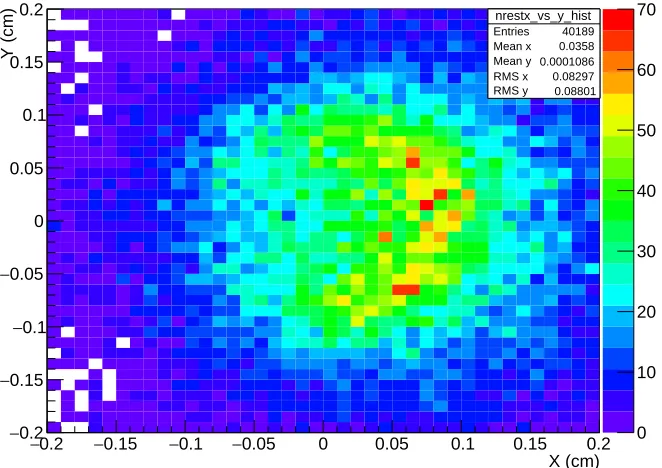
effects, it is better to set the final ˆz parallel to ˆzCM. The X and Y projections of
the ˆznrest in the CM frame are plotted against each other for final-state-interaction
dominated events and quasi-free events, which are shown in Fig. 1.8 and 1.7,
respec-tively. It turns out that the spread of these distributions around zero correspond to
the angle difference between ˆznrest and ˆzCM, which are 5.4◦ for final-state-interaction
dominated events in the exclusive process and < 1◦ for quasi-free events. Although
the final-state-interaction dominated events show significant spread, this coordinate
choice is the best way to present the quasi-free results for the bound neutron data.
The cosθ∗π− and φ∗π− are calculated ultimately in the CM frame. In summary, the
coordinates are set by:
ˆ
z = q~ ∗
|q~∗|, CM frame
ˆ
xis in the~k, ~k0 plane of the n rest frame and perpendicular to ˆz,and,
ˆ
y= ˆz×x,ˆ
(1.21)
which are shown in Fig. 1.6.
X (cm) 0.1
− −0.08 −0.06 −0.04 −0.02 0 0.02 0.04 0.06 0.08 0.1
Y (cm)
0.1 − 0.08 −
0.06 −
0.04 −
0.02 −
0 0.02 0.04 0.06 0.08 0.1
nrestx_vs_y_hist Entries 20281 Mean x 0.004428 Mean y −0.0001721 RMS x 0.0205 RMS y 0.02071
0 50 100 150 200 250 300 nrestx_vs_y_hist
Entries 20281 Mean x 0.004428 Mean y −0.0001721 RMS x 0.0205 RMS y 0.02071
Figure 1.7: TheX andY projections of the ˆznrestin the CM frame are plotted against
X (cm) 0.2
− −0.15 −0.1 −0.05 0 0.05 0.1 0.15 0.2
Y (cm)
0.2
−
0.15
−
0.1
−
0.05
−
0 0.05 0.1 0.15
0.2 nrestx_vs_y_hist
Entries 40189 Mean x 0.0358 Mean y 0.0001086 RMS x 0.08297 RMS y 0.08801
0 10 20 30 40 50 60 70
nrestx_vs_y_hist
Entries 40189 Mean x 0.0358 Mean y 0.0001086 RMS x 0.08297 RMS y 0.08801
Figure 1.8: TheX andY projections of the ˆznrestin the CM frame are plotted against
each other for final-state-interaction dominated events.
Formalism
The cross section for the exclusive γ∗n → pπ− reaction with unpolarized electron
beam and unpolarized free neutron target is given by
d5σ
dE0dΩ∗π−dΩe0
= Γυ
E0,Ωe0
dσ dΩ∗π−
. (1.22)
Where the virtual photon flux that depends on the matrix elements of the leptonic
interaction is calculated by
Γυ
E0,Ωe0
= α
2π2
E0 E
Kγ
(1−)Q2. (1.23)
Here α = 1/137 represents the electromagnetic coupling constant, corresponds to
the transverse polarization of the virtual photon,
= 1 + 2 |~q|
2
Q2
!
tan2θe
2
!−1
, (1.24)
and the photon equivalent energy is calculated by
Kγ =
W2−Mn2
2Mn