Paper Title (not finalized yet. Please vote or suggest):
Building large-scale hierarchical models of the world
with binary sparse distributed representations.
or
Building the world model
with binary sparse distributed representations.
Keywords: analogy,
analogical mapping. analogical retrieval, APNN,
associative-projective neural networks, binary coding,
binding, categories, chunking,
compositional distributed representations, concepts,
concept hierarchy,
connectionist symbol processing, context-dependent thinning, distributed memory, distributed representations, Hebb,
long-term memory, nested representations, neural assemblies, part-whole hierarchy, representation of structure, sparse coding,
taxonomy hierarchy, thinning,
working memory, world model.
Ernst M. Kussul
Centro de Instrumentos
Universidad Nacional
Autonoma de Mexico
Apartado Postal 70186
04510 Mexico D.F.
Mexico
[email protected]
Dmitri A. Rachkovskij
V. M. Glushkov Cybernetics Center
Pr. Acad. Glushkova 40
Kiev 03680
Ukraine
[email protected]
Rationale for soliciting Commentary
Many researchers agree on the basic architecture of the "world model" where knowledge about the world required for organization of agent's intelligent behavior is represented. However, most proposals on possible implementation of such a model are far from being plausible both from computational and neurobiological points of view.
Implementation ideas based on distributed connectionist representations offer a huge information capacity and flexibility of similarity representation. They also allow a distributed neural network memory to be used that provides an excellent storage capacity for sparse patterns and naturally forms generalization (or concept, or taxonomy) hierarchy using the Hebbian learning rule. However, for a long time distributed representations suffered from the "superposition catastrophe" that did not allow nested part-whole (or compositional) hierarchies to be handled. Besides, statistical nature of distributed representations demands their high dimensionality and a lot of memory, even for small tasks.
Local representations are vivid, pictorial and easily interpretable, allow for an easy manual construction of both types of hierarchies and an economical computer simulation of toy tasks. The problems of local representations show up with scaling to the real world models. Such models include an enormous number of associated items that are met in various contexts and situations, comprise parts of other items, form multitude intersecting multilevel part-whole hierarchies, belong to various category-based hierarchies with fuzzy boundaries formed naturally in interaction with environment. It appears that using local representations in such models becomes less economical than distributed ones, and it is unclear how to solve their inherent problems under reasonable requirements imposed on memory size and speed (e.g., at the level of mammals' brain).
We discuss the architecture of Associative-Projective Neural Networks (APNNs) that is based on binary sparse distributed representations of fixed dimensionality for items of various complexity and generality. Such representations are rather neurobiologically plausible, however we consider that the main biologically relevant feature of APNNs is their promise for scaling up to the full-sized adequate model of the real world, the feature that is lacked by implementations of other schemes (proposals).
As in other schemes of compositional distributed representations, such as HRRs of Plate and BSC of Kanerva, an on-the-fly binding procedure is proposed for APNNs. It overcomes the
ABSTRACT (medium - 250 words)
Many researchers agree on the basic architecture of the "world model" where knowledge about the world required for organization of agent's intelligent behavior is represented. However, most proposals on possible implementation of such a model are far from being plausible both from computational and neurobiological points of view.
Implementation ideas based on distributed connectionist representations offer a huge information capacity, flexibility of similarity representation, and possibility to use a distributed neural network memory. However, for a long time distributed representations suffered from the "superposition catastrophe". Local representations are vivid, pictorial and easily interpretable, allow for an easy manual construction of hierarchical structures and an economical computer simulation of toy tasks. The problems of local representations show up with scaling to the real world models, and it is unclear how to solve them under reasonable requirements imposed on memory size and speed.
We discuss the architecture of Associative-Projective Neural Networks (APNNs) that is based on binary sparse distributed representations of fixed dimensionality for items of various complexity and generality, and provides a promise for scaling up to the full-sized model of the real world. An on-the-fly binding procedure proposed for APNNs overcomes the superposition catastrophe, permitting representation of the order and grouping of structure components. These representations allow a simple estimation of structures' similarity, as well as finding various kinds of associations based on their context-dependent similarity. Structured distributed auto-associative neural network is used as long-term memory, wherein representations of items organized into part-whole (compositional) and concept (generalization) hierarchies are built. Examples of schematic APNN architectures and processes for recognition, prediction, reaction, analogical reasoning, and other tasks required for functioning of an intelligent system, as well as APNN implementations, are considered.
ABSTRACT (small - 100 words)
1. Introduction
Research in artificial intelligence (AI) and cognitive science suggests that organization of intelligent behavior requires the world model - a system of knowledge about domain and about intelligent system itself. The world model must allow the intelligent system (hereafter referred to as the System) (the agent?) to recognize the world states and their sequences perceived with sensors, and to respond to them according to the System's goals, e.g., by a sequence of actions. In so doing, efficient performance of the System requires predictions of the environment and the System changes, including the results of their interactions.
Following the principle of system and environment adequacy (e.g., Antomonov 1974; 1969; see also Ashby 1956), it may be inferred that complexity and organization of the world model must be adequate to complexity and organization of environment and of the System's behavior. Of special interest are the principles of construction, implementation, and operation of adequate world models at the complexity level of humans and mammals - the only known examples of intelligent systems capable of efficient functioning in complex real environment.
1.1. Organization of the world model
Various principles of adequate real-world model organization were proposed by many authors from diverse branches of science - from philosophy and cognitive science to AI and system analysis. A picture that emerges from the works of Hebb (1949), Amosov (1967), Quillian (1968), Rumelhart, Lindsay, & Norman (1972), Anderson & Bower (1973), Minsky (1975), Schank & Abelson (1977), Anderson & Hinton (1981), Rumelhart, Smolensky, McClelland, & Hinton (1986), Booch (1994), Barsalou (1999), Nirenburg &Raskin.(2001), and many other researchers may be sketched as follows (see also section 2).
The world model comprises interrelated models of various items (objects and attributes) stored in the System's memory. The objects may be real and abstract, e.g., physical bodies, processes, situations, their parts, concepts, sentences, etc. The objects are characterized by permanency of some attributes, dynamic or static (properties, parts, relations with other objects), or by regularities of their changes. However, division of items into objects and attributes is rather relative. The item considered as an attribute in one case is considered as an object in another case. An object may be a part, and therefore an attribute, of a more complex object. An attribute-property may be composite, and therefore may have its own attributes. However, there probably exist elementary, terminal attributes that do not have their own attributes.
Models are associated with each other. For example, a model of an object is linked with the models of its attributes and with the models of more complex objects which have it as an attribute. Thus, models have hierarchical compositional structure. It is a part-whole or a compositional hierarchy. Therefore, the models of attributes may be considered as component models connected with each other in the model of the whole object. A model-whole of some hierarchical level can be a model-part of models of more complex objects.
A model-whole is built up using the models-components - attributes of various modalities and structural parts with their relationships. It concerns various objects, such as usual things, visual scenes, action plans, or sentences. The models of a ball or a dog in visual modality of the System have component models - the attributes of shape, color, texture, size. Besides, a dog model has its
component models in structural modality - the models of body, head, paws, tail. The structure models also include component models of spatial relations between body-part models, and their changes in the process of dog movement.
The model of event "approach, dog, ball" includes the models of objects-parts (dog, ball) and the model of changing their spatial relation (approach). The model of situation "approach, dog, ball; bite, dog, ball; burst, ball" includes the models-parts of three events "approach, dog, ball", "bite, dog, ball", "burst, ball".
For example, there exists the model of Rover (a specific dog). Rover is a spaniel. A spaniel is a dog. There exist models of "spaniel" and "dog" representing more and more general classes with nested attributes. The permanency of attribute combinations of specific objects and their classes allows knowledge accumulated as a result of the System's experience to be exploited and transferred to new objects, similar but non-identical to the known ones.
Associations or links should exist between the models of classes of various degree of generality. A model of a more specific concept has an access to a more general class model and to its models-attributes, allowing attribute inheritance and transitions between the models of various generality levels. Models of various generality are also linked by part-whole associations.
Associations between the component models of a model-whole allow transitions between the models, such as models of objects, classes, and their attributes, permitting the System to perform recognition, predictions, and reactions. Perception of certain combination of models-attributes allows recognition of an object or a class. For example, perception of a rolling colored sphere and furry barking quadruped running after it permits the objects belonging to the classes of balls and dogs to be identified.
Identification of a model by observable attributes, e.g., visual appearance, provides an access to other, unobservable attributes. Recognition of a situation allows the System to get access to the attributes associated with the evolution of similar situations in the past, and to predict its outcomes. The models of System's actions must be formed and associated with the models of objects and situations on the basis of its previous activity. This allows the System to respond to various objects and situations by actuating appropriate programs of behavior consisting of action models that also have a hierarchical structure. By recognition of a dog and a rolling ball, the System may anticipate that the dog will run after, bite it, and the ball may burst. If the ball is valuable for the System, it may bring into operation the model of some complex action to save the ball, e.g., to reach the ball before the dog, or distract the dog from the ball.
Thus, the large-scale model of the real world requires building, storage, modification, and operation of a very large number of models of various complexity and generality (objects, situations, actions, their classes, attributes, associations), organized in the "part-whole" and "is-a" hierarchies, that are mainly formed as a result of unsupervised learning.
1.2. Implementation of the world model
Representation of the models and associations defines largely the implementation of mechanisms of learning and operating with the models. In turn, the way of the world model implementation determines its adequacy and scaling potential, as well as peculiarities and efficiency of the System functioning.
However, most approaches to implementation of the world models (schemata, scripts, plans, frames, semantic networks, memory organization packages, conceptual dependencies, etc.) are neither neurologically relevant, nor they even in principle allow scaling up to the size and complexity of the real world in respect to memory, speed, variety and flexibility required. Most of those approaches are based on traditional symbolic AI representations that are close to localist connectionist models in neural network implementation.
In local schemes, representation and storage of each model requires a separate memory location. Associations between models are implemented explicitly, by physical connections or pointers. Representation of a model-whole is an isolated combination of connections or pointers to the
component models, therefore it does not contain immediate information about the content of the component models. Finding similarity between composite models demands complex processes of their decoding through the elementary component models and finding the correspondences between the component models of various hierarchical levels.
Such peculiarities of local representations lead to a number of drawbacks in respect to building of a full-scale model of the real world. They include a weak potential for scaling in terms of required memory size; difficulties of representation of similar objects and attributes and estimation of similarity; problems with generalization, storage of classes and class instances, emergence of
classification (is-a) hierarchy. It should be noted, that these drawbacks are not very important for flat, unstructured models (Page 2001), but manifest themselves in full measure for nested composite models (see section 3).
assemblies (Hebb 1949) that influenced the work of Marr (1969), Willshaw (1981), Anderson (1972), Nakano (1972), Grossberg (1971), Kohonen (1972), Palm (1980), Hinton, McClelland & Rumelhart (1986), Kanerva (1988), and many others. However, until recently the ideas inherent in Hebb's paradigm have not been developed enough, especially the problem of representation of part-whole hierarchies in the structure of assemblies (e.g,. Legendy 1970; von der Malsburg 1986; Feldman 1989, Milner 1996).
1.3. Associative-Projective Neural Networks
Our approach to building a rich, well-scaling, hierarchical world model is developing in the framework of the paradigm of Associative-Projective Neural Networks (APNNs) (e.g., Kussul 1992; Kussul, Rachkovskij, & Baidyk 1991). The APNNs are a neural network architecture based on structured compositional distributed representations. It is one branch of work on modeling of thinking processes initiated by N.M. Amosov in early 60-s in the V.M. Glushkov Institute of Cybernetics, Kiev, Ukraine (Amosov 1967). Another branch of that work consisted in building localist semantic networks - M-networks (Amosov, Kasatkin, Kasatkina, & Talayev 1973). Originally these two directions were followed in parallel, resulting in the world's first autonomous robot (vehicle) controlled by neural networks in natural environment (Amosov, Kasatkin, & Kasatkina 1975; Amosov, Kussul, & Fomenko 1975).
The foundations of the APNN paradigm were proposed by Kussul in 1983. In the framework of APNNs, an attempt was made to combine the hierarchical organization of the world model of Amosov and other researchers with the advantages of Hebb's assemblies and distributed
representations. The employment of distributed representations having a high information capacity allows the world's diversity to be reflected in APNNs. The use of binary sparse representations causes the simplicity of implementations and is not without neurobiological relevancy.
Distributed representations of models-wholes in APNNs are bound and reduced distributed representations of their component models (structural parts and other attributes). The procedure of Context-Dependent Thinning is used for their construction (see section 6). Using such representations, it is easy to represent similar items and find similarity of composite models-wholes immediately, without decoding and mapping of their component models.
In APNNs, the links between associated models-wholes and models-parts, as well as between models of classes and instances, are not explicit. They are found by the context-dependent similarity of corresponding distributed representations. For example, similarity of representations of models-wholes and component models allows finding the component models by the wholes, and the model-whole by the component models. Multi-level character of part-model-whole hierarchy is reflected in multiple levels of APNNs. Using of distributed associative memory for storage of model representations maintains a high storage capacity, creates a natural basis for classification hierarchy, provides an easy finding of similar representations necessary for recognition, classification, prediction, association, etc.
1.4. An outline of the article
In this article we consider the basic ideas and architectural solutions underlying the paradigm of APNNs. In section 2 general problems concerning hierarchical organization of the world model are discussed. In section 3 a comparative analysis of local and distributed representations for
2. Organization of the world model
Organization of adequate world model must reflect perceived organization of the world, and also provide execution of processes required for the System's behavior - learning, recognition, prediction, reaction, etc. In this section we outline the views we share with many researchers concerned with these problems in various fields - from philosophy and cognitive science to AI and object-oriented design. Approaches to neural network implementation of the world model will be considered in the remainder of this article.
2.1. Perceived organization of the world 2.1.1. Objects and attributes
Information about states of the external and internal world arriving to the brain from sensors of various kind is diverse and variable. However, our perception of the world partitions it into objects that interact, change, have some characteristics, reflecting availability of regularities in the organization of the world and human capability to extract and use them. The nature of those regularities is diverse -some are determined by physical or chemical laws, other result from the regularities in behavior of living creatures, etc. Thus, we perceive the regular organization of the world in terms of objects and attributes.
It is assumed that the System must extract some characteristics that permit objects to be separated, identified, and distinguished. These characteristics are called attributes or features. Objects are characterized by permanency of some combinations of attributes or regularities in their changes.
For example, physical bodies and their aggregates are spatially structured and bounded tangible entities. Permanency of attributes corresponding to those characteristics provides the basis for perception of physical bodies. A table, a tree, fog, a manufacturing plant are examples of bodies. In addition to physical bodies, there are objects of various kind, real and abstract, that are still
characterized by permanency of some attributes, e.g., a chemical process, a word, a sentence, a model, a centaur.
Attributes may have various nature, modality, complexity, etc., providing a basis for their classification into various groups or categories - rather arbitrary, though. Attributes may be static (states) or dynamic (actions, processes, events). For example, the attributes of spatial location of a body at some time instant are its state, and their changes with time are some actions or events. Processes and actions have a phase structure, consisting of sequences of state changes.
Some attributes are inherent in a thing independently of other things. Those are properties or intrinsic attributes of a thing. Some properties are immediately extracted from the information perceived by sensors of various modalities, such as green, round, large, loud, musk, soft, hot, sweet, etc. Sensors inside the body give the attributes of its state, e.g., proprioceptive sensors provide position of body parts, chemical sensors provide the attributes of hunger, thirst, pleasure, emotions, etc. Extraction of more abstract properties, such as kind, beautiful, brave, clever, probably requires more complex processing of information about items and their relationships.
Division of entities into objects and attributes is rather arbitrary, because entities that manifest themselves as attributes may appear in other relations as having attributes, i.e., as objects. Entities indivisible into attributes will be referred to as elementary, primitive, or base-level attributes (green, warm).
Entities (or items) do not exist in isolation. There exist numerous relationships between them -links, interactions, dependencies. These are spatial (above), temporal (after), causal, part-whole relations, etc. Relations are attributes that require several objects to manifest themselves. They may be directed (A above B, A sold B a book) or undirected (A and B are neighbors). Arguments of directed relations have roles (agent A, object B, etc.).
2.1.2. Part-whole relations and hierarchy
hierarchical level are composed of inter-related objects-parts of the lower level of part-whole hierarchy. Parts of objects, in their turn, may be composite objects, comprising the parts of lower hierarchical levels.
Parts may be found in physical bodies and other objects. For example, a proton is a part of an atom, an arm is a part of a body. A process consists of phases or operations, a motor act consists of elementary movements. A relational instance consists of predicate and arguments. "Bite", "dog", "ball" are parts of situation. "Bite, dog, ball", "burst, ball" are parts of cause-effect relation. Object parts may be considered as its attributes. For example, a proton is an attribute of an atom, a head is an attribute of a body, "bite", "dog", "ball" are attributes of the corresponding situation.
Part-whole hierarchy reflects the hierarchy of interactions, interdependencies of things at various levels of the integral world. Objects interact, interrelate with each other to a varying degree. Some combinations of objects interact stronger than others, making up stable structures - complex objects-wholes consisting of parts.
Steadiness, regularity, stability of object-whole structure may be different. Parts of some objects are able to exist only as constituents (only in composition) of the whole. Parts of a live organism can only exist together, providing each other with necessary resources and supporting integrity of the organism. Other objects-wholes have a less stable structure than physical bodies. For example, parts of situations are not so mandatory, can exist without each other and be involved in many situations.
2.1.3. Object structure and global attributes
It is known from the theory of systems that functions of a system can not be reduced to the functions of its components (emergent behavior). For hierarchical systems, function of a system at certain
hierarchical level is determined by its structure - the components of previous hierarchical levels, their interactions and functions. Variability of system structure and component functions causes variability of system functions (Antomonov 1974).
If an object-whole is considered as a system, and its global attributes (properties, functions, behavior) are considered as the system functions, then the global attributes are determined by the objects-parts and their interactions (though do not reduce to them). Therefore, the structure of objects contains important information for the intelligent System.
For example, green color of a forest observed from a distance is specified by green color of tree crowns, and, in turn, it is specified by green color of leaves. If it is raining and we recognized a tree from a distance by its integral appearance, we may suppose it can protect us from rain. However, we have to choose the tree with a thick and branchy crown. Also, the type of associative memory in a neural network and its characteristics depend on the characteristics of neurons, the structure of connections, learning rules.
2.1.4. Contexts
The object structure - parts and their relationships - contains an important information about its global attributes. Therefore a known structure of an object provides a bottom-up context that allows
properties, functions, behavior of the object to be predicted or specified. For example, behavior of a lion without a mane (lioness or cub) or with a wounded paw will differ from the behavior of lion with another body structure.
Objects-parts are constituents of various objects-wholes (bodies, scenes, situations). The attributes of parts may depend on the whole that provides a top-down context. For example, behavior of a lion depends on whether a prey or another lion is in front of it.
Besides, global attributes of an object may depend on each other. This type of context may be named "side context", or "same-level context". For example, hunger or satiety influences the lion's behavior.
2.1.5. Class-instance relations and category-based (generalization) hierarchy
their organization into classes - groups or sets of objects sharing common patterns of attributes, such as sensor features, parts, properties, behaviors, etc.
This allows accumulated experience to be transferred to new objects and situations and predictions to be made. For example, similar looking objects behave similar. Assigning an object to a class, we may assume that it inherits essential attributes typical of (inherent in) that class. If the mechanism of classes was absent, knowledge about each novel object would be gained from scratch.
Particular object is considered as an instance of a class. It has its own specific attributes in addition to common attributes of the class. Whereas an object is a concrete entity that exists in the world, a class represents only an abstraction. Probably, it stems from existence of class models in brain (see section 2.2.2).
Classes make up hierarchies. Some classes may possess common attributes allowing their integration into a more general or abstract class. Those classes have less number of common attributes and combine less similar objects. The levels of this hierarchy are the levels of generality-specificity (generalization-specification), or the levels of abstraction of categories or concepts, from very specific to very general.
For example, let us consider the taxonomy of plants. Trees, bushes, grass are plants. Birches, poplars, pines are trees. Birches, poplars are broad-leaved trees. Specific birch is an instance of birches.
This type of hierarchy allows the information about the classes of objects to be represented economically, without replicas for each object, but storing it in the model of common class. It also allows making categorical inferences and predicting the object attributes, once an object is classified.
How such hierarchies are formed and represented by humans is unknown. Probably the following basic schemes are realized.
- Supervised schemes. The teacher postulates the combination of attributes that assigns an object to a class. Or, the teacher points to the objects belonging a class, and their common combinations of attributes are revealed. Not all objects of a class share the same combinations of attributes.
- Unsupervised schemes. Objects are observed and manipulated. Common combinations of attributes are extracted and form classes. Or, some "prototype" - a typical class representative - is formed, and sufficient resemblance of an object to the prototype determines the class membership.
2.2. Hierarchical structure of the models
2.2.1. Compositional structure of the world model
The world is structured. It may be supposed that discreet perception of the world through various objects and attributed results from existence of their models in the brain. Therefore, the System must have internal representations - the models of various kinds of attributes - properties, relations, actions, parts, etc. There must be also models of various objects simple and complex, real and abstract -bodies, situations, scenes, processes, etc., including the System's model.
The world is integral. Integrity of the world in its partitions, perception of objects of varied complexity as integral items characterized by combinations of interconnected attributes and existing in interaction and interdependence with each other, suggests compositional structure of models and existence of associations or interconnections between the models.
It is presumed that the model of an object-whole is a composite model in which an aggregate of component models is interconnected or associated. The component models may be the models of an object's global attributes, or the models of an object's structure - objects-parts and their interrelations. Also, the model of object-whole may be a model-component of more complex objects or relations. Interconnections must fix the structure of component models in the composite models. Also, they must provide an access or association between the models.
For example, in the model of a physical object, the models of its attributes of various sensory modalities should be interconnected, as well as its structure model (if known) and the models of behavior - various actions in which the object may be involved. In the model of a situation, the models of its components are associated - the models of objects and their relations, the models of its possible evolution - the models of changes of the objects' states and interactions, the models of results of those interactions; as well as the models of assessment of those results' usefulness or harm for the System, and the models of the System reactions - if the System is one of the objects.
Interconnections between component models and composite models provide mental associations between parts and wholes. In thinking, it is reflected in associations between objects, between attributes, between objects and attributes - one of the items induces the thought about another one. Existence of models-wholes in which the models-parts are interconnected serves as a basis for
perception of the world in terms of objects. Existence of models-parts influences perception of not only structured physical objects, but also various abstract objects, processes, plans, etc.
Connections between the models of both the same and different hierarchical levels also permit operations or processes necessary for the System functioning to be performed (section 2.3).
Apparently, models, connections, and processes operating on them can be implemented by various ways. The implementation issues will be considered in further sections.
2.2.2. Category-based structure of the world model
The world is diverse. Therefore, there must exist an abundance of models of various modalities and degree of complexity - of attributes, relations, actions, objects, as well as situations where the objects and the System find themselves. Thus, it is necessary to form, associate, store, modify a tremendous number of models.
The world is regular. Despite a multitude of models, a number of component models and their combinations occur together in various composite models. The combinations of component models typical for some group of composite models and interconnected with each other make up models of classes or categories. In these terms, concept is a named class model, that is, a class model that has its name as one of the component models.
The number of attribute models in the class model is less than that in a specific object's model. However, those attributes are essential, typical for the class.
The occurrence of class models allows a model of new, unknown object to be constructed not "from zero", but to use class models as the basis. It facilitates the construction process, making it supplementing the class model with the individual attributes - object peculiarities. In this way knowledge accumulated in the System is extended to new objects.
Classification or type-token relations or associations - object X belongs to class Y - are established in consciousness, reflecting the commonality of attributes. An interconnection between the model of a class and the model of a class instance (a specific object) must correspond to this relation.
Thus, similarity of objects in their diversity provides the basis for another kind of hierarchical organization of models, that is usually referred to as the hierarchy of general-specific, the hierarchy of similarities, kind-of, or classification hierarchy. The degree of similarity may be different, and the classes are ordered in the hierarchy by the degree of generality. A class with a greater set of attributes is included in a class with a smaller set of attributes. Therefore, class models must be connected with each other, so that the model of a less general class must have access to the model of a more general class and its models-attributes.
2.2.3. Plurality of hierarchies
A model-attribute may be a component of various models-objects, and a model-object may be a part of various models of more complex objects, e.g., scenes. Various partitions of an object model into models-parts are also possible. Depending on the context, the System may extract different attributes from perceived information, or use various subsets of attributes to describe a certain object. Thus, a model may be a part of many part-whole hierarchies.
For example, a tree may be described from various standpoints.
(a) If a tree is described with respect to its functioning as a living organism, then such parts as roots, a trunk with branches, leaves may be selected. Roots are responsible for absorbing water and minerals from the soil. The trunk and branches transport raw materials up to the leaves. The leaves use the substances from the roots and CO2 from the air to produce organic substances through
photosynthesis. They are distributed to the trunk, branches, and roots for their growth. If the property of trees to grow vertically is of interest, than the attribute of roots to fix the trunk in the ground and the attribute of trunk to support the crown may be of interest.
modalities, such as the model of "rustle" attribute from acoustical modality and "leaf touch" attribute of tactile modality, are component models of the composite model - multi-modal sensory model of the crown.
(c) In the model of a crown, its component models, such as models of branches and leaves, may also be distinguished, and may be decomposed into still smaller parts-models. For example, the property of a crown as a whole to protect from the sun and rain is influenced by the size and shape of leaves.
Classification is fuzzy and flexible as well. An object may belong to many classification hierarchies, in a similar manner as it can belong to various part-whole hierarchies. Classification useful for the System depends on the context, the goals, etc. This specifies the class model used by the System, and therefore the set of attribute models to which access is gained. That is, an object may inherit from different classes, depending on the context. For example, a tree may be considered as a shelter, as a kind of fuel, as a source of food, as a kind of plant, etc. Moreover, the set of attributes used to assign an object to a certain class is not fixed. Various object models of the same class may have different sets of attributes common with the models of the class attributes.
Unlike combining parts into wholes, where the whole requires simultaneous availability of several parts, a concept of any subclass belongs to the more abstract class combining those subclasses. Therefore, the category-based hierarchy may be considered as an OR-type hierarchy, and the part-whole hierarchy may be considered as an AND-type hierarchy.
Not only instances, but also classes may form part-whole hierarchies. For example, this poplar in the yard has the short crooked trunk and the large asymmetric crown. But, poplars has long straight trunks and symmetric pointed crowns. Also, trees have trunks and crowns.
Models-wholes coinciding with models of classes, and their models-parts coinciding with models of subclasses are also possible. For example, a wardrobe, a bed, a table are kinds of furniture and parts of furniture suit.
Hierarchical levels may be considered as levels of abstraction. In the part-whole hierarchy, these are levels of scale increasing-decreasing. Abstractions of the higher level relate to diminished items, wherein the details of their parts are indistinguishable, and abstractions of the lower level are enlarged items with more details. At each scale level, details essential for that specific level of consideration are "visible". In the category-based hierarchy, these are levels of generalization-specification. Abstractions of the higher level (class) are more general, containing most important attributes, and abstractions of the lower level (subclass) are more specified, containing more attributes, but both refer to items of a certain scale level.
2.3. Manipulations with the models
We have considered the structural organization of models. Some peculiarities of model formation will be discussed in section 2.4. In this section, let us consider processes operating on the formed models.
Models and their interconnections are stored in long-term memory. The basic type of models' processing may be seen as their associating - finding in long-term memory and extracting to working memory the model most fitting the input model(s) (probe) in the current context. The retrieved model is exploited for the System's needs - e.g., extracting other models, their detailed comparing, actuating the System's effectors, etc.
Three basic types of associations between the models may be distinguished. They are all context-dependent and include finding the model of the same complexity level most similar to the probe, finding the component models of the probe, and finding super models of which the probe is the component. These three types of associations may be accomplished between the models of various levels of generality - specific objects or concepts.
As shown in section 3 and further, these processes may be implemented very differently, depending on the representation of models and their interconnections.
2.3.1. Similarity of models and object identification
The value or measure of similarity and difference between composite models is a function of their common and different attribute models, as well as of similarity degree of corresponding (but non-identical) attribute models. This value depends on the context which can determine the set of attribute models in the composite models selected for comparison, and importance of those attributes.
in working memory from the models-components of observable attributes. The context may influence selection of models-attributes forming the object's model. Then the similarity of this probe model to the models from long-term memory is determined. The model from long-term memory similar enough to the probe model is selected as the recognition result or as a hypothesis about the perceived object. For example, a ball can be recognized by the attributes round, orange, smooth, elastic, or an orange can be recognized by the attributes round, orange, smooth, sweet.
Observable attributes of various modalities can be used to find the similarity of models. They can be static and dynamic sensory attributes characterizing appearance and behavior of an object. They can also be object's parts and their relations, in statics and in dynamics. Finding similarity and
difference of complex composite models requires taking into account similarity of their component models - parts, their relationships, roles of the parts. Since the size of long-term memory for the real-world model is huge, implementation of model representations and similarity estimation procedures must be computationally efficient. It must allow a parallel process of finding similarity of nested composite model-probe to all structured models in long-term memory, or at least suggest good hypotheses about the most similar models, that could be then verified thoroughly.
To identify the class model of a probe, coincidence of some subset of observable attributes with the attributes essential or typical for the class and contained in its model is enough. Observed attributes may not fully coincide with the models of specific objects, if the observed object is unknown to the System or perceived in an unknown context or from a new viewpoint.
2.3.2. Associations between models, predictions and responses
After getting assess to some model, e.g., by some set of its component models, the System must get access to other components of the model. The System must also get access to composite models that have this model as their component. Such an access or association is accomplished via the
interconnections between component and composite models.
For example, after recognition of an object by selection of its model using observed attributes of certain modalities, the System must get access to unobserved attributes, or to the component models of other modalities. Unobserved attributes could be the attributes of visual appearance, structure, past behavior, experience of interaction with the System, the System's responses. This allows the System to predict the structure and behavior of objects or evolution of situations and form its own behavior.
If an object is recognized by some observable parts and their spatial relations, prediction of availability and position of unobservable parts can be made, facilitating their search and recognition. If the head and the tail of a dog jut out of grass, it may be predicted that the body and the legs are between them in the grass.
The choice of particular component models predicting behavior of the recognized object depends on the context - other objects and their behavior, time and space conditions, current state of the object, etc. For example, prediction of the lion's behavior depends on whether it hunts or sleeps, hungry or thirsty, presence of prey, its proximity, etc. (see also section 2.1.4).
The models associated with the recognized object must also contain information concerning experience of various versions of System-object interactions, their results and assessment. This provides information for action planning, allowing the System to choose or construct the plan of adequate interaction with the object in particular situation (see also section 2.5). Once the model-program of behavior (of interaction with the object) is chosen, the System must get access to its components - models of actions. Models of actions also have a hierarchical structure, their components of the bottom level control the System's effectors.
The number of predictable attributes in a class model is less than in a model of specific object, but those attributes are more reliable for making predictions about an unknown object. Therefore, classification allows making more justified predictions than recognition of the closest model of specific object which would transfer too many attributes without sufficient reasons.
However, the confidence of predictions for unknown objects is lower than for familiar objects. Predictions and hypotheses should be verified and refined with caution. When encountered a dog, it is better to suppose that it can bite. Then one could discover with joy that the small spaniel Rover living next door usually does not bite. However, premature generalization can spoil this joy by bites from spaniel Fido and from even smaller, but spiteful Pekinese Dolly.
The world is changeable and the System is adaptive. Therefore, to a large extent the models and their connections must be formed and modified in interaction with environment. This concerns formation of object models, their classes, non-inborn attributes. This also concerns organization of models into part-whole and categorization hierarchies.
Learning requires the availability of modifiable long-term memory in the System. For operations with the models, there must exist working memory that can promptly change its content interacting with environment and long-term memory.
The process of learning must be substantially unsupervised. The System does not know in advance which combinations of attributes correspond to objects of various complexity and their classes and what responses are appropriate to observed objects. Therefore the System must accumulate some kind of statistics of observed attributes, extract their regular combinations, and use this information and its variations for formation of models. This also concerns the models of the System's interactions with objects.
The teacher facilitates and accelerates the learning process because it allows a substantial reduction of statistics extraction stage for model formation. The use of words is especially efficient because it allows description of situations that were not met by the System, introduction of concepts, etc.
Let us consider some peculiarities of thinking that must influence the model formation.
2.4.1 Chunking
Practice shows that an individual can not comprehend, recognize, operate a large number of different objects simultaneously. It seems that the maximum number of chunks of information that a person can simultaneously comprehend is on the order of 7+-2 or even 4+-1 (Cowan 2001). This size is probably connected with the span of human short-term or immediate memory or attention focus. It does not depend on the information content of a chunk (e.g., 4 letters or 4 syllables or 4 words).
Such peculiarities of perception may be connected with those of model structure and operation, which in their turn may be connected with the peculiarities of the world organization. The probability of stable combinations of parts is higher if their number is lower. However, if an object-part has appeared that can make up objects-wholes by regular combinations of such parts, then it can build up large objects. Examples are atomic and molecular structure of things, cell structure of living matter. Regularities and dependencies of attributes are also easier to discover if their number is modest.
However, we are able to perceive complex objects by appropriate organization of information referred to as chunking. In the process of chunking, groups of small number of parts combine into the whole. Chunking is recursive; chunks of a certain hierarchical level (parts) are combined into the chunk of the higher hierarchical level (whole). In so doing, we can comprehend a complex object level by level, focusing sequentially on its parts of different levels, and at each level we need only comprehend a few parts at once. This is possible for a human, because the complexity of information chunks is not important.
Thus it is assumed that in forming part-whole hierarchical organization of models, the limitation of chunking is taken into account. The model-whole at each level and at any moment is formed from just a few models-parts, and only a few component models can be associated with the model-whole simultaneously. Moreover, it seems we can understand only those objects or systems, for which we have such a hierarchical structure of models.
In various contexts, the components of a chunk of a certain model may be different. For example, when we look at a car from outside, we pay attention to its shape, color, wheels; from inside we look at the windows, seats' upholstery; when driving, we pay attention to the controls. Therefore, the total number of models-parts in the model-whole may be much more than the number of models in a chunk, since the model-whole may be formed sequentially from many chunks of few components each (see also section 2.1.3, 2.1.4, 2.2.3).
2.4.2. Model synthesis and abstraction
Let us consider synthesis of models-wholes from models-parts. As this takes place, a small
combination of component models must be selected from their total number, probably with the focus of attention (voluntary or involuntary), and integrated into the model-whole in working memory.
be combined in the human brain not only reflecting the perceived world or previous experience, but also in a novel way, as evidenced by creativity.
When sets of component models are combined into a composite model, coarsening, idealization, and abstraction of a composite object take place. The object becomes coarsen, it is considered as a simpler one. Only a small subset of component models and their interactions essential in particular context are selected for inclusion into the composite model. The autonomy of those components and importance of those connections is idealized. Abstraction from the internal structure of components and connections is performed. The degree of this abstraction is different for various implementations of models and can exert a determining influence on the System functioning, as shown in section 3.
A relative autonomy of models also allows focusing on a single part - an object of some level of whole hierarchy, its components and functions, ignoring the others. Thus the levels of part-whole hierarchy represent different levels of abstraction, each built upon the other, and each understandable by itself. We choose a given level of abstraction to suit our particular needs. For example, computer repairing at the level of PCB modules does not require knowledge of chips and all the more a gate-level design of chips and an atomic design of gates.
2.4.3. Model analysis and decomposition
In order to perceive an object as a whole, there must exist its model as a whole. The models of its global attributes must be connected in this model. However, if the System has no information about the object structure, there are no connections between the model-whole and the models of attributes-parts, and probably no models of such parts at all. Besides, not all possible global attributes of an object may be connected in the existing model-whole.
Probably, for each object of unknown structure, the System must seek to find out in the composition of the object its structural components and their interrelations and construct their models if they do not exist. This also concerns the models of its global attributes. Elucidation or refinement of the object's attributes may be realized by inspection of the object, that manifests itself in humans and mammals in the feeling of curiosity. This can also be done by analogy to the available models of similar objects with known structure.
The found component models of the object must be connected with each other and with the model-whole in the process of model synthesis. Such a combination of analysis (extraction of parts from the whole) and synthesis (incorporating the component models into the model-whole) enrich the model-whole, because the models-parts become its members.
Thus, the information in the models concerning the object's structure allows the System (see also section 2.1.3):
- to recognize or facilitate recognition of an object, especially a class instance;
- to predict the whole object by its parts and the parts by the whole, e.g., in sensory perception or in design of an object with desired global attributes (behavior, functions);
- to interact with the object-whole through the proper interaction with its parts;
- to solve large problems or design large system. The object must be decomposed into smaller and smaller parts, each of which may be solved or refined independently, and which will jointly produce the sought-for result (see also object-oriented design approach, e.g., Booch 1994);
- to transfer knowledge by analogy. The objects comprising similar parts in similar relations are due to have similar appearance and behavior (attributes).
2.5 Functional acts as constituents of intelligent behavior
Amosov (1979, 1967) considers activities of the System as an aggregate of "functional acts" aimed at the achievement of some goals. The goals are the models of desired states of environment and the System which are set externally or by the System.
current situation, the System can extract associated experience of evolution of similar situations in the past, and hence predict future of the current situation and its results for the System, with due regard to the System's own actions.
At the next stage, situation estimation, action planning, and decision making are performed. The recognized situation and its forecast is estimated in respect to its potential for meeting the current System's needs. If the estimate is high enough, the model of target state of environment is created in accordance to the System's goal and current state.
It is assumed that the component models of "current state" - "action" - "resulting state" are associated and stored in the System's memory. Therefore, the action model that transforms current situation to target situation can be found provided with those states. The object may be the System itself, and the action may be the System's action.
The actions might be not only elementary, but generalized ones - e.g., some behavioral programs. The model of generalized action is unfolded into the plan - the sequence of more specific actions towards the model of target situation. Since the action models include the states of the System and environment resulting from each action, as well as the sensible cost of achieving the result, the change of state resulting from a certain action can be predicted. The action plan corresponding to the optimal total sensible evaluation is selected. If the target can be achieved with reasonable costs, a decision is made concerning the plan realization, followed by the realization stage itself.
The plans and actions have a hierarchical structure. The plan of a boy for getting to school does not consist of detailed actions, such as movements of arms or legs. Instead, major parts of plan exist, such as "exit the house", "go to the bus stop", "wait for the bus", "take the bus", etc. Each part of the plan has each own subgoals. To exit the house, it is necessary to go out of the flat, to come downstairs, to go into the street, etc. At some level of detailed elaboration of the plan, its fulfillment is realized by a hierarchical sequence of elementary motor acts. For example, the System effectors can be actuated to effect the environment or to search for an additional sensory information.
The feedback from the real results achieved and efforts spent is used to correct the plan of current actions. Besides, the experience obtained is used for modification of action, result, and cost models in memory.
Behavior is built as an aggregate of FA. The larger FA of higher hierarchical levels are unfolded through the smaller acts of the lower levels, and the latter, in their turn, are realized through concrete actions. Besides, existence of various goals of the System leads to the necessity of a complicated interaction between the network of FA targeted at the goals' accomplishment.
2.6. Two types of hierarchy: a local summary
The part-whole hierarchical organization of the models allows
- knowledge about the world - the objects and attributes of various complexity and their relationships - to be represented, stored, and processed;
- a hierarchical, discrete and continuous structure of the world to be reflected;
- operation with many objects despite a limited span of short-term memory by hierarchical chunking of parts into wholes;
- variation of the scale of consideration, by focusing on the model objects of certain complexity or level in the part-whole hierarchy;
- associations between the models of parts and wholes, thus enabling - identification or recognition of observed objects;
- evaluation of similarity and differences between objects;
- prediction of unobserved attributes and objects, such as appearance and behavior of objects, evolution of situations, etc.;
- facilitation of object recognition and search;
- retrieval of or construction of the models of interactions with the objects; - realization of interactions with the objects through effectors;
- an economical storage of knowledge about objects in the models of their classes, without its replication in the model of each specific object;
- a facilitated construction of new models for which the classes (or categories) are given;
- a variable level of abstraction by focusing on the objects or concepts of certain level in the category-based hierarchy;
3. Distributed vs local representation of the models
Let us consider how the models of items of various complexity and generality (diverse objects and attributes, their classes, etc.) could be implemented in connectionist networks.
A connectionist network is a brainlike medium consisting of interconnected units or nodes -analogs of neurons or their distinct populations. A unit has a level of activation that is projected from it to connected units along weighted connections. The weights are analogs of synaptic efficacies. The level of activation of a unit is a function of the sum of weighted activations of other units connected to it.
Two basic types of information representation in connectionist networks are local and distributed one. We will consider construction and processing mechanisms, and their peculiarities, for both representation types. The implementation issues to be addressed include: how to represent models of elementary and composite items (objects and attributes), and part-whole associations between component and composite models; how to store and retrieve such representations of various hierarchical levels using associations between the item models of the same or different hierarchical levels; how to represent, store, and process items and classes of different generality and their hierarchical relations.
To simplify the exposition and discussion of the associated problems, we will use toy implementation examples. They reveal some basic problems and approaches to their solution for both representation schemes. Obviously, the implementation schemes for particular applications should have their own peculiarities.
We are mainly concerned with hierarchically organized items and their models, according to the framework presented in the previous section. Examples of this section are mainly unimodal and do not take into account the sequence of components in composite items. These generalizations will be considered in sections 7 and 8. Besides, let us consider representations that use binary units. For distributed representations, the outline of this section is oriented on the mechanisms developed in the framework of APNNs. These mechanisms will be discussed in more details in the following sections. However, most of the arguments and examples are applicable to the other schemes of distributed representations of compositional structures, such as HRRs of Plate (1991, 1995, 2000) or BSC of Kanerva (1994, 1996, 1998).
3.1. General definitions
General definitions of distributed and local representations may be as follows. In distributed
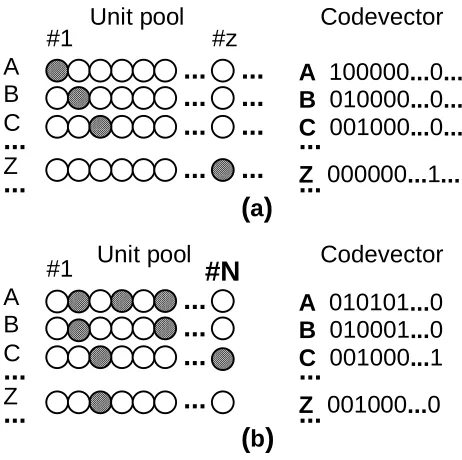
representations, any item can be represented by a distributed pattern of activity over its pool of units. In local representations, any item can be represented by a single active unit from the pool (Figure 3.1).
"Any item" means an item of any nature and complexity level. It may be a model of an elementary attribute, a relation, a physical object, a scene, a class of thereof, etc. "Can be represented" leaves the mechanisms for allocation or assignment of units to represent a particular item for further specification. However, after the mechanism has been established, "with a local representation, activity in individual units can be interpreted directly" (Thorpe 1995, p.550). Local representation of an item is close to the notion of symbol in symbolic representations.
"A distributed pattern" means that many units from the pool participate in the representation of an item, and that a single unit participate in representation of many items. Therefore, "with
distributed coding individual units cannot be interpreted without knowing the state of other units in the network" (Thorpe 1995, p.550).
A pattern of activity over a pool of N units can be considered as a codevector, where each element represents the state of the corresponding unit. Bold font will be used to denote codevectors, and italic font - for the corresponding items. For binary units, the codevectors are binary.
3.2. Elementary items
Elementary (indecomposable) items correspond to the models that have no internal structure (their component models are unknown or unimportant). Possible examples may be such properties as color, weight, speed, labels, probably some kinds of relations, etc.
In local representations, an elementary item is represented by a single unit. An active state of that unit corresponds to the presence of the item. Single elementary item is encoded by a codevector with a single 1 (Figure 3.1a). In distributed representations, different codevectors with a number of 1s are used to encode different items (Figure 3.1b).
3.2.2. Information capacity
In local representations, diversity of possible representations is limited by the number of units in the pool. The pool of N units is capable to represent locally up to N items. In distributed representations, codevectors overlap. Therefore much more than N items can be represented by different binary codevectors from the pool (up to (M from N), where M is the number of 1s in a codevector). 3.2.1. Similarity
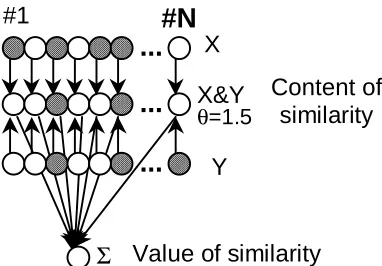
Similarity of items encoded by codevectors may be characterized by two parameters: the composition (content) and the value (degree). The content of similarity is the elementwise product of the
corresponding codevectors.
For binary codevectors, it is the overlapping 1s:
O(X,Y) = X&Y. (3.1)
The degree of similarity is estimated by dot product of those codevectors. For binary codevectors, dot product is simply the fraction of coinciding 1s. Normalized similarity value of X to Y is
S(X,Y) = |X&Y|/(|X| + small_const), (3.2)
where |X| is the number of 1s in X, & is bitwise conjunction. small_const is used for codevectors of different density (see also Carpenter & Grossberg 1987; Marshall 1990) and will usually be omitted hereafter for simplicity.
In local representations, since the codevectors are orthogonal, similarity of elementary items is "all-or-none". If two items are represented by the same unit, they are identical. If they are represented by different units, they are non-similar.
In binary distributed representations, the 1s in codevectors overlap. So, the degree of similarity of two items can be expressed by the degree of correlation of their codevectors. The same codevector is used to represent identical items. To represent non-similar items, randomly generated codevectors are usually used.
Dot product of randomly generated codevectors is approximately the same for large N, and its mean value and standard deviation depend on the statistical distribution of the codevector elements. An average overlap of two random binary codevectors is S=M*M/N*N. For dense binary random
codevectors (M=0.5N), S=0.25. For sparse binary random codevectors, e.g., M<0.01N, S<0.0001. The codevectors with larger overlap are used to represent similar items. Such sparse codevectors are deemed to be used in APNNs (see section 5). In Figure 3.1b, A and B are correlated, A and C are uncorrelated.
3.3 Simple composite items
Simple composite items are the items whose models have elementary models (of attributes and/or parts) as their components.
3.3.1. Fully-articulated representation - representation by superposition
3.3.2 Similarity
Similarity content for local representations is defined by identical components (similarity of the component sets). In distributed representations, the content of similarity is defined not only by the similarity of component sets, but by the similarity of representations of components as well. For example, in local representations, if there are two similar components, A and A', represented by different units, they will not contribute to similarity. In distributed representations, A and A' with common 1s in their codevectors will contribute to the similarity of the composite representations where they are the components.
Both for local and distributed representations, the value of similarity of two simple composite items represented in the fully-articulated manner can be determined as in Eq. 3.2. For example, let
X=AvBvC,Y=AvBvD, where v denotes superposition (disjunction). Both for local representations and for binary distributed representations with a small overlap of component codevectors, the value of similarity will be approximately 2/3 (neglecting the small_const).
Context-dependent similarity mode - similarity in terms of some subset of components - is also possible. For example, if we are interested in similarity in terms of A and B, similarity of X and Y
is full.
3.3.3 Decoding or unfolding
Decoding or unfolding is finding the components provided with the representation of a composite item. In the fully-articulated local representation, information on the components is immediately available from the interpretation of activity of individual units'. In the disjunctive distributed representation, the similarity of a composite codevector to each of its possible component codevectors is calculated, and the component codevectors with the maximal values of overlap are selected. For example, AvBvC has the value of similarity of approximately 1/3 to each of A, B, and C, and much less similarity to other possible component codevectors.
3.4. Complex composite items: superposition catastrophe and binding
Complex composite or hierarchical items are the items whose parts are in turn compositional items. 3.4.1. The superposition catastrophe
If we try to construct representations of hierarchical items recursively, by superposition of their fully-articulated representations, we will encounter the problem well-known as "ghosts" or "superposition catastrophe" (Feldman 1989; von der Malsburg 1986; see also Rachkovskij & Kussul 2001). It is connected with the fact that superposition is not an adequate operation to compose representations of hierarchical items.
Under superposition, representations of the parts composing the whole are not bound together. The fully-articulated representation of the whole is indistinguishable from the representation of the set of their parts. Therefore, when several composite sub-items are combined into the new whole, their components are mixed together, the information on their combination in sub-items is not preserved, and it can not be determined to which whole a part belongs.
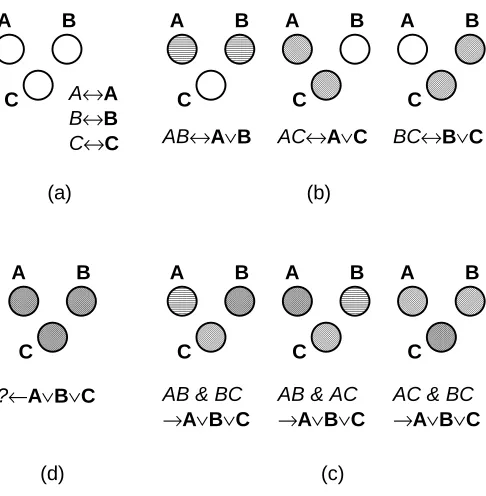
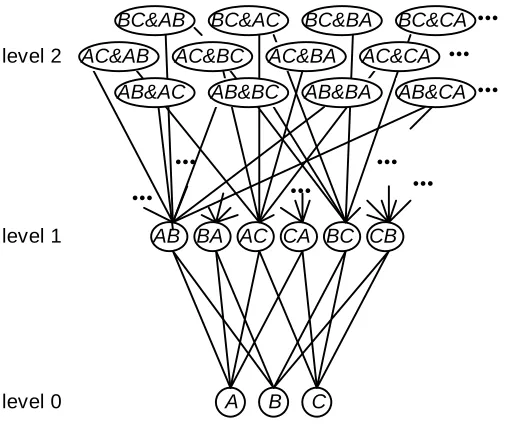
The simplest illustration could be as follows. Let there be components A,B,C and composites
AvB, AvC, BvC (Figure 3.3). If the codevectors of any two of three composites (e.g., AvB and BvC) are activated, the third composite will become active as well, though unbidden (here, "ghost" AvC). In "superposition catastrophe" formulation, the same situation is described as follows: which two
composite items are really present, if A,B,C are activated? These problems also manifest themselves as "spurious memories" (Hopfield, Feinstein, & Palmer 1983; Vedenov et. al. 1987) for superposition learning rules, e.g., Hebb’s learning rule (Hebb 1949), in matrix-type distributed associative memory (i.e., spurious attractors in Willshaw or Hopfield networks).
3.4.2. Binding
In symbolic bracketed notation, representation of hierarchical items may be thought of as expanded in time or space and structured by brackets. The brackets show how the components are grouped or bound together. In ((AB)(AC)), A is bound to B, A is bound to C, AB is bound to AC, where A, B, C are elementary items.
To transform symbolic bracketed notation of structured items into local or distributed connectionist representations, some analog of brackets is required that shows the boundaries of sub-items. The mechanism for introduction of such "brackets" or grouping together representations of items is called binding.
Let us consider "conjunctive" schemes for implementation of the binding operation.
3.5. Conjunctive binding and reduced representation of simple composite items in local representations 3.5.1. The binding scheme
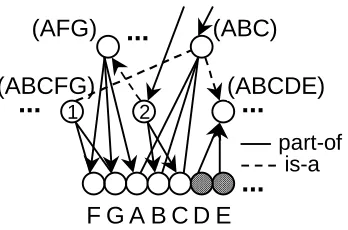
In local representations, introduction of a new unit to represent a composite item is analogous to introduction of brackets to represent binding of components, or to introduction of a new symbol (to substitute) for a combination of symbols denoting bound parts inside the brackets. Such a local representation of composite items may be called reduced or conjunctive local representation, or local conjunctive binding of the components. For example, A&B&C -> (ABC).
The introduced unit representing the binding of component units has connections with the latter. These connections represent part-whole relations between the components and the composite (see also 3.7.1). Thus, introduction of local reduced representations of composite items leads to the growth of the units' pool and necessity to beat connections to the introduced units (Figure 3.4). 3.5.2. Decoding and similarity of bindings
In local reduced representations, decoding of bindings (or retrieval of component representations) is done by following of connections from the unit representing the composite to the units-components (Figure 3.4).
In local representations, each composite item represented in the local reduced form makes up a machine for calculation of its similarity value to any other composite item represented in the fully-articulated form - a dot-product machine. This value is available from the unit of reduced
representation. The connection weights (equal to 1 for binary representations) encode its components, e.g., (ABC)=A&B&C in Figure 3.5. Components of the fully-articulated local representation of another composite item are activated in the input component pool, e.g., AvBvD. Then the activity of the (ABC)
unit provides the readings of the similarity value S between two simple composite representations,
AvBvC and AvBvD. In our example, S=2/3.
However, content of similarity is absent at the unit of reduced representation. Obviously, the same value of similarity may be produced by very different composite items, e.g., ABC and ABD, EBC, AFC, etc. Also, if the component units are activated differently, the contribution of each unit is undefined - only the sum of contributions is available.
In order to find the similarity content of two simple composite items provided with their (non-identical) local reduced representations, both should be decoded through their fully-articulated
representations, and then the elementary components should be compared (by elementwise product). To find their similarity value, one of the simple composite items should be decoded, and then the dot-product machine of the local reduced representation of the other composite item will output the value of similarity.
However, if the similarity value of a unit corresponding to reduced representation is not maximal (the items are not identical), then there is not enough info for retrieval of the components - it is not known, which subset of components provided the observed value of similarity.
3.6. Conjunctive binding in distributed representations 3.6.1. The binding schemes