O R I G I N A L R E S E A R C H
Survival, Prevalence, Progression and Repair of
Abdominal Aortic Aneurysms: Results from Three
Randomised Controlled Screening Trials Over
Three Decades
This article was published in the following Dove Press journal: Clinical Epidemiology
Jes S Lindholt, 1–3 Axel C
Diederichsen,2,4 Lars M Rasmussen,2,5Lars Frost, 6,7 Flemming H Steffensen,8Jess
Lambrechtsen,8 Grazina
Urbonaviciene,6,7 Martin Busk,9Kenneth Egstrup,8 Katrine L Kristensen, 1–3
Carsten Behr Andersen,3
Rikke Søgaard 10
1Department of Cardiothoracic and Vascular Surgery, Odense University Hospital, Odense, Denmark;2Elitary Centre for Individualized Medicine in Arterial Diseases (CIMA), Odense, Denmark; 3Department of Vascular Surgery, Viborg Hospital, Viborg, Denmark;4Department of Cardiology, Odense University Hospital, Odense, Denmark;5Department of Clinical Biochemistry and Pharmacology, Odense University Hospital, Odense, Denmark; 6Department of Cardiology, Diagnostic Centre, Regional Hospital Silkeborg, Silkeborg, Denmark;7Department of Clinical Medicine, Aarhus University, Aarhus, Denmark;8Department of Cardiology, Vejle Hospital, Vejle, Denmark;9Department of Cardiology, University Hospital Odense Svendborg, Svendborg, Denmark; 10Department of Public Health and Department of Clinical Medicine, Aarhus University, Aarhus, Denmark
Aim:The prevalence and mortality of abdominal aortic aneurysms (AAA) has been reported to decline. The aim of this study is to compare survival, prevalence, and repair rate of AAA in Denmark in the 1990s, the 2000s and the 2010s –and to examine any change in factors known to influence the prevalence.
Methods:Baseline status and up to 5-year outcomes of 34,079 general population men aged 65–74 were obtained from three RCTs; the Viborg study (1994–1998, n=4,860), the Viborg Vascular (VIVA) trial (2008–2011, n=18,748), and the Danish Cardiovascular (DANCAVAS) trial (2015–2018, n=10,471). After the millennium (VIVA and DANCAVAS) men with AAA were further offered low dose aspirin and statins. Follow-up data were not available for the DANCAVAS trial yet.
Results: Across the three decades, the AAA prevalence was 3.8% (Reference), 3.3% (p<0.001) and 4.2% (p=0.882), the proportion of smokers were 62%, 42% and 34% (p<0.001) amongst men with AAA, but AAA risk associations with smoking increased during the decades suggesting increased tobacco consumption of smokers. In addition, the proportions of attenders with ischemic heart disease or stroke increased significantly. The aneurysmal progression rate in the 1990s was 2.90 vs 2.98 mm/year in the 2000s (p=0.91). The need for preventive AAA repair increased insignificantly in the 2000s (Age adj. HR= 1.29, 95% C.I.: 0.95; 1.71, p=0.10), and mortality of men with screen-detected AAA was lower in the 2000s compared to the 1990s (Age-adj. HR= 0.28, 95% C.I.: 0.22; 0.36, p<0.001).
Conclusion:The Danish prevalence of AAA today compares to the nineties. Unchanged aneurysmal progression rates combined with improved survival of men at risk of AAA leave them in longer time to develop an AAA, be diagnosed and to need later aneurysmal repair or experience rupture.
Clinical Trial Registrations:Viborg study: No possibility of registration in the nineties. VIVA: NCT00662480, URL: https://clinicaltrials.gov/show/NCT00662480, DANCAVAS: ISRCTN12157806, URL:http://www.isrctn.com/ISRCTN12157806.
Keywords: abdominal aortic aneurysms, screening, prevalence, survival, progression, smoking
Introduction
After an epidemic rise in mortality of abdominal aortic aneurysm (AAA) during the 1980s and early 1990s, reports from Sweden, UK and the US reported declining prevalence and AAA-specific mortality after the millennium.1–3Actually, the decline
Correspondence: Jes S Lindholt Department of Cardiothoracic and Vascular Surgery, Odense University Hospital, J.B. Winsløv Vej 4, Odense 5000, Denmark
Tel +45 2464 1214
Email [email protected]
Clinical Epidemiology
Dove
press
open access to scientific and medical research
Open Access Full Text Article
Clinical Epidemiology downloaded from https://www.dovepress.com/ by 118.70.13.36 on 24-Aug-2020
was reported shortly after thefirst implementations of gen-eral population screening programs for men in Sweden, UK and US, while other countries now halt back a decision about general population screening, because the continued decrease in prevalence of AAA may tip the balance
between harm and benefit.4,5 However, at the same time,
evidence on the value of screening to citizens emerge and
show that informed individuals are able to reflect on the
participation decision if given a choice. When asked to
weigh the potential health benefit against potential harms
of overtreatment and later regret of the participation deci-sion, individuals valued the benefit >10 times higher than the harm.6
The cause of the decrease in AAA prevalence has mainly been explained as monofactorial - a simple and logic consequence of reduced smoking in the Western
World.7Epidemiological trends are, however, very seldom
monofactorially driven. Although reduced smoking could be a partly explaining factor, the developed societies, health care systems and technologies have changed; the
prehospital emergency services have been greatly
improved with increasingly faster and better supported transfer of emergencies to hospitals, where modern, sophisticated, high-tech imaging secures fast and valid diagnoses followed by much better outcomes of emer-gency procedures. Furthermore, focus on AAA combined with easier access to detection has caused a much higher incidental detection of AAA. A modern Danish model on screening for AAA estimated that the annual probability of a large AAA being incidentally detected is around 15%
compared to only 3% in the 1990s.8 This combined with
the introduction of endovascular aneurysm repair (EVAR) and much better outcomes of preventive repair has caused
a constant increase in preventive, elective procedures.9
Altogether, these factors suggest that the observed
decrease in AAA-specific mortality is hardly attributable
to lower prevalence and reduced smoking alone.
In Denmark, three randomised controlled trials on the
efficacy of screening for AAA have been conducted by the
same principal investigator since 1994 using high-quality equipment and uniform standardized screening and sur-veillance methods allowing for comparison of risk factors and outcomes across three decades. Consequently, the aim of this study is to compare the survival, prevalence, and
repair rate of AAA across three decades–the 1990s, the
2000s and the 2010s–and to explain any change by trends
in factors known to influence the prevalence of AAA:
smoking, predisposing comorbidity, aneurysmal growth,
need for aneurysm repair, and survival of men with AAA.9
Materials and Methods
Attenders to three randomised screening trials for AAA of
men aged 65–74; the Viborg study from the 1990s
(n=4,816), The VIVA trial from the 2000s (n=18,710) and the DANCAVAS trial from the 2010s (n=10,471)
In the Viborg and VIVA trials, all men aged 65–74
years, and living in the county of Viborg during 1994–98
or in the Central Denmark Region during 2008–2011, were
randomised 1:1 without exclusion criteria to be invited to screening for AAA by abdominal aortic ultrasound (US) scanning at the nearest hospital by special trained mobile screening teams consisting of nurses.10,11
Maximal infrarenal anterior-posterior aortic were mea-sured in the peak of the systole at the widest diameter in case of a dilatation, and if not, just above the bifurcation. This method for assessing has proven to be very reprodu-cible with high observer agreement.12,13
Men with an AAA above 50 mm were referred for vascular evaluation, while those below 50 mm were fol-lowed by annual control scans to check for progression to operation-recommendable sizes. The annual growth rates were calculated by individual linear regression analysis of the observed AP diameters during observation time.
In the DANCAVAS trial, 65–74-year-old men living in
on the island of Funen or in the municipalities of Kolding, Fredericia, Vejle, Silkeborg and Ikast-Brande were rando-mised 2:1 as controls or for invitation to ECG gated
truncal non-contrast CT scanning for quantification of
coronary calcification and screening for aneurysms
caus-ing the infrarenal aorta examined in the end diastole per-formed and measured by specially trained radiographers. This method has been validated and found in agreement with the above mentioned US-based method, probably due to measurement in the end-diastolic phase.14,15
In all three trials, non-responders were reinvited once. In the VIVA and DANCAVAS trials, the additional screen-ing offers were performed at the same time as the AAA screening.
In the Viborg study and the DANCAVAS trial, transverse
aortic diameters ≥30 mm were also considered as AAA,
while in VIVA it was only AP diameters, so this paper
only deals with those having an AP diameter ≥30 mm.
A maximal infrarenal anterior-posterior aortic diameter
≥30 mm was used to define an AAA in all three trials. In
the Viborg and VIVA trials, people with an aortic diameter
Clinical Epidemiology downloaded from https://www.dovepress.com/ by 118.70.13.36 on 24-Aug-2020
between 30–49 mm were offered annual surveillance while
people with an aortic diameter≥50 mm were referred to CT
scan and assessment of indication for elective surgery. In the DANCAVAS trial, similar regimes were offered but the threshold for referral to vascular surgeons for assessment of indication for elective surgery was increased to 55 mm.
No further preventive actions were offered in the
Viborg study, while positive findings in the VIVA and
DANCAVAS trials were prescribed with statins and low dose aspirin, if not already initiated or contraindicated. In
addition, active smokers with positive findings in the
VIVA trial were offered assistance to quit smoking.10,11,14 All attenders to the VIVA and DANCAVAS trials
ful-filled a similar health questionnaire including smoking
habits, while this was only the case for positive findings
in the Viborg trial. The used proportion of smokers among
attenders was based upon a study of age and sex-stratified
proportions of smokers in Denmark in the 1990s.16
Hypertension was self-reported in all trials, and comor-bidities were register-based regarding the Viborg Study and VIVA as any hospital admission during the last ten years prior to randomisation, while comorbidities were self-reported in DANCAVAS. Outcome data concerning
aneurysmal repair and overall mortality after five years
were obtained from national health registers, and only available for the Viborg Study and VIVA trial.
Written informed consent was collected at entrance to the studies, which were conducted in agreement with the Helsinki Declaration, and approved by the relevant ethical committees:
The Viborg Study (The Scientific Ethical Committee of the
Counties of Northern Jutland and Viborg, 2-16-41-2-90), the
VIVA trial (The Scientific Ethical Committee of the Mid
Region of Denmark, M20080028), and DANCAVAS (The
Scientific Ethical Committee of Southern Denmark,
S20140069), and data protection authorities.
Statistical Analysis
Baseline characteristics are reported as frequencies (%) with
95% confidence intervals (CI) and means with standard
deviations (SD), and compared by chi square test for cate-gorical variables, and ANOVA for continuous variables.
Comparisons among the trials were adjusted for age as the selection to the Viborg Study differed slightly from the two other trials as 74-year-old men were not invited. To test for differences in prevalences in AAA, logistic regres-sion was used using the trial from 90s as the reference with adjustment for age. A subgroup analysis regarding
65-year-old men was performed, as this group is the potential target for screening.
Odds ratios for having an AAA in all three decades were calculated regarding ever vs never-smokers, current smokers vs never smokers, and ex-smokers vs never smokers.
To test for differences in the growth rate over the decades, individual linear regression was used to estimate the individual growth rate and thus taking into account that different numbers of observations and different intervals between observations were present.
Differences in growth rate over the decades were
examined univariately by unpairedt-test.
Cox regression analysis adjusted for age was used to compare the need for aneurysmal repair and overall survi-val of AAA detected men over the decades as well. In addition, cox regression analyses adjusted for age were performed to compare mortality of AAA detected men with attending men without AAA across the decades.
As sensitivity analysis, we estimated subhazard ratios with 95% CI using competing risk regression regarding repair rate as death is an obvious competing risk. This method was chosen to account for informative censoring during the long follow-up of this study. Time was mea-sured from baseline screening until a participant under-went surgery, died or end of follow-up, whichever came first. We adjusted for age as in the main analysis.
Corresponding author had full access to all the data in the study and takes responsibility for its integrity and the data analyses.
Results
In all, 110,117 were randomised of which 48,179 were invited to screening and 34,079 (71%) attended. Attendance rates varied from 4,860 out of 6333 (77%) in the 1990s, 18,710 out of 25,076 (74%) in the 2000s and 10,471 out of 16,768 (62%) in the 2010s. The mean ages were 67.3, 69.0 and 69.0, respectively (p<0.001).
Trends in Demographic Characteristics
and Risk Factors
The prevalence of acute myocardial infarction (AMI) remained unchanged through the three decades, but the proportion of angina pectoris or stroke at baseline
increased significantly. In all, the proportion having had
some manifestation of occlusive cardiovascular disease increased (Table 1).
Clinical Epidemiology downloaded from https://www.dovepress.com/ by 118.70.13.36 on 24-Aug-2020
Height, body mass index (BMI) and lowest measured ankle-brachial blood pressure index (ABI) increased signifi -cantly, while systolic and diastolic blood pressure decreased
significantly in accordance with significantly more using
antihypertensive therapy in the last trial. Use of low dose
aspirin decreased, while use of statins was unchanged in general and among those having an AAA diagnosed (Table 1).
We do not have population-based trial data regarding smoking habits from the 1990s, but assumable 41% were
Table 1 Risk Factors and Comorbidities in Screened General Population Men Across Decades: Prevalence in All Attenders and Attenders with a Positive Test for Abdominal Aortic Aneurysm
1990s (Viborg) N=4816 2000s (VIVA) N=18,748 2010s (DANCAVAS) N=10,471 P-value
Attenders (n) 4816 18,748 10,471
Mean (SD) Mean (SD) Mean (SD)
Age (years) 67.3 (2.66) 69.0 (2.81) 69.0 (2.60) <0.001
Height (cm) 176.0 (6.27) 177.0 (6.52) <0.001
Body mass index (kg/m2) – 26.5 (3.57) 26.9 (3.80) <0.001
Systolic blood pressure (mmHg) – 158 (21.5) 149.8 (18.6) <0.001
Diastolic blood pressure (mmHg) – 85.6 (11.1) 82.2 (9.89) <0.001
Ankle-brachial blood pressure index – 1.04 (0.16) 1.11 (0.16) <0.001
Max. aortic diameter (mm) 18.8 (5.16) 19.1 (5.26) 20.7 (5.05) <0.001
n (%) n (%) n (%)
Current smoking *(45.0%) 3933 (21.1) 1582 (15.2) <0.001
Use of low dose aspirin – 6069 (33.4) 3756 (35.9) <0.001
Use of statins – 6420 (35.6) 3090 (34.8) 0.193
Use of antihypertensive therapy – 7904 (42.5) 4788 (45.7) 0.001
Diabetes 95 (2.9) 2028 (10.9) 1230 (11.7) <0.001
Previous acute myocardial infarction 351 (7.3) 974 (5.20) 694 (6.6) <0.001
Previous ischemic heart disease 492 (10.2) 2171 (11.6) 1106 (10.6) <0.001
Previous stroke 125 (2.6) 899 (4.8) 709 (6.8) <0.001
Previous peripheral arterial disease 131 (2.7) 354 (1.9) 253 (2.4) 0.637
Positive screening test AAA (n) 184 618 443
Mean (SD) Mean (SD) Mean (SD)
Age (years) 67.8 (2.80) 69.5 (2.79) 69.7 (2.61) <0.001
Height (cm) 175.1 (9.61) 176.3 (6.04) 177.3 (6.75) 0.003
Body mass index (kg/m2) 26.9 (3.75) 27.5 (3.76) 28.9 (4.32) <0.001
Systolic blood pressure (mmHg) 158 (21.7) 155 (21.6) 149 (18.6) <0.001
Diastolic blood pressure (mmHg) 93 (13.0) 87 (11.9) 83 (10.5) <0.001
Ankle-brachial blood pressure index 0.97 (0.24) 0.95 (0.19) 0.98 (0.19) 0.030
Max. aortic diameter (mm) 38.0 (9.74) 40.6 (11.8) 38.8 (9.21) <0.001
Aneurysmal growth rate (mm/year) 2.90 (2.56) 2.98 (2.57) – 0.914
n (%) n (%) n (%)
Current smoking 108 (62.1) 259 (41.4) 156 (35.4) <0.001
Use of low dose aspirin 73 (41.2) 326 (52.6) 207 (46.7) 0.012
Use of statins 0 (0.0) 335 (54.1) 270 (60.9) <0.001
Use of antihypertensives 60 (32.6) 339 (54.5) 268 (60.5) <0.001
Diabetes 3 (2.3) 70 (11.3) 71 (16.0) <0.001
Previous acute myocardial infarction 32 (17.4) 70 (11.3) 84 (19.0) 0.369
Previous ischemic heart disease 40 (9.8) 116 (18.8) 108 (24.3) 0.032
Previous stroke 8 (4.3) 55 (8.9) 57 (12.9) 0.003
Previous peripheral arterial disease 10 (5.4) 29 (4.7) 22 (5.0) <0.001
Note:*Data from Osler et al.16
Abbreviation:AAA, abdominal aortic aneurysm.
Clinical Epidemiology downloaded from https://www.dovepress.com/ by 118.70.13.36 on 24-Aug-2020
active smokers,15 in the 2000s were 21% of the attenders active smokers, and 15% in the 2010s (p<0.001). Regarding
those with a positive AAAfinding, 62%, 42% and 34% were
active smokers in 1990s, 2000s and 2010s (p<0.001), respectively.
Odds ratios for having an AAA in all three decades regarding ever vs never-smokers, current smokers vs never smokers, and ex-smokers vs never smokers were all sig-nificant, and increased during the decades (Table 2).
Prevalence of Abdominal Aortic Aneurysms
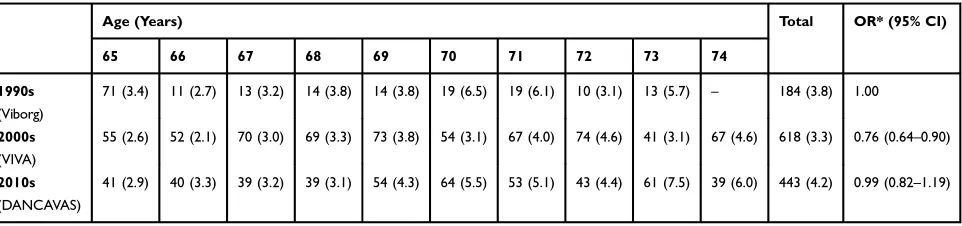
The AAA prevalence stratified by age and decade of study
is shown in Table 3 and illustrated in Figure 1. The
pre-valence of AAA was 3.8%, 3.3% and 4.2%, respectively. Adjusted for age at randomisation and using the 1990s as
reference, 2000s had significantly lower risk of AAA (age
adj. OR= 0.76, 95% CI: 0.64; 0.90, p<0.001), while the
2010s had equal risk of AAA compared to the 90s (age
adj. OR=0.99, 95% CI: 0.82; 1.19, p=0.882) (Table 3).
Regarding the subgroup of men aged 65, the preva-lence of AAA was 3.4% in the 1990s, 2.6% in the 2000s and 2.9% in the 2010s, respectively (p=0.334).
Aneurysmal Growth Rate and Need for
Surgical Repair
This change in smoking habits and the intention to moti-vate current smokers to stop smoking in the VIVA trial from the 2000s together with other general cardiovascular preventive actions as statin and low dose aspirin
medica-tion and antihypertensive treatment ought to influence
aneurysmal growth, but the mean annual aneurysmal growth rate appeared to be unchanged from 2.90 ± 2.57 mm/year in the 1990s to 2.98 ±2.57 mm/year in the 2000s (p=0.91).
Table 2Association Between Smoking Status (%) and AAA
Smoking AAA No AAA All Odds Ratio AAA (95% CI)
Ever vs Never Smoker Current vs Never Smoker Ex vs Never Smoker
1990s* Current 62 52 52 3.07 (1.45; 7.79) 3.37 (1.57; 8.63) 2.65 (1.20; 6.90)
Ex 35 37 37
Never 4 11 11
2000s Current 41 20 21 4.78 (3.58; 6.51) 7.41 (5.45; 10.24) 3.70 (2.74; 5.09)
Ex 50 50 50
Never 8 30 29
2010s Current 34 14 15 4.46 (3.27; 6.20) 7.96 (5.66; 11.36) 3.53 (2.56; 4.95)
Ex 56 53 53
Never 10 33 32
Note:*In the Viborg trial of the 1990s, smoking was only assessed for participants with a positive screening test. A matched gender and birth cohort from the 1994 Danish National Health and Morbidity Survey was therefore used to inform the missing distributions for the“No AAA”and“All”columns, respectively.24
Abbreviation:AAA, abdominal aortic aneurysm.
Table 3Age-Stratified Prevalence of Abdominal Aortic Aneurysms (n and %) and Overall Time Trends Across Decades (Odds Ratios with 95% Confidence Intervals)
Age (Years) Total OR* (95% CI)
65 66 67 68 69 70 71 72 73 74
1990s
(Viborg)
71 (3.4) 11 (2.7) 13 (3.2) 14 (3.8) 14 (3.8) 19 (6.5) 19 (6.1) 10 (3.1) 13 (5.7) – 184 (3.8) 1.00
2000s
(VIVA)
55 (2.6) 52 (2.1) 70 (3.0) 69 (3.3) 73 (3.8) 54 (3.1) 67 (4.0) 74 (4.6) 41 (3.1) 67 (4.6) 618 (3.3) 0.76 (0.64–0.90)
2010s
(DANCAVAS)
41 (2.9) 40 (3.3) 39 (3.2) 39 (3.1) 54 (4.3) 64 (5.5) 53 (5.1) 43 (4.4) 61 (7.5) 39 (6.0) 443 (4.2) 0.99 (0.82–1.19)
Note:*Age adjusted to account for the Viborg trial not including 74-year-old men odds ratios of abdominal aortic aneurysms between the three trials using the Viborg Study as reference.
Clinical Epidemiology downloaded from https://www.dovepress.com/ by 118.70.13.36 on 24-Aug-2020
The need for aneurysmal repair increased insignifi -cantly by almost 30% in the 2000s compared to the 1990s regardless of the indication threshold having been increased from 5.0 cm to 5.5 cm (HR= 1.29, 95% C.I.:
0.95; 1.71, p=0.10), Figure 1. When competing risk
ana-lysis was performed, the insignificant increased risk of
needing aneurysmal repair in the 2000s compared to the 1990s was sustained (age-adj SHR: 1.30, 95% CI: 0.94; 1.80, p=0.115).
Overall Survival
In the 1990s, the age-adjusted five-year mortality hazard
among subjects screened positive for AAA was almost twice as high compared to the other attenders (Age adj. HR=1.88, 95% CI: 1.57; 2.24, p<0.001). In the 2000s, this risk was almost 2.5-fold increased (Age adj. HR=2.40, 95% CI: 2.02; 2.86, p<0.001). However, comparing survi-val of those detected with an AAA in the 1990s and the
2000s, the age-adjusted five-year mortality hazard was
72% lower in the 2000s (Age-adj. HR= 0.277, 95% C.I.: 0.215; 0.356, p<0.001) (Figure 2).
Discussion
This comparison of the three Danish RCTs including AAA screening through three decades demonstrated no decline
in AAA prevalence –rather a paradoxical sustained
pre-valence after a small decline in the 2000s. Paradoxical as we all expected the prevalence to decline. However,
prevalence is a function of incidence and living years, and substantially improved survival was observed and could be explained by the decreased smoking rates and modern pharmacological prophylaxis with statins and low dose aspirin. However, smoking cessation and modern cardiovascular pharmacological prevention did not inhibit aneurysmal growth rates. The unchanged aneurysmal pro-gression rates and longer survival could explain the
sus-tained prevalence of AAA and although insignificant, 30%
increased need for elective repair, the latter combined with better outcomes of surgical repair allows patients with
more comorbidity to be treated – particularly after the
introduction of EVAR.17,18 The 1990s used a 50-mm
threshold, as it took place before the UKSAT trial and
ADAM study defined the current threshold at 55 mm. In
the 2000s, they were referred for CT scanning and vascular evaluation when it was or became more than 50 mm. Some may have been offered repair before 55 mm; we don´t have data access to that, but still, the general lower threshold in the 1990s is a bias towards no change in repair rate. The opposite could be possible regarding no repair as EVAR has been introduced, and operative results improved. However, in the 1900s, 16.4% referred for surgery weren´t repaired, while it also was 15.2% in the 2000s regarding those above 55 mm.
Our observation of sustained AAA prevalence is in contrast to other reports.1–3Synchronously with the reports
on declining AAA-specific mortality, nationwide screening
programmes of 65-year-old men have been implemented in Sweden, UK, and the USA all reporting a much lower
Figure 1Five-year cumulative aneurysmal repair for men with screen-detected abdom-inal aortic aneurysm in the 1990s versus the 2000s (Age adj. HR = 1.29, 95% C.I.: 0.95; 1.71, p=0.10).
Figure 2Five-year mortality of men detected with abdominal aortic aneurysm in the 1990s versus the 2000s regarding overall mortality (Age-adjusted HR= 0.277, 95% C.I.: 0.215; 0.356, p<0.001).
Clinical Epidemiology downloaded from https://www.dovepress.com/ by 118.70.13.36 on 24-Aug-2020
prevalence than observed in the screening studies from the 90s.1–3However, age is a very strong risk factor for AAA, and the screening studies from the 1990s enrolled men
aged 65–74 years. Only in the Gloucestershire screening
trial, the prevalence of AAA has been described solely for 65-year-old men since the 1990s and reported to be
declining.19 Again, it can be questioned whether this
could be partly explained by technology development. The B-mode imaging quality of ultrasound (US) scanners has taken a dramatic rise in quality since thefirst genera-tions in the late eighties and early nineties –it was espe-cially difficult to define the posterior aortic wall in absence
of calcifications, which without doubt has triggered
mea-surements on the longitudinal anterior ligament of the vertebra causing substantial overdiagnosing. Finally, the proportion being diagnosed incidentally has increased sub-stantially, and it is likely that those with a known AAA would not attend a screening programme for something
already detected as they would not gain any benefit of it.
The VIVA and DANCAVAS trials offered additional screening offers, which could have attracted more men with an AAA to attend.
The present observations in this study are based upon studies conducted with several strengths; they are popula-tion-based with high attendance rates minimising the risk of selection bias, the Viborg and VIVA trial used exactly the same method for detection and surveillance of AAA mini-mising the risk of information bias between these two trials, and all three trials included the same gender and age-group minimising the risk of confounding. However, it also carries some limitations; the examined geographically areas were not exactly the same, and local differences may exist. In addition, the improvement of US scanners between the Viborg study and the VIVA study could have produced more reliable AAA diagnoses in the VIVA trial, and in the Viborg Study, the transverse aortic diameter was also mea-sured, so the measurements were performed in the axial plane, which risks lack of right-angled measurements com-pared to VIVA, which only used the longitudinal plane. Such information bias would be towards the null hypothesis that the prevalence was declining, which was seen between the Viborg study and the VIVA trial.
Ultrasound- versus CT-Based Screening
The latter use of CT scanning in DANCAVAS ought to produce a bias towards a higher prevalence, because CT scanning, in general, is reported to overestimate the
aortic diameter compared to the US.20 However, the
screening methods of the two modalities were compared in 533 consecutive attenders in the DANCAVAS pilot
study showing no difference.15 The explanation seems
most obvious that while the US-based measurement in the two US-based trials were measured in the peak of the systole, the CT scans in DANCAVAS were produced in the end-diastole as a consequence of the ECG gating
needed to estimate coronary calcification scores, and
the infrarenal aortic diameter difference between the peak of the systole and the end of diastole was described
in general to be 2 mm in the VIVA trial–similar to the
differences usually described between US and CT.12,21
However, as a number of other measurement aspects than technology will impact agreement between these tech-nologies, we strongly disbelieve that this explains ourfi nd-ing of a sustained prevalence. First, the DANCAVAS
protocol was defined to match the Viborg and VIVA by
specifying strict anterior-posterior measurements from pla-que to plapla-que (inner to inner measurements). Second, the qualification and training of the staff will directly influence the systematic error of e.g. the rate of visualization,
preci-sion in the identification of the plaques, and agreement
across repeated measurements. Third, both random and systematic errors are affected by scale and scope of setting where there is a notable difference between protocolised high-volume screening trials and ad hoc measurement stu-dies without reported strict standards of measurement. The screening method used in DANCAVAS was validated with
the US confirming CT measures AAA diameters higher
than the US, but more than 95% are not aneurysmatic, and overall there was no disagreement between the two modalities regarding infrarenal anterior-posterior aortic dia-meters. Nevertheless, the prevalence of AAA was 18% higher by CT scanning than US scanning in the validation study which could be an artefact because of the change in screening modality. However, 60% of these AAA were either more than 5 mm larger by CT or aorta weren´t visualised at the US. We interpret this as a consequence of the ultrasound scans were performed by unexperienced medical students after basic supervised training. However, we can never prove the rest isn´t due to the difference in methods, but this would maximally cause a 10% higher AAA prevalence by CT scanning.
Sustained Prevalence of AAA in Denmark
A sustained prevalence of AAA in Denmark is supported by a constant incidence of preventive elective and emergency
interventions in Denmark (www.karbase.dk). In fact,
Clinical Epidemiology downloaded from https://www.dovepress.com/ by 118.70.13.36 on 24-Aug-2020
a VASCUNET presentation at the ESVS annual meeting in 2018 demonstrated a higher national incidence of elective AAA repairs in Denmark (43.2/100.000) compared to England (33.5/100.000) and Sweden (37.5/100.000), where
nation-wide screening programmes are implemented.
Furthermore, a worldwide WHO based report clearly showed
a sustained and higher AAA-specific mortality in Denmark
compared to Sweden, UK and the USA.3Finally, in addition,
the prevalence of AAA by the US in the pilot study of DANCAVAS was 4.5%, which still seems similar or even higher than observed in the 1990s but the numbers examined were relatively low leaving relatively wide confidence inter-vals (95% C.I.: 3.0; 6.6%).
Potential Explanations
Odds ratios for having an AAA in ever, current, and
former smokers compared to never all confirmed that any
history of smoking is associated with AAA, but more surprisingly, the risk association has increased during the decades indicating an increased tobacco consumption
(so-called “hardening of smokers”) among smokers. This is
only possible, if the tobacco use per smoker has increased. While the prevalence of smoking has declined substan-tially over recent decades, there is empirical support for
the “hardening”hypothesis in that the daily consumption
per smoker in Denmark has increased from 14 cigarettes in the 1990s, to 20 in the 2000s, and to 25 in the 2010s.20So smokers have increased their use of tobacco, and they
survive CVD better and live longer,22 which combined
increases their cumulative smoking exposure and thus risk of AAA explaining the sustained prevalence of AAA. What remains to be shown is whether Denmark is uniquely experiencing a paradox of sustained prevalence of
AAA – perhaps through a unique hereditary disposition,
which is suggested by a twin study demonstrating that 70%
of all Danish AAA can be genetically explained23 - or
whether this is the first sign of a general paradox in the
prevalence of AAA in similar countries as a consequence of the increasing aging population of men in risk of devel-oping an AAA. Although the improved survival observed in the 2000s has been sustained, or improved upon in the 2010s remains to be seen, thefinding of a marked two-third reduc-tion in overall mortality by introducing general cardiovascu-lar preventive actions in cases with screen-detected AAA calls for adding such actions to existing screening pro-grammes and be taken into consideration by decision-makers evaluating whether permanent screening should be offered in their area.
Acknowledgments
The numerous involved project, – administrative, – and
clinical staff making these trials possible are truly acknowledged, as well as the GPs in the Central Region and the Southern Region of Denmark who took over the preventive actions.
Funding
The Viborg study as funded by The Danish Heart Foundation, The Danish National Research Council, and The County of Viborg. The VIVA trial was funded by the
7th European framework programme:
Health-2007-2.4.2-2.: Project full title: Fighting Aneurysmal disease. Grant agreement no: 200647, the Mid Region of Denmark, Viborg Hospital, and The Danish Council for Independent Research. The DANCAVAS trial is supported by The Danish Heart Foundation, The Danish Council for
Independent Research, The Region of Southern
Denmark, and the Helse Foundation.
Disclosure
Dr Lars Frost reports personal fees from Bayer,
Boehringer Ingelheim, BMS, MSD, and Pfizer, outside
the submitted work. The authors report no other conflicts
of interest in this work.
References
1. Svensjö S, Björck M, Gürtelschmid M, Djavani Gidlund K, Hellberg A, Wanhainen A. Low prevalence of abdominal aortic aneur-ysm among 65-year-old Swedish men indicates a change in the epide-miology of the disease. Circulation. 2011;124(10):1118–1123. doi:10.1161/CIRCULATIONAHA.111.030379
2. Anjum A, Powell JT. Is the incidence of abdominal aortic aneurysm declining in the 21st century? Mortality and hospital admissions for England & Wales and Scotland.Eur J Vasc Endovasc Surg.2012;43 (2):161–166. doi:10.1016/j.ejvs.2011.11.014
3. Sidloff D, Stather P, Dattani N, et al. Aneurysm global epidemiology study: public health measures can further reduce abdominal aortic aneurysm mortality.Circulation. 2014;129(7):747–753. doi:10.1161/ CIRCULATIONAHA.113.005457
4. Wanhainen A, Svensjö S, Holst J, Björck M, Gottsäter A, Swedish Aneurysm Screening Study group and the Swedish Society for Vascular Surgery. Screening for abdominal aortic aneurysm.Lancet.
2019;393(10166):27–28. doi:10.1016/S0140-6736(18)32761-2 5. Johansson M, Zahl PH, Siersma V, Jørgensen KJ, Marklund B,
Brodersen J. Screening for abdominal aortic aneurysm – authors’ reply. Lancet. 2019;393(10166):28. doi:10.1016/S0140-6736(18)327 42-9
6. Hansen TB, Lindholt JS, Diederichsen ACP, et al. Individual prefer-ences on the balancing of good and harm of cardiovascular disease screening.Heart.2019. doi:10.1136/heartjnl-2018-314103
7. Johansson M, Hansson A, Brodersen J. Estimating overdiagnosis in screening for abdominal aortic aneurysm: could a change in smoking habits and lowered aortic diameter tip the balance of screening towards harm?BMJ.2015;350:h825. doi:10.1136/bmj.h825
Clinical Epidemiology downloaded from https://www.dovepress.com/ by 118.70.13.36 on 24-Aug-2020
8. Søgaard R, Laustsen J, Lindholt JS. Cost effectiveness of abdominal aortic aneurysm screening and rescreening in men in a modern con-text: evaluation of a hypothetical cohort using a decision analytical model.BMJ.2012;345:e4276. doi:10.1136/bmj.e4276
9. Lindholt JS. Abdominal aortic aneurysms.Dan Med Bull.2010;57 (12):B4219.
10. Grøndal N, Søgaard R, Lindholt JS. Baseline prevalence of abdom-inal aortic aneurysm, peripheral arterial disease and hypertension in men aged 65-74 years from a population screening study (VIVA trial).Br J Surg.2015;102(8):902–906. doi:10.1002/bjs.9825 11. Lindholt JS, Juul S, Fasting H, Henneberg EW. Screening for
abdom-inal aortic aneurysms: single centre randomised controlled trial.BMJ.
2005;330(7494):750. doi:10.1136/bmj.38369.620162.82
12. Grøndal N, Bramsen MB, Thomsen MD, Rasmussen CB, Lindholt JS. The cardiac cycle is a major contributor to variability in size measurements of abdominal aortic aneurysms by ultrasound.
Eur J Vasc Endovasc Surg.2012;43(1):30–33. doi:10.1016/j.ejvs.20 11.09.025
13. Lindholt JS, Vammen S, Juul S, Henneberg EW, Fasting H. The validity of ultrasonographic scanning as screening method for abdominal aortic aneurysm. Eur J Vasc Endovasc Surg. 1999;17 (6):472–475. doi:10.1053/ejvs.1999.0835
14. Diederichsen AC, Rasmussen LM, Søgaard R, et al. The Danish Cardiovascular Screening Trial (DANCAVAS): study protocol for a randomized controlled trial. Trials. 2015;16:554. doi:10.1186/ s13063-015-1082-6
15. Liisberg M, Diederichsen AC, Lindholt JS. Abdominal ultrasound-scanning versus non-contrast computed tomography as screening method for abdominal aortic aneurysm– a validation study from the randomized DANCAVAS study. BMC Med Imaging. 2017;17 (1):14. doi:10.1186/s12880-017-0186-8
16. Osler M, Prescott E, Gottschau A, et al. Trends in smoking preva-lence in Danish adults, 1964-1994. The influence of gender, age, and education. Scand J Soc Med. 1998;26(4):293–298. doi:10.1177/ 14034948980260041101
17. Adkar SS, Turner MC, Leraas HJ, et al. Low mortality rates after endovascular aortic repair expand use to high-risk patients.J Vasc Surg.2018;67(2):424–432. doi:10.1016/j.jvs.2017.06.107
18. Wanhainen A, Verzini F, Van Herzeele I, et al. Editor’s Choice – European Society for Vascular Surgery (ESVS) 2019 clinical practice guidelines on the management of abdominal aorto-iliac artery aneur-ysms.Eur J Vasc Endovasc Surg. 2019;57(1):8–93. doi:10.1016/j. ejvs.2018.09.020
19. Darwood R, Earnshaw JJ, Turton G, et al. Twenty-year review of abdominal aortic aneurysm screening in men in the county of Gloucestershire, United Kingdom. J Vasc Surg. 2012;56(1):8–13. doi:10.1016/j.jvs.2011.12.069
20. Ng M, Freeman MK, Fleming TD, et al. Smoking prevalence and cigarette consumption in 187 countries, 1980-2012.JAMA.2014;311 (2):183–192. doi:10.1001/jama.2013.284692
21. Wanhainen A, Bergqvist D, Björck M. Measuring the abdominal aorta with ultrasonography and computed tomography–difference and variability. Eur J Vasc Endovasc Surg. 2002;24(5):428–434. doi:10.1053/ejvs.2002.1748
22. Hjerteforeningen (The Danish Heart Foundation). HjerteTal.dk [Internet].2018. Available from: https://hjerteforeningen.dk/alt-om-dit-hjerte/hjertetal/hjertetaldk/. Accessed January 13, 2020. 23. Joergensen TM, Christensen K, Lindholt JS, Larsen LA, Green A,
Houlind K. Editor’s choice–high heritability of liability to abdom-inal aortic aneurysms: a population based twin study. Eur J Vasc Endovasc Surg.2016;52(1):41–46. doi:10.1016/j.ejvs.2016.03.012 24. Osler M, Holstein B, Avlund K, Damsgaard MT, Rasmussen NK.
Socioeconomic position and smoking behaviour in Danish adults.
Scand J Public Health. 2001;29(1):32–39. doi:10.1177/1403494 8010290010801
Clinical Epidemiology
Dove
press
Publish your work in this journal
Clinical Epidemiology is an international, peer-reviewed, open access, online journal focusing on disease and drug epidemiology, identifi ca-tion of risk factors and screening procedures to develop optimal pre-ventative initiatives and programs. Specific topics include: diagnosis, prognosis, treatment, screening, prevention, risk factor modification,
systematic reviews, risk & safety of medical interventions, epidemiol-ogy & biostatistical methods, and evaluation of guidelines, translational medicine, health policies & economic evaluations. The manuscript management system is completely online and includes a very quick and fair peer-review system, which is all easy to use.
Submit your manuscript here:https://www.dovepress.com/clinical-epidemiology-journal
Clinical Epidemiology downloaded from https://www.dovepress.com/ by 118.70.13.36 on 24-Aug-2020