A Monthly Double-Blind Peer Reviewed Refereed Open Access International e-Journal - Included in the International Serial Directories
International Journal in IT and Engineering
http://www.ijmr.net.in email id- [email protected]
Page 100
INTRODUCTION TO VIBRATION & ISOLATION SYSTEM
Mr.SagarKarkhile Prof. G B Pokale
Dept. of Mechanical Engineering, Dr D Y Patil School of Engineering,
Lohegaon,Pune-412105
Abstract:
Recently, viscoelastic damping materials have also been used in rotor dynamic applications. For rotor stability improvement, viscoelastic bearing supports have been studied by some researchers. The dynamic behavior of visco-elastically supported bearing applications has been analyzed in this field.In day today life in most of the companies balancing and noise reduction problems are absolute due to better designing techniques of manufacturing. Vibration isolators are used for the reduction of machine vibration in every industry, so we are implementing isolation method.
1.1 Vibration
Vibration is a mechanical phenomenon hereby oscillations occur about an equilibrium point. The oscillations may be periodic such as the motion of a pendulum or random such as the movement of a tire on a gravel road.Vibratory systems comprise means for storing potential energy (spring), means for storing kinetic energy (mass or inertia), and means by which the energy is gradually lost (damper). The vibration of a system involves the alternating transfer of energy between its potential and kinetic forms.
In the linear spring shown in the change in the length of the spring is proportional to the force acting along its length:
Mass. A mass is a rigid body whose acceleration x¨ according to Newton’s second law is proportional to the resultant F of all forces acting on the mass:
Damper.In the viscous damper shown in the applied force is proportional to the relative velocity of its connection points:
1.2
Classification of VibrationA]According to actuating force:
i) Free vibration ii) Forced vibration
B] According to external resistance:
i) Un-damped vibration ii) Damped vibration
C] According to motion of system w.r.t. axis
i) Longitudinal vibration ii) Transverse vibration iii) Torsional vibration
D] According to behavior of vibration system.
i) Linear vibration ii) Non linear vibration
E] According to magnitude of actuating force at a given time.
i) Deterministic vibration ii) Random vibration
1.3 Methods of Reducing Undesirable Vibration
1. By removing unbalanced forces and couple in machine parts which causes vibration.
2. By placing machinery on proper type of vibration isolators.
3. By putting sound proof screens or glass is noise is created due to vibrating part.
A Monthly Double-Blind Peer Reviewed Refereed Open Access International e-Journal - Included in the International Serial Directories
International Journal in IT and Engineering
http://www.ijmr.net.in email id- [email protected]
Page 101 1.4 Research
Panda K. C., Dutt J. K. [3]in their paper frequency dependent characteristics of the polymeric supports have been found by simultaneously minimizing the unbalanced response and maximizing the stability limit speed. This process yields better support characteristics than those obtained by minimizing unbalance response alone. Optimum characteristics have been found for the rotor shaft system mounted on (a) rolling element bearings and (b) plain cylindrical journal bearings at the ends having polymeric supports. The effects of viscous internal damping in the shaft, support mass and gyroscopic effect due to non-symmetrical location of the disc have been considered in the analysis. A procedure of controlling the slope of the support characteristics versus frequency of excitation has been used and found to be very suitable for obtaining feasible support characteristics. Examples have been presented to justify the above conclusions.
Dutt, J.K. and Toi T. [4]used polymeric material in the form of sectors as bearing supports for improving the dynamic performance of rotor–shaft systems, which often suffer from two major problems (a) resonance and (b) loss of stability, resulting in excessive vibration of such systems. Polymeric material in the form of sectors has been considered in their work as bearing supports. Polymeric material has been considered in their work as both stiffness and loss factor of such materials varies with the frequency of excitation. Stiffness and loss factor have been found out for the proposed support system comprising of polymeric sectors. Depending upon the frequency of excitation the system matrix, in this case, changes and dynamic performance of the rotor–shaft
system also changes accordingly. Here in this work avoidance of resonance and application of optimum damping in the support have been investigated by finding out the optimum dimension, i.e., the optimum thickness and optimum length of the sectors. It has been theoretically found that use of such sectors reduces the rotor unbalanced response, increases the stability limit speed for simple rotor–shaft systems and thus improves the dynamic characteristics. Parameters of the system have been presented in terms of non-dimensional quantities.
Espindola J. J., et.al. [6]introduced a new approach for characterization of viscoelastic materials via generalized derivatives. It is shown that, as derived by modeling generalized various functions transmissibility, obtained at various test temperatures, can be used simultaneously for the characterization of integrated material interest. Results with butyl rubber and silicone were presented and discussed.
N. Venugopal, et.al. [7]applied Taguchi’s
A Monthly Double-Blind Peer Reviewed Refereed Open Access International e-Journal - Included in the International Serial Directories
International Journal in IT and Engineering
http://www.ijmr.net.in email id- [email protected]
Page 102 M. I. Friswell, et.al. [8]in their paper
used internal variable approach to model the viscoelastic material for the transient dynamic responses, and includes an energy dissipation model. They gave an example of a turbo molecular pump, and the difficulty in balancing such machines is demonstrated. They investigated the effect of an elastomer support on the dynamics of a rotating machine. In particular the effect of the frequency and temperature dependent modulus has been demonstrated. Although the example was relatively simple, from which a number of conclusions may be drawn. It was shown that the dynamic characteristics of a machine change significantly with temperature because of the changes in stiffness and damping characteristics of the elastomer.
Figure 1.1: The support temperature (solid) and the rotational speed (dashed) of the machine
Above figure shows that if the running temperature of the machine could be estimated then the machine could be balanced at this temperature. However small changes in the ambient temperature or the support configuration may cause changes in this operational temperature that would significantly increase the response at the operational speed. In fact the situation is even more complex. The problem is highly non-linear, and the temperature of the supports also depends on the past history
of vibration. Thus there can be multiple steady state solutions depending on how the machine was run-up. Balancing such systems will be very difficult.
Carlos Alberto Bavastri, et.al.[2] in their paper presented a numerical methodology for predicting the dynamic response of a simple rotor system in steady state, with bearings containing layers of viscoelastic material. The model used for the viscoelastic material is the four parameter fractional derivative model, due to its ability of representing the real dynamic behavior of the material. The preceding developments were applied to run a numerical example of a simple dynamic rotor system with two disks (one larger than the other) mounted on roller bearings and viscoelastic layers. The methodology introduced by this work is of foremost importance in guiding vibration and noise control actions on rotor systems by the use of viscoelastic materials.
H.G. Tillema,[5]The excitation behavior of a bearing application under operating conditions can be efficiently simulated with a harmonic response analysis using a hybrid modeling approach. This means that the harmonic forces are obtained by combining the measured acceleration data of aset of response points on the vibrating structure, and the predicted frequency response functions (FRF) between the location of the excitation force and the response points. Vibrations can be effectively isolated only if vibrations are transmitted from the rotor/shaft via the bearings to the housing. If the housing is directly excited, noise reduction must be achieved by increasing the damping of the system as well.
A Monthly Double-Blind Peer Reviewed Refereed Open Access International e-Journal - Included in the International Serial Directories
International Journal in IT and Engineering
http://www.ijmr.net.in email id- [email protected]
Page 103 system is defined as the ratio between
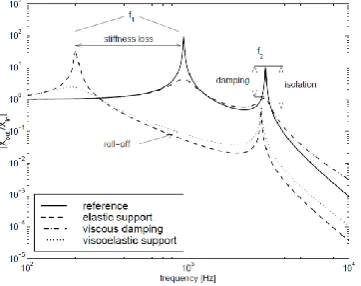
the displacement of mass M2,Xout, and the displacement of the vibrating support Xin. Obviously, a low transmissibility implies a good vibration isolation. The transmissibility curves of the reference system, the viscously damped system and the elastically supported system are collected in Figure 2.2. In addition, the curve of a visco elastically supported system is shown.
Figure 1.2: Transmissibility of the 2-DOF mass-spring system.
The system shows two resonance frequencies. At the lowest resonance frequency, f1, both masses move in phase on the spring with stiffness K1. At the second resonance frequency, f2, the masses move out of phase. Clearly, the vibration amplitudes of the reference system near the resonance frequencies are reduced when a viscous damping treatment is applied. In the case of an elastically supported system the first resonance frequency significantly decreases as a result of the stiffness loss for frequencies above.
2.Problem Definition
Rotating machines produce or absorb larger and larger amounts of power in relatively small physical packages. The fact that those machines work with large density of flows of energy is associated to the high speeds of rotor rotation. It implies high inertia loads, shaft
deformations, high levels of vibrations and dynamic instabilities. Rotating machines often have problems of instability when working at high rotations, which can result in sudden failures of the whole system or parts of it. This problem can be solved by including damping in the bearings. In general, with this type of control, not only can the vibration levels be reduced but also the area of stability can be enlarged.
Noise and vibration control has become a fundamental concern in several industries in order to improve the performance, security, durability, and comfort of the products as well as customer satisfaction. Surface damping treatments involving viscoelastic materials have been widely used as they are relatively simple and economic to be implemented and they provide high damping capability over wide temperature and frequency ranges.
Viscoelastic materials are widely employed in vibration and noise control devices due to their high capacity of vibratory energy dissipation. In order to do so, accurate knowledge of their dynamic properties is essential.
A Monthly Double-Blind Peer Reviewed Refereed Open Access International e-Journal - Included in the International Serial Directories
International Journal in IT and Engineering
http://www.ijmr.net.in email id- [email protected]
Page 104 3. Vibration, Isolation & Damping
3.1 Vibration isolation is the process of isolating an object, such as a piece of equipment, from the source of vibrations.
3.2 Passive isolation
"Passive vibration isolation" refers to vibration isolation or mitigation of vibrations by passive techniques such as rubber pads or mechanical springs, as opposed to "active vibration isolation".
3.3 Active isolation
Active vibration isolation systems contain, along with the spring, a feedback circuit which consists of a piezoelectric accelerometer, a controller, and an electromagnetic transducer. The acceleration (vibration) signal is processed by a control circuit and amplifier. Then it feeds the electromagnetic actuator, which amplifies the signal. As a result of such a feedback system, a considerably stronger suppression of vibrations is achieved compared to ordinary damping.
The principles of vibration isolation and vibration damping can easily be explained with the help of simple mass-spring systems. Let us consider a vibrating object transmitting vibrations to a certain structure via a specific stiffness. In the two-dimensional example this system is represented by two masses M1 and M2 and springs K1 and K2 on an excited support (Figure 3.1a). The vibrating support, for example, could represent a shaft, whereas the two masses could represent housing with 2 degrees of freedom.
Figure 3.1: Two-dimensional spring mass systems on an excited support.[1] (a) Reference system (b) viscously damped system(c) viscoelastically supported system.
Vibration damping can be achieved by adding a parallel damper C to the system (Figure 3.1b). Vibrations of the support can be isolated by use of a soft elastic or viscoelastic support, indicated by Kelastic
and Kviscoelastic,respectively, in Figure
3.1c.
The viscoelastic layers can be added between the external layer of the roller bearing and the bearing housing or underneath the bearing housing, as shown in Fig. 3.2a and Fig.3.2c. Inthe former case, the inertia of the bearing can be neglected while, in the latter, it must be considered. Figures 3.2b and 3.2d show simplified representations for both the situations mentioned above. In the current work, it was used the second alternative (Fig. 3.2c&Fig.3.2d) with layers of viscoelastic material.
A Monthly Double-Blind Peer Reviewed Refereed Open Access International e-Journal - Included in the International Serial Directories
International Journal in IT and Engineering
http://www.ijmr.net.in email id- [email protected]
Page 105
Figure 4.3: A viscoelastic layer mounted beneath the bearing housing.(2)
5 Viscoelastic Material
5.1Selection Of Material For Testing
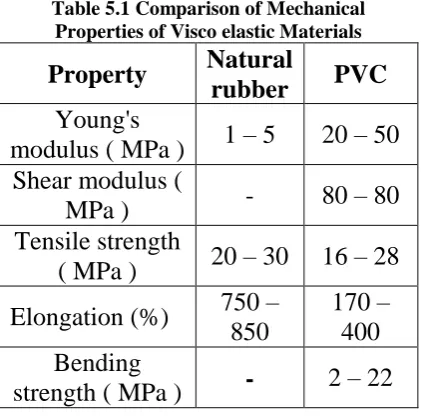
The selection of viscoelastic material is based on the ease of availability, installation, replacement and cost. As per the market survey rubber and PVC is easily available material. Out of this two, rubber is used for several applications. But PVC is not used yet. Hence we choose rubber and PVC for this experiment.
5.3Comparison Of Mechanical And Physical Properties Of Visco Elastic Materials
Table 5.1 Comparison of Mechanical Properties of Visco elastic Materials
Property Natural
rubber PVC
Young's
modulus ( MPa ) 1 – 5 20 – 50 Shear modulus (
MPa ) - 80 – 80 Tensile strength
( MPa ) 20 – 30 16 – 28
Elongation (%) 750 – 850
170 – 400 Bending
strength ( MPa ) - 2 – 22
Table 5.2Comparisonsof Physical Properties of Viscoelastic Materials
Property Natural
rubber PVC
Thermal
expansion 6.7 - 6.7 1.5– 2.1 Thermal
conductivity (W/mK)
0.13 - 0.142
0.13 - 0.15
Specific heat (J/kg K )
1880 - 1880
900 – 1800 Density (
Kg/m3 ) 910 - 930
1190 – 1280 Dielectric loss
factor
0.0016 - 0.005
A Monthly Double-Blind Peer Reviewed Refereed Open Access International e-Journal - Included in the International Serial Directories
International Journal in IT and Engineering
http://www.ijmr.net.in email id- [email protected]
Page 106 6. References
1. H.G. Tillema, Thesis Noise reduction of rotating machinery by viscoelastic bearing supports, University of Twente, Enschede, Netherlands, pp. 2-3, February 2003.
2. Carlos Alberto Bavastri, Euda Mara da S. Ferreira, Jose Joao de Espindola, Eduardo Marcio de O. Lopes, Modeling of Dynamic Rotors with Flexible Bearings due to the use of Viscoelastic Materials, Journal of the Brazil, Soc. of Mech. Sci. & Eng., 3(1), pp. 23-29, January-March 2008. 3. Panda, K.C.,Dutt J.K., Design of
Optimum Support Parameters for Minimum Rotor Response and Maximum Stability Limit, Journal of Sound and Vibration, 223 (1), pp. 1-21, May 1999. 4. Dutt, J.K., Toi T., RotorVibration
Reduction With Polymeric Sectors, Journal of Sound and Vibration, Vol. 262(4), pp. 769-793, May 2003.
5. H.G. Tillema, Noise Reduction Of Rotating Machinery By Viscoelastic Support, SKF Engineering & Research Centre BV in Nieuwegein, the Netherlands, PhD thesis, University of Twente, Enschede, The Netherlands February 2003 6. Espindola, J.J., Silva Neto, J.M.
and Lopes, A Generalized Fractional Derivative Approach to Viscoelastic Material Properties Measurement, Applied Mathematics and Computation, Vol. 164(2), pp. 493-506, May 2005.
7. N. Venugopal, C.M. Chaudhari, Nitesh P. Yelve, An Investigation on Vibration of Visco-elastic materials by Using Taguchi
Method & ANOVA,NCRTM 2006.
8. M. I. Friswell, J. T. Sawicki, D. J. Inman, A. W. Lees, The Response of Rotating Machines on Viscoelastic Supports, International Review of Mechanical Engineering (I.RE.M.E.), 1 (1), pp. 32-40, 2007.
9. Severino P. C. Marques, Guillermo J. Creus, Computational

![Figure 3.1: Two-dimensional spring mass systems on an excited support.[1]](https://thumb-us.123doks.com/thumbv2/123dok_us/8607484.1397192/5.595.330.516.534.670/figure-dimensional-spring-mass-systems-excited-support.webp)